



棉织物因其穿着舒适性、透气性及保暖轻便等特性,在防护服、轨道交通和家居装饰等领域得到广泛应用。然而,棉纤维的极限氧指数仅约为18%,遇火源时极易燃烧并释放大量热量,对人类生命与财产安全构成严重威胁[1]。其高度易燃性所引发的火灾隐患,长期以来成为制约棉织物在阻燃防护领域应用的难题[2]。近年来,基于表面功能化处理的阻燃改性技术凭借高效性和工艺简便性而受到关注[3]。然而,传统阻燃涂层仍存在界面结合力弱、耐久性差等问题,在机械摩擦条件下易发生界面剥离,导致阻燃性能衰减,尤其在经多次磨损后更为突出。现有研究多通过物理共混或化学交联提高涂层的黏结强度,但往往以牺牲阻燃效率为代价:过度交联固化会抑制阻燃组分的膨胀成炭过程,而提高阻燃剂添加量则会削弱涂层的力学性能。因此,在兼顾阻燃效率的前提下实现涂层界面黏附力、耐磨性与长效耐久性的提升,仍是当前阻燃织物涂层研究领域亟待解决的重要难题[4-5]。
本研究构建了一种基于阳离子-π相互作用的高附着力、阻燃性能优异的耐磨复合涂层(PA6PM/VA6%)。通过紫外线引发聚合,分别合成具有苯环结构的聚丙烯酰氧乙基二甲基苄基氯化铵(PADBAC)和含季铵盐结构的聚2-甲基丙烯酰氧乙基磷酸胆碱(PMPC)。进一步引入乙烯基磷酸(VA)作为协效阻燃成分后,可促进基材在燃烧过程中形成致密炭层,有效抑制火焰蔓延。其中,PADBAC链段提供丰富的苯环结构,可与PMPC链段的季铵盐阳离子结构形成阳离子-π相互作用,从而增强涂层在棉织物表面的附着力及涂层的内聚力。将涂层整理至棉织物上,可赋予其耐久阻燃性,并研究了改性织物的表面形貌、力学性能、阻燃性、热稳定性以及耐磨性等。
1 实验部分
1.1 实验材料
丙烯酰氧乙基二甲基苄基氯化铵(ADBAC,90%),上海梯希爱(TCl)化成工业发展有限公司;2-甲基丙烯酰氧乙基磷酸胆碱(MPC,96%)、乙烯基磷酸(VA,95%)、2-羟基-4-(2-羟乙氧基)-2-甲基苯丙酮(光引发剂2959,98%),上海阿拉丁生化科技股份有限公司。纯棉织物(面密度为168 g/m2),市售。
1.2 实验仪器
LGJ-50F冷冻干燥机(宁波新艺超声设备有限公司)、AV11-400 MHz核磁共振谱仪(瑞士布鲁克公司)、Waters 1515 GPC凝胶色谱仪(美国沃特世科技有限公司)、Nicolet 6700傅里叶红外光谱仪(美国赛默飞世尔科技公司)、Cary 50紫外可见分光光度计(美国安捷伦科技有限公司)、INSTRON 3366电子万能材料试验机(美国英斯特朗公司)、Prox台式扫描电子显微镜(荷兰飞纳公司)、LSM 800激光共聚焦显微镜(德国卡尔·蔡司股份公司)、CZF-3水平垂直燃烧测定仪(南京江宁分析仪器有限公司)、JF-6全自动氧指数测定仪(江苏天惠试验机械有限公司)、TG209 F1 Libra热重分析仪(德国耐驰仪器制造有限公司)、Taber耐磨试验机(杭州五佳机械设备有限公司)。
1.3 试样制备
聚丙烯酰氧乙基二甲基苄基氯化铵(PADBAC)的制备:利用浓度为2.5 mmol/L的光引发剂2959引发10%的单体ADBAC水溶液的聚合反应。在365 nm紫外线照射和氮气保护条件下反应,磁力搅拌反应30 min。反应结束后,将所得粗产物溶液倒入过量丙酮中沉淀,抽滤并收集固体产物。所得固体以体积比为1∶100的比例分散于超纯水中,置于截留分子量为3 500 u的透析袋中,在超纯水中透析3 d。透析产物经液氮预冻后,在-30 ℃下冷冻干燥 72 h,得到目标聚合物PADBAC。
聚2-甲基丙烯酰氧乙基磷酸胆碱(PMPC)的制备:将2.5 mmol/L的光引发剂2959与0.2 mol/L的单体MPC溶于超纯水中,搅拌形成均相溶液。将混合液转移至反应器中,在氮气气氛下除氧30 min后密封。采用光强15 mW/cm2、波长365 nm的紫外线光源,于室温下照射30 min,引发光聚合反应制得PMPC粗产物。反应结束后,将产物装入截留分子量为3 500 u的透析袋中,在超纯水中透析5 d,透析产物经冷冻干燥得到纯聚合物PMPC。
阻燃涂层织物的制备:将尺寸为300 mm×80 mm的棉织物置于100 ℃的烘箱中干燥1 h至恒态质量。将聚合物PADBAC与PMPC分别按质量比为1∶1、2∶1、4∶1、6∶1混合,并加入蒸馏水搅拌均匀;随后添加质量分数为6%的阻燃协效剂VA,制得PA1PM/VA6%、PA2PM/VA6%、PA4PM/VA6%、PA6PM/VA6%溶液。采用喷涂工艺将该溶液均匀喷涂于棉织物表面,经60 ℃烘干2 h去除水分后,制得阻燃PA6PM/VA6%改性棉织物。
1.4 测试与表征
化学结构表征:采用1H核磁共振波谱仪(1H NMR,400 MHz)测定涂层中功能基团的结构特征及其化学位移。采用傅里叶红外光谱仪(FT-IR)对单体、聚合物及涂层改性棉织物的化学结构进行表征,扫描32次,波数范围为4 000~500 cm-1。使用紫外可见分光光度计(UV-Vis)测定涂层的紫外吸收光谱,以分析其功能基团间的阳离子-π相互作用。采用凝胶渗透色谱仪(GPC)测定涂层的分子量及其分布,以水为流动相。
涂层黏附性能测试:采用万能材料试验机,依据GB/T 7124—2008《胶粘剂拉伸剪切强度的测定(刚性材料对刚性材料)》测定涂层的拉伸强度。选取尺寸为70 mm×25 mm的不锈钢板和棉织物作为基材,将待测涂层均匀涂覆于2片不锈钢板和棉织物的黏接区域,其尺寸为20 mm×25 mm。在恒定拉伸速率10 mm/min下进行测试,直至黏接界面发生破坏,记录最大拉力值,并计算涂层的附着强度。选取尺寸为70 mm×25 mm经向、纬向的棉和改性棉样条,进行垂直拉伸测试,记录最大拉力值,并计算样条的力学强度。
微观形貌观察:采用台式扫描电子显微镜(SEM)观察样品的表面微观形貌。利用激光共聚焦显微镜(LSCM)测试样品表面的粗糙度(Sa)。
阻燃性能测试:采用全自动氧指数测定仪,依据GB/T 5454—1997《纺织品燃烧性能试验氧指数法》测试织物的极限氧指数。采用水平垂直燃烧测定仪,依据GB/T 5455—2014《纺织品 燃烧性能垂直方向损毁长度、阴燃和续燃时间的测定》中的垂直燃烧法(UL-94)测试织物的阻燃性能。
耐磨与耐水洗性能测试:采用耐磨试验机,依据ASTM D3884—2009《纺织品耐磨性的标准指南(旋转平台、双头法)》进行耐磨性能测试,测试在大气条件(温度20 ℃,相对湿度65%)下进行,样品为直径100 mm的圆形织物,砂轮转速为50 r/min。依据GB/T 17596—1998《纺织品 织物燃烧试验前的商业洗涤程序》评估涂层的耐水洗性,测试样品为350 mm×500 mm的织物样条,在40 ℃水温下与含过硼酸钠的低泡沫洗涤剂在2 L玻璃烧杯中,采用200 r/min的转速进行匀速搅拌15 min后干燥处理,记为1个洗涤循环。
热稳定性分析:采用热重分析仪(TGA)在氮气气氛下测试织物的热质量损失行为。氮气流速为20 mL/min,升温速率为10 ℃/min,测试温度范围为40~700 ℃。
2 结果与分析
2.1 涂层的结构分析
2.1.1 化学结构分析
图1示出PADBAC和PMPC涂层的化学结构及其聚合反应过程。
图1
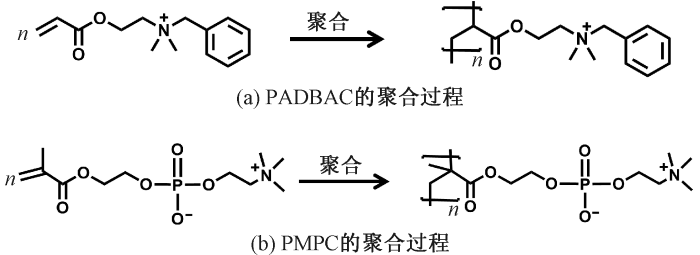
图1
涂层中聚合物PADBAC和PMPC的聚合反应过程
Fig.1
Polymerization reaction processes of PADBAC (a) and PMPC (b) in coating
聚合物的分子量及分布是决定其物理化学性质的关键参数,其直接影响涂层的成膜性、力学强度及界面相容性等。通过GPC分析了2种均聚物的分子量,结果见表1。结果显示,PADBAC和PMPC的数均分子量分别为2 645和10 316,且多分散指数均小于2.5。
表1 2种聚合物的GPC结果
Tab.1
| 聚合物 | Mw | Mn | Mz | PDI |
|---|---|---|---|---|
| PADBAC | 5 854 | 2 645 | 12 257 | 2.21 |
| PMPC | 14 860 | 10 316 | 20 287 | 1.44 |
注:Mw为重均分子量,Mn为数均分子量,Mz为Z均分子量,PDI为多分散指数。
采用FT-IR表征单体与聚合物的化学结构变化,结果如图2所示。聚合反应后,烯烃位于1 630 cm-1附近的C=C伸缩振动吸收峰强度显著减弱,烯烃双键被消耗,表明单体发生了聚合反应。在聚合物的谱图中,1 730 cm-1附近的酯羰基C=O伸缩振动吸收峰依然存在,说明在聚合过程中酯基得以保留。PADBAC中季铵盐基团的吸收峰在970 cm-1处仍清晰可见;而PMPC在1 090 cm-1处的P—O—C伸缩振动峰和1 250 cm-1处的P=O伸缩振动峰也得以保留。
图2
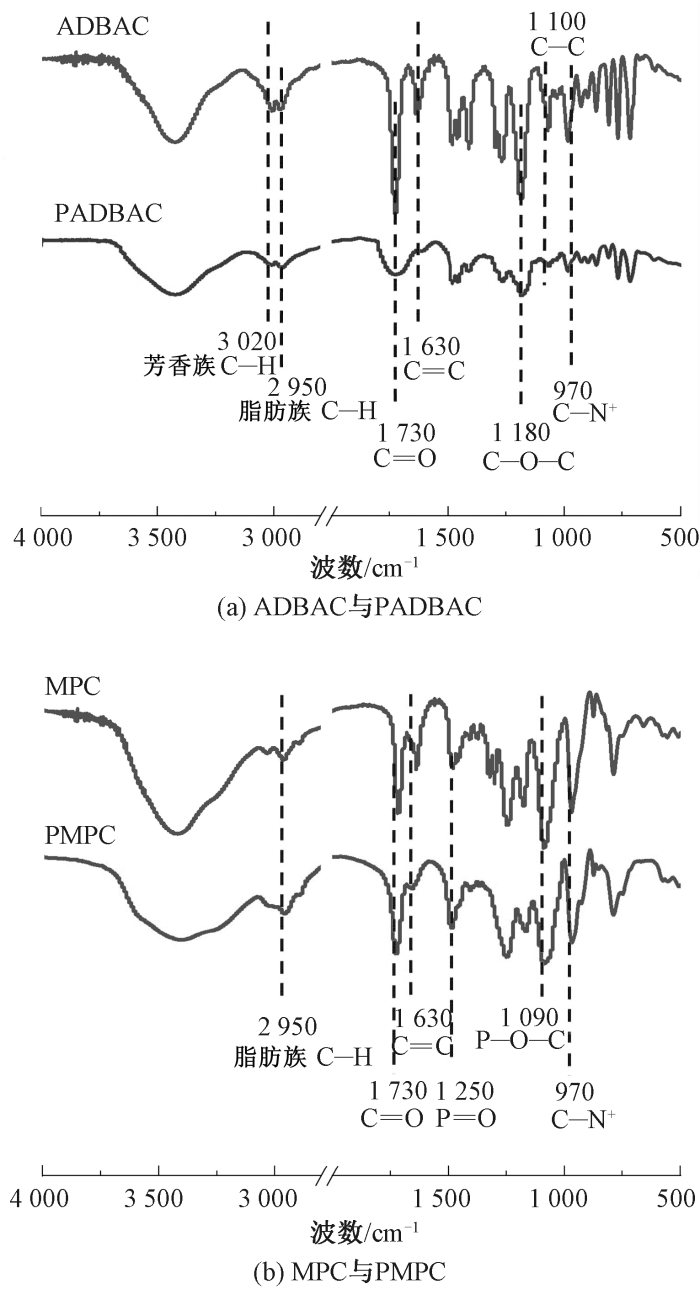
图2
单体ADBAC与MPC在聚合前后的红外光谱图
Fig.2
FT-IR spectra of ADBAC and MPC before and after polymerization. (a) ADBAC and PADBAC; (b) MPC and PMPC
图3示出采用1H NMR对单体及聚合物化学结构的分析结果。首先,ADBAC单体的末端烯烃乙烯基质子表现出裂分模式,其中顺式质子位于化学位移δ 5.95,反式质子位于δ 6.45,而与酯基直接相连的次乙烯基质子出现在δ 6.20。其次,MPC单体末端亚乙烯基质子(CH2)由于α-甲基取代,其裂分不明显,仅显示为2个单峰,分别位于δ 5.70(顺式)和δ 6.05(反式)。然而,2个单体分别聚合完成后,谱图中单体的烯烃结构的特征质子信号已完全消失,表明单体已发生聚合反应。同时,高场区域出现归属于聚合物主链亚甲基和次甲基的鼓包信号峰(δ 0.8~2.5),且侧链质子峰显著展宽,说明2种单体均已成功聚合,生成目标聚合物PADBAC和PMPC。
图3
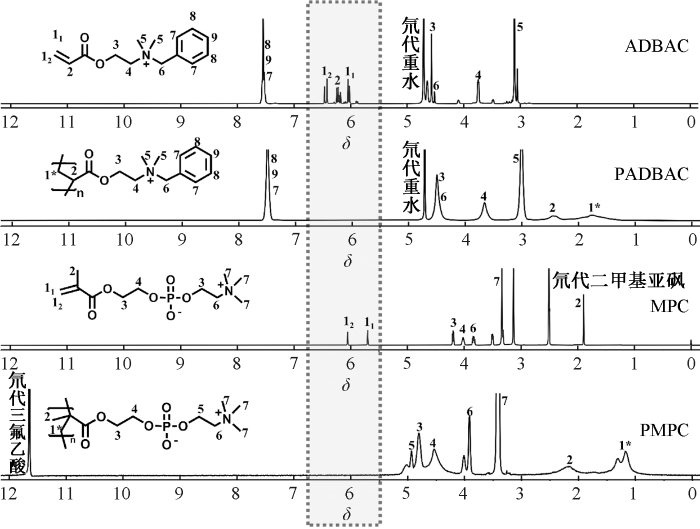
图3
单体ADBAC和MPC在聚合前后的1H NMR谱图
Fig.3
1H NMR spectra of ADBAC and MPC before and after polymerization
图4
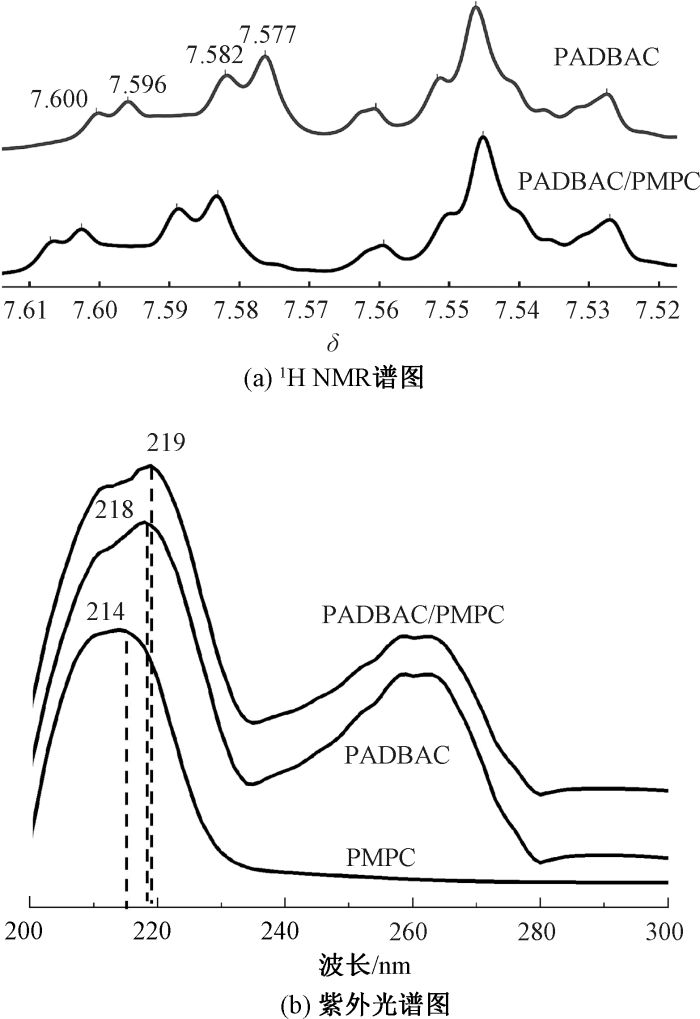
图4
PADBAC与PMPC复配前后的1H NMR谱图和紫外光谱图
Fig.4
1H NMR(a) and UV(b) spectra of PADBAC and PMPC before and after combination
2.1.2 附着力
通过万能材料试验机的垂直拉伸实验测试涂层对基材的拉伸强度,结果如图5所示。
图5
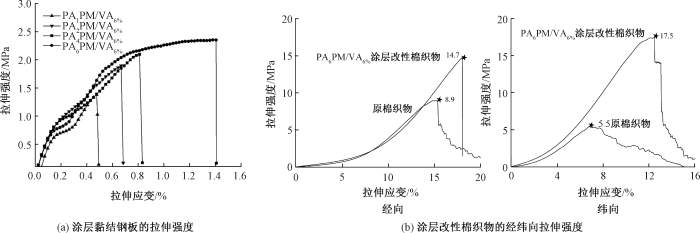
图5
涂层黏结钢板的拉伸强度和棉织物表面改性前后在经纬向的拉伸强度
Fig.5
Adhesion strength of coated adhesive steel sheet (a) and tensile strength of cotton fabric in warp and weft directions before and after surface modification (b)
为测试PA6PM/VA6%复合涂层的基材普适性,将该涂层涂覆在多种基材表面(见图6),包括亚克力板、纸杯、木板、钢板、棉织物和橡胶。结果显示,涂层在各类基材上均表现出稳定且牢固的黏附性能,表明PA6PM/VA6%涂层可用于不同基材,并具有良好的附着力。
图6
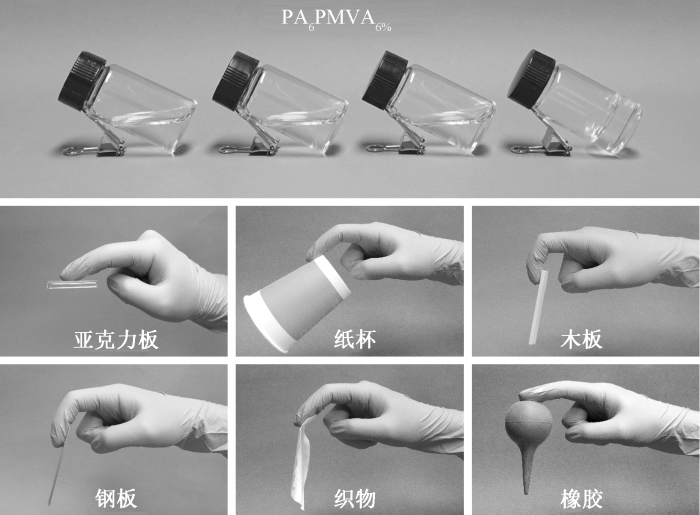
图6
PA6PM/VA6%涂层对多种基材的黏附展示
Fig.6
Digital images showing strong adhesion of PA6PM/VA6% on various substrates
2.2 棉织物表面形貌和化学结构分析
图7(a)示出未改性的棉织物与PA6PM/VA6%涂层改性的棉织物(涂层负载率30%)的SEM照片。可以看出,原始棉纤维表面光滑,而改性棉织物表面被涂层均匀覆盖,表明涂层在纤维表面形成了完整且连续的功能性保护层。
图7
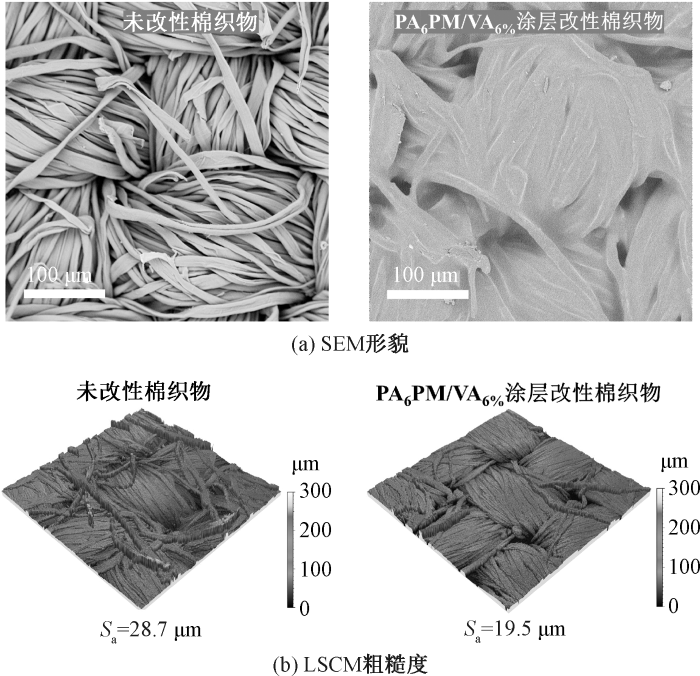
图7
未改性棉织物及PA6PM/VA6%涂层改性棉织物的SEM照片及其LSCM粗糙度
Fig.7
SEM images (a) and LSCM roughness (b) of cotton fabric and PA6PM/VA6%-coated cotton fabric
通过LSCM对棉织物以及PA6PM/VA6%涂层改性棉织物的表面形貌进行观察并测试其表面粗糙度,结果如图7(b)所示。未改性棉织物的粗糙度Sa值为28.7 μm,而PA6PM/VA6%改性棉织物的降至19.5 μm,表明复合涂层能够对织物进行有效改性,并填充织物纤维间部分空隙,从而显著降低棉纤维表面的粗糙度。
为进一步说明涂层可附着于织物表面,图8示出未改性棉织物与PA6PM/VA6%涂层改性棉织物的FT-IR光谱。由图可知,PA6PM/VA6%改性棉织物在1 730 cm-1处出现了归属于涂层中酯羰基(C=O)伸缩振动的吸收峰;在1 460 cm-1处出现了对应于涂层中季铵盐基团的C—H弯曲振动的吸收峰。相比之下,原始棉纤维在3 326 cm-1处出现了O—H的强吸收峰。在PA6PM/VA6%涂层体系中,由于磷酸酯与酯羰基等基团可与棉纤维表面的羟基形成氢键,导致O—H吸收峰发生红移并伴随峰形宽化。该现象表明,涂层与棉纤维界面之间存在氢键相互作用,从而增强了界面附着力。综上,结果进一步证明PA6PM/VA6%涂层已成功构筑于棉织物表面。
图8
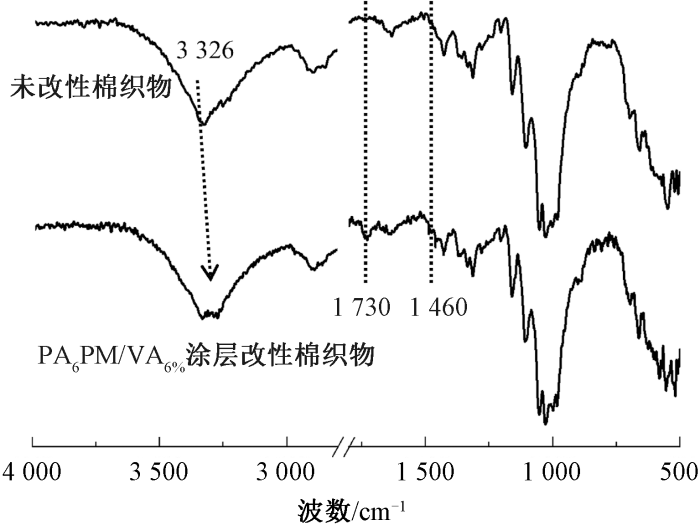
图8
未改性棉织物及PA6PM/VA6%涂层改性棉织物的红外光谱图
Fig.8
FT-IR spectra of cotton fabric and PA6PM/VA6%-coated cotton fabric
2.3 阻燃性能分析
棉织物的极限氧指数(LOI)仅约为18%,具有高度可燃性,在垂直燃烧测试中会被完全焚烧为灰烬。为研究涂层中乙烯基磷酸(VA)质量分数对阻燃性能的影响,测试了在不同VA添加量下复合涂层的阻燃性能,结果如图9所示。首先,涂层中PMPC组分具有一定阻燃作用,在燃烧过程中,PMPC可分解并释放含磷片段及氮自由基,其可与气相中的可燃自由基(H·和HO·)结合,从而中断链式燃烧反应。在未添加VA(即VA质量分数为0%)时,PA6PM涂层改性棉织物LOI值可提升至27%,高于原始棉织物。随着VA质量分数增加至6%,涂层阻燃性能进一步增强,LOI值升至35%。然而,VA亦是一种强酸催化剂,当其质量分数超过6%时,过强的酸性会破坏棉纤维结构,从而导致其力学强度下降。因此,综合阻燃性与力学性能的平衡,选取VA质量分数为6%的涂层(PA6PM/VA6%)作为目标涂层,该涂层可在保持棉纤维力学强度的同时,实现高效阻燃防护。
图9
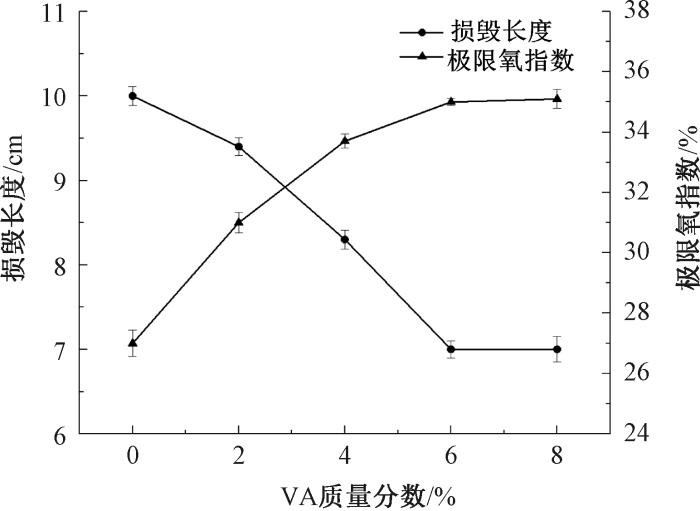
图9
不同VA质量分数下涂层改性棉织物的极限氧指数和垂直燃烧损毁长度
Fig.9
LOI volues and vertical burning damage lengthes of coated cotton fabrics with different VA contents
采用UL-94垂直燃烧测试方法对未改性棉织物和PA6PM/VA6%涂层改性棉织物的阻燃性能进行测试,结果如图10所示。
图10
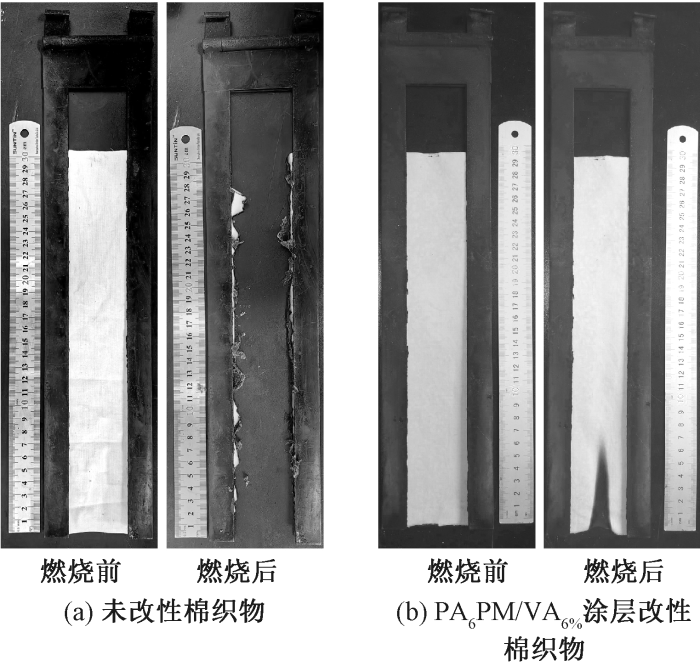
图10
未改性棉织物及PA6PM/VA6%涂层改性棉织物在垂直燃烧测试前后的图片
Fig.10
Images of cotton fabric (a) and PA6PM/VA6%-coated cotton fabric (b) before and after vertical burning tests
由图10可看出,PA6PM/VA6%改性棉织物在点燃12 s并移开火源后能够实现离火自熄,显示出优异的阻燃性能。该现象可归因于PA6PM/VA6%涂层在燃烧过程中能够牢固附着于纤维表面,从而确保VA与PMPC组分持续发挥阻燃作用。结果表明,未改性棉织物在燃烧测试中被完全烧毁,而PA6PM/VA6%涂层改性棉织物离火自熄后的损毁长度仅约为7.5 cm,且其燃烧区域形成了致密且连续的炭层,有效阻隔了热量与氧气的传递,抑制了火焰的进一步蔓延。上述结果表明,PA6PM/VA6%涂层可显著提升棉织物的阻燃性能。
2.4 耐磨性能和耐水洗性能分析
涂层改性织物在实际应用中不仅需具备优异的阻燃性能,还应具有良好的耐磨性和耐水洗性。图11示出经不同摩擦循环次数和水洗次数后,PA6PM/VA6%改性棉织物的LOI值变化情况。结果表明,在经1 000次摩擦后,PA6PM/VA6%改性棉织物其LOI值仍可保持在28.7%,显著高于未改性棉织物;在经50次水洗后,其LOI值仍保持在32.6%。以上结果说明,PA6PM/VA6%涂层在提供高效阻燃性能的同时,其内部的阳离子-π相互作用也可有效提升涂层的内聚力及其与纤维界面的结合强度,从而赋予织物优良的耐磨性与耐洗性,实现了阻燃性能与耐磨耐洗性能的协同提升。
图11
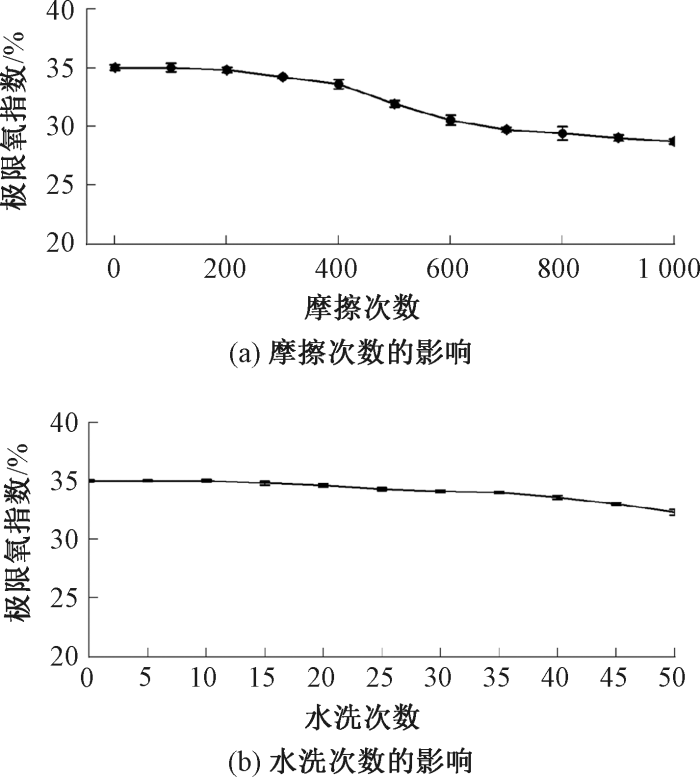
图11
摩擦次数与水洗次数对PA6PM/VA6%涂层改性棉织物LOI值的影响
Fig.11
Rubbing cycles vs LOI (a) value and washing cycles vs LOI value (b) of PA6PM/VA6%-coated cotton fabric
2.5 热稳定性能
聚合物PADBAC与PMPC在氮气气氛下的热重(TG)分解曲线如图12所示。热重分析结果表明,2种聚合物均表现出典型的多阶段热分解特征,并具有一定的成炭能力。其中,PMPC在700 ℃时的质量保留率高达25.62%,显示出一定的成炭特性。
图12
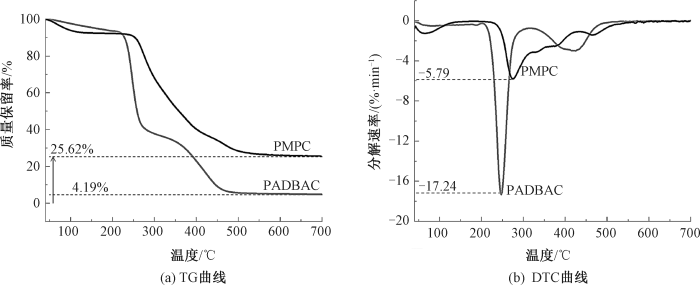
图12
PADBAC、PMPC的热重分解曲线
Fig.12
Thermogravimetric decomposition curves of PADBAC and PMPC. (a) TG curves; (b) DTC curves
图13(a)示出未改性棉织物与PA6PM/VA6%改性棉织物在氮气气氛下的TG分解曲线。
图13
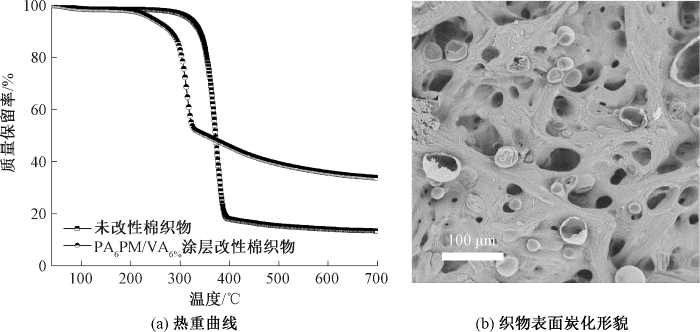
图13
改性棉织物的热重曲线及700 ℃下PA6PM/VA6%涂层改性棉织物表面的炭化形貌SEM照片
Fig.13
TG curves of coated cotton fabric (a) and SEM images of char residue on PA6PM/VA6%-coated cotton fabric after burning at 700 ℃ (b)
由图13(a)可看出,2种样品均呈现1个主要热分解阶段。未改性棉织物的初始热分解温度(T5%)为319 ℃,随后发生显著质量损失,在700 ℃时的质量保留率仅为13.6%。相比之下,PA6PM/VA6%涂层改性棉织物的初始热分解温度为243 ℃,但在700 ℃时的质量保留率高达33.8%,约为未改性棉织物的2.5倍。这种差异可归因于PA6PM/VA6%涂层中VA与PMPC所含的磷酸酯结构在较低温度下优先分解,生成聚磷酸等酸性物质,从而催化棉纤维的脱水成炭反应,并在织物表面形成致密炭化层(见图13(b))。该炭层作为有效的隔热与阻隔屏障,显著提高了PA6PM/VA6%改性棉织物的热稳定性与阻燃性能。
3 结论
本研究通过紫外光引发聚合制备了PADBAC与PMPC,并将其与阻燃助剂乙烯基磷酸VA复配,在棉织物表面构建了具有阳离子-π相互作用的强黏附高耐磨阻燃涂层。结果表明,PADBAC与PMPC质量比为6∶1且VA质量分数为6%的PA6PM/VA6%涂层表现出优异的阻燃、黏附及耐磨性。该涂层的拉伸强度可达2.35 MPa且PA6PM/VA6%涂层改性织物在垂直燃烧测试中可实现快速离火自熄,损毁长度仅为7.5 cm,极限氧指数(LOI)高达35%。经1 000次摩擦循环后,其LOI值仍保持在28.7%,显示出良好的耐磨性与耐久阻燃性。热重分析结果显示,PA6PM/VA6%改性棉织物的质量保留率为33.8%,约为未改性棉织物的2.5倍,表明该涂层可有效促进炭化层的形成,并提高织物的热稳定性。该研究为开发强黏附、高耐磨及耐久阻燃织物涂层提供了新策略。
参考文献
高等级化学防护服用多层膜面料的阻燃性能和热防护性能
[J].以芳纶织物、聚酯织物和腈纶织物为骨架层,聚烯烃膜为成型层,聚卤代烯烃膜为阻隔层,试制高等级化学防护服用多层膜面料。采用电子织物强力机、极限氧指数仪、锥形量热仪和热防护性能测试仪,研究织物种类及聚烯烃母粒和阻燃剂种类对多层膜面料力学性能、阻燃性能、燃烧行为和热防护性能的影响。结果表明:以芳纶织物和聚酯织物为骨架层的多层膜面料具有更好的力学性能;以B/C型聚烯烃母粒和Y型阻燃剂为原料的多层膜面料具有更高的阻燃性能;以腈纶织物为骨架层的多层膜面料具有更低的热释放和较高的残炭含量,但是由于在测试过程中会出现严重熔融现象,其热防护性能较差。综上,以芳纶织物为骨架层,C型母粒和Y型阻燃剂制备的聚烯烃膜为成型层,试制的多层膜面料综合性能最佳。
Flame retardancy and thermal protection performance of multi-layer film fabric for high-level chemical protective clothing
[J].The multi-layer film fabric for high-level chemical protective clothing was trial-produced using aramid fabric, polyester filament fabric and acrylic fabric as the skeleton layer, polyolefin film as the forming layer, and polyhalogenated olefin film as the barrier layer. The effect of fabric, polyolefin masterbatch and flame retardant types on mechanical property, flame retardancy, combustion behavior and thermal protection performance of the multi-layer film fabrics were investigated by electronic fabric strength machine, limit oxygen index meter, cone calorimeter and thermal protection performance tester. The results show that multi-layer film fabrics with aramid fabric and polyester filament fabric as skeleton layer have better mechanical properties. A higher flame retardancy can be achieved for the multi-layer film fabrics made from B/C-type polyolefin masterbatch and Y-type flame retardant. The multi-layer film fabrics with acrylic fabric as the skeleton layer has lower heat release and higher carbon residue, but its thermal protection performance is poor due to severe melting phenomenon during the testing process. In summary, the multi-layer film fabric trial produced with aramid fabric as the skeleton layer, polyolefin film prepared by C-type masterbatch and Y-type flame retardant as the forming layer, has the best comprehensive performance.
阻燃及未阻燃棉织物的热分析
[J].
Thermal analysis of flame-retardant and non-flame-retardant cotton fabrics
[J].
New methods for flame-retarding PET without melt dripping
[J].
基于硅氧体系的织物用阻燃、疏水双功能涂层
[J].
DOI:10.7536/PC230501
[本文引用: 1]

织物的阻燃涂层在日常使用和清洁维护中,由于亲水性太强易导致阻燃性能急剧下降,因此阻燃、疏水双功能涂层现已成为织物功能涂层的研究热点。其中硅氧体系化合物由于同时具有高耐热性和低表面能,因而在阻燃和疏水涂层体系中表现优异。本文通过有机硅体系、有机硅/纳米二氧化硅杂化体系以及笼型聚倍半硅氧烷(POSS)体系在高温成炭性、低表面能、表面微纳结构以及可控多功能化等方面的优异展现,层层递进地描述了兼具优异阻燃和疏水性能的织物用涂层的最新研究进展,并探究了其阻燃和疏水性能与硅氧系化合物结构之间的构效关系。最后提出阻燃和疏水性能间的协同机理、高效性的提升以及复杂环境下涂层性能的服役稳定性等,是织物用阻燃、疏水双功能涂层的未来发展方向;并针对功能化织物材料的部分应用场景需求,提出了热点分析与展望。
Fabric coatings based on silicon oxide structure with both flame-retardant and hydrophobic properties
[J].
DOI:10.7536/PC230501
[本文引用: 1]
<p id="p00010">The flame retardancy of coatings on fabrics would always be destroyed and drastically reduced by daily use or routine maintenance because of their hydrophility. So functional coatings with both flame retardancy and hydrophobicity have become a research focus in fabric field. Coatings of silicon oxide compound with high heat resistance and low surface energy have presented good flame retardancy and hydrophobicity. In this paper, the latest research progress about fabric coatings with both excellent flame retardant and hydrophobic properties is described progressively by organosilicon, organosilicon/nano-silicon and polyhedral oligomeric silsesquioxane (POSS) system on the aspects of char formation, low surface energy, micro-nano structure and controllable multi-functionalization. The relationship between the structure of silicon oxide compound and the properties of flame-retardancy and hydrophobicity is deeply investigated. Finally, synergetic mechanism of flame-retardancy and hydrophobicity, enhancement of functional efficiency and service stability of coatings in complex environment are put forward as the future development of fabric coatings with both flame-retardancy and hydrophobicity. According to the requirements of some application scenarios of functional fabric materials, the hot spots are analyzed and prospected.</p> <div class="mag_zhaiyao_sec"><strong class="mag_zhaiyao_title">Contents </strong><p id="p00020" class="mag_zhaiyao_p">1 Introduction</p><p id="p00025" class="mag_zhaiyao_p">2 Research progress</p><p id="p00030" class="mag_zhaiyao_p">2.1 Organosilicon compounds</p><p id="p00035" class="mag_zhaiyao_p">2.2 Organosilicon/nano-silicon</p><p id="p00040" class="mag_zhaiyao_p">2.3 Polyhedral oligomeric silsesquioxane(POSS)</p><p id="p00045" class="mag_zhaiyao_p">3 Conclusion and outlook</p></div>
纺织品的阻燃及多功能化研究进展
[J].
Research progress on flame-retardation and multi-functionalization of textiles
[J].DOI:10.1177/004051757304300101 URL [本文引用: 1]
A facile strategy based on ionic liquids to modulate the antibacterial, flame-retardant, and sensing properties of cotton fabrics
[J].DOI:10.1002/adfm.v35.28 URL [本文引用: 1]
Dual covalent crosslinking strategy to fabricate flame-retardant, hydrophobic, high-strength and breathable fabric
[J].DOI:10.1016/j.cej.2025.165781 URL [本文引用: 1]
反应型阻燃剂丙烯基磷酸二甲酯的合成及紫外光辐照接枝棉织物
[J].
Preparation of reactive flame retardant dimethly allylphosphonate and its grafting onto cotton fabric via ultraviolet light irradiation
[J].
Biopolymer-based flame retardants and flame-retardant materials
[J].
Advanced flame-retardant methods for polymeric materials
[J].DOI:10.1002/adma.v34.46 URL [本文引用: 1]
Competitive cation-π interactions between small cations and polycations with phenyl groups in poly(cation-π) hydrogels
[J].DOI:10.1016/j.giant.2020.100005 URL [本文引用: 1]
Single-molecule force spectroscopy reveals cation-π interactions in aqueous media are highly affected by cation dehydration
[J].DOI:10.1103/PhysRevLett.130.118101 URL
Rapid formation of antifouling coatings via cation-π interactions
[J].DOI:10.1039/D4PY00859F URL [本文引用: 1]
纤维表面导电功能改性技术的研究进展
[J].
Research progress on conductive function modification technology on fiber surface
[J].
Highly harsh-environment-stable and sustainable multifunctional silk textiles enabled by programmable underwater robust yet stimulus-reversible cation-π adhesion
[J].
DOI:10.34133/research.0910
URL
[本文引用: 1]
Durable multifunctional textiles with advanced protective performance are increasingly crucial for maintaining stability in complex and harsh environments. However, the prevalent use of disposable synthetic surface treatments poses an intractable challenge to the circular economy focused on sustainability. In this study, we introduce an innovative biomimetic sustainable silk textile that is stable in harsh environments and offers high flame retardancy, antibacterial, and anti-mildew properties through a simple yet effective surface treatment strategy. This treatment leverages a specially designed aromatic polyorganosiloxane with quaternary ammonium structures, capable of programmable, robust, and stimulus-responsive reversible cation–π adhesion. The resulting strong water-insensitive cohesive energy from biomimetic cation–π interactions between aromatic and cationic moieties ensures that the multifunctional textiles exhibit excellent long-term durability, even under challenging conditions such as underwater, in saltwater, and in acidic or alkaline solutions. Moreover, the reversible reconstruction of cation–π adhesion allows for on-demand surface treatment recycling, achieving a 100% recycling rate. This study offers a new approach to creating smart and multifunctional textiles that combine sustainability with robust performance in harsh environments.

 京公网安备11010502044800号


