



综上所述,现有研究多集中于竹浆纤维抑菌率表征及加工工艺对抑菌率的影响规律分析,但针对竹浆纤维抑菌成分的深度研究鲜有报道。为进一步揭示竹浆纤维抑菌性的产生机制,深入探讨竹浆纤维抑菌性能与化学成分间的关系,本文以溶剂萃取、溶剂溶解和硫酸水解的方式分离竹浆纤维中的抑菌成分,并结合气相色谱-质谱联用技术对其进行成分分析,旨在明确竹浆纤维中发挥抑菌活性的关键物质,为抑菌纺织品的研发提供参考。
1 实验部分
1.1 实验材料
竹浆纤维(天竹,1.33 dtex×38 mm)、竹浆粕(河北吉藁化纤有限责任公司);平纹纯棉织物(绍兴柯桥立汇纺织品有限公司),其经纬纱线密度均为18.25 tex,面密度为120 g/m2。
牛肉粉、蛋白胨、琼脂粉(北京奥博星生物技术有限责任公司);大肠埃希菌(北京保藏生物科技有限公司);磷酸氢二钠、磷酸二氢钾(天津市科密欧化学试剂有限公司);无水乙醇、氢氧化钠、尿素、乙酸乙酯、无水甲醇、石油醚(上海阿拉丁生化科技股份有限公司);N-甲基吗啉-N-氧化物(上海麦克林生化科技股份有限公司);氢氧化钡(上海易恩化学技术有限公司);3,5-二硝基水杨酸(DNS)显色剂(广东和为医药科技有限公司);葡萄糖(国药集团化学试剂有限公司)。
1.2 实验仪器
GZX-GF101-1-SII型电热鼓风干燥箱(上海贺德实验设备有限公司)、O/SGYM 1008型电子天平(上海佑科仪表有限公司)、ZWYC-2933型电热恒温培养箱(上海智域分析仪器制造有限公司)、SW-CJ-1FD型超净台(苏州净化设备有限公司)、SQ510C型灭菌锅(重庆雅马科技有限公司)、DF-101 S型恒温水浴锅(巩义市予华仪器有限责任公司)、UV-1800型紫外可见分光光度计(上海美谱达仪器有限公司)、Nicolet型傅里叶变换红外光谱仪(赛默飞世尔科技有限公司)、GeminiSEM 500型场发射扫描电子显微镜(卡尔蔡司股份公司)、KQ-200DE型数控超声波清洗器(昆山市超声仪器有限公司)、SXKW型调温电热套(北京市光明医疗仪器有限公司)、Hei-VAP Core ML/G3型旋转蒸发仪(海道尔夫仪器设备(上海)有限公司)、TDZ4K型台式低速离心机(湖南湘仪实验室仪器开发有限公司)、JJ-3型精密定时电动搅拌机(江苏中大仪器科技有限公司)、SCION 456-TQ型气相色谱-质谱联用分析系统(赛里安仪器有限公司)、Vario El cube型有机元素分析仪(艾力蒙塔分析系统有限公司)。
1.3 竹浆纤维萃取及溶解与再生
1.3.1 萃取工艺
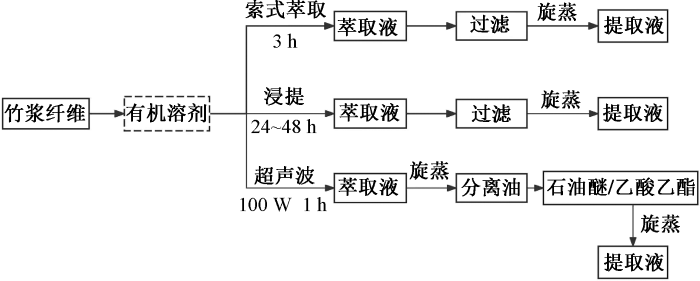
分别采用索式提取法、浸提法和超声提取法萃取竹浆纤维中的抑菌成分,萃取工艺见图1。
图1
1.3.2 N-甲基吗啉-N-氧化物溶液溶解工艺
称取35 g纯度为97%的N-甲基吗啉-N-氧化物(NMMO),加入5.4 mL去离子水,制成质量分数为86.3%的NMMO溶液;精确称取1 g干燥竹浆纤维(长度剪为2 mm),将其置于NMMO溶液中,加热并搅拌以促进溶解,达到预定时间后取样。随后配制低含量的NMMO水溶液,将含溶解态纤维素的NMMO溶液缓慢倒入其中。静置一段时间后,纤维素逐渐析出,经反复清洗去除残留NMMO,得到溶出物备用。
1.3.3 碱/尿素体系溶解工艺
先将剪碎的竹浆纤维置于60 ℃烘箱中干燥24 h,充分干燥后备用。准确称取7 g氢氧化钠和12 g尿素,溶于100 mL去离子水中,混合均匀后,置于冰箱预冷至-15 ℃。加入5 g干燥竹浆纤维(长度剪为2 mm),高速搅拌5 min,得到纤维素分散液,室温下以4 000 r/min离心5 min,取上清液即为纤维素溶液。随后将纤维素溶液缓慢倒入大量去离子水中,静置待纤维素完全析出,洗涤至中性后干燥备用。
1.4 竹浆纤维的水解工艺
1.4.1 硫酸水解工艺
采用两段水解工艺,第1段水解使用浓硫酸作为催化剂进行预处理,破坏纤维素分子的复杂结晶结构,水解温度控制为53 ℃,液固比为12∶1;第2段水解则是通过稀释第1段酸解液,将硫酸质量分数降至4%以下,通过加热煮沸,使竹浆纤维水解更彻底。
1.4.2 还原得糖量测定
绘制葡萄糖标准曲线:配制质量浓度为10 g/L的葡萄糖标准溶液。分别移取2.5、5.0、7.5、10.0、12.5 mL该标准溶液,定容至25 mL;向各定容溶液中加入1 mL DNS显色剂,调配成不同质量分数的葡萄糖溶液。采用紫外可见分光光度计在540 nm波长下测定各溶液的吸光度。以葡萄糖质量分数为横坐标,吸光度为纵坐标,绘制标准曲线。
测定原理:以还原得糖量作为竹浆纤维酸水解效果的评价指标,在碱性条件下,葡萄糖经加热氧化成糖酸等产物,DNS显色剂被还原为棕色的3-氨基-5-硝基水杨酸;在540 nm波长下测定水解物的吸光度,对照标准曲线即可计算出样品中的总糖含量。
1.5 测试与表征
1.5.1 抑菌性能测试
参照GB/T 20944.3—2008《纺织品 抑菌性能的评价 第3部分:振荡法》,以大肠埃希菌为代表菌种,测试试样的抑菌率。设空白组、对照组和抑菌织物组,实验用品预先在灭菌锅中进行灭菌处理;按照标准要求配制营养液和营养琼脂。菌种活化:用移液枪取1 mL的菌液放入装有营养液的锥形瓶中,在37 ℃摇床中振荡18 h,以活化菌种;移取1 mL活化菌液移入盛有9 mL营养液的试管中,振荡摇匀,稀释10倍,重复此操作再稀释2次,移取5 mL稀释菌液至45 mL PBS中,制成实验菌液。抑菌培养:移取5 mL实验菌液置于70 mL PBS缓冲液中,加入样品,放至培养箱中,于37 ℃培养18 h。移取100 μL培养的菌液,放于900 μL PBS缓冲液中,梯度稀释至10-4或10-5。取100 μL的稀释菌液均匀滴在固体培养基上,用涂布棒涂布20~30下,倒放培养基,放至恒温振荡培养箱中,于37 ℃培养24 h。
以未经任何处理的平纹纯棉织物作为对照,并采用“0”接触对照法验证实验的准确性与可靠性。抑菌率计算公式为
式中:Y为样品的抑菌率,%;Wa为对照样活菌浓度平均值,CFU/mL;Wb为试样活菌浓度平均值,CFU/mL。
1.5.2 微观结构观察
采用场发射扫描电子显微镜观察竹浆纤维表面微观形貌。测试前,将样品固定于电镜样品台上进行喷金处理。
1.5.3 化学结构及元素表征
采用傅里叶变换红外光谱仪表征竹浆纤维的化学结构,分析其所含化学键与官能团,测试波数范围为4 000~400 cm-1。
采用有机元素分析仪测试竹浆纤维中C、H、N、S与O元素的含量。
1.5.4 紫外光谱测试
采用紫外光谱仪测试竹浆纤维硫酸水解产物的紫外吸收光谱,测试波长范围为200~400 nm。
1.5.5 化学组成测试
采用沉淀法去除酸水解液中的硫酸根离子,具体操作为:利用氢氧化钡与硫酸根离子反应生成硫酸钡沉淀。将离心后的上清液经0.2 μm滤膜真空抽滤,收集滤液并真空干燥。取0.1 g干燥样品,加入5 mL N,N-二甲基甲酰胺,振荡混匀后静置至样品完全溶解,所得溶液采用气相色谱-质谱联用分析系统进行组分分离和分析。
色谱柱:SCION-5 MS型石英毛细管色谱柱(北京康谱源科技有限公司),规格为30 m×0.25 mm,膜厚为0.25 μm。色谱条件:载气为高纯氦气,流速为1.0 mL/min,进样口温度为280 ℃;升温程序为初始温度70 ℃,保持3 min,再以8 ℃/min速率升温至280 ℃,保持5 min;进样量为1 μL。质谱条件:离子源为EI源,温度为280 ℃,电离能量为70 eV,溶剂延迟时间为8 min;扫描方式为全扫描。
2 结果与讨论
2.1 抑菌性分析
竹浆纤维常应用于贴身内衣、婴幼儿用品及家纺产品,这类应用场景中易滋生大肠埃希菌。由于大肠埃希菌对天然抑菌成分更为敏感,能精准体现竹浆纤维固有的抑菌性能,因此,选取大肠埃希菌为代表菌种,采用振荡法对竹浆纤维进行抑菌性能测试。结果显示,竹浆纤维对大肠埃希菌的平均抑菌率达93.07%。大肠埃希菌的生长情况如图2所示。
图2
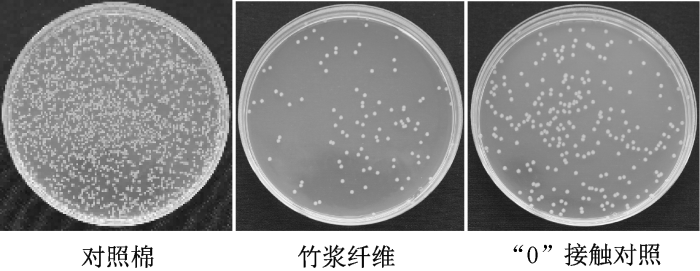
图2
棉、竹浆纤维与未接触对照菌落生长情况
Fig.2
Growth of colonies on cotton, bamboo pulp fibers and non-contact control sample
2.2 微观形貌分析
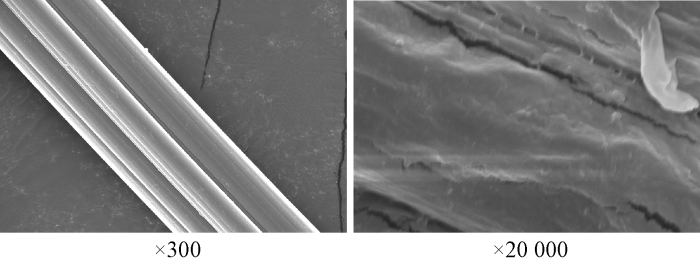
图3示出竹浆纤维的扫描电镜照片。由图可知,纤维表面分布有沟槽,放大2万倍后,可观察到纤维表面存在裂隙结构。这些微观结构赋予竹浆纤维良好的透湿与透气性能,能够使纤维保持干爽状态,从而营造出不利于细菌生长繁殖的环境。
图3
2.3 化学结构分析
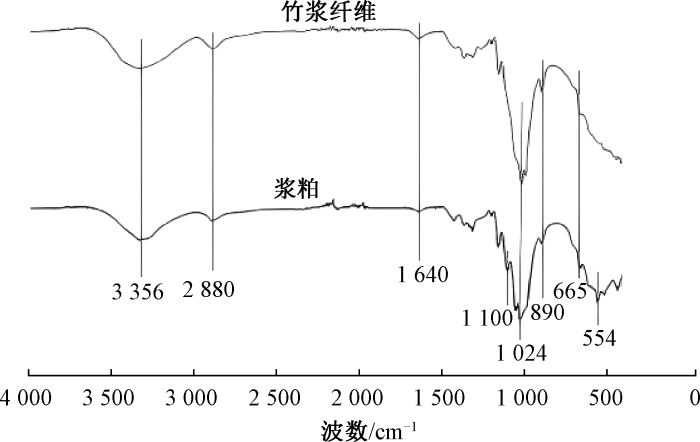
图4示出竹浆纤维和用于制备竹浆纤维的竹浆粕的红外光谱图。由图可见,890 cm-1附近的吸收峰对应—CH2—的面外弯曲振动;1 024 cm-1附近的吸收峰归属于C—O—C拉伸振动,表征纤维素典型的吡喃型糖环结构;1 110 cm-1附近的吸收峰源于C—O—H的变角振动;1 640 cm-1附近的吸收峰与酰胺键中C=O伸缩振动有关;2 880 cm-1附近的吸收峰由样品吸附水的弯曲振动引起;3 356 cm-1附近出现—OH的宽带特征吸收峰。说明竹浆纤维和浆粕的主要组成物质是纤维素,同时,含有带有C=O等基团的伴生物。
图4
2.4 元素分析
测试结果表明,竹浆纤维中C、H、O、N、S元素的含量分别为39.85%、6.09%、53.71%、0.20%、0%,竹浆纤维中C、H、O元素比例为6.54∶1∶8.88,该比例与纯纤维素中C、H、O的理论占比不一致,表明竹浆纤维除纤维素主体成分外,还含有一定量的其它化合物。竹浆纤维中未检测出S元素,由此可排除含硫物质对纤维抑菌性的干扰;同时,纤维中检出N元素,含量为0.20%,关于该元素的来源、存在形式及其对抑菌性的潜在影响,有待今后进一步深入探究。
2.5 竹浆纤维的溶剂萃取及抑菌性分析
分别采用甲醇、乙醇、乙酸乙酯、乙醚和超纯水作为提取溶剂,对竹浆纤维中的可溶性成分进行萃取,并测试经不同溶剂提取后竹浆纤维对大肠埃希菌的抑菌率,结果如表1所示。
表1 不同溶剂提取后竹浆纤维的抑菌率
Tab.1
| 编号 | 溶剂/提取方法 | 抑菌率/% |
|---|---|---|
| 1 | 水/索式提取 | 71.3 |
| 2 | 无水乙醇/浸提 | 73.0 |
| 3 | 75%乙醇/索式提取 | 75.4 |
| 4 | 75%乙醇/混合提取 | 75.3 |
| 5 | 无水甲醇/浸提 | 68.7 |
| 6 | 水/超声波提取 | 80.3 |
实验结果表明,经各类溶剂提取处理后,竹浆纤维对大肠埃希菌的抑制率虽有小幅下降,但仍保持在70%及以上。这表明本实验所用的溶剂未能将竹浆纤维中的抑菌成分有效分离出来。
2.6 溶解再生纤维素抑菌性分析
采用NMMO及碱/尿素体系溶解竹浆纤维,再用非溶剂将纤维素析出,借助振荡法测试所得再生纤维素的抑菌性能,测试结果如图5所示。
图5
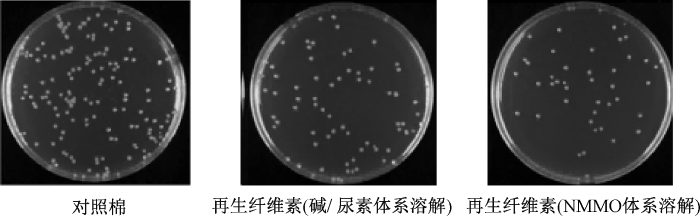
经计算,NMMO及碱/尿素溶剂体系溶解竹浆纤维所得2种再生纤维素对大肠埃希菌的抑菌率分别为48.20%和67.60%。由此可见,竹浆纤维经溶解、再生处理后抑菌性下降,但对菌落生长仍有一定抑制作用。这进一步证实,采用溶剂萃取和溶解的方法无法将竹浆纤维中的抑菌成分完全分离。
2.7 竹浆纤维酸水解产物成分分析
采用硫酸水解的方法将竹浆纤维降解为低分子物质,然后用气相色谱-质谱联用技术分析竹浆降解产物的成分。为此,首先用葡萄糖含量优化硫酸水解的工艺条件。
2.7.1 葡萄糖标准曲线绘制
采用DNS显色法绘制葡萄糖标准曲线,结果如图6所示。
图6
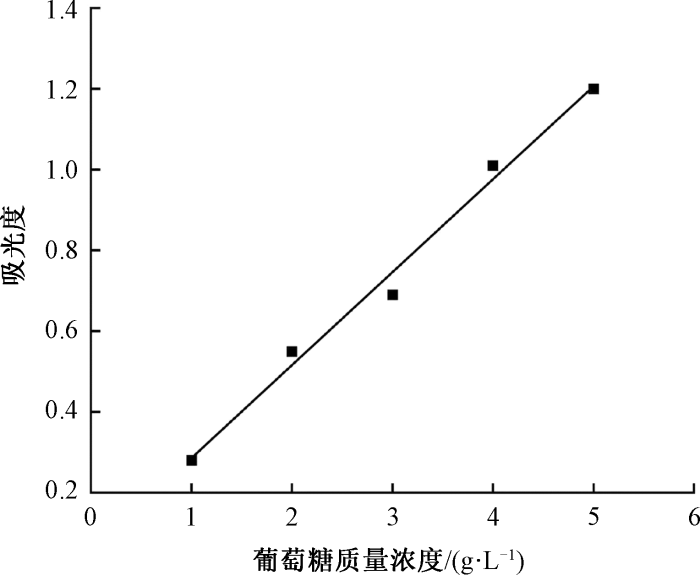
通过数据分析,得到标准葡萄糖质量浓度与吸光度之间的线性关系,其线性回归方程和相关系数为:
2.7.2 硫酸质量分数对水解效果的影响
图7示出不同质量分数的硫酸水解产物的紫外光吸收光谱。可以看出,当硫酸质量分数在70%和60%时,短时间内纤维素即发生氧化反应,水解液随之逐渐变黑,表明纤维素发生炭化现象,并伴随大量副产物生成。当硫酸质量分数降低至55%时,纤维素可在较短时间内快速溶解,水解液先变为黄色,后逐渐转为浅褐色,水解产物中存在副产物。当硫酸质量分数降低至50%时,预水解阶段的纤维素未能完全溶解,有微量残渣均匀悬浮于水解液中。综上所述,水解竹浆纤维时所用硫酸的适宜质量分数在50%~55%之间。
图7
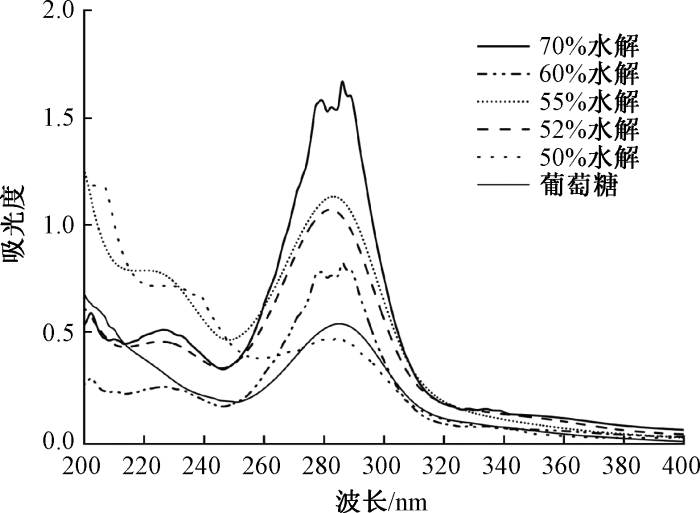
图7
不同质量分数硫酸水解产物紫外光吸收光谱图
Fig.7
Ultraviolet absorbance spectra of sulfuric acid hydrolysates at different concentrations
为进一步确定硫酸的最佳质量分数,配制质量分数为51%、52%、53%、54%、55%的硫酸水溶液用于竹浆纤维水解,测试各水解产物在540 nm波长处的吸光度,并根据标准曲线计算对应的还原得糖量,硫酸质量分数与得糖量关系如图8所示。实验结果表明,当硫酸质量分数为53%时,竹浆纤维近乎全部溶解,水解产物中杂质含量较少,还原糖得量达到最大值;当硫酸质量分数超过53%时,还原糖得量呈下降趋势,且水解体系中副产物含量增加,因此,使用两段硫酸水解法水解竹浆纤维时,硫酸的最佳质量分数为53%。
图8
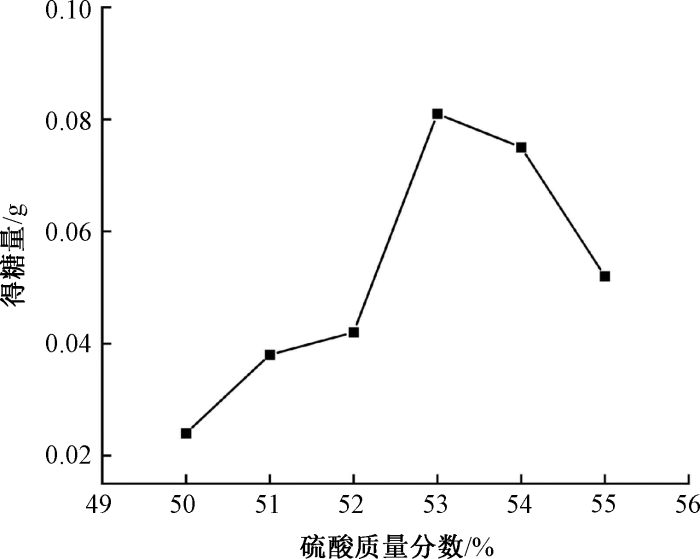
图8
硫酸质量分数与得糖量关系
Fig.8
Relationship between sulfuric acid concentration and sugar yield
2.7.3 水解产物的化学组成分析
图9
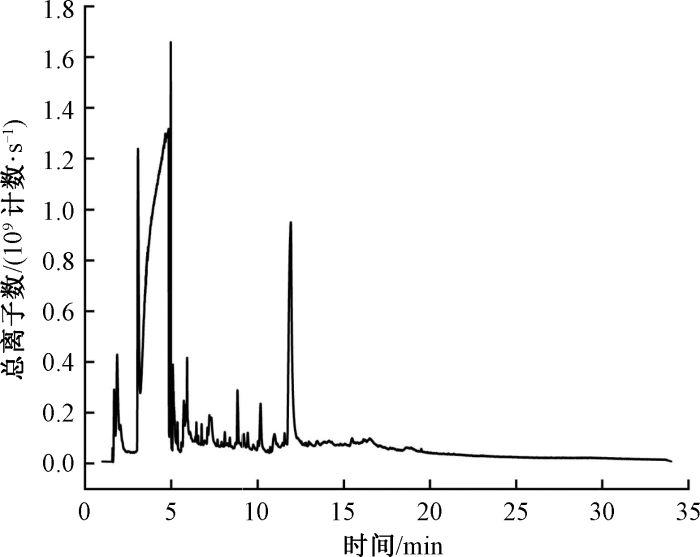
图9
水解产物气质联用总离子流图
Fig.9
Total ion current diagram of hydrolysate by gas chromatography-mass spectrometry
表2 竹浆纤维水解产物的气相色谱-质谱联用分析结果
Tab.2
| 序号 | 保留时间/min | 化合物名称 | CAS号 | 分子式 | 成分类型 |
|---|---|---|---|---|---|
| 1 | 1.599 | N-甲基酪胺 | 370-98-9 | C9H13NO | 生物碱 |
| 2 | 1.867 | 丙酮醛 | 78-98-8 | C3H4O2 | 醛 |
| 3 | 3.075 | N,N-二甲基甲酰胺 | 68-12-2 | C3H7NO | 溶剂残留 |
| 4 | 4.916 | 巴豆醛 | 123-73-9 | C4H6O | 醛 |
| 5 | 4.954 | 2-羟基-2-环戊烯-1-酮 | 10493-98-8 | C5H6O2 | 酮 |
| 6 | 4.981 | 糠醛 | 98-01-1 | C5H4O2 | 醛 |
| 7 | 5.099 | 糠醇 | 98-00-0 | C5H6O2 | 醇 |
| 8 | 5.374 | 2H-吡喃-2-酮 | 504-31-4 | C5H4O2 | 酮 |
| 9 | 5.734 | 2(5H)-呋喃酮 | 497-23-4 | C4H4O2 | 呋喃衍生物 |
| 10 | 5.931 | 环己酮 | 108-94-1 | C6H10O | 酮 |
| 11 | 6.463 | 5-甲基糠醛 | 620-02-0 | C6H6O2 | 醛 |
| 12 | 6.565 | 4-甲氧基-3-丁烯-2-酮 | 4652-27-1 | C5H8O2 | 酮 |
| 13 | 6.840 | 2-十一酮 | 112-12-9 | C11H22O | 酮 |
| 14 | 7.112 | 2H-吡喃-2,6(3H)-二酮 | 5926-95-4 | C5H4O3 | 酮 |
| 15 | 7.692 | 甲基环戊烯醇酮 | 80-71-7 | C6H8O2 | 酮 |
| 16 | 8.407 | 2-羟基吡啶 | 142-08-5 | C5H5NO | 吡啶衍生物 |
| 17 | 8.852 | 2-糠酸甲酯 | 611-13-2 | C6H6O3 | 酯 |
| 18 | 9.422 | 麦芽酚 | 118-71-8 | C6H6O3 | 酚 |
| 19 | 10.168 | 2,3-二氢-3,5二羟基-6-甲基-4(H)-吡喃-4-酮 | 28564-83-2 | C6H8O4 | 酮 |
| 20 | 10.591 | 3-氨基苯酚 | 591-27-5 | C6H7NO | 酚 |
| 21 | 10.729 | 5-甲基-2-乙酰基呋喃 | 1193-79-9 | C7H8O2 | 呋喃衍生物 |
| 22 | 10.959 | (+/-)-β-羟基-γ-丁内酯 | 5469-16-9 | C4H6O3 | 内酯 |
| 23 | 11.558 | 5-乙酰氧基甲基-2-呋喃醛 | 10551-58-3 | C8H8O4 | 醛 |
| 24 | 11.917 | 5-羟甲基糠醛 | 67-47-0 | C6H6O3 | 醛 |
| 25 | 14.159 | 甲基2-脱氧-BETA-D-赤式-吡喃戊糖苷 | 17676-20-9 | C6H12O4 | 糖苷 |
| 26 | 15.576 | 2-羟基-4-甲氧基苯甲醛 | 673-22-3 | C8H8O3 | 醛 |
| 27 | 18.903 | 1,6-脱水-Β-D-呋喃葡萄糖 | 7425-74-3 | C6H10O5 | 糖苷 |
由表2可知,气相色谱-质谱联用技术从竹浆纤维水解产物中检测出27种化合物,涵盖酮类、酚类、呋喃类、生物碱、吡啶衍生物、内酯及糖苷等多种类型。
已有研究表明,糠醇、糠醛和糠酸对枯草芽孢杆菌和葡萄球菌具有抑菌活性,对2类菌株的生长均能产生不同程度的抑菌效果,且糠醛的抑菌活性优于糠醇和糠酸。糠醛和糠醇主要存在于植物纤维中的木质素组分中,属于非溶出型抑菌成分,是天然复合抑菌体系中的核心物质。从鹅毛草精油中提取的糠醛,可显著抑制大肠埃希菌、铜绿假单胞菌、表皮葡萄球菌、金黄色葡萄球菌和黄体微球菌的生长[18]。2-十一酮对大肠埃希菌等革兰阴性菌的抑制作用有限,对革兰阳性菌抑制效果一般,对白色念珠菌具有一定的抑制效果,对霉菌类微生物抑菌效果更突出,但其抑菌机制的相关研究目前仍鲜有[19-
综上所述,竹浆纤维水解产物中具有抑菌功能的成分包括糠醇、糠醛、2-十一酮、麦芽酚、2-羟基-4-甲氧基苯甲醛。根据气相色谱-质谱联用测试结果计算各抑菌成分的峰面积百分比,分别为1.93%、4.83%、0.035%、0.20%和0.14%。由此可见,竹浆纤维的抑菌性能源于上述多种抑菌成分协同作用。
3 结论
1)竹浆纤维对大肠埃希菌具有稳定的抑制效果,一方面,纤维的孔隙结构可维持自身干爽状态,营造不利于细菌滋生的环境;另一方面,其抑菌活性成分主要源自天然竹材,且与纤维素结合比较紧密,难以通过常规溶剂萃取或溶解的方式实现有效分离。
2)通过酸水解结合气相色谱-质谱联用技术对竹浆纤维水解产物进行分离和成分分析,结果显示其水解产物中含有醛类、酚类、生物碱、糖苷等多类物质,其中糠醇、糠醛、2-十一酮、麦芽酚、2-羟基-4-甲氧基苯甲醛为纤维的主要抑菌成分。其中2-十一酮与2-羟基-4-甲氧基苯甲醛为首次在竹浆纤维中被发现的抑菌活性成分。
3)竹浆纤维的抑菌性能是其微观形态结构与多元抑菌成分协同作用的结果。
参考文献
纺织品抗菌材料及其应用研究进展
[J].
Research progress of textile antibacterial materials and their applications
[J].
人工抗菌纤维的研究现状和发展趋势
[J].
DOI:10.11949/0438-1157.20200633

随着人们环保意识和健康意识的提高,抗菌技术在纤维纺织市场的需求日益增长。人工抗菌纤维是将抗菌剂加入到普通纤维中制备的具有抗菌功能的复合纤维,工艺简单,易于工业化生产并满足市场需求。抗菌剂是人工抗菌纤维制备过程中的关键成分,决定了抗菌纤维的制备方法和抗菌效果。基于此,针对人工抗菌纤维,重点探讨了近年来无机抗菌剂、有机抗菌剂、天然抗菌剂和新型材料抗菌剂用于人工抗菌纤维制备的研究现状,并对人工抗菌纤维未来的研究重点和发展趋势进行了展望。
Research status and development trend of artificial antibacterial fibers
[J].
抗菌功能纺织品的研究进展
[J].
Research progress of antibacterial functional textiles
[J].
海藻酸盐基非织造医用敷料的研究进展
[J].
Research progress in alginate-based nonwoven medical dressings
[J].
抗菌纺织品舒适性能研究
[J].
Study on antibacterial textiles comfortable property
[J].
The design and production of bamboo pulp silver fiber/cotton antibacterial fabric
[J].
Antibacterial potential of extracts from different Brazilian bamboo species
[J].DOI:10.1007/s40415-020-00683-8
Biological activities and phytochemical profiles of extracts from different parts of bamboo (Phyllostachys pubescens)
[J].
DOI:10.3390/molecules19068238
PMID:24945578
[本文引用: 1]
Besides being a useful building material, bamboo also is a potential source of bioactive substances. Although some studies have been performed to examine its use in terms of the biological activity, only certain parts of bamboo, especially the leaves or shoots, have been studied. Comprehensive and comparative studies among different parts of bamboo would contribute to a better understanding and application of this knowledge. In this study, the biological activities of ethanol and water extracts from the leaves, branches, outer culm, inner culm, knots, rhizomes and roots of Phyllostachys pubescens, the major species of bamboo in Japan, were comparatively evaluated. The phytochemical profiles of these extracts were tentatively determined by liquid chromatography-mass spectrometry (LC-MS) analysis. The results showed that extracts from different parts of bamboo had different chemical compositions and different antioxidative, antibacterial and antiallergic activities, as well as on on melanin biosynthesis. Outer culm and inner culm were found to be the most important sources of active compounds. 8-C-Glucosylapigenin, luteolin derivatives and chlorogenic acid were the most probable compounds responsible for the anti-allergy activity of these bamboo extracts. Our study suggests the potential use of bamboo as a functional ingredient in cosmetics or other health-related products.
The origin of the antibacterial property of bamboo
[J].DOI:10.1080/00405000.2011.614742 URL [本文引用: 1]
GC-MS characterization, in vitro antioxidant and antimicrobial activity of newly isolated oil from edible wild bamboo rice (Bambusa bambos)
[J].DOI:10.1080/22311866.2014.939715 URL [本文引用: 1]
Bamboo fiber antibacteral effect: a review
[J].
Investigation and comparison of antibacterial property of bamboo plants, natural bamboo fibers and commercial bamboo viscose textiles
[J].DOI:10.1080/00405000.2020.1807300 URL [本文引用: 1]
A comparative study of bamboo Lyocell fiber and other regenerated cellulose fibers
[J].
DOI:10.1515/HF.2009.005
URL
[本文引用: 1]
A new type of regenerated cellulose fiber can be made from bamboo cellulose by the Lyocell process. In this paper, the morphology and crystal structure of the bamboo Lyocell fiber was investigated by optical microscopy, scanning electron microscopy, and wide angle X-ray diffractometry. Moreover, the mechanical properties, fibrillation behavior, moisture adsorption property, negative ion effect, and antibacterial capability of the bamboo Lyocell fiber were studied. The results showed that the bamboo Lyocell fiber proved to be similar to the structure and properties of wood Lyocell fiber, such as smooth surface, circular cross-section, high crystallinity, high tensile strength, low elongation at break, good moisture adsorption property, and easy fibrillation. Furthermore, the bamboo Lyocell fiber surpassed wood Lyocell fiber concerning negative ion effect and antibacterial property.
An investigation into the antibacterial properties of bamboo/cotton blended fabric and potential limitations of the test method AATCC 147
[J].DOI:10.1080/15440478.2019.1612305 URL [本文引用: 1]
Bamboo fibre reinforced biocomposites: a review
[J].DOI:10.1016/j.matdes.2012.06.015 URL [本文引用: 1]
Antimicrobial treatments for textiles
[J].
Antityrosinase and antimicrobial activities of furfuryl alcohol, furfural and furoic acid
[J].DOI:10.1016/j.ijbiomac.2013.02.019 URL [本文引用: 1]
Antimicrobial activity of undecan-2-one, undecan-2-ol and their derivatives
[J].DOI:10.1080/0972060X.2009.10643763 URL [本文引用: 1]
Chemical composition, antibacterial and antifungal activities of Ruta graveolens L. volatile oils
[J].DOI:10.1080/23312009.2016.1220055 URL
藜芦胺对人胶质母细胞瘤细胞U251增殖的影响及机制
[J].
Effects and mechanism of veratramine on the proliferation of human glioblastoma U251 cells
[J].
Heptanal inhibits the growth of Aspergillus flavus through disturbance of plasma membrane integrity, mitochondrial function and antioxidant enzyme activity
[J].DOI:10.1016/j.lwt.2021.112655 URL [本文引用: 1]
Maltol, a natural flavor enhancer, inhibits NLRP3 and non-canonical inflammasome activation
[J].
DOI:10.3390/antiox11101923
URL
[本文引用: 1]
Maltol (3-hydroxy-2-methyl-4-pyrone) is used widely as a food and cosmetic supplement, and it has antioxidant and anti-inflammatory activities. Inflammasome causes the maturation and secretion of interleukin (IL)-1β and -18 through the activation of caspase-1 (Casp1), which contributes to various inflammatory diseases. This study examined the effects of maltol on the inflammasome activation in macrophages and mice. Lipopolysaccharide (LPS)-primed macrophages were treated with a trigger of NLRP3, NLRC4, AIM2, or non-canonical (NC) inflammasomes in the presence of maltol. The secretion of IL-1β and IL-18 and the cleavage of Casp1 were analyzed as indices of inflammasome activation. Mice were injected with LPS and an NLRP3 trigger with or without maltol, and the peritoneal IL-1β secretions were observed. The effects of maltol on reactive oxygen species (ROS) production and Casp1 activity were analyzed to determine the mechanism. Maltol inhibited the activation of NLRP3 and NC inflammasomes, but it did not alter the other inflammasomes. Maltol also attenuated IL-1β secretion resulting from the inflammasome activation in mice. The anti-inflammatory mechanism of maltol was revealed by the inhibition of ROS production and Casp1 activity. Maltol is suggested to be promising as a anti-inflammasome molecule.
Correction to: antibacterial activity of 2-hydroxy-4-methoxy-benzaldehyde and its possible mechanism against Staphylococcus aureus
[J].

 京公网安备11010502044800号


