



天然彩棉纤维是一类通过生物工程技术获得色彩的天然纤维原料,主要有棕、绿、黄、灰等颜色。其制品通常无需进行后续的漂染加工且具有一定的本征抗菌性能,常用于制作婴儿襁褓、内衣/睡衣、运动休闲服装等直接接触皮肤类纺织品。通常而言,天然彩棉纤维主体长度偏短,纤维较细,强力较低,可纺性较差,因此常需与其它纤维进行混纺。如以天然棕色棉(BCF)为原料,通过优化清梳联、并粗、细纱等纺纱工艺,开发出BCF/细绒棉(30/70)混纺针织纱,成纱条干与万米纱疵得到显著改善[6];采用条混工艺将大豆蛋白/聚乙烯醇复合纤维与BCF进行混纺并以氨纶丝作为纱芯,制备出赛络纺弹力包芯纱,由其制成的织物具有手感柔软细腻、包覆性良好的特点[7];以天然棕色棉(BCF)、天然绿色棉(GCF)、天然白色棉(CF)为主要原料混纺制备的系列彩棉织物,其性能与白色棉织物几乎相当,且后期不需染色[8]。这些研究大都聚焦在天然彩棉短纤维的低混纺比纺纱加工或相关纺织品的开发上,对不同彩棉品种间的抗菌性能差异关注较少(尤其是BCF与GCF)[9-10]。
1 实验部分
1.1 实验材料与仪器
实验材料:天然棕色棉(BCF)、天然绿色棉(GCF)、天然白色棉(CF),产地均为新疆地区;柞蚕丝短纤维(APF),由辽宁省营口中晨发展有限公司提供。4种纤维的基本规格和性能如表1所示。无水乙醇,天津市科密欧化学试剂有限公司;营养肉汤,国药集团化学试剂有限公司;营养琼脂培养基由琼脂粉(北京百灵威科技有限公司)和营养肉汤按配比配制;磷酸盐(PBS)缓冲溶液,由1.35 g磷酸二氢钾(上海麦克林生化科技股份有限公司)与7.16 g磷酸氢二钠(天津市科密欧化学试剂有限公司)配制而成。
表1 纤维性能参数
Tab.1
| 纤维 编号 | 平均长 度/mm | 线密度/ dtex | 断裂强度/ (cN·dtex-1) | 断裂伸长 率/% | 初始模量/ (cN·dtex-1) |
|---|---|---|---|---|---|
| BCF | 28.40 | 1.60 | 1.95 | 6.50 | 44.80 |
| GCF | 24.50 | 1.44 | 1.76 | 5.58 | 39.10 |
| CF | 32.10 | 1.74 | 2.21 | 6.91 | 52.24 |
| APF | 30.40 | 2.83 | 3.15 | 15.80 | 118.31 |
实验仪器:FA2004型电子天平(上海舜宇恒平科学仪器有限公司);ZQPL-200型恒温培养摇床(天津市莱玻特瑞仪器设备有限公司);ZXSD-R1160型生化培养箱、ZHJH-C1109B型超净工作台(上海智城分析仪器制造有限公司);HRLM-80型高压蒸汽灭菌器(青岛海尔生物医疗股份有限公司);YG063G型全自动单纱强力仪(陕西长岭纺织机电科技有限公司);FA203C型梳棉机(经纬纺织机械股份有限公司);FA306A型并条机(沈阳宏大纺织机械有限责任公司);JWF494型粗纱机(赛特环球机械(青岛)有限公司);FA506型细纱机(山西经纬合力机械制造有限公司);Uster® Zweigle-HL400型毛羽仪、Uster® ME100型条干仪(乌斯特技术有限公司)。
1.2 纺纱工艺流程
采用棉纺普梳工艺纺制3种线密度为29.5 tex的混纺纱:BCF/APF(70/30)、GCF/APF(70/30)、CF/APF(70/30),混纺比均为质量比。纺纱工艺流程为:预处理→混棉→清梳联→头道并条→二道并条→粗纱→细纱→络筒。
主要纺纱工艺参数如下:为防止成纱加工中的缠绕与堵眼问题,采用含糖棉用复配整理剂(由0.75%纤维平滑剂、2%抗静电剂、0.25%柔软剂、0.1%稳定剂及96.9%纯水组成,所有助剂均由天津工业大学纺织助剂有限公司提供)对棉包四周进行喷淋给湿,闷包放置48 h后开松混棉;梳理工序中,锡林转速为340 r/min,刺辊转速为850 r/min,盖板速度为5 cm/min,道夫转速为12 r/min,生条定量为23.2 g/(5 m);并条道数为2道,并条车速为200 m/min,2道并条工序均喂入8根,总牵伸倍数为8.25倍,主牵伸倍数为4.20倍;粗纱机牵伸倍数为6.58倍、捻度为80捻/m、粗纱定量为7.35 g/(10 m)、锭速为600 r/min;细纱机牵伸倍数为27.2倍、捻度为990捻/m,锭速为9 100 r/min。
1.3 纱线性能表征与测试
1.3.1 纱线线密度与捻度测试
根据GB/T 4743—2009《纺织品 卷装纱 绞纱法线密度的测定》,将所纺纱线置于标准大气压条件(温度为20 ℃,相对湿度为65%)下平衡24 h后,采用缕纱测长仪摇取100 m待测纱线,在电子天平上重复称量5次,取平均值,计算纱线线密度;采用纱线捻度仪测试纱线的捻度,设置隔距长度为250 mm,预加张力为0.5 cN/dtex,共测量10次,取平均值,计算捻度。
1.3.2 纱线力学性能测试
根据GB/T 3916—2013《纺织品 卷装纱 单根纱线断裂强力和断裂伸长率的测定(CRE法)》,将所纺纱线置于标准大气条件下平衡24 h后,采用全自动单纱强力仪测量纱线的断裂强力和断裂伸长率。设置参数如下:钳口隔距500 mm,拉伸速度500 mm/min,预加张力0.5 cN/dtex,样共测量30次,取平均值,再计算单纱断裂强度与断裂伸长率。
1.3.3 成纱质量指标测试
根据GB/T 3292.1—2008 第1部分《纺织品 纱条条干不匀试验方法 第1部分:电容法》,将所纺纱线置于标准大气条件下平衡24 h后,采用Uster条干仪测试纱线条干均匀度与纱疵等质量指标,共测试10次,取平均值,测试时长为1 min,测试速度为400 mm/min。
根据GB/T 3292.2—2008《纺织品 纱线条干不匀试验方法 第2部分:光电法》,将所纺纱线置于标准大气压条件下平衡24 h后,采用Uster毛羽仪测试纱线毛羽情况,共测试10次,取平均值,测试时长为1 min,测试速度为400 mm/min。
1.3.4 纱线抗菌性能测试
根据GB/T 20944.3—2008《纺织品 抗菌性能的评价 第3部分:振荡法》测试所纺纱线的抗菌性能,即通过纱线处理、菌种活化、接触振荡、涂板培养后,根据实验组(含纱线样品的涂板)与对照组(不含纱线样品的涂板)的菌落生长情况及菌落数计算抑菌率(保留2位小数),从而对待测试样的抗菌性能进行评价。目标菌种分别为大肠埃希菌ATCC 25922和金黄色葡萄球菌ATCC 25923(均来自天津物源生物科技有限公司),菌液浓度分别为3.85×10⁴、1.55×10⁴ CFU/mL。抑菌率计算公式为
式中:Y为抑菌率,%;C为对照组菌落数,CFU/mL;E为实验组菌落数,CFU/mL。
2 结果与讨论
2.1 混纺纱线密度与捻度特征
3种混纺纱线的实物如图1所示,其实测线密度与平均捻度如表2所示。由表可知,3种混纺纱的实测线密度均与工艺线密度(29.5 tex)之间存在一定偏差,偏差幅度从大到小依次为GCF/APF、BCF/APF、CF/APF,这是由混纺纱主体组分(天然彩棉)的本征性能差异所引起。结合表中纤维基础性能参数进一步分析可知,天然彩棉(GCF与BCF)相较于白色棉,纤维长度短、线密度值小,在梳理过程中易被针齿打断或被过度握持而形成短绒并脱落,导致纤维间抱合力显著降低,进而在后续并条、粗纱及细纱的牵伸过程或加捻过程中被牵伸力拔脱甩出,导致成纱线密度出现波动[15]。实际捻度与设计捻度也存在略小偏差(小于0.5%),这是由于在加捻过程中存在机器损耗或络筒过程中因纱线捻度较高而发生局部扭绞退捻,从而导致实测捻度发生变化。因此,为避免天然彩棉纤维在成纱加工中过度损伤而影响生条质量,梳理工艺宜选择“多松少打、以松代打、柔和开松”的工艺原则,在确保梳理平直与除杂的前提下尽可能降低梳理力度[16]。
图1
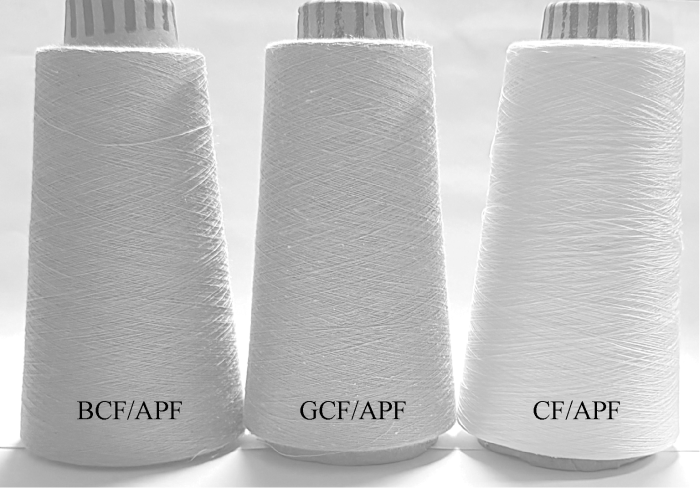
表2 混纺纱线的线密度与捻度
Tab.2
| 纱线种类 | 工艺线 密度/tex | 实际线 密度/tex | 捻度/ (捻·m-1) |
|---|---|---|---|
| BCF/APF(70/30) | 29.5 | 29.29±0.23 | 987 |
| GCF/APF(70/30) | 29.5 | 29.09±0.39 | 982 |
| CF/APF(70/30) | 29.5 | 29.54±0.11 | 989 |
2.2 天然彩棉品种对纱线力学性能的影响
3种混纺纱线的拉伸力学性能测试结果如表3所示。天然彩棉对混纺纱拉伸力学性能的影响主要源于其与CF棉以及APF的本征性能差异及混纺界面作用差异。
表3 混纺纱线的拉伸性能
Tab.3
| 纱线种类 | 断裂强度 | 断裂伸长率 | ||
|---|---|---|---|---|
| 平均值/ (cN·tex-1) | CV值/ % | 平均 值/% | CV值/ % | |
| BCF/APF(70/30) | 11.87 | 6.2 | 11.48 | 14.20 |
| GCF/APF(70/30) | 9.14 | 6.9 | 9.42 | 37.44 |
| CF/APF(70/30) | 13.67 | 5.8 | 12.97 | 10.87 |
天然彩棉(尤其是GCF)在纤维长度、线密度、断裂强度、断裂伸长率及初始模量等关键质量指标上均不及CF与APF(见表1),这种“短、细、弱、低伸长、高离散”的特征使得彩棉纤维在纱条中易出现分布不均、抱合力下降等问题,降低了纱线结构的一致性,从而影响纱线的力学性能。由表3可知,CF/APF具有最高的断裂强度(13.67 cN/tex),这是因为,CF长度适中、强度稳定,可在纱线中构建连续均匀的承载网络,而具有高强力的APF短纤维则可作为应力传递与增强组分,促使二者间形成协同承载体系。天然彩棉纤维长度短、强度低,且自身离散性较大,因此当引入天然彩棉纤维后,由CF与APF形成的承载体系被逐渐削弱,导致BCF/APF与GCF/APF的断裂强度出现不同程度的下降。由于BCF的本征纤维特性更接近CF,故BCF/APF的强度优于GCF/APF的。在断裂伸长率方面:CF/APF凭借CF与BCF的协同变形能力以及混纺纱线结构的均匀稳定性,断裂伸长率最高(12.97%);BCF/APF与GCF/APF则因天然彩棉的“低强低伸”特性导致二者在承载拉力时易过早达到伸长极限而发生断裂,从而引发纱线整体提前断裂,因此断裂伸长率出现一定下降。其断裂强度CV值与断裂伸长率CV值进一步验证了上述分析:天然彩棉纤维本征性能的高离散性(包括纤维长度、线密度、断裂强度、断裂伸长率等)均会显著影响天然彩棉混纺纱的拉伸性能,其中GCF影响尤为突出(GCF/APF的断裂伸长率CV值高达37.44%)。
2.3 天然彩棉品种对纱线质量的影响
常发性纱疵主要包括纱线细节、粗节和棉结,其数量与分布情况可直接反映成纱质量稳定性。表4示出混纺纱线的纱疵测试结果。由表可知,GCF/APF的纱疵数量显著多于BCF/APF和CF/APF。其原因是彩棉、CF以及APF间的本征性能差异(长度、细度、强力等),破坏了成纱牵伸过程的稳定性与纤维抱合均匀性:一方面,天然彩棉长度整齐度较差,且纤维整体偏细偏弱,易导致混纺须条在牵伸罗拉钳口处的握持力分布不匀,部分细短纤维易因握持不足而发生超前变速,而部分稍长纤维则因“滞后变速”形成局部堆积,分别诱发纱线细节、粗节等疵点;另一方面,彩棉与APF间的抱合程度较差,牵伸过程中未充分抱合的纤维易从纱体表面伸出,受后续加捻作用缠绕成结。此外,成纱短绒(尤其是GCF损伤形成的短绒)在牵伸过程中更易发生滑移与过度牵伸,进一步加剧牵伸不匀,最终导致纱疵数量显著增加。
表4 混纺纱线的常发性纱疵
Tab.4
| 纱线种类 | 细节/ (个·km-1) | 粗节/ (个·km-1) | 棉结/ (个·km-1) | |||
|---|---|---|---|---|---|---|
| -40% | -50% | +35% | +50% | +140% | +280% | |
| BCF/APF (70/30) | 1 637 | 597 | 2 954 | 1 023 | 2 798 | 256 |
| GCF/APF (70/30) | 2 290 | 1 162 | 3 543 | 1 297 | 3 496 | 423 |
| CF/APF (70/30) | 1 032 | 233 | 2 172 | 843 | 2 238 | 212 |
天然彩棉、CF以及APF之间存在的本征性能差异,除会造成混纺纱的常发性纱疵外,还会进一步恶化成纱条干与纱线毛羽。3种混纺纱的条干不匀率情况如图2(a)所示。可见,在混纺体系中引入彩棉后,纱线的条干不匀率显著增加,GCF/APF与BCF/APF的条干不匀率分别为24.86%和17.37%,均高于CF/APF(12.89%)。作为纱线品质的核心评价指标之一,条干不匀率的升高反映出二者的成纱均匀性较CF/APF分别出现了不同程度的劣化。混纺纤维间的长度离散性极易导致纤维在牵伸区内的握持控制情况发生突变,造成浮游纤维数量与动程的增加,尤其是长度短、线密度值小、强力差的纤维组分受影响越严重(如GCF纤维),进一步劣化纱线的条干均匀度。
图2
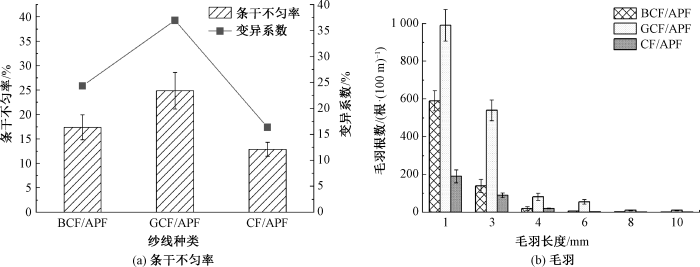
图2
3种混纺纱的条干不匀率与毛羽情况
Fig.2
Yarn evenness (a) and hairiness (b) of three types of blended yarns
3种纱线的毛羽测试结果如图2(b)所示。可见:BCF/APF与CF/APF的毛羽长度与总毛羽数量主要集中于1~3 mm短毛羽区间内;GCF/APF除具有大量<3 mm短毛羽外,还具有大量≥3 mm的有害长毛羽。这是由于GCF与APF间的纤维特性差异较大,界面抱合力显著降低,从而导致GCF因抱合不足从纱体滑脱,进而毛羽指标不断恶化。
2.4 天然彩棉品种对纱线抑菌性能的影响
选取大肠埃希菌(革兰阴性菌)和金黄色葡萄球菌(革兰阳性菌)为测试菌株,对3种混纺纱线的抑菌性能进行测试,结果如图3所示。
图3
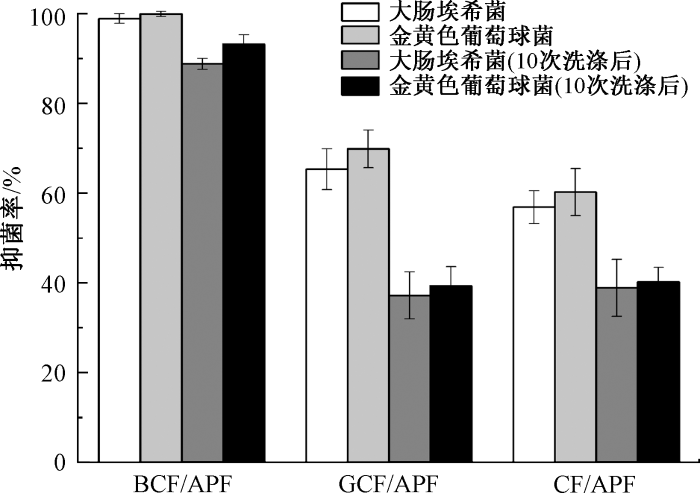
图3
3种混纺纱线的抑菌率
Fig.3
Antibacterial rates of blended yarns against Escherichia coli and Staphylococcus aureus
由图3可看出:BCF/APF对这2种菌株均展现出了优异的抑菌效果,抑菌率均大于95%,经10次洗涤后仍可表现出良好的抑菌效果(对大肠埃希菌和金黄色葡萄球菌的抑菌率分别为88.79%和93.24 %),达到国家标准要求;而GCF/APF对大肠埃希菌和金黄色葡萄球菌的抑菌率仅有65.34%和69.83%,显著低于BCF/APF,且经10次洗涤后抑菌率进一步降至35%~40%,与CF/APF几乎持平,丧失有效抗菌能力。
平板涂布照片(见图4)直观佐证了3种混纺纱线的抑菌性能:BCF/APF组培养基上的菌落数量极少,而GCF/APF组与CF/APF组培养基上均可观察到密集分布的菌落。显然,BCF/APF的抑菌性能显著优于GCF/APF和CF/APF。尽管BCF与GCF均为同产区的天然纤维品种,但二者抗菌性能却存在显著差异。究其原因是2种天然彩棉的色素化学本质与抗菌机制不同,从而引起混纺纱抗菌性能差异:BCF的色素主要是缩合单宁类物质,其可通过破坏细菌细胞壁完整性、抑制胞内酶活性实现广谱抗菌,对大肠埃希菌、金黄色葡萄球菌、肺炎克雷伯菌等常见细菌均具有显著的抑制作用[17-18];GCF的色素以黄酮类物质为主,该类物质缺乏与细菌作用的关键活性基团,抗菌活性微弱,几乎无明显抗菌效果。
图4
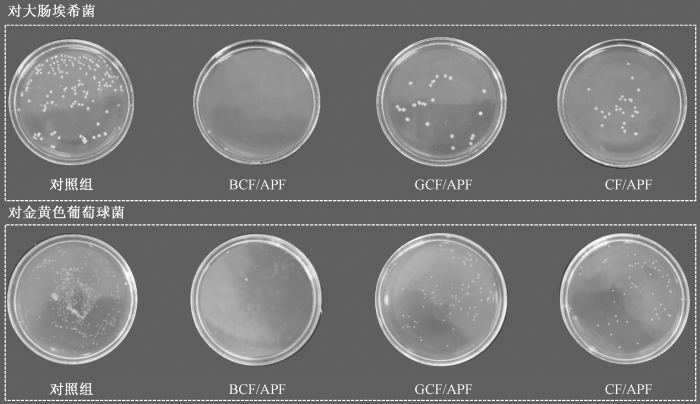
图4
3种混纺纱线对大肠埃希菌与金黄色葡萄球菌的抑菌效果(×10)
Fig.4
Antibacterial effect of blended yarns against Escherichia coli and Staphylococcus aureus(×10)
3 结论
本文以天然棕色棉纤维(BCF)、天然绿色棉纤维(GCF)、天然白色棉纤维(CF)和柞蚕丝短纤维(APF)为原料,采用棉纺普梳工艺分别纺制了3种混纺纱线,探究了彩棉品种对纱线结构、性能及抗菌活性的影响规律,主要得出以下结论。
1)与CF/APF相比,天然彩棉纤维的引入虽然可以通过环保工艺实现纱线着色,但在一定程度上降低了混纺纱的强力并劣化纱线质量。
2)GCF本征纤维特性与可纺性较差,具体表现在线密度值小、长度短、强力低等方面,在梳理及后续牵伸过程中易损伤,加剧短绒生成,牵伸控制难度增加,成纱质量稳定性最差。
3)GCF/APF对大肠埃希菌和金黄色葡萄球菌的抑菌率仅为65.34%和69.83%,而BCF/APF对2种菌株的抑菌率则高达95.12%和98.73%,性能差异主要归结于2种天然彩棉自身所含天然色素物质的抗菌活性不同:BCF色素主要为缩合单宁类物质;GCF色素主要为黄酮类物质。
综上,天然棕色棉/柞蚕丝混纺纱(BCF/APF(70/30))可协同发挥天然棕色棉的天然抗菌性与柞蚕丝的力学增强作用,兼具优异的抗菌耐久性与稳定的成纱质量,提高了纱线的差异化与功能化附加值,为亲肤型绿色织物的开发提供了创新解决方案。其天然、非溶出型抗菌特性,尤其适合易敏感肌肤人群的日常与医疗辅助使用,能有效降低化学整理剂带来的皮肤刺激风险,契合当前纺织行业“双碳”目标与绿色消费趋势,同时呼应了“大健康”理念下纺织品向主动健康防护升级的时代需求。
参考文献
Antibacterial cotton fabric with enhanced durability prepared using silver nanoparticles and carboxymethyl chitosan
[J].
DOI:S0144-8617(17)30989-X
PMID:28962757
[本文引用: 1]

Carboxymethyl chitosan (CMCTS) and silver nanoparticles (Ag NPs) were successfully linked onto a cotton fabric surface through a simple mist modification process. The CMCTS binder was covalently linked to the cotton fabric via esterification and the Ag NPs were tightly adhered to the fiber surface by coordination bonds with the amine groups of CMCTS. As a result, the coating of Ag NPs on the cotton fabric showed excellent antibacterial properties and laundering durability. After 50 consecutive laundering cycles, the bacterial reduction rates (BR) against both S. aureus and E. coli remained over 95%. It has potential applications in a wide variety of fields such as sportswear, socks, and medical textile.Copyright © 2017 Elsevier Ltd. All rights reserved.
抗菌功能纺织品的研究进展
[J].
Advances on antibacterial textiles
[J].
光动力抗菌技术在纺织品上的应用研究进展
[J].
DOI:10.13475/j.fzxb.20200903610
[本文引用: 1]
为研究光敏剂在纺织材料上负载的抗菌效果和其在纺织品改性中应用的可能性,通过文献调研的方式对光动力抗菌的研究背景、光敏剂的种类、抗菌纺织品的应用情况、光敏剂常用的负载形式进行归纳整理。研究表明:作为一种能高效杀菌的新型抗菌材料,光动力抗菌纺织品具有良好的发展前景;通过化学共价键合光敏剂的改进负载方法能够解决常见负载方式中出现的结合牢度差、重复利用性不佳等问题,进一步拓宽抗菌材料的研发途径;目前光敏剂对其光敏抗菌性能均未能做到精准调控,今后的研究应当通过控制光敏剂的种类及光敏剂浓度等因素实现对光敏抗菌性能的把控。
Progress in application of photodynamic antibacterial technology for textiles
[J].
DOI:10.13475/j.fzxb.20200903610
[本文引用: 1]
In order to study the antibacterial effect of photosensitizers loaded on textile materials and the possibility of its application for textile modifications, the research background of photodynamic antibacterial, types of photosensitizers, current applications of antibacterial textiles, and photosensitizers were systematically reviewed. The commonly used loading forms of the drug are examined, and the conclusions and future prospects are summarized. The review indicates that photodynamic antibacterial textiles are a new type of antibacterial material that can be effectively sterilized and has a good development prospect. The improved loading method through chemical covalent bonding of photosensitizers can solve the problems of poor binding fastness and poor reusability associated with the commonly used loading methods, and can further broaden the research and development path of antibacterial materials. At the same time, it is realized that the current photosensitizers have not been able to control accurately their photosensitizing antibacterial properties. Future research should control the photosensitive antibacterial properties by controlling the types of photosensitizers and the concentration of photosensitizers.
抗菌功能纺织品的研究进展
[J].
Research progress of antibacterial functional textiles
[J].
抗菌纺织品的概念辨析和研究开发方向
[J].
The concept analysis and research and development direction of antibacterial textiles
[J].
天然彩棉/细绒棉混纺纱生产实践
[J].
Production practice of natural colored cotton/medium cotton blended yarn
[J].
大豆蛋白纤维/彩棉赛络纺弹力包芯纱的开发
[J].
Development of soybean protein fiber combed colored cotton and PU core-spun yarn by SIRO spinning
[J].
Colored cotton fabric production without dyeing within the sustainability concept in textile
[J].DOI:10.1016/j.indcrop.2022.115419 URL [本文引用: 1]
不同混纺比彩棉与白棉混纺纱线性能分析
[J].
Performance analysis of blended yarn of colored cotton and white cotton with different blending ratios
[J].
天然彩棉纤维混纺纱产品的开发及工艺的研究
[J].
Research on the development and technology of naturally colored cotton blended yarn products
[J].
Analysis of antibacterial properties of naturally colored cottons
[J].
DOI:10.1177/0040517512447585
URL
[本文引用: 1]
The antibacterial activity of naturally colored cottons (NCCs) is evaluated. Compared to the conventional white cotton, brown NCC was found to exhibit excellent antibacterial activity with a reduction rate of 89.1% and 96.7%, when in contact with two species of bacteria, Staphylococcus aureus and Klebsiella pneumoniae, respectively, while the antibacterial effect of green NCC was faint. To investigate the antibacterial mechanism of NCCs, pigments have been extracted from NCC fibers for further determination of their antibacterial activity using the disk diffusion method, and the chemical nature of extracted pigments was also analyzed. The results are as follows: the pigment from brown cotton fibers showed significant inhibition against the two challenge bacteria, while the resistance capacity of the pigment from green cotton fiber was insignificant, indicating that the antibacterial efficacy of NCC fibers was highly related to the chemical nature of the pigment. Diagnostic results indicated that the pigment from brown cotton belonged to condensed tannins, and the pigment from green cotton fiber was identified as flavonoids. The effect of high-temperature treatment on antibacterial activity of the pigment extracted from brown cotton was also examined. It showed that the general textile high-temperature curing conditions decrease its antibacterial activity, but the antibacterial activity still has a satisfactory retention, indicating a durable natural antibacterial performance of brown NCC to the high-temperature curing technology.
Flavonoid biosynthetic and starch and sucrose metabolic pathways are involved in the pigmentation of naturally brown-colored cotton fibers
[J].DOI:10.1016/j.indcrop.2020.113045 URL [本文引用: 1]
柞叶染料对柞蚕丝织物的染色及其吸附动力学研究
[J].
Dyeing properties and adsorption kinetics of oak leaf extract on tussah silk
[J].
柞蚕丝与莱赛尔纤维混纺纱线的开发
[J].
Development of wild silk fiber/Lyocell fiber blended yarn
[J].
香蕉茎秆纤维/抗菌纤维混纺纱的制备及其性能
[J].
DOI:10.13475/j.fzxb.20230805701
[本文引用: 1]
为促进天然香蕉茎秆纤维在纺织服装领域的应用,采用半精纺纺纱工艺,以香蕉茎秆纤维(BF)、优可丝安泰贝抗菌纤维(ATB)和稀土抑菌再生纤维素纤维(XT)为原料,制备了混纺比为50/50、65/35、70/30、85/15的8种BF/抗菌纤维混纺纱和1种BF纯纺纱,表征了纱线的线密度和捻度,探究了混纺比例与纱线力学性能、质量指标、抗菌性能的关系。结果表明,9种纱线实测的线密度和捻度与设计值存在偏差,但其偏差在允差范围内;ATB和XT的加入提高了BF纯纺纱的力学性能与抗菌性能,改善了BF纯纺纱的条干均匀度、毛羽指数、棉结、粗节、细节等质量指标,且香蕉/抗菌纤维混纺纱强度高、毛羽少、手感柔软,适宜开发各类机织和针织面料。
Preparation and properties of banana stem fiber/antibacterial fiber blended yarn
[J].
DOI:10.13475/j.fzxb.20230805701
[本文引用: 1]
<p id="p00010"><strong>Objective</strong> With the proposal of the "double carbon economy" policy, green environmental protection and sustainable development become the direction of future textile development, and Xitu it is of great significance to develop new natural plant fibers and promote the application of natural banana stem fibers in the field of textile and clothing.</p><p id="p00015"><strong>Method</strong> The semi-worsted spinning process was adopted with banana stem fiber (BF), EcoCosy<sup>R</sup> antibacterial fibers (ATB) and rare earth antibacterial regenerated cellulose fiber (XT) as raw materials. Eight types of BF/antibacterial fibers (ATB and XT) blended yarns, with blending ratio of 50/50, 65/35, 70/30 and 85/15, and one BF pure spun yarn were prepared. The yarn density and twist were characterized, and the relationship between the blending ratio and mechanical properties, quality index and antibacterial properties of the yarn was investigated.</p><p id="p00020"><strong>Results</strong> The measured linear density and twist of the 9 types of yarns were different from the designed values, but the deviation was within the tolerance range. The mechanical properties of BF pure spinning are poor, with the breaking strength being (7.12±1.45) cN/tex, the elongation at break (2.56±0.43)%, and the initial modulus (247.11±81.07) cN/tex. The mechanical properties of yarns were improved with the addition of ATB and XT content. The elongation at break of BF/ATB(50/50) and BF/XT(50/50) yarns was the highest, which was (4.19±0.46)% and (4.74±0.41)%. The breaking strength of BF/ATB(85/15) and BF/XT(70/30) yarns is the highest, and they were (9.33±1.45) cN/tex and (8.97±1.28) cN/tex respectively. With the increase of the content of ATB and XT, the defects such as knots, thick knots and detail of the yarn were greatly reduced, and the evenness of yarn strip and hairiness index were improved. The yarn unevenness was decreased from 21.83% to 13.91% and 14.8% respectively, and the hair index was decreased from 6.72 mm to 5.85 mm and 5.27 mm respectively, decreasing by 13% and 22%. The bacteriostatic rate of BF pure spinning against <i>Escherichia coli</i> was 65.47%, and the bacteriostatic rate of yarn increased with the increase of ATB and XT content. When the ratio of BF/ATB and BF/XT blended yarn was 50/50, the inhibition rate of <i>Escherichia coli</i> reached the maximum, which were 88.79% and 84.76% respectively, while for <i>Staphylococcus aureus</i>, the content of ATB and XT had little effect on the inhibition rate, and the inhibition rate of BF pure spun yarn and blended yarn could reach more than 95%.</p><p id="p00025"><strong>Conclusion</strong> The addition of ATB and XT improved the mechanical properties and antibacterial properties of BF pure spinning. In addition, it also improves the quality indexes of BF pure spun yarn, such as strip evenness, hairiness index, knots, thick knots and details, making the blended yarn have higher breaking strength, excellent antibacterial property. It is of great significance for its application and development in clothing, and is suitable for the development of leisure woven shirt fabric and knitted fabric.</p>
梳棉机梳理彩棉纤维工艺及其针布的配置
[J].
Color fiber carding process and the card clothing configuration
[J].

 京公网安备11010502044800号


