



目前,对瑜伽裤的性能优化研究主要从款式结构设计和面料性能分析两方面入手。在款式结构方面,由于传统的平面纸样和立裁难以直观、快速地呈现穿着效果[5],因此三维虚拟试衣软件被广泛应用于服装结构的研究,如VStitcher、CLO 3D、Style3D等[6-7]。利用虚拟软件进行结构改进比传统方法节省了时间和成本,同时能够进行个性化的数字服装设计[8]。陈晓真等[9]针对连体裤制作繁琐、合体性差等问题,提出了一种基于CLO 3D虚拟人体转换与参数化设计的纸样快速生成方法,提升了服装纸样结构的改进效率。Liu等[10]使用CLO 3D模拟不同姿势下的压力发现,大腿/臀部、小腿、腰部和裆部的压力分布对裤子的舒适度有显著影响,为裤装结构优化设计提供了参考。在数字化服装设计中,Qi等[11]利用CLO 3D将传统文化与现代技术相结合,对澳门葡萄牙裔女性的服饰进行数字化设计和创新。
在面料性能方面,面料的选择对瑜伽裤的功能性和舒适性至关重要,通过优化面料性能可以调节服装对人体的束缚与支撑[12]。然而,面料的物理属性和穿着服装的压力分布在虚拟平台与真实测试中存在一致性误差[13]。Youn等[14]通过实验对比发现,穿着医用腰带的虚拟压力值和实测压力值在CLO 3D模拟中存在误差。Kim等[15]选择不同氨纶含量的面料制成瑜伽裤,在CLO 3D中进行模拟和压力测试,发现不同氨纶含量的瑜伽裤在压力测试中无明显差异,进一步提出现有仿真模拟算法对织物力学性能的敏感度较低,即缺乏精准的面料属性数据时,模拟结果难以反映真实的压力值,因此,如何将服装在虚拟平台中的压力与实测压力统一化是采用虚拟技术优化服装的一个难题。
为优化女瑜伽休闲裤的样板结构、提升裤装舒适性,本文从瑜伽休闲裤的压力分布出发,基于面料物理属性构建数字化面料,探讨典型瑜伽动作下瑜伽裤的虚拟与实测压力的定量关系,利用CLO 3D虚拟模拟实现样板结构与面料属性的共同优化。
1 实验准备
1.1 款式设计
为满足日常运动和时尚出行需求,通过调研市场常见的运动休闲裤,本研究选取的款式设计如表1所示。
表1 款式设计
Tab.1
| 款式编号 | 腰部 形式 | 裤型 | 分割设计 | 口袋 形式 | 腰部面料层数 |
|---|---|---|---|---|---|
| 1 | 低腰 | 直筒 | 无 | 斜插袋 | 单层 |
| 2 | 低腰 | 直筒 | 裤前分割 | 斜插袋 | 单层 |
| 3 | 中腰 | 喇叭 | 无 | 无 | 双层 |
| 4 | 高腰 | 喇叭 | 无 | 无 | 单层 |
| 5 | 高腰 | 喇叭 | 裤前 | 斜插袋 | 双层 |
| 6 | 低腰 | 束脚 | 无 | 斜插袋 | 单层 |
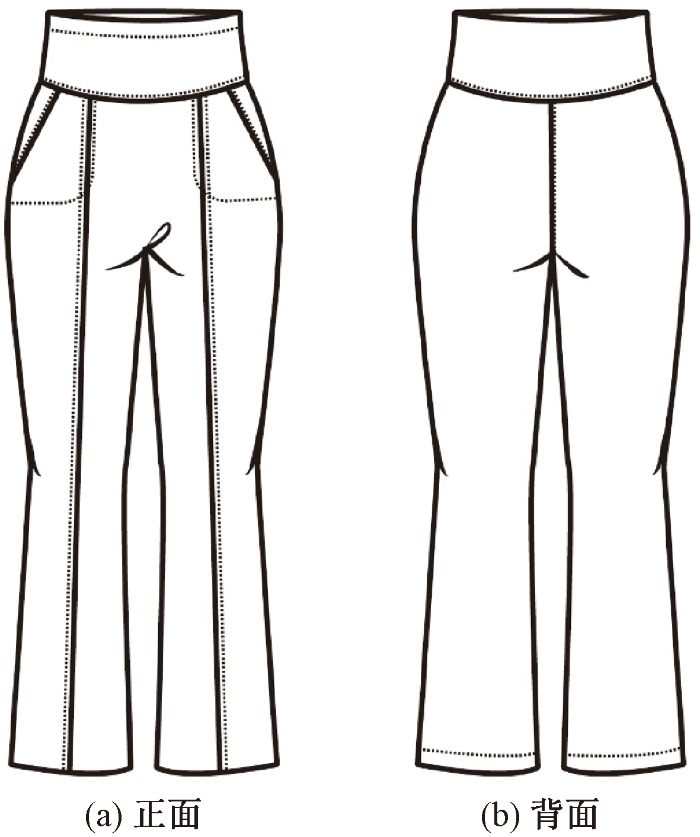
为满足瑜伽裤从运动伸展到日常通勤的多维需求,根据上述款式,本研究设计出一款兼具时尚与功能的瑜伽休闲裤,如图1所示。廓形为上紧下松;高腰设计;从臀峰线以下逐渐增加松量,形成微喇宽松结构,提升体型包容性;前片为纵向分割设计,通过视错觉原理拉长腿部线条;口袋为侧贴袋设计。
图1
1.2 面料选择
通过市场调研确定面料选择方向。调研采用线上问卷和线下品牌走访结合的方式,聚焦年轻女性运动与日常出行的功能需求。选择一款纬平针织面料(浙江珍艾科技有限公司),成分包括:粘胶纤维(37.7%)、氨纶(7.4%)、涤纶(43.6%)、莱赛尔纤维(11.3%)。
1.3 规格设定
1.3.1 服装规格
结合日常运动需求和服装工效学,参考GB/T 1335.2—2008《服装号型 女子》对服装进行松量调整,以女性中间标准体型160/84A为基码,腰围、臀围、裤长、裤口规格尺寸分别为66、89、100、49 cm。
1.3.2 虚拟模特
根据GB/T 10000—2023《中国成年人人体尺寸》中成年女性标准体型的规定,设定160/84A的标准体虚拟模特,对关键部位进行尺寸调整,身高、腰围、腰围高、臀围、大腿围、小腿围、膝围、踝围、直裆部位规格尺寸分别为160、68、103、90、54、33、33.5、21、27 cm。
1.4 试样准备与性能测试
1.4.1 面料性能测试及数字化建模
在标准大气环境静置24 h的295 mm×295 mm面料样本上,分别裁剪出大小为220 mm×30 mm的经向、纬向和斜向(45°)的3个测量样本。
参考GB/T 4669—2008《纺织品 机织物 单位长度质量和单位面积质量的测定》,使用PX124ZH电子天平(上海浦春计量仪器有限公司)测量3个样本的面密度,并取其均值。
参考GB/T 3820—1997《纺织品和纺织制品厚度的测定》,采用200 cN的砝码和200 mm2的压脚,使用YG141LA织物厚度仪(兰州电子仪器有限公司)测量面料的厚度。
参考GB/T 3923.1—2013《纺织品 织物拉伸性能 第1部分:断裂强力和断裂伸长率的测定(条样法)》,使用SST1000拉伸度自动化测试仪(浙江凌迪数字科技有限公司)测量面料的拉伸强度。
参考GB/T 18318.1—2009《纺织品 弯曲性能的测定 第1部分:斜面法》,使用SBE1000弯曲度自动化测试仪(浙江凌迪数字科技有限公司)测量面料的弯曲刚度。
虚拟面料的物理性能参数如表2所示。表中拉伸和弯曲值在模拟软件中表示数值的大小(范围为0~100),无具体单位。在拉伸测量中,记录面料经向、纬向和斜向在微小形变下的力,对应模拟面料的拉伸数值差异较小,说明该面料具有均衡的平面拉伸阻力;在弯曲性能测量中,面料经向、纬向和斜向的实际伸长长度差异较小,对应模拟中的弯曲数值无明显差异,说明该面料的悬垂性与织物经纬向相关性较低。即该面料能高度贴合人体曲面,同时在拉伸状态下保持结构稳定。
表2 物理性能参数
Tab.2
| G/ (g·m-2) | H/ mm | μ | 拉伸 | 弯曲 | ||||
|---|---|---|---|---|---|---|---|---|
| 经向 | 纬向 | 斜向 | 经向 | 纬向 | 斜向 | |||
| 324.43 | 1.0 | 0.2 | 22.79 | 23.11 | 22.19 | 35.56 | 34.88 | 35.22 |
注:G为面密度;H为厚度;μ为摩擦因数。
采用SSC1000面料自动化扫描仪(浙江凌迪数字科技有限公司)采集面料的色彩与纹理。
DeepModa模型是一款基于大量三维样本学习训练的AI模型,其能够在自动匹配面料物理属性和色彩纹理后生成一款虚拟面料。通过对虚拟面料进行悬垂度的对比(如图2所示),对其物理参数进行修正,结果显示二者具有较高相似度。
图2
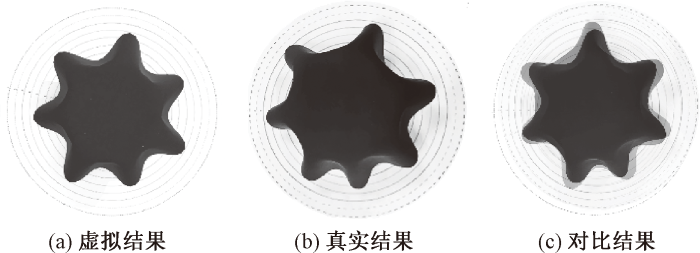
图2
悬垂度对比
Fig.2
Hanging distance comparison. (a) Virtual results; (b) Authentic results; (c) Comparison results
1.4.2 气囊压力测试
采用AMI气囊式接触压力测量系统进行服装接触压力测试,该系统由气囊式传感器、AMS-950 主机、数据采集器及其它附件组成。基于气压式服装压力测试法,将接触压力转化为气压测试。其中,气囊与半导体应变片式压力传感器共同感压,能够测量曲率较大或构造较复杂的部位。
2 实验内容
2.1 动作设计
图3
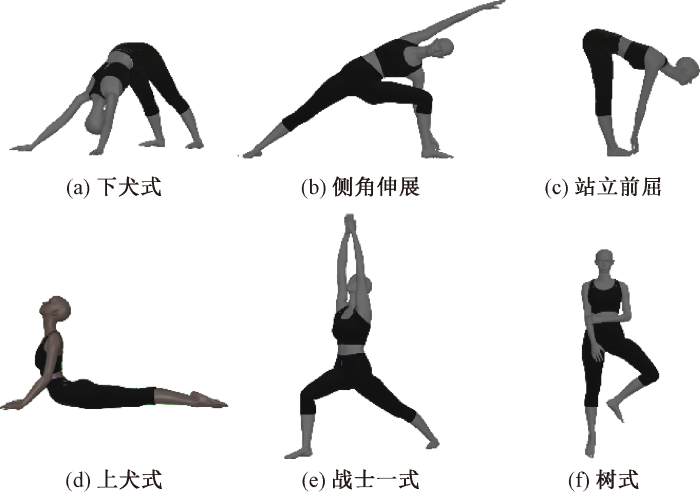
图3
静态压力测试姿态示意图
Fig.3
Schematic diagrams of static pressure test postures. (a) Downward-facing dog pose; (b) Side angle stretching; (c) Standing forward bending; (d) Upward-facing dog pose; (e) Warrior I pose; (f) Tree pose
2.2 压力点标记
参照人体尺寸测量标准和人体结构设定测量基准线。选取4个区域测量服装压力:腰部、臀部、大腿和膝盖。腰部为躯干向内弯曲的部位,是裤装合身度的关键部位之一;臀部测量位置为臀部最宽处;大腿在运动中经历大幅度运动,测量位置在大腿中部与根部;膝盖作为下肢运动的中心关节,经常处于屈曲状态,测量位置为膝盖前侧。设计选择的压力测量点如图4所示。
图4
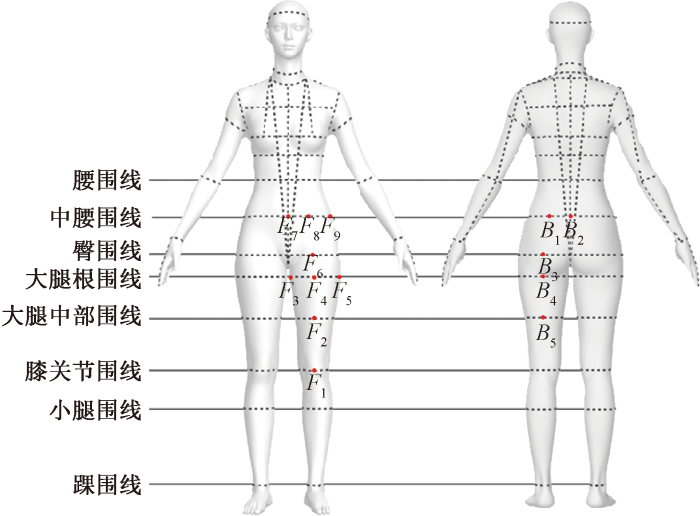
为提高测量准确性,以压力测量点为中心,上、下、左、右各5 mm处标记,形成压力测试区域,以五点平均法测量压力值的平均值,表示该点的虚拟试穿压力值。
2.3 实验样衣制作
2.3.1 结构纸样
为增加腰部束缚力,腰部优化为超高腰“三明治”式设计,解决运动时腹部挤出的问题,同时强调女性腰臀部曲线,增添时尚感;在前片腰部1/2处设计纵向分割;裤腿下摆设计为微喇阔腿。优化设计后的瑜伽休闲裤结构图、样板图如图5所示。
图5
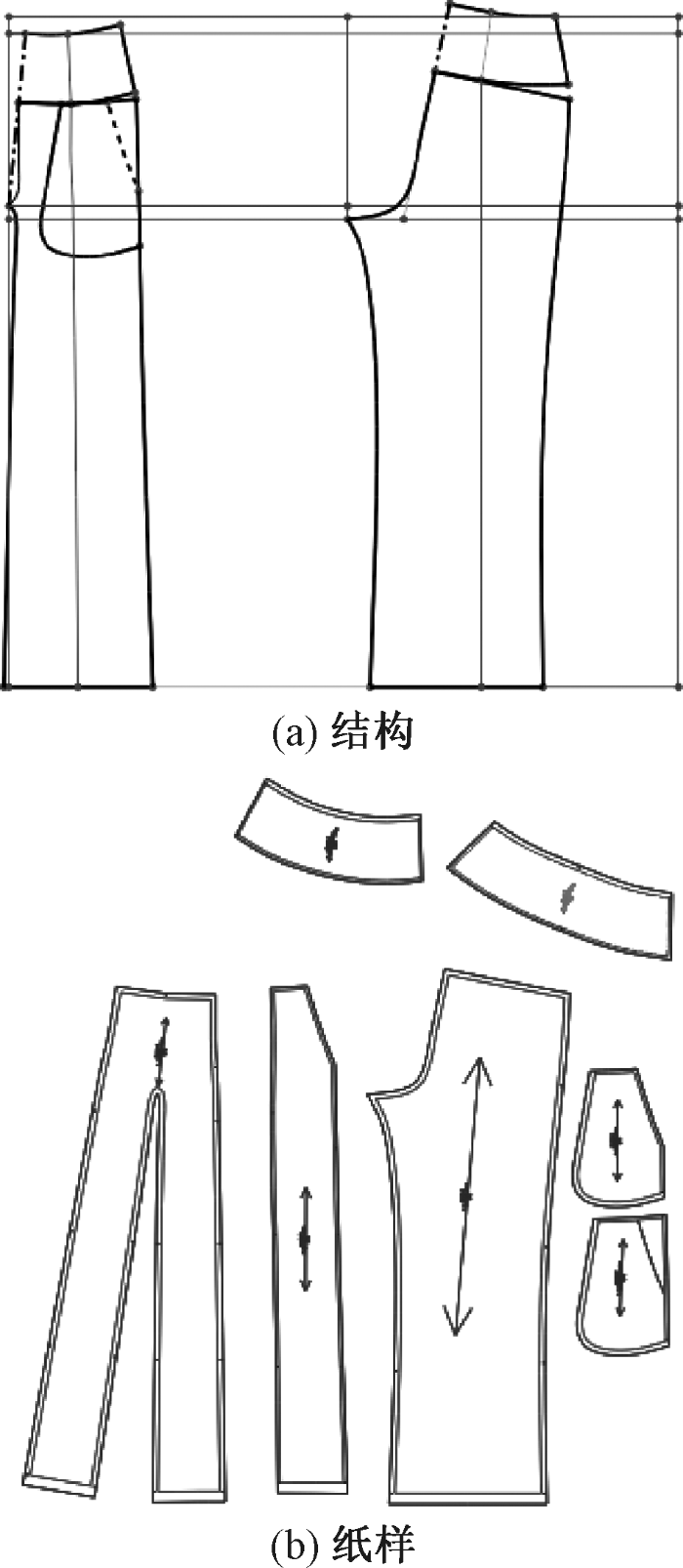
图5
实验瑜伽休闲裤
Fig.5
Experimental yoga lounge pants. (a) Structure; (b) Paper pattern
2.3.2 虚拟试穿
使用BOKE CAD(深圳市博克时代科技开发有限公司)生成样板后导入CLO 3D中,在160/84A标准体女性虚拟模特身上进行试穿。面料设定为生成的虚拟面料,虚拟试穿静止效果如图6所示。外观虚拟效果与真实效果基本一致。
图6
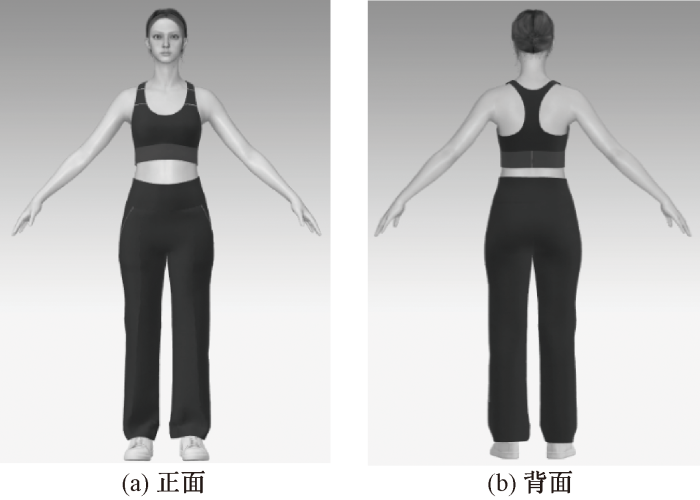
在CLO 3D的试穿压力图谱功能中,通过模拟服装在三维虚拟环境中的力学效果,结合面料的物理属性和人体模型的动态交互对服装表面的压力分布进行表征[18]。依次调整动作模块,设置服装显示模式为透明,打开试穿压力图谱,在不同动作状态下点击压力测量点并记录。
2.3.3 样衣制作
选取瑜伽裤号型为160/84A。面料:黑色纬编针织面料。辅料:弹力长丝缝纫线(双股,22 tex,100%锦纶)、中缝烫条(100%聚酯纤维)。设备: M700B(4N)-DL2(双切)缝纫机(飞马(天津)缝纫机有限公司)。
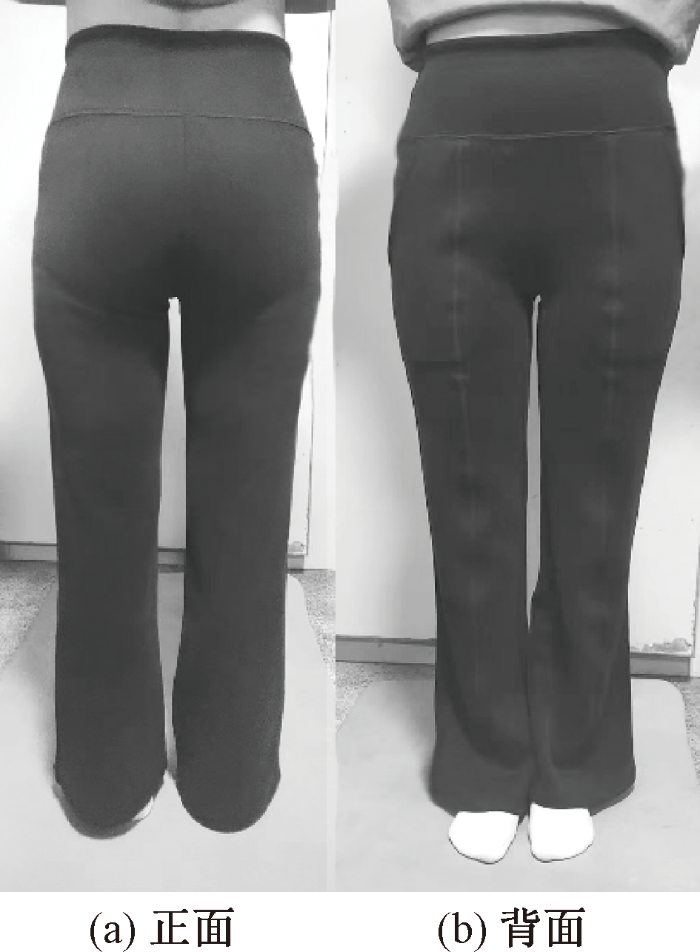
采用拼接无骨的四针六线工艺,以6针/cm的中等偏高密度,0.7 cm的拼接宽度进行缝制,保证牢固度与弹性。实验样衣真人穿着效果如图7所示。
图7
2.4 真人实验
1)点位标记。实验对象为160/84A标准体真人模特,与虚拟模特形成对照。实验对象保持静止站立状态,使用记号笔在压力测量点进行标记,标记时采用“十”字标记。
2)放置传感器。首先对气囊传感器进行放气和充气,传感器连接压力仪主机。压力仪主机连接数据采集器并连接至电脑。使用医用胶带固定气囊传感器,气囊紧贴皮肤面上的红点与人体“十字”标记点处重合,固定传感器连接线。
3)数据采集。设置软件参数后,在室温26 ℃,湿度60%环境下进行测试。气囊传感器固定于同一压力测量点时,依次进行动作并采集数据,实验对象保持动作稳定后,连续采集数据60 s,等待仪器响应后结束。更换测量点位并重复操作,顺序依次从膝盖部位转向腰部测量。
2.5 数据分析
异常值处理。以虚拟压力和实测压力均值为基准,计算各组标准差,以均值±3倍标准差为范围,剔除超范围数据后重算均值并进行数据分析。
2.5.1 描述统计
1)整体特征。通过计算均值、标准差、最大值和最小值反映虚拟压力值与实测压力值的整体分布特征及不同动作(点位)下的压力差异。整体描述统计如表3所示。
表3 整体描述统计
Tab.3
| 类型 | 均值 | 标准差 | 最大值 | 最小值 |
|---|---|---|---|---|
| 虚拟压力 | 0.26 | 0.22 | 1.11 | 0.01 |
| 实测压力 | 1.13 | 1.13 | 10.33 | 0.01 |
实际使用的传感器在服装与皮肤之间会形成局部突起,接触应力集中,因此,实测数值普遍高于理想状态下的虚拟数值。不同动作(点位)的波动更明显。
2)动作特征。按照动作分组,计算虚拟与实测压力均值,反映不同动作的整体受力差异。动作分组均值差异如表4所示。
表4 动作分组描述
Tab.4
| 动作 | 虚拟压力 均值/kPa | 实测压力 均值/kPa | 实测值/虚拟值 |
|---|---|---|---|
| 下犬式 | 0.30 | 0.80 | 2.67 |
| 侧角伸展 | 0.37 | 1.10 | 2.97 |
| 站立前屈 | 0.23 | 0.92 | 4.00 |
| 上犬式 | 0.22 | 0.92 | 4.18 |
| 战士一式 | 0.27 | 1.25 | 4.63 |
| 树式 | 0.17 | 1.81 | 10.65 |
由表4可知,所有动作实测压力均值均高于虚拟压力值。其中,树式动作为单腿支撑,战士一式动作为大幅度非对称拉伸,虚拟平台的数字模特为刚性体,无法精确反映动态中的身体围度变化和皮肤与面料间的摩擦,因此,树式动作和战士一式动作的实测/虚拟压力比值最大。
3)点位特征。按照点位分组,计算虚拟与实测压力均值,反映不同点位的受力差异,结果如表5所示。
表5 点位分组描述
Tab.5
| 点位 | 虚拟压力均值 | 实测压力均值 |
|---|---|---|
| F1 | 0.13 | 3.08 |
| F2 | 0.25 | 1.76 |
| F9 | 0.32 | 1.28 |
| B3 | 0.40 | 1.85 |
| B5 | 0.04 | 0.14 |
基于压力特征、虚拟模拟和实测环境分析:F1、F2、F9在上犬式动作中,受到人体自重的影响使实测压力值远大于虚拟压力。B3为臀部支撑点,虚拟压力值与实测压力值均偏高,而B5为背面的次要部位,整体受力较小。
2.5.2 相关分析
1)全样本相关分析。P值(0≤P≤1)是衡量统计推断可靠性的重要指标,在假设检验中,P值指在原假设成立的条件下,获得当前或极端样本观测值的概率。设定显著性水平α为0.05,当P<0.05时,判定结果具有显著性;当P≥0.05时,则认为样本间的差异或相关性无统计学意义。
全样本的虚拟与实测压力值相关系数为0.18,P值为0.10(P>0.05)。即二者之间存在较弱正相关关系,虚拟压力对实测压力的预测能力较弱。
2)动作分组相关分析。按照动作类型分组,分别计算每个动作中虚拟与实测压力值的相关系数,结果如表6所示。
表6 动作分组相关分析
Tab.6
| 动作 | 相关系数 | P值 |
|---|---|---|
| 下犬式 | 0.87 | 0.00 |
| 侧角伸展 | 0.41 | 0.15 |
| 站立前屈 | 0.72 | 0.00 |
| 上犬式 | 0.15 | 0.61 |
| 战士一式 | 0.14 | 0.62 |
| 树式 | 0.25 | 0.38 |
由表6可知,下犬式动作相关系数为0.87,P值为0.00,即虚拟与实测压力值在下犬式动作中呈显著正相关。站立前屈动作的相关系数为0.72,P值为0.00,呈显著正相关。
3)点位分组相关分析。按照测量点位进行分组,分别计算每个点位虚拟与实测压力值的相关系数,结果如表7所示。
表7 点位分组相关分析
Tab.7
| 点位 | 相关系数 | P值 |
|---|---|---|
| F1 | 0.67 | 0.14 |
| F2 | 0.18 | 0.73 |
| F3 | 0.01 | 0.98 |
| F4 | 0.33 | 0.52 |
| F5 | 0.18 | 0.73 |
| F6 | 0.89 | 0.02 |
| F7 | 0.17 | 0.75 |
| F8 | 0.96 | 0.00 |
| F9 | -0.27 | 0.61 |
| B1 | -0.38 | 0.46 |
| B2 | -0.01 | 0.99 |
| B3 | -0.01 | 0.99 |
| B4 | -0.12 | 0.82 |
| B5 | 0.93 | 0.01 |
在关键受力部位和特定动作下(如下犬式动作),相关性较高。其中:F6、F8和B5的相关系数绝对值大于0.8且P值小于0.05,因此,虚拟仿真在预测主要压力集中区域方面较为准确,可对关键高压点位进行拟合。
2.5.3 回归分析
R2为决定系数(0≤R2≤1),反映因变量的变异中可由自变量解释的比例,R2值越接近1时,样本的拟合度越好。
图8
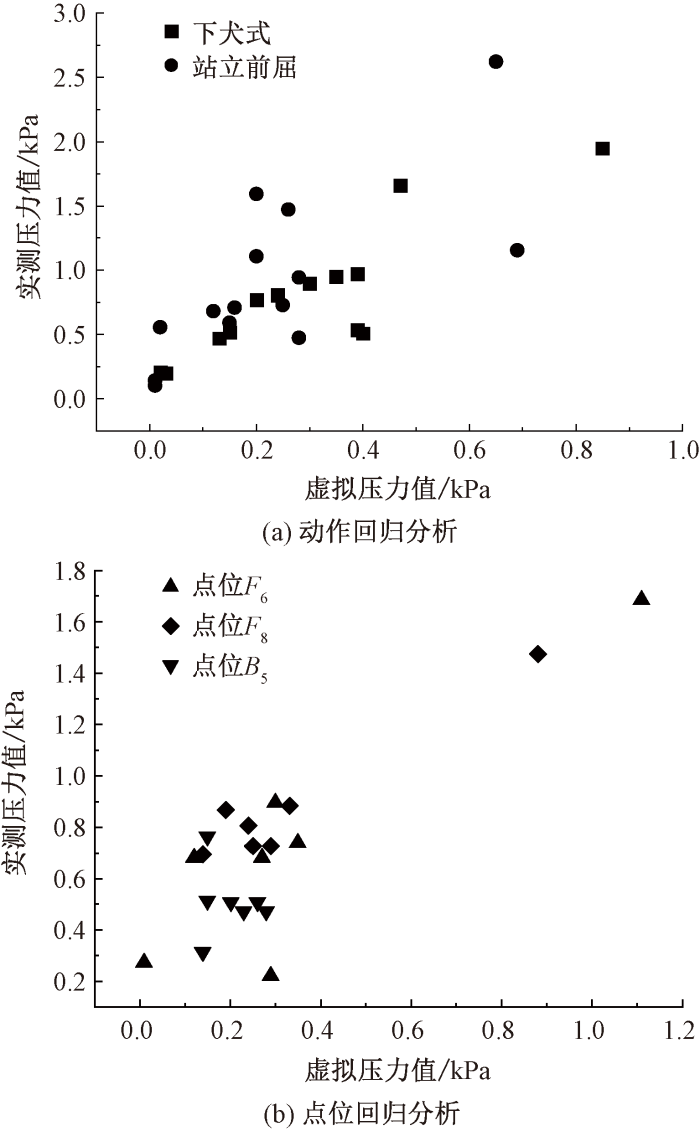
图8
回归分析散点图
Fig.8
Regression analysis scatter plots. (a) Action regression analysis; (b) Point regression analysis
表8 回归分析结果
Tab.8
| 分组 | 回归系数 | R2 | 回归方程 |
|---|---|---|---|
| 下犬式 | 2.03 | 0.75 | y=2.03x+0.20 |
| 站立前屈 | 2.29 | 0.53 | y=2.29x+0.38 |
| F6 | 1.21 | 0.79 | y=1.21x+0.32 |
| F8 | 1.04 | 0.92 | y=1.04x+0.54 |
| B5 | 3.37 | 0.86 | y=3.37x |
注:x为虚拟压力值;y为实测压力值。
3 虚拟优化
3.1 压力分布优化
人体的压力舒适阈值存在显著的部位差异(腰腹为0.6~1.1 kPa,臀部及下肢为1.5~2.8 kPa)[20]。其中,人体较舒适的服装压力为1.96~3.92 kPa,不舒适的服装压力的临界值为5.88~9.81 kPa。结合实测压力值与虚拟压力值,以压力舒适范围为基准,观察虚拟试穿压力云图,定位出压力集中点F3、F6、B3,这3点主要分布在臀部和大腿内侧区域,对此区域进行二次优化。
前片:在裤片前片内侧三角区增加结构分割线。大腿内侧沿皮肤拉伸方向进行分割并增加0.5 cm的松量,通过横纵线上的变化满足动态运动时的压力需求。
图9
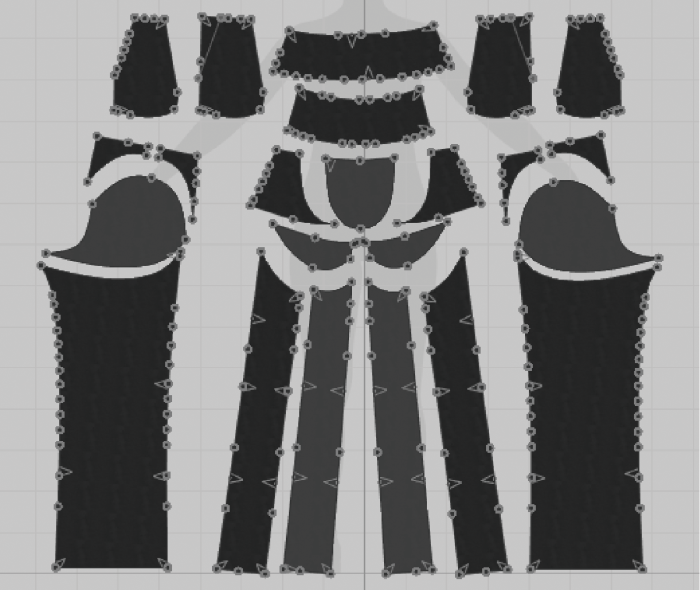
3.2 面料改进
结构优化降低了织物的拉伸应变,但无法完全消除拉伸的区域(如B3点位),需通过调整面料的物理属性(拉伸模量和弯曲刚度),使面料在发生相同形变时回弹降低。通过样板优化和面料改进共同构成优化方案。
针织服装的压力分布与面料物理性能显著相关。其中,面料的拉伸强度、拉伸模量、压缩模量和厚度与压力分布呈正相关,面料的弯曲刚度、回弹性、摩擦因数和表面粗糙度与压力分布呈负相关。结合二次纸样优化和面料物理属性,对大腿前侧中段与臀部的面料进行改进。在CLO 3D中进行面料性能优化,优化后面料参数为:厚度0.8 mm、剪切刚度25 N/m、弯曲刚度2.7×10-6 N·m、摩擦因数30、变形强度70、表面粗糙度60。其中:摩擦因数、变形强度和表面粗糙度在软件内为范围从0~100的某个数值,代表该项性能的强度,无具体单位。优化效果如图10所示。
图10
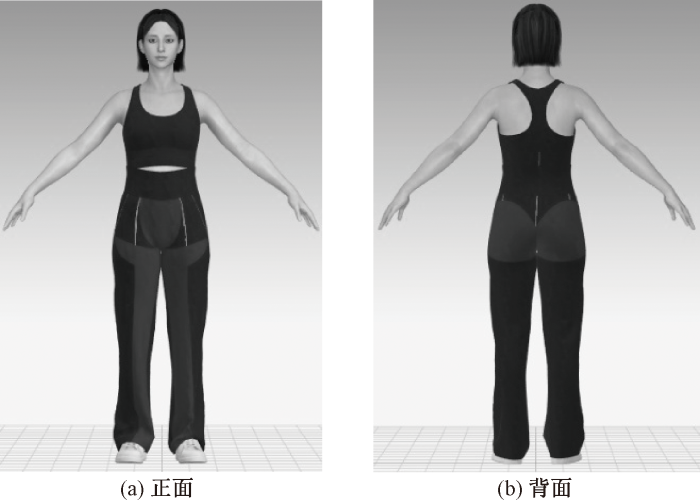
3.3 优化分析
基于纸样优化和面料性能优化进行分析,选用160/84A标准体模特,与优化前结果形成对照(优化结果如表9所示),压力减小比率计算公式为
式中:A为优化前压力值, kPa;A0为优化后压力值,kPa;ε为压力减小比率,%。
表9 优化结果
Tab.9
| 动作 编号 | 点位 | 优化前 压力值/kPa | 优化后 压力值/kPa | 压力减小 比率/% |
|---|---|---|---|---|
| F3 | 0.39 | 0.35 | 10.26 | |
| 1 | F6 | 0.30 | 0.28 | 6.67 |
| B3 | 0.47 | 0.42 | 10.64 | |
| F3 | 0.39 | 0.36 | 7.69 | |
| 2 | F6 | 1.11 | 1.02 | 8.11 |
| B3 | 0.50 | 0.46 | 8.00 |
注:1为下犬式动作;2为侧角伸展动作。
优化后压力值均有不同程度的减小,该优化方案显著改善了压力分布,提高了女瑜伽休闲裤的舒适性。
4 结论
1)在虚拟压力与实测压力分析中,部分动作与点位能够有效映射实测压力,可以作为数字化模拟的指标。下犬式的虚拟压力与实测压力相关性强,拟合方程为y=2.03x+0.20。
2)虚拟仿真在趋势上与实测结果有一定一致性。但复杂动作及多数点位的虚拟压力值与实测压力值误差较大,相关系数小于0.8。说明虚拟模拟仍存在局限,CLO 3D中的虚拟模特由刚性骨骼与静态皮肤蒙皮组成,无法模拟一些动作下的身体围度变化(如树式动作)和大幅度拉伸下面料与皮肤之间的摩擦(如战士一式动作)。
3)从样板结构和面料性能进行压力分布优化,重新测量下犬式动作和侧角伸展动作下F3、F6、B3点位的压力值,压力值均下降了6%以上,说明优化后能提升女瑜伽休闲裤的压力舒适性。
本研究通过建立数字化面料提升了虚拟模拟的准确性,构建了女休闲瑜伽裤虚实压力的预测模型。以中间体型和单一服装为实验样本,研究对象为静态动作,未充分考虑不同体型、不同款式服装及静动态变化下的受力。今后研究可引入具有动态柔性特征的人体模型,通过扩大真人实验样本,进一步验证并提升数字化压力预测模型的普适性。
参考文献
Effect of yoga-based exercises on functional capacity, dyspnea, quality of life, depression, anxiety, and sleep of infected healthcare workers during the COVID-19 pandemic: a prospective clinical trial
[J].
DOI:10.5606/tftrd.2023.11605
PMID:38766577
[本文引用: 1]

The study aimed to investigate the effect of yoga-based exercises on functional capacity, dyspnea, quality of life, depression, anxiety, and sleep quality following coronavirus disease 2019 (COVID-19).Forty-one COVID-19-infected healthcare professionals (35 females, 6 males; mean age: 39.7±6.5 years; range, 28 to 55 years) who were actively working during the subacute period were included in the prospective controlled study between March 2021 and September 2021. The participants were divided into two groups: the yoga-based exercise group (YBEG; n=26) and the nonintervention group (n=15). Besides routine recommendations, the YBEG performed stretching, relaxation, isometric strengthening, breathing, and meditation exercises of 60 min twice a week for eight weeks. Clinical outcome was measured with flexibility tests (shoulder flexibility and sit and reach tests), hand grip strength, 6-min walk test, dyspnea score, Beck Depression and Anxiety Inventory, Short Form 36 (SF-36) quality of life, Pittsburgh sleep quality index (PSQI), and the International Physical Activity Questionnaire (IPAQ) before and after eight weeks in both groups.Beck anxiety scores, IPAQ scores, PSQI, SF-36 pain, and social functioning subparameters were positively statistically significant in the YBEG (p<0.05). The only parameter found to be insignificant in time and between groups was the SF-36 mental health subparameter (p>0.05). In addition, the YBEG had significant improvements in muscle strength, flexibility, functional capacity, physical activity level, quality of life, anxiety, depression levels, and sleep scores between before and after the eight-week intervention period (p<0.05).Yoga programs have led to an increase in functional capacity and physical performance, a decrease in anxiety and depression complaints, and an increase in the quality of life in healthcare professionals who were in the process of returning to work during the post-COVID-19.Copyright © 2023, Turkish Society of Physical Medicine and Rehabilitation.
Role of yoga in minimizing stress and anxiety in women experiencing dysmenorrhea
[J].
DOI:10.15280/jlm.2023.13.2.90
PMID:37970322
[本文引用: 1]
Primary dysmenorrhea is characterized by recurring, crampy lower abdominal pain occurring during menstruation in the absence of pelvic pathology. It is the most common gynaecological complaint among adolescents. According to the literature, young females with primary dysmenorrhea experience stress, anxiety, lower-back pain, and depression. Yoga is widely practiced to improve health and promote relaxation. It includes breath regulation, simple meditation, and practicing particular body postures. Regular Yoga practice can serve as an adjunct to the primary treatment of dysmenorrhea symptoms. This study focuses on the impacts and benefits of yoga in young females with dysmenorrhea and associated physiological changes.© 2023 Journal of Lifestyle Medicine.
Pressure distribution and comfort evaluation of negative-ease yoga pants using ANSYS finite-element simulation
[J].
Pressure evaluation of seamless yoga leggings designed with partition structure
[J].
DOI:10.2478/aut-2021-0053
URL
[本文引用: 1]
It is a novel approach to design the partition structure of clothing according to the deformation of the human body surface skin during exercise. The functional evaluation of these products remains unknown, and there is limited knowledge about the effects of the partition structure design on the pressure comfort of clothing. This research carried out a partitioned structural design of the leggings based on the skin deformation of the lower limbs of the human body during yoga exercise and developed two styles of seamless yoga leggings. The skin pressure exerted by the new seamless yoga leggings was compared with two commercial yoga leggings. Eight female college students were invited to wear all the yoga leggings samples and perform yoga exercises. The skin pressure exerted by yoga leggings was measured by the German novel-Pliance multipurpose pressure distribution measurement system on 10 body positions. The results showed that yoga leggings designed with a partitioned structure exert a comfortable pressure on the skin during yoga exercise, and the pressure change was smaller under different yoga postures, which has better pressure stability. The partition structure design model of seamless yoga leggings was optimized, which provided a reference for the functional partition design and product development of seamless yoga leggings.
三维虚拟技术导向下服装企业产品设计开发模式研究
[J].
Research on product design and development models of apparel enterprises under 3D virtual technology guidance
[J].
Body data-driven garment pattern construction in digital fashion innovations: a review
[J].
CLO3D-based 3D virtual fitting technology of down jacket and simulation research on dynamic effect of cloth
[J].DOI:10.1155/wcm.v2022.1 URL [本文引用: 1]
基于CLO3D技术的戏服装扮虚拟仿真研究: 以褶子为例
[J].
Research on the virtual simulation of costume dressing by CLO3D virtual technology: a case study of casual coats
[J].
基于三维虚拟模特转换的女士连体长裤参数化纸样生成
[J].
Parameterized pattern generation of women's jumpsuit based on three-dimensional virtual model transformation
[J].
Research on pressure comfort of yoga suit and optimization scheme of pattern based on CLO 3D software
[J].DOI:10.1088/1742-6596/1790/1/012016 [本文引用: 1]
Study on the digital design of Macau native portuguese women's clothing in a metacosmic perspective
[J].
DOI:10.54097/hiaad.v4i3.14
URL
[本文引用: 1]
This paper studies the digital design of Macau native Portuguese women's costumes from the perspective of meta-universe. Firstly, it explains the current development of Macau native Portuguese women's costumes and the necessity of digital design, secondly, it analyzes the feasibility of the digital design of Macau native Portuguese women's costumes on this basis, and proposes the innovative application of digital technology in digital design of costumes, and finally, it concludes the application methodology of digital design of costumes in the meta-universe, with a view to effectively combining the costumes and modern digitalization to give them new vitality, and to contribute to the cultural inheritance, design and cultural and creative industries of Macau's costumes. Finally, it concludes the application method of clothing digitalization design in the meta-universe, in order to effectively combine Macau native Portuguese women's clothing with modern digitization and give it new vitality, so as to provide reference for the inheritance of Macau's clothing culture and the development of design and cultural and creative industries.
运动服装的设计方法及发展趋势
[J].
Design methods and development tendency of sportswear
[J].
Advanced virtual fit technology for precision pressure application in medical compression waistbands
[J].
DOI:10.3390/app142210697
URL
[本文引用: 1]
The design of medical-grade compression garments is essential for therapeutic efficacy, requiring precise pressure distribution on specific body areas. This study evaluates the effectiveness of virtual fit technology, focusing on CLO3D, in designing these garments. Simulated strain and pressure values from CLO3D were compared to experimental measurements, alongside the development of a CP model using CLO3D’s digitized stretch stiffness (Youn’s CP model). Using a 3D-scanned manikin, the mechanical behavior of eight knit fabrics, including composite structures, was assessed under strain of 5%, 10%, 15%, and 20%. The results showed that CLO3D’s built-in pressure simulation overestimated the pressure, especially in plaited fabrics such as SJP and INTP, with discrepancies of up to 10 kPa at strain levels above 15%. In contrast, the experimental pressure measurements using the Kikuhime and PPS sensors varied within 0.13 to 2.59 kPa. Youn’s CP model provided a closer fit to the experimental data, with deviations limited to within 1.9 kPa. This finding highlights the limitations of CLO3D for precision-required applications and underscores the need for more advanced, customized algorithms in virtual fit technology to ensure reliable compression garment design, particularly in medical contexts, where precise pressure control is critical for patient outcomes.
Efficient representation of garment fit with elastane fibers across yoga poses in 3D fashion design software: a preliminary study using CLO 3D software
[J].
DOI:10.3390/app151910306
URL
[本文引用: 2]
With the growing adoption of CLO 3D in the fashion industry and educational settings, the need for accurate material representation and fit simulation in virtual environments is increasing. This study aimed to evaluate whether CLO 3D, without the aid of physical samples, can reliably simulate clothing pressure for compression wear made from different materials. Unlike previous CLO 3D studies that focused on design or pattern accuracy, this study critically examined material-specific simulation limitations and proposed technical enhancements. Two types of leggings with varying spandex content were tested across five yoga poses using the CLO 3D software(version 2024.2.214). The results showed that CLO 3D did not detect differences in clothing pressure caused by variations in spandex content. Furthermore, the pressure values remained constant across different poses for both fabrics, failing to reflect realistic mechanical differences. The highest total clothing pressure was recorded in the Lunge pose (277.02 kPa), and the lowest in the Plow pose (241.37 kPa). These findings suggest that the current simulation engine lacks sensitivity to fabric-specific mechanical properties and movement-based variation. To address these limitations, this study proposes five optimization functions for CLO 3D, including material property input, technical textile databases, environmental condition settings, AI-based comfort prediction, and data management tools. These proposals are expected to strengthen the scientific validity, functional realism, and user-centered applicability of CLO 3D in designing sportswear, medical compression garments, and customized apparel.
Comparative study of physical and virtual fabric parameters: physical versus virtual drape test using commercial 3D garment software
[J].DOI:10.1080/00405000.2024.2314273 URL [本文引用: 1]
基于人体工程学的高温瑜伽服结构优化设计
[J].
Structural optimization design of high-temperature yoga clothing based on ergonomics
[J].
基于下肢运动特征的纬编无缝瑜伽裤结构设计
[J].
Structural design of weft-knitted seamless yoga pants based on leg motion characteristics
[J].
Modeling of virtual clothing and its contact with the human body
[J].DOI:10.1515/aut-2023-0039 URL [本文引用: 1]
Comparison of actual and virtual pressure of athletic clothing in active poses
[J].
DOI:10.1108/IJCST-02-2024-0036
URL
[本文引用: 1]
The circular design process in contemporary fashion design, from two-dimensional (2D) sketching and pattern making to three-dimensional (3D) prototypes, can be facilitated by virtual prototyping. Virtual pressure representations on avatars provide visual and quantitative information regarding garment fit and comfort, which are particularly important for active wear. The purpose of this study is to investigate the benefits of using avatars in active poses from 3D body scans and the use of digital 3D tools for the design process and the prediction of fit of active wear.
Distribution of the preferred clothing pressure over the whole body
[J].
DOI:10.1177/0040517518786272
[本文引用: 1]
A system for measuring clothing pressure employing a renewed hydrostatic pressure-balancing method was examined using three calibration methods. All methods revealed an almost perfectly linear Y = X relation for the pressure load (X) and the reading of the system (Y). In the application, the distributions of elastic band pressure were examined on 21 planes from head to foot. The preferred elastic band pressures of the leg and arm were significantly higher than those of the neck and abdomen. These results are due to the large presence of the autonomic nervous system at the surfaces of the neck and abdomen. In the area of the abdomen, the preferred elastic band pressure was higher from the mammilla to the shoulder than for the anteroposterior midlines. The development of compression ware must consider appropriate tightening for each body part.

 京公网安备11010502044800号


