纺织学报 ›› 2026, Vol. 47 ›› Issue (03): 263-271.doi: 10.13475/j.fzxb.20250902501
袁书卿1, 梁雪1, 师云龙1,2( ), 钱晓明1,2, 桑慧莹1, 谢易俊3, 邱梦仕3, 毛琴芳3
YUAN Shuqing1, LIANG Xue1, SHI Yunlong1,2(), QIAN Xiaoming1,2, SANG Huiying1, XIE Yijun3, QIU Mengshi3, MAO Qinfang3
摘要:
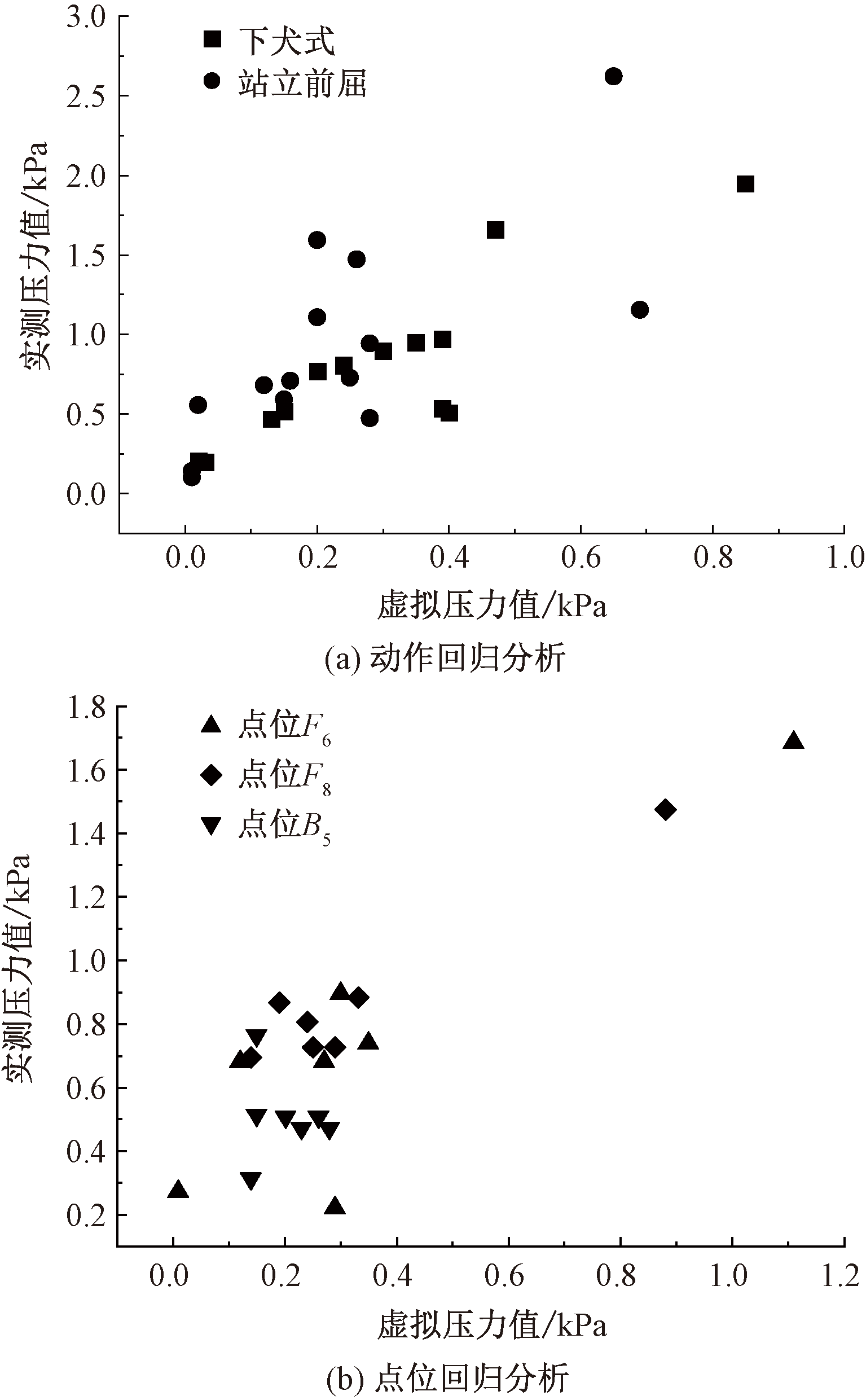
为探究服装在虚拟设计中动态压力与实测压力的定量关系,进行服装压力舒适性量化,以女式瑜伽休闲裤为研究对象,首先完成款式设计与实验样衣制作,对标面料物理属性后生成虚拟仿真面料;然后,分别选取真人模特与虚拟模特作为实验对象,筛选具有不同拉伸幅度的瑜伽典型动作并标记关键压力点位,分别进行虚拟试穿与真人动态压力测试;最后,通过相关性分析与回归分析处理实验数据,确立虚拟与实测压力的定量关系,并依据压力分布需求对样衣版型进行二次优化设计。结果表明:在下犬式等主要受力方向明确的动作中,虚拟与实测压力呈显著线性相关,但对复杂动作及多数点位,因动作特性及个体差异导致虚拟与实测数据存在较大误差。通过对纸样结构及面料性能的优化,在下犬式和侧角伸展动作下,3个关键点位的压力值下降超过6%,有效提升了服装对不同体型和运动状态的适应性,验证了优化方案的有效性。
中图分类号:
| [1] |
ÖNAL R, KUTAY ORDU GÖKKAYA N, KORKMAZ S, et al. Effect of yoga-based exercises on functional capacity, dyspnea, quality of life, depression, anxiety, and sleep of infected healthcare workers during the COVID-19 pandemic: a prospective clinical trial[J]. Turkish Journal of Physical Medicine and Rehabilitation, 2023, 69(4): 488-499.
doi: 10.5606/tftrd.2023.11605 pmid: 38766577 |
| [2] |
CHHIKARA A, JAIN M, VATS S, et al. Role of yoga in minimizing stress and anxiety in women experiencing dysmenorrhea[J]. Journal of Lifestyle Medicine, 2023, 13(2): 90-96.
doi: 10.15280/jlm.2023.13.2.90 pmid: 37970322 |
| [3] | JIANG L, REN X, HAO Y, et al. Pressure distribution and comfort evaluation of negative-ease yoga pants using ANSYS finite-element simulation[J]. Textile Research Journal, 2025: 00405175251329930. |
| [4] |
WANG W R, YU X L, CONG H L. Pressure evaluation of seamless yoga leggings designed with partition structure[J]. AUTEX Research Journal, 2023, 23(2): 300-309.
doi: 10.2478/aut-2021-0053 |
| [5] | 李洁涵, 刘晓刚, 阮艳雯, 等. 三维虚拟技术导向下服装企业产品设计开发模式研究[J]. 丝绸, 2025, 62(10): 31-40. |
| LI Jiehan, LIU Xiaogang, RUAN Yanwen, et al. Research on product design and development models of apparel enterprises under 3D virtual technology guidance[J]. Journal of Silk, 2025, 62(10): 31-40. | |
| [6] | LYU Y R, WANG Z H, YE Q W, et al. Body data-driven garment pattern construction in digital fashion innovations: a review[J]. Textile Research Journal, 2025: 00405175251352800. |
| [7] |
HUANG S X, HUANG L. CLO3D-based 3D virtual fitting technology of down jacket and simulation research on dynamic effect of cloth[J]. Wireless Communications and Mobile Computing, 2022, 2022(1): 5835026.
doi: 10.1155/wcm.v2022.1 |
| [8] | 陈心, 尹玲, 任丽红, 等. 基于CLO3D技术的戏服装扮虚拟仿真研究: 以褶子为例[J]. 丝绸, 2022, 59(5): 50-58. |
| CHEN Xin, YIN Ling, REN Lihong, et al. Research on the virtual simulation of costume dressing by CLO3D virtual technology: a case study of casual coats[J]. Journal of Silk, 2022, 59(5): 50-58. | |
| [9] | 陈晓真, 吴莹, 杨叶, 等. 基于三维虚拟模特转换的女士连体长裤参数化纸样生成[J]. 纺织学报, 2025, 46(7): 193-201. |
| CHEN Xiaozhen, WU Ying, YANG Ye, et al. Parameterized pattern generation of women's jumpsuit based on three-dimensional virtual model transformation[J]. Journal of Textile Research, 2025, 46(7): 193-201. | |
| [10] |
LIU W Y, YAO T, YAO C, et al. Research on pressure comfort of yoga suit and optimization scheme of pattern based on CLO 3D software[J]. Journal of Physics: Conference Series, 2021, 1790(1): 012016.
doi: 10.1088/1742-6596/1790/1/012016 |
| [11] |
QI Y. Study on the digital design of Macau native portuguese women's clothing in a metacosmic perspective[J]. Highlights in Art and Design, 2023, 4(3): 47-53.
doi: 10.54097/hiaad.v4i3.14 |
| [12] | 吕迎蕊, 王朝晖, 叶勤文, 等. 运动服装的设计方法及发展趋势[J]. 纺织学报, 2025, 46(3): 256-265. |
| LÜ Yingrui, WANG Zhaohui, YE Qinwen, et al. Design methods and development tendency of sportswear[J]. Journal of Textile Research, 2025, 46(3): 256-265. | |
| [13] |
YOUN S, ZHAN S, MATHUR K, et al. Advanced virtual fit technology for precision pressure application in medical compression waistbands[J]. Applied Sciences, 2024, 14(22):10697.
doi: 10.3390/app142210697 |
| [14] |
KIM J, CHAE Y, KIM J, et al. Efficient representation of garment fit with elastane fibers across yoga poses in 3D fashion design software: a preliminary study using CLO 3D software[J]. Applied Sciences, 2025, 15(19): 10306.
doi: 10.3390/app151910306 |
| [15] |
YOUN S, KNOWLES C G, MILLS A C, et al. Comparative study of physical and virtual fabric parameters: physical versus virtual drape test using commercial 3D garment software[J]. The Journal of the Textile Institute, 2025, 116(1): 33-46.
doi: 10.1080/00405000.2024.2314273 |
| [16] | 范春红, 王佳昱, 骆顺华. 基于人体工程学的高温瑜伽服结构优化设计[J]. 针织工业, 2025(10): 59-64. |
| FAN Chunhong, WANG Jiayu, LUO Shunhua. Structural optimization design of high-temperature yoga clothing based on ergonomics[J]. Knitting Industries, 2025(10): 59-64. | |
| [17] | 王伟荣, 丛洪莲. 基于下肢运动特征的纬编无缝瑜伽裤结构设计[J]. 纺织学报, 2021, 42(6): 140-145. |
| WANG Weirong, CONG Honglian. Structural design of weft-knitted seamless yoga pants based on leg motion characteristics[J]. Journal of Textile Research, 2021, 42(6): 140-145. | |
| [18] |
BAI L L, TAO C, CHEN J H, et al. Modeling of virtual clothing and its contact with the human body[J]. AUTEX Research Journal, 2024, 24: 20230039.
doi: 10.1515/aut-2023-0039 |
| [19] |
VURUSKAN A, ASHDOWN S P. Comparison of actual and virtual pressure of athletic clothing in active poses[J]. International Journal of Clothing Science and Technology, 2025, 37(1): 1-21.
doi: 10.1108/IJCST-02-2024-0036 |
| [20] |
MITSUNO T, KAI A. Distribution of the preferred clothing pressure over the whole body[J]. Textile Research Journal, 2019, 89(11): 2187-2198.
doi: 10.1177/0040517518786272 |
| [1] | 陶晨, 洪兴华, 印梅芬. 仿真服装压力的虚拟皮肤建模[J]. 纺织学报, 2025, 46(10): 197-205. |
| [2] | 于昊冉, 王萍, 王浩, 丁东. 基于交叉关注多视角生成扩散的高精度三维虚拟试穿模型[J]. 纺织学报, 2025, 46(03): 167-176. |
| [3] | 谢红, 张林蔚, 沈云萍. 基于人体臂部的连续动态服装压力预测模型及准确性表征方法[J]. 纺织学报, 2024, 45(07): 150-158. |
| [4] | 刘玉叶, 王萍. 基于纹理特征学习的高精度虚拟试穿智能算法[J]. 纺织学报, 2023, 44(05): 177-183. |
| [5] | 刘杰, 高志. 基于柔性薄膜传感器的服装压力检测仪研制[J]. 纺织学报, 2021, 42(12): 159-165. |
| [6] | 黎博文, 王萍, 刘玉叶. 基于人体动态特征的三维服装虚拟试穿技术[J]. 纺织学报, 2021, 42(09): 144-149. |
| [7] | 王伟荣, 丛洪莲. 基于下肢运动特征的纬编无缝瑜伽裤结构设计[J]. 纺织学报, 2021, 42(06): 140-145. |
| [8] | 程宁波, 吴志明, 柯思成. 服装压力对男子骑行运动中肌肉疲劳的影响[J]. 纺织学报, 2019, 40(08): 130-135. |
| [9] | 王永荣 罗胜利 廖银琳 刘宇. 女性服装压力舒适阈限的测试与研究[J]. 纺织学报, 2018, 39(03): 132-136. |
| [10] | 陈丽华. 织物定伸长力与弹力服装宽裕量的关系[J]. 纺织学报, 2016, 37(07): 115-0120. |
| [11] | 方贵盛. 基于草绘的服装衣片设计[J]. 纺织学报, 2013, 34(5): 133-139. |
| [12] | 刘红;陈东生;魏取福. 服装压力对人体生理的影响及其客观测试[J]. 纺织学报, 2010, 31(3): 138-142. |
| [13] | 金子敏;罗晓菊;沈加加;阎玉秀;陶建伟. 无缝内衣对男子下体静态压力舒适性的影响[J]. 纺织学报, 2009, 30(06): 99-103. |
| [14] | 尹玲;张文斌;夏蕾. 服装压力舒适性的研究综述与剖析[J]. 纺织学报, 2008, 29(3): 137-142. |
| [15] | 宋晓霞;冯勋伟. 服装压力与人体舒适性之关系[J]. 纺织学报, 2006, 27(3): 103-105. |
|
||
 京公网安备11010502044800号