纺织学报 ›› 2025, Vol. 46 ›› Issue (10): 197-205.doi: 10.13475/j.fzxb.20240705701

• 服装工程 • 上一篇    下一篇

仿真服装压力的虚拟皮肤建模

陶晨1, 洪兴华2, 印梅芬3()   

  1. 1.绍兴文理学院 蔡元培艺术与设计学院, 浙江 绍兴 312000
    2.浙江理工大学 纺织科学与工程学院, 浙江 杭州 310018
    3.浙江省检验检疫科学技术研究院, 浙江 杭州 311202
  • 收稿日期:2024-07-26 修回日期:2025-04-18 出版日期:2025-10-15 发布日期:2025-10-15
  • 通讯作者: 印梅芬(1979—),女,高级工程师,硕士。主要研究方向为纺织服装数字化技术。E-mail:ymf@zaiq.org.cn
  • 作者简介:陶晨(1981—),男,副教授,博士。主要研究方向为纺织服装虚拟现实技术。
  • 基金资助:
    国家自然科学基金项目(51803185)

Virtual skin modeling for clothing pressure simulation

TAO Chen1, HONG Xinghua2, YIN Meifen3()   

  1. 1. Caiyuanpei College of Art & Design, Shaoxing University, Shaoxing, Zhejiang 312000, China
    2. College of Textile Science and Engineering, Zhejiang Sci-Tech University, Hangzhou, Zhejiang 310018, China
    3. Zhejiang Academy of Science and Technology for Inspection & Quarantine, Hangzhou, Zhejiang 311202, China
  • Received:2024-07-26 Revised:2025-04-18 Published:2025-10-15 Online:2025-10-15

摘要:

针对虚拟试衣中的服装压力舒适性难以评估的问题,提出一种基于虚拟皮肤模型的压力仿真算法。在虚拟环境中对皮肤、织物及其接触行为进行建模:采用粒子弹簧系统构建织物模型,建立模拟参数与织物力学性质之间的映射,利用体积约束和形态约束仿真皮肤弹性,实现基于梯度变化的皮肤形态响应,通过动量重分配机制处理皮肤与织物的接触行为,模拟皮肤受力状态并计算出实时压力,最后开展服装人体实验对模型进行了验证。研究发现:皮肤模型的保形因子α对虚拟压力有直接影响,随α值增大,各个测量位点上模拟压力同步增大表现为先接近真实值、后逐渐背离;在不同测量位点上,虚拟压力接近真实压力时对应的α值有所不同,胸高点上对应值最小、肩高点上对应值最大,反映了人体不同部位上皮肤个性差异;在采用单一α值的情况下,虚拟压力与真实压力误差为17.72%,采用混合α值表现人体不同部位的皮肤差异,经过改进和优化相对误差降至8.92%。

关键词: 服装工程, 虚拟皮肤模型, 虚拟服装, 服装压力, 虚拟试衣, 皮肤弹性

Abstract:

Objective Virtual fitting attracts much research attention for clothing digitalization. Existing studies regard the human body as rigid in body representation, adopt a one-way repulsion model in the contact mechanism, and implement a simple process of pushing the clothing away from the human body when dealing with contact. These studies focus on improving the visual effect of virtual fitting, while the clothing pressure simulation and pressure comfort evaluation are ignored. This study represents an annovation attempt to replace the existing one-way contact mechanism, and proposes a virtual skin model, which fully reflects the deformation of human skin and the mutual effect between clothing and the body, which is designed for perceiving the pressure transmitted from clothing to the body, thus providing a method for the prediction of pressure comfort in the scenario of virtual fitting.

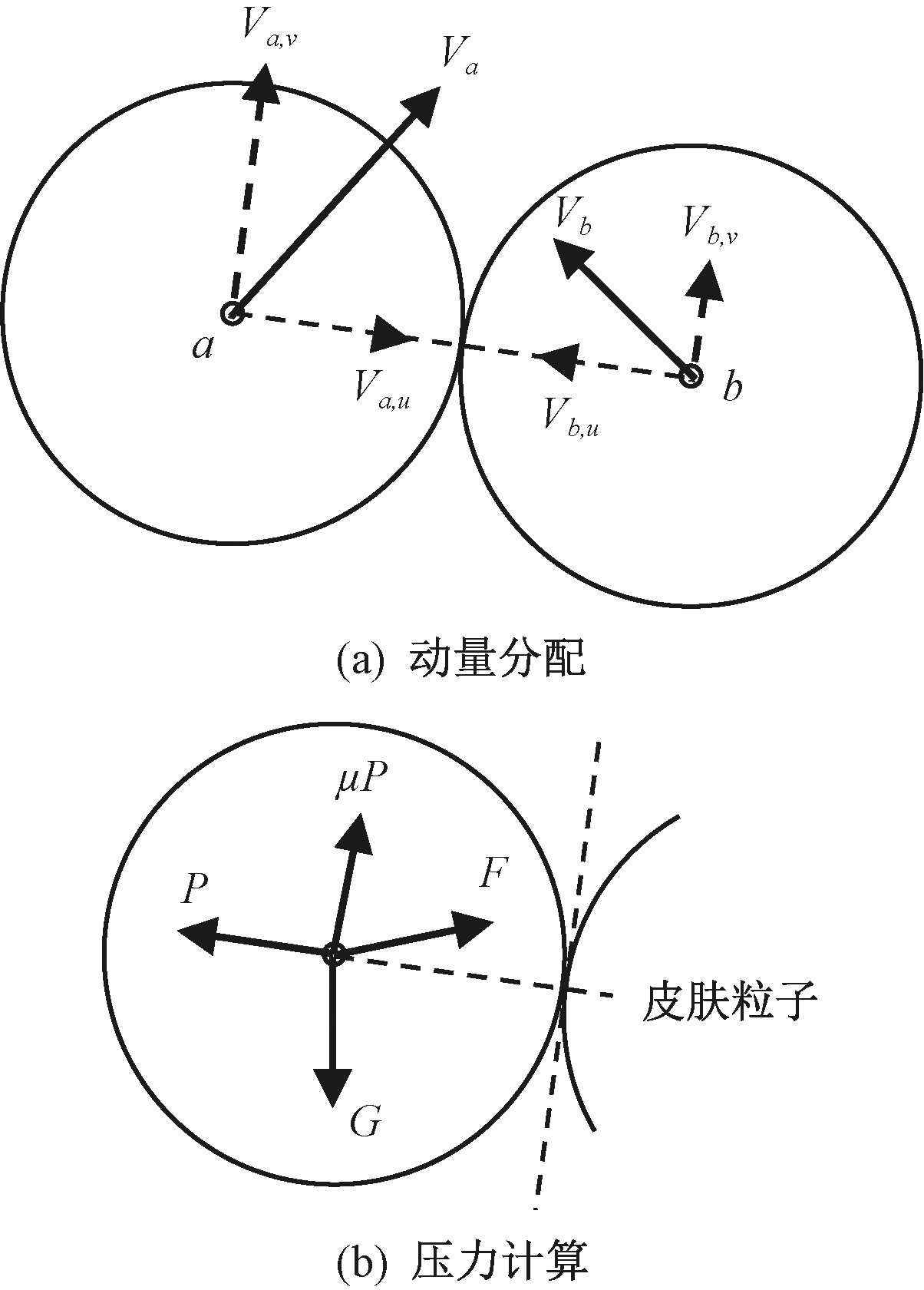
Methods The skin with mechanical properties was constructed by volume constraint and shape constraint, and the variability of skin shape was controlled by the shape preserving factor, thus regulating the degree of skin firmness or relaxation. The particle spring system was used to construct the fabric model in order to facilitate skin contact and interaction, and the mapping between the spring coefficient and the real fabric mechanical properties was established. The contact behavior of particles was conducted by momentum reallocation, and the spatial displacement of particles was calculated by the integral of particle velocity on the time slices, so as to complete the contact deformation on both skin and clothing. By calculating the force of particles in the contact process, the real-time clothing pressure on human skin was obtained, and thus the clothing pressure in virtual space was simulated and evaluated.

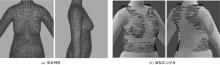
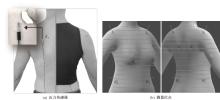
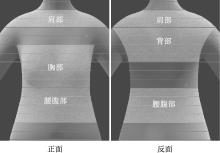
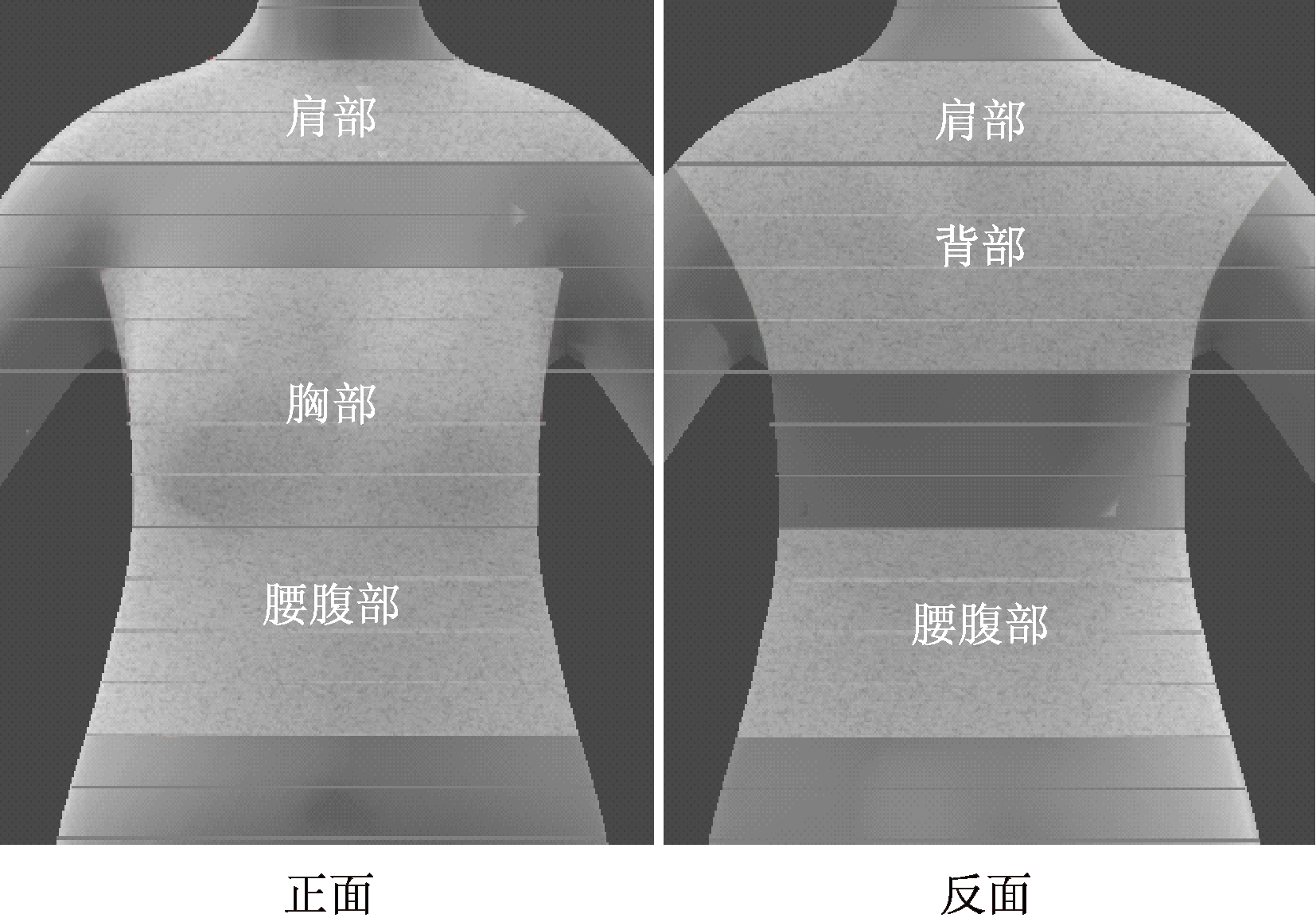
Results The elastic coefficient of the fabric model was obtained from the tensile test of the real fabric, so that the mapping between the virtual fabric and the real fabric was established. The virtual fabric was tailored and sewn to produce virtual clothing. A live body model was scanned, and the skin was generated from the resulting body surface mesh. The virtual clothing was placed on the human body with the skin layer, and the interaction between skin and clothing was simulated with respect to the contact algorithm so as to calculate the clothing pressure. The pressure was mainly concentrated in the chest, shoulders, back and side waist, which is consistent with the intuitive experience. The pressure sensors were attached on the body skin, and the real pressure on the spots of the chest, shoulder, back and side waist was collected and compared with the simulated pressure. With the increased value of shape preserving factor α, the virtual pressure at each spot increased gradually, first approaching the real pressure value and then gradually deviating from it. The overall error of simulated pressure decreased first and then increased as the α value increased, and the shape preserving factor α=0.5 corresponding to the minimum error of 17.8% was regarded as the descriptive parameter for the personality of the subject's skin. The minimum errors of simulated pressure on the chest, shoulder, back and side waist points appeared at α=0.28, 0.81, 0.66 and 0.45 respectively, which was consistent with the fact that the skin flexibility of the chest is the largest, followed by the waist, the back and the shoulder successively. The skin was divided into four regions surrounding chest, shoulder, back and waist. The shape preserving factor in each region was set to the value corresponding to the minimum pressure error of the spot to form the so-called mixed shape preserving factors, and the virtual pressure was calculated and compared with the case in which the single preserving factor takes effect. The results show that the minimum error was 17.72% with single preserving factor and 8.92% when using mixed preserving factors. It is proved that using mixed preserving factors to describe body skin can effectively reduce the error and improve the precision of simulation by considering the difference of various parts of body skin.

Conclusion The skin model proposed in this study can simulate the contact and interaction between human body and clothing, and fetch the clothing pressure on the skin in real time, so as to provide theory and methods for high-level virtual fitting and comfort evaluation. The mechanical behavior of human skin is simulated by volume constraint and shape constraint, with the latter being manipulated by the shape preserving factors, and thus the expression of skin firmness or relaxation is achieved. In the particle space, the contact behavior of particles is conducted by the momentum reallocation rule, and the change of spatial position after contact is achieved by the integral of particle velocity, so as to introduce the contact deformation of skin and clothing. By calculating the force of clothing particles in the contact process, the clothing pressure on human body is obtained. In the verification experiment, the virtual skin is constructed from the real human body mesh, and the virtual fabric is built with the real fabric as the prototype. The measured real clothing pressure is compared with the simulated pressure, and the mixed shape preserving factor is employed to reflect the difference of the skin in different parts of human body, leading to a reduced error of 8.92%.

Key words: clothing engineering, virtual skin model, virtual clothing, clothing pressure, virtual fitting, skin flexibility

中图分类号: 

  • TP391.41

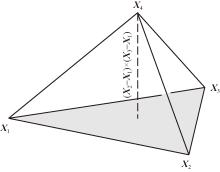
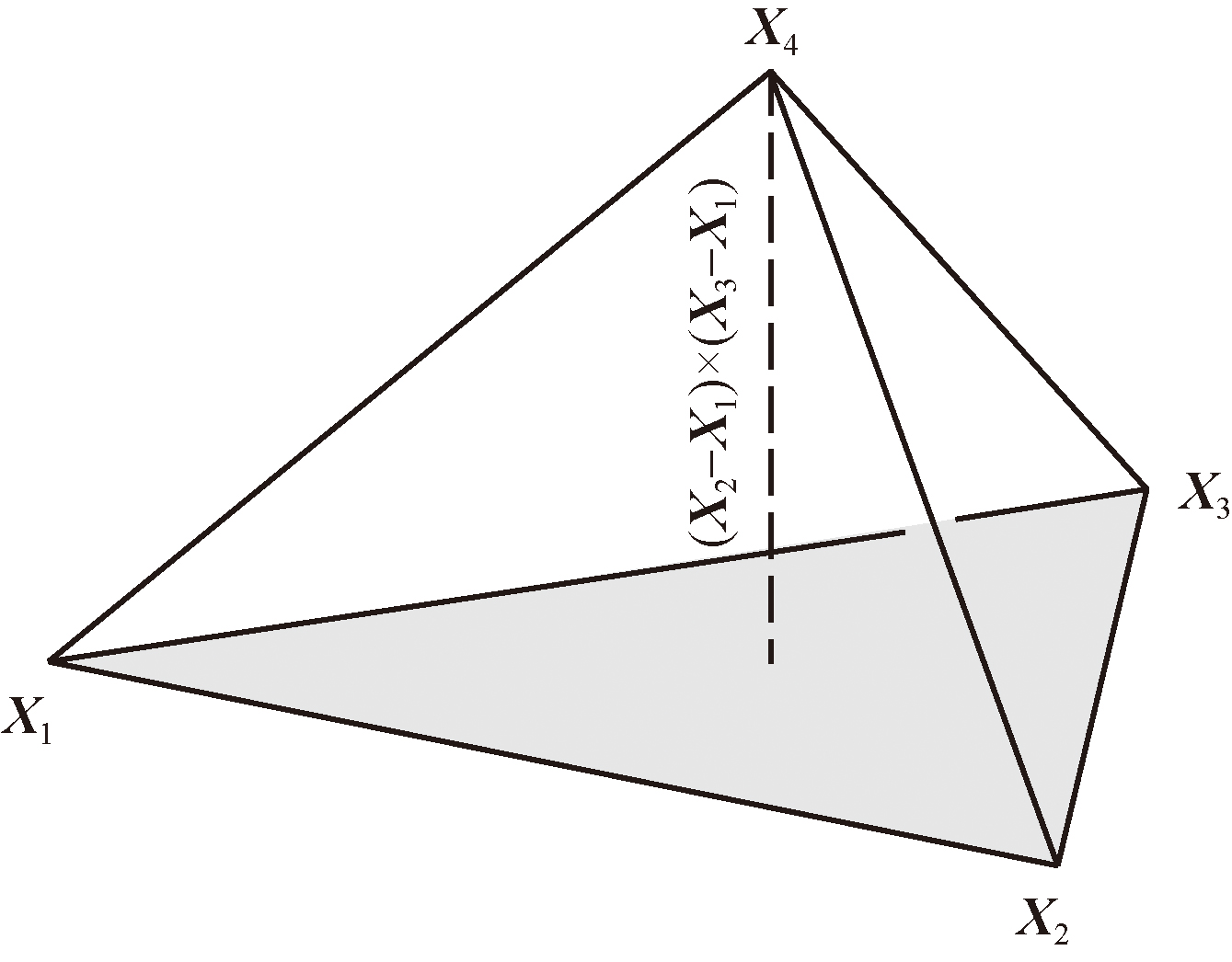
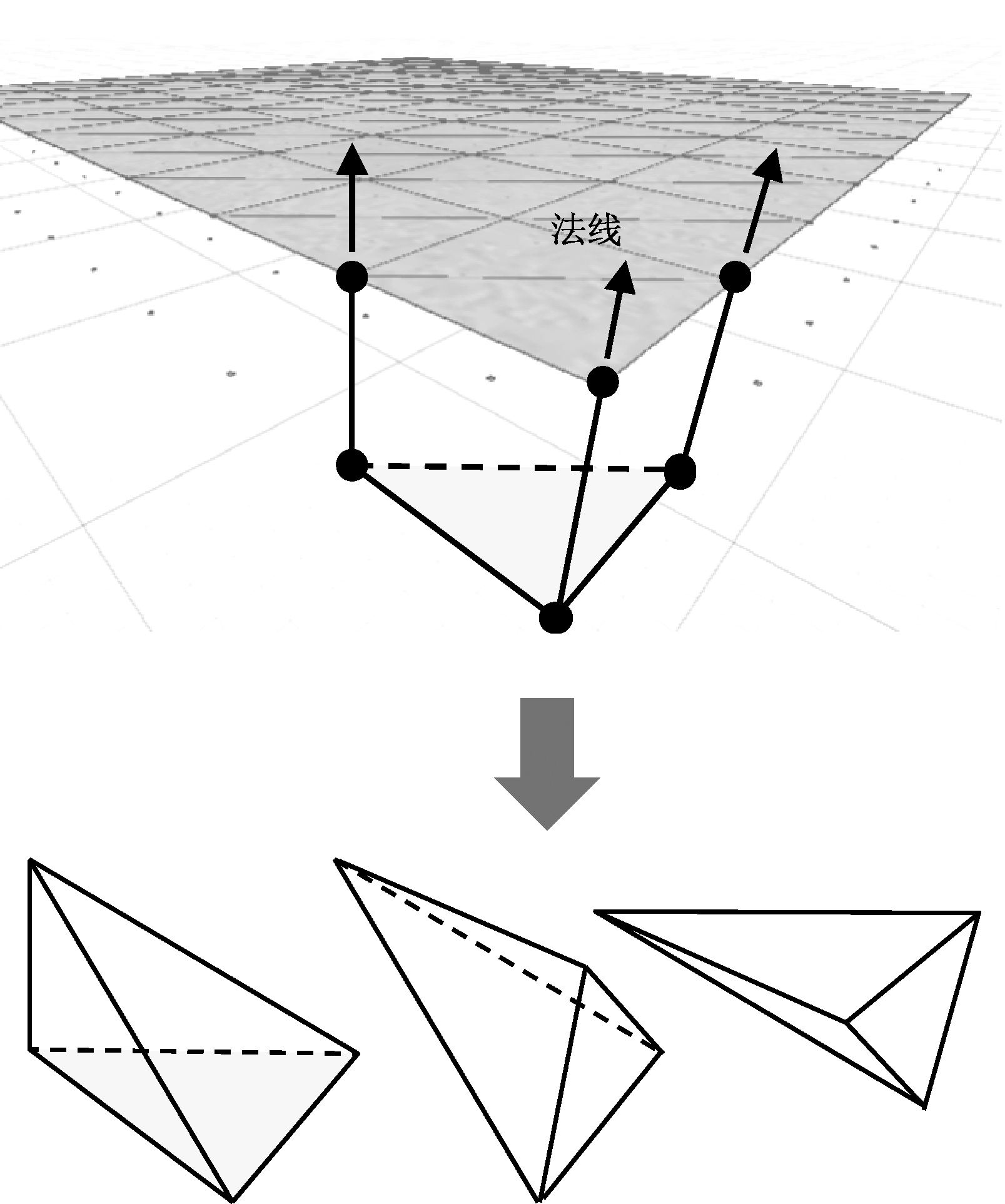
图1

皮肤单元四面体"

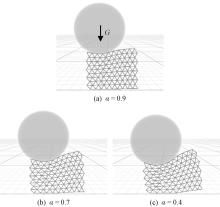
图2

皮肤单元聚集体的受力表现"

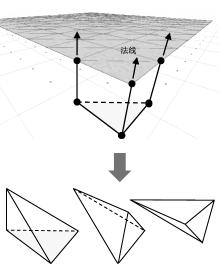
图3

反向扩展与棱柱分割"

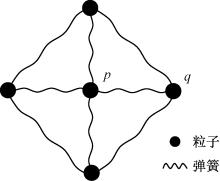
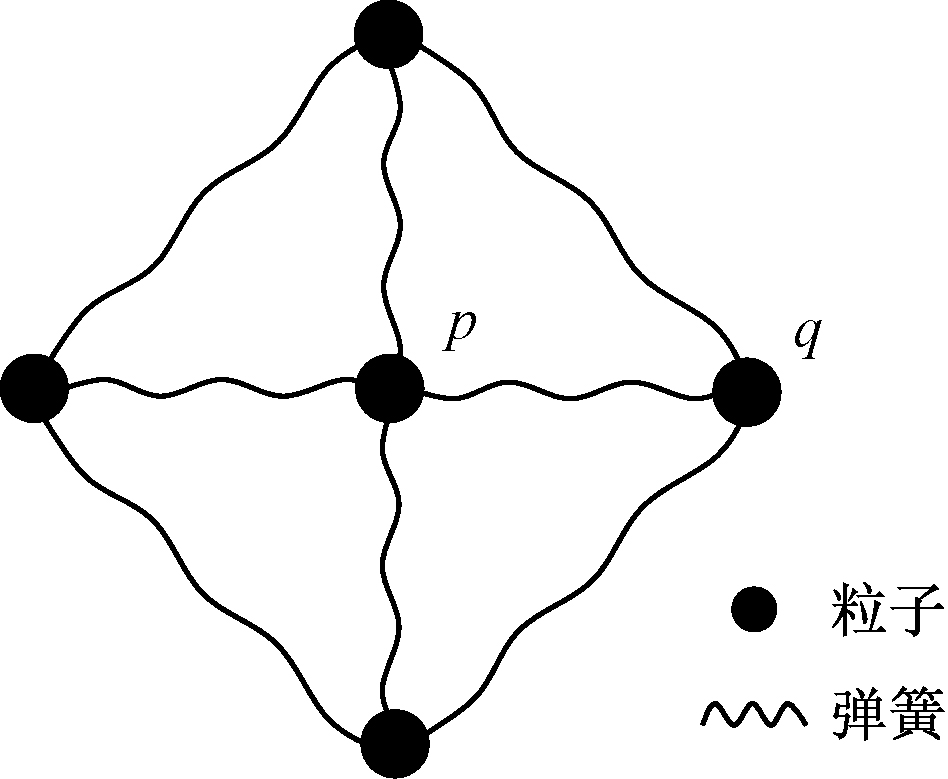
图4

粒子弹簧模型"

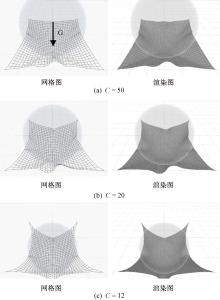
图5

虚拟织物及其张力表现"

图6

接触机制"

表1

织物力学性能"

伸长/
cm
横向应
力/cN
纵向应
力/cN
横向回复
率/%
纵向回复
率/%
0.00 0 0 100 100
0.50 2 3 100 100
1.00 5 9 99 100
1.50 12 19 99 99
2.00 23 34 99 99
2.50 34 48 99 98
3.00 41 59 98 98
3.50 46 68 97 97
4.00 50 74 96 96

表2

织物与皮肤之间的摩擦力"

法向负荷/cN 摩擦力/cN
50 11.83
100 18.28
150 29.97
200 36.78
250 43.76
300 55.62
350 67.32
400 74.82
450 80.75

图7

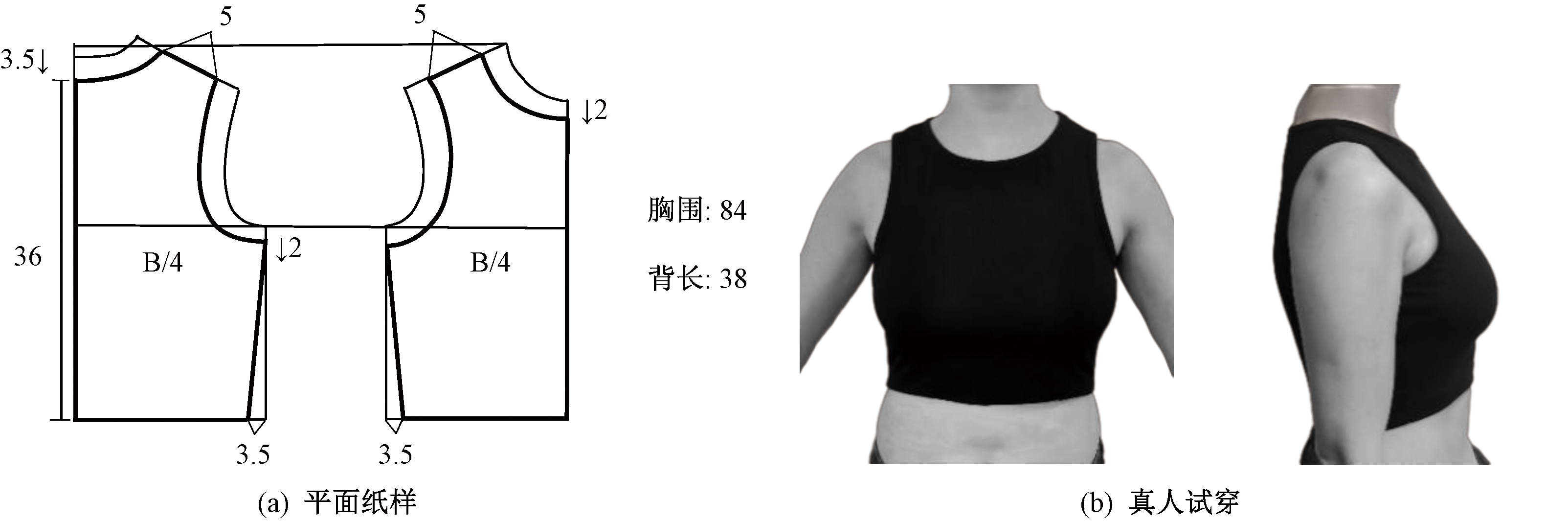
服装制作与试穿 注:图中数值单位为cm。"

图8

虚拟试穿与压力表现"

图9

服装压力测量 注:采用Arduino FSR402薄膜型压力传感器,量程0.5~500 cN。"

表3

虚拟压力与真实压力比较"

保形
因子
压力/cN 误差/
%
B S K W
0.1 15.18 ↓ 10.17 ↓ 6.30 ↓ 4.55 ↓ 31.04
0.2 15.93 ↓ 10.86 ↓ 6.72 ↓ 4.73 ↓ 27.22
0.3 22.76 ↑ 11.85 ↓ 7.31 ↓ 5.02 ↓ 22.41
0.4 23.00 ↑ 12.80 ↓ 7.78 ↓ 5.25 ↓ 19.10
0.5 23.68 ↑ 13.50 ↓ 8.19 ↓ 5.26 ↓ 17.80
0.6 24.74 ↑ 14.24 ↓ 8.51 ↓ 7.94 ↑ 18.01
0.7 25.85 ↑ 14.85 ↓ 10.31 ↑ 8.24 ↑ 19.58
0.8 26.97 ↑ 15.17 ↓ 10.83 ↑ 8.59 ↑ 23.23
0.9 27.88 ↑ 18.42 ↑ 11.66 ↑ 8.91 ↑ 28.67
1.0 28.47 ↑ 19.25 ↑ 12.32 ↑ 9.12 ↑ 33.20

图10

皮肤区域"

表4

单一保形因子与混合保形因子的比较"

保形因子 压力/cN 误差/
%
B S K W
α=0.53 23.99 13.73 8.30 7.77 17.72
混合α 21.66 15.02 9.19 7.38 8.92
[1] PUMAROLA A, SANCHEZ J, CHOI G P, et al. 3D people: modeling the geometry of dressed humans[C]// Proceedings of the International Conference on Computer Vision. Seoul: IEEE Press, 2019: 2242-2251.
[2] WAN Yan, WANG Yue, YAO Li. Research of virtual try-on technology based on two-dimensional image[C]// Computer Graphics International Conference. Berlin:Springer Press, 2023: 373-384.
[3] LIN Ling, ZHANG Mingmin, PAN Zhigeng, et al. Image-based detection and response of continuous fast collision between cloth and human body[J]. Journal of Software, 2015, 26(S2): 1-7.
[4] ZANG Hui, LIU Zhen, CHAI Yanjie. Real-time collision detection method for fluid and cloth[J]. Journal of Computer-Aided Design & Computer Graphics, 2018, 30(4): 602-610.
[5] BAI Linlin, TAO Chen, CHEN Junhong, et al. Modeling of virtual clothing and its contact with the human body[J]. AUTEX Research Journal, 2024. DOI: 10.1515/aut-2023-0039.
[6] JIANG Liguo, YE Juntao, SUN Liming, et al. Transferring and fitting fixed-sized garments onto bodies of various dimensions and postures[J]. Computer-Aided Design, 2019, 106(1): 30-42.
doi: 10.1016/j.cad.2018.08.002
[7] MOUHOU A, SAAIDI A, YAKHLEF M, et al, 3D garment positioning using Hermite radial basis func-tions[J]. Virtual Reality, 2022, 26(1): 295-322.
doi: 10.1007/s10055-021-00566-7
[8] XIAO Boxiang, HU Zhiyuan, LIU Zhengdong, et al. A dynamic virtual try-on simulation framework for speed skating suits[J]. The Journal of The Textile Institute, 2024, 115(5): 713-723.
doi: 10.1080/00405000.2023.2201549
[9] 赖安琪, 蒋高明, 李炳贤. 全成形毛衫花式结构三维仿真[J]. 纺织学报, 2023, 44(2): 103-110.
LAI Anqi, JIANG Gaoming, LI Bingxian. Three-dimensiomal simulation of whole gament with fancystructures[J]. Journal of Textile Research, 2023, 44(2): 103-110.
[10] 沈毅, 齐红衢. 织物悬垂形态的模拟仿真[J]. 纺织学报, 2010, 31(10): 34-39.
SHEN Yi, QI Hongqu. Simulation of fabric drapingshape[J]. Journal of Textile Research, 2010, 31(10): 34-39.
[11] KY S Z E, XH LIU. Fabric drape simulation by solid-shell finite element method[J]. Finite Elements in Analysis and Design, 2007, 43(11): 819-838.
doi: 10.1016/j.finel.2007.05.007
[12] HAN Mingu, CHANG Seunghwan. Draping simulations of carbon/epoxy fabric prepregs using a non-orthogonal constitutive model considering bending behavior[J]. Composites Part A(Applied Science and Manufacturing), 2021. DOI: 10.1016/j.compositesa.2021.106483.
[13] YIN Chen, WANG Q Jane, ZHANG Mengqi. Accurate simulation of draped fabric sheets with nonlinear modeling[J]. Textile Research Journal, 2021, 92(3/4): 539-560.
doi: 10.1177/00405175211039573
[14] VAJIHA M, PAYVANDY P. Introducing and optimizing a novel mesh for simulating knitted fabric[J]. The Journal of the Textile Institute, 2018, 109(2): 202-218.
doi: 10.1080/00405000.2017.1335446
[15] 曹竞哲, 陶晨, 白琳琳. 基于变形网格的织物悬垂形态模拟[J]. 纺织学报, 2024, 45(6): 59-67.
CAO Jingzhe, TAO Chen, BAI Linlin. Fabric drape profile simulation based on a deformable mesh[J]. Journal of Textile Research, 2024, 45(6): 59-67.
[16] ROBERT B, RONALD F, JOHN A. Robust treatment of collisions, contact and friction for cloth anima-tion[C]// Proceedings of the 29th Annual Conference on Computer Graphics and Interactive Techniques. Texas: ACM Press, 2002: 594-603.
[17] ANDREW S, JONATHAN S, GEOFFREY I, et al. Robust high-resolution cloth using parallelism, history-based collisions, and accurate friction[J]. IEEE Transactions on Visualization and Computer Graphics, 2008, 15(2): 339-350.
doi: 10.1109/TVCG.2008.79
[18] CHEN Zhili, FENG Renguo, WANG Huamin. Modeling friction and air effects between cloth and deformable bodies[J]. ACM Transactions on Graphics, 2013, 32(4): 1-8.
[19] TANG Min, WANG Tongtong, LIU Zhongyuan, et al. I-Cloth: incremental collision handling for GPU-based interactive cloth simulation[J]. ACM Transactions on Graphics, 2018, 37(6): 1-10.
[20] MÜLLER M, HEIDELBERGER B, HENNIX M, et al. Position based dynamics[J]. Journal of Visual Communication and Image Representation, 2007, 18(2): 109-118.
doi: 10.1016/j.jvcir.2007.01.005
[1] 罗瑞奇, 常大顺, 胡新荣, 梁金星, 彭涛, 陈佳, 李丽. 基于改进外观流网络的跨体态虚拟试衣[J]. 纺织学报, 2025, 46(06): 203-211.
[2] 纪梦琪, 何瑛, 马咏倩. 基于三维试衣的凸肚体男西裤样板的优化[J]. 纺织学报, 2025, 46(06): 187-195.
[3] 荆建伟, 胡裕鹏, 马王菲, 袁子舜, 顾冰菲, 徐望. 防弹衣间隙量与防护效果的有限元分析[J]. 纺织学报, 2025, 46(04): 187-196.
[4] 侯珏, 丁焕, 杨阳, 陆寅雯, 余灵婕, 刘正. 基于混合知识蒸馏和特征增强技术的轻量级无解析式虚拟试衣网络[J]. 纺织学报, 2024, 45(09): 164-174.
[5] 陆寅雯, 侯珏, 杨阳, 顾冰菲, 张宏伟, 刘正. 基于姿态嵌入机制和多尺度注意力的单张着装图像视频合成[J]. 纺织学报, 2024, 45(07): 165-172.
[6] 谢红, 张林蔚, 沈云萍. 基于人体臂部的连续动态服装压力预测模型及准确性表征方法[J]. 纺织学报, 2024, 45(07): 150-158.
[7] 王一品, 李小辉. 服装褶皱形态的参数化表征方法[J]. 纺织学报, 2024, 45(06): 149-154.
[8] 袁甜甜, 王鑫, 罗炜豪, 梅琛楠, 韦京艳, 钟跃崎. 基于注意力机制和视觉转换器的三维虚拟试衣网络[J]. 纺织学报, 2023, 44(07): 192-198.
[9] 叶勤文, 王朝晖, 黄荣, 刘欢欢, 万思邦. 虚拟服装迁移在个性化服装定制中的应用[J]. 纺织学报, 2023, 44(06): 183-190.
[10] 鲁虹, 宋佳怡, 李圆圆, 滕峻峰. 基于合体两片袖的内旋造型结构设计[J]. 纺织学报, 2022, 43(08): 140-146.
[11] 王春茹, 袁月, 曹晓梦, 范依琳, 钟安华. 立领结构参数对服装造型的影响[J]. 纺织学报, 2022, 43(03): 153-159.
[12] 刘杰, 高志. 基于柔性薄膜传感器的服装压力检测仪研制[J]. 纺织学报, 2021, 42(12): 159-165.
[13] 张益洁, 李涛, 吕叶馨, 杜磊, 邹奉元. 服装松量设计及表征模型构建研究进展[J]. 纺织学报, 2021, 42(04): 184-190.
[14] 陈咪, 叶勤文, 张皋鹏. 斜裁裙参数化结构模型的构建[J]. 纺织学报, 2020, 41(07): 135-140.
[15] 夏海浜, 黄鸿云, 丁佐华. 基于迁移学习与支持向量机的服装舒适度评估[J]. 纺织学报, 2020, 41(06): 125-131.
Viewed
Full text


Abstract

Cited

  Shared   
  Discussed   
No Suggested Reading articles found!