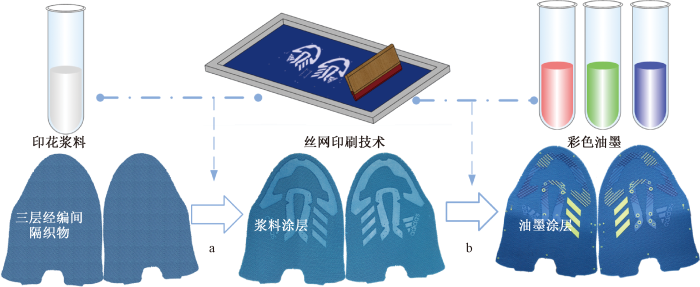
Objective Warp-knitted fabrics are ideal for athletic vamp by virtue of their perme ability, light weight, and multi-directional stretchability. However, their irregular porous structure makes the dynamic behavior of printing paste extremely complex. The current industry practice remains largely manual and experience-dependent, resulting in high skill barriers, labor intensity, and inconsistent print quality. Given the labor-intensive nature and lack of effective evaluation strategies, it is urgent to investigate printing mechanisms, develop advanced equipment, and enhance automation.
Method Static, dynamic, and transient shear tests of the printing paste were conducted first to characterize its rheological properties, followed by the development of an analytical method to deal with the morphological change of the wedge-shaped variable-section squeegee, providing an analytical solution. Furthermore, based on lubrication theory, a mathematical model of the printing flow field was established, yielding dimensionless velocity and dynamic pressure distributions. A printing mechanism was eventually designed with precise force control and adjustable angle, achieving decoupled control of printing force, angle, and speed.
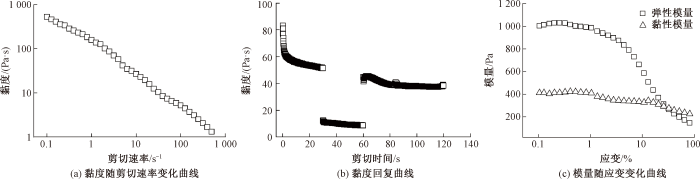
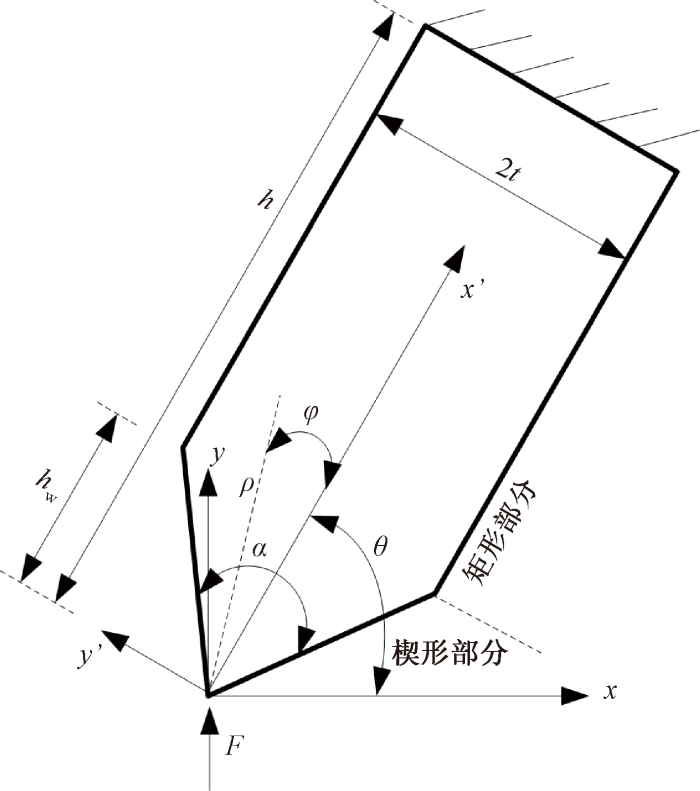
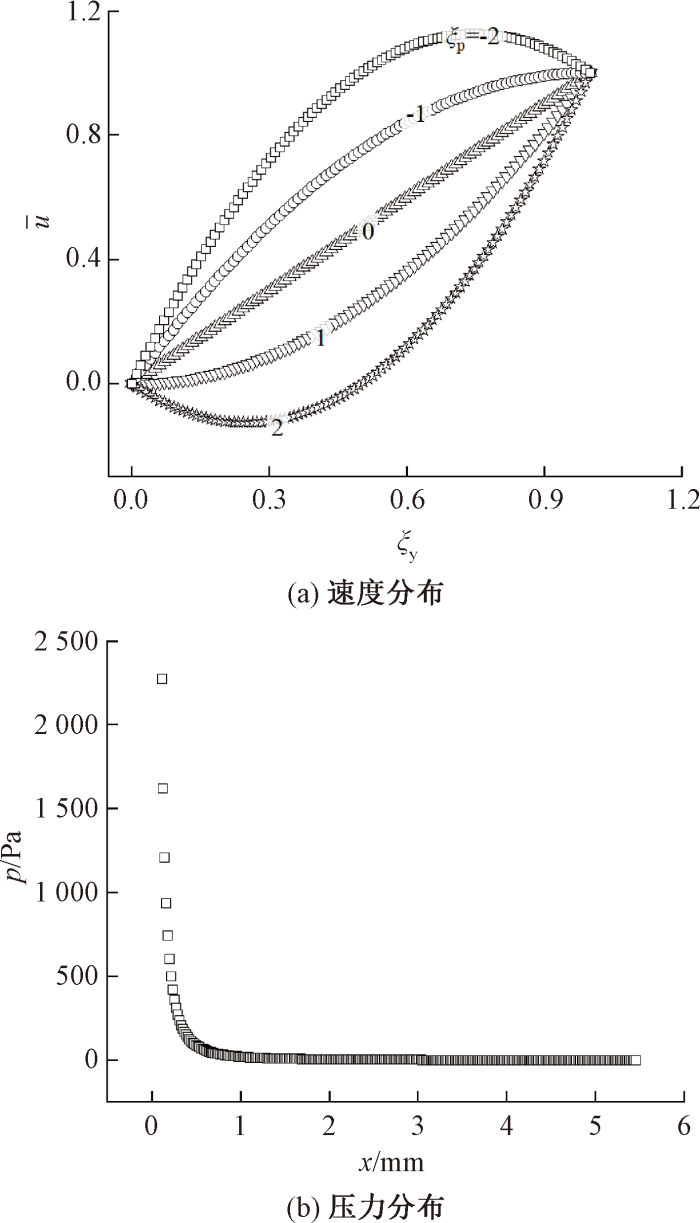
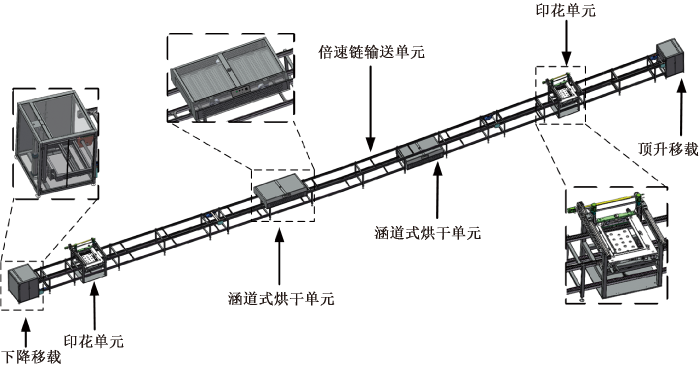
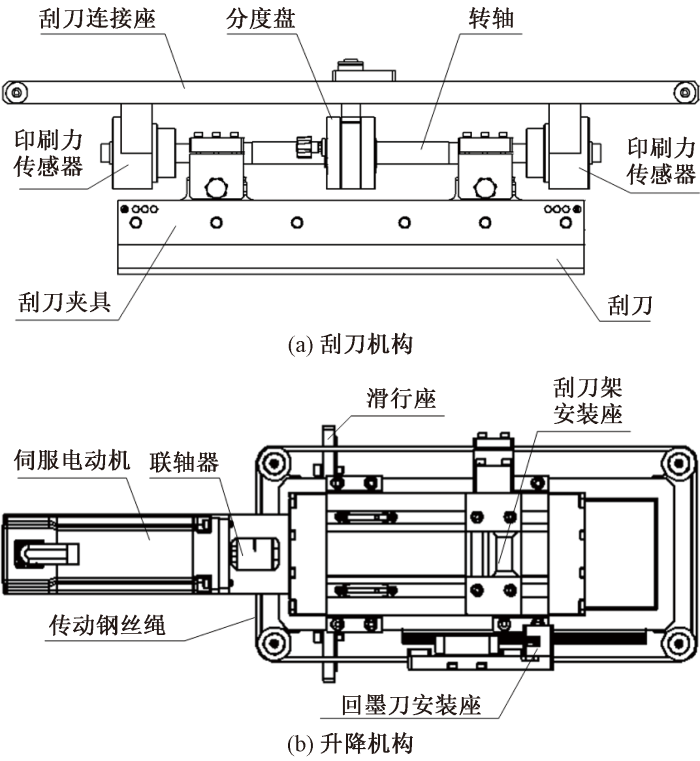
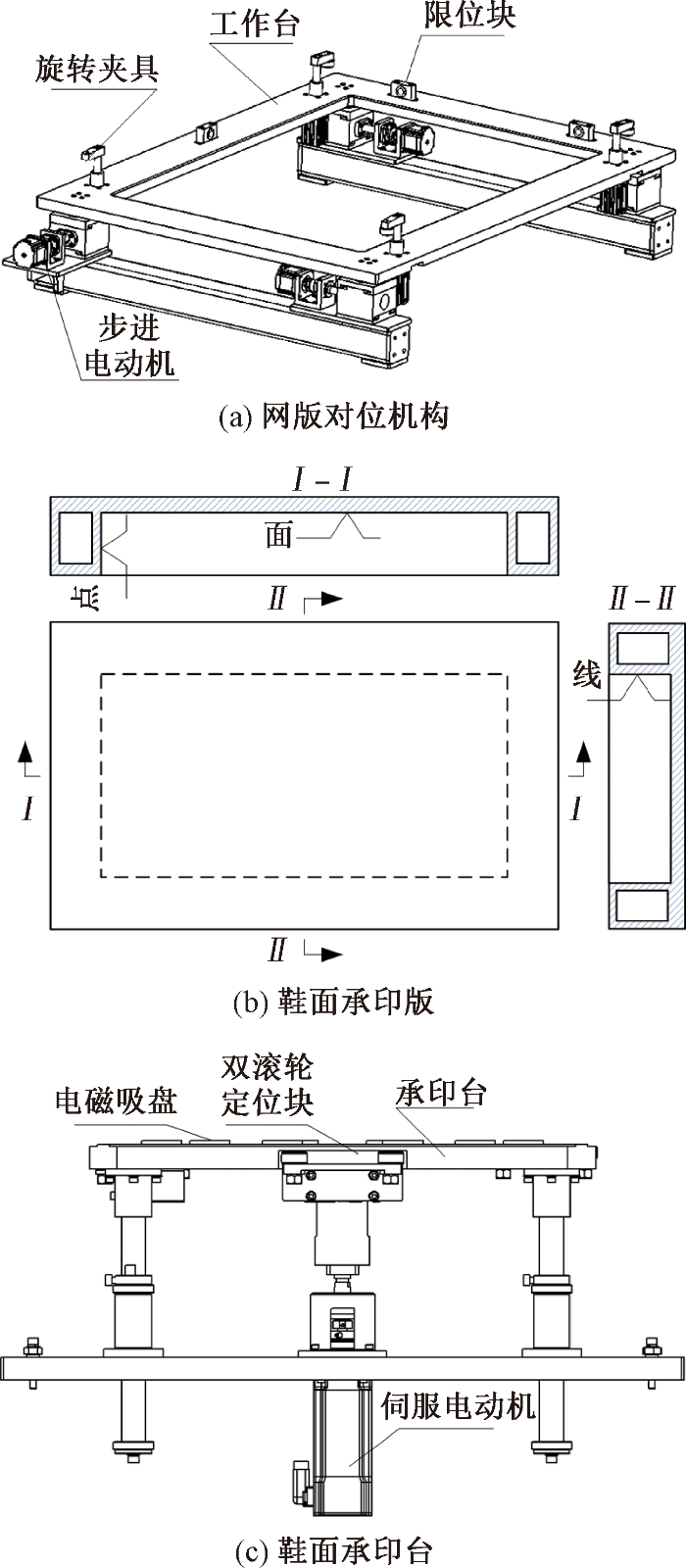
Results Printing paste exhibited high viscosity at low shear rates, with a significant decrease in viscosity as the shear rate increases, characterizing it as a shear-thinning fluid. Thixotropic tests showed a favorable structure recovery rate of 71.05%, which is crucial for pattern clarity. Rheological analysis revealed that both elastic and viscous moduli were strain-dependent. Beyond a critical strain of 24.77%, the elastic modulus decreased more sharply than the viscous modulus, indicating the gradual disintegration of the local elastic structure and a transition to dominant viscous behavior. An analytical method was proposed to solve the morphological change of the wedge-shaped variable cross-section squeegee. The squeegee is divided into a wedge-shaped section and a rectangular section. For the wedge-shaped section, the relationship between displacement and stress was derived from the geometric and constitutive equations in polar coordinates, and the expressions for the displacement components of the wedge-shaped section were obtained. For the rectangular section, a stress function was proposed according to its loading conditions. The geometric and constitutive equations in Cartesian coordinates for the plane strain problem were established, and the displacement components of the rectangular section were obtained. Applying boundary conditions and coordinate transformations provided a complete description of the squeegee's morphological change. The established flow field model demonstrated that fluid velocity distribution depends on the pressure gradient, squeegee speed, and squeegee deformation. Numerical integration of the dynamic pressure equation revealed that pressure on the screen surface increases sharply near the squeegee tip, confirming this zone as the primary driver for paste transfer. Furthermore, a printing equipment with a cyclically moving substrate and fixed printing units was designed. It enables precise control of printing force, adjustable angle, and decoupled regulation of force, angle, and velocity, addressing inconsistencies in manual printing. The flexible printing carrier and positioning system were developed, limiting maximum error to within 0.2 mm.
Conclusion This multidisciplinary study, integrating fluid mechanics, elasticity theory, and mechanical design, provides a comprehensive investigation into printing of warp-knitted athletic vamp. The non-Newtonian behavior and strain threshold of the paste were characterized, and an analytical method for determining the stress, strain, and displacement distributions of a wedge-shaped squeegee with a variable cross-section was proposed. Precise boundaries of the printing flow field were established. Based on lubrication theory, a mathematical model of the flow field was developed, enabling the determination of the velocity and pressure distributions of the printing paste. Furthermore, the dedicated printing equipment for warp-knitted athletic vamp was designed and developed. This research provides significant insights into the printing mechanism, contributes to enhancing the level of automation in the industry, improves the competitiveness of warp-knitted athletic vamp, and supports the realization of green and intelligent manufacturing.
LIU Yuegang, MENG Zhuo, ZHANG Junling, XU Liyun, CAI Gaowei. Dynamic modeling of flow field and equipment design for warp-knitted athletic vamp printing[J]. Journal of Textile Research, 2026, 47(03): 272-280 doi:10.13475/j.fzxb.20250903301
The positioning accuracy is low when aligning the screens in automatic shoe upper printing, affecting the quality of upper printing. This paper proposed a positioning platform for printing machine based on redundant actuation. By adding a Y-axis on the base of original positioning platform, the rigidity and ability to manipulate heavy loads of the Y-direction of the positioning platform was effectively improved, thereby improving the positioning accuracy of the positioning platform of the printing machine. Due to the coupling of the mechanism motion during the movement of the redundant actuation mechanism, the geometric method was used to decouple the motion and the control strategy based on the use of electronic cam was proposed. Reversing backlash compensation was adopted, which further improved the positioning accuracy of the platform hence ensured the printing quality of the shoe upper. After experimental verification, the Y-direction positioning accuracy of the printing machine platform was improved by 85.7%, and that in the Z-direction rotation 72.9%. The X-direction reversing backlash was improved by 50%, the Y-direction reversing backlash by 75%, and the Z-direction rotation reversing backlash 42.86%.
Aiming at the problem that the combination of parameters such as blade pressure, squeegee speed, blade angle and ink viscosity in the 3D additive printing process has a great influence on the printing quality, but the combination of various process parameters in actual production cannot be optimal, the BP neural network improved by the additional momentum method was adopted to construct a 3D additive printing process model. The model was trained by the experimental parameters to determine the nonlinear relationship between process parameters and printing quality. The genetic algorithm was adopted to optimize the nonlinear function to achieve the optimal parameter combination of the 3D additive printing process: printing pressure of 4 800 N, squeezing angle of 18 degrees, squeezing speed of 400 mm/s and ink viscosity of 170.5 Pa·s, The model prediction error is basically stable within the range of 0.01. The comparison experiments were carried out using the parameters before and after optimization. The experimental results show that the algorithm can realize the quality prediction and parameter optimization of 3D additive printing process, thereby improving the printing quality and shortening the product development time.
LIUY G, MENGZ, WANGY C, et al.
Analysis and modeling of viscosity for aqueous polyurethane dispersion as a function of shear rate, temperature, and solid content
Aqueous polyurethane dispersion (PUD) has attracted increasing attention in a wide range of industrial applications because of their versatile properties as well as ecofriendly nature. In this study, the aqueous PUD used in warp-knitted vamp printing was characterized by Fourier transform infrared spectra, dynamic light scattering, and laser Doppler electrophoresis. The mean diameter and zeta potential are 206.6 nm and -18.3 mV, respectively. The rheological behavior of aqueous PUD as a function of shear rate, temperature, and solid content was investigated experimentally. Besides, a new correlation model was proposed based on the Carreau equation and Arrhenius relation. The resulting model has high accuracy in viscosity estimation under complex conditions according to the prediction interval of 95%. Furthermore, the reasonable ranges of parameters were proposed theoretically for successful printing.
MENGZ, LIUY G, JIC C, et al.
Rheological experiment and fractional derivative model for aqueous polyurethane dispersion
[J]. Journal of Applied Polymer Science, 2022, 139(22): 52259.






 京公网安备11010502044800号


