



临床上常见的慢性创面,如烧烫伤、糖尿病病足等,因存在组织液渗出量大、愈合周期长且易继发感染等问题[1],对创面开展高效管理与护理成为影响其愈合效果的关键因素。随着材料科学与生物医学的交叉融合,新型功能性敷料的开发已成为组织修复领域的研究热点。其中,气凝胶材料凭借超高的孔隙率和比表面积,展现出优异的吸液保水能力,可为创面营造适宜的愈合环境[2],然而,传统块状气凝胶因三维网络骨架的力学脆弱性,存在加工成形困难、力学稳定性差等问题,严重制约了其在动态创面护理中的应用。Wang等[3]通过同轴湿法纺丝工艺制备中空纤维素醋酸酯/聚丙烯酸纤维,其特有的中空结构为气凝胶纤维提供重要结构支撑。Aghababaei等[4]对气凝胶纤维进行加捻制成纤维束,提高了纤维的力学性能。Yu等[5]在氧化石墨烯(GO)纳米片中掺入聚二烯丙基二甲基氯化铵,促进GO在基质内更均匀地分散,有助于在气凝胶中形成更稳定的骨架结构,从而提高力学性能。这些方法致力于从结构设计或组分调控方面改善气凝胶的力学性能,但仍面临一定局限性。
基于此,本研究提出金属离子交联协同抗菌功能化的设计策略:通过在气凝胶纤维纺丝成形前引入Cu2+预交联工艺,构建具有连续多孔结构的CMC/Cu2+抗菌气凝胶纤维,为开发气凝胶纤维基多功能敷料提供技术和理论参考。
1 实验部分
1.1 材料与设备
羧甲基纤维素钠(CMC)、无水乙醇、酵母浸膏、氢氧化钠,均为分析纯,国药集团化学试剂有限公司;酵母蛋白胨、琼脂粉,均为分析纯,北京奥博星生物有限责任公司;硫酸铜,分析纯,天津市化学试剂三厂;磷酸氢二钠、磷酸二氢钾、乙酸、磷酸盐(PBS)缓冲液,分析纯,上海麦克林生化科技有限公司;金黄色葡萄球菌(S.aureus,ATCC25923)、大肠埃希菌(E.coli,ATCC25922),山西医科大学;棉纱线,市售;实验中所用水均为去离子水。
FA324TC型电子天平、SN-QX-20D型超声波清洗机,上海力辰科技有限公司;LC-LX-L60D型台式离心机,上海智城分析仪器制造有限公司;YTLG-10A型真空冷冻干燥机,上海叶拓有限公司;湿法纺丝机,天津科迈仪器有限公司;Y208W型半自动小样织机,江阴市通源纺机有限公司;JSM-IT700HR型场发射扫描电子显微镜,深圳市宏腾半导体技术有限公司;ESCAL-ab220i-XL型光电子能谱仪,美国赛默飞世尔科技公司;CMT4204G型电子万能试验机,盛林精密机械设备(山东)有限公司。
1.2 试样的制备
1.2.1 纺丝液的制备
称取3 g CMC放于去离子水中,持续搅拌至完全溶解,经5 000 r/min转速离心5 min,脱泡后得到质量分数为3%的CMC纺丝液。
称取0.06 g硫酸铜,放于97 mL去离子水中使其完全溶解,随后称取CMC溶于上述溶液中,离心脱泡后得到质量分数为3%的预交联CMC纺丝液。
1.2.2 CMC/Cu2+气凝胶纤维的制备
分别称取不同质量的硫酸铜放于蒸馏水中,经超声波溶解得到浓度分别为0.05、0.10、0.15、0.2 mol/L的硫酸铜溶液作为湿法纺丝凝固浴。图1示出预交联CMC/Cu2+气凝胶纤维制备工艺流程。将纺丝液和硫酸铜溶液分别置于料筒和凝固浴槽中,启动仪器,使纺丝液在压强作用下经喷丝孔喷出,经过凝固浴(在凝固浴中羧甲基纤维素钠与Cu2+发生配位络合作用),随后经牵伸卷绕装置进行牵伸,牵伸比为1.2,制得CMC/Cu2+凝胶纤维,最后将凝胶纤维进行冷冻干燥得到气凝胶纤维。
图1
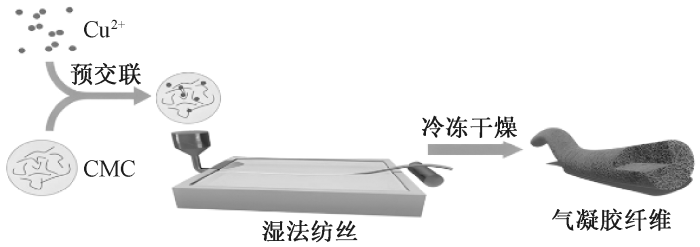
图1
预交联CMC/Cu2+气凝胶纤维制备工艺流程图
Fig.1
Process flow chart for preparation of pre-crosslinked CMC/Cu2+ aerogel fibers
1.3 表征与测试
1.3.1 微观结构观察
取少量样品置于导电胶上,在加速电压为10 kV下,采用场发射扫描电子显微镜观察样品表面和截面形貌。实验前将样品在液氮中进行处理。
1.3.2 分子结构表征
采用光电子能谱仪对样品进行X射线光电子能谱(XPS)测试,分析表面化学组成和元素的键合状态,其中Al Kα X射线作为激发光源,功率约为150 W,本底真空度为3×10⁻⁴ Pa。
1.3.3 拉伸性能测试
参照GB/T 3923.1—2013《纺织品 织物拉伸性能 第1部分:断裂强力和断裂伸长率的测定(条样法)》,使用电子万能试验机测试气凝胶纤维及其敷料的拉伸性能。测试时的拉伸速度为2 mm/min,载荷范围为0.01~200 N。
1.3.4 抗菌性能测试
根据GB/T 20944.3—2008《纺织品 抗菌性能的评价 第3部分:振荡法》测试气凝胶纤维的抗菌性能。将新鲜培养的细菌经梯度稀释至浓度为1×10⁵ CFU/mL作为实验用菌液。取灭菌后样品与菌液在PBS缓冲液中振荡,共培养24 h;随后,取100 μL振荡缓冲液,转移至固体培养基上,均匀涂布后在37 ℃下继续培养24 h;对菌落计数,按照下式计算细菌存活率:
式中:M为细菌存活率,%;A为样品组菌落数;B为对照组菌落数。
将新鲜培养的细菌经梯度稀释至105 CFU/mL作为实验用菌液。取100 μL振荡缓冲液,转移至固体培养基上,均匀涂布后将样品放置于涂有细菌的培养皿中,在37 ℃下继续培养24 h,测量样品周围形成的抑菌圈的直径以评估抗菌性能。
1.3.5 液体吸收率测试
取干燥后样品浸泡于生理盐水中,每隔5 s取出样品,用滤纸去除表面多余水分,进行称量,按照下式计算样品的液体吸收率:
式中:N为样品的液体吸收率,%;C为浸泡后样品质量,g;D为样品初始质量,g。
2 结果与讨论
2.1 气凝胶纤维的湿法成形工艺优化
图2
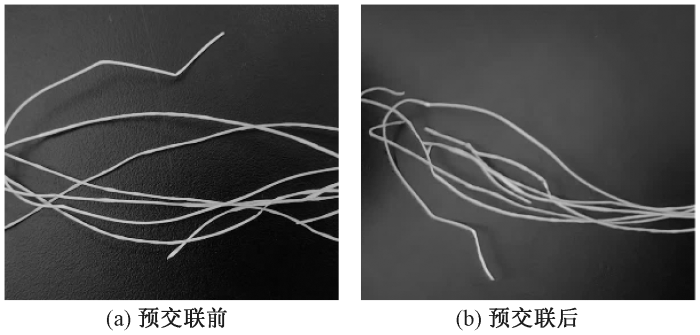
图2
预交联前后CMC/Cu2+气凝胶纤维的实物照片
Fig.2
Images of CMC/Cu2+ aerogel fibers before (a) and after (b) pre-crosslinking
表1 不同纺丝参数与气凝胶纤维力学性能
Tab.1
| 样品 编号 | 喷丝孔 内径/ mm | 凝固 浴浓度/ (mol·L-1) | 气压/ MPa | 牵伸比 | 断裂 强度/ MPa |
|---|---|---|---|---|---|
| 1 | 0.67 | 0.15 | 0.16 | 1.2 | 2.55 |
| 2 | 0.60 | 0.15 | 0.16 | 1.2 | 2.83 |
| 3 | 0.50 | 0.15 | 0.16 | 1.2 | 3.40 |
| 4 | 0.40 | 0.15 | 0.16 | 1.2 | 4.20 |
由表1可知,在纺丝液质量分数(3%)、凝固浴浓度(0.15 mol/L)、气压(0.16 MPa)及牵伸比 (1.2)均相同的情况下,随着喷丝孔型号的增大(即喷丝孔内径减小,由0.67 mm减至0.4 mm),纤维的拉伸断裂强度逐步上升,当喷丝孔的内径为0.40 mm时,CMC/Cu2+气凝胶纤维的断裂强度为4.20 MPa,高于用其它孔径制备的抗菌气凝胶纤维。这主要是纤维的直径效应和气凝胶网络结构的致密化共同作用的结果:一方面,根据 Weibull 强度理论,纤维的拉伸强度与直径的平方根呈反比,导致强度上升[9];另一方面,在相同的挤出速度和冷却条件下,随着喷丝孔直径的减小,纺丝溶液在喷丝孔内的停留时间变长,使得纤维内部的溶剂有更充足的时间进行扩散和挥发,从而导致气凝胶纤维的网络结构更加致密[10],纤维的拉伸强度增加。
纺丝液经凝固过程形成纤维,该过程直接影响气凝胶纤维结构的致密程度。为探究最佳的凝固浴浓度,对不同凝固浴浓度下制备的气凝胶纤维进行拉伸性能测试,结果如表2所示。随着凝固浴浓度从0.05 mol/L增加到0.20 mol/L,气凝胶纤维的断裂强度呈先增大后减小的趋势。当凝固浴浓度为0.15 mol/L时,气凝胶纤维的断裂强度最高,为4.20 MPa。这主要是因为增大凝固浴浓度可使初生气凝胶纤维内部网络结构更加致密,分子链之间的缠结和作用力更强,使得纤维在受到外力拉伸时,能够更有效地传递应力,从而表现出更高的拉伸强度。当凝固浴浓度超过0.15 mol/L时,纤维表面与高浓度的凝固浴接触,会迅速凝固形成致密的皮层,溶剂交换速率过快,导致相分离过程不均,纤维内部形成大量结构缺陷,使内应力集中,进而在拉伸过程中引发早期断裂,拉伸断裂强度下降[11]。
表2 不同浓度凝固浴下气凝胶纤维的力学性能
Tab.2
| 样品 编号 | 喷丝孔 内径/ mm | 凝固 浴浓度/ (mol·L-1) | 气压/ MPa | 牵伸比 | 断裂 强度/ MPa |
|---|---|---|---|---|---|
| 5 | 0.40 | 0.05 | 0.16 | 1.2 | 2.59 |
| 6 | 0.40 | 0.10 | 0.16 | 1.2 | 2.85 |
| 7 | 0.40 | 0.15 | 0.16 | 1.2 | 4.20 |
| 8 | 0.40 | 0.20 | 0.16 | 1.2 | 2.89 |
通过调节喷丝孔内径和凝固浴浓度可对气凝胶纤维的拉伸性能进行优化,但其拉伸强度仍需增强。在湿法纺丝中,纺丝液凝固成形过程中分子链的构象、分子链间的相互作用都发生变化,因此纺丝液的特性对纤维的结构性能造成了一定影响。基于此,在纺丝原液中引入适量铜离子,通过离子键形成预交联结构实现分子链的预聚集和有序排布,从而增强后期纺丝成形气凝胶纤维的强度[12]。为保证纺丝的连贯性,在后续纺丝过程中选择0.5 mm喷丝孔,分别对预交联前后的气凝胶纤维进行拉伸性能测试,结果如表3所示。可看到,未经预交联的气凝胶纤维拉伸断裂强度范围仅在2.50~3.40 MPa之间,预交联后气凝胶纤维在相同凝固浴浓度下的拉伸断裂强度均显著增强,达到8.82~12.10 MPa,提升幅度为65%~71%。这一增强效果主要归因于湿法纺丝前的预交联作用,通过提前优化羧甲基纤维素分子链的排列,构建铜离子键预交联结构,增强了气凝胶纤维内部的交联密度,从而有效提升了气凝胶纤维的力学性能。
表3 不同纺丝液时气凝胶纤维的力学性能
Tab.3
| 纺丝液 类别 | 喷丝孔 内径/ mm | 凝固 浴浓度/ (mol·L-1) | 气压/ MPa | 牵伸比 | 断裂 强度/ MPa |
|---|---|---|---|---|---|
| 未预交联 | 0.5 | 0.05 | 0.16 | 1.2 | 2.50 |
| 0.5 | 0.10 | 0.16 | 1.2 | 2.85 | |
| 0.5 | 0.15 | 0.16 | 1.2 | 3.40 | |
| Cu2+ 预交联 | 0.5 | 0.05 | 0.16 | 1.2 | 8.82 |
| 0.5 | 0.10 | 0.16 | 1.2 | 10.20 | |
| 0.5 | 0.15 | 0.16 | 1.2 | 12.10 |
注:纺丝液质量分数为3%。
综上所述,在喷丝孔内径为0.5 mm、凝固浴浓度为0.15 mol/L以及预交联条件下制得的CMC/Cu2+气凝胶纤维的拉伸断裂强度较佳。与传统湿法纺丝工艺相比,在纺丝工艺前提前引入微量铜离子进行预交联,有助于增强气凝胶纤维的拉伸强度,由此拓宽了气凝胶纤维的应用领域。
2.2 气凝胶纤维的微观形貌
为探明预交联工艺的引入对CMC/Cu2+气凝胶纤维拉伸强度增强的机制,对预交联前后气凝胶纤维的微观结构进行对比,结果如图3所示。
图3
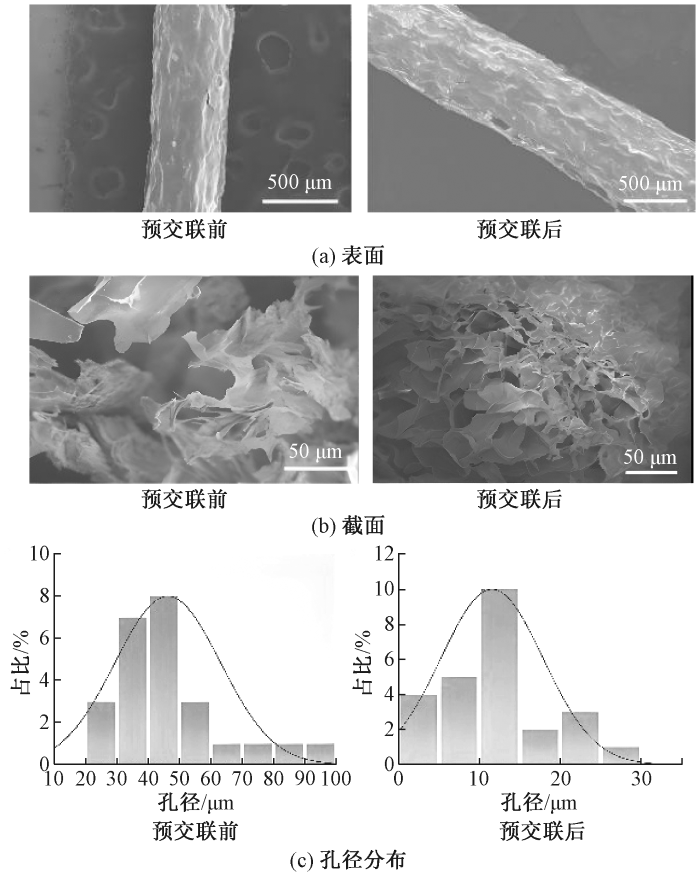
图3
不同气凝胶纤维的微观形貌和孔径分布
Fig.3
Microscopic morphologies and pore size distributions of different aerogel fibers. (a) Surface; (b) Cross-section; (c) Pore size distribution
由图3可知,2种气凝胶纤维均呈现皮芯结构,外层较致密,内部均出现大量的孔洞,这是由于冷冻干燥使凝胶纤维内部孔隙中的溶剂被移除,并由空气替代所致,使得气凝胶纤维具有多孔洞结构。通过对气凝胶纤维内部孔的孔径进行统计分析发现:未经预交联的气凝胶纤维的结构更为疏松,孔径较大,集中分布在30~50 μm之间;相较之下经预交联的气凝胶纤维更为致密,孔径较小且分布更为集中,主要在10~15 μm之间。这是因为预交联使CMC分子链因浓度预先聚集,在凝固浴中双扩散过程中相分离更缓慢均匀。这表明通过构建铜离子键预交联结构,能够提高纤维内部的交联密度,从而影响到气凝胶纤维总体的致密程度。
2.3 气凝胶纤维的分子结构
图4
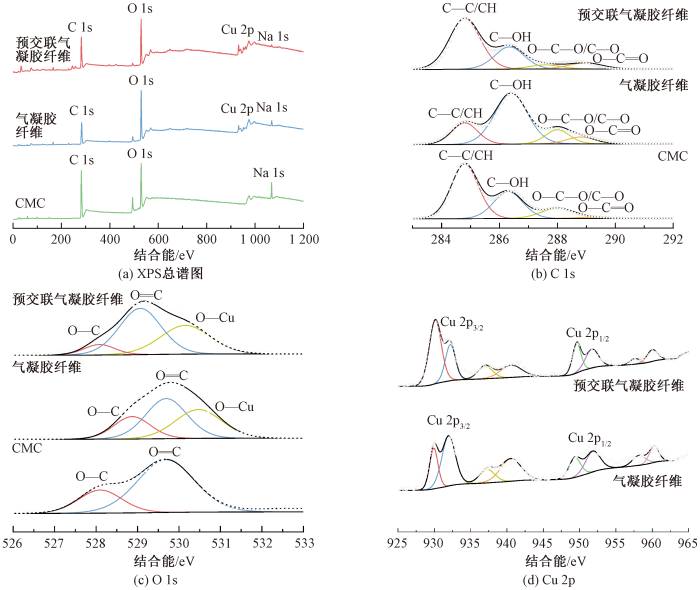
图4
CMC、气凝胶纤维和预交联气凝胶纤维的XPS曲线
Fig.4
XPS curves of CMC, aerogel fibers and pre-crosslinked aerogel fibers. (a) Total spectra; (b) C 1s; (c) O 1s (d) Cu 2p
气凝胶纤维和预交联气凝胶纤维中的Cu元素含量分别为1.59%和2.87%, 如表4所示。这进一步说明2.2节中凝胶纤维的内部网络结构更加致密的原因在于铜离子与CMC分子链间存在更多的配位作用。此外,CMC分子链自身丰富的羟基与羧基因存在氢键、链段间的范德华力及物理缠结等作用,共同赋予CMC/Cu2+气凝胶纤维稳定的三维网络结构。
表4 CMC、气凝胶纤维和预交联气凝胶纤维中的元素含量
Tab.4
| 样品类别 | 元素含量/% | |||
|---|---|---|---|---|
| C | O | Na | Cu | |
| CMC | 54.84 | 21.76 | 2.87 | — |
| 气凝胶纤维 | 37.00 | 28.30 | 1.50 | 1.59 |
| 预交联气凝胶纤维 | 48.54 | 27.38 | 0.90 | 2.87 |
2.4 气凝胶纤维的抗菌性能
采用平板菌落计数法对气凝胶纤维的抗菌性能进行测试,CMC和CMC/Cu2+气凝胶纤维对E.coli和S.aureus的抗菌效果如图5所示。对比可知,引入Cu2+后气凝胶纤维对E.coli和S.aureus的抑菌率均有显著提升,达到99.99%,抗菌性能优异。
图5
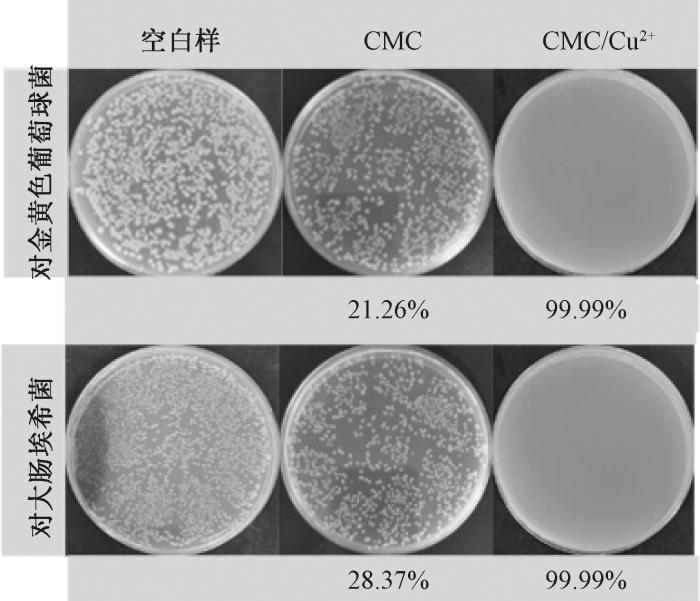
图5
CMC和CMC/Cu2+气凝胶纤维对大肠埃希菌和对金黄色葡萄球菌的抗菌效果图
Fig.5
Antibacterial effect of CMC and CMC/Cu2+ aerogel fibers against E.coli and S.aureus
图6
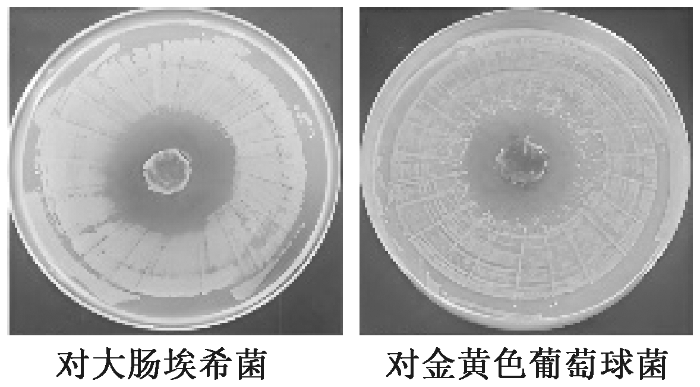
图6
CMC/Cu2+气凝胶纤维对大肠埃希菌和金黄色葡萄球菌的抑菌圈
Fig.6
Antibacterial zones of CMC/Cu2+ aerogel fibers against E.coli and S.aureus
2.5 气凝胶纤维的液体吸收率
敷料液体吸收率的大小直接关系到其吸收创面渗出液的能力,对预交联后CMC/Cu2+气凝胶纤维的液体吸收率进行测试,结果如图7所示。由图可知,气凝胶纤维在40 s内持续吸收液体,液体吸收率高达1 100%。在临床应用中,因敷料较高的吸收渗液能力,能有效避免慢性创面微环境中的渗液积累,从而降低创面感染的风险。
图7
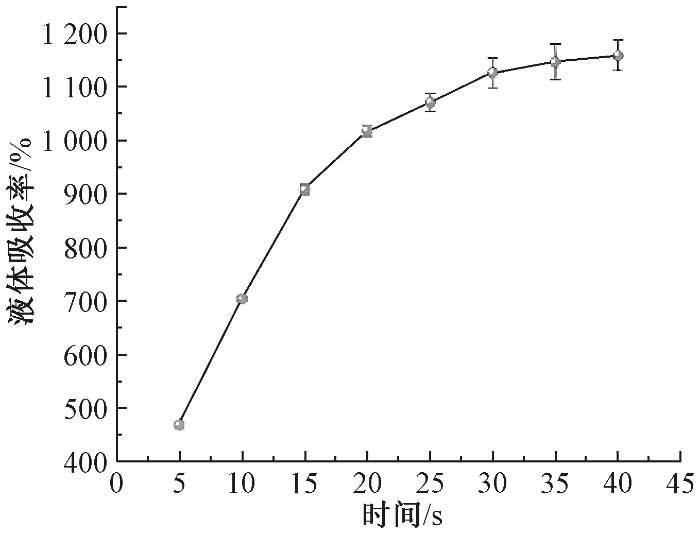
图7
CMC/Cu2+气凝胶纤维的液体吸收率
Fig.7
Liquid absorption rate of CMC/Cu2+ aerogel fibers
3 结论
通过在湿法纺丝前引入预交联工艺,以铜离子交联作用促使羧甲基纤维素钠(CMC)分子链在湿法纺丝体系中实现有序组装,结合冷冻干燥技术成功构筑具有连续多孔结构的羧甲基纤维素钠/铜(CMC/Cu2+)气凝胶纤维。通过纺丝工艺参数优化,在喷丝孔内径为0.5 mm、凝固浴浓度为0.15 mol/L条件下,经预交联的CMC/Cu2+气凝胶纤维的拉伸断裂强度达到12.10 MPa。其成形机制主要是预交联工艺中CMC和Cu2+之间的配位作用、湿法纺丝过程中双扩散作用,共同优化了CMC分子排列,构建离子键预交联结构,提高了CMC/Cu2+内部的交联密度,从而提升了气凝胶纤维的力学性能。此外,气凝胶纤维对金黄色葡萄球菌和大肠埃希菌的抑菌率均达到99.99%,液体吸收率高达1 100%。本研究提出了制备羧甲基纤维素抗菌气凝胶纤维敷料的新思路,对推进烧烫伤创面治疗技术发展具有积极意义。
参考文献
Hydrogel dressings for the treatment of burn wounds: an up-to-date overview
[J].DOI:10.3390/ma13122853 URL [本文引用: 1]
香蕉假茎制备抗菌敷料的性能分析
[J].
Performance analysis of the antibacterial wound dressing using banana pseudostem
[J].
Robust silk fibroin/graphene oxide aerogel fiber for radiative heating textiles
[J].
Polyimide aerogel fiber bundles for extreme thermal management systems in aerospace applications
[J].
Cellulose-based aerogel fibers with enhanced mechanical properties for thermal insulation and humidity response
[J].DOI:10.1016/j.ijbiomac.2025.147053 URL [本文引用: 1]
基于抗菌性壳聚糖/羧甲基纤维素复合药物涂层的聚氨酯敷料
[J].
DOI:10.19894/j.issn.1000-0518.220164
[本文引用: 1]

以抗菌性壳聚糖和羧甲基纤维素为涂层主体材料,通过层层自组装成膜技术,利用抗菌性苦参碱为功能药物,构建了基于抗菌性壳聚糖/羧甲基纤维素复合药物涂层的聚氨酯敷料。再通过分子间化学交联改变了聚合物内部结构,提升涂层的机械稳定性。分别在硅片和聚氨酯敷料上成功制备了复合药物涂层。在模拟的生理条件下,分析了交联(CHI/CMC)<sub>25</sub>涂层、空白聚氨酯基底和交联(CHI/CMC)<sub>10</sub>涂层修饰的聚氨酯基底对苦参碱的药物装载和释放性能,三者的载药量分别为27.8、285.2和330.0 μg/cm<sup>2</sup>。相较于交联(CHI/CMC)<sub>25</sub>涂层和空白聚氨酯基底,聚氨酯基底(CHI/CMC)<sub>10</sub>交联涂层的载药量分别提升了10.9倍和20%,聚氨酯基底不仅具有良好的药物装载能力,还具有延缓药物释放速度的作用。交联(CHI/CMC)<sub>10</sub>涂层可以增强基底的力学性能,相较于原始的聚(对苯二甲酸乙二醇酯-1,4-环己二烯二亚甲基对苯二甲酸酯)(PETG)板,PETG板-交联(CHI/CMC)<sub>10</sub>涂层的断裂时间和标准应变均提升了25.1%。抑菌实验表明,由于壳聚糖和苦参碱的协同抗菌作用,与单药组相比,复合药物涂层的抑菌效果增强了1倍。复合药物涂层对金黄色葡萄球菌和大肠杆菌展现出明显的抑制生长作用,生长抑制率分别为35.7%和53.8%。
Polyurethane dressing based on antibacterial chitosan/carboxymethyl cellulose composite drug coating
[J].
DOI:10.19894/j.issn.1000-0518.220164
[本文引用: 1]
Using antibacterial chitosan and carboxymethyl cellulose as the main coating materials, the polyurethane dressing based on antibacterial chitosan/carboxymethyl cellulose composite drug coating is constructed by using antibacterial matrine as the functional drug through the layer-by-layer self-assembly membrane technology. Furthermore, the internal structure of the polymer is changed by intermolecular chemical cross-linking to improve the mechanical stability of the coating. Composite drug coatings are successfully prepared on silicon wafers and polyurethane dressings, respectively. The drug loading and release properties of crosslinked (CHI/CMC)25 coating, blank polyurethane substrate and crosslinked (CHI/CMC)10 coating modified polyurethane substrate are also analyzed under simulated physiological conditions for matrine with the drug loading of 27.8, 285.2 and 330.0 μg/cm2. Compared with the crosslinked (CHI/CMC)25 coating and the blank polyurethane substrate, the drug loading capacity of the polyurethane substrate (CHI/CMC)10 crosslinked coating is improved by 10.9 times and 20%, respectively. The polyurethane substrate not only has excellent drug loading capacity, but also has the effect of delaying drug release rate. The crosslinked (CHI/CMC)10 coating can enhance the mechanical properties of the substrate. Compared with the original poly(ethylene terephthalateco-1,4-cylclohexylen-edimethylene terephthalate (PETG) sheet, the fracture time and standard strain of the PETG sheet-crosslinked (CHI/CMC)10 coating are increased by 25.1%. Bacterial inhibition experiments show that the antibacterial effect of the compound drug coating is enhanced by 1-fold compared with the single drug group due to the synergistic antibacterial effect of chitosan and matrine. The compound drug coating shows significant growth inhibition against Staphylococcus aureus and Escherichia coli, with growth inhibition rates of 35.7% and 53.8%, respectively.
羧甲基纤维素复合薄膜的制备及其抗菌性能研究
[J].
Preparation and antibacterial properties of carboxymethyl cellulose composite films
[J].
Photothermal-ionic-pharmacotherapy of myocardial infarction with enhanced angiogenesis and antiapoptosis
[J].
Uni-and bimodal Weibull distribution for analyzing the tensile strength of Diss fibers
[J].DOI:10.1080/15440478.2017.1371094 URL [本文引用: 1]
Effect of DMSO/H2O coagulation bath on the structure and property of polyacrylonitrile fibers during wet-spinning
[J].DOI:10.1002/app.v105:3 URL [本文引用: 1]
NiCo bimetallic and the corresponding monometallic organic frameworks loaded CMC aerogels for adsorbing Cu2+: adsorption behavior and mechanism
[J].DOI:10.1016/j.ijbiomac.2023.125169 URL [本文引用: 1]
Designment of polydopamine/bacterial cellulose incorporating copper (II) sulfate as an antibacterial wound dressing
[J].DOI:10.1016/j.msec.2021.112591 URL [本文引用: 1]
镍钴双金属MOF-纤维素气凝胶三维复合材料关键制备工艺参数对Cu2+吸附性能/机制的影响
[J].
Effects of key preparation parameters of nickel cobalt bimetallic MOF-cellulose aerogel three-dimensional composites on Cu2+ adsorption performance/mechanism
[J].
Adsorption properties of cellulose/guar gum/biochar composite hydrogel for Cu2+, Co2+ and methylene blue
[J].DOI:10.1016/j.ijbiomac.2023.125021 URL [本文引用: 1]
基于铜离子交联改善壳聚糖水凝胶力学性能和抗菌性能的研究
[J].
Study on the improvement of mechanical properties and antibacterial properties of chitosan hydrogels based on copper ion crosslinking
[J].

 京公网安备11010502044800号


