



体内组织或脏器脱离正常解剖位置,通过先天或后天形成的缺损、薄弱区或孔隙进入其它部位的病理状态,临床上统称为疝[1]。疝是一类影响全球数百万人的常见疾病,临床治疗多以手术修复为主,其中聚丙烯(PP)补片凭借良好的力学性能与生物相容性,成为目前应用最广泛的疝修补材料,也是临床植入术中最主流的合成补片[2]。PP补片由 PP 单丝经挤出、编织成网状结构,可允许组织长入,为疝缺损区域提供持久、强韧且稳定的力学支撑;同时具有传染病传播风险低、取材方便、力学性能稳定等优势,自应用于疝修复以来,已逐步成为临床治疗的 “金标准”[3]。经编PP补片物理性能优良,且有利于组织长入,但其亲水性较差,导致细胞相容性不够理想;此外,补片表面较为粗糙,若与内脏器官直接接触易引发腹腔粘连[4]。研究表明,PP补片的抗粘连性能主要通过表面亲水性改性形成物理屏障得以实现[5]。与此同时,植入物相关感染已成为日益困扰医患双方的突出问题,该问题不仅会延长患者住院时间、增加医疗成本,更可能导致手术失败甚至引发全身性感染等严重并发症。目前,细菌感染与组织粘连仍是疝修补手术面临的重要挑战,因此,开发兼具耐感染与抗粘连性能的疝补片具有重要临床意义。
为解决上述PP补片存在的抗感染、抗粘连问题,需选取适宜的功能组分构建抗菌涂层。植酸(PA)是来源于植物种子的有机磷类化合物,易溶于水,具有金属离子螯合能力强、无毒、生物相容性好等优点[6-7]。此外,PA 可通过螯合过渡金属离子和抑制活性氧生成,从而减轻神经损伤部位的氧化应激,表现出内在的抗氧化活性[8]。苯扎氯铵(BAC)作为一种阳离子表面活性剂,具有抗菌、杀真菌功效[9]。其在水溶液中高度溶解,可解离成十二烷基二甲基苄基离子,通过强大的表面活性改变细菌胞膜通透性,导致菌体破裂、胞浆内容物外渗,阻碍细菌代谢而发挥杀菌作用[10]。同时,BAC还能抑制细菌脱氧核糖核酸的复制与转录,进而抑制细菌生长[11]。二者的协同作用为构建兼具抗感染、生物相容性的PP补片涂层提供了良好的物质基础。
涂层在基材表面形成覆层的工艺手段,其制备过程简便易行。Raj 等[12]采用猪胆囊细胞外基质水凝胶涂覆 PP 补片,以减轻PP 补片诱导的不良组织反应。Bredikhin 等[13]用抗氧化维生素 E 涂覆 PP 疝修补片,以缓解术后炎症。Yu 等[14]在经等离子体处理的 PP补片表面涂覆壳聚糖和海藻酸钠,显著提高了该补片的亲水性能。Qiao 等[15]基于聚多巴胺的黏附能力,采用序贯沉积或共沉积的方法,在 PP 疝修补片上构建多巴胺介导的两性离子聚甲基丙烯酸磺基甜菜碱涂层,多巴胺处理后的疝修补片具有良好的力学性能、稳定性及优异的抗巨噬细胞黏附和增殖能力,肿瘤坏死因子 α(TNF-α )和白细胞介素6(IL-6 )的释放量显著降低。PA水溶性良好,但分子间相互作用较弱,直接通过溶液浸泡难以形成致密涂层[16];其分子中6个磷酸基团,具有较高的负电性,可增强离子水合网络,可通过静电吸引与阳离子化合物结合,从而共沉积于PP补片表面。
综上,本文选取PA和BAC,利用PA良好的亲水性和生物相容性及BAC高效的抗菌性,通过一步共沉积法[17]在PP补片上制备PA/BAC涂层,并系统探究改性补片的表面形貌、化学成分、亲水性能、蛋白质黏附性能、顺应性以及体外抗菌性能,以期为抗菌兼抗粘连复合补片的研究提供新的方法。
1 实验部分
1.1 主要材料
苯扎氯铵(BAC,20%水)、无水乙醇、磷酸盐缓冲溶液(PBS,0.1 mol/L,pH值为7.4),购自麦克林生化科技股份有限公司(上海);植酸(PA, 50%水),购自广州科檬生物科技有限公司;二氯甲烷,购自广州泽塔生物科技有限公司;聚丙烯(PP)补片(三针经缎组织),购自常州市宏翔医疗用品科技有限公司;金黄色葡萄球菌(ATCC6538)、大肠埃希菌(ATCC25922),购自上海鲁微科技有限公司;LB肉汤琼脂,购自生工生物工程股份有限公司(上海);牛血清白蛋白(BSA)、CCK-8试剂盒,购自上海阿拉丁生化科技股份有限公司;L929 小鼠成纤维细胞、L929小鼠成纤维细胞培养基,购自广州杰特伟生物科技有限公司;去离子水,实验室自制。
1.2 PA/BAC涂层补片的制备
首先将PP补片于室温条件下浸入乙醇(30 mL)和二氯甲烷(15 mL)的混合溶剂中洗涤3次[18],以去除PP补片上的抗氧化剂和其它可溶性添加剂。随后室温下自然晾干,正反面经紫外光交替照射30 min后,装入无菌培养皿中备用。将2 mg /mL PA与BAC在50 mL超纯水中混合,得到PA/BAC的混悬液。将PP补片放入等离子体清洗机处理5 min,随后浸入上述PA /BAC悬浮液中浸泡4 h。之后浸入超纯水中洗去多余的溶液,室温干燥。根据BAC质量分数不同(相对于PA,0.05%、0.08%、0.1%和0.15%),所得PA/BAC涂层PP补片样品分别命名为PA/BAC(0.05%)、PA/BAC(0.08%)、PA/BAC(0.1%)和PA/BAC(0.15%)。作为对照,将PP补片浸入50 mL的PA (2 mg /mL)溶液中4 h,样品标记为PA。制备流程如图1所示。
图1
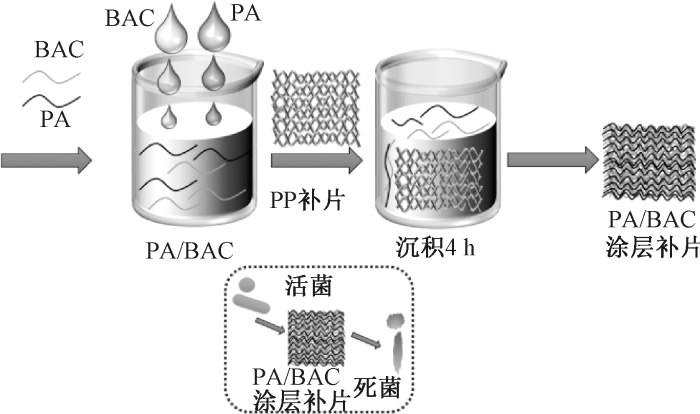
图1
一步共沉积法生成PA/BAC涂层补片的示意图
Fig.1
Schematic diagram of preparing PA/BAC coated patch by one-step co-deposition method
1.3 表面形貌与化学成分表征
采用Ultra Plus场发射扫描电子显微镜(德国卡尔蔡司股份公司)对补片涂层和原PP补片的表面形貌进行观察。采用Ultima IV X射线衍射仪(日本理学株式会社)表征样品的结晶结构。采用Nicolet iS50R傅里叶变换红外光谱仪(美国赛默飞世尔科技有限公司)表征样品的化学结构。采用Nexsa X射线光电子能谱仪(美国赛默飞世尔科技有限公司)表征涂层补片的化学成分。
1.4 亲水性及顺应性测试
为验证原PP补片和涂层PP补片的亲水性变化,采用DSA25接触角测角仪(德国克吕士公司)对2种样品的静态水接触角进行测定。为明确涂层对PP补片顺应性的影响,选择PA/BAC (0.15%)补片作为测试样品,对其进行随意折叠和弯曲处理,观察其顺应性情况。
1.5 体外抗菌测试
为进一步验证涂层补片的抗菌效果,将涂层补片(直径为10 mm的圆片)置于48孔板内,每孔加入 200 μL 去离子水,随后将孔板置于 37 ℃、相对湿度不低于 90% 的恒温培养箱中共培养 2 h。共培养结束后夹出涂层补片,每孔加入 100 μL浓度为 1×10⁵ CFU/mL 的菌液,于 37 ℃下孵育 2 h。将孵育后的菌液进行 10 倍梯度稀释至适宜浓度,均匀涂布于肉汤琼脂平板上,最后置于 37 ℃恒温培养箱中孵育 12 h,进行菌落计数。抑菌率η的计算公式如下:
式中:N0为对照组原PP补片的平均菌落数;N为实验组(PA、PA/BAC(0.05%)、PA/BAC(0.08%)、PA/BAC(0.1%)、PA/BAC(0.15%))的平均菌落数。
1.6 蛋白质吸附量测试
将样品切成1.0 cm ×1.0 cm大小,通过紫外线杀菌1 h。然后,将样品浸入3 mL 质量浓度为0.5 mg/mL的牛血清白蛋白溶液(BSA)中。在37 ℃黑暗环境下孵育12 h后,用UV-2700 紫外可见分光光度计(日本岛津制作所)在278 nm波长下测定样品孵育前后溶液中BSA的质量浓度。吸附蛋白量
式中:C0和Ca分别为吸附前后的BSA质量浓度,mg/mL;W为补片的初始质量,g ;V为BSA溶液的初始体积,mL。
1.7 体外细胞测试
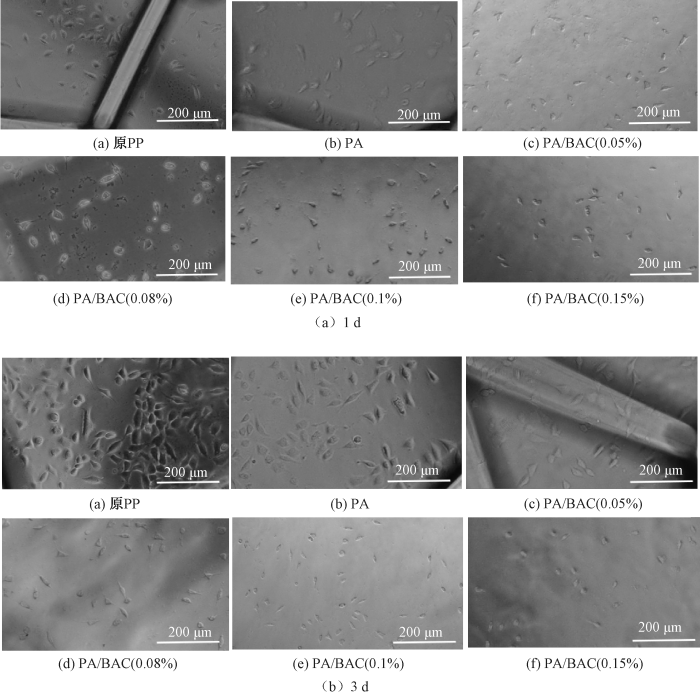
采用细胞与材料共培养法检测细胞毒性。将L929细胞以1×10⁴个/孔的密度接种于48孔板,在37 ℃、5% CO2的湿化气氛培养箱中分别孵育1、3 d。随后将不同涂层的PP样品置于细胞层上方;以PP补片作为平行对照。采用CCK-8法监测细胞活性。具体操作如下:孵育1、3 d后取出样品,更换为含CCK-8试剂的新鲜培养基(200 μL),继续在37 ℃培养箱中孵育1 h,随后采用Multiskan SkyHigh酶标仪(美国赛默飞世尔科技有限公司)测定450 nm波长下的吸光度,细胞活性以相对于对照组得到的吸光度值的百分比表示。同时,通过光学显微镜观察并记录孵育1、3 d后对照组与实验组的细胞形态,用于直观评价样品对细胞生长状态的影响。
1.8 数据处理
所有实验均设3个平行样,实验数据采用Origin 2022软件进行统计分析,组间统计学比较采用双侧t检验进行统计学分析;所有数据以均值±标准差(SD)表示,统计学差异判定标准为:*表示p≤ 0.05,**表示p≤0.01,***表示p≤ 0.001,上述情况均认为差异具有统计学意义。
2 结果与讨论
2.1 表面形貌分析
图2示出原PP补片及各涂层补片的SEM照片。
图2
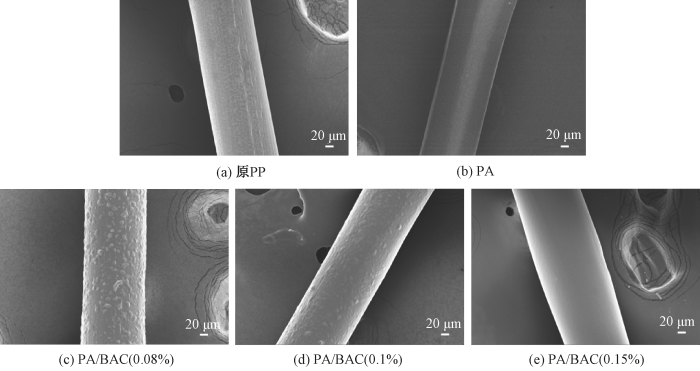
图2
原PP补片和涂层PP补片的SEM 照片
Fig.2
SEM images of original PP patch and coated PP patch. (a) Original PP; (b) PA; (c) PA/BAC (0.08%); (d) PA/BAC(0.1%); (e) PA/BAC(0.15%)
PA/BAC涂层补片与原PP补片和PA涂层补片相比,沉积现象更加突出,PA/BAC(0.08%)补片沉积斑点较大,且较为稀疏;PA/BAC(0.1%)补片沉积斑点变小并变得稠密,沉积物增加。而PA/BAC(0.15%)补片上形成一层沉积物。沉积物包覆整个PP补片。由此可见,由于PA和BAC之间的静电相互作用,随着BAC质量分数的增加,更多的PA/BAC沉积在PP补片表面[17]。
2.2 化学结构分析
图3为原PP补片及各涂层补片的红外光谱图。在3 000~2 800 cm-1的范围内,原PP补片出现—CH3(2 950 cm-1)和—CH2(2 850 cm-1)的伸缩振动峰;而PA含磷氧基团、烷基贡献少,因此该区域峰形无明显变化;PA/BAC涂层补片随 BAC 质量分数升高,2 900 cm-1 附近吸收峰增强,这是由于BAC 的 N—CH3伸缩振动与 PP的—CH3峰重叠,叠加后峰强增加;同时 3 000 cm-1 以上逐渐出现芳基 C—H振动峰,苯环 —CH—逐渐出现弱吸收,在BAC质量分数为0.15%的涂层中更为明显,证明 BAC 的C6H5—CH2— 被成功引入。在1 600~1 500 cm-1范围内,PA/BAC涂层补片随 BAC 质量分数升高,在1 600、1 500 cm-1附近逐渐出现弱峰,对应苯环的C=C伸缩振动[21],进一步验证了 BAC中苯环的存在。PA涂层补片在1 150~1 050 cm-1范围内出现强吸收峰,对应PA的P—O伸缩振动,证明 PA成功沉积。以上结果表明,PA/BAC涂层已成功负载在补片表面。
图3
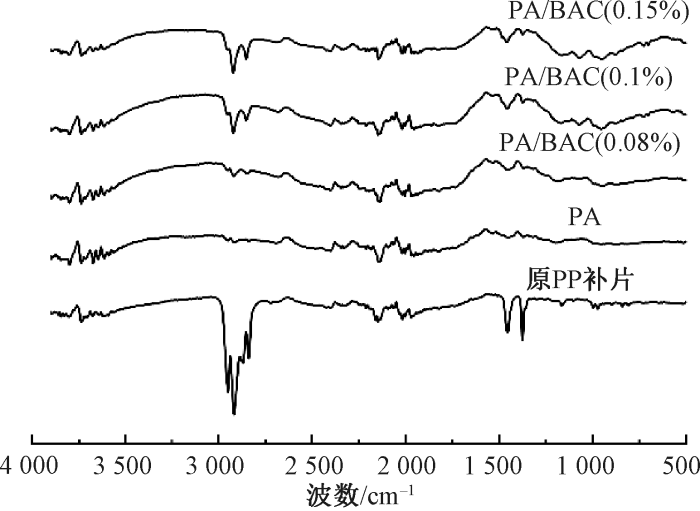
图3
原PP补片和涂层PP补片傅里叶红外光谱图
Fig.3
FT-IR spectra of original PP patch and coated PP patch
2.3 结晶结构分析
图4示出原PP补片及各涂层补片的XRD图谱。所有样品衍射峰均对应 α-PP 的 (110)、(040)、(130) 晶面,无新晶相生成;原 PP 补片衍射峰尖锐、强度高且峰宽窄,结晶度高;PP补片沉积PA/BAC后,PA 的极性基团破坏 PP 分子链疏水作用,抑制结晶,使峰强度降低;随着BAC质量分数从 0.08% 增至 0.15%,PP 特征峰强度先降后微升,其中BAC 质量分数为 0.1% 时峰强最低,这是由于BAC 与 PA 形成离子复合物,增强 PA 对 PP 的吸附。BAC质量分数在 0.15%时,过量 BAC沉积在PP表面,阻碍PA对结晶的抑制作用,故峰值略有上升。
图4
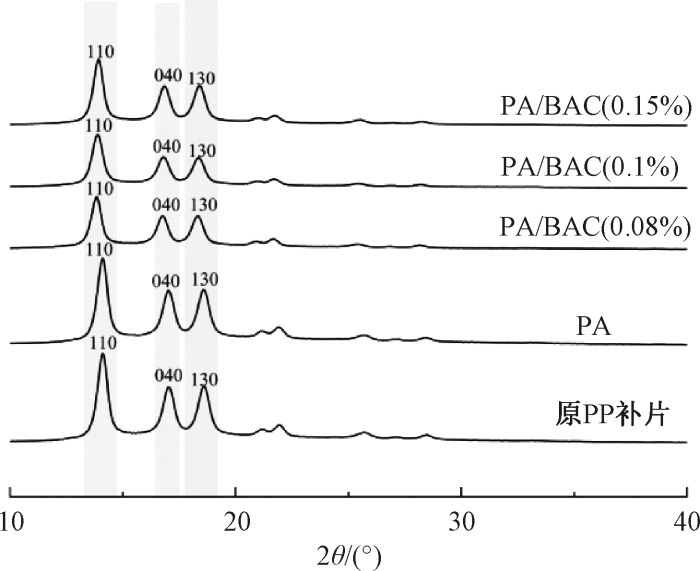
图4
原PP补片和涂层PP补片XRD谱图
Fig.4
XRD patterns of original PP patch and coated PP patch
2.4 化学组成分析
图5示出PA/BAC涂层补片XPS高分辨率谱图。如图5(a)所示,2个以结合能285.0、532.6 eV为中心的优势峰,分别归属于C 1s和O 1s。随着BAC质量分数的增加,O 1s的峰值强度先逐渐增大。这是由于BAC质量分数增加时,通过静电相互作用促使PA的负载量同步增加;但当BAC质量分数过高时,静电结合后剩余的 BAC 会单独吸附在PP补片表面,挤占了原本由 PA/BAC 占据的位点,导致表面整体的氧元素相对占比下降。对于样品PA/BAC(0.08%),其C 1s组分峰分别位于284.7、285.8、284.2 eV处(见图5(b)~(d)),主要归属于C—C/C—H、C—N/C—O和苯环C;其中C—O来源于PA[22],而C—N和苯环C的特征峰则证实BAC成功沉积。样品PA/BAC(0.1%)、PA/BAC(0.15%)的C 1s组分峰与PA/BAC(0.08%)相似。综上,进一步证实PA/BAC涂层已成功沉积在PP补片表面。
图5
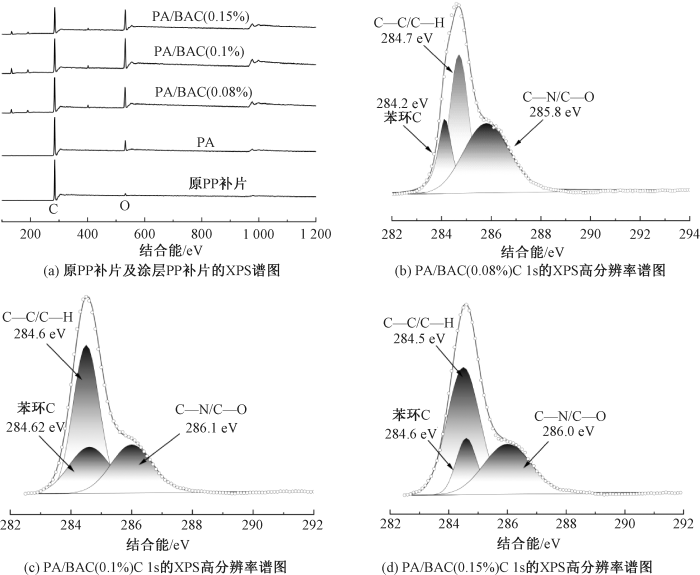
图5
原PP补片及涂层补片表面化学成分分析
Fig.5
Surface chemical composition of original PP patch and coated patch.(a) XPS spectra of PP patch and coated PP patch; (b)High-resolution C 1s XPS spectra of PA/BAC (0.08%); (c) High-resolution C 1s XPS spectra of PA/BAC (0.1%) ; (d) High-resolution C 1s XPS spectra of PA/BAC (0.15%)
2.5 静态水接触角分析
图6
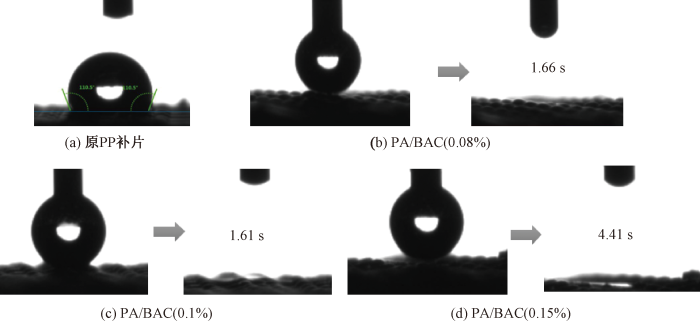
图6
原PP补片和涂层PP补片水接触角图
Fig.6
Water contact angle diagrams of original PP patch and coated PP patch. (a) Original PP patch; (b) PA/BAC(0.08%); (c) PA/BAC(0.1%); (d) PA/BAC(0.15%)
2.6 涂层补片的顺应性能分析
良好的顺应性是PP补片作为疝修补植入假体的核心优势。本研究系统考察了PA/BAC复合涂层对其顺应性的调控效应,结果如图7所示。为直观表征 PA/BAC(0.15%)补片的顺应性特征,本研究选取该涂层补片开展弯折、卷曲等动态力学形变实验,结果表明,涂层修饰后的 PP 补片仍展现出优异的顺应性,其本征柔顺特性得以有效保留。
图7

2.7 涂层补片的抗菌性能分析
赋予疝修补补片优异的抗菌性能对于提高手术成功率和患者预后至关重要[24]。本研究通过体外抗菌实验,系统评价了PA/BAC复合涂层补片对常见致病菌(金黄色葡萄球菌和大肠埃希菌)的抑制效果,结果如图8所示。由图可知,含PA涂层的补片对2种菌株均未出现抑菌圈,证实该涂层无抗菌性能;PA/BAC(0.05%)对大肠埃希菌未出现明显抑菌圈,但与PA涂层表面布满菌落不同,PA/BAC(0.05%)表面几乎无菌落生成,且对金黄色葡萄球菌的平均抑菌圈直径为20.6 mm。其它BAC质量分数的涂层补片对2种菌株均显示出不同大小的抑菌圈。抗菌结果(见图8(a))显示,PA/BAC(0.08%)对大肠埃希菌和金黄色葡萄球菌的平均抑菌圈直径分别为14.6、21 mm;PA/BAC(0.1%)的分别为20.6、28.6 mm;PA/BAC(0.15%)的分别为22.5 、40 mm;各涂层间的差异显著。上述结果表明,所有PA/BAC对大肠埃希菌和金黄色葡萄球菌均表现出良好的抑菌活性,且抑菌效果随BAC质量分数增加而增强,表明该复合涂层能够有效抑制细菌在补片表面的黏附和增殖,从而有望降低植入后感染的风险。
图8
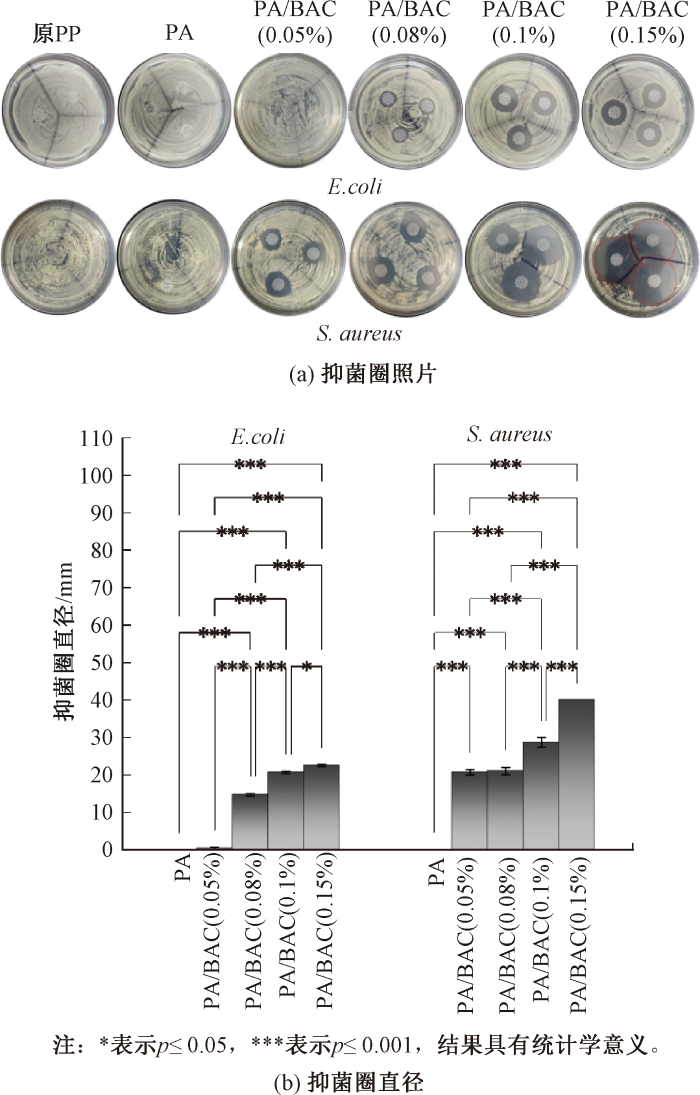
图8
涂层补片对大肠埃希菌和金黄色葡萄球菌的抑制效果
Fig.8
Antibacterial activities of coated patches against E. coli and S. aureus.(a)Inhibition zones; (b)Diameter of inhibition zones
抑菌率测试结果如图9及表1所示。将大肠埃希菌和金黄色葡萄球菌分别与PA/BAC(0.05%)、PA/BAC(0.08%)、PA/BAC(0.1%)、PA/BAC(0.15%)补片共培养后,涂覆于LB琼脂板上培养12 h,仅在PA/BAC(0.05%)组的大肠埃希菌培养板中观察到2个菌落,其它组别均无菌落出现。经计算,PA/BAC(0.05%)对大肠埃希菌和金黄色葡萄球菌的抑菌率分别达到99.99%以上和100%,其它质量分数的涂层对2种菌株的抑菌率均为100%(见表1)。结果表明,所有PA/BAC涂层补片对大肠埃希菌和金黄色葡萄球菌均表现出优异的抗菌性能,且抗菌能力随着BAC质量分数的增加而增强。这一效果归因于BAC在PP补片表面的有效沉积,而这一沉积过程通过引入PA发挥其表面亲和性、并借助PA与BAC间的静电相互作用来实现的[17]。与将抗菌单体二烯丙基二甲基氯化铵接枝于PP补片上[25],以及含有Fe3+水凝胶包裹PP补片的抗菌方案[26] 对比,本文的制备方法简单、反应条件温和,且所得补片的抗菌性更优。
图9
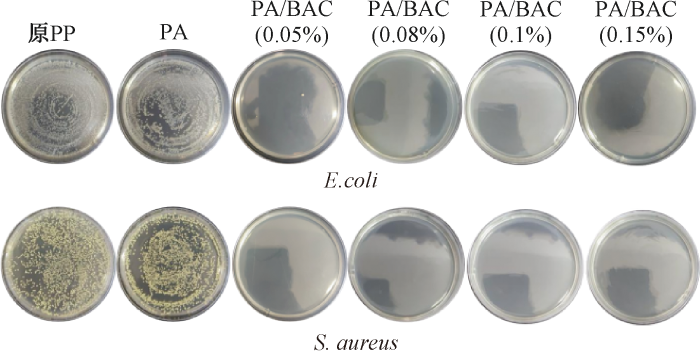
图9
涂层补片对大肠埃希菌和金黄色葡萄球菌的杀菌效果照片
Fig.9
Bactericidal effect of coated patches against E. coli and S. aureus
表1 涂层补片对大肠埃希菌和金黄色葡萄球菌的抑菌率
Tab.1
| 补片 | 抑菌率/% | |
|---|---|---|
| 对E. coli | 对S. aureus | |
| PA | 0 | 0 |
| PA/BAC(0.05%) | ≥99.99 | 100 |
| PA/BAC(0.08%) | 100 | 100 |
| PA/BAC(0.1%) | 100 | 100 |
| PA/BAC(0.15%) | 100 | 100 |
2.8 蛋白质吸附能力分析
细胞的黏附依赖于蛋白质的吸附。本研究选择牛血清白蛋白(BSA)作为模型蛋白,考察其在原PP、PA、PA/BAC(0.08%)、PA/BAC(0.1%)、PA/BAC(0.15%)涂层补片上的吸附行为,结果如图10所示。实验测得上述5种材料的蛋白质吸附量分别为(67.2±3.87)、(44.5±2.72)、(40.2±2.65)、(43.4±2.48)mg/g和(39.4±3.04)mg/g。
图10
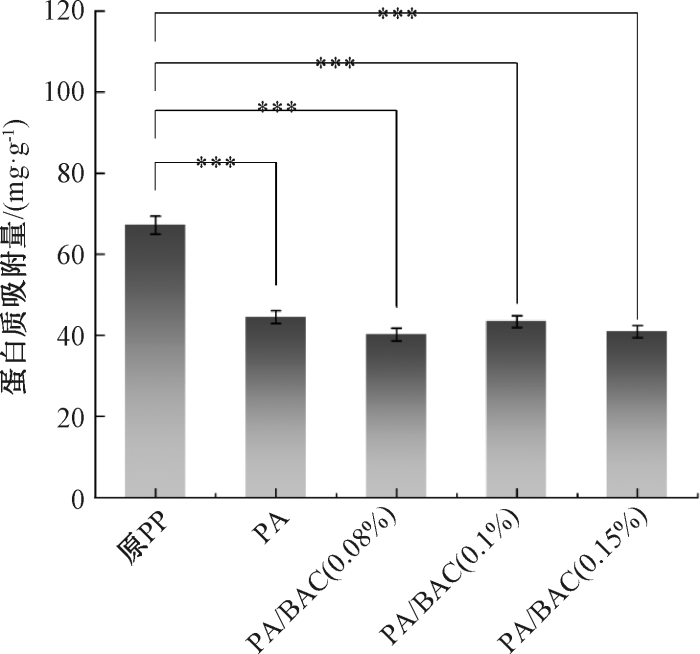
图10
BSA蛋白吸附量
注:***表示p≤ 0.001,结果具有统计学意义。
Fig.10
BSA protein adsorption capacity
在蛋白质吸附性能方面,PA 涂层补片与PA/BAC复合涂层补片之间无显著差异,而二者与原PP补片相比均存在显著差异。与原PP补片相比,亲水性涂层在补片表面形成水屏障,使表面更为光滑,从而减少了蛋白质吸附[18]。上述结果表明,带有亲水性涂层的PP补片具有抗细胞黏附性能。
2.9 细胞毒性分析
以小鼠成纤维细胞(L929)为细胞模型,系统评估了涂层补片的细胞毒性。材料与细胞共培养1、3 d后,采用CCK-8法检测细胞活性,结果显示,PA/BAC(0.05%)、PA/BAC(0.08%)涂层组的细胞活性分别达82%、76%。光学显微镜下观察细胞形态(见图11),培养1 d各组细胞均呈正常状态,贴壁生长,但PA/BAC涂层组细胞数量较对照组和PA组有所减少;培养3 d,原PP、PA、PA/BAC(0.05%)、PA/BAC(0.08%)、PA/BAC(0.1%)涂层组细胞均正常贴壁生长,但随BAC质量分数增加,细胞活性有所减弱。实验结果表明,低质量分数BAC的生物安全性相对较好。后续将进一步优化BAC用量或对其进行改性,以制备抗菌效率高且生物安全性良好的复合补片。
图11
3 结论
本研究针对聚丙烯疝补片临床应用中存在的细菌感染、术后粘连问题,提出植酸与苯扎氯铵表面功能化策略,通过低温等离子体预处理结合一步共沉积工艺,在 PP 补片表面构建 PA/BAC 涂层,可在4 h内完成制备。该方法条件温和、操作简便,为PP补片的功能化处理提供了新思路。该涂层的成功制备依赖于 PA 的表面亲和性及其与 BAC 之间的静电相互作用。静态水接触角结果显示,液滴可在PA/BAC涂层补片表面快速浸润,亲水性显著提升,蛋白质黏附实验表明,该涂层补片的蛋白质吸附量较原PP补片明显降低,为抗粘连性能提供了支撑。体外抗菌实验结果表明,PA/BAC 涂层对大肠埃希菌、金黄色葡萄球菌均表现出优异抗菌效果,抑菌圈随 BAC质量分数增加而扩大,抑菌率可达 100%。细胞实验发现,PA/BAC(0.05%)、PA/BAC(0.08%)、PA/BAC(0.1%)补片上细胞形态正常、贴壁生长良好。未来将重点探索BAC的最佳用量范围及其低毒化改性策略。综上,本研究开发的 PA/BAC 涂层一步共沉积策略,在实现 PP 补片抗菌与抗粘连性能协同提升的同时,具备工艺简便、条件温和的产业化优势,为疝修补材料的功能化改性提供了创新路径。
参考文献
一文了解疝气以及护理
[J].
Understanding hernia and nursing care
[J].
Infection-resistant polypropylene hernia mesh: vision & innovations
[J].DOI:10.1021/acsabm.4c01751 URL [本文引用: 1]
Polypropylene mesh coated with dual cross-linked hyaluronic acid/polyvinyl alcohol composite hydrogel with antiadhesion and angiogenesis properties for abdominal wall repair
[J].DOI:10.1002/admt.v10.9 URL [本文引用: 1]
植酸添加对铝合金微弧氧化膜组织结构及性能的影响
[J].
Effect of phytic acid addition on microstructure and properties of micro arc oxidation film on aluminum alloy
[J].
植酸-硅烷改性氧化石墨烯/聚天门冬氨酸酯复合涂层的构筑及其防腐蚀机理
[J].
Preparation of phytic acid and silane modified graphene oxide polyaspartic acid ester composite coating and its anti-corrosion mechanism
[J].
Natural polysaccharide-based injectable hydrogels with tunable mechanical and electrical properties enabled by phytic acid
[J].DOI:10.1016/j.carres.2025.109555 URL [本文引用: 1]
一种新型复合抗菌剂的制备及其抗菌性能研究
[J].
Preparation and antibacterial properties of benzalkonium chloride-Fe3+-montmorillonite antibacterial agent
[J].
苯扎氯铵溶液联合盐酸环丙沙星栓对细菌性阴道炎疗效研究
[J].
Study on the efficacy of benzalkonium chloride solution combined with ciprofloxacin hydrochloride suppositories in the treatment of bacterial vaginosis
[J].
Surface modification of polypropylene mesh with a porcine cholecystic extracellular matrix hydrogel for mitigating host tissue reaction
[J].
DOI:10.1021/acsabm.0c01627
PMID:35014417
[本文引用: 1]

Polypropylene (PP) meshes are widely used for repairing skeletal muscle defects like abdominal hernia despite the chances of undesirable pro-inflammatory tissue reactions that demand revision surgeries in about 45% of cases. Attempts have been made to address the problem by modifying the mesh surface and architecture. These procedures have yielded only incremental improvements in the management of overall postoperative complications, and the search for a clinically viable therapeutic strategy continues. This study deployed a tissue engineering approach for mitigating PP-induced adverse tissue reaction by dip-coating the mesh with a hydrogel formulation of the porcine cholecystic extracellular matrix (CECM). The biomaterial properties of the CECM hydrogel-coated PP (C-PP) meshes were studied and their biocompatibility was evaluated by and tests based on ISO standards. Further, the nature of tissue reactions induced by the hydrogel-coated mesh and a commercial PP hernia repair graft was compared in a rat model of partial-thickness abdominal wall defect. Histomorphologically, in comparison with the PP graft-induced tissue reaction, C-PP caused a favorable graft-acceptance response characterized by reduced numbers of pro-inflammatory M1 macrophages and cytotoxic lymphocytes. Remarkably, the differential inflammatory response of the C-PP graft-assisted healing was associated with a fibrotic reaction predominated by deposition of type I collagen rather than type III collagen, as desired during skeletal muscle repair. It was concluded that the CECM hydrogel is a potential biomaterial for surface modification of polymeric biomedical devices.
Anti-inflammatory coating of hernia repair meshes: a 5-rabbit study
[J].DOI:10.1007/s10029-020-02122-9 [本文引用: 1]
Preparation and performances of coated polypropylene hernia mesh with natural biomaterials
[J].DOI:10.1016/j.colcom.2021.100535 URL [本文引用: 1]
Dopamine-mediated zwitterionic polyelectrolyte-coated polypropylene hernia mesh with synergistic anti-inflammation effects
[J].
DOI:10.1021/acs.langmuir.0c00602
PMID:32336102
[本文引用: 1]
Over 20 million ventral hernia repairs are performed worldwide annually and only a minority (<10%) of cases are not mesh-based. However, even polypropylene (PP), endorsed as the "gold standard" of all prosthetic materials used in this field, is still subject to many complications caused by the foreign body reaction (FBR). Here, we describe the buildup of dopamine-mediated zwitterionic poly(sulfobetaine methacrylate) (PSBMA) coatings to inhibit nonspecific protein adsorption. Based on the universal adhesive ability of polydopamine (PDA), PSBMA has been coated on the PP mesh surface two strategies: sequential deposition (PSBMA-PDA-PP) and co-deposition (PSBMA@PDA-PP). The presence of PSBMA shows great contribution to obviously decreased hydrophobicity of the PP surface (WCA = 36.3° and WCA = 30.7°) as well as improved protein resistance (Reduction = 74% and Reduction = 82%). Notably, as the intermedia between PP and PSBMA, PDA can endow the PP mesh with antioxidant activity, further featuring synergistic anti-inflammation therapeutic effect when coupled with PSBMA. With almost equal surface content of PSBMA, PSBMA-PDA-PP exhibited a more superior ability against macrophage adhesion and proliferation and showed more significantly decreased releases of TNF-α and IL-6 (< 0.05) than those of PSBMA@PDA-PP, fundamentally attributed to its more neutral surface potential and the protection for polyphenols of PDA from oxidation with PSBMA as the outer layer. Furthermore, the coating layers demonstrated good stability and no sacrifice of the pristine mechanical property. The proposed dopamine-mediated PSBMA coatings possess high potential in biomedical implant areas for attenuating the FBR.
Phytic acid-promoted rapid fabrication of natural polypeptide coatings for multifunctional applications
[J].DOI:10.1016/j.cej.2022.135917 URL [本文引用: 1]
Durable and robust antibacterial polypropylene hernia mesh for abdominal wall defect repair
[J].
Polypropylene mesh coated with hyaluronic acid/polyvinyl alcohol composite hydrogel for preventing bowel adhesion
[J].DOI:10.1016/j.ijbiomac.2024.132061 URL [本文引用: 2]
猪圆环病毒2型Cap蛋白琼脂扩散试验检测方法的建立
[J].
Establishment of an agar-gel precipitation test for PCV2 cap protein
[J].
一株抗黄芪根腐病芽孢杆菌的筛选、鉴定及抑菌物质的初步研究
[J].
Screening and identification of Bacillus subtilis against root rot disease of Astragalus membranaceus and preliminary study on the antibacterial substance
[J].
Nanofibers fortified with synergistic defense route: a potent wound dressing against drug-resistant bacterial infections
[J].DOI:10.1016/j.cej.2023.146492 URL [本文引用: 1]
Surface antimicrobial modification of polyamide by poly(hexamethylene guanidine) hydrochloride
[J].DOI:10.1002/pat.v31.8 URL [本文引用: 1]
The pyranine-benzalkonium ion pair: a promising fluorescent system for the ratiometric detection of wound pH
[J].DOI:10.1016/j.snb.2017.04.045 URL [本文引用: 1]
用于应对疝修补术后并发症的经编补片研究进展
[J].
Research progress in warp-knitted meshes for tackling complications after hernia repair
[J].
DOI:10.1177/004051757304300101
URL
[本文引用: 1]
The paper deals with studies elucidating the effects of hank of the ingoing material and of doubling at the ringframe upon yarn quality and spinning performance under different spinning conditions obtained by varying the spindle speed and count spun. The results show that with coarse and medium mixings, the hank of the roving fed could be varied over a wide range without affecting yarn properties. The use of finer hank, however, led to a reduction in end-breakage rate in such mixings. With fine mixings, finer input hank and low ringframe drafts led to poorer yam quality and comparable or poorer spinning performance.
Plasma-induced diallyldimethylammonium chloride antibacterial hernia mesh
[J].
DOI:10.1021/acsabm.2c00695
PMID:36446396
[本文引用: 1]
A hernia is a pathological condition caused by a defect or opening in the muscle wall, which leads to organs pushing through the opening or defect. Hernia recurrence, seroma, persistent pain, tissue adhesions, and wound infection are common complications following hernia repair surgery. Infection after hernia mesh implantation is the third major complication leading to hernia recurrence. In order to reduce the incidence of late infections, we developed a polypropylene mesh with antibacterial properties. In this study, knitted polypropylene meshes were exposed to radio-frequency plasma to activate their surfaces. The antibacterial monomer diallyldimethylammonium chloride (DADMAC) was then grafted onto the mesh surface using pentaerythritol tetraacrylate as the cross-linker since it is able to engage all four functional groups to form a high-density cross-linked network. The subsequent antibacterial performance showed a 2.9 log reduction toward and a 0.9 log reduction for.
Dual dynamic crosslinked hydrogel patch embodied with anti-bacterial and macrophage regulatory properties for synergistic prevention of peritendinous adhesion
[J].DOI:10.1002/adfm.v34.34 URL [本文引用: 1]

 京公网安备11010502044800号


