纺织学报 ›› 2024, Vol. 45 ›› Issue (12): 189-198.doi: 10.13475/j.fzxb.20240305501

• 服装工程 • 上一篇    下一篇

基于机器视觉技术的百褶裙动态美感评价

任柯1,2, 周衡书1,2,3,4(), 魏瑾瑜1,2, 闫文君1,5, 左言文1,5   

  1. 1.湖南工程学院 纺织服装学院, 湖南 湘潭 411104
    2.智能纺织加工技术湖南省普通高校重点实验室, 湖南 湘潭 411104
    3.短流程智能纺织湖南省工程研究中心, 湖南 湘潭 411104
    4.湖南省新型纤维面料及加工工程技术研究中心, 湖南 湘潭 411104
    5.湖南工程学院 智能化服装检测与研发研究中心, 湖南 湘潭 411104
  • 收稿日期:2024-03-25 修回日期:2024-07-01 出版日期:2024-12-15 发布日期:2024-12-31
  • 通讯作者: 周衡书(1967—),男,教授。主要研究方向为现代纺织技术与服装数字化技术。E-mail:280434272@qq.com
  • 作者简介:任 柯(1996—),男,硕士生。主要研究方向为纺织机械、服装数字化技术。
  • 基金资助:
    湖南省研究生科研创新省级重点项目(CX20221293);湖南省重点研发计划项目(2022NK2042)

Dynamic aesthetic evaluation of pleated skirts based on machine vision technology

REN Ke1,2, ZHOU Hengshu1,2,3,4(), WEI Jinyu1,2, YAN Wenjun1,5, ZUO Yanwen1,5   

  1. 1. School of Textiles and Clothing, Hunan Institute of Engineering, Xiangtan, Hunan 411104, China
    2. Key Laboratory of Intelligent Textile Processing Technology, College of Hunan Province, Xiangtan, Hunan 411104, China
    3. Short-Process Intelligent Textile Engineering Research Center, Xiangtan, Hunan 411104, China
    4. Hunan Provincial Engineering Research Center for Novel Fiber Fabrics and Processing, Xiangtan, Hunan 411104, China
    5. Intelligent Clothing Evaluating and Development Research Center Hunan Institute of Engineering, Xiangtan, Hunan 411104, China
  • Received:2024-03-25 Revised:2024-07-01 Published:2024-12-15 Online:2024-12-31

摘要:

针对百褶裙缺少动态美感评价方法的问题,采用高速相机结合机器视觉技术,研制了裙装动态图像采集装置,设定并提取了不同转速下的投影轮廓面积、侧面展开面积、动态裙身宽度、裙摆展开角度、活泼率5个百褶裙的动态视觉特征指标,建立了百褶裙动态美感客观评价方法。同时选取悬垂感、整体美感、轮廓曲面美感、褶裥均匀感和飘逸感5个主观评价指标,采用专家评价法对百褶裙在不同转速下的美感进行主观评价,并对主客观评价结果进行回归分析与皮尔逊相关性分析。结果表明,百褶裙动态视觉特征与主观美感评价结果具有高度相关性,由此建立了百褶裙动态美感评价数学模型,为传统民族服饰的美感评价提供了基于机器视觉技术的科学方法。

关键词: 百褶裙, 机器视觉技术, 动态美感, 美感评价, 图像识别

Abstract:

Objective The study aimed to assess the dynamic aethetics of pleated skirts, a hallmark of Chinese tradition celebrated for their fluid and elegant movement. Recognizing the gap in scientific methods for measuring the beauty of traditional ethnic garments in motion, it leveraged machine vision technology and high-speed photography to develop quantifiable visual feature indices and a comprehensive mathematical model.

Method The study utilized machine vision technology integrated with high-speed cameras to evaluate objectively the dynamic aesthetics of pleated skirts. A custom dynamic image capture device was designed, incorporating a rotating display platform and multiple high-speed cameras positioned at different angles to capture dynamic images of the skirts at various rotational speeds. Multi-angle image capture was firstly carried out at different rotational speeds to ensure a comprehensive recording of the dynamic process. Subsequently, machine vision algorithms were applied to process and analyze these images, extracting key dynamic visual features such as projected contour area, lateral expansion area, skirt width, expansion angle, and liveliness. These features were systematically quantified to assess the dynamic aesthetics of the skirts under different speed conditions.

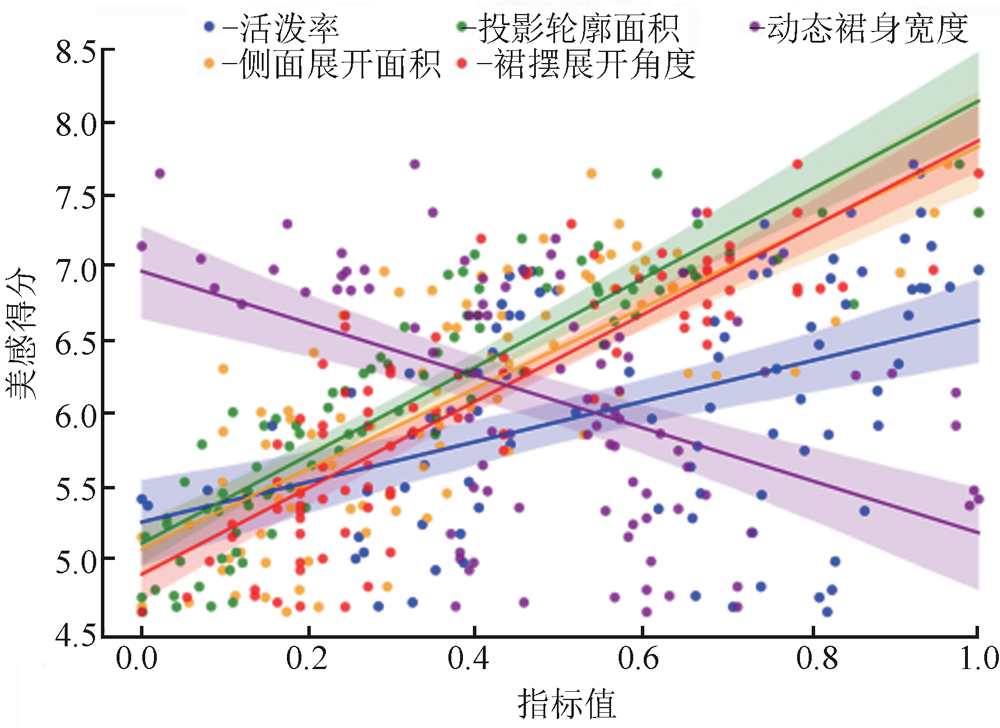
Results This study conducted an in-depth analysis of the dynamic aesthetics of pleated skirts using machine vision technology and high-speed cameras, uncovering the relationship between motion and perceived beauty. A custom dynamic image capture device was utilized, equipped with a high-speed industrial camera capable of capturing up to 245 frames/s, and a dynamic display platform that allowed for precise control of the skirt's rotational speed. The study extracted and quantified dynamic visual characteristics such as projected contour area, lateral expansion area, skirt width, expansion angle, and liveliness using this setup. Based on these quantified dynamic features and subjective evaluations from experts, regression analysis was employed to develop a mathematical model capable of objectively assessing skirt aesthetics. Within the rotational speed range of 24 r/min to 48 r/min, various dynamic characteristics of the skirts were extracted and quantified, where the projected contour area were considered between 2 281.9 cm2and 8 253.0 cm2, the lateral expansion area from 4 112.3 cm2 to 6 278.3 cm2, skirt width from 36.427 cm to 51.178 cm, the expansion angle from 32°to 101°; and the liveliness index from 60.2% to 79.1%. These data indicate significant differences in the dynamic performance of pleated skirts at different rotational speeds. Subjective evaluations of the dynamic aesthetics of pleated skirts were carried out by fashion professionals at different rotational speeds using five main aesthetic criteria, which are drape, overall aesthetics, contour curve aesthetics, airiness, and pleat uniformity, using a scoring scale from 1 to 10. For overall aesthetics, the average score was 6.569 with a standard deviation (SD) of 1.963, wheras the average score for drape was 6.053 (SD 1.873), the average score for contour curve aesthetics was 6.224 (SD 1.955), the average score for airiness was 6.211 (SD 2.121), and the average score for pleat uniformity was 5.629 (SD 2.220). The entropy method was employed to calculate a weighted summation of these scores, yielding the final subjective aesthetic score. Pearson correlation analysis revealed a strong correlation between the dynamic visual characteristics of the skirts and the final aesthetic scores obtained from the subjective evaluation. Within the rotational speed range of 24 r/min to 48 r/min, changes in projected contour area showed the strongest correlation with aesthetic scores, with a correlation coefficient as high as 0.893 for flowing elegance and 0.882 for overall aesthetics, underscoring its critical role in visual appeal. Lateral expansion area and expansion angle also exhibited significant positive correlations with aesthetic scores, with correlation coefficients of 0.741 for lateral expansion area and airiness, and 0.740 for expansion angle and overall aesthetics. In contrast, liveliness displayed a weaker correlation but still had some influence, such as a correlation coefficient of 0.644 with drape. Skirt width showed a negative correlation with aesthetic scores, with relatively low correlation coefficients across all aesthetic criteria, such as -0.486 with overall aesthetics, indicating that within a certain speed range, wider skirts may detract from their dynamic aesthetic appeal. Regression analysis was performed, using the final aesthetic score as the dependent variable and the quantified dynamic visual indices as independent variables, resulting in the establishment of a mathematical model for evaluating the dynamic aesthetics of skirts. The regression analysis revealed significant differences in the impact of the main visual indices on aesthetic scores. The non-standardized coefficient for the constant term was 4.519, with a very high level of significance (P < 0.001). Among the indices, the projected contour area had the highest standardized coefficient of 0.563, indicating the greatest influence on aesthetic scores (P < 0.001). The lateral expansion area followed, with a standardized coefficient of 0.294 (P < 0.001), also showing a significant impact. The influence of dynamic skirt width was minor, with a standardized coefficient of 0.036, and was not significant (P = 0.660). The adjusted R2of the regression model was 0.811, indicating that the model explained 81.1% of the variance in aesthetic scores, and the overall regression model was highly significant (F = 78.224, P < 0.001), demonstrating a high level of fit. These findings further validate the effectiveness of the machine vision-based method for objectively evaluating skirt aesthetics.

Conclusion This study developed an analysis device based on machine vision technology, capable of accurately identifying and quantifying the dynamic visual characteristics of skirts. By leveraging machine vision, the device effectively addresses the challenge of accurately measuring skirt parameters in dynamic conditions, significantly improving both measurement efficiency and precision. Moreover, it mitigates the subjective limitations of traditional manual evaluation of skirt aesthetics. The regression model, constructed using data obtained from this device in combination with subjective assessments, exhibits a high degree of fit, further demonstrating the feasibility of using this device for dynamic evaluation of skirts. The objective evaluation mathematical model established from this foundation also contributes to the standardization and quantification of aesthetic evaluation in the fashion industry. This research not only pioneers a new method for evaluating the dynamic aesthetics of skirts but also provides valuable data references for skirt design. In the future, the device and evaluation model can be further optimized to accommodate a wider variety of garments. Additionally, by integrating artificial intelligence, it will be possible to explore the variations in garment aesthetics under diverse environmental conditions, thereby enriching the breadth and depth of research in garment aesthetics.

Key words: pleated skirt, machine vision technology, dynamic aesthetics, aesthetic evaluation, image recognization

中图分类号: 

  • TS941.2

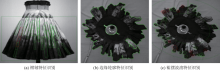
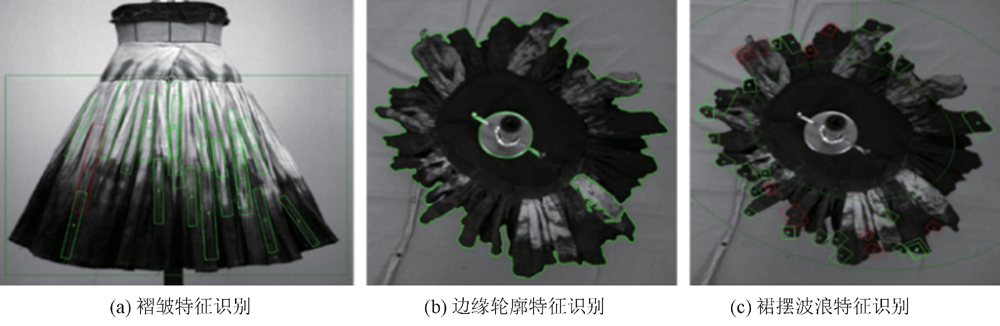
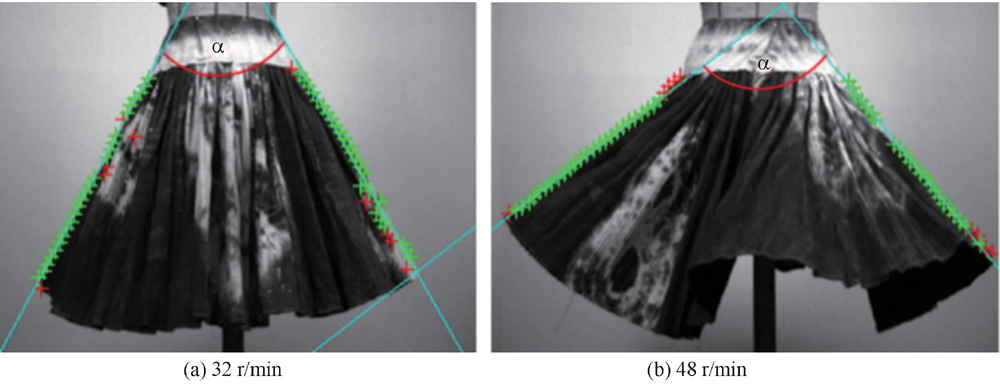
图1

百褶裙动态特征提取"

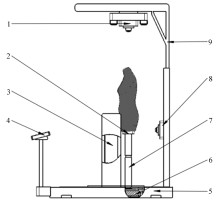
图2

图像采集装置示意图 1 —顶部工业相机;2—展示人台;3—LED光源;4—控制台;5—底座;6—电动机;7—传动轴;8—侧面工业相机;9—伸缩支柱。"

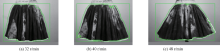
图4

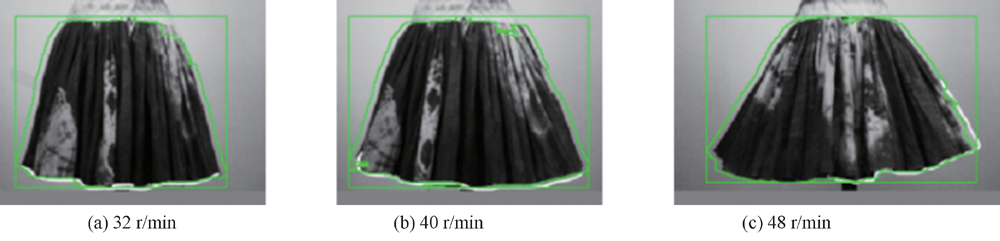
不同转速下百褶裙侧面展开面积识别"

图5

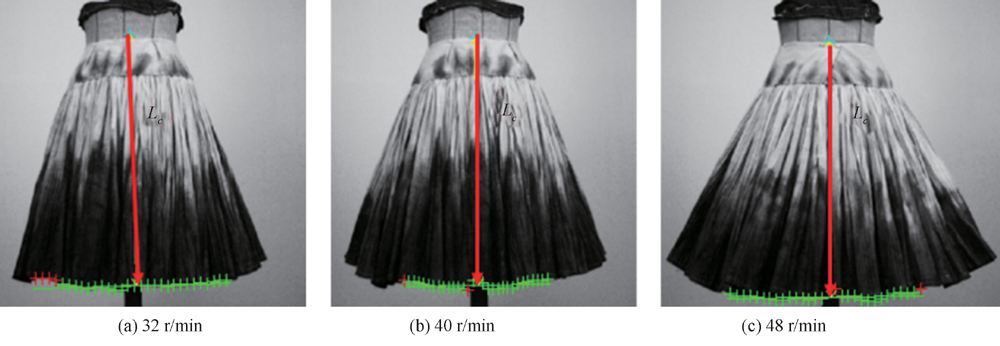
不同转速下百褶裙动态裙身宽度测量"

图6

不同转速下百褶裙裙摆展开角度测量"

表1

百褶裙样本参数"

样品
编号
褶裥
距离/
cm
长度/
cm
褶裥
数量
厚度/
mm
密度/
(根·(10 cm)-1)
面密度/
(g·m-2)
经密 纬密
1 0.8 53 730 0.26 257 246 92
2 0.8 53 949 0.26 257 246 92
3 0.6 53 949 0.26 257 246 92
4 0.6 53 730 0.41 250 232 136
5 0.8 53 949 0.41 250 232 136
6 0.8 73 949 0.41 250 232 136

表2

百褶裙动态美感评价指标"

动态美感
评价指标
符号 说明
悬垂感 y1 百褶裙在旋转时的悬垂效果
整体美感 y2 百褶裙旋转时外观整体效果
轮廓曲面美感 y3 百褶裙轮廓线条的动态流畅度和曲面的美感
飘逸感 y4 百褶裙在运动中带来的轻盈飘逸效果
褶裥均匀感 y5 百褶裙褶皱在整个裙身上的分布是否均匀且统一

表3

主观评价结果描述性统计"

得分项 样本
最大
最小
平均
标准
中位
方差 峰度
悬垂感 944 10 1 6.053 1.873 6 3.509 -0.330
整体美感 944 10 1 6.569 1.963 7 3.855 -0.405
轮廓曲面美感 944 10 1 6.224 1.955 7 3.822 -0.387
飘逸感 944 10 1 6.211 2.121 6 4.497 -0.514
褶裥均匀感 944 10 1 5.629 2.220 6 4.927 -0.895

表4

百褶裙动态特征测试结果"

百褶
裙编
转速/
(r·min-1)
投影轮
廓面积/
cm2
侧面展
开面积/
cm2
动态裙
身宽度/
cm
裙摆展
开角度/
(°)
活泼
率/
%
1 24 3 004.4 4 238.6 51.187 48 60.2
1 32 3 623.7 5 233.2 50.756 50 67.4
1 40 5 641.2 5 861.9 46.612 82 81.4
1 48 8 253.0 6 278.3 40.829 90 85.4
2 24 2 281.9 3 839.9 44.541 40 46.0
2 32 2 907.7 4 187.7 44.282 32 54.7
2 40 4 557.7 4 965.9 42.555 62 72.4
2 48 5 922.7 5 275.0 39.534 101 77.4
3 24 2 486.0 4 112.3 45.318 42 47.8
3 32 3 155.0 4 561.6 46.008 54 57.2
3 40 4 615.2 4 876.5 43.764 82 71.0
3 48 6 812.8 5 174.8 36.427 84 79.1

表5

主要视觉指标与美感得分相关性分析"

指标 褶皱均匀感得分 飘逸感得分 轮廓曲面美感得分 整体美感得分 悬垂感得分
活泼率 0.517(0.000***) 0.507(0.000***) 0.548(0.000***) 0.494(0.000***) 0.644(0.000***)
侧面展开面积 0.690(0.000***) 0.741(0.000***) 0.713(0.000***) 0.679(0.000***) 0.678(0.000***)
投影轮廓面积 0.774(0.000***) 0.893(0.000***) 0.833(0.000***) 0.882(0.000***) 0.676(0.000***)
动态展开角度 0.741(0.000***) 0.844(0.000***) 0.768(0.000***) 0.837(0.000***) 0.589(0.000***)
动态裙身宽度 -0.334(0.001***) -0.546(0.000***) -0.408(0.000***) -0.486(0.000***) -0.224(0.033**)

表6

美感评价指标权重"

目标层 准则层 权重/% 信息熵值
主观评价
美感最终
得分Y
y1悬垂感得分 17.200 0.989
y2整体美感得分 15.239 0.990
y3轮廓曲面美感得分 17.408 0.988
y4飘逸感得分 21.370 0.986
y5褶裥均匀感得分 28.784 0.981

表7

主要视觉指标与美感得分线性回归分析"

指标 非标准化系数 标准化系数 t P VIF R2 调整后R2 F
B 标准误差
常数 4.519 0.265 17.03 0.000*** - 0.821 0.811 F=78.224
P=0.000***
投影轮廓面积 2.025 0.471 0.563 4.296 0.000*** 8.191
侧面展开面积 0.223 0.447 0.058 0.5 0.619 6.418
动态裙身宽度 -0.145 0.329 0.036 0.441 0.660 3.125
裙摆展开角度 1.122 0.375 0.299 2.992 0.004*** 4.75
活泼率 0.343 0.222 0.099 1.542 0.127 1.958

图7

百褶裙动态视觉特征与美感得分关系图"

[1] 宫博. 浅谈苗族百褶裙[J]. 黑龙江纺织, 2015, 39(2): 27-28.
GONG Bo. An introduction to the Miao pleated skirt[J]. Heilongjiang Textile, 2015, 39(2): 27-28.
[2] 王晓红, 徐军, 姚穆. 采用图像处理技术客观评价织物悬垂性能[J]. 东华大学学报(自然科学版), 1999, 44(3): 38-42.
WANG Xiaohong, XU Jun, YAO Mu. Objective eva-luation of fabric drape performance by image pro-cessing[J]. Journal of Donghua University(Natural Science), 1999, 44(3): 38-42.
[3] 李静. 斜裁A型裙外观形态与面料力学性能关系研究[D]. 苏州: 苏州大学,2014:8-41.
LI Jing. Research on the relationship between appearance morphology and fabric mechanical properties of diagonally cut a-shape skirt[D]. Suzhou: Soochow University,2014:8-41.
[4] 高鹏, 王永强, 周聪玲, 等. 基于机器视觉的服装样片轮廓特征数据采集系统[J]. 天津科技大学学报, 2020, 35 (6):60-65.
GAO Peng, WANG Yongqiang, ZHOU Congling, et al. Machine vision-based data acquisition system for contour features of garment samples[J]. Journal of Tianjin University of Science and Technology, 2020, 35 (6):60-65.
[5] ZULKIFLI S Z B, KIM, et al. Similarities and differences between virtual and actual pants.[J]. International Journal of Clothing Science and Technology, 2020, 33(1) :199-217.
[6] 陈莉莉. 基于SURF的服装图像特征提取[C]// 韩润平, 邢少鹏, 茹水强,等.南洋理工大学香港环球科研协会 2018年先进电子材料、计算机与材料工程国际学术会议论文集. 北京: 北京服装学院, 2018: 8-23.
CHEN Lili. Clothing image feature extraction based on SURF[C]// HAN Runping, XING Shaopeng, RU Shuiqiang, et al. Proceedings of the 2018 International Conference on Advanced Electronic Materials, Computers and Materials Engineering (AEMCME 2018). Beijing: Beijing Institute of Fashion Technology, 2018: 8-23.
[7] RUIFAN L, WENCONG L, HAOYU L, et al. Multiple features with extreme learning machines for clothing image recognition[J]. IEEE Access, 2018, 6: 36283-36294.
[8] 韩剑虹, 周衡书, 刘向荣, 等. 基于三维人体形态的织物立体悬垂测试方法与表征[J]. 纺织学报, 2018, 39(1):39-44.
HAN Jianhong, ZHOU Hengshu, LIU Xiangrong, et al. Three-dimensional drape test method and characterisation of fabrics based on three-dimens-ional human body morphology[J]. Journal of Textile Research, 2018, 39(1) :39-44.
[9] 韩剑虹, 周衡书, 赵雪莲, 等. 竹原纤维交织女式夏装面料开发与风格评价[J], 湖南工程学院学报(自然科学版), 2015, 25(1) :62-67.
HAN Jianhong, ZHOU Hengshu, ZHAO Xuelian, et al. Development and style evaluation of interwoven women's summer fabrics with bamboo plain fibre[J]. Journal of Hunan Institute of Engineering(Natural Science Edition), 2015, 25(1):62-67.
[10] 侯文科. 苗族百褶裙制作工艺[J]. 今日民族, 2010, 31(1): 30-31.
HOU Wenke. Craftsmanship of the Miao pleated skirt[J]. Today's Ethnicity, 2010, 31(1): 30-31.
[11] 许晶玉, 周梦. 贵州苗族百褶裙几何纹样的形式特征与符号解读:以福泉、安龙、紫云地区百褶裙为例[J]. 艺术设计研究, 2023, 32(5): 59-67.
XU Jingyu, ZHOU Meng. Formal characteristics andsymbolic interpretation of geometric patterns of guizhou miao pleated skirts the example of pleated skirts in fuquan, anlong and ziyun regions[J]. Art Design Research, 2023, 32(5): 59-67.
[12] 刘思彤. 苗族百褶裙褶裥造型研究与设计实践[D]. 北京: 北京服装学院,2019:5-31.
LIU Sitong. Research and design practice on pleated modelling of Miao pleated skirt[D]. Beijing: Beijing Institute of Fashion Technology,2019:5-31.
[13] 李冬雪. 苗族百褶裙工艺研究与应用[J]. 山东纺织经济, 2015, 30(1): 27-28.
LI Dongxue. Research and application of Miao pleated skirt craft[J]. Shandong Textile Economy, 2015, 30(1): 27-28.
[14] 李鹏飞, 郑明智, 景军锋. 基于机器视觉的服装尺寸在线测量系统[J]. 毛纺科技, 2017, 45(3):42-47.
LI Pengfei, ZHENG Mingzhi, JING Junfeng. Online measurement system of garment size based on machine vision[J]. Wool Textile Journal, 2017, 45(3):42-47.
[15] 朱云, 凌志刚, 张雨强. 机器视觉技术研究进展及展望[J]. 图学学报, 2020, 41(6):871-890.
ZHU Yun, LING Zhigang, ZHANG Yuqiang. Research progress and prospect of machine vision technology[J]. Journal of Graphics, 2020, 41(6):871-890.
[16] 马静静. 基于VisionPro技术的汽车仪表视觉检测[J]. 汽车实用技术, 2015, 40(12):69-71.
MA Jingjing. Visual inspection of automotiveinstru-mentation based on VisionPro technology[J]. Auto-motive Practical Technology, 2015, 40(12):69-71.
[17] 郭静, 罗华, 张涛. 机器视觉与应用[J]. 电子科技, 2014, 27(7):185-188.
GUO Jing, LUO Hua, ZHANG Tao. Machine vision and applications[J]. Electronic Science and Tech-nology, 2014, 27(7):185-188.
[18] MINGZHEN R, YAJIE L, XINMIN M. Research on the application status of image recognition technology in textile and clothing field[J]. SHS Web of Conferences, 2023.DOI:10.1051/shsconf/202315503021.
[19] HAIJUAN D, MINGLONG L. Personalized smart clothing design based on multimodal visual data detection[J]. Computational Intelligence and Neuroscience, 2022. DOI:10.1155/2022/4440652.
[20] 李梦雪, 支阿玲, 吴巧英. 基于图像处理技术的抽褶裙造型客观评价[J]. 现代纺织技术, 2018, 26(6): 62-69.
LI Mengxue, ZHI Aling, WU Qiaoying. Objectivevaluation of pumped skirt modelling based on image processing technology[J]. Advanced Textile Technology, 2018, 26(6): 62-69.
[1] 李杨, 张永超, 彭来湖, 胡旭东, 袁嫣红. 基于改进甲壳虫全域搜索算法的机织物疵点检测[J]. 纺织学报, 2024, 45(10): 89-94.
[2] 胡旭东, 汤炜, 曾志发, 汝欣, 彭来湖, 李建强, 王博平. 基于轻量化卷积神经网络的纬编针织物组织结构分类[J]. 纺织学报, 2024, 45(05): 60-69.
[3] 孙春红, 丁广太, 方坤. 基于稀疏字典学习的羊绒与羊毛分类[J]. 纺织学报, 2022, 43(04): 28-32.
[4] 刘国维, 潘如如, 高卫东, 周建. 基于总变差的织物疵点分割方法[J]. 纺织学报, 2021, 42(11): 64-70.
[5] 李涛, 杜磊, 黄振华, 蒋玉萍, 邹奉元. 服装款式图识别与样板转换技术研究进展[J]. 纺织学报, 2020, 41(08): 145-151.
[6] 许倩, 陈敏之. 基于深度学习的服装丝缕平衡性评价系统[J]. 纺织学报, 2019, 40(10): 191-195.
[7] 黎聪 闫学娜 曾祥忠 梁猛 张莹. 应用一维傅里叶变换的剖幅区自动识别与定位[J]. 纺织学报, 2016, 37(01): 147-151.
[8] 夏帆 刘翔. 基于服装设计要素和法则的智能配搭设计[J]. 纺织学报, 2015, 36(07): 94-99.
[9] 王懿 张竞琼. 近代马面裙形制类型与演变的实例分析[J]. 纺织学报, 2014, 35(4): 110-0.
[10] 张海波 黄铁军 修毅 赵野军 章江华. 基于神经网络的男西装图像情感语义识别[J]. 纺织学报, 2013, 34(12): 138-0.
[11] 曹丽;汪亚明;包晓敏. 机器视觉在服装尺寸自动测量中的应用[J]. 纺织学报, 2003, 24(01): 19-20.
Viewed
Full text


Abstract

Cited

  Shared   
  Discussed   
No Suggested Reading articles found!