纺织学报 ›› 2024, Vol. 45 ›› Issue (12): 199-205.doi: 10.13475/j.fzxb.20230902301
龚新霞, 邵秋, 杨瑞华( )
)
GONG Xinxia, SHAO Qiu, YANG Ruihua()
摘要:
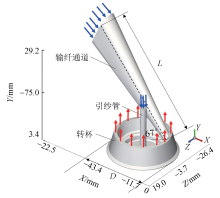
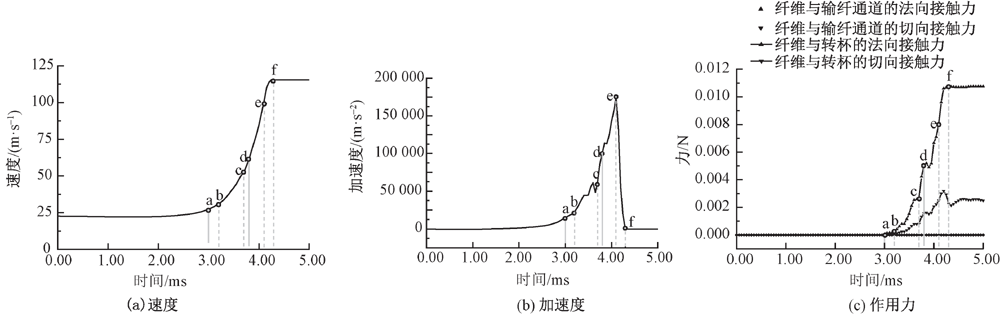
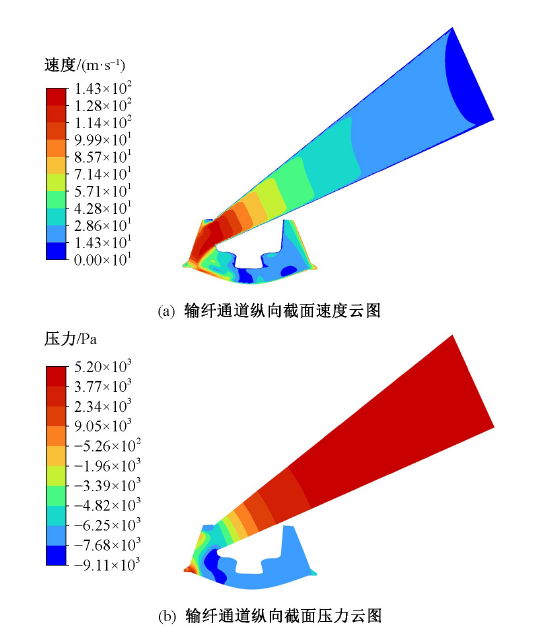
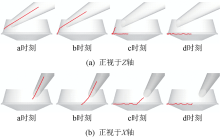
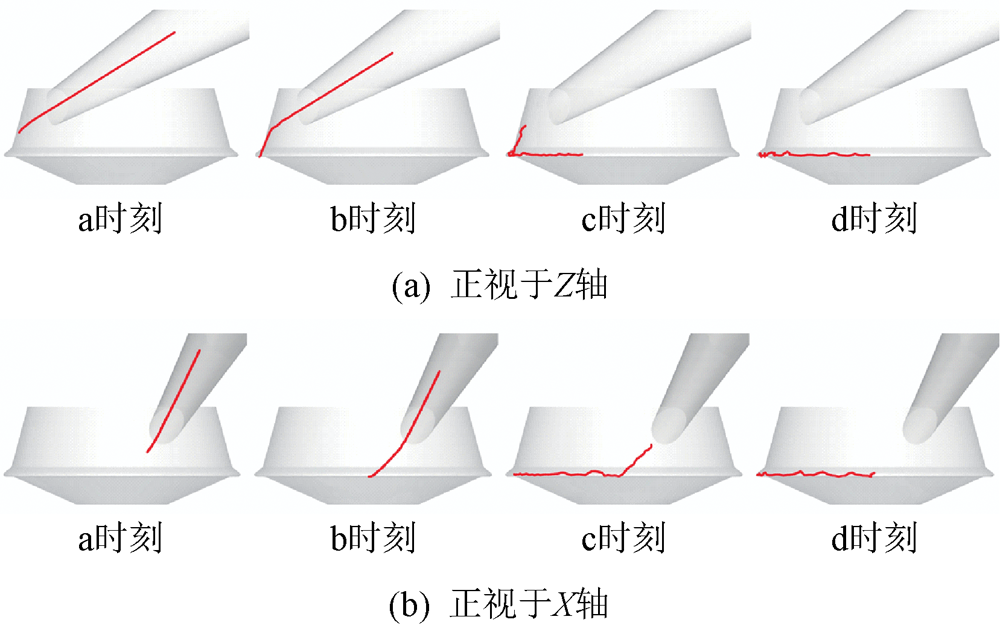
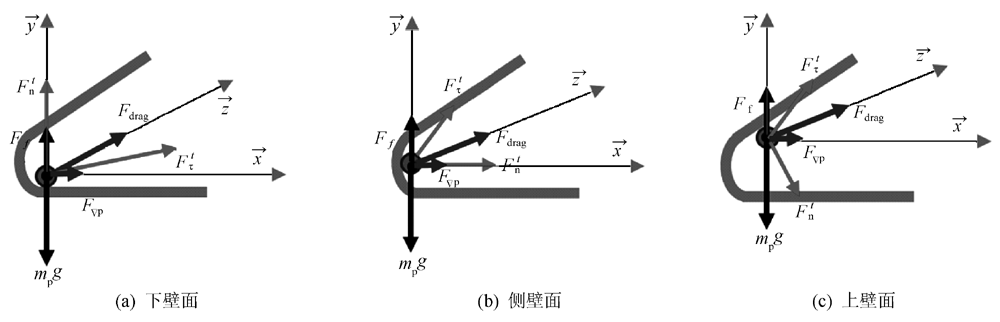
为研究转杯纺关键部件(输纤通道、转杯)中纤维运动的规律,借助数值模拟软件Rocky DEM 2022R1和ANSYS Fluent 2022R1模拟了28 mm的棉纤维在输纤通道、滑移面和凝聚槽内的运动,结合气流场云图、纤维运动控制方程对棉纤维的速度、加速度、形态变化进行分析。结果表明,纤维在纺纱器的速度呈先增后不变的规律;纤维在输纤通道的速度为22~27.4 m/s,纤维形态不会有大幅度变化;纤维在转杯内的速度为27.4~115.5 m/s,纤维在凝聚槽由多段小幅度弯折状态,转变为完全伸直紧贴凝聚槽壁面的状态。通过数值模拟分析纤维速度和形态变化的根本原因,可从理论上为生产优化和设计解决方法提供指导,对转杯纺输纤通道、转杯等关键部件的设计具有一定参考意义。
中图分类号:
| [1] | 郭臻, 李新荣, 卜兆宁, 等. 喷气涡流纺中纤维运动的三维数值模拟[J]. 纺织学报, 2019, 40(5):131-135. |
| GUO Zhen, LI Xinrong, BU Zhaoning, et al. Three-dimensional numerical simulation of fiber movement in nozzle of murata vortex spinning[J]. Journal of Textile Research, 2019, 40(5): 131-135. | |
| [2] | 杨瑞华, 何闯. 纤维在转杯和输纤通道中的运动模拟[J]. 丝绸, 2022, 59(7):40-48. |
| YANG Ruihua, HE Chuang. Simulation of fiber movement in the rotor and fiber transport channel[J]. Journal of Silk, 2022, 59(7):40-48. | |
| [3] | PEI Z G, ZHANG Y, ZHOU J. A model for the particle-level simulation of multiple flexible fibers moving in a wall-bounded fluid flow[J]. Journal of Fluids and Structures, 2018, 80: 37-38. |
| [4] | 邓茜茜, 杨瑞华. 输棉通道位置对转杯纺纤维运动的影响[J]. 丝绸, 2020, 57(8): 42-49. |
| DENG Qianqian, YANG Ruihua. Effect of fiber transport channel position on fiber motion in rotor spinning[J]. Journal of Silk, 2020, 57(8): 42-49. | |
| [5] | 林惠婷, 汪军. 纤维在输纤通道气流场中运动的模拟[J]. 纺织学报, 2018, 39(2): 55-61. |
| LIN Huiting, WANG Jun. Simulation on fiber motion in airflow field of transfer channel[J]. Journal of Textile Research, 2018, 39(2): 55-61. | |
| [6] | 熊海浪. 纤维在旋转气流场中的耦合运动机理研究[D]. 杭州: 浙江理工大学, 2022:26-33. |
| XIONG Hailang. Study on the coupled motion mechanism of fibers in a rotating airflow field[D]. Hangzhou: Zhejiang Sci-Tech University, 2022:26-33. | |
| [7] | 龚新霞, 邵秋, 刘林兵, 等. 转杯纺发展现状及成纱关键技术研究[J]. 棉纺织技术, 2023, 51(5):79-84. |
| GONG Xinxia, SHAO Qiu, LIU Linbing, et al. Rotor spining development status and yarn-forming key technology[J]. Cotton Textile Technology, 2023, 51(5):79-84. | |
| [8] | YANG R H, HE C, PAN B, et al. Effect of position of the fiber transport channel on fiber motion in the high-speed rotor[J]. Textile Research Journal, 2021, 91(19-20):2294-2302. |
| [9] | 杨瑞华, 何闯, 龚新霞, 等. 转杯纺分梳排杂区的气流场数值模拟[J]. 纺织学报, 2022, 43(10): 31-37,76. |
| YANG Ruihua, HE Chuang, GONG Xinxia, et al. Numerical simulation of airflow field in carding and trash removal zone of rotor spinning[J]. Journal of Textile Research, 2022, 43(10): 31-37,76. | |
| [10] | SCHMID C F, SWITZER L H, KLINGENBERG D J. Simulations of fiber flocculation: effects of fiber properties and interfiber friction[J]. Journal of Rheology, 2000, 44(4): 781-809. |
| [11] | HOSSEIN K, DEHKORDIA M. Prediction of equilibrium mixing state in binary particle spouted beds: effects of solids density and diameter differences, gas velocity, and bed aspect ratio[J] Advanced Powder Technology, 2015, 26(5):1371-1382. |
| [12] | MARHEINEKE N, WEGENER R. Modeling and application of a stochastic drag for fibers in turbulent flows[J]. International Journal of Multiphase Flow, 2010, 37(2):136-148. |
| [1] | 张定眺, 王倩茹, 邱芳, 李凤艳. 转杯纺分梳排杂区气流场的多维数值模拟对比[J]. 纺织学报, 2024, 45(10): 64-71. |
| [2] | 方敬兵, 沈敏, 李俊祥, 王真, 余联庆. 纤维束与异形筘内合成气流的相互耦合作用[J]. 纺织学报, 2024, 45(03): 194-201. |
| [3] | 范居乐, 张玉泽, 汪军. 动态牵伸过程中浮游纤维变速点分布模拟[J]. 纺织学报, 2024, 45(03): 44-48. |
| [4] | 李玲, 丁倩, 汪军. 转杯纺并合效应模型的构建与解析[J]. 纺织学报, 2023, 44(12): 43-49. |
| [5] | 王青, 梁高翔, 殷俊清, 盛晓超, 吕绪山, 党帅. 新型气流牵伸通道结构模型的构建与性能分析[J]. 纺织学报, 2023, 44(11): 52-60. |
| [6] | 崔月敏, 程隆棣, 和杉杉, 吕金丹, 崔益怀. 基于循环迭代法的牵伸区纤维运动仿真模拟[J]. 纺织学报, 2023, 44(02): 76-82. |
| [7] | 韩万里, 谢胜, 王新厚, 王玉栋. 熔喷气流场中的纤维运动模拟与分析[J]. 纺织学报, 2023, 44(01): 93-99. |
| [8] | 杨瑞华, 何闯, 龚新霞, 陈鹤文. 转杯纺分梳排杂区的气流场数值模拟[J]. 纺织学报, 2022, 43(10): 31-35. |
| [9] | 汪军, 史倩倩, 李玲, 张玉泽. 双喂给双分梳转杯纺技术研究进展[J]. 纺织学报, 2022, 43(08): 12-20. |
| [10] | 牛雪娟, 徐妍慧. 不同流通间隙排布条件下碳纤维束展纤行为研究[J]. 纺织学报, 2022, 43(06): 165-170. |
| [11] | 刘宜胜, 周鑫磊, 刘丹丹. 气动折入边装置中纱线初始位置对折边效果的影响[J]. 纺织学报, 2022, 43(03): 168-175. |
| [12] | 张思宇, 余莉, 贾贺, 刘鑫. 柔性伞衣织物的自由变形折叠建模及其充气机制研究[J]. 纺织学报, 2021, 42(07): 108-114. |
| [13] | 杨瑞华, 潘博, 郭霞, 王利军, 李健伟. 环锭纺及转杯纺和喷气涡流纺混色纱的纤维混合效果研究[J]. 纺织学报, 2021, 42(07): 76-81. |
| [14] | 史倩倩, 王姜, 张玉泽, 林惠婷, 汪军. 转杯纺纱器气流场形成机制的数值分析[J]. 纺织学报, 2021, 42(02): 180-184. |
| [15] | 刘宜胜, 徐光逸. 斜吹气流入射角对纱线折入的影响[J]. 纺织学报, 2020, 41(07): 72-77. |
|
||
 京公网安备11010502044800号