纺织学报 ›› 2025, Vol. 46 ›› Issue (07): 209-216.doi: 10.13475/j.fzxb.20250102101
刘颖慧1, 张昭华1,2( ), 杨艺文1
LIU Yinghui1, ZHANG Zhaohua1,2(), YANG Yiwen1
摘要:
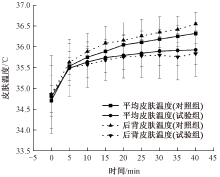
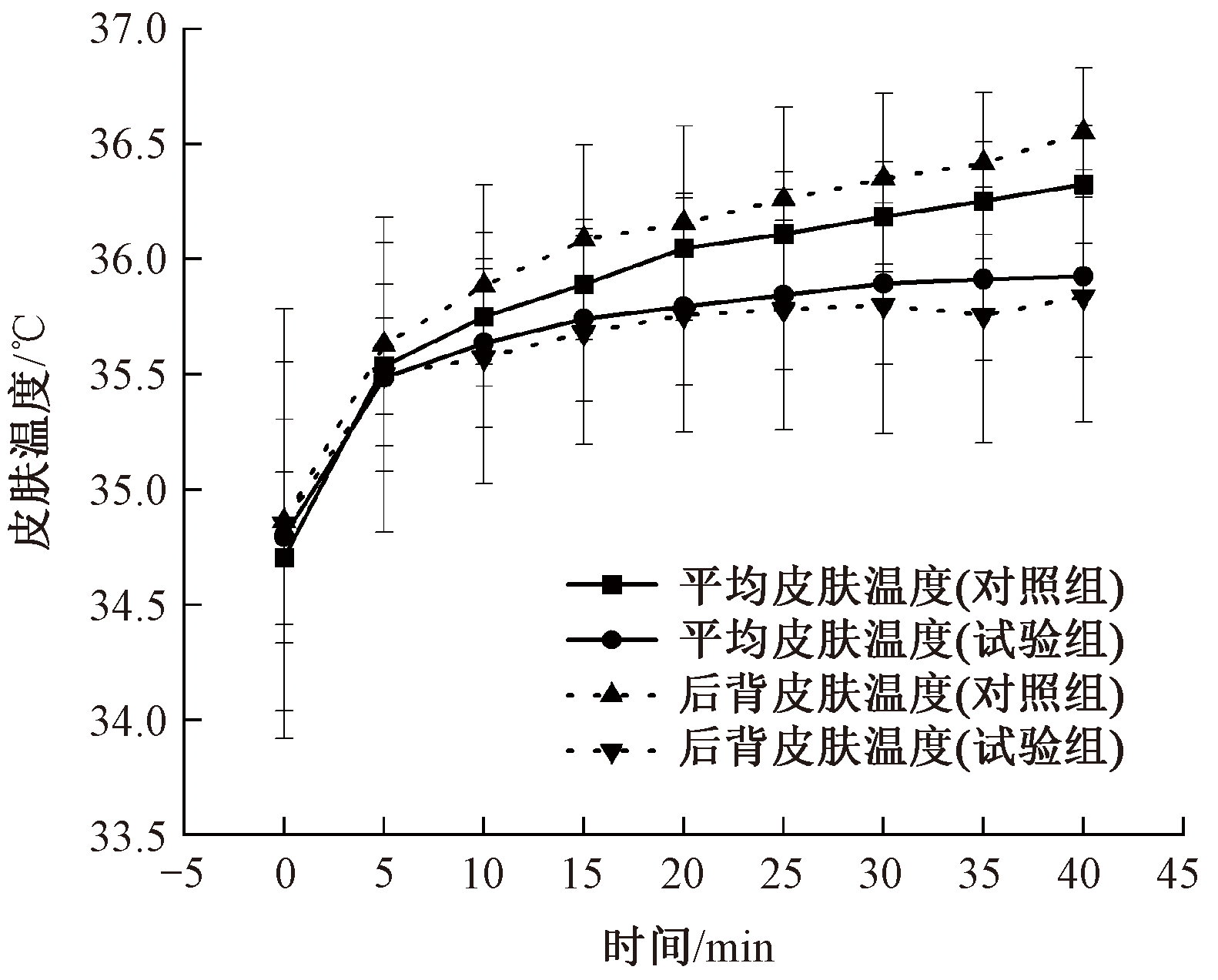
为避免高温危害,改善高温环境下人体热舒适性,降低建筑能耗,研制了一款管道式热电制冷通风服,并进行了人体着装试验和暖体假人试验。在温度为35 ℃、相对湿度为70%的人工气候舱内,6位受试者分别穿着普通工作服和热电制冷通风服进行对照试验,记录受试者的生理参数和主观感觉;另外进行了暖体假人试验,测试热电制冷通风服的冷却功率。结果表明:穿着热电制冷通风服使得人体的平均皮肤温度和后背皮肤温度分别下降了0.4和0.71 ℃,核心温度显著降低,热感觉、湿感觉和热舒适度均显著改善;通风服在2 h持续冷却时间内提供的有效冷却功率为36.56 W,单位质量冷却功为13.9 W/kg,制冷系数为0.64,具有优良的冷却性能。认为在个体降温服中应用热电制冷技术可提高服装降温效果,为个体降温服的设计研发提供了参考。
中图分类号:
| [1] |
XIANG J, BI P, PISANIELLO D, et al. Health impacts of workplace heat exposure: an epidemiological review[J]. Industrial Health, 2014, 52(2): 91-101.
doi: 10.2486/indhealth.2012-0145 pmid: 24366537 |
| [2] | LUCAS R A, EPSTEIN Y, KJELLSTROM T. Excessive occupational heat exposure: a significant ergonomic challenge and health risk for current and future workers[J]. Extreme Physiology & Medicine, 2014, 3: 1-8. |
| [3] | YANG L, YAN H, LAM J C. Thermal comfort and building energy consumption implications-a review[J]. Applied Energy, 2014, 115: 164-173. |
| [4] | CHOUDHARY B. Effectiveness of air ventilation clothing in hot and humid environment for decreasing and intermittent activity scenarios[J]. Building and Environment, 2023. DOI: 10.1016/j.buildenv.2023.110436. |
| [5] | CHEN X, ZHANG Z. Experimental comparison of cooling power and thermos-physiological performance of two hybrid cooling clothing: thermoelectric and PCM-fans ventilated garments[J]. Building and Environment, 2024. DOI:10.1016/j.buildenv.2024.111276. |
| [6] | YANG J, ZHANG Y, HUANG Y, et al. Effects of liquid cooling garment on physiological and psychological strain of firefighter in hot and warm environments[J]. Journal of Thermal Biology, 2023. DOI: 10.1016/j.jtherbio.2023.103487. |
| [7] | SONG W, LU W, YU S, et al. Evaluating a novel portable semiconductor liquid cooling garment for reducing heat stress of healthcare workers in a hot-humid environment[J]. Building and Environment, 2025. DOI: 10.1016/j.buildenv.2024.112194. |
| [8] | WANG H, XU Z, GE B, et al. Experimental study on a phase change cooling garment to improve thermal comfort of factory workers[J]. Building and Environment, 2023. DOI: 10.1016/j.buildenv.2022.109819. |
| [9] | MOUSSALEM C K, MNEIMNEH F, SARIEDDINE R, et al. Effect of phase change material cooling vests on body thermoregulation and thermal comfort of patients with paraplegia: a human subject experimental study[J]. Global Spine Journal, 2023, 13(7): 1754-1764. |
| [10] |
GUAN M, LI J. Garment size effect of thermal protective clothing on global and local evaporative cooling of walking manikin in a hot environment[J]. International Journal of Biometeorology, 2020, 64: 485-499.
doi: 10.1007/s00484-019-01836-5 pmid: 32016640 |
| [11] | GUO Y, CHAN A P, WONG F K, et al. Developing a hybrid cooling vest for combating heat stress in the construction industry[J]. Textile Research Journal, 2019, 89(3): 254-269. |
| [12] | SONG W, WANG F, WEI F. Hybrid cooling clothing to improve thermal comfort of office workers in a hot indoor environment[J]. Building and Environment, 2016, 100: 92-101. |
| [13] | ZHAO M, GAO C, WANG F, et al. A study on local cooling of garments with ventilation fans and openings placed at different torso sites[J]. International Journal of Industrial Ergonomics, 2013, 43(3): 232-237. |
| [14] |
党天华, 赵蒙蒙, 钱静. 基于微型风扇阵列的通风服研发与测评[J]. 现代纺织技术, 2022, 30(4): 214-221.
doi: 10.19398/j.att.202109021 |
|
DANG Tianhua, ZHAO Mengmeng, QIAN Jing. Development and evaluation of ventilation clothing based on micro fan array[J]. Advanced Textile Technology, 2022, 30(4): 214-221.
doi: 10.19398/j.att.202109021 |
|
| [15] |
吴国珊, 刘何清, 吴世先, 等. 不同环境下个体通风服的制冷量[J]. 纺织学报, 2021, 42(10): 139-145.
doi: 10.13475/j.fzxb.20200908507 |
|
WU Guoshan, LIU Heqing, WU Shixian, et al. Cooling capacity of personal ventilation systems in different environments[J]. Journal of Textile Research, 2021, 42(10): 139-145.
doi: 10.13475/j.fzxb.20200908507 |
|
| [16] | 吴国珊, 韦徐美, 刘何清, 等. 湿热和干热环境下通风服的冷却效果[J]. 毛纺科技, 2023, 51(6): 110-116. |
| WU Guoshan, WEI Xumei, LIU Heqing, et al. Cooling effect of ventilation suits in humid and dry heat environments[J]. Wool Textile Journal, 2023, 51(6): 110-116. | |
| [17] |
CHAN A P, ZHANG Y, WANG F, et al. A field study of the effectiveness and practicality of a novel hybrid personal cooling vest worn during rest in Hong Kong construction industry[J]. Journal of Thermal Biology, 2017, 70: 21-27.
doi: S0306-4565(17)30006-2 pmid: 29074022 |
| [18] |
CHAN A P, YANG Y, SONG W F. Evaluating the usability of a commercial cooling vest in the Hong Kong industries[J]. International Journal of Occupational Safety and Ergonomics, 2018, 24(1): 73-81.
doi: 10.1080/10803548.2017.1282237 pmid: 28100117 |
| [19] | ZHAO D, LU X, FAN T, et al. Personal thermal management using portable thermoelectrics for potential building energy saving[J]. Applied Energy, 2018, 218: 282-291. |
| [20] | LOU L, SHOU D, PARK H, et al. Thermoelectric air conditioning undergarment for personal thermal management and HVAC energy saving[J]. Energy and Buildings, 2020. DOI: 10.1016/j.enbuild.2020.110374. |
| [21] | HOYT T, ARENS E, ZHANG H. Extending air temperature setpoints: simulated energy savings and design considerations for new and retrofit buildings[J]. Building and Environment, 2015, 88: 89-96. |
| [22] | 张昭华, 李璐瑶, 安瑞平. 管道式通风服头部与躯干部位的热湿舒适性评价[J]. 纺织学报, 2020, 41(8): 88-94. |
| ZHANG Zhaohua, LI Luyao, AN Ruiping. Thermal-wet comfort evaluation of head and torso ventilation of pipe garment[J]. Journal of Textile Research, 2020, 41(8): 88-94. | |
| [23] | MITCHELL D, WYNDHAM C. Comparison of weighting formulas for calculating mean skin temper-ature[J]. Journal of Applied Physiology, 1969, 26(5): 616-622. |
| [24] | WANG H, ZHANG G, LIN H, et al. Study on a ventilating vest with thermoelectric cooling to improve thermal comfort and cognitive ability[J]. Energy and Buildings, 2025. DOI: 10.1016/j.enbuild.2024.115188. |
| [1] | 钱静, 赵蒙蒙, 党天华. 多孔式通风服衣下空气层的定量研究[J]. 纺织学报, 2022, 43(04): 133-139. |
| [2] | 张昭华, 陈之瑞, 李璐瑶, 肖平, 彭浩然, 张钰涵. 人体局部皮肤的气流敏感性及其影响因素[J]. 纺织学报, 2021, 42(12): 125-130. |
| [3] | 吴国珊, 刘何清, 吴世先, 游波, 宋小鹏. 不同环境下个体通风服的制冷量[J]. 纺织学报, 2021, 42(10): 139-145. |
| [4] | 赵敬德, 丁义冉, 张春红. 室外高温环境下通风服装的传热模型与实验研究[J]. 纺织学报, 2021, 42(06): 153-159. |
| [5] | 张昭华, 李璐瑶, 安瑞平. 管道式通风服头部与躯干部位的热湿舒适性评价[J]. 纺织学报, 2020, 41(08): 88-94. |
| [6] | 赵蒙蒙, 柯莹, 王发明, 李俊. 通风服热舒适性研究现状与展望[J]. 纺织学报, 2019, 40(03): 183-188. |
| [7] | 范一强 贺建芸 刘士成 高克鑫 张亚军. 制冷与制热空调服的研究进展[J]. 纺织学报, 2018, 39(07): 174-180. |
| [8] | 赵蒙蒙 宋晓霞. 通风服装对人体热舒适的影响[J]. 纺织学报, 2017, 38(10): 94-97. |
| [9] | 许静娴 李俊 刘慧娟 王云仪. 热调节暖体假人在着装舒适性评价中的应用现状[J]. 纺织学报, 2017, 38(07): 164-172. |
| [10] | 张向辉;王云仪;李俊;张文斌. 防护服装结构设计对着装舒适性的影响[J]. 纺织学报, 2009, 30(06): 138-144. |
|
||
 京公网安备11010502044800号