纺织学报 ›› 2026, Vol. 47 ›› Issue (04): 215-224.doi: 10.13475/j.fzxb.20250603501
李宇彤1, 于施佳2, 韩曙光3( )
)
LI Yutong1, YU Shijia2, HAN Shuguang3()
摘要:
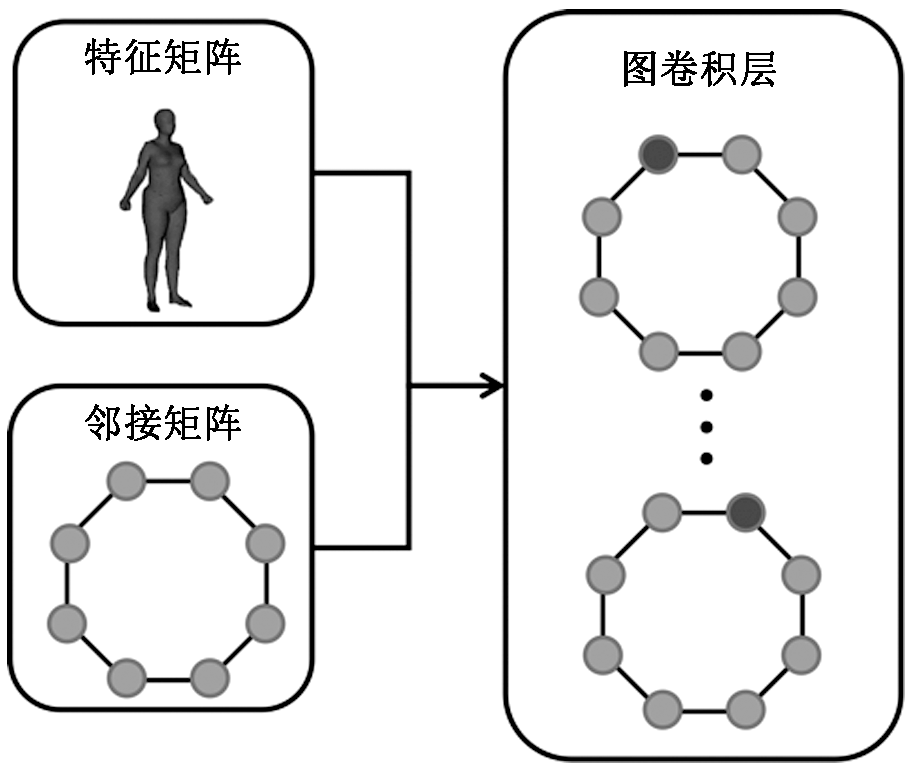
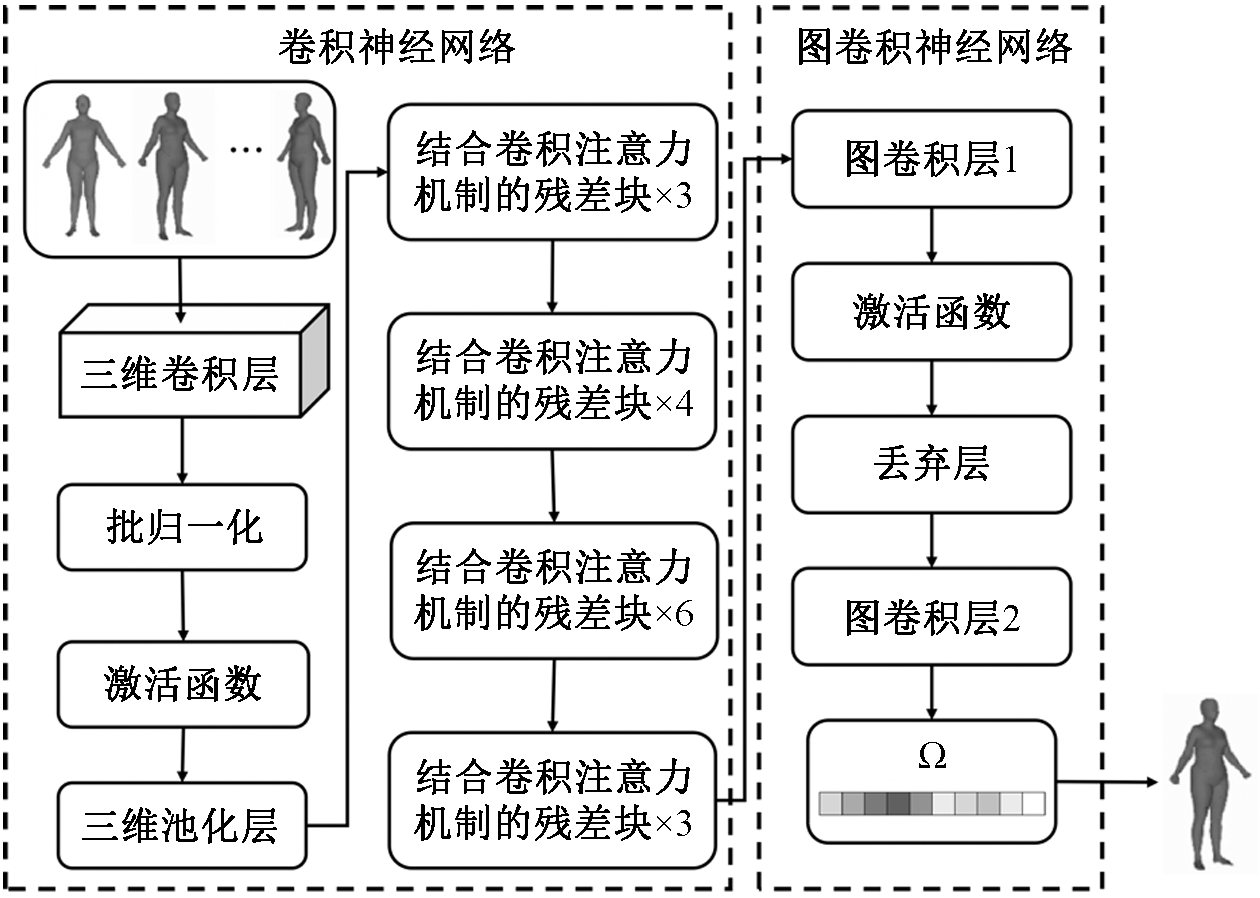
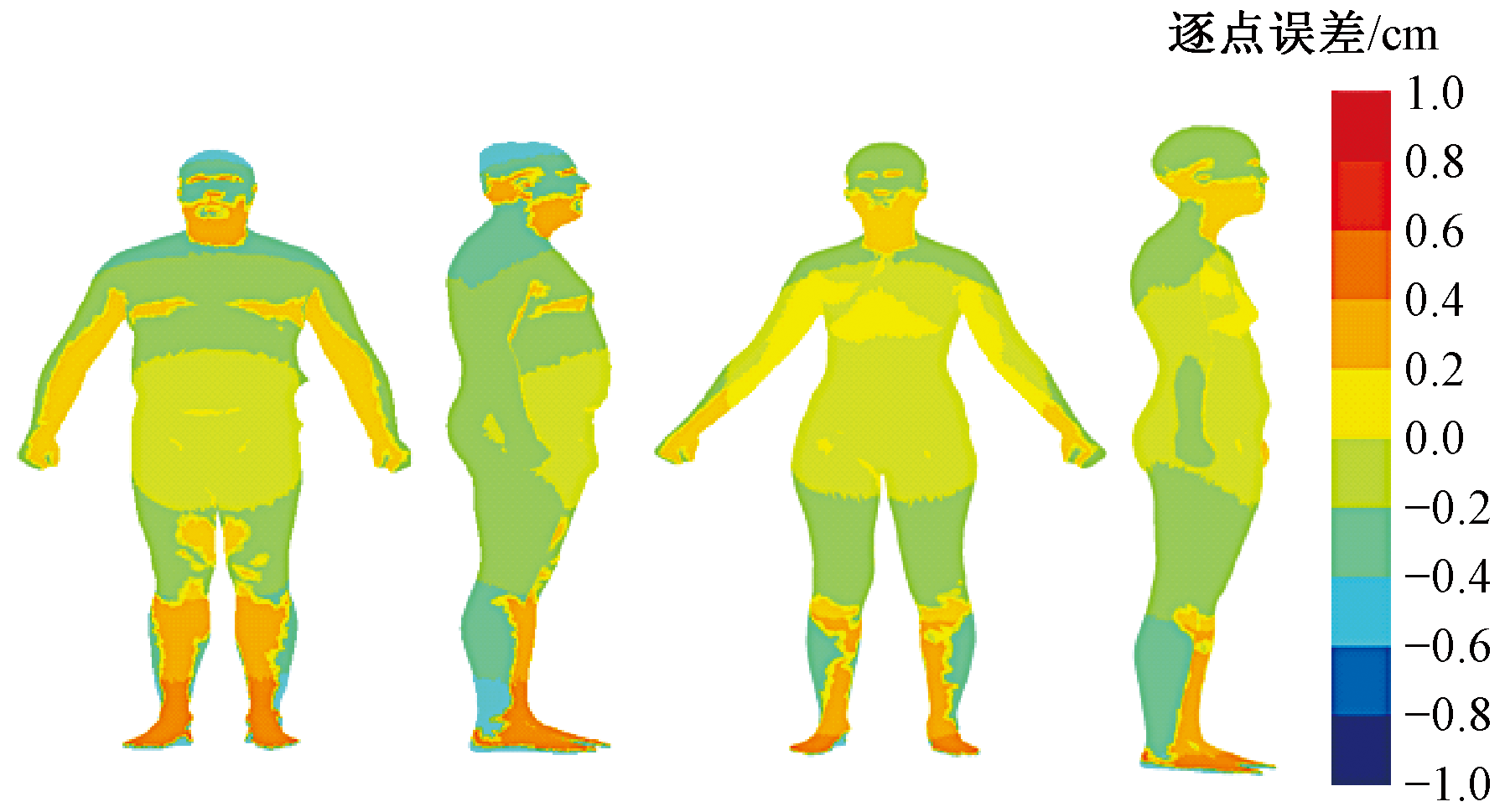
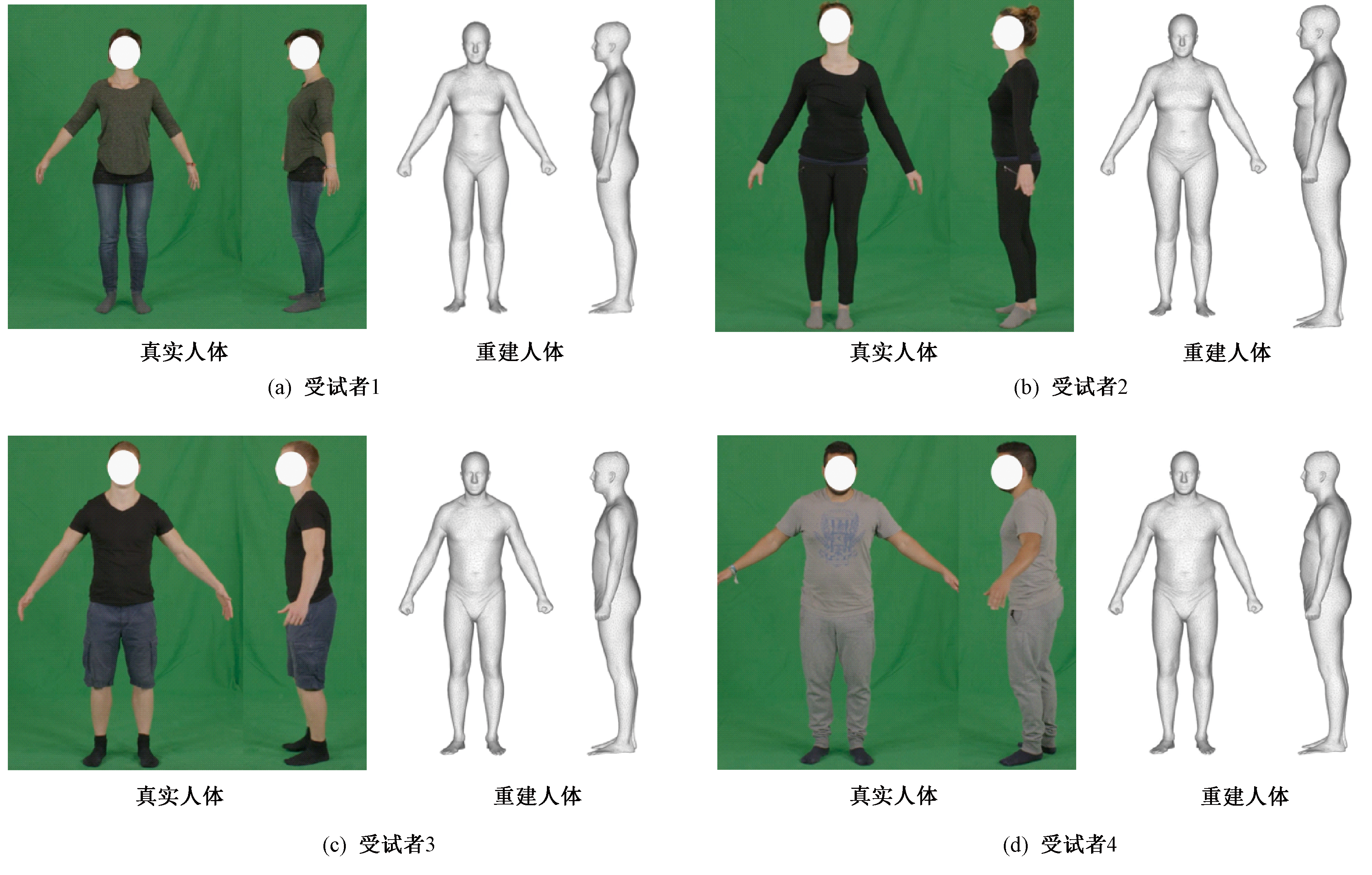
针对多视图三维人体重建中缺少特征融合的问题,提出一种结合卷积神经网络与图卷积神经网络的重建模型。通过采集人体水平旋转360°的视频序列,提取出包含人体不同视图信息的关键帧,利用主成分分析将三维人体模型压缩为k维系数表征。在此基础上,通过改进的ResNet-50网络提取多视图特征,并引入卷积块注意力模块强化“空间-通道”特征选择能力。将不同视图特征定义为图节点,利用图卷积层捕获多视图间拓扑关系,实现特征信息的跨视图传播,提升多视图特征融合能力。实验结果表明:该方法提取的平均顶点误差均小于0.5 cm;人体基本围度的误差百分比均小于5%;消融实验验证了图卷积网络结构拥有更高的重建准确率。该网络可有效刻画多视图间的几何约束关系,为虚拟试衣系统提供高精度的人体重建解决方法。
中图分类号:
| [1] | 程碧莲, 蒋高明, 李炳贤. 三维服装虚拟展示技术的研究进展[J]. 纺织学报, 2024, 45(5): 248-257. |
| CHENG Bilian, JIANG Gaoming, LI Bingxian. Research progress in three-dimensional garment virtual display technology[J]. Journal of Textile Research, 2024, 45(5): 248-257. | |
| [2] | ZENG Y H, FU J L, CHAO H Y. 3D human body reshaping withAnthropometric modeling[C]// Internet Multimedia Computing and Service. Singapore: Springer, 2018: 96-107. |
| [3] |
ZHAO T H, LI S N, NGAN K N, et al. 3-D reconstruction of human body shape from a single commodity depth camera[J]. IEEE Transactions on Multimedia, 2019, 21(1): 114-123.
doi: 10.1109/TMM.2018.2844087 |
| [4] |
季勇, 蒋高明. 基于学习功能的人体模型表达与实现[J]. 纺织学报, 2021, 42(10): 146-149, 156.
doi: 10.13475/j.fzxb.20200802605 |
|
JI Yong, JIANG Gaoming. Expression and realization of human body model based on learning model[J]. Journal of Textile Research, 2021, 42(10): 146-149, 156.
doi: 10.13475/j.fzxb.20200802605 |
|
| [5] | VAROL G, CEYLAN D, RUSSELL B, et al. BodyNet: volumetric inference of 3D human body shapes[C]//Computer Vision - ECCV 2018. Cham: Springer, 2018: 20-38. |
| [6] | BOGO F, KANAZAWA A, LASSNER C, et al. Keep it SMPL: automatic estimation of 3D human pose and shape from a single image[C]//Computer Vision - ECCV 2016. Cham: Springer, 2016: 561-578. |
| [7] | DIBRA E, JAIN H, ÖZTIRELI C, et al. HS-nets:estimating human body shape from silhouettes with convolutional neural networks[C]//2016 Fourth International Conference on 3D Vision (3DV). New York: IEEE, 2016: 108-117. |
| [8] | 王婷, 顾冰菲. 基于图像的人体颈肩部三维模型构建[J]. 纺织学报, 2021, 42(1): 125-132. |
|
WANG Ting, GU Bingfei. 3-D modeling of neck-shoulder part based on human photos[J]. Journal of Textile Research, 2021, 42(1): 125-132.
doi: 10.1177/004051757204200210 |
|
| [9] | LIU B, LIU X P, YANG Z X, et al. Concise and effective network for 3D human modeling from orthogonal silhouettes[EB/OL]. 2019: arXiv: 1912.11616. https://arxiv.org/abs/1912.11616. |
| [10] | XIU Y L, YANG J L, CAO X, et al. ECON:explicit Clothed humans Optimized via Normal integra-tion[C]//2023 IEEE/CVF Conference on Computer Vision and Pattern Recognition (CVPR). New York: IEEE, 2023: 512-523. |
| [11] | ZHANG G J, YAO N J, ZHANG S S, et al.MultiGO:towards multi-level geometry learning for monocular 3D textured human reconstruction[C]//2025 IEEE/CVF Conference on Computer Vision and Pattern Recognition (CVPR). New York: IEEE, 2025: 338-347. |
| [12] | SU H, MAJI S, KALOGERAKIS E, et al.Multi-view convolutional neural networks for 3-D shape recognition[C]//2015 IEEE International Conference on Computer Vision (ICCV). New York: IEEE, 2016: 945-953. |
| [13] | CHEN X Z, MA H M, WAN J, et al.Multi-view 3D object detection network for autonomous driving[C]//2017 IEEE Conference on Computer Vision and Pattern Recognition (CVPR). New York: IEEE, 2017: 6526-6534. |
| [14] | WEI X, YU R X, SUN J.View-GCN:view-based graph convolutional network for 3D shape analy-sis[C]//2020 IEEE/CVF Conference on Computer Vision and Pattern Recognition (CVPR). New York: IEEE, 2020: 1847-1856. |
| [15] | ALLEN B, CURLESS B, POPOVIĆ Z. The space of human body shapes: reconstruction and parameterization from range scans[J]. ACM Transactions on Graphics, 2003, 22(3): 587-594. |
| [16] | ANGUELOV D, SRINIVASAN P, KOLLER D, et al. SCAPE: shape completion and animation of peo-ple[M]// Seminal graphics papers:pushing the boundaries, volume 2. New York, NY, USA: ACM, 2023: 819-827. |
| [17] | LOPER M, MAHMOOD N, ROMERO J, et al. SMPL: a skinned multi-person linear model[M]// Seminal graphics papers:pushing the boundaries, volume 2. New York, NY, USA: ACM, 2023: 851-866. |
| [18] | YANG Y P, YU Y, ZHOU Y, et al. Semantic parametric reshaping of human body models[C]// 2014 2nd International Conference on 3D Vision. New York: IEEE, 2015: 41-48. |
| [19] | WOO S, PARK J, LEE J Y, et al. CBAM: convolutional block attention module[C]//Computer Vision - ECCV 2018. Cham: Springer, 2018: 3-19. |
| [20] | SAITO S, HUANG Z, NATSUME R, et al. PIFu:pixel-aligned implicit function for high-resolution clothed human digitization[C]//2019 IEEE/CVF International Conference on Computer Vision (ICCV). New York: IEEE, 2020: 2304-2314. |
| [21] | ALLDIECK T, MAGNOR M, XU W P, et al. Video based reconstruction of 3D people models[C]// 2018 IEEE/CVF Conference on Computer Vision and Pattern Recognition. New York: IEEE, 2018: 8387-8397. |
| [1] | 都晓广, 景军锋, 王永波. 基于改进YOLOv9s的轻量级蕾丝织物表面缺陷检测方法研究[J]. 纺织学报, 2026, 47(04): 145-153. |
| [2] | 吕泽彬, 李子印, 汪小东, 叶飞, 刘伟红. 基于三阶段残差动态聚焦网络的羽绒图像分类[J]. 纺织学报, 2026, 47(02): 73-83. |
| [3] | 冯峥嵘, 刘贝芬, 陈孟元. 基于多尺度特征融合的花卉类印花图案风格迁移模型[J]. 纺织学报, 2026, 47(02): 264-272. |
| [4] | 冯采伶, 于施佳, 韩曙光. 基于深度学习的服装关键点实时检测模型[J]. 纺织学报, 2026, 47(01): 196-206. |
| [5] | 张晓婷, 赵鹏宇, 潘如如, 高卫东. 基于深度特征融合的格子织物图像检索方法[J]. 纺织学报, 2025, 46(08): 89-95. |
| [6] | 罗瑞奇, 常大顺, 胡新荣, 梁金星, 彭涛, 陈佳, 李丽. 基于改进外观流网络的跨体态虚拟试衣[J]. 纺织学报, 2025, 46(06): 203-211. |
| [7] | 陆寅雯, 侯珏, 杨阳, 顾冰菲, 张宏伟, 刘正. 基于姿态嵌入机制和多尺度注意力的单张着装图像视频合成[J]. 纺织学报, 2024, 45(07): 165-172. |
| [8] | 胡旭东, 汤炜, 曾志发, 汝欣, 彭来湖, 李建强, 王博平. 基于轻量化卷积神经网络的纬编针织物组织结构分类[J]. 纺织学报, 2024, 45(05): 60-69. |
| [9] | 顾梅花, 花玮, 董晓晓, 张晓丹. 基于上下文提取与注意力融合的遮挡服装图像分割[J]. 纺织学报, 2024, 45(05): 155-164. |
| [10] | 师红宇, 位营杰, 管声启, 李怡. 基于残差结构的棉花异性纤维检测算法[J]. 纺织学报, 2023, 44(12): 35-42. |
| [11] | 马创佳, 齐立哲, 高晓飞, 王子恒, 孙云权. 基于改进YOLOv4-Tiny的缝纫线迹质量检测方法[J]. 纺织学报, 2023, 44(08): 181-188. |
| [12] | 袁甜甜, 王鑫, 罗炜豪, 梅琛楠, 韦京艳, 钟跃崎. 基于注意力机制和视觉转换器的三维虚拟试衣网络[J]. 纺织学报, 2023, 44(07): 192-198. |
| [13] | 付晗, 胡峰, 龚杰, 余联庆. 面向织物疵点检测的缺陷重构方法[J]. 纺织学报, 2023, 44(07): 103-109. |
| [14] | 陈佳, 杨聪聪, 刘军平, 何儒汉, 梁金星. 手绘草图到服装图像的跨域生成[J]. 纺织学报, 2023, 44(01): 171-178. |
| [15] | 顾梅花, 刘杰, 李立瑶, 崔琳. 结合特征学习与注意力机制的服装图像分割[J]. 纺织学报, 2022, 43(11): 163-171. |
|
||
 京公网安备11010502044800号