纺织学报 ›› 2024, Vol. 45 ›› Issue (11): 88-98.doi: 10.13475/j.fzxb.20231100301
陆爽怿1,2, 周赳1,2( )
)
LU Shuangyi1,2, ZHOU Jiu1,2()
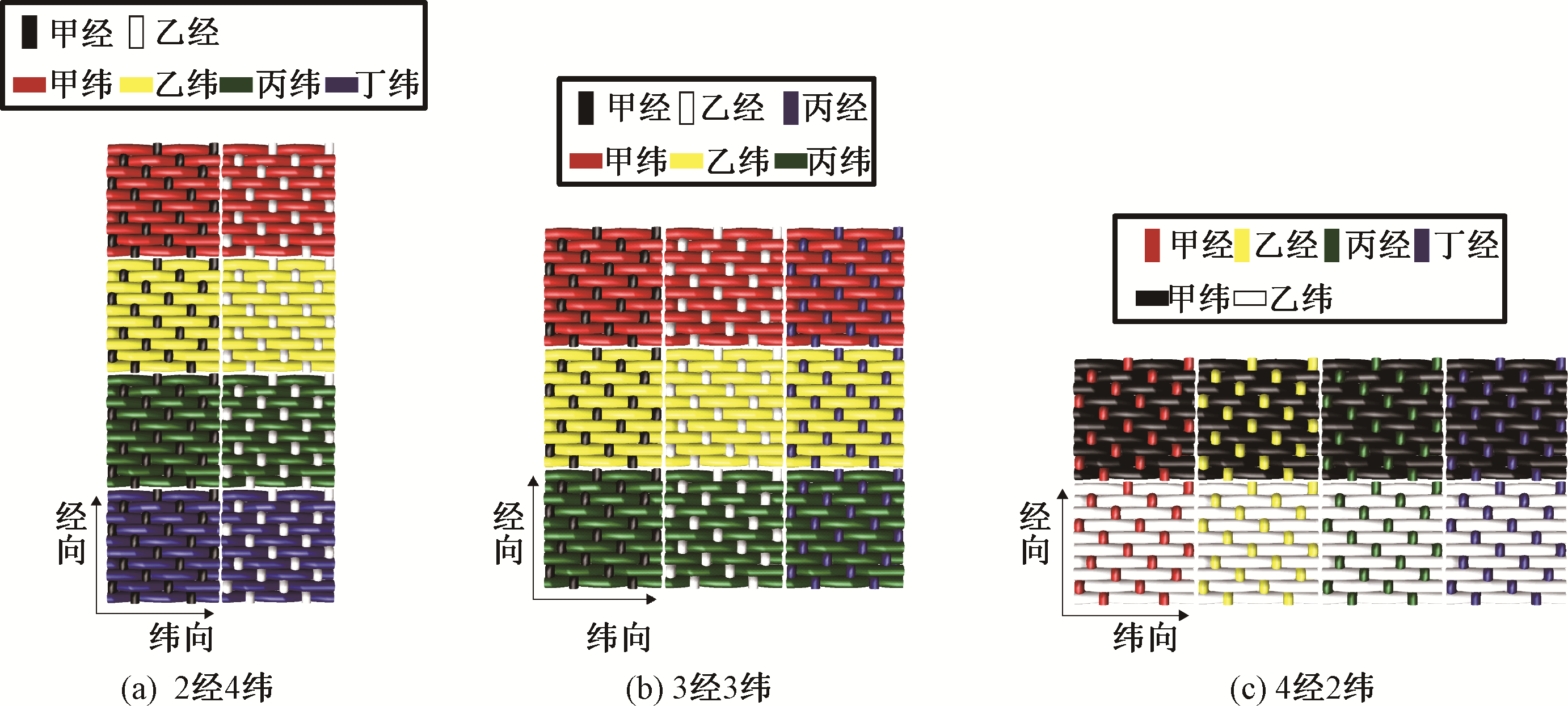
摘要: 针对数码提花结构经纬基色配置及选取受限导致结构显色色域不足的问题,在分层组合设计模式下构建了基于双向多基色的2经4纬的基本模型和2经6纬的衍生模型,以红、绿、黄、蓝、黑、白为纱线色,分别形成48和1 440种经纬配置方法及28和124类表里层关系,全息组织被用于调控色相、纯度及明度来扩充提花结构显色色域空间,2种模型的代表性显色组织与显色组合组织总数的最大值分别为3 605 139与84 392 722 413,最后通过织物模拟来验证2种模型的结构显色适用性。结果表明:经向与经纬双向配置黑、白丝线以及纬向配置红、黄、绿、蓝丝线,利用全息组织可令2种结构模型的结构显色理论色彩数目分别达106级和1011级,为全色域效果的数码提花织物开发及智能化设计研究提供参考。
中图分类号:
| [1] | 周赳, 龚素娣. 电子提花彩色像景织物的设计原理[J]. 丝绸, 2001 (9): 31-33, 37. |
| ZHOU Jiu, GONG Sudi. The design principle of colorful woven photograph in electronic Jacquard[J]. Journal of Silk, 2001 (9): 31-33, 37. | |
| [2] |
张爱丹, 周赳. 全显技术组织对三纬组合织物结构混色规律的影响[J]. 纺织学报, 2018, 39(10): 44-49.
doi: 10.13475/j.fzxb.20171010706 |
|
ZHANG Aidan, ZHOU Jiu. Influence of full-color weave on color mixing law of compound fabric structure with triple-weft[J]. Journal of Textile Research, 2018, 39(10): 44-49.
doi: 10.13475/j.fzxb.20171010706 |
|
| [3] | CHUNG Jih Lung. Method for manufacturing jacquard with colored image: USA, US6185475[P]. 2001-02-06. |
| [4] | 李加林, 陶永政. 数码仿真彩色丝织技术及其应用[J]. 纺织学报, 2004, 25(1): 123-125. |
| LI Jialin, TAO Yongzheng. Digital emulative color silk weaving technique and application[J]. Journal of Textile Research, 2004, 25(1): 123-125. | |
| [5] | 李加林. 现代丝织像景织物及结构设计特征[J]. 丝绸, 2004(3): 11-13. |
| LI Jialin. Modern silk weaving photograph and its structure design features[J]. Journal of Silk, 2004(3): 11-13. | |
| [6] | SPEICH Francisco. Patterned fabric and a method for the production thereof: USA, US6994120[P]. 2006-02-07. |
| [7] | OSAKI Keiji. Reproduction of various colors on Jacquard textiles by only eight kinds of color wefts[C]// 9th Congress of the International Colour Association. Belingham: SPIE, 2002: 740-744. |
| [8] | NG Frankie, ZHOU Jiu. Innovative layered-combination mode for digital jacquard fabric design[J]. Textile Research Journal, 2009, 79(8): 737-743. |
| [9] | 陆爽怿, 周赳. 单经双纬组合全显色提花织物的结构交织平衡特征[J]. 纺织学报, 2021, 42(9): 59-65. |
| LU Shuangyi, ZHOU Jiu. Balanced interlacement characteristics of compound full-color jacquard structure with single warp and double wefts[J]. Journal of Textile Research, 2021, 42(9): 59-65. | |
| [10] | 周赳, 胡伊丽. 等经浮长的三纬组合全显结构设计与应用[J]. 纺织学报, 2023, 44(6): 78-84. |
| ZHOU Jiu, HU Yili. Design and application of equal float length on full-color weave in triple-weft jacquard fabric structures[J]. Journal of Textile Research, 2023, 44(6): 78-84. | |
| [11] |
张爱丹, 郭珍妮, 汪阳子. 模块组合全显色结构提花织物设计与仿色优化比较[J]. 纺织学报, 2021, 42(10): 67-74.
doi: 10.13475/j.fzxb.20201101308 |
|
ZHANG Aidan, GUO Zhenni, WANG Yangzi. Comparative research on color simulation optimization of jacquard fabric based on modularized compound full-color structure[J]. Journal of Textile Research, 2021, 42(10): 67-74.
doi: 10.13475/j.fzxb.20201101308 |
|
| [12] | 张爱丹. 色彩仿真数码提花织物的纹制工艺特征分析[J]. 装饰, 2022, (6): 136-138. |
| ZHANG Aidan. Characteristic analysis of weave pattern production process of color simulation digital Jacquard fabric[J]. Art & Design, 2022, (6): 136-138. | |
| [13] | KIM K R, XIN J H, ZENG L. CMYK channel modification to optimize optical yarn color mixing effects for multicolored jacquard artwork reproduction[J]. Textile Research Journal, 2022, 92(13/14): 2357-2367. |
| [14] | ZENG Lei, KIM Ken Ri, XIN John H. A feasible weave color scope inspection by using primary yarn colors to improve jacquard reproduction quality[J]. Textile Research Journal, 2022, 92(19/20): 3641-3652. |
| [15] | HUA Tao, TANG Lau Yiu, CHIU Wing Yan, et al. Color attributes of colored-yarn mixed woven fabrics made of raw-white warps and multicolored wefts and based on weft-backed structures[J]. Polymers, 2018, 10(2): 1-8. |
| [16] | CHAE Youngjoo. A spectral reflectance-based approach for formulating color mixing recipes for single- and multi-layered woven structures[J]. Scientific Reports, 2022, 12(1): 1-7. |
| [17] | SPEICH Francisco. Method of manufacturing colored patterned, aerial textile structures, system for carrying out the method and aerial textile structure formed in accordance with the method: USA, US6390143[P], 2002-05-21. |
| [18] | 罗炳金. 棉织锦3种色彩组织模型设计与应用[J]. 纺织学报, 2012, 33(7): 39-44. |
| LUO Bingjin. Design and application of three models of color figured patterns for woven cotton brocade[J]. Journal of Textile Research, 2012, 33(7): 39-44. | |
| [19] | MATHUR Kavita, et al.SEYAM Abdel-Fattah M, HINKS David, Towards automation of color/weave selection in Jacquard design: model verification[J]. Color Research and Application, 2009, 34(3): 225-232. |
| [20] | 李启正. 多色经提花织物用于彩色图像表现的创新设计技术[D]. 杭州: 浙江理工大学, 2005: 10-46. |
| LI Qizheng. An innovative design method on multi-warp jacquard fabric to imitate color image[D]. Hangzhou: Zhejiang Sci-Tech University, 2005: 10-46. | |
| [21] | 黄伟斌, 罗来丽, 周赳. 四色经高密度数码提花丝织物的设计实践[J]. 丝绸, 2011, 48(1): 34-36. |
| HUANG Weibin, LUO Laili, ZHOU Jiu. Design practice on 4-color warps high density jacquard silk tapestry[J]. Journal of Silk, 2011, 48(1): 34-36. | |
| [22] | 黄伟斌, 罗来丽, 周赳. 高密度多色经提花丝织物的数码化设计[J]. 纺织学报, 2011, 32(6): 56-60. |
| HUANG Weibin, LUO Laili, ZHOU Jiu. Digital design of high density multicolored-warp jacquard silk brocade[J]. Journal of Textile Research, 2011, 32(6): 56-60. | |
| [23] | 周赳, 段丽娜, 屠永坚. 双经双纬渐变显色提花织物设计原理与方法[J]. 纺织学报, 2016, 37(6): 36-41, 47. |
| ZHOU Jiu, DUAN Lina, TU Yongjian. Design principle and method of color gradient expression on double-warp double-weft jacquard fabric[J]. Journal of Textile Research, 2016, 37(6): 36-41, 47. | |
| [24] | 刘志娟. 双经三纬渐变显色提花织物设计研究与实践[D]. 杭州: 浙江理工大学, 2020: 6-45. |
| LIU Zhijuan. Design research and practice of color gradient effect jacquard fabric with double-warps and three-wefts[D]. Hangzhou: Zhejiang Sci-Tech University, 2020: 6-45. |
| [1] | 穆秀萍, 蒋高明, 陈钰珊, 李炳贤. 纬编多针道织物数字化设计方法[J]. 纺织学报, 2024, 45(11): 106-113. |
| [2] | 姜绍华, 梁帅童, 裴刘军, 张红娟, 王际平. 基于概率密度函数的织物染色侵入动力学分析[J]. 纺织学报, 2023, 44(10): 90-97. |
| [3] | 尹昂, 丛洪莲. 经编单向导湿织物设计与结构优化[J]. 纺织学报, 2023, 44(04): 86-91. |
| [4] | 方镁淇, 王茜, 李彦, 李超婧, 黎昊, 王璐. 女性压力性尿失禁吊带的设计及其体外力学性能评价[J]. 纺织学报, 2022, 43(03): 38-43. |
| [5] | 张萌, 周赳. 附加纬接结的双层全显色结构设计原理和方法[J]. 纺织学报, 2022, 43(03): 83-88. |
| [6] | 彭稀, 屠永坚, 周赳. 纬排2比1纬二重渐变显色结构设计原理与方法[J]. 纺织学报, 2021, 42(12): 63-69. |
| [7] | 黄锦波, 祝成炎, 张红霞, 洪兴华, 周志芳. 基于剑杆织机改造的三维间隔机织物工艺设计[J]. 纺织学报, 2021, 42(06): 166-170. |
| [8] | 孟灵灵, 魏取福, 严忠杰, 仲珍珍, 王小慧, 沈佳宇, 陈洪炜. 磁控溅射Ag/ZnO纳米薄膜涤纶织物的制备及其性能[J]. 纺织学报, 2021, 42(03): 143-148. |
| [9] | 吕庆涛, 赵世波, 杜培健, 陈利. 树脂基纺织复合材料疲劳性能表征与分析方法研究现状[J]. 纺织学报, 2021, 42(01): 181-189. |
| [10] | 金诗怡, 周赳. 具有双层效果的提花-印花-剪花织物的设计[J]. 纺织学报, 2020, 41(06): 48-54. |
| [11] | 李聃阳, 王瑞, 刘星, 张淑洁, 夏兆鹏, 阎若思, 代二庆. 剪切增稠液对不同结构芳纶织物防刺性能的影响[J]. 纺织学报, 2020, 41(03): 106-112. |
| [12] | 周赳, 陆爽怿. 数码提花织物分层组合设计原理及其实践[J]. 纺织学报, 2020, 41(02): 58-63. |
| [13] | 孙婷, 吕智宁, 李艳清, 祝成炎, 田伟. 立体几何褶皱织物的成型与织造[J]. 纺织学报, 2020, 41(02): 64-68. |
| [14] | 张爱丹, 周赳. 基于图像色网点化设计的织物结构呈色特征[J]. 纺织学报, 2019, 40(09): 56-61. |
| [15] | 张萌 周赳. 双面双层结构提花织物的表里换层设计与实践[J]. 纺织学报, 2018, 39(12): 41-46. |
|
||
 京公网安备11010502044800号