纺织学报 ›› 2025, Vol. 46 ›› Issue (01): 16-24.doi: 10.13475/j.fzxb.20231201101
陈世昌1,2( ), 曹峻华1,2, 陈文兴1
CHEN Shichang1,2(), CAO Junhua1,2, CHEN Wenxing1
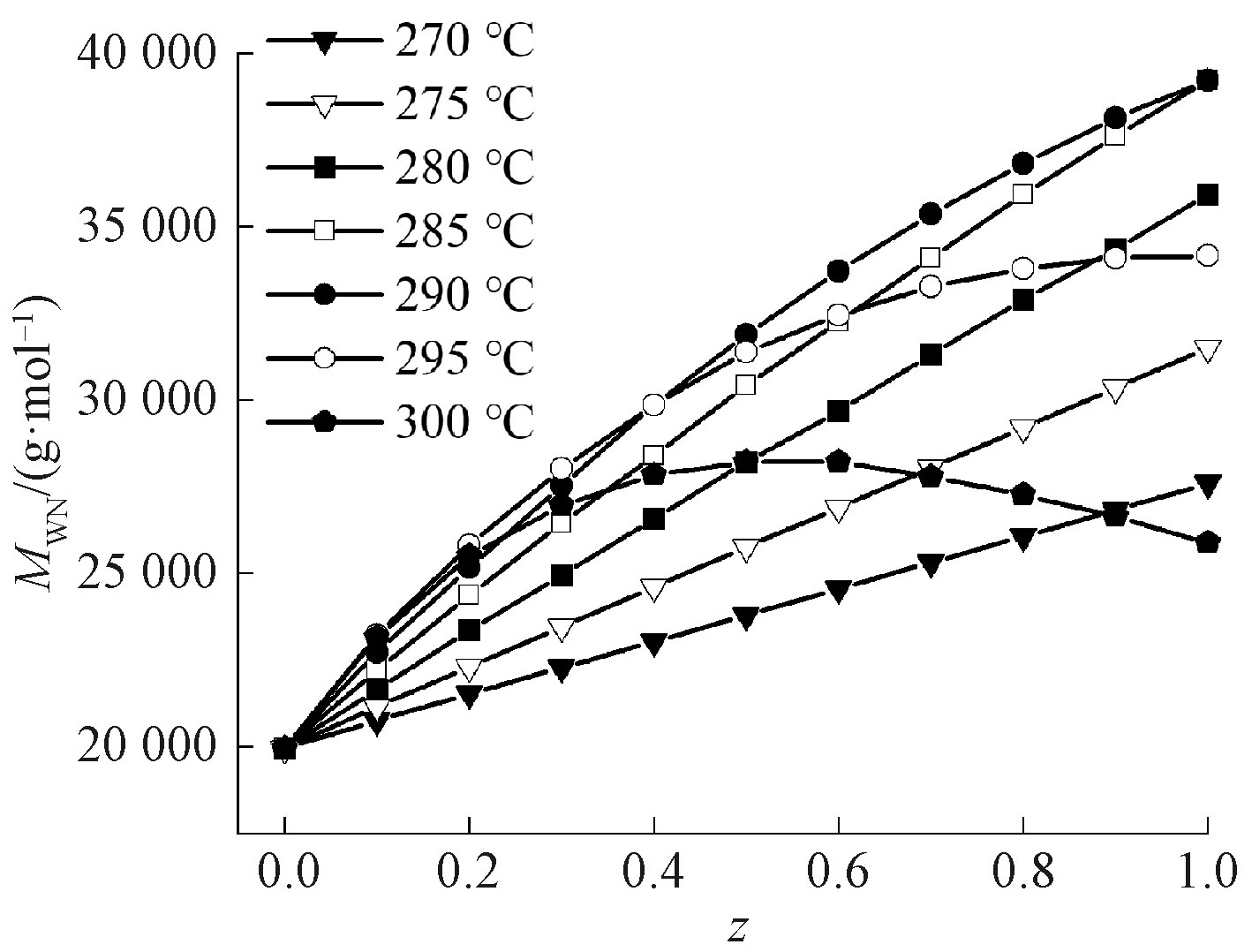
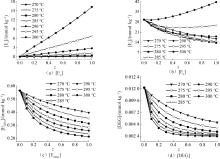
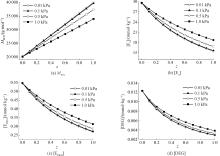
摘要: 为促进对降膜熔融缩聚制备高分子量聚对苯二甲酸乙二醇酯(PET)增黏反应过程的理论认识,指导降膜反应器的设计与缩聚工艺优化,建立了降膜反应器串联五釜的连续聚合过程数学模型,以与工业生产数据匹配的五釜流程模拟结果为降膜反应釜入口物料参数,考察了PET分子量与端基量等品质指标随降膜增黏反应进程的变化,讨论了降膜反应器内温度和压力对聚合产物分子量与端基量的影响规律。结果表明:随着增黏反应的进行,可顺利得到特性黏度为1.0 dL/g以上、端羧基量为16 mmol/kg的产品;所建立的降膜反应器模型能够对增黏效果进行灵敏分析,高温低压有利于提升增黏反应效率,但过低的压力导致高黏熔体变得难处理和转移,且会增加设备成本和提高工艺精确控制的难度,温度过高则会显著增加副产物的生成;对降膜反应器选择压力为0.1 kPa左右、温度区间为285~290 ℃进行工艺参数调优,采用优化后的连续生产工艺流程最终反应器出口PET的分子量在39 000 g/mol左右;模拟结果与工业生产值吻合,可运用于分析降膜增黏反应技术应用实践。
中图分类号:
| [1] | 刘海霆. 关于我国聚酯工业发展趋势的分析[J]. 合成技术及应用, 2023, 38(1): 24-27. |
| LIU Haiting. Analysis on the development trend of polyester industry in China[J]. Synthesis Technology and Application, 2023, 38(1):24-27. | |
| [2] | 钱伯章. 我国PET生产现状[J]. 聚酯工业, 2017, 30(1): 5-7,10. |
| QIAN Bozhang. Production status of PET in China[J]. Polyester Industry, 2017, 30(1): 5-7,10. | |
| [3] | 姚军义, 王玉合, 吴旭华, 等. 国内涤纶工业丝发展现状[J]. 合成技术及应用, 2017, 32(2): 26-30. |
| YAO Junyi, WANG Yuhe, WU Xuhua, et al. Development status of polyester industry filament in China[J]. Synthetic Technology and Application, 2017, 32(2): 26-30. | |
| [4] | 陈文兴, 马建平, 王建辉, 等. 涤纶工业丝熔体直纺生产技术的研发[J]. 合成纤维工业, 2013, 36(4): 1-4. |
| CHEN Wenxing, MA Jianping, WANG Jianhui, et al. Development of melt direct spinning process technology for polyester industrial yarn[J]. Synthetic Fiber Industry, 2013, 36(4): 1-4. | |
| [5] | 赵玲, 朱中南. 聚酯熔融缩聚增黏过程的工程分析[J]. 聚酯工业, 2004, 17(1): 1-4. |
| ZHAO Ling, ZHU Zhongnan. Engineering analysis of viscosity increasing process of polyester melt polycondensation[J]. Polyester Industry, 2004, 17(1): 1-4. | |
| [6] | CHEN S, ZHANG L, WANG Y, et al. Residence time distribution of high viscosity fluids falling film flow down outside of industrial-scale vertical wavy wall: experimental investigation and CFD prediction[J]. Chinese Journal of Chemical Engineering, 2019, 27(7): 1586-1594. |
| [7] | WANG Y J, CHEN S C, LIN Q S, et al. Numerical simulation and experimental verification of the film-forming behavior of falling film flow down clamped channels with high-viscosity fluid[J]. Industrial & Engineering Chemistry Research, 2020, 59(44): 19698-19711. |
| [8] | CHEN S, CHEN S, GUANG S, et al. Film reaction kinetics for melt postpolycondensation of poly(ethylene terephthalate)[J]. Journal of Applied Polymer Science, 2020. DOI:10.1002/app.48988. |
| [9] | 吕陈秋, 顾爱军, 张宇航, 等. 基于Aspen Polymer的聚酯聚合反应研究及流程模拟[J]. 化工进展, 2014, 33(5): 1086-1092,1100. |
| LU Chenqiu, GU Aijun, ZHANG Yuhang, et al. PET polymerization analysis and process simulation with Aspen Polymer[J]. Chemical Industry and Engineering Progress, 2014, 33(5): 1086-1092,1100. | |
| [10] | 罗娜. 大型聚酯生产过程智能建模、控制与优化研究[D]. 上海: 华东理工大学, 2010:11-38. |
| LUO Na. Research on intelligent modeling,control and optimization for poly(ethylene terephalate)process[D]. Shanghai: East China University of Science and Technology, 2010:11-38. | |
| [11] | 张素贞, 叶心宇, 陈军. 聚酯工业生产过程模型及仿真[J]. 计算机与应用化学, 1994(4): 258-268. |
| ZHANG Suzhen, YE Xinyu, CHEN Jun. Modelling and simulation of PET industrial process[J]. Computers and Applied Chemistry, 1994(4): 258-268. | |
| [12] | 李文艳. 工业聚酯装置生产过程建模与分析[D]. 杭州: 浙江大学, 2011: 22-49. |
| LI Wenyan. Modeling and analysis of industrial poly(ethylene terephthalate)plant[D]. Hangzhou: Zhejiang University, 2011: 22-49. | |
| [13] | 王金堂, 周兴贵, 赵玲, 等. 五釜工艺聚酯工业装置的稳态模拟[J]. 合成纤维工业, 2012, 35(1): 59-63. |
| WANG Jintang, ZHOU Xinggui, ZHAO Ling, et al. A steady-state model for five-reactor PET industrial process[J]. Synthetic Fiber Industry, 2012, 35(1): 59-63. | |
| [14] | LAUBRIET C, LECORRE B, CHOI K Y. Two-phase model for continuous final stage melt polycondensation of poly(ethylene terephthalate): 1: steady-state analy-sis[J]. Industrial & Engineering Chemistry Research, 1991, 30(1): 2-12. |
| [15] | RIECKMANN T, VÖLKER S. Micro-kinetics and mass transfer in poly(ethylene terephthalate) synthesis[J]. Chemical Engineering Science, 2001, 56(3): 945-953. |
| [16] | 刘向文, 朱中南. 聚对苯二甲酸乙二醇酯缩聚反应动力学研究[J]. 聚酯工业, 1994(4): 5-8; 1995(1):17-21. |
| LIU Xiangwen, ZHU Zhongnan. Study on the kinetics of polycondensation polymerization of polyethylene terephthalate[J]. Polyester Industry, 1994(4): 5-8; 1995(1):17-21. | |
| [17] | RAVINDRANATH K, MASHELKAR R A. Modeling of poly(ethylene terephthalate) reactors[J]. Polymer Engineering & Science, 1982, 22(10): 628-636; 1984, 24(1): 30-41. |
| [18] | SCHEIRS J, LONG T E. Modern polyesters:chemistry and technology of polyesters and copolyesters[M]. New York: John Wiley & Sons, 2005:69-71. |
| [19] | RAVINDRANATH K, MASHELKAR R A. Finishing stages of PET synthesis: a comprehensive model[J]. AIChE Journal, 1984, 30(3): 415-422. |
| [20] | 赵玲, 朱中南, 戴干策. PET缩聚过程反应与传质:Ⅰ:反应动力学研究[J]. 化学反应工程与工艺, 2000(2): 159-163. |
| ZHAO Ling, ZHU Zhongnan, DAI Gance. Study on reaction and mass transfer:Ⅰ:reaction kinetics of PET polycondensation process[J]. Chemical Reaction Engineering and Technology, 2000(2): 159-163. | |
| [21] | 赵玲, 朱中南, 戴干策. PET缩聚过程反应与传质:Ⅱ:传质规律研究[J]. 化学反应工程与工艺, 2000(2): 164-168. |
| ZHAO Ling, ZHU Zhongnan, DAI Gance. Study on the reaction and mass transfer:II:mass transfer rules of PET polycondensation process[J]. Chemical Reaction Engineering and Technology, 2000(2): 164-168. | |
| [22] | RENWEN H, FENG Y, TINZHENG H, et al. The kinetics of formation of diethylene glycol in preparation of polyethylene terephthalate and its control in reactor design and operation[J]. Die Angewandte Makromolekulare Chemie, 1983, 119(1): 159-172. |
| [1] | 王容容, 周洲, 冯祥, 申莹, 刘峰, 邢剑. 聚酯纤维与聚乙烯/聚丙烯双组分纤维多孔吸声材料的制备及其性能[J]. 纺织学报, 2025, 46(02): 61-68. |
| [2] | 邴琳涵, 王锐, 吴雨航, 刘博同, 黄寒江, 魏建斐. 聚对苯二甲酸乙二醇酯基碳点热解法制备及其在阻燃改性中的应用[J]. 纺织学报, 2024, 45(10): 1-8. |
| [3] | 宇平, 王海跃, 汪毅, 孙钦超, 王彦, 胡祖明. 聚酯织物的直接氟修饰疏水改性及其作用机制[J]. 纺织学报, 2024, 45(10): 137-144. |
| [4] | 邓钢, 张涛, 吴超平, 王军, 张磊. 异形二醋酯纤维干法纺丝成形过程模拟及其截面分析[J]. 纺织学报, 2024, 45(09): 42-49. |
| [5] | 王玉玺, 唐春霞, 张丽平, 付少海. 纳米炭黑的Steglich酯化反应制备及乙二醇分散性[J]. 纺织学报, 2024, 45(07): 104-111. |
| [6] | 袁野, 张安莹, 魏丽菲, 高建伟, 陈咏, 王锐. 含磷阻燃聚酯的合成动力学及其性能[J]. 纺织学报, 2024, 45(04): 50-58. |
| [7] | 范博, 吴伟, 王健, 徐红, 毛志平. 分散染料在超临界CO2流体染色聚酯纤维中的扩散行为[J]. 纺织学报, 2024, 45(02): 134-141. |
| [8] | 缪璐璐, 董正梅, 朱繁强, 荣慧, 何林伟, 郑国全, 邹专勇. 芯丝种类与纺纱速度对喷气涡流纺包芯纱性能的影响[J]. 纺织学报, 2023, 44(12): 50-57. |
| [9] | 亓晓杰, 孙莉娜, 廖海洋, 马博谋, 俞建勇, 王学利, 刘修才. 超柔软高吸湿改性聚对苯二甲酸乙二醇酯纤维的制备及其性能[J]. 纺织学报, 2023, 44(09): 27-34. |
| [10] | 张颖, 宋明根, 姬洪, 陈康, 张先明. 热定形工艺对高强型聚酯工业丝结构性能的影响[J]. 纺织学报, 2023, 44(09): 43-51. |
| [11] | 尚小愉, 朱坚, 王滢, 张先明, 陈文兴. 侧基含磷阻燃共聚酯的制备及其固相增黏反应[J]. 纺织学报, 2023, 44(07): 1-9. |
| [12] | 柳敦雷, 陆佳颖, 薛甜甜, 樊玮, 刘天西. 超疏水隔热聚酯纳米纤维/二氧化硅气凝胶复合膜的制备及其性能[J]. 纺织学报, 2023, 44(07): 18-25. |
| [13] | 周歆如, 范梦晶, 胡铖烨, 洪剑寒, 刘永坤, 韩潇, 赵晓曼. 喷丝速率对连续水浴静电纺纳米纤维包芯纱结构与性能的影响[J]. 纺织学报, 2023, 44(06): 50-56. |
| [14] | 赫爽, 孙莉娜, 胡红梅, 朱瑞淑, 俞建勇, 王学利. 全生物基聚呋喃二甲酸丙二醇酯及其纤维制备与性能[J]. 纺织学报, 2023, 44(05): 63-69. |
| [15] | 苏旭中, 梁巧敏, 王汇锋, 张娣, 崔益怀. 棉/生物基弹性聚酯纤维混纺针织物的服用性能[J]. 纺织学报, 2023, 44(05): 119-124. |
|
||
 京公网安备11010502044800号




 Z+EG
Z+EG Ea+AA
Ea+AA Z+AA
Z+AA Ea+DEG
 Z+DEG
Z+DEG Ea+EDEG
 Eg+W
Eg+W Z+W
Z+W Ea+Ev
Ea+Ev