纺织学报 ›› 2025, Vol. 46 ›› Issue (05): 222-226.doi: 10.13475/j.fzxb.20240304001
李际军( ), 刘泽华
LI Jijun(), LIU Zehua
摘要:
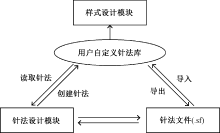
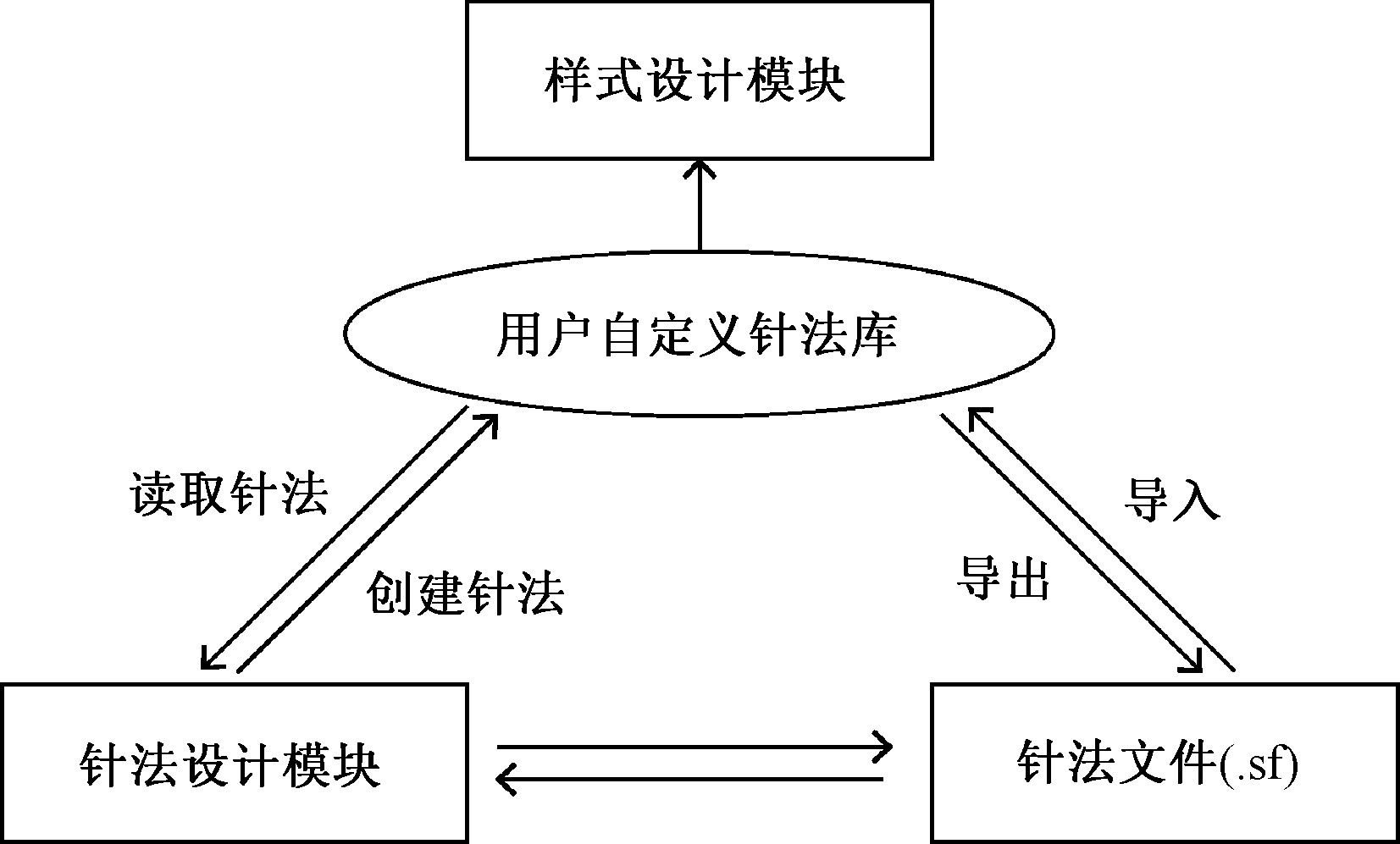
针织针法多样性是针织服装的特色之一,利用三维仿真的方法拓展并模拟各种针法可以显著提升针织衣物设计效率。针法的三维仿真主要包含三维建模和实时渲染2个阶段。建模阶段提出了一套参数化的针法设计方法,通过改进的非均匀Catmull-Rom曲线金字塔算法生成纱线中心轨迹曲线、扫掠生成纱线的三维模型,拓展了针织织法类型,实现了基于基础针法的复杂针法快速建模;渲染阶段利用环境光遮蔽Phong算法和Kajiya-Kay光照模拟算法分别对纱线模型的主干部分和毛刺部分渲染,获得实时的逼真效果。在此基础上设计实现了用户自定义针法库模块,针法库包括针法类型、织行数与针脚数、针法结点拓扑关系等细节,可为后续各个针法建模组件提供参考。验证结果表明,所提三维模型算法实现了针织衣片针法自由设计、服装三维真实感展示等功能。
中图分类号:
| [1] | JAMSHAID Hafsa, MISHRA Rahesh. Knitting science, technology, process and materials: a sustainable approach[M]. Hong Kong: Springer, 2024:1-13. |
| [2] | KYOSEV Yordan, BOUSSU Framcois. Advanced weaving technology[M]. Lille: Springer, 2022: 195-251. |
| [3] | Knitting design software:7 best to use in 2025[R/OL].[2024-01-08]. https://windowsreport.com/knitting-design-software. |
| [4] | SPERL Georg, NARAIN Rahul, WOJTAN Chris. Homogenized yarn-level cloth[J]. ACM Trans Graph, 2020, 39(4): 1-15. |
| [5] | LEAF Jonathan, WU Rundong, ESTON Schweickart, et al. Interactive design of periodic yarn-level cloth patterns[J]. ACM Trans Graph, 2018, 37(6):1-15;. |
| [6] | YUKSEL Cem, KALDOR Jonathan M, JAMES Doug L, et al. Stitch meshes for modeling knitted clothing with yarn-level detail[J]. ACM Trans Graph, 2012, 31(4):1-12. |
| [7] | KALDOR Jonathan M, JAMES Doug L, MARSCHNER Steve. Simulating knitted cloth at the yarn level[J]. ACM Trans Graph, 2008, 27(3):1-9. |
| [8] | ZHAO S, LUAN F, BALA K. Fitting procedural yarn models for realistic cloth rendering[J]. ACM Trans Graph, 2016, 35(4): 1-11. |
| [9] | DELBUKBUREWATTE G B, DIAS T. Porosity and capillarity of weft knitted spacer structures[J]. Fibers and Polymers, 2009, 10(2): 226-230. |
| [10] | LIU Haisang, KYOSEV Yordan, JIANG Gaoming. Yarn-level modeling and geometric simulation of warp-knitted clothing elements-first results and chall-enges[J]. Communications in Development and Assembling of Textile Products, 2022, 3(2):115-126. |
| [11] | FUKUTA Yuka, OHTA Kouichi, KINARI Toshiyasu. 3D modelling of basic weft-knitted fabric structures[J]. Journal of Textile Engineering, 2011, 57(2):37-44. |
| [12] | HTOO Nyi Nyi, SOGA Atsushi, WAKAKO Lina, et al. 3-Dimension simulation for loop structure of weft-knitted fabric considering mechanical properties of yarn[J]. Journal of Fiber Science and Technology, 2017, 73(5):105-113. |
| [13] | 日本宝库社. 棒针编织针法符号125和编织花样125[M]. 郑州: 河南科学技术出版社, 2013:1-127. |
| Japanese Treasure House. Bar needle weaving needle method symbol 125 and weaving pattern 125[M]. Zhengzhou: Henan Science and Technology Press, 2013:1-127. | |
| [14] | 王晗. 纬编织物三维服装建模算法的研究与实现[D]. 杭州: 浙江大学, 2019:1-64. |
| WANG Han. Research and implementation of 3D clothing modeling algorithm for weft knitted fabric[D]. Hangzhou: Zhejiang University, 2019:1-64. | |
| [15] | 张玚. 三维织物针法设计与真实感显示的研究与实现[D]. 杭州: 浙江大学, 2021:1-82. |
| ZHANG Ting. Research and implementation of 3D fabric needle design and realistic display[D]. Hangzhou: Zhejiang University, 2021:1-82. | |
| [16] | 王丰. 虚拟服装衣片设计与缝合算法研究[D]. 杭州: 浙江大学, 2018:1-51. |
| WANG Feng. Research on virtual clothing piece design and sewing algorithm[D]. Hangzhou: Zhejiang University, 2018:1-51. | |
| [17] | 秦令森. 虚拟服装纹理对齐与多层衣片建模的研究与实现[D]. 杭州: 浙江大学, 2021:1-67. |
| Qin Lingsen. Research and implementation of virtual clothing texture alignment and multi layer clothing piece modeling[D]. Hangzhou: Zhejiang University, 2021:1-67. | |
| [18] | LI Y, YANG L, CHEN S, et al. Three dimensional simulation of weft knitted fabric based on surface model[J]. Computer Modeling & New Technologies, 2014, 18(3):52-57. |
| [19] | MCKEE P J, SOKOLOW A C, YU J H, et al. Finite element simulation of ballistic impact on single jersey knit fabric[J]. Composite Structures, 2017, 162:98-107. |
| [20] | VASSILIADISA S G, KALLIVRETAKI A E, PROVATIDIS C G. Geometrical modelling of plain weft knitted fabrics[J]. Indian Journal of Fibre & Textile Research, 2007, 32: 62-71. |
| [21] | WU K, YUKSEL C. Real-time fiber-level cloth rendering[C]// I3D'17: Proceedings of the 21st ACM SIGGRAPH Symposium on Interactive 3D Graphics and Games. San Francisco, California: Association for Computing Machinery, 2017. DOI: 10.1145/3023368.3023372. |
| [22] | 刘欧. 针织衣物的渲染与任意姿势的人体着装算法研究[D]. 杭州: 浙江大学, 2020:1-59. |
| LIU Ou. Research on the rendering of knitted clothing and the algorithm for human body dressing in any posture[D]. Hangzhou: Zhejiang University, 2020:1-59. |
| [1] | 顾文敏, 蒋高明, 刘海桑, 李炳贤. 基于网格模型的全成形裙装三维仿真[J]. 纺织学报, 2025, 46(05): 214-221. |
| [2] | 尚静雨, 蒋高明, 陈钰珊, 刘海桑, 李炳贤. 花式纱罗织物设计与三维仿真[J]. 纺织学报, 2025, 46(04): 81-88. |
| [3] | 马运娇, 王蕾, 潘如如. 基于双斜交平面镜的纱线条干三维仿真[J]. 纺织学报, 2025, 46(02): 86-91. |
| [4] | 关松松, 蒋高明, 杨美玲, 李炳贤. 基于线圈结构的双针床经编毛绒织物三维仿真[J]. 纺织学报, 2024, 45(09): 84-90. |
| [5] | 赵俊杰, 蒋高明, 程碧莲, 李炳贤. 毛衫绞花织物的三维仿真与实现[J]. 纺织学报, 2023, 44(12): 81-87. |
| [6] | 杨美玲, 蒋高明, 王婷, 李炳贤. 基于弹簧-质点模型的单贾卡经编鞋材三维仿真[J]. 纺织学报, 2023, 44(11): 113-119. |
| [7] | 杨美玲, 蒋高明, 王婷, 李炳贤. 经编间隔鞋材设计与三维仿真[J]. 纺织学报, 2023, 44(08): 96-102. |
| [8] | 郑培晓, 蒋高明, 丛洪莲, 李炳贤. 多色调线横条纹织物的设计与三维仿真[J]. 纺织学报, 2023, 44(06): 85-90. |
| [9] | 陈钰珊, 蒋高明, 李炳贤. 纬编绕经织物设计与三维仿真[J]. 纺织学报, 2022, 43(12): 62-68. |
| [10] | 路丽莎, 蒋高明. 全成形针织服装三维款式向二维样板转化方法[J]. 纺织学报, 2022, 43(10): 133-140. |
| [11] | 詹必钦, 李玉贤, 董智佳, 丛洪莲. 全成形双层结构针织服装部件化虚拟展示研究[J]. 纺织学报, 2022, 43(08): 147-152. |
| [12] | 詹必钦, 丛洪莲, 吴光军. 全成形双层结构针织服装工艺模型研究与应用[J]. 纺织学报, 2021, 42(03): 149-154. |
| [13] | 代振兴, 陈广锋, 陈革. 基于Rhino-Python的多圈高簇绒地毯三维仿真[J]. 纺织学报, 2020, 41(06): 69-75. |
| [14] | 范晓健 李晶 刘红卫 王善凯 孙晓盼. 碳纤维层叠布用缝纫机的改进设计与三维仿真[J]. 纺织学报, 2016, 37(10): 141-144. |
| [15] | 徐艳华 杨婧. 纸样技术在非常规造型毛针织服装编织工艺中的应用[J]. 纺织学报, 2016, 37(08): 107-113. |
|
||
 京公网安备11010502044800号