纺织学报 ›› 2025, Vol. 46 ›› Issue (05): 252-261.doi: 10.13475/j.fzxb.20240600301

• 机械与设备 • 上一篇    下一篇

基于多工况的铲式落布车车身设计与优化

宋栓军(), 尚长伟, 张家豪, 周进良   

  1. 西安工程大学 机电工程学院, 陕西 西安 710048
  • 收稿日期:2024-06-03 修回日期:2024-12-31 出版日期:2025-05-15 发布日期:2025-06-18
  • 作者简介:宋栓军(1974—),男,教授,博士。主要研究方向为机器人技术、生产系统优化等。E-mail:songshuanjun@126.com
  • 基金资助:
    国家自然科学基金项目(72001166);陕西省重点研发计划项目(2023-YBGY-349)

Body design and optimization of shovel type fabric unloading vehicle based on multi-working conditions

SONG Shuanjun(), SHANG Changwei, ZHANG Jiahao, ZHOU Jinliang   

  1. College of Mechanical and Electrical Engineering, Xi'an Polytechnic University, Xi'an, Shaanxi 710048, China
  • Received:2024-06-03 Revised:2024-12-31 Published:2025-05-15 Online:2025-06-18

摘要:

为解决当前落布车车身重、无法适应不同幅宽布辊、工作过程中稳定性差等问题,结合落布过程中的7种工况,基于拓扑优化的方法设计了一款轻量化、高稳定性的铲式落布车。首先对车身基本结构进行了力学分析,得出载荷分配与车轮位置的关系。在此基础上,通过7种工况下的静态结构分析得到影响车身结构的权重比,将各工况的权重比、车身振动特征和模态参数作为车身拓扑优化问题的依据条件,随后对其形状尺寸进行优化,以此获得最优车身结构设计方案。通过仿真实验,对比分析了优化前后落布车的车身刚度、模态等性能。结果表明,考虑多工况的优化方案其车身减重32.5%,各工况下稳定性明显提升。

关键词: 车身结构, 轻量化, 力学分析, 多工况, 拓扑优化, 仿真分析, 落布车

Abstract:

Objective In the textile workshop, the handling of full rolls of fabric sticks is a key and difficult problem. There are design problems in the existing fabric unloading vehicle, which cause it to consume a lot of energy in the process of handling to overcome its own weight, and the poor stability of the vehicle body also affects the transportation efficiency. Therefore, it is of great significance to optimize the vehicle body structure of the fabric unloading vehicle to achieve the design goals of equal strength, light weight and high stability.
Method Aiming at the problems such as high body weight and poor stability, a system-level optimization method was introduced to improve the anti-torsional performance and the uniformity of modal natural frequency distribution and eliminate the potential stress concentration by optimizing the overall design, material and layout of the vehicle body. At the same time, considering several working conditions, the topological optimization method is utilized to adjust the material distribution, which can meet the requirements of structural strength and stiffness to the maximum extent and reduce the weight of the vehicle body. The comprehensive application of these optimization methods provides a new idea for the precise design and efficient optimization of the vehicle body structure of the fabric unloading vehicle.
Results This paper introduces a comprehensive optimization methodology addressing vehicle body weight, stability, and the design of a specialized fabric unloading vehicle. By meticulously optimizing the vehicle body's structure, materials, and layout, improvements in anti-torsional resilience and modal frequency distribution uniformity are achieved, effectively eliminating stress concentration. This systematic approach combines vehicle body optimization principles with the specialized requirements of fabric unloading vehicles, enhancing their performance and structural integrity in industrial applications. system-level optimization method, this paper optimizes the vehicle body of the fabric unloading vehicle, finds the most dangerous working condition under 5 working conditions, and then carries out topology optimization to achieve the design of equal strength, lightweight and high stability of the vehicle body. After simulation verification, according to the comparison results, it is shown that after optimization, the first five order natural frequency of the vehicle body is significantly increased, which reduces the potential risk of the falling vehicle being affected by vibration during driving, and thus improves the stability of the vehicle body. The optimized vehicle body uses less material under the same load, while its strength, stiffness and stability are significantly improved. Compared to the original design, the optimized solution not only achieves a 32.5% reduction in vehicle body weight. The static stiffness analysis results of the optimized vehicle body are compared. It can be seen that the maximum stress of the optimized vehicle body is reduced by 23.3%, which fully meets the allowable stress conditions and approaches to the allowable stress, thus improving the utilization rate of materials. After optimization, the maximum deformation of the vehicle body is reduced by 60.3%, and the maximum displacement of the frame is reduced by 9%, that is, the stiffness of the vehicle body is enhanced. This shows that the system level optimization scheme considering the loading condition is feasible.
Conclusion The proposed optimization method not only significantly improves the performance of the vehicle body structure, but also provides a new optimization idea for related fields, which has certain practical value and theoretical guidance. However, the specific details and complexity of the working conditions, may be ignored, resulting in the simulation results are not accurate enough, and the description has certain limitations. Therefore, in order to improve the accuracy of the research results, it is necessary to further explore the specific effects of specific conditions. Subsequently, more types and quantities of working conditions are considered, and the influence of factors such as different heights and angles is considered in the loading and unloading process, so as to simulate the actual working scene more comprehensively. At the same time, the load calculation process is refined, considering the influence of the power arm length, the shape of the hook, the friction between the hook and the cloth, etc., so as to simulate the actual loading situation more accurately. Furthermore, a more refined simulation model is introduced, such as considering the influence of factors such as the speed change of the cloth hook in the process of resetting, the friction between the fabric and the fabric cart, so as to improve the accuracy of the simulation and make the optimized results more accurate and reasonable.

Key words: vehicle body structure, lightweight, mechanical analysis, multiple load cases, topology optimization, simulation analysis, fabric unloading vehicle

中图分类号: 

  • TH122

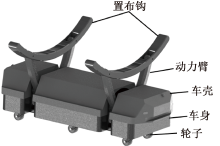
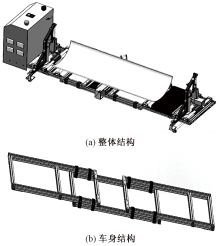
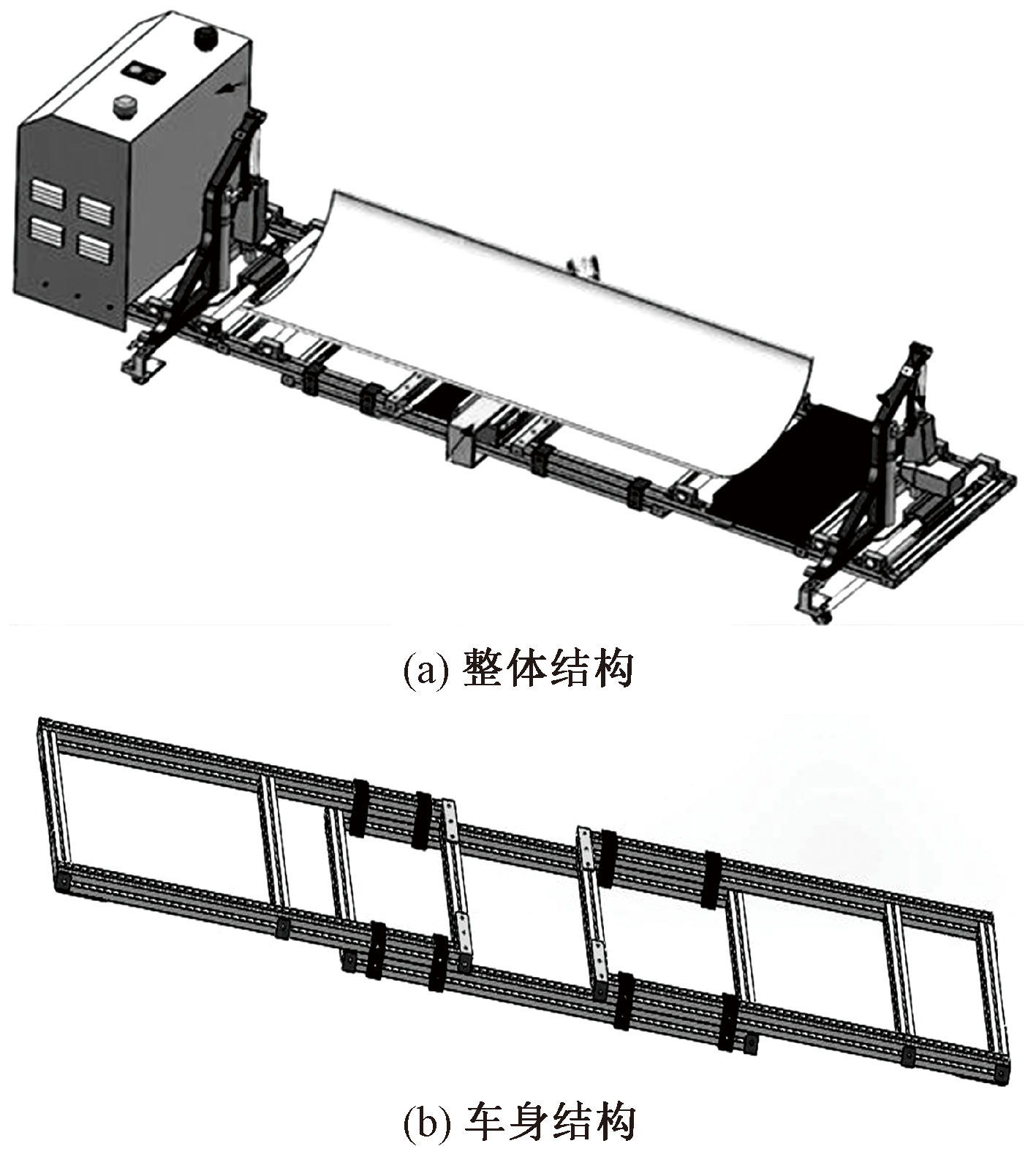
图1

落布车样图"

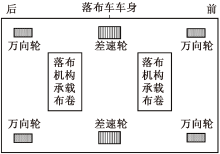
图2

落布车布局简图"

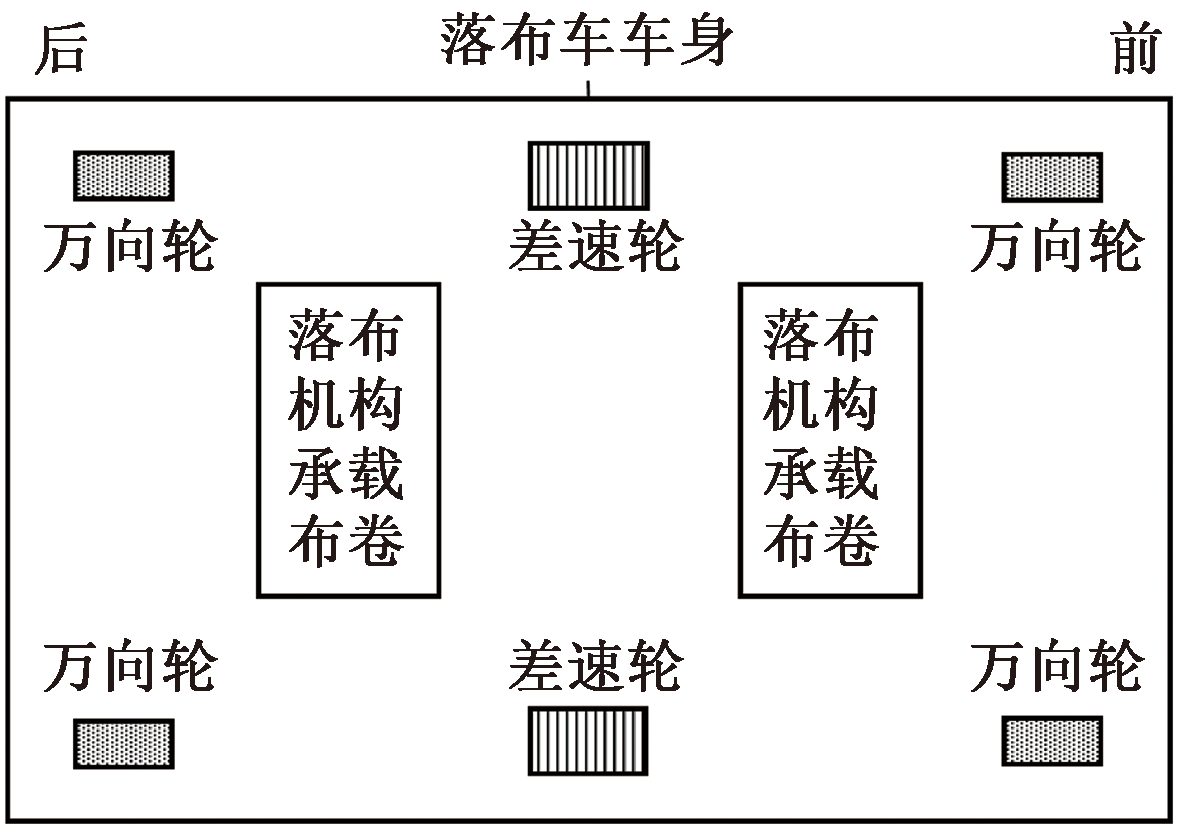
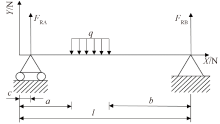
图3

受载工况图"

表1

7种不同工况约束和载荷情况"

工况
类型
方向约束 载荷施加
前万向轮 后万向轮 差速轮
装载工况 X,Y X,Y Y,Z Y轴方向上1.2倍
全局载荷
横移工况 X,Y X,Y X,Y Y轴方向上全局载荷
制动工况 X,Y,Z X,Y,Z X,Y,Z Y轴方向上全局载荷
卸载工况 Y,Z Y,Z Y,Z Y轴方向上全局载荷
转弯工况 Y,Z Y,Z Y Y轴方向上全局载荷
加速 YZ Y YZ Y轴全局载荷和
X轴上惯性量
减速 YZ YZ YZ Y轴全局载荷和
X轴上惯性量

图4

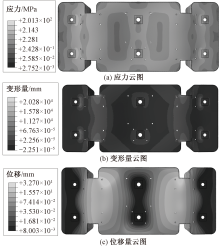
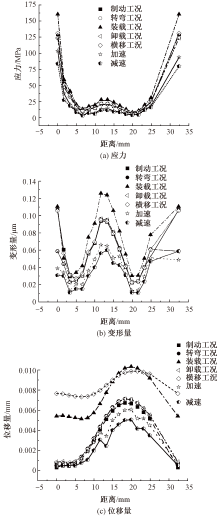
装载工况有限元求解结果图"

图5

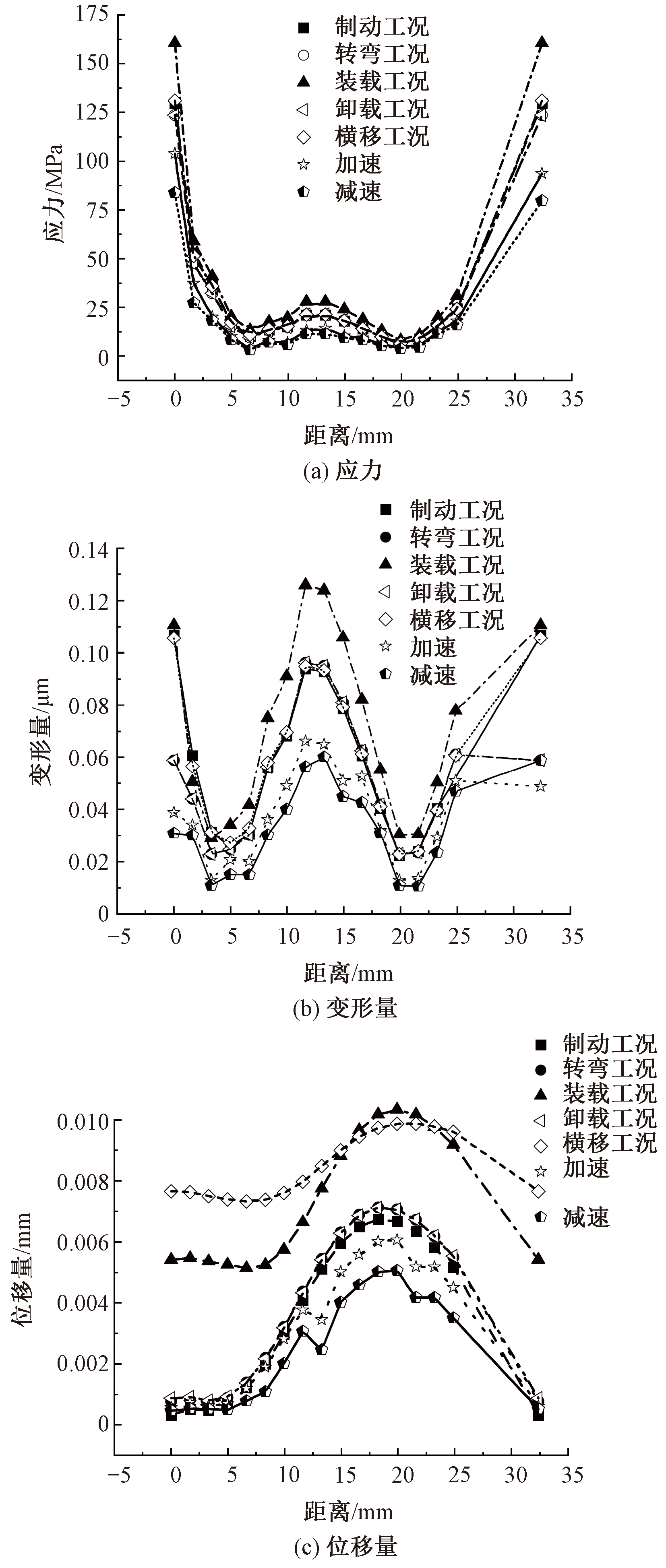
静态分析点集分布图"

表2

7种不同工况下车身结构静力学仿真校验"

工况类型 最大变
形量/mm
最大等效
应力/MPa
最大位
移量/mm
装载工况 0.000 68 201.3 0.327
横移工况 0.000 57 167.9 0.273
制动工况 0.000 54 167.1 0.267
卸载工况 0.000 56 151.9 0.269
转弯工况 0.000 55 151.9 0.269
加速 0.000 46 139.4 0.227
减速 0.000 36 111.7 0.178

表3

7种工况影响权重"

工况类型 权重
装载工况 0.311
横移工况 0.159
制动工况 0.130
卸载工况 0.128
转弯工况 0.123
加速 0.086
减速 0.063

图6

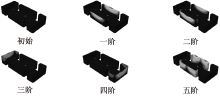
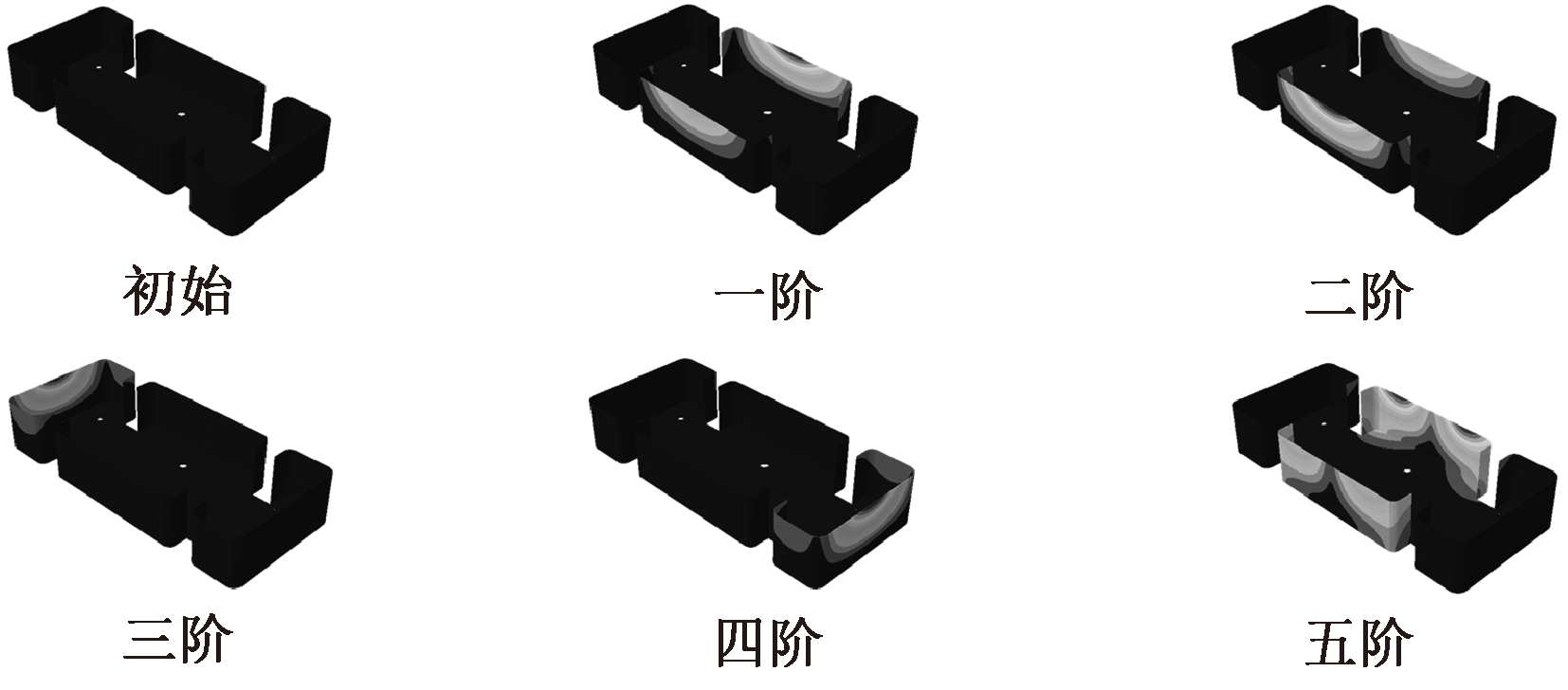
模态分析下车身模态振型图"

表4

车身前5阶固有频率及振型"

阶数i 固有频率/Hz 对应振型
1 56.73 局部侧弯
2 56.94 局部侧弯
3 70.01 局部侧弯
4 70.65 局部侧弯
5 82.30 局部侧向扭转

图7

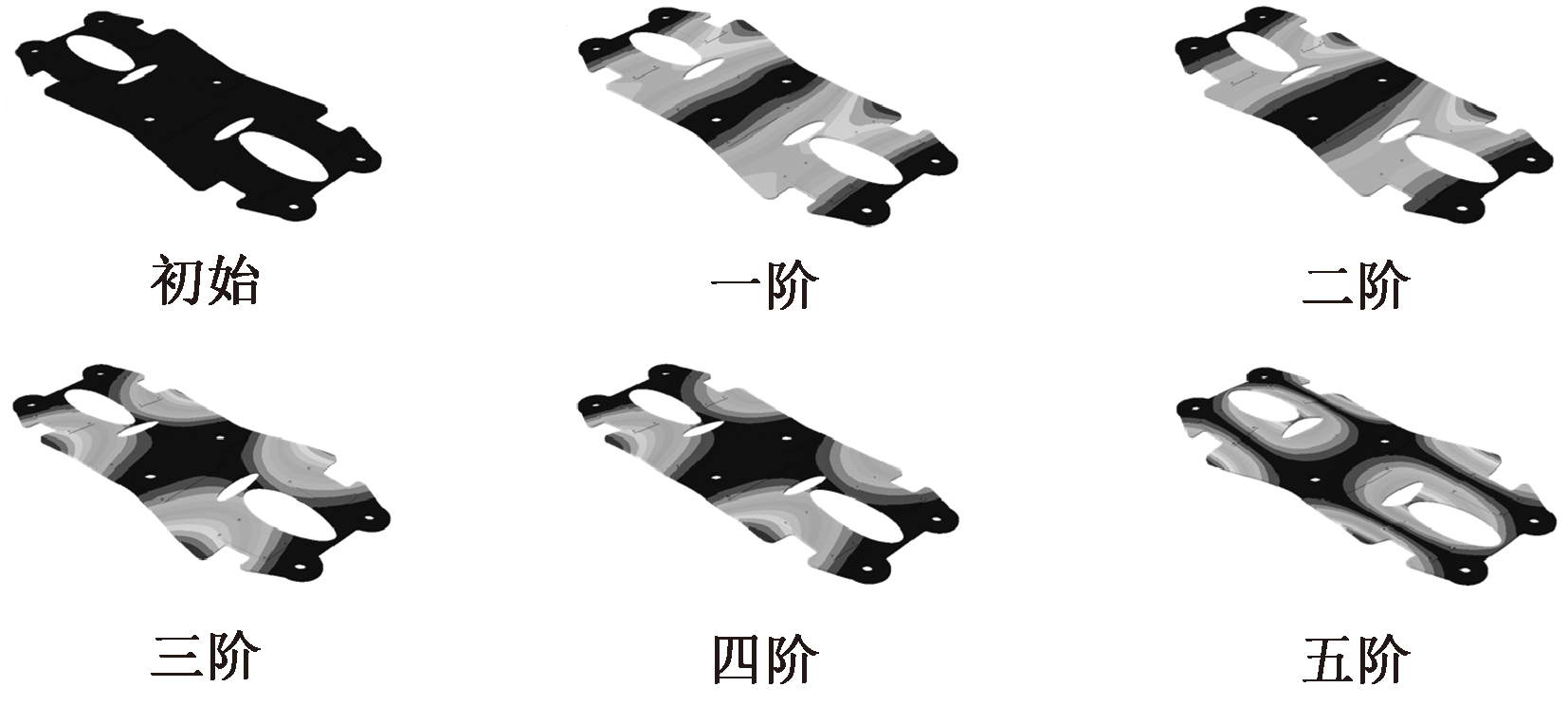
优化后车身模态振型图"

表5

优化前后车身的前5阶固有频率对照"

阶数i 固有频率/Hz
优化前 优化后
1 16.73 159.72
2 56.94 169.87
3 70.01 180.14
4 70.65 185.81
5 82.50 207.67

图8

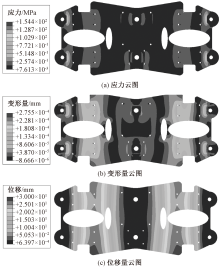
优化后车身有限元求解结果图"

表6

优化前后车身静态刚度分析结果"

类型 最大变
形量/mm
最大
应力/MPa
最大位
移量/mm
优化前 0.000 68 201.3 0.327
优化后 0.000 27 154.4 0.300
变化率/% -60.3 -23.3 -9

图9

经验设计落布车结构图"

表7

经验法与本文优化法设计的车身参数比较"

类型 质量/kg 长/m 宽/m 高/m
经验设计 34.133 1.30 0.52 0.200
本文优化设计 19.095 1.12 0.76 0.008

表8

经验法与本文优化法设计的稳定性参数比较"

类型 落布车重心
高度/mm
车身宽
长比
车身最大负载
变形量/mm
经验设计 227.51 0.40 0.026 00
本文优化设计 156.50 0.68 0.000 68

表9

车身前5阶固有频率及模态形状对照"

阶数i 经验设计
固有频率/Hz
模态形状 本文优化设计
固有频率/Hz
模态形状
1 34.15 局部侧弯 159.72 整体扭转
2 63.76 局部侧弯 169.87 整体扭转
3 70.46 局部扭转 180.14 整体侧弯
4 81.33 局部扭转 185.81 整体侧弯
5 89.43 局部侧弯扭转 207.67 整体侧弯
扭转
[1] 余联庆, 郑飞, 李琳. 一种双边型自动多载落布小车:201810614981.7[P]. 2018-12-21.
YU Lianqing, ZHENG Fei, LI Lin. A bilateral automatic multi load fabric dropping cart: 201810614981.7[P]. 2018-12-21.
[2] 段博, 余联庆, 樊飞. 超长车体AGV落布小车控制系统设计研究[J]. 自动化与仪器仪表, 2020(12): 79-84.
DUAN Bo, YU Lianqing, FAN Fei. Design and research of control system for extra long vehicle AGV cloth drop car[J]. Automation and Instrumentation, 2020 (12): 79-84.
[3] 李鹏飞, 王水明, 周贤钢, 等. 链条导轨型自动落布小车设计与实践[J]. 棉纺织技术, 2022, 50(6):66-70.
LI Pengfei, WANG Shuiming, ZHOU Xiangang, et al. Design and practice of chain guide automatic cloth drop car[J]. Cotton Textile Technology, 2022, 50 (6): 66-70.
[4] LI Shenhua, ZHOU Dashuang, PAN Anxia. Integrated lightweight optimization design of wall thickness, material, and performance of automobile body side structure[J]. Structural and Multidisciplinary Optimization, 2024. DOI: 10.1007/s00158-024-03810-1.
[5] QIN Huan, GUO Yi, LIU Zijian, et al. Shape optimization of automotive body frame using an improved genetic algorithm optimizer[J]. Advances in Engineering Software, 2018, 121(7):235-249.
[6] FU C L, BAI Y C, LIN C, et al. Design optimization of a newly developed aluminum-steel multi-material electric bus body structure[J]. Structural and Multidisciplinary Optimization, 2019, 60: 2177-2187.
[7] LI S, WANG D, WANG S, et al. Structure-connection-performance integration lightweight optimisation de-sign of multi-material automotive body skeleton[J]. Structural and Multidisciplinary Optimization, 2023, 66(9): 1-9.
[8] 李作轩, 贾良跃, 郝佳, 等. 基于多工况关联的无人车辆车身结构轻量化优化设计[J]. 兵工学报, 2023, 44(11):3529-3542.
doi: 10.12382/bgxb.2022.1301
LI Zuoxuan, JIA Liangyue, HAO Jia, et al. Multi-condition-correlated lightweight optimization design of unmanned vehicle body structure[J]. Journal of Ordnance Engineering, 2023. 44(11), 3529-3542.
[9] 吴斌, 钱晓明, 武星, 等. 自动导引车骨架结构优化设计[J]. 中国机械工程, 2014, 25(19):2653-2657,2664.
WU Bin, QIAN Xiaoming, WU Xing, et al. Optimization design of automatic guided vehicle skeleton structure[J]. China Mechanical Engineering, 2014, 25(19):2653-2657,2664.
[10] TECHASEN T, WANSASUEB K, PANAGANT N, et al. Simulta neous topology, shape, and size optimization of truss-es, taking account of uncertainties using multi-objective evolutionary algorithms[J]. Engineering with Computers, 2019, 35(2): 721-740.
[11] 李健, 王宏伟, 慕宗燚, 等. 考虑性能稳定性的机械系统可靠性分配方法研究[J]. 中国机械工程, 2024, 35(5):821-828,850.
LI Jian, WANG Hongwei, MU Zongyi, et al. Research on reliability allocation method for mechanical systems considering performance stability[J] China Mechanical Engineering, 2024, 35 (5): 821-828,850.
[12] 孙旭光, 李强强, 孙晓策, 等. 某两栖车辆新质材料白车身模态分析与测试[J]. 科学技术与工程, 2023, 23(7): 2864-2870.
SUN Xuguang, LI Qiangqiang, SUN Xiaoce, et al. Modal Analysis and test of a new material body in white for amphibious vehicle[J]. Science Technology and Engineering, 2023, 23(7): 2864-2870.
[13] CHEN J L, KWAK Y, XU M R, et al. Topology and mod-ular size optimization of small electric vehicle frame based on cross-section contribution analysis[J]. Structural and Multidisciplinary Optimization, 2021, 64(6): 1-18.
[14] IQBAL T, WANG L, LI D, et al. A general multi-objective topology optimization methodology developed for customized design of pelvic prostheses[J]. Medical Engineering & Physics, 2019, 69: 1-8.
[15] 芮强, 王红岩, 王良曦. 多工况载荷下动力舱支架结构拓扑优化设计[J]. 兵工学报, 2010, 31(6):782-786.
RUI Qiang, WANG Hongyan, WANG Liangxi. Topology optimization design of power cabin support structure under multiple working conditions and loads[J]. Journal of Ordnance Engineering, 2010, 31 (6): 782-786.
[16] LIU J H, LUO L, XIAO X W, et al. Multi-objectives topology optimization of frame in an electric mining dump truck based on fuzzy satisfaction variable weight coefficients method[J]. Journal of Mechanical Science and Technology, 2022, 36(6): 3059-3069.
[1] 白雨薇, 徐健, 朱耀麟, 丁展博, 刘晨雨. 基于改进YOLOv8的梳棉机棉网上棉结检测方法[J]. 纺织学报, 2025, 46(03): 56-63.
[2] 胡旭东, 汤炜, 曾志发, 汝欣, 彭来湖, 李建强, 王博平. 基于轻量化卷积神经网络的纬编针织物组织结构分类[J]. 纺织学报, 2024, 45(05): 60-69.
[3] 陆伟健, 屠佳佳, 王俊茹, 韩思捷, 史伟民. 基于改进残差网络的空纱筒识别模型[J]. 纺织学报, 2024, 45(01): 194-202.
[4] 周莉, 樊培宏, 金玉婷, 张龙琳, 李新荣. 服装逆向造型的数字化设计方法[J]. 纺织学报, 2023, 44(12): 138-144.
[5] 任国栋, 屠佳佳, 李杨, 邱子安, 史伟民. 基于轻量化网络和知识蒸馏的纱线状态检测[J]. 纺织学报, 2023, 44(09): 205-212.
[6] 徐健, 胡道杰, 刘秀平, 韩琳, 闫焕营. 基于改进型RFB-MobileNetV3的棉杂图像检测[J]. 纺织学报, 2023, 44(01): 179-187.
[7] 蒋高明, 周濛濛, 郑宝平, 郑培晓, 刘海桑. 绿色低碳针织技术研究进展[J]. 纺织学报, 2022, 43(01): 67-73.
[8] 梁灼, 贾国欣, 任家智, 李金键. 棉纺精梳机钳板的变形及其应力分析[J]. 纺织学报, 2021, 42(12): 145-150.
[9] 李志强, 倪莉, 赵则祥, 张洪, 梁颖. 梳理机工作辊结构的优化设计[J]. 纺织学报, 2019, 40(08): 146-150.
[10] 高哲 蒋高明. 多轴向经编曲面复合材料汽车门低速碰撞数值模拟[J]. 纺织学报, 2018, 39(02): 43-48.
[11] 邢京京 钱晓明. 织物的防刺机制及刀具形状对防刺性能的影响[J]. 纺织学报, 2017, 38(08): 55-61.
[12] 汪兴兴 卓露 朱昱 倪威 倪红军. R680系列自动印花机椭圆运动机构建模与仿真解析[J]. 纺织学报, 2017, 38(03): 143-148.
[13] 李静一;王晓锋. 基于Kalman滤波器的服装零售业库存控制策略[J]. 纺织学报, 2010, 31(5): 131-136.
[14] 刘燕军;杨佳;吕春英;傅学起. 半胱氨酸改性聚丙烯膜的热稳定性与力学性能[J]. 纺织学报, 2008, 29(4): 5-9.
[15] 周香琴. 毛巾织机起毛机构的动力学分析与设计[J]. 纺织学报, 2007, 28(8): 96-99.
Viewed
Full text


Abstract

Cited

  Shared   
  Discussed   
No Suggested Reading articles found!