纺织学报 ›› 2025, Vol. 46 ›› Issue (06): 1-7.doi: 10.13475/j.fzxb.20241201301

• 纤维新材料与纺织绿色发展青年科学家沙龙专栏 •    下一篇

涤纶乙二醇解产物在甲醇酯交换过程的转化规律

徐文豪1, 陈琳2, 徐世美2, 汪秀丽2, 王玉忠2()   

  1. 1.四川大学 化学工程学院, 四川 成都 610046
    2.四川大学 化学学院, 四川 成都 610046
  • 收稿日期:2024-12-06 修回日期:2025-03-12 出版日期:2025-06-15 发布日期:2025-07-02
  • 通讯作者: 王玉忠(1961—),男,教授,博士。主要研究方向为高分子材料的阻燃与高性能化、生物基与生物降解高分子及高分子材料的循环与升级回收。E-mail: yzwang@scu.edu.cn
  • 作者简介:徐文豪(1997—),男,博士生。主要研究方向为废旧涤纶纺织品的醇解与单体全回收。
  • 基金资助:
    国家重点研发计划项目(2023YFC3904901)

Transformation rule of polyester glycolysis products in methanol transesterification

XU Wenhao1, CHEN Lin2, XU Shimei2, WANG Xiuli2, WANG Yuzhong2()   

  1. 1. School of Chemical Engineering, Sichuan University, Chengdu, Sichuan 610046, China
    2. College of Chemistry, Sichuan University, Chengdu, Sichuan 610046, China
  • Received:2024-12-06 Revised:2025-03-12 Published:2025-06-15 Online:2025-07-02

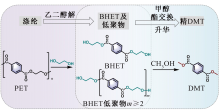
摘要: 为高效回收利用废旧纺织品中的涤纶,针对工业上采用的乙二醇解-甲醇酯交换联合工艺,揭示了涤纶在该联合工艺中的化学回收反应历程,确定了涤纶乙二醇解产物中对苯二甲酸双羟乙酯(BHET)及低聚物向对苯二甲酸二甲酯(DMT)转化的规律。结果表明:在第1步乙二醇解过程中,涤纶醇解产物主要为BHET的单体、二聚体、三聚体、四聚体和五聚体;在第2步甲醇酯交换过程中,BHET的单体、二聚体和三聚体在65 ℃下反应3 h可完全转化为DMT;而四聚体和五聚体由于分子量大导致反应活性较低,难以完全转化为DMT;由于DMT是该联合工艺中涤纶的最终回收单体,在乙二醇解过程中,涤纶解聚为BHET的单体、二聚体和三聚体是“有效”解聚,因此可通过提高乙二醇比例和延长解聚时间来提高BHET单体及二聚体和三聚体的含量,以提高最终DMT的产量和回收率,助力实现涤纶的高效化学回收和循环再利用。

关键词: 废旧纺织品, 循环再利用, 涤纶, 乙二醇解, 甲醇酯交换, 低聚物, 转化规律

Abstract:

Objective Polyester is the most widely used fiber material in waste textiles, and its efficient recycling is the key to solving the problem of waste textiles. At present, the combined glycolysis-methanol transesterification process is widely used in industry. In this process, the methanol transesterification reaction of glycolysis products into dimethyl terephthalate (DMT)is the key step. Therefore, the transformation rule of glycolysis products in methanol transesterification can provide theoretical guidance for the efficient chemical recycling of waste polyester.

Method In this paper, the chemical recycling of polyester was studied according to the industrial combined glycolysis-methanol transesterification process. The depolymerization products of polyester textile during glycolysis and methanol transesterification were qualitatively and quantitatively studied by high performance liquid chromatography-mass spectrometry (HPLC-MS).

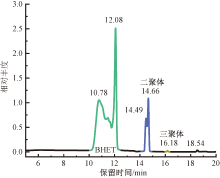
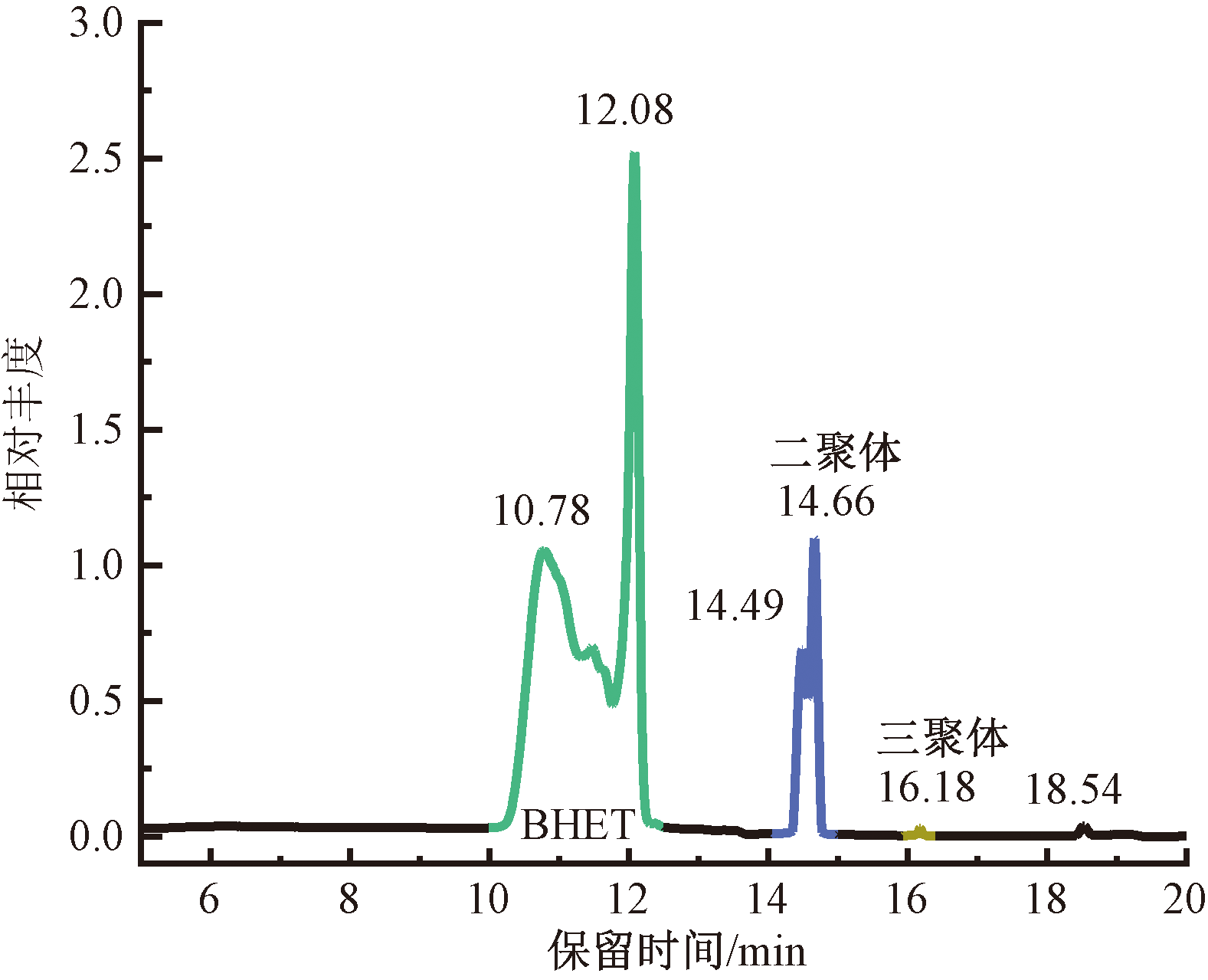
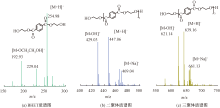
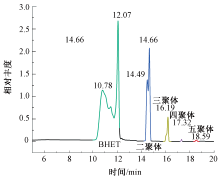
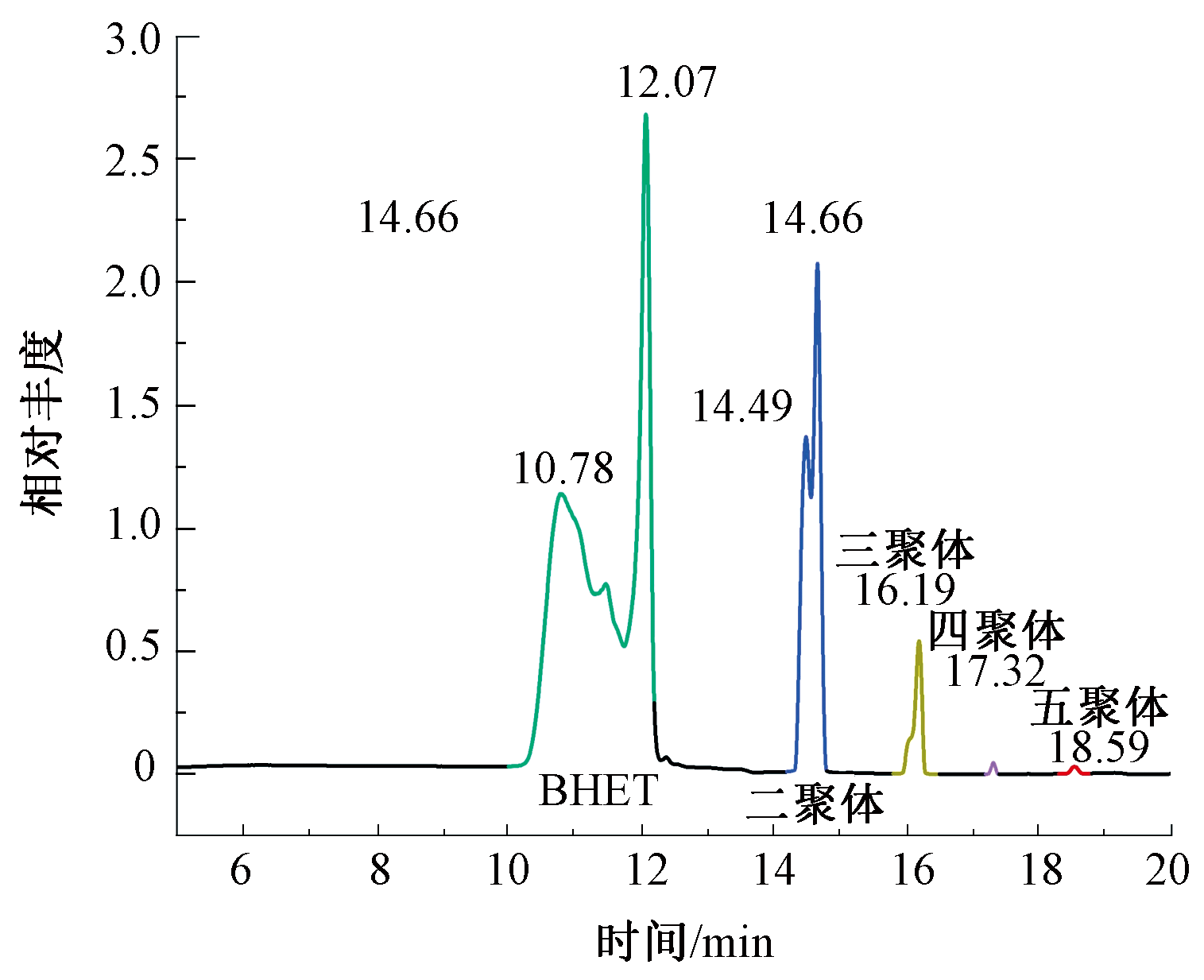
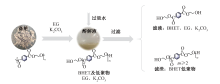
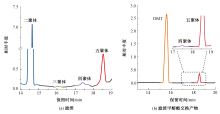
Results In the first step of glycolysis, the glycolysis products of polyester are mainly bis(2-hydroxyethyl) terephthalate (BHET) monomer, dimer, trimer, tetramer, and pentamer. The oligomer content can be controlled by reducing the ethylene glycol ratio and shortening the depolymerization time. Firstly, the glycolysis solution with a mass ratio of polyethylene terephthalate (PET) to ethylene glycol (EG) of 1∶1 and depolymerized at 190 ℃ for 1 h was selected for methanol transesterification. HPLC-MS showed that BHET monomer, dimer, and trimer could be completely converted into DMT within 3 h, while tetramer and pentamer could not be completely converted into DMT due to their large molecular weight and low reaction activity. The intermediate 2-hydroxyethyl methyl terephthalate is generated during the conversion of BHET and oligomers to DMT. The conversion rate of BHET and oligomers to DMT was very fast (within 5 min), and then remain at a very low content. The BHET in the PET glycolysis products was separated by water washing, and the conversion process of BHET oligomers to DMT was studied in detail. HPLC-MS confirmed that the separated oligomer products were mainly BHET dimer, tetramer, pentamer and trace trimer. The separated BHET oligomers were subjected to methanol transesterification reaction. It was found that the BHET dimer and trimer completely disappeared after methanol transesterification, which again showed that dimer and trimer were completely converted into DMT. However, BHET tetramer and pentamer still exist, proving that it was difficult to completely convert them into DMT. This is because BHET tetramer and pentamer have larger molecular weights and lower reactivity. They have fewer effective collisions with methanol in the transesterification reaction and cannot be completely converted into DMT. Since DMT is the final recycled monomer of polyester in this combined process, the depolymerization of polyester into BHET monomer, dimer, and trimer during glycolysis is the ″effective″ depolymerization.

Conclusion Aiming at the glycolysis-methanol transesterification combined process used in industry, the methanol transesterification process of the glycolysis depolymerization products of polyester was researched and revealed. In the first step of glycolysis, the glycolysis products of polyester are mainly BHET monomer, dimer, trimer, tetramer, and pentamer. In the second step of methanol transesterification, BHET monomer, dimer, and trimer can be completely converted into DMT at 65 ℃ for 3 h. However, BHET tetramers and pentamers exhibit low reactivity due to their large molecular weight and are difficult to be completely converted into DMT. The depolymerization of polyester into BHET monomer, dimer, and trimer during glycolysis represents the ″effective″ depolymerization. Therefore, the content of BHET monomer and its dimer and trimer can be increased by increasing the proportion of ethylene glycol and prolonging the depolymerization time, thereby improving the final DMT yield and achieving efficient chemical recycling of polyester fibers. The transformation rules of BHET and its oligomers to DMT in the glycolysis products of polyester were determined, which provides theoretical guidance for the chemical recycling of polyester textiles in glycolysis-methanol transesterification combined process.

Key words: waste textile, recycling, polyester, glycolysis, methanol transesterification, oligomer, transformation rule

中图分类号: 

  • TS102.9

图1

涤纶化学回收的乙二醇解-甲醇酯交换联合工艺流程"

图2

涤纶乙二醇解液(涤纶与乙二醇质量比为1∶1.5)高效液相色谱图"

图3

涤纶乙二醇解液质谱图"

图4

涤纶乙二醇解液(涤纶与乙醇质量比为1∶1)高效液相色谱图"

表1

甲醇酯交换过程中不同反应时间下的组成分析"

反应
时间/
min
相对含量/%
BHET
聚体

聚体

聚体

聚体
DMT MHET
0 70.68 17.16 8.06 1.82 0.90 0 0
1 2.85 0 3.21 0.39 0.70 68.19 13.36
5 0.12 0 0 0.19 0.26 84.98 14.45
10 0.29 0 0 0.18 0.55 84.00 11.60
30 0.10 0 0 0.17 0.65 80.40 18.40
60 0.41 0 0 0.10 0.24 82.84 12.78
90 0.09 0 0 0.14 0.30 90.67 8.80

图5

涤纶乙二醇解产物的分离过程"

图6

涤纶乙二醇解产物中滤渣及滤渣甲醇酯交换产物的液相色谱图"

[1] 赵国樑. 我国废旧纺织品综合再利用技术现状及展望[J]. 北京服装学院学报(自然科学版), 2019, 39(1): 94-100.
ZHAO Guoliang. Present situation and prospect of comprehensive recycling technologies of waste textiles in China[J]. Journal of Beijing Institute of Fashion Technology(Natural Science Edition), 2019, 39(1): 94-100.
[2] 孙瑞, 王晓映, 薛菁雯, 等. 国内废旧服装回收再利用的调查与分析[J]. 纺织导报, 2021(1): 44-47.
SUN Rui, WANG Xiaoying, XUE Jingwen, et al. Investigation and analysis of waste clothing recycling and reuse in China[J]. China Textile Leader, 2021(1): 44-47.
[3] 崔晓雪, 魏文静, 张立东, 等. 化学降解废旧聚酯生产有色涤纶短纤维工艺探讨[J]. 合成纤维工业, 2018, 41(2): 71-73.
CUI Xiaoxue, WEI Wenjing, ZHANG Lidong, et al. Production process of colored polyester staple fiber through chemical degradation of polyester waste[J]. China Synthetic Fiber Industry, 2018, 41(2): 71-73.
[4] 陈龙, 周哲, 张军, 等. 废旧棉与涤纶纺织品化学法循环再生利用的研究进展[J]. 纺织学报, 2022, 43(5): 43-48.
CHEN Long, ZHOU Zhe, ZHANG Jun, et al. Research progress in chemical recycling of waste cotton and polyester textile[J]. Journal of Textile Research, 2022, 43(5): 43-48.
[5] 刘雪辉, 徐世美, 张帆, 等. 高分子材料的化学升级回收[J]. 高分子学报, 2022, 53(9): 1005-1022.
LIU Xuehui, XU Shimei, ZHANG Fan, et al. Chemical upcycling of polymeric materials[J]. Acta Polymerica Sinica, 2022, 53(9): 1005-1022.
[6] XU Wenhao, CHEN Lin, ZHANG Shun, et al. New insights into urethane alcoholysis enable chemical full recycling of blended fabric waste[J]. Green Chemistry, 2023, 25(1): 245-255.
[7] KOSLOSKI-OH Sophia C, WOOD Zachary A, MANJARREZ Yvonne, et al. Catalytic methods for chemical recycling or upcycling of commercial polymers[J]. Materials Horizons, 2021, 8(4): 1084-1129.
[8] ZHANG Shun, XU Wenhao, DU Rongcheng, et al. Cosolvent-promoted selective non-aqueous hydrolysis of PET wastes and facile product separation[J]. Green Chemistry, 2022, 24(8): 3284-3292.
[9] HIDEKI Kurokawa, MASA-AKI Ohshima, KAZUO Sugiyama, et al. Methanolysis of polyethylene terephthalate (PET) in the presence of aluminium tiisopropoxide catalyst to form dimethyl terephthalate and ethylene glycol[J]. Polymer Degradation and Stability, 2003, 79(3): 529-533.
[10] WANG Tianlin, SHEN Chuanchao, YU Guangren, et al. The upcycling of polyethylene terephthalate using protic ionic liquids as catalyst[J]. Polymer Degradation and Stability, 2022. DOI:10.1016/j.polymdegradstab.2022.110050.
[11] 汪少朋, 吴宝宅, 何洲. 废旧纺织品回收与资源化再生利用技术进展[J]. 纺织学报, 2021, 42(8): 34-40.
WANG Shaopeng, WU Baozhai, HE Zhou. Technology progress in recycling and reuse of waste textiles[J]. Journal of Textile Research, 2021, 42(8): 34-40.
[12] 鲍青青, 孙海钰, 陈卓, 等. 涤纶化学降解单体产物的高效结晶提纯研究[J]. 高分子学报, 2023, 54(3): 346-355.
BAO Qingqing, SUN Haiyu, CHEN Zhuo, et al. Efficient purification of the glycolysis monomer of polyester enabled by its unique phase transition property[J]. Acta Polymerica Sinica, 2023, 54(3): 346-355.
[13] 余新健, 叶建荣, 徐允武, 等. 废旧涤纶纺织品的化学解聚工艺[J]. 合成纤维, 2018, 47(6): 34-36.
YU Xinjian, YE Jianrong, XU Yunwu, et al. Chemical depolymerization technology of waste polyester textiles[J]. Synthetic Fiber in China, 2018, 47(6): 34-36.
[14] 张瑞芝, 梁帅童, 张红娟, 等. 再生与原生涤纶醇解液的液相色谱检测及鉴别[J]. 印染, 2023, 49(3): 63-67.
ZHANG Ruizhi, LIANG Shuaitong, ZHANG Hongjuan, et al. Determination and identification of regenerated and virgin polyester alcoholysis liquor by liquid chromatography[J]. China Dyeing & Finishing, 2023, 49(3): 63-67.
[1] 史晟, 王涯舟, 王淑花, 庞明科, 李鑫, 张美玲, 高承永. 废旧涤纶醇解及含氟水性聚氨酯的制备[J]. 纺织学报, 2025, 46(06): 8-16.
[2] 朱梦慧, 葛美彤, 董智佳, 丛洪莲, 马丕波. 纬编双面羊毛/涤纶交织物的结构与热湿性能评价[J]. 纺织学报, 2025, 46(05): 179-185.
[3] 魏志强, 刘新华. 耐热仿生结构色织物的制备及其性能[J]. 纺织学报, 2025, 46(05): 195-201.
[4] 张金芹, 李晶, 肖明, 毕曙光, 冉建华. 聚苯乙烯/还原氧化石墨烯微球传感电热织物的自组装法制备[J]. 纺织学报, 2025, 46(05): 202-213.
[5] 赵祥璐, 方寅春, 李伟. 超疏水自清洁结构色织物的制备及其性能[J]. 纺织学报, 2025, 46(04): 154-161.
[6] 江文杰, 郭明瑞, 高卫东. 棉/涤纶短纤皮芯纱及其织物的力学性能[J]. 纺织学报, 2025, 46(03): 49-55.
[7] 王浙峰, 蔡王丹, 李诗雅, 徐青艺, 张红霞, 祝成炎, 金肖克. 抗菌除臭复合功能机织物的服用性能[J]. 纺织学报, 2025, 46(03): 90-99.
[8] 殷连博, 李家炜, 段慧敏, 宋理想, 陈玉霜, 厉巽巽, 戚栋明. 液体分散染料染色废水的循环染色[J]. 纺织学报, 2025, 46(03): 131-140.
[9] 李鑫, 叶培培, 赵晓曼, 王鸿博, 杨国荣, 洪剑寒. 氧化铋-硅橡胶基X射线防护织物的制备及性能[J]. 纺织学报, 2025, 46(02): 227-235.
[10] 杨露, 孟家光, 陈雨青, 支超. 基于废旧纺织品的湿度响应纤维素/聚氨酯复合材料的制备及其性能[J]. 纺织学报, 2025, 46(02): 26-34.
[11] 朱琳, 王展鹏, 吴宝宅, 汪少朋, 刘一鸣, 代成娜, 陈标华. 废旧涤纶织物的溶剂萃取剥色及其对醇解的影响[J]. 纺织学报, 2025, 46(01): 103-110.
[12] 许秋歌, 郭寻, 朵永超, 吴若楠, 钱晓明, 宋兵, 符浩, 赵宝宝. 高收缩聚酯/聚酰胺6中空橘瓣型纺黏针刺非织造布的制备及其性能[J]. 纺织学报, 2024, 45(12): 41-49.
[13] 章红豆, 陈芳, 楚祥婷, 陆惠文, 刘新金, 苏旭中. 基于示踪纤维法测试的化纤条内纤维弯钩[J]. 纺织学报, 2024, 45(12): 74-79.
[14] 武浩, 周嫦娥, 高振清, 冯嘉禾. 基于还原-氧化体系的活性染料染色棉织物剥色[J]. 纺织学报, 2024, 45(12): 128-136.
[15] 陈世昌, 杨冬冬, 陈文兴. 聚乙二醇柠檬酸酯平滑剂合成及其复配油剂性能[J]. 纺织学报, 2024, 45(11): 128-135.
Viewed
Full text


Abstract

Cited

  Shared   
  Discussed   
No Suggested Reading articles found!