纺织学报 ›› 2025, Vol. 46 ›› Issue (01): 103-110.doi: 10.13475/j.fzxb.20240106501

• 染整工程 • 上一篇    下一篇

废旧涤纶织物的溶剂萃取剥色及其对醇解的影响

朱琳1, 王展鹏1, 吴宝宅2, 汪少朋2, 刘一鸣1, 代成娜1(), 陈标华1   

  1. 1.北京工业大学 环境科学与工程学院, 北京 100124
    2.北京芯友工程技术有限公司, 北京 100124
  • 收稿日期:2024-01-31 修回日期:2024-09-18 出版日期:2025-01-15 发布日期:2025-01-15
  • 通讯作者: 代成娜(1984—),女,副教授,博士。主要研究方向为高分子固废资源化利用。E-mail:daicn@bjut.edu.cn
  • 作者简介:朱琳(1999—),女,硕士生。主要研究方向为废旧纺织品回收与利用。
  • 基金资助:
    国家自然科学基金面上项目(22178009)

Decolorization of waste polyester fabrics by solvent extraction and its influence on glycolysis

ZHU Lin1, WANG Zhanpeng1, WU Baozhai2, WANG Shaopeng2, LIU Yiming1, DAI Chengna1(), CHEN Biaohua1   

  1. 1. College of Environmental Science and Engineering, Beijing University of Technology, Beijing 100124, China
    2. Beijing Sinceyou Technology & Engineering Co., Ltd., Beijing 100124, China
  • Received:2024-01-31 Revised:2024-09-18 Published:2025-01-15 Online:2025-01-15

摘要:

针对有色废旧涤纶织物乙二醇醇解回收过程中染料残留问题,利用溶剂萃取法进行醇解前剥色处理,进一步考察剥色对涤纶织物醇解性能的影响。综合考虑涤纶织物的剥色率及质量损失情况,从多种类型溶剂(单一有机溶剂、混合有机溶剂、低共熔溶剂)中筛选出性能优异的乙酸和氯苯2种溶剂,系统探究了剥色温度、固液比和剥色时间等条件对织物剥色效果的影响,发现当剥色温度为130 ℃,固液比为1:30,剥色时间为20 min时,乙酸和氯苯对9种市售涤纶织物都有较好的剥色效果,最佳剥色率分别为82.9%和88.4%。剥色前后对废旧涤纶织物进行乙二醇醇解实验,结果表明,乙酸和氯苯的使用能够普遍提高醇解产物的回收率,最高可使回收率分别增加11.44%和12.48%,且回收产物的纯度均高于90%,有助于废旧涤纶织物的高效回收。

关键词: 废旧纺织品, 涤纶织物, 溶剂萃取, 剥色, 乙酸, 氯苯, 醇解, 回收再利用

Abstract:

Objective With the rapid growth of textile consumption, its effective recycling has become an urgent challenge. Polyethylene terephthalate (PET) is a major commercial fabric material, with significant annual production and consumption. Due to production requirements, a variety of dyes and auxiliaries are usually added to PET fabrics, and these additives cause degradation of product quality in the chemical recycling process, which is not conducive to achieving high-value recycling and closed-loop recycling. Therefore, it is necessary to pre-decolorize the fabrics so as to reduce the burden for the subsequent purification of bis(hydroxyethyl terephthalate) (BHET). In this study, it was proposed to decolorize PET fabrics using solvent extraction method, and the influence of decolorization on PET glycolysis performance were further examined.

Method The PET fabrics samples were cut into small pieces of approximately 2 cm×2 cm beforehand, and the PET pieces were washed and dried. Then, a certain amount of PET samples was added into solvent in a three-neck flask, which was connected with a condenser. The flask was placed in an oil bath to maintain the required temperature. After decolorization, the fabrics pieces were taken out and washed, dried in an oven at 60 ℃. The L*,a*,b* values before and after decolorization were determined by chromameter, and then the decolorization ratio was calculated. The gravimetric method was adopted to calculate the BHET recovery rate of PET glycolysis. The purity of the recovered BHET was determined by high-performance liquid chromatography.

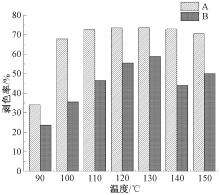
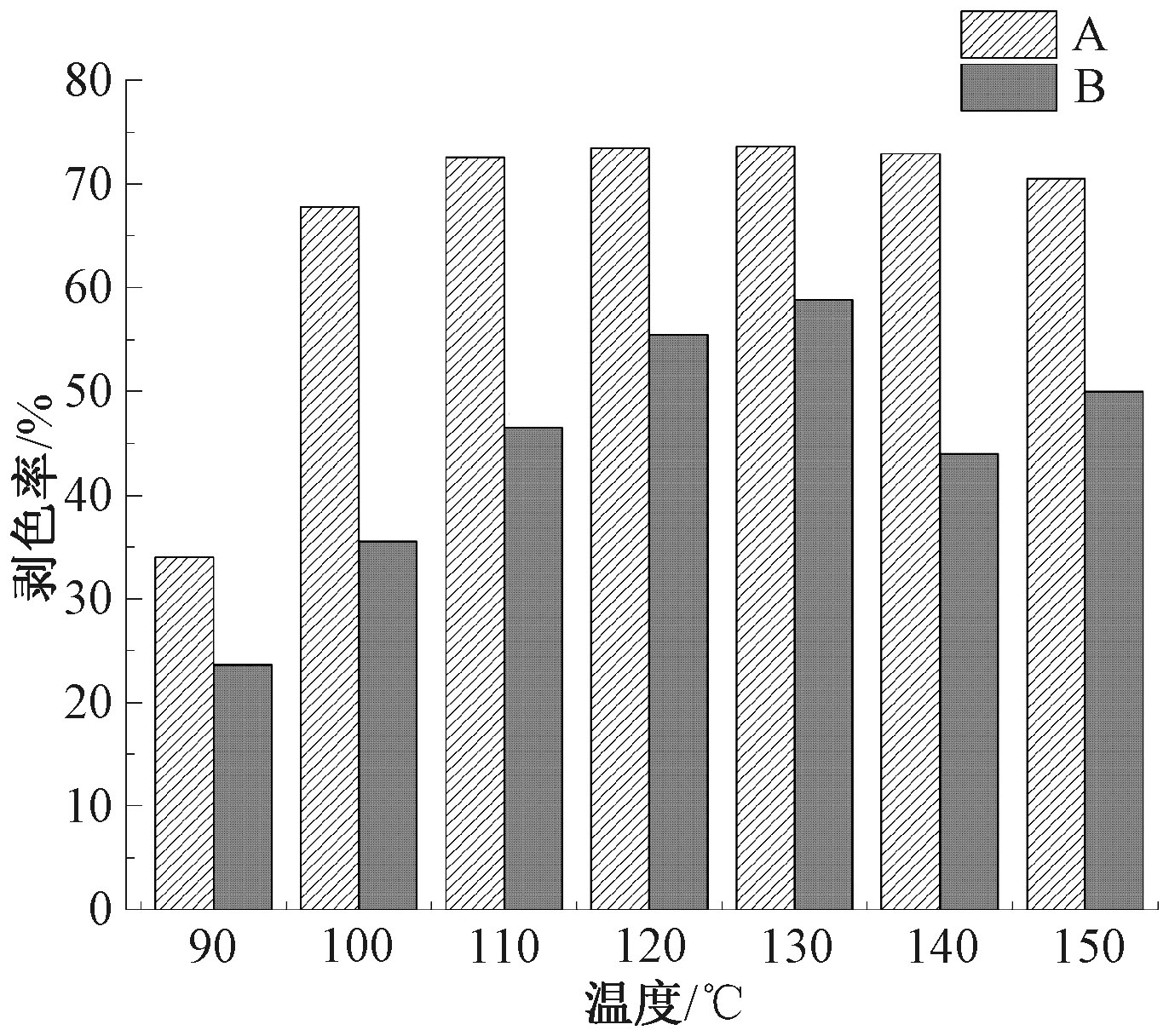
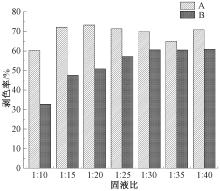
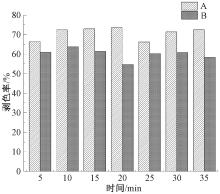
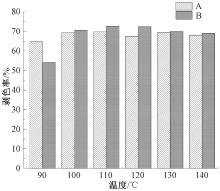
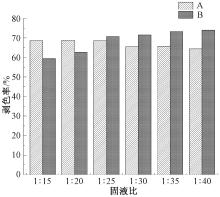
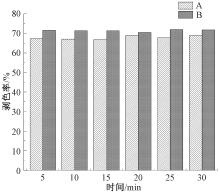
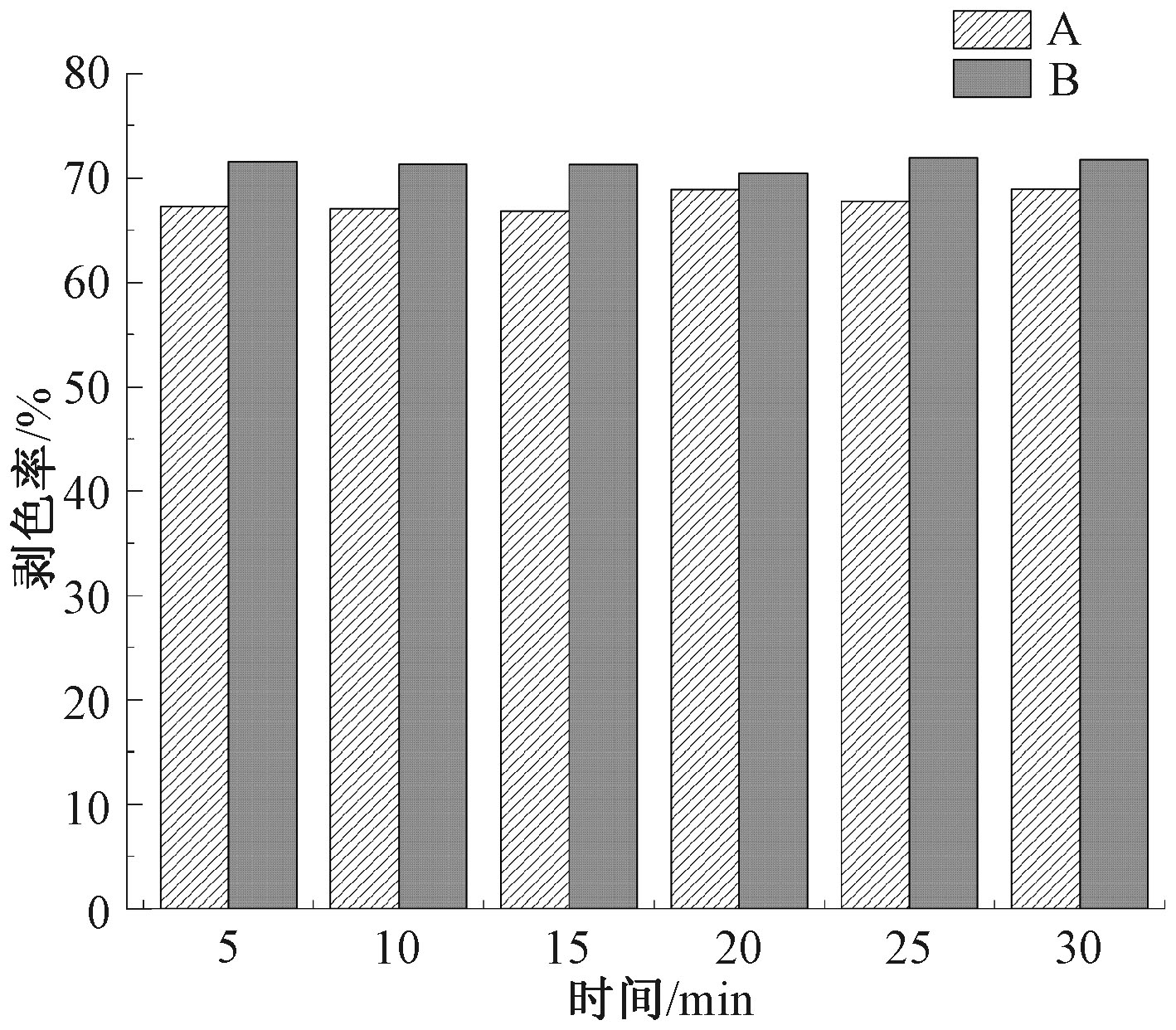
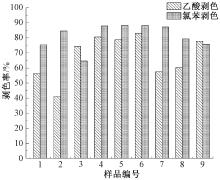
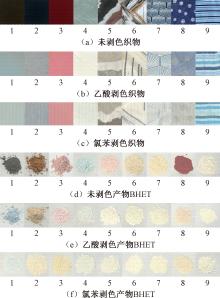
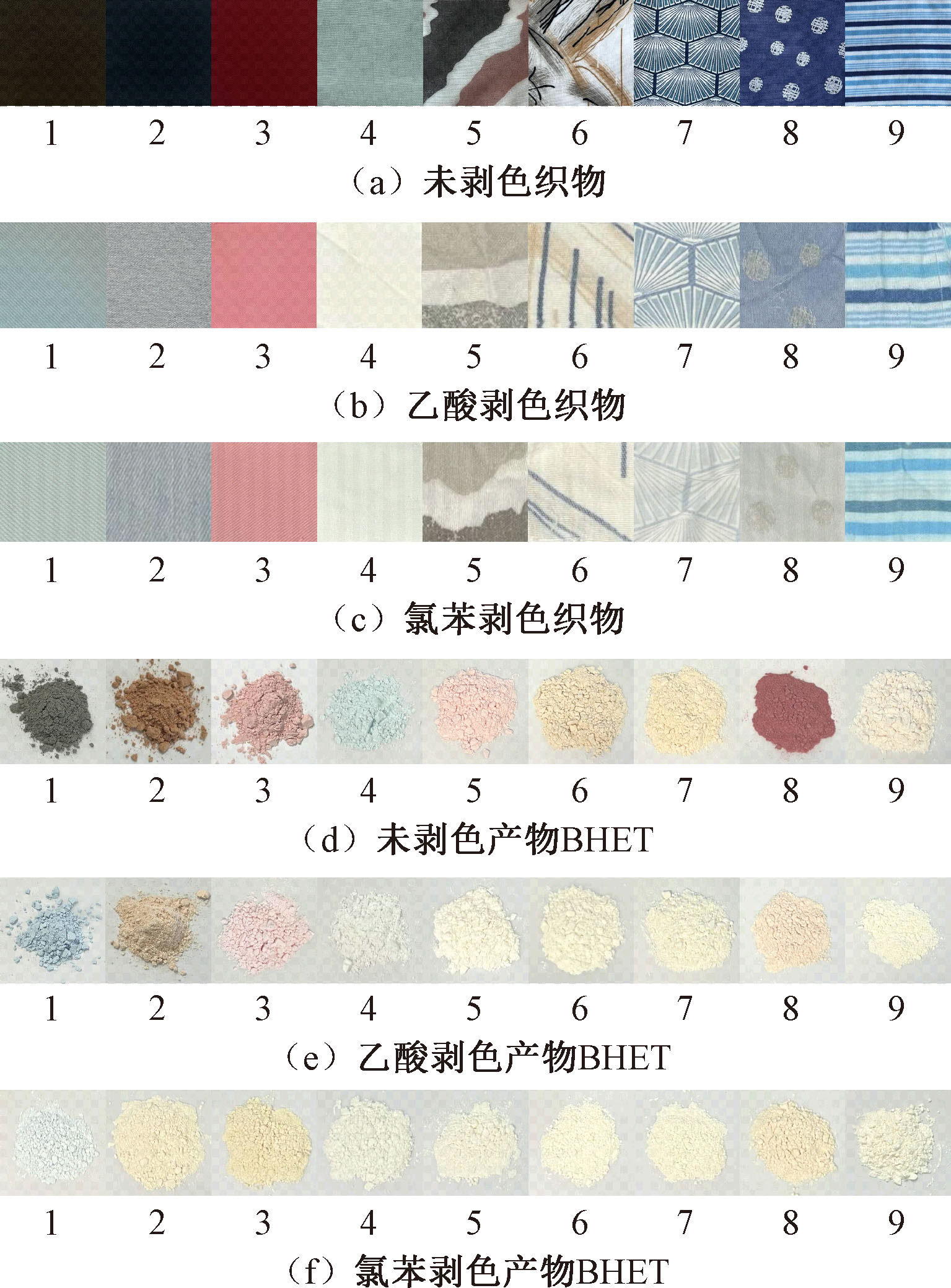
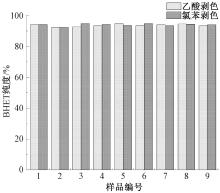
Results Solvent screening experiments among different types of solvents (i.e, single organic solvent, mixed solvent, and deep eutectic solvent (DES)) were conducted based on the decolorization ratio and PET textile mass loss for two single-color PET fabrics. Among them, DES was found not suitable for use as a decolonization solvent because of its high viscosity. Considering the general decolorization effect of solvents on PET fabrics, acetic acid and chlorobenzene, which are more effective in decolorization and easy to recycle and use, were finally selected as the optimal solvents. Then, the operating parameters (i.e., operating temperature, solid-liquid mass ratio and decolorization time) optimization were carried out through single-factor experiments for acetic acid and chlorobenzene decolorization, and the optimal operating condition for acetic acid was identified to be temperature 130 ℃, solid-liquid ratio 1:30, and treatment time 20 min for acetic acid. For chlorobenzene decolorization, it was evident that the concerned parameters had little effect on the decolorization performance. In order to test the universality and suitability of the two types of solvents, nine PET fabrics with different colors were decolorized using acetic acid and chlorobenzene under the optimal conditions, and the optimal decolorization ratios were all higher than 80%, reaching 82.9% and 88.4%, respectively. In particular, the general applicability of chlorobenzene decolorization was better, with decolorization ratios higher than 75% for most samples. Decolorization with acetic acid and chlorobenzene did not affect glycolysis and even contributed to the increase in BHET recovery rate. Especially, after decolorization with chlorobenzene, a general increase of 5%-12% was achieved in BHET recovery rate. In addition, the BHETs recovered through the decolorized fabrics were still of high quality, with purity greater than 90% for all.

Conclusion Different types of solvents (i.e, single organic solvent, mixed solvent, and deep eutectic solvent) were used for PET fabrics decolorization, and acetic acid and chlorobenzene were chosen as the optimal solvents. The selected solvents can be used for PET fabrics with other colors, and the optimal decolorization ratio for the nine fabrics tested was more than 80%. Moreover, decolorization did not affect the glycolysis reaction, ensuring high recovery and purity of BHET. Removal part of the dye from textiles by extraction before glycolysis can greatly reduce the burden of subsequent purification of BHET, which is more economical and has greater potential for industrialization.

Key words: waste fabric, polyester fabric, solvent extraction, decolorization, acetic acid, chlorobenzene, glycolysis, recycling

中图分类号: 

  • TS159

表1

使用单一有机溶剂剥色后样品的质量损失率与剥色率"

剥色剂 溶解度参数/
(103 J1/2·m-3/2)
质量损失率/% 剥色率/%
A B A B
乙酸 25.8 1.33 1.48 72.41 53.45
氯苯 19.5 2.00 1.80 61.78 70.07
DMSO 26.4 1.89 1.48 58.86 74.92
二氯甲烷 19.9 1.49 1.18 58.45 43.98
DMF 24.8 2.36 2.14 51.77 74.80
正丁醇 23.4 0.92 0.45 44.28 46.15
正己醇 21.9 1.02 0.96 39.76 35.49
正辛醇 21.1 0.46 1.19 33.45 36.19

表2

使用混合有机溶剂剥色后样品的质量损失率与剥色率"

剥色剂 质量损失率/% 剥色率/%
A B A B
氯苯/乙酸
(体积比1:1)
1.68 1.96 66.35 49.82
环丁砜/DMF
(体积比1:1)
1.95 1.58 59.40 78.41
吗啉/正己醇
(体积比1:1)
1.41 1.23 53.41 70.71
吗啉/丙酮
(体积比3:1)
2.03 1.81 50.41 67.68
吗啉/乙醇
(体积比1:1)
1.59 1.09 49.93 70.74

表3

使用DES剥色后样品的质量损失率与剥色率"

剥色剂 质量损失率/% 剥色率/%
A B A B
乙酸/DL-薄荷醇
(量比1:1)
0.37 -0.19 68.39 59.19
辛酸/百里酚
(量比1:1)
-2.28 -1.03 63.01 49.02
癸酸/百里酚
(量比1:1)
-2.00 -1.56 57.90 48.81
己酸/百里酚
(量比1:1)
-1.28 -0.16 57.22 48.50
利多卡因/苯酚
(量比1:2)
-0.56 -0.48 56.74 56.87
苯甲醇/百里酚
(量比1:1)
-0.18 -0.18 53.13 57.15
壬酸/百里酚
(量比1:1)
-0.20 -0.70 52.52 52.50
利多卡因/乙二醇
(量比1:3)
-0.88 -0.60 49.11 27.00

图1

不同温度条件下乙酸对样品的剥色率"

图2

不同固液比条件下乙酸对样品的剥色率"

图3

不同时间条件下乙酸对样品的剥色率"

图4

不同温度条件下氯苯对样品的剥色率"

图5

不同固液比条件下氯苯对样品的剥色率"

图6

不同剥色时间条件下氯苯对样品的剥色率"

图7

乙酸和氯苯对9种涤纶织物的剥色率"

图8

乙酸和氯苯对9种涤纶织物的剥色效果"

图9

剥色前后织物的BHET回收率"

图10

剥色后织物的BHET纯度"

[1] 2022年中国化纤行业运行分析与2023年展望_中国化学纤维工业协会[EB/OL]. (2023-03-15)[2024-06-03]. .
[2] FEI X, FREEMAN H S, HINKS D. Toward closed loop recycling of polyester fabric: step 1: decolorization using sodium formaldehyde sulfoxylate[J]. Journal of Cleaner Production, 2020. DOI:10.1016/j.jclepro.2020.120027.
[3] 李雁. 有色废弃PET材料的化学回收及下游产品开发[D]. 大连: 大连理工大学, 2009: 16-22.
LI Yan. Chemical recycling and downstream product development of waste coloured polyethylene tere-phthalate[D]. Dalian: Dalian University of Technology, 2009: 16-22.
[4] HUANG J, YAN D, DONG H, et al. Removal of trace amount impurities in glycolytic monomer of polyethylene terephthalate by recrystallization[J]. Journal of Environmental Chemical Engineering, 2021. DOI:10.1016/j.jece.2021.106277.
[5] CHEN Z, SUN H, KONG W, et al. Closed-loop utilization of polyester in the textile industry[J]. Green Chemistry, 2023, 25(11): 4429-4437.
[6] 陈奠宇, 刘龙飞, 王江, 等. 涤纶废料的剥色工艺探索[J]. 化工进展, 2009, 28(S1): 111-114.
CHEN Dianyu, LIU Longfei, WANG Jiang, et al. Discussion on the stripping process of polyester waste[J]. Chemical Industry and Engineering Progress, 2009, 28(S1): 111-114.
[7] 李悦, 董伟伟, 蔡再生. 分散染料染色涤纶织物的剥色研究[J]. 国际纺织导报, 2020, 48(6): 24-26,28-34.
LI Yue, DONG Weiwei, CAI Zaisheng. Study on stripping of polyester fabrics dyed with disperse dyes[J]. Melliand China, 2020, 48(6): 24-26,28-34.
[8] 吴宝宅. 废旧纺织品回收脱色技术[D]. 呼和浩特: 内蒙古工业大学, 2013: 15-18.
WU Baozhai. The decoloration technology of recycled waste textiles[D]. Hohhot: Inner Mongolia University, 2013: 15-18.
[9] 孙晨晓, 周小进. 二氯甲烷萃取涤纶织物分散染料的研究[J]. 现代丝绸科学与技术, 2015, 30(2): 53-54,61.
SUN Chenxiao, ZHOU Xiaojin. Study on the extraction of disperse dyes from polyester fabrics by dichloromethane[J]. Modern Silk Science & Technology, 2015, 30(2): 53-54,61.
[10] 吴宝宅, 武志云, 汪少朋, 等. 应用二甲基亚砜对废旧聚酯纺织品的脱色[J]. 纺织学报, 2014, 35(4): 84-87.
WU Baozhai, WU Zhiyun, WANG Shaopeng, et al. Recycled waste polyester textiles decoloration by DMSO[J]. Journal of Textile Research, 2014, 35(4): 84-87.
[11] 吴宝宅, 武志云, 汪少朋, 等. DMF在聚酯纺织品脱色中的应用研究[J]. 染整技术, 2013, 35(6): 11-14.
WU Baozhai, WU Zhiyun, WANG Shaopeng, et al. Research on application of DMF for decolorization of polyester textiles[J]. Textile Dyeing and Finishing Journal, 2013, 35(6): 11-14.
[12] 侯文生, 凌晨, 蔡智锋, 等. 有色涤棉混纺织物剥色的研究[J]. 应用化工, 2018, 47(10): 2097-2102.
HOU Wensheng, LING Chen, CAI Zhifeng, et al. Research on stripping of colored polyester-cotton blended fabric[J]. Applied Chemical Industry, 2018, 47(10): 2097-2102.
[13] 朱永辉, 王立永, 张海宁, 等. 着色物上染料的分离与提纯方法及应用实例[J]. 中国纤检, 2015(8): 76-79.
ZHU Yonghui, WANG Liyong, ZHANG Haining, et al. The method to separation and purification dyes on the colored material and application examples[J]. China Fiber Inspection, 2015 (8): 76-79.
[14] CHEN C, CAO Y, ALI A, et al. How to apply terpenoid-based deep eutectic solvents for removal of antibiotics and dyes from water: theoretical prediction, experimental validation and quantum chemical evaluation[J]. Environmental Research, 2023. DOI:10.1016/j.envres.2023.116180.
[15] ASLA A, MARTÍNEZ-RICO Ó, OTERO P, et al. Water decolorization using tuned ternary deep eutectic solvents[J]. Journal of Molecular Liquids, 2023. DOI:10.1016/j.molliq.2023.121832.
[1] 李鑫, 叶培培, 赵晓曼, 王鸿博, 杨国荣, 洪剑寒. 氧化铋-硅橡胶基X射线防护织物的制备及性能[J]. 纺织学报, 2025, 46(02): 227-235.
[2] 杨露, 孟家光, 陈雨青, 支超. 基于废旧纺织品的湿度响应纤维素/聚氨酯复合材料的制备及其性能[J]. 纺织学报, 2025, 46(02): 26-34.
[3] 武浩, 周嫦娥, 高振清, 冯嘉禾. 基于还原-氧化体系的活性染料染色棉织物剥色[J]. 纺织学报, 2024, 45(12): 128-136.
[4] 尹祥, 朱恩清, 杨静, 杨海艳, 王大伟, 石纯, 史正军. 可纺性竹原纤维的脱胶工艺及其性能[J]. 纺织学报, 2024, 45(09): 106-112.
[5] 徐豫松, 周杰, 甘佳怡, 张涛, 张先明. 含磷氮水性聚氨酯的制备及其在涤纶织物阻燃整理中应用[J]. 纺织学报, 2024, 45(07): 112-120.
[6] 于承浩, 王元非, 于腾波, 吴桐. 热致自卷曲左旋聚乳酸/聚乳酸-羟基乙酸共聚物纳米纤维血管支架制备及其性能[J]. 纺织学报, 2024, 45(07): 18-23.
[7] 邵明军, 蹇玉兰, 唐唯, 柴希娟, 万辉, 解林坤. 涤纶织物表面耐久超疏水涂层制备及其水油分离性能[J]. 纺织学报, 2024, 45(04): 142-150.
[8] 韩非, 郎晨宏, 邱夷平. 废旧纺织品循环经济的监督检验体系研究进展[J]. 纺织学报, 2023, 44(03): 231-238.
[9] 廖云珍, 朱亚楠, 葛明桥, 孙同明, 张欣宇. 聚对苯二甲酸乙二醇酯/SrAl2O4:Eu2+,Dy3+含杂纤维醇解及其回收产物性能[J]. 纺织学报, 2023, 44(02): 44-54.
[10] 庞明科, 王淑花, 史晟, 薛立钟, 郭红, 高承永, 卢建军, 赵晓婉, 王子涵. 废旧聚对苯二甲酸乙二醇酯纤维醇解制备阻燃水性聚氨酯及其应用[J]. 纺织学报, 2023, 44(02): 214-221.
[11] 张典典, 李敏, 关玉, 王思翔, 胡桓川, 付少海. 仿植被可见光-近红外反射光谱特征的分散染料印花织物制备及其性能[J]. 纺织学报, 2023, 44(01): 142-148.
[12] 张楚丹, 王锐, 王文庆, 刘燕燕, 陈睿. 阳离子改性阻燃涤纶织物的制备及其性能[J]. 纺织学报, 2022, 43(12): 109-117.
[13] 梅敏, 钱建华, 周榆凯, 杨晶晶. 纳米SiO2/含氟硅防水透湿整理剂的制备及其应用[J]. 纺织学报, 2022, 43(12): 118-124.
[14] 王曙东. 三维多孔生物可降解聚合物人工食管支架的结构与力学性能[J]. 纺织学报, 2022, 43(12): 16-21.
[15] 吴焕岭, 谢周良, 汪阳, 孙万超, 康正芳, 徐国华. 胶原蛋白改性聚乳酸-羟基乙酸载药纳米纤维膜的制备及其性能[J]. 纺织学报, 2022, 43(11): 9-15.
Viewed
Full text


Abstract

Cited

  Shared   
  Discussed   
No Suggested Reading articles found!