纺织学报 ›› 2025, Vol. 46 ›› Issue (09): 205-212.doi: 10.13475/j.fzxb.20250306201

• 服装工程 • 上一篇    下一篇

服装定制化生产的多维度裁剪方案择优机制

吴希滢1,2, 杜劲松1,3(), 李涵涵3,4   

  1. 1.东华大学 服装与艺术设计学院, 上海 200051
    2.东华大学 现代服装设计与技术教育部重点实验室, 上海 200051
    3.新疆大学 纺织与服装学院, 新疆 乌鲁木齐 830017
    4.新疆大学 新疆智能与绿色纺织重点实验室, 新疆 乌鲁木齐 830017
  • 收稿日期:2025-03-27 修回日期:2025-05-20 出版日期:2025-09-15 发布日期:2025-11-12
  • 通讯作者: 杜劲松(1970—),男,副教授,博士。主要研究方向为服装智能制造。E-mail:ducccp@dhu.edu.cn
  • 作者简介:吴希滢(2001—),女,硕士生。主要研究方向为服装智能制造。
  • 基金资助:
    新疆自治区区域协同创新专项—上海合作组织科技伙伴计划及国际科技合作计划项目(2025E01012)

Optimal selection mechanism for multi-dimensional cutting schemes in garment customization production

WU Xiying1,2, DU Jinsong1,3(), LI Hanhan3,4   

  1. 1. College of Fashion and Design, Donghua University, Shanghai 200051, China
    2. Key Laboratory of Clothing Design and Technology, Ministry of Education, Donghua University, Shanghai 200051, China
    3. College of Textiles and Clothing, Xinjiang University, Urumqi, Xinjiang 830017, China
    4. Key Laboratory of Intelligent and Green Textile, Xinjiang University, Urumqi, Xinjiang 830017, China
  • Received:2025-03-27 Revised:2025-05-20 Published:2025-09-15 Online:2025-11-12

摘要:

针对服装定制生产中多维度裁剪方案择优的多目标优化问题,现有研究缺乏对混合订单生产环境下工艺匹配与资源调度的协同优化机制。为此,提出一种订单工艺-裁剪方案-生产安排的三维耦合模型,构建基于机器学习的动态择优机制。通过分析订单属性与裁剪工艺的多维度特征,采用分类回归决策树算法匹配铺布单元与裁剪设备,并应用非支配排序遗传二代算法,以最小化设备最长裁剪实践与最大化裁床工作平衡率为目标,实现混合订单的智能化排产决策,以HL定制企业为例,基于22个多源订单的1 065床裁剪任务进行验证。实例验证表明:优化后最长完成时间最高减少4.2%,生产平衡率提升至89.96%,优化率最高达15.2%。该模型能显著缩短生产周期和平衡资源分配效率,为定制化服装柔性制造提供动态决策方案。

关键词: 服装定制生产, 多维度裁剪方案, CART决策树, NSGA-II算法, 动态排产优化, 服装生产效率

Abstract:

Objective The rapid proliferation of personalized customization and fast-response orders in the garment industry necessitates dynamic scheduling for mixed-order production. Existing studies predominantly focus on single-order optimization, lacking frameworks to address multi-dimensional heterogeneity in fabric properties, order sizes, and equipment compatibility. A three-dimensional coupling model is developed to optimize cutting schemes, enhance resource allocation efficiency, and reduce production cycles. It is critical for enabling flexible manufacturing systems to adapt to small-batch, high-variability environments while balancing efficiency and equilibrium.

Methods A data-driven framework integrated machine learning and multi-objective optimization. Order attributes and cutting parameters were quantified into feature vectors. A classification and regression tree (CART) algorithm, trained on historical data, classified spreading units and matched them to compatible devices. An improved non-dominated sorting genetic algorithm II (NSGA-Ⅱ) was adopted to optimize scheduling with dual objectives, i.e. minimizing total cutting time (F1) and maximizing production balance rate (F2). Constraints included device availability and fabric-device compatibility matrices. Validation was carried out using real-world data from HL Customization Enterprise, involving heterogeneous equipment and mixed orders.

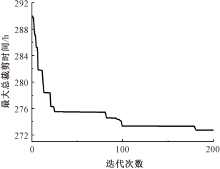
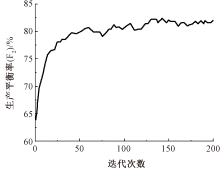
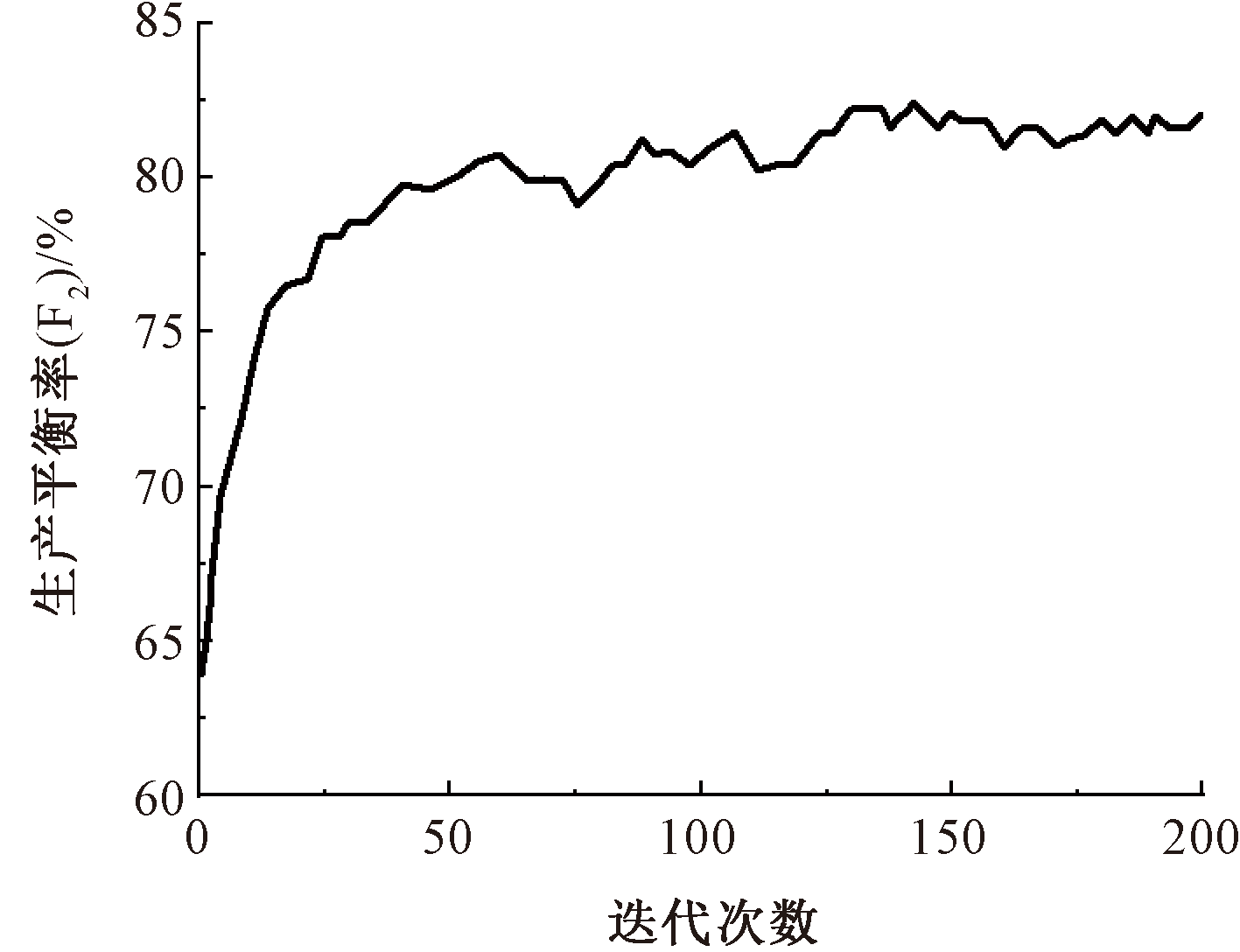
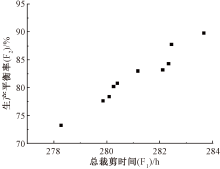
Results The proposed framework demonstrated significant improvements in production efficiency, resource allocation, and decision-making robustness through comprehensive validation with real-world data. The CART model identified fabric width as the most influential factor in device matching, with a feature importance of 0.299, followed by color (0.245) and texture orientation (0.102), while attributes like fabric elasticity and thickness showed negligible impacts. These criteria enabled the classification of 1 065 spreading units into seven device categories. Narrow-width fabrics measuring 91.5 mm or less were systematically assigned to devices P1-P3 and P5-P7 under rules such as limiting layers to 11.0 and texture orientation thresholds to 0.5. Orders requiring precision for wider fabrics, such as 144 mm materials, were routed to laser cutters (P4).The N S G A II helped achieve the dual-objective optimization, reducing the maximum completion time by 4.2%, from 291.95 to 279.63 hours, while improving the production balance rate to 89.96%. Pareto solutions revealed a spectrum of trade-offs, where the most time-efficient solution minimized the completion time to 279.63 h but yielded a lower balance rate of 70.54%, whereas the equilibrium-focused solution achieved an 89.96% balance rate at a marginally higher completion time of 284.64 hours. Total cutting time was converged to 274 h after 200 generations, with 78% of non-dominated solutions at generation 100 remaining optimal in the final set, indicating algorithm stability. Device workload variation was decreased sharply, as evidenced by the reduction in the coefficient of variation from 0.15 to 0.05, ensuring near-uniform utilization across 83% of equipment. Material efficiency improved significantly, with fabric waste decreasing by 23% through optimized device-fabric pairing. Orders with complex patterns, such as striped fabrics, achieved 98.2% material utilization when assigned to laser cutters, compared to 89.5% with conventional methods. The algorithm-maintained solution diversity, with crowding distances exceeding 0.8, and minimized premature convergence through a population size of 200, crossover probability of 0.6, and mutation probability of 0.4. Cross-generational analysis revealed a 12.3% increase in non-dominated solutions between generations 50 and 200. These results highlight the framework's capacity to reconcile conflicting objectives in mixed-order production. The integration of data-driven classification and multi-objective optimization enhanced operational efficiency while introducing adaptability to dynamic order influx, as demonstrated by a 27% reduction in rescheduling frequency for new orders. Empirical relationships, such as the inverse correlation between fabric width and device compatibility, further validated the model's alignment with real-world constraints.

Conclusions This study proposes a dynamic decision-making framework integrating the CART and NSGA-II to address resource allocation and efficiency coordination in mixed-order garment customization. The framework shortens the maximum completion time by 4.2%, improves production balance rate to 89.96%, and decreases material waste by 23% through optimized device-fabric pairing. The CART model identifies fabric width, color, and texture orientation as critical factors in equipment compatibility, while NSGA-II generates Pareto solutions that balance efficiency and equilibrium. The innovation lies in dynamically mapping order attributes to process parameters, overcoming limitations of single-objective optimization. The framework is scalable to discrete manufacturing sectors such as automotive and electronics, particularly for small-batch, high-variability scenarios. Future work should integrate real-time IoT data for adaptive scheduling and explore multi-stage production chain coordination. Practical implementation requires establishing process rule libraries and adopting digital twin technology for constraint simulation. This research advances intelligent transformation in garment manufacturing, providing an important reference for sustainable and flexible production paradigms.

Key words: customized garment production, multi-dimensional cutting scheme, CART decision tree, NSGA-II algorithm, dynamic scheduling optimization, garment production efficiency

中图分类号: 

  • TS941

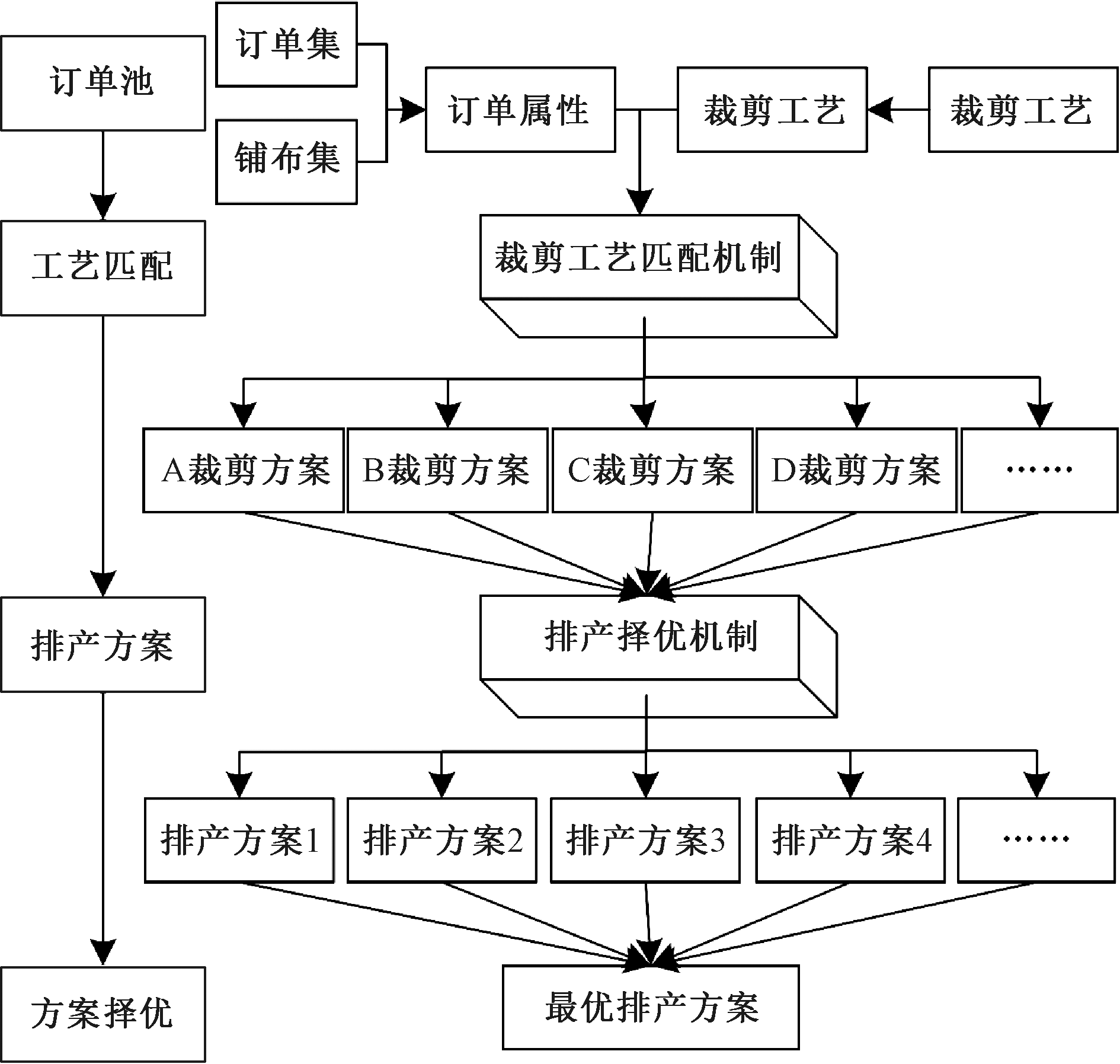
图1

服装多源订单裁剪工艺匹配"

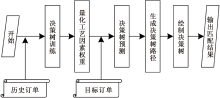
图2

工艺决策路径"

表1

企业现有裁剪设备清单"

序号
编号
设备名称 裁剪
方式
宽度/
m
层数 台数 日产能/
P1 奔马5003 直刀 1.6 1~100 5 20
P2 奔马2503 直刀 1.6 1~50 5 20
P3 纳捷2516 滚刀 1.6 1~10 37 27
P4 全瑞QR1628SC 激光 1.6 1~2 10 30
P5 纳捷12009 滚刀 0.9 1~10 13 25
P6 纳捷6009 滚刀 0.9 1~10 28 35
P7 瑞州12009 滚刀 0.9 1~10 18 35

表2

多源订单数据"

计划单批号 款号 色号 数量/
(件·条-1)
条格
A1-2400686 M2010724-30-2 藏青 57 成色
A1-2400686 W2014092-18-3 藏青 69 成色
A1-2400686 M3020446-9 藏青 114 成色
A1-2400686 W3023186-3 藏青 138 成色
A1-2400686 W5023185-2 藏青 138 成色
A2-2400804 SM-15 白色 23 条格
A2-2400806 M26979 宝蓝 2 条格
A2-2400806 M26979-1 白色 2 条格
A2-2400806 M36980-9 宝蓝 4 条格
A2-2400806 M36980-9 白色 4 条格
A22-2401821 HLS-90-Y 浅灰 530 成色
A22-2401821 HLS-90B-Y 浅灰 530 成色

表3

各订单ET-CAD排版方案"

床数 单号 物料 幅宽/cm 拉布数 铺布长度/cm 用量/m 套数
1 A1-2400686 面料 74.00 4 302.76 1 211.03 2个半件
2 A1-2400686 面料 74.00 2 564.78 1 129.57 4个半件
3 A1-2400686 面料 74.00 2 561.98 1 123.96 4个半件
4 A1-2400686 面料 74.00 2 302.62 605.25 2个半件
5 A1-2400686 面料 74.00 2 550.77 1 101.55 4个半件
6 A1-2400686 面料 74.00 2 286.58 573.16 2个半件
7 A1-2400686 面料 74.00 2 293.05 586.10 2个半件
8 A1-2400686 面料 74.00 2 296.35 592.70 2个半件
9 A1-2400686 面料 74.00 2 292.46 584.92 2个半件
10 A1-2400686 面料 74.00 2 282.98 565.95 2个半件
11 A1-2400686 面料 74.00 2 293.49 586.99 2个半件
12 A1-2400686 面料 74.00 2 301.29 602.57 2个半件
13 A1-2400686 面料 74.00 2 299.96 599.92 2个半件
1 062 A22-2401821 面料 144.00 2 580.66 1 161.00 8件
1 063 A22-2401821 面料 144.00 2 456.34 913.00 6件
1 064 A22-2401821 面料 144.00 2 287.43 575.00 4件
1 065 A22-2401821 面料 144.00 1 296.12 296.00 4件

表4

裁剪方案重要特征值"

因素序号 订单维度 工艺维度 单床维度 重要特征值
1 订单数量 裁剪层数 拉布高 0.354 650
2 定制尺寸 裁剪次数 单床款式数量 0.000 000
3 单床套排数量 0.000 000
4 款式面料 裁剪方向 条格毛流 0.101 620
5 面料幅宽 0.298 558
6 面料属性 0.000 000
7 面料颜色 0.245 172
8 面料弹性 0.000 000
9 面料厚度 0.000 000
10 面料光滑度 0.000 000

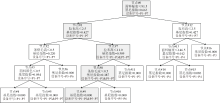
图3

匹配决策树路径"

图4

最大裁剪时间迭代图"

图5

生产平衡率迭代图"

图6

解集的帕累托图"

表5

双目标优化率结果"

解编号 最大完成
时间/h
F1优化率
R1/%
生产
平衡率/%
F2优化率
R2/%
初始解 291.95 - 78.07 -
1 279.63 4.20 70.54 -9.60
2 279.65 4.20 72.34 -7.30
3 280.00 4.10 74.15 -5.00
4 280.36 4.00 81.31 4.10
5 281.75 3.50 84.44 8.20
6 282.86 3.10 84.94 8.80
7 283.54 2.90 85.71 9.80
8 284.09 2.70 88.23 13.00
9 284.64 2.50 89.96 15.20
[1] 陈清婷, 杜劲松, 林镶, 等. 面向服装供应链平台的订单生产双向推荐策略[J]. 纺织学报, 2022, 43(6):151-156.
CHEN Qingting, DU Jinsong, LIN Xiang, et al. A duo-directional recommendation strategy for order-production oriented to apparel supply chain platforms[J]. Journal of Textile Research, 2022, 43(6):151-156.
[2] CHEN X, DENG Y, DI C, et al. High-accuracy clothing and style classification via multi-feature fusion[J]. Applied Sciences, 2022, 12(19): 10062.
doi: 10.3390/app121910062
[3] 徐希朋, 徐燕妮, 季晓芬. 单次定制订单的青年女性群体服装定制号型[J]. 丝绸, 2023, 60(8):82-90.
XU Xipeng, XU Yanni, JI Xiaofen. Customized sizes for young women's group clothing with a single customized order[J]. Journal of Silk, 2023, 60(8):82-90.
[4] PIETRONI N, DUMERY C, FALQUE R, et al. Computational pattern making from 3D garment models[J]. ACM Trans Graph, 2022, 41(4): 157:1-14.
[5] ÜNAL C, YÜKSEL A D. Cut order planning optimisation in the apparel industry[J]. Fibres & Textiles in Eastern Europe, 2020, 28(1):8-13.
[6] TUO W, ZHENG P. Analysis of the effect of clothing material on the spreading scheme[J]. Advanced Materials Research, 2011, 332: 1559-1562.
[7] 杜守信, 毋涛. 双种群混合遗传算法的裁剪分床应用研究[J]. 计算机工程与应用, 2021, 57(22):182-189.
doi: 10.3778/j.issn.1002-8331.2007-0013
DU Shouxin, WU Tao. Study on application of double population hybrid genetic algorithm in cut order planning[J]. Computer Engineering and Applications, 2021, 57(22):182-189.
doi: 10.3778/j.issn.1002-8331.2007-0013
[8] 吴祥, 吕金洋, 林文杰, 等. 基于深度强化学习的服装裁剪分床复合优化算法[J/OL]. 系统科学与数学,1-21[2025-03-24]. http://kns.cnki.net/kcms/detail/11.2019.o1.20250126.0939.016.html.
WU Xiang, LÜ Jinyang, LIN Wenjie, et al. A deep reinforcement learning-based composite optimization algorithm for garment cut order planning[J/OL]. Journal of Systems Science and Mathematical Sciences,1-21[2025-02-24]. http://kns.cnki.net/kcms/detail/11.2019.o1.20250126.0939.016.html.
[9] 谢子昂, 杜劲松, 赵国华. 衬衫吊挂流水线的自适应动态调度[J]. 纺织学报, 2020, 41(10):144-149.
doi: 10.13475/j.fzxb.20200100406
XIE Ziang, DU Jinsong, ZHAO Guohua. Adaptive dynamic scheduling of garment hanging production line[J]. Journal of Textile Research, 2020, 41(10):144-149.
doi: 10.13475/j.fzxb.20200100406
[10] XU H, XU B, YAN J. Balancing apparel assembly lines through adaptive ant colony optimization[J]. Textile Research Journal, 2019, 89(18): 3677-3691.
doi: 10.1177/0040517518819836
[11] 熊福力, 张涛. 集成工人分配与分布式流水生产调度的改进蛇优化算法[J/OL]. 控制工程,1-14[2025-02-21].https://doi.org/10.14107/j.cnki.kzgc.20240252.
XIONG Fuli, ZHANG Tao. Joint worker assignment and production scheduling based on an improved snake optimization algorithm in distributed flow shop systems[J/OL]. Control Engineering of China,1-14[2025-02-21].https://doi.org/10.14107/j.cnki.kzgc.20240252.
[12] YU S, LI X, WANG H, et al. C_cart: an instance confidence-based decision tree algorithm for classification[J]. Intelligent Data Analysis, 2021, 25(4): 929-948.
doi: 10.3233/IDA-205361
[1] 张旭靖, 王立川, 陈雁. 服装缝制生产物料的低碳配送路径优化[J]. 纺织学报, 2020, 41(03): 143-147.
Viewed
Full text


Abstract

Cited

  Shared   
  Discussed   
No Suggested Reading articles found!