纺织学报 ›› 2025, Vol. 46 ›› Issue (11): 1-8.doi: 10.13475/j.fzxb.20250500801

• 纤维材料 •    下一篇

热致变色纤维膜的制备及其温度传感性能

梁治1,2, 姬康瑞1,2, 黎张成1,2, 何钰1,2, 王灿1,2, 侯冲1,2,3()   

  1. 1.华中科技大学 纺织新材料与先进加工全国重点实验室, 湖北 武汉 430074
    2.华中科技大学光学与电子信息学院, 湖北 武汉 430074
    3.深圳华中科技大学研究院, 广东 深圳 518057
  • 收稿日期:2025-05-08 修回日期:2025-07-17 出版日期:2025-11-15 发布日期:2025-11-15
  • 通讯作者: 侯冲(1987—),男,教授,博士。主要研究方向为多功能柔性纤维器件。E-mail:chong@hust.edu.cn
  • 作者简介:梁治(2000—),男,博士生。主要研究方向为光学纤维器件。
  • 基金资助:
    国家重点研发计划项目(2022YFB3805804);湖北省自然科学基金联合基金项目(2025AFD615);深圳市基础研究面上项目(JCYJ20240813153401002)

Preparation of thermochromic fiber membrane and its temperature-sensing performance

LIANG Zhi1,2, JI Kangrui1,2, LI Zhangcheng1,2, HE Yu1,2, WANG Can1,2, HOU Chong1,2,3()   

  1. 1. State Key Laboratory of New Textile Materials and Advanced Processing, Huazhong University of Science and Technology, Wuhan,Hubei 430074, China
    2. School of Optical and Electronic Information, Huazhong University of Science and Technology,Wuhan, Hubei 430074, China
    3. Research Institute of Huazhong University of Science and Technology in Shenzhen,Shenzhen, Guangdong 518057, China
  • Received:2025-05-08 Revised:2025-07-17 Published:2025-11-15 Online:2025-11-15

摘要:

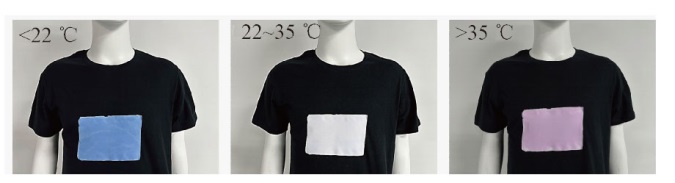
针对热致变色柔性温度传感器制备工艺复杂、拉伸性不足、多色彩协同调控困难等问题,通过溶液法将2种具有不同变色效果的热致变色微胶囊与热塑性弹性体苯乙烯-乙烯-丁烯-苯乙烯嵌段共聚物(SEBS)混合,制得纺丝液,再采用溶液吹纺技术制备出3种颜色分段响应的柔性可拉伸热致变色纤维膜。对热致变色纤维膜的微观结构进行测试表征,分析热致变色微胶囊质量分数对其力学性能的影响规律,研究热致变色微胶囊质量分数为30%的纤维膜在不同温度下的变色光谱特性和时间响应性能,并探究其疏水性和透湿性。结果表明:所制备的热致变色纤维膜在低于22 ℃时呈现蓝色,在22~35 ℃区间呈现白色,在高于35 ℃时转变为粉红色;该纤维膜具有良好的力学性能,断裂伸长率最高可达611%;同时,其还具备良好的疏水性,经10 min水浸润后,接触角仍大于120°。基于上述特性构建的柔性可穿戴温度传感器,实现了对环境温度的无源可视化监测,在柔性温度传感领域展现出广阔的应用前景。

关键词: 热致变色纤维膜, 温度传感性能, 溶液吹纺, 苯乙烯-乙烯-丁烯-苯乙烯嵌段共聚物, 柔性温度传感器, 热致变色微胶嚢, 智能可穿戴纺织品

Abstract:

Objective The thermochromic flexible temperature sensor, visible to the naked eye, effectively addresses the issues of limited flexibility, additional power requirements, and intricate structures associated with conventional rigid temperature sensors. To advance the field of wearable temperature sensing, developing a thermochromic flexible temperature sensor with superior stretchability and multi-color integration is of significant importance. This study aims to investigate the fabrication and temperature-sensing properties of thermochromic fiber membranes produced via solution blow spinning.
Method Two types of thermochromic microcapsules were employed, with one transitioning from colorless to blue at 22 ℃ and the other transforming from colorless to pink at 35 ℃. The microcapsules were blended with a styrene-ethylene-butene-styrene (SEBS) block copolymer via a solution-based approach to prepare the spinning solution. The spinning solution was subsequently blown through a high-pressure nozzle using a solution blow spinning technique, yielding thermochromic fiber membranes. The mechanical properties, spectral and chromatic characteristics, response time, hydrophobicity, and moisture permeability of the thermochromic fiber membranes were systematically tested and analyzed. To verify their temperature-sensing performance, the thermochromic fiber membrane was applied to a standard fabric for visualized temperature detection in ambient conditions.
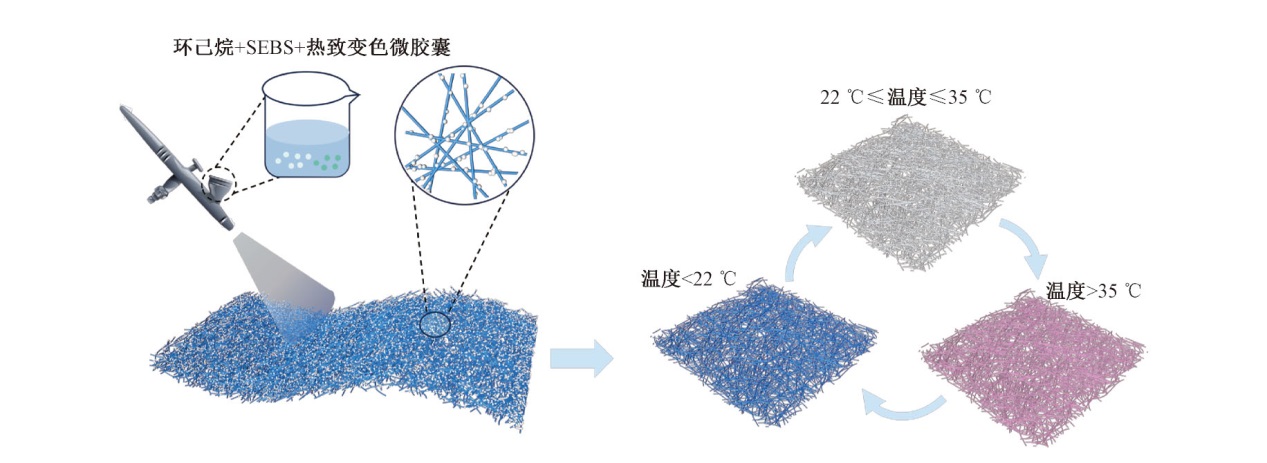
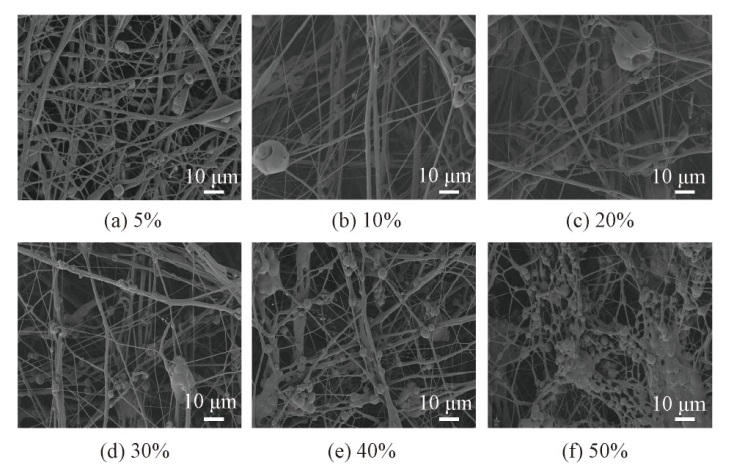
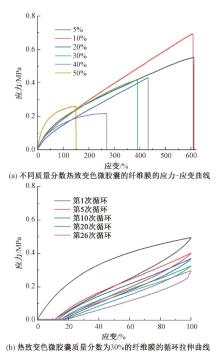
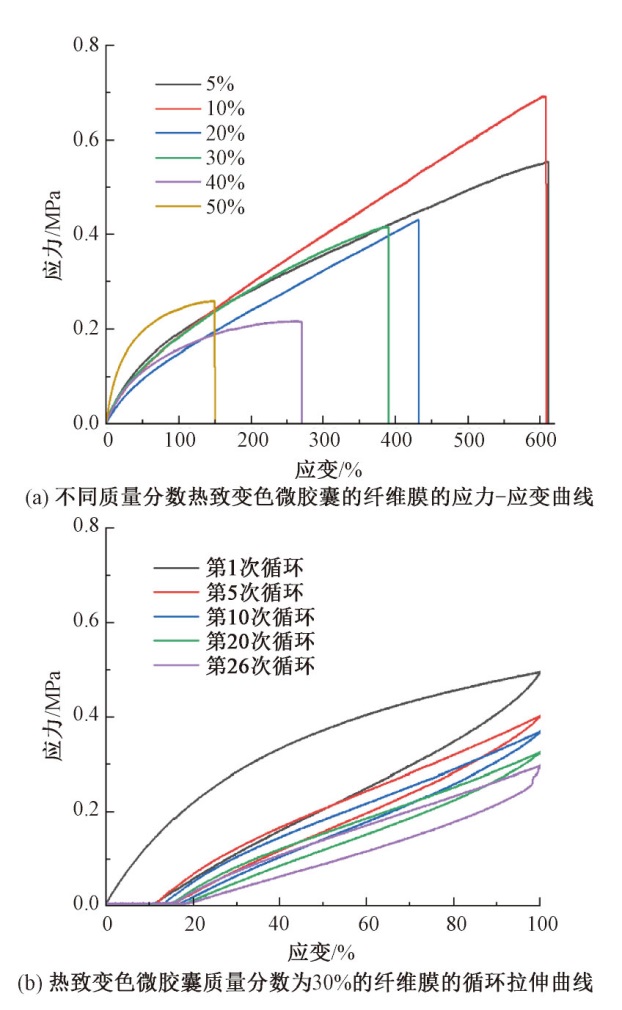
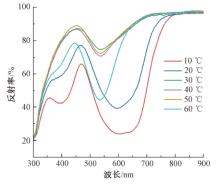
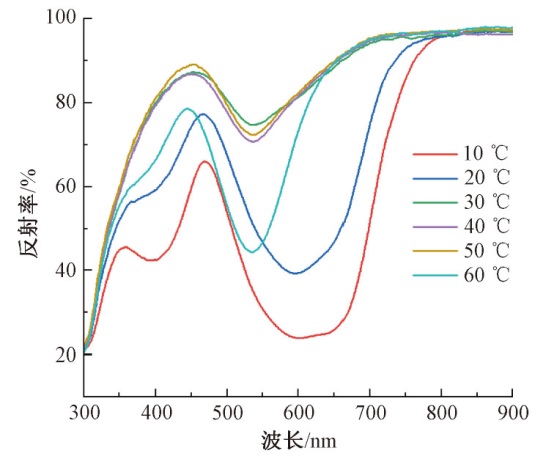
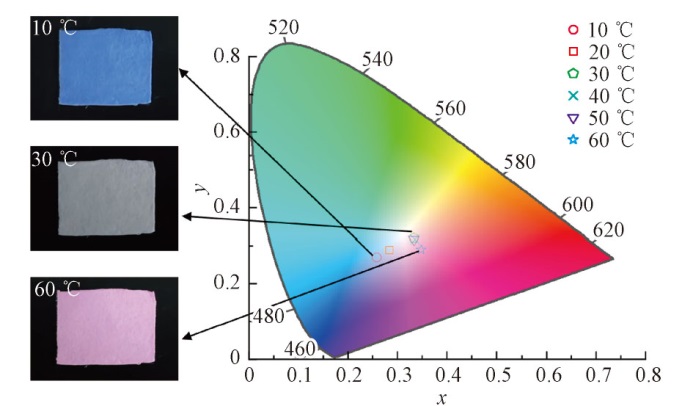
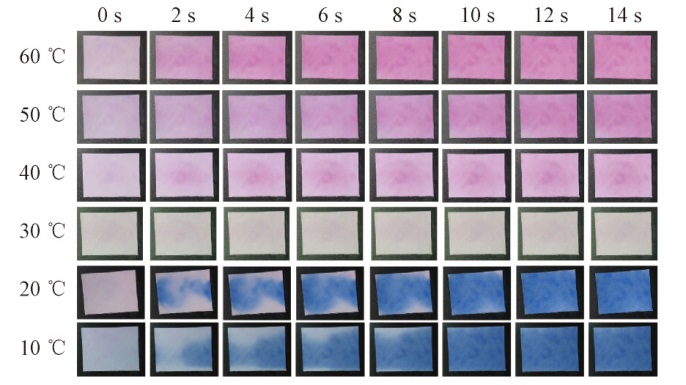
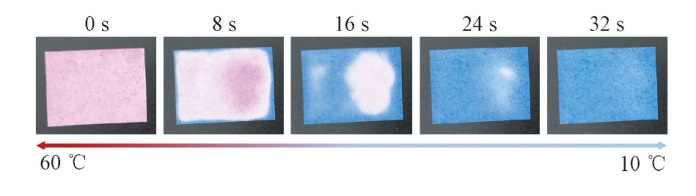
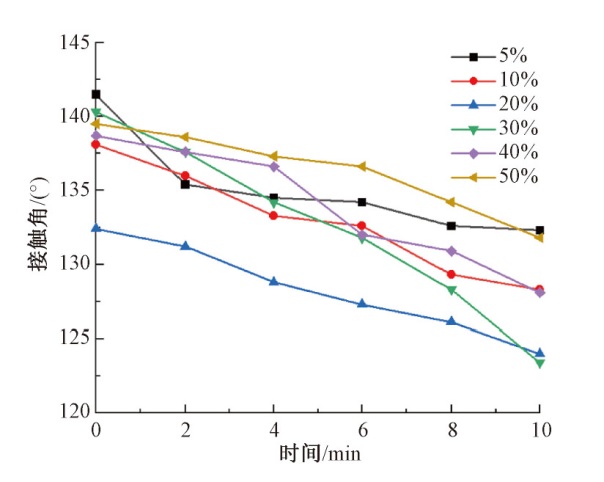
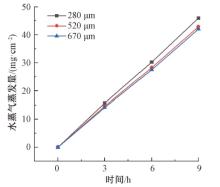
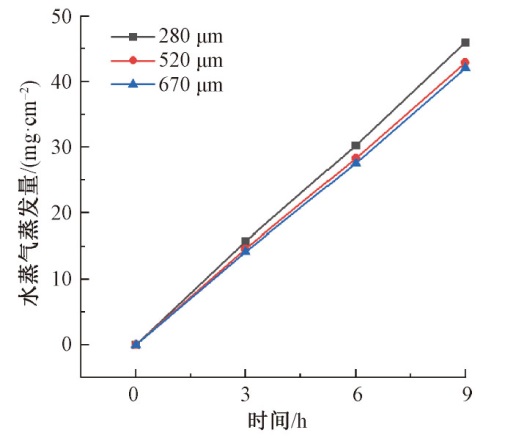
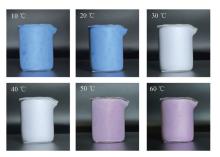
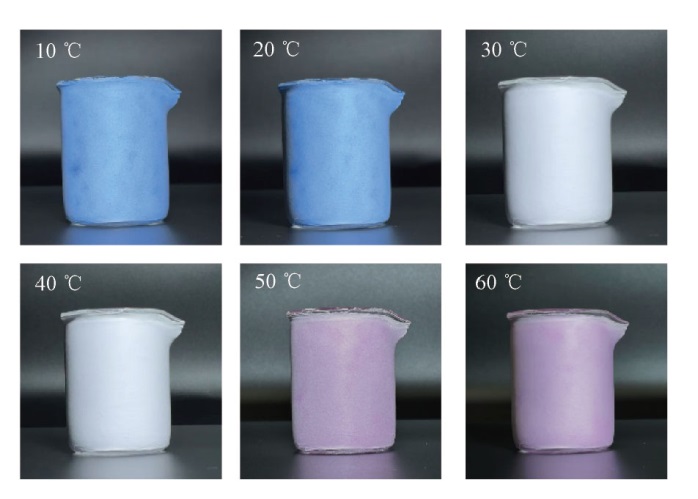
Results Scanning electron microscope characterization demonstrated that the blended spinning solution of SEBS and thermochromic microcapsules formed a fiber cross-mesh structure under high-pressure airflow conditions. This structural arrangement led to the degradation of fiber formation and the progressive aggregation of thermochromic microcapsules with increasing content. With the mass fraction of thermochromic microcapsules increasing from 5% to 10%, 20%, 30%, 40%, and 50%, the maximum strain of the thermochromic fiber membranes decreased sequentially from 611% to 608%, 432%, 390%, 269%, and 149%. Upon being stretched to 100% of its original length, the fiber membrane containing 30% thermochromic microcapsules withstood 26 stretching cycles prior to fracturing. Spectrum and chromaticity analyses revealed that the prepared thermochromic fiber membrane displayed a blue color at temperatures below 22 ℃, a white appearance at temperatures between 22 ℃ and 35 ℃, and a pink hue at temperatures above 35 ℃. Specifically, the fiber membrane with 30% thermochromic microcapsules underwent a color transition from white to blue within 10 s at 10 ℃, while the shift from white to pink at 60 ℃ similarly required 10 s to stabilize. The thermochromic fiber membranes exhibited excellent hydrophobicity, achieving an initial maximum water contact angle of 141.5°, which remained above 120° even after 10 min of water exposure. Following a 9-hour moisture permeability test, the water vapor permeability of the fiber membrane containing 30% thermochromic microcapsules with a thickness of 280 μm was measured at 5.08 mg/(cm2·h). Spraying thermochromic fibers onto the glass surface facilitates visualized water temperature sensing, which is crucial for ensuring safe drinking practices. By integrating the thermochromic fiber membrane with conventional fabric, intelligent wearable textiles can be developed, enabling visual sensing of environmental temperature through its temperature-color response relationship.
Conclusion The thermochromic fiber membranes enable visualized temperature sensing by exhibiting distinct color transitions across multiple temperature intervals, thereby overcoming the limitations of conventional thermochromic membranes, which are typically restricted to single-color changes and narrow temperature ranges. Experimental results demonstrate that these thermochromic fiber membranes possess excellent stretchability and hydrophobicity, underscoring their potential for applications in wearable temperature sensing. The smart wearable fabric fabricated using these thermochromic fiber membranes enables visualized temperature detection without the need for additional power input. Moreover, these membranes are facile to fabricate, lightweight, and can be seamlessly integrated with conventional fabrics, thereby significantly reducing the costs associated with practical applications.

Key words: thermochromic fiber membrane, temperature sensing, solution blow spinning, styrene-ethylene-butene-styrene block copolymer, flexible temperature sensor, thermochromic microcapsule, intelligent wearable textiles

中图分类号: 

  • TQ 317.9

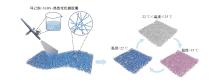
图1

热致变色纤维膜的制备工艺及其温度-颜色响应关系"

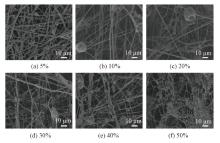
图2

不同质量分数热致变色微胶囊的热致变色纤维膜表面扫描电镜照片"

图3

热致变色纤维膜的力学性能"

图4

不同温度下热致变色纤维膜的反射光谱"

图5

不同温度下热致变色纤维膜的CIE 1931 色度图坐标"

图6

热致变色纤维膜的响应时间"

图7

热致变色纤维膜从高温到低温的变色过程"

图8

热致变色纤维膜的疏水性"

图9

热致变色纤维膜的透湿性"

图10

附着于玻璃杯上热致变色纤维膜的温度传感性能"

图11

附着于织物上热致变色纤维膜的环境温度感知性能"

[1] MADHVAPATHY S R, BURY M I, WANG L W, et al. Miniaturized implantable temperature sensors for the long-term monitoring of chronic intestinal inflammation[J]. Nature Biomedical Engineering, 2024, 8(8): 1040-1052.
doi: 10.1038/s41551-024-01183-w
[2] LU Y F, ZHANG H J, ZHAO Y, et al. Robust fiber-shaped flexible temperature sensors for safety monitoring with ultrahigh sensitivity[J]. Advanced Materials, 2024, 36(18): 2310613.
doi: 10.1002/adma.v36.18
[3] XIAO H Y, LI S B, HE Z D, et al. Dual mode strain-temperature sensor with high stimuli discriminability and resolution for smart wearables[J]. Advanced Functional Materials, 2023, 33(16): 2214907.
doi: 10.1002/adfm.v33.16
[4] CAI J Y, DU M J, LI Z L. Flexible temperature sensors constructed with fiber materials[J]. Advanced Materials Technologies, 2022, 7(7): 2101182.
doi: 10.1002/admt.v7.7
[5] LIU L, DOU Y Y, WANG J H, et al. Recent advances in flexible temperature sensors: materials, mechanism, fabrication, and applications[J]. Advanced Science, 2024, 11(36): 2405003.
doi: 10.1002/advs.v11.36
[6] LIU G, LV Z Y, BATOOL S, et al. Biocompatible material-based flexible biosensors: from materials design to wearable/implantable devices and integrated sensing systems[J]. Small, 2023, 19(27): 2207879.
doi: 10.1002/smll.v19.27
[7] ARMAN KUZUBASOGLU B, KURSUN BAHADIR S. Flexible temperature sensors: a review[J]. Sensors and Actuators A: Physical, 2020, 315: 112282.
doi: 10.1016/j.sna.2020.112282
[8] CHEN T D, YANG Q J, FANG C Q, et al. Advanced design for stimuli-reversible chromic wearables with customizable functionalities[J]. Advanced Materials, 2025, 37(6): 2413665.
doi: 10.1002/adma.v37.6
[9] HA H, SURYAPRABHA T, CHOI C, et al. Recent research trends in textile-based temperature sensors: a mini review[J]. Nanotechnology, 2023, 34(42): 422001.
doi: 10.1088/1361-6528/ace913
[10] ZHAN L Y, XU W X, HU Z X, et al. Full-color ″off-on″ thermochromic fluorescent fibers for customizable smart wearable displays in personal health monitoring[J]. Small, 2024, 20(29): 2310762.
doi: 10.1002/smll.v20.29
[11] LIU S L, ZHANG W T, HE J Z, et al. Fabrication techniques and sensing mechanisms of textile-based strain sensors: from spatial 1D and 2D perspectives[J]. Advanced Fiber Materials, 2024, 6(1): 36-67.
doi: 10.1007/s42765-023-00338-9
[12] 吕晓双, 刘丽萍, 俞建勇, 等. 纤维基自供能电子皮肤的构建及其应用性能研究进展[J]. 纺织学报, 2022, 43(10): 183-191.
doi: 10.13475/j.fzxb.20220404509
LÜ Xiaoshuang, LIU Liping, YU Jianyong, et al. Fabrication and application research progress of fiber-based self-powered electronic skins[J]. Journal of Textile Research, 2022, 43(10): 183-191.
doi: 10.13475/j.fzxb.20220404509
[13] LIM T, SEO H S, YANG J, et al. Reversible thermochromic fibers with excellent elasticity and hydrophobicity for wearable temperature sensors[J]. RSC Advances, 2024, 14(9): 6156-6164.
doi: 10.1039/d3ra06432h pmid: 38375008
[14] KIM D H, BAE J, LEE J, et al. Porous nanofiber membrane: rational platform for highly sensitive thermochromic sensor[J]. Advanced Functional Materials, 2022, 32(24): 2200463.
doi: 10.1002/adfm.v32.24
[15] LI P, SUN Z H, WANG R, et al. Flexible thermochromic fabrics enabling dynamic colored display[J]. Frontiers of Optoelectronics, 2022, 15(1): 40.
doi: 10.1007/s12200-022-00042-3
[16] GE F Q, PENG J, TAN J L, et al. Color tunable photo-thermochromic elastic fiber for flexible wearable heater[J]. Advanced Composites and Hybrid Materials, 2024, 7(5): 173.
doi: 10.1007/s42114-024-00994-4
[17] ZHANG L P, YANG Y T, WANG J X, et al. A portable, sprayable, highly malleable, elastic, and hydrophobic antibacterial fibrous wound dressing for infected wound healing[J]. Advanced Fiber Materials, 2025, 7(2): 528-540.
doi: 10.1007/s42765-024-00500-x
[18] QU Y P, NGUYEN-DANG T, PAGE A G, et al. Superelastic multimaterial electronic and photonic fibers and devices via thermal drawing[J]. Advanced Materials, 2018, 30(27): 1707251.
doi: 10.1002/adma.v30.27
[19] LI D, LIU X, LI W, et al. Scalable and hierarchically designed polymer film as a selective thermal emitter for high-performance all-day radiative cooling[J]. Nature Nanotechnology, 2020, 16(2): 153-158.
doi: 10.1038/s41565-020-00800-4
[20] WU X K, LI J L, XIE F, et al. A dual-selective thermal emitter with enhanced subambient radiative cooling performance[J]. Nature Communications, 2024, 15: 815.
doi: 10.1038/s41467-024-45095-4 pmid: 38280849
[21] LIU B Y, WU J W, XUE C H, et al. Bioinspired superhydrophobic all-In-one coating for adaptive thermoregulation[J]. Advanced Materials, 2024, 36(31): 2400745.
doi: 10.1002/adma.v36.31
[1] 张红霞, 齐芳汐, 赵静, 邢毅, 吕治家. 蜂巢结构介电层织物基传感器的一体成形及其性能[J]. 纺织学报, 2025, 46(10): 86-94.
[2] 方剑, 任松, 张传雄, 陈钱, 夏广波, 葛灿. 智能可穿戴纺织品用电活性纤维材料[J]. 纺织学报, 2021, 42(09): 1-9.
Viewed
Full text


Abstract

Cited

  Shared   
  Discussed   
No Suggested Reading articles found!