纺织学报 ›› 2025, Vol. 46 ›› Issue (11): 9-18.doi: 10.13475/j.fzxb.20250302801
王瀚文, 李万鑫, 李晨, 喻麟洁, 王文庆, 董振峰, 魏建斐, 朱志国( ), 王锐
), 王锐
WANG Hanwen, LI Wanxin, LI Chen, YU Linjie, WANG Wenqing, DONG Zhenfeng, WEI Jianfei, ZHU Zhiguo(), WANG Rui
摘要:
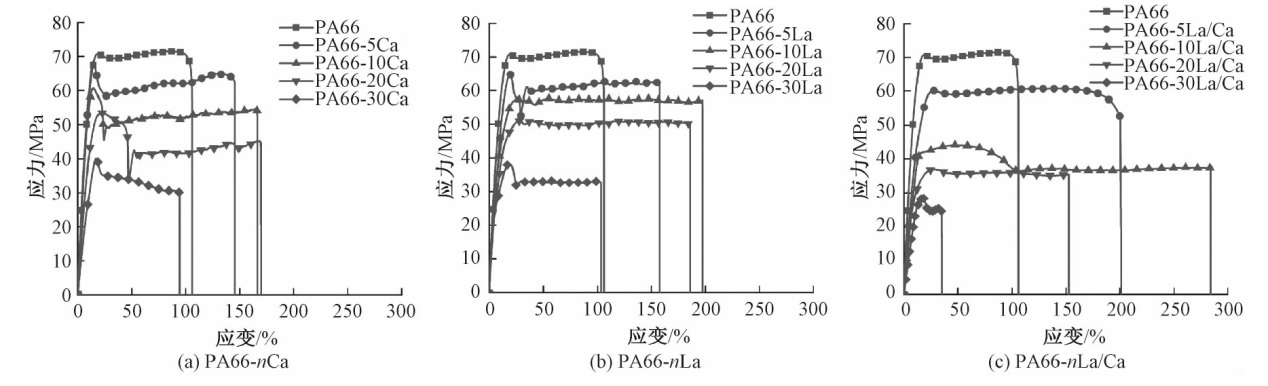
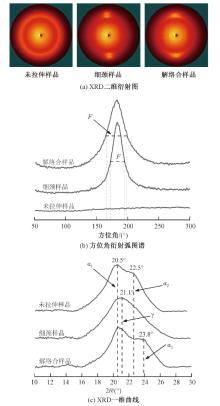
为探究聚酰胺66(PA66)的氢键作用对其聚集态结构、加工性能及材料性能的要影响,通过溶液共混方式将金属氯化物(CaCl2、LaCl3)与PA66共混复合,构建单氯化物(PA66-nCa、PA66-nLa)和双氯化物(PA66-nLa/Ca)复合体系。研究分子间氢键的变化及其对PA66结晶性能和力学性能的影响。结果表明:单独或者复配添加氯化物均能屏蔽PA66的分子间氢键,PA66/氯化物的结晶能力明显下降甚至基本消失;相同添加量下,对氢键的屏蔽能力由高到低依次为PA66-La/Ca、PA66-La、PA66-Ca,复配添加具有协同屏蔽作用,且水的解络合作用可使氢键恢复,表明氯化物对PA66的氢键作用具有可逆调控性;力学性能方面,氢键被屏蔽后PA66样品的可拉伸性明显增强,其中PA66-5La/Ca和PA66-10La/Ca的断裂伸长率增加更明显,均超过200%,是PA66断裂伸长率的2~3倍,应力诱导作用大幅增加了样品的取向度,并出现由α晶型向γ晶型的转变;拉伸取向(未断裂)样品经过水的解络合处理4~6 h后,由于高取向、高结晶度和氢键恢复的叠加作用,其拉伸强度最高提升至原始强度的1.70倍左右。
中图分类号:
| [1] | 王红, 楚久英. 芳香族聚酰胺纤维研究进展及应用[J]. 国际纺织导报, 2020, 48(4): 4, 6, 9. |
| WANG Hong, CHU Jiuying. Research progress and application of aromatic polyamide fiber[J]. Melliand China, 2020, 48(4): 4, 6, 9. | |
| [2] |
陈美玉, 来悦, 孙润军, 等. 生物基聚酰胺56纤维的结晶行为[J]. 纺织学报, 2017, 38(12): 7-13.
doi: 10.13475/j.fzxb.20170305807 |
|
CHEN Meiyu, LAI Yue, SUN Runjun, et al. Crystallization behavior of bio-based polyamide 56 fibers[J]. Journal of Textile Research, 2017, 38(12): 7-13.
doi: 10.13475/j.fzxb.20170305807 |
|
| [3] | 宋明, 张华, 陈欣, 等. 基于链间氢键调控实现高倍拉伸制备CoPA 6/66高强纤维的研究[J]. 合成纤维工业, 2022, 45(3): 11-16. |
| SONG Ming, ZHANG Hua, CHEN Xin, et al. Preparation of high-strength CoPA 6/66 fiber by super-drawing based on interchain hydrogen bond regula-tion[J]. China Synthetic Fiber Industry, 2022, 45(3): 11-16. | |
| [4] |
尹佳伦, 马小鹏, 姚丽菲, 等. 尼龙66工业长丝的纺丝工艺及关键影响因素探究[J]. 化工新型材料, 2024, 52(10): 243-247, 252.
doi: 10.19817/j.cnki.issn1006-3536.2024.10.036 |
|
YIN Jialun, MA Xiaopeng, YAO Lifei, et al. Exploration of spinning process and key influencing factors of nylon 66 industrial filament[J]. New Chemical Materials, 2024, 52(10): 243-247, 252.
doi: 10.19817/j.cnki.issn1006-3536.2024.10.036 |
|
| [5] |
WANG Z C, SONG M, LI X L, et al. Copolymerization-regulated hydrogen bonds: a new routine for high-strength copolyamide 6/66 fibers[J]. Polymers, 2022, 14(17): 3517.
doi: 10.3390/polym14173517 |
| [6] |
DAI L X, YING L N. Infrared spectroscopic investigation of hydrogen bonding in EVOH containing PVA fibers[J]. Macromolecular Materials and Engineering, 2002, 287(8): 509-514.
doi: 10.1002/1439-2054(20020801)287:8<>1.0.CO;2-3 |
| [7] |
MURTHY N S. Hydrogen bonding, mobility, and structural transitions in aliphatic polyamides[J]. Journal of Polymer Science Part B: Polymer Physics, 2006, 44(13): 1763-1782.
doi: 10.1002/polb.v44:13 |
| [8] | BHAT G. Structure and properties of high-performance fibers[M]. Cambridge: Elsevier Ltd, 2016:1-4. |
| [9] |
FAN W X, WANG C K, TSAI C C, et al. Ultradrawing properties of ultrahigh molecular weight polyethylenes/functionalized activated nanocarbon as-prepared fibers[J]. RSC Advances, 2016, 6(4): 3165-3175.
doi: 10.1039/C5RA20982J |
| [10] |
VASANTHAN N, KOTEK R, JUNG D W, et al. Lewis acid-base complexation of polyamide 66 to control hydrogen bonding, extensibility and crystallinity[J]. Polymer, 2004, 45(12): 4077-4085.
doi: 10.1016/j.polymer.2004.03.074 |
| [11] | 李传斌, 陈巍, 程德康, 等. PA66聚集态结构转变的研究[J]. 塑料工业, 2018, 46(6): 23-27. |
| LI Chuanbin, CHEN Wei, CHENG Dekang, et al. Study on the aggregation structure transition of poly-amide 66[J]. China Plastics Industry, 2018, 46(6):23-27. | |
| [12] |
ZHANG H M, SHI C M, HE M M, et al. Structure and property changes of polyamide 6 during the gel-spinning process[J]. Journal of Applied Polymer Science, 2013, 130(6): 4449-4456.
doi: 10.1002/app.v130.6 |
| [13] | 鲁圣军, 甘华华, 何敏, 等. PA6/CaCl2复合材料络合配位的红外研究[J]. 塑料工业, 2012, 40(5): 65-67, 77. |
| LU Shengjun, GAN Huahua, HE Min, et al. FTIR study on the complexation of the PA6/CaCl2 compo-sites[J]. China Plastics Industry, 2012, 40(5): 65-67, 77. | |
| [14] |
YANG Z K, YIN H H, LI X N, et al. Study on dry spinning and structure of low mole ratio complex of calcium chloride-polyamide 6[J]. Journal of Applied Polymer Science, 2010, 118(4): 1996-2004.
doi: 10.1002/app.v118:4 |
| [15] | 孙文秀, 胡先波, 徐怡庄, 等. 聚酰胺与稀土离子相互作用的研究[J]. 化学学报, 2000, 58(12): 1602-1607. |
| SUN Wenxiu, HU Xianbo, XU Yizhuang, et al. Study on the interaction between polyamide and lanthanide ions[J]. Acta Chimica Sinica, 2000, 58(12): 1602-1607. | |
| [16] | 姜超, 安晶晶, 彭中梁, 等. 金属离子与聚酰胺相互作用的研究进展[J]. 塑料, 2016, 45(4): 81-84, 112. |
| JIANG Chao, AN Jingjing, PENG Zhongliang, et al. Research progress on the interaction between metal ions and polyamide[J]. Plastics, 2016, 45(4): 81-84, 112. | |
| [17] | 智海辉, 张龙, 郑今欢. 聚酰胺湿法涂层浆的制备机制及其成膜性能[J]. 纺织学报, 2015, 36(9): 65-69. |
|
ZHI Haihui, ZHANG Long, ZHENG Jinhuan. Preparation mechanism and membrane properties of polyamide wet coating[J]. Journal of Textile Research, 2015, 36(9): 65-69.
doi: 10.1177/004051756603600108 |
|
| [18] |
FORD R A, MARSHALL H S B. Some group IV tetrahalide-alcohol complexes as solvents for poly-amides[J]. Journal of Polymer Science, 1956, 22(101): 350-352.
doi: 10.1002/pol.12.v22:101 |
| [19] |
MILLOT C, FILLOT L A, LAME O, et al. Assessment of polyamide-6 crystallinity by DSC[J]. Journal of Thermal Analysis and Calorimetry, 2015, 122(1): 307-314.
doi: 10.1007/s10973-015-4670-5 |
| [20] |
LAYACHI A, FRIHI D, SATHA H, et al. Non-isothermal crystallization kinetics of polyamide 66/glass fibers/carbon black composites[J]. Journal of Thermal Analysis and Calorimetry, 2016, 124(3): 1319-1329.
doi: 10.1007/s10973-016-5286-0 |
| [21] | SUN B H. Study on the mechanism of nylon 6,6 dissolving process using CaCl2/MeOH as the solvent[J]. Chinese Journal of Polymer Science, 1994(1):57-65. |
| [22] | 吴博, 谢晓琼, 李卫领, 等. 利用裂解气相色谱-质谱法研究PA66/PA6合金的定性定量分析[J]. 塑料工业, 2021, 49(7):94-98,10. |
| WU Bo, XIE Xiaoqiong, LI Weiling, et al. Study on Analysis of PA66/PA6 alloy by pyrolysis gas chromatography-mass spectrometry[J]. China Plastics Industry, 2021, 49(7):94-98,10. | |
| [23] |
WEI M, DAVIS W, URBAN B, et al. Manipulation of nylon-6 crystal structures with its α-cyclodextrin inclusion complex[J]. Macromolecules, 2002, 35(21): 8039-8044.
doi: 10.1021/ma020765m |
| [24] |
MA Y N, ZHOU T, SU G H, et al. Understanding the crystallization behavior of polyamide 6/polyamide 66 alloys from the perspective of hydrogen bonds: projection moving-window 2D correlation FTIR spectroscopy and the enthalpy[J]. RSC Advances, 2016, 6(90): 87405-87415.
doi: 10.1039/C6RA09611E |
| [25] |
VALENTI B, BIANCHI E, TEALDI A, et al. Bulk properties of synthetic polymer-inorganic salt systems. IV. role of the polymeric substrate[J]. Macromolecules, 1976, 9(1): 117-122.
doi: 10.1021/ma60049a023 |
| [1] | 顾戚惠, 阳知乾, 王海楼, 魏发云, 张伟. 机织间隔织物增强水泥基复合材料的制备及其力学性能[J]. 纺织学报, 2025, 46(10): 120-128. |
| [2] | 高敏, 程春祖, 徐中凯, 赵庆波, 张东, 代欣欣. 含硅改性磷氮阻燃Lyocell纤维的制备及其性能[J]. 纺织学报, 2025, 46(10): 19-29. |
| [3] | 侯颖慧, 刘肖燕, 柳东辰, 郝矿荣, 邹婷. 基于体外降解的输尿管支架管的多目标优化[J]. 纺织学报, 2025, 46(09): 154-162. |
| [4] | 高闻语, 陈诚, 奚晓玮, 邓林红, 刘杨. 改性丝素蛋白纤维增强胶原基角膜修复材料的制备及其性能[J]. 纺织学报, 2025, 46(08): 1-9. |
| [5] | 梁锋, 方沿, 张伟华, 唐余玲, 李双洋, 周建飞, 石碧. 基于金属-多酚网络的胶原蛋白基纤维制备及其力学性能[J]. 纺织学报, 2025, 46(08): 10-17. |
| [6] | 陈晴宇, 陆春红, 张斌, 晋义凯, 黄琪帏, 王超, 丁彬, 俞建勇, 王先锋. 碳纤维增强水泥基灌浆料的制备及其性能[J]. 纺织学报, 2025, 46(08): 120-126. |
| [7] | 岳航, 鹿超, 王春红, 李瀚宇. 基于主要化学成分的红麻与大麻拉伸强度预测[J]. 纺织学报, 2025, 46(08): 62-70. |
| [8] | 朱雷, 李晓俊, 程春祖, 徐纪刚, 杜心宇. 四硼酸钠/单宁酸交联对海藻酸钙纤维结构与性能的影响[J]. 纺织学报, 2025, 46(07): 28-36. |
| [9] | 刘宇祥, 乌婧, 徐锦龙, 谢锐敏, 王华平. 阳离子可染聚对苯二甲酸丙二醇酯预取向丝的制备及其性能[J]. 纺织学报, 2025, 46(07): 46-52. |
| [10] | 李金键, 薛元, 陈宥融. 时序分布的段彩竹节纱及三通道转杯成纱工艺设计[J]. 纺织学报, 2025, 46(03): 72-81. |
| [11] | 宋婉萌, 王宝弘, 孙宇, 杨家祥, 刘云, 王玉忠. 兼具力学性能与高效阻燃性能粘胶织物的制备及其性能[J]. 纺织学报, 2025, 46(02): 188-196. |
| [12] | 卢海龙, 于影, 左雨欣, 王浩然, 陈洪立, 汝欣. 取向增强抗CO2腐蚀纤维薄膜的制备及其性能[J]. 纺织学报, 2024, 45(12): 33-40. |
| [13] | 杨鑫, 张昕, 潘志娟. 丝素纳米原纤增强再生丝素蛋白/聚乙烯醇纤维的结构与性能[J]. 纺织学报, 2024, 45(11): 1-9. |
| [14] | 缪璐璐, 孟小奕, 董正梅, 彭倩, 何林伟, 邹专勇. 热处理工艺对喷气涡流纺低熔点涤纶长丝包芯纱力学性能的影响[J]. 纺织学报, 2024, 45(11): 73-79. |
| [15] | 王宇航, 谭晶, 李好义, 徐锦龙, 杨卫民. 纳米纤维纱线静电纺制备技术研究进展[J]. 纺织学报, 2024, 45(11): 235-243. |
|
||
 京公网安备11010502044800号