纺织学报 ›› 2025, Vol. 46 ›› Issue (03): 72-81.doi: 10.13475/j.fzxb.20231008601

• 纺织工程 • 上一篇    下一篇

时序分布的段彩竹节纱及三通道转杯成纱工艺设计

李金键1, 薛元1(), 陈宥融2   

  1. 1.江南大学 纺织科学与工程学院, 江苏 无锡 214122
    2.浙江泰坦股份有限公司, 浙江 绍兴 311800
  • 收稿日期:2023-10-25 修回日期:2024-08-07 出版日期:2025-03-15 发布日期:2025-04-16
  • 通讯作者: 薛元(1962—),男,教授,博士。研究方向为数字化与智能化纤维及纱线成形加工技术。E-mail:fzxueyuan@qq.com
  • 作者简介:李金键(1994—),男,博士生。主要研究方向为数字化纺纱。
  • 基金资助:
    浙江省“尖兵”“领雁”研发攻关计划项目(2022C01188)

Design of segment colored slub yarn with time series distribution and three-channel rotor yarn forming process

LI Jinjian1, XUE Yuan1(), CHEN Yourong2   

  1. 1. College of Textile Science and Engineering, Jiangnan University, Wuxi, Jiangsu 214122, China
    2. Zhejiang Taitan Co., Ltd., Shaoxing, Zhejiang 311800, China
  • Received:2023-10-25 Revised:2024-08-07 Published:2025-03-15 Online:2025-04-16

摘要: 为探索基于数控三通道转杯纺纱机纺制时序化段彩竹节纱的成纱工艺,分析了段彩竹节纱的外观特征,并对其形态结构与色彩参数进行表征;根据三通道数控转杯纺纱机成纱机制,分别建立了段彩竹节纱的基纱、粗节、细节的线密度、混合比以及色彩的数学模型;提出了用三通道数控纺纱机纺制段彩竹节纱粗细节的方法,同时建立了粗细节及其色彩的时序化分布模型。设计了8种时序化分布的段彩竹节纱外观形态及纺纱工艺,通过三通道数控转杯纺纱机HFX-03-T与KU482A型染色实验编织机制备出了对应的段彩竹节纱及其织物,并对纱线进行力学性能测试。结果表明,纱线各项指标均能达到FZ/T 12001—2015《转杯纺棉本色纱线》一等品等级规格。

关键词: 段彩竹节纱, 三通道转杯纺纱, 纺纱工艺, 时序化, 粗细节, 力学性能

Abstract:

Objective As a combination of segment color yarn and slub yarn, segment colored slub yarn has multi-component changes in shape, structure and color, which gives textile and garment a stronger sense of color hierarchy and mechanism fullness, and provides new impetus for fabric design. At present, the methods of spinning segment colored slub yarn mainly focus on the ring spinning machine, but few reports on the rotor spinning segment colored slub yarn are known. In this paper, how to spin segment colored slub yarn with shape, structure and color timing changes by three-channel CNC rotor spinning is studied.

Method Firstly, the linear density, twist, blending ratio, thick and thin knot and color of segment colored slub yarn were parametrically characterized and the corresponding mathematical model was established. Then, combined with the principle of yarn formation by three-channel CNC rotor spinning and the mechanism of yarn morphology regulation, the formation mechanism of thick and thin knot and segment color of segment colored slub yarn with spinning timing distribution was constructed based on the three-channel CNC rotor spinning machine. On this basis, eight different styles of segment colored slub yarn with timing distribution of thick knots and their fabrics were prepared, and the mechanical properties of the yarns were tested.

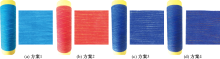
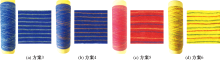
Results In this study, eight types of segment-colored slub yarns were designed, comprising four with short slub segments (125.6 mm length) and four with long slub segments (1 420 mm length). Among the four short-segment slub yarns, two types were blended from two colored fibers, while the other two incorporated three colored fibers. Compared to the two-color slub segments, the three-color variants demonstrated richer color expression and enhanced three-dimensional effects on fabric surfaces. Similarly, among the four long-segment slub yarns, two types were blended from three colored fibers, while the remaining two used two colored fibers. Each long-segment slub yarn featured two distinct color combination patterns, exhibiting greater color variability and more pronounced color transitions compared to the former. The mechanical property tests performed with the XL-2 yarn strength tester showed that the yarn strength follows this order from lowest to highest: the base yarn segment is less than the base-slub transition segment is less than the slub segment. All test results met the first-grade requirements of FZ/T 12001―2015 ‘Cotton Rotor Spun Grey Yarn’.

Conclusion Based on the principle of three-channel CNC rotor spinning, this paper extends the yarn forming principle of three-channel CNC rotor spinning machine for spinning segment colored slub yarn, and establishes the formation mechanism and timing model of base yarn, thick and thin knot and color of segment colored slub yarn. The eight kinds of segment colored slub yarn fabrics have the characteristics of bright color, unique pattern, changeable style and strong three-dimensional sense, which provides a new idea for the design of clothing fabrics. However, due to the limitation of the mechanical structure (rotor circumference) of the rotor spinning machine, the shortest length of the slub segment of the spun segment colored slub yarn has to be greater than or equal to the rotor circumference, which is also the core issue to be faced in the future.

Key words: segment colored slub yarn, three channel rotor spinning, spinning process, time series, thick and thin knot, mechanical property

中图分类号: 

  • TS104.7

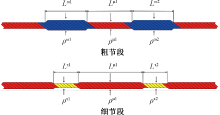
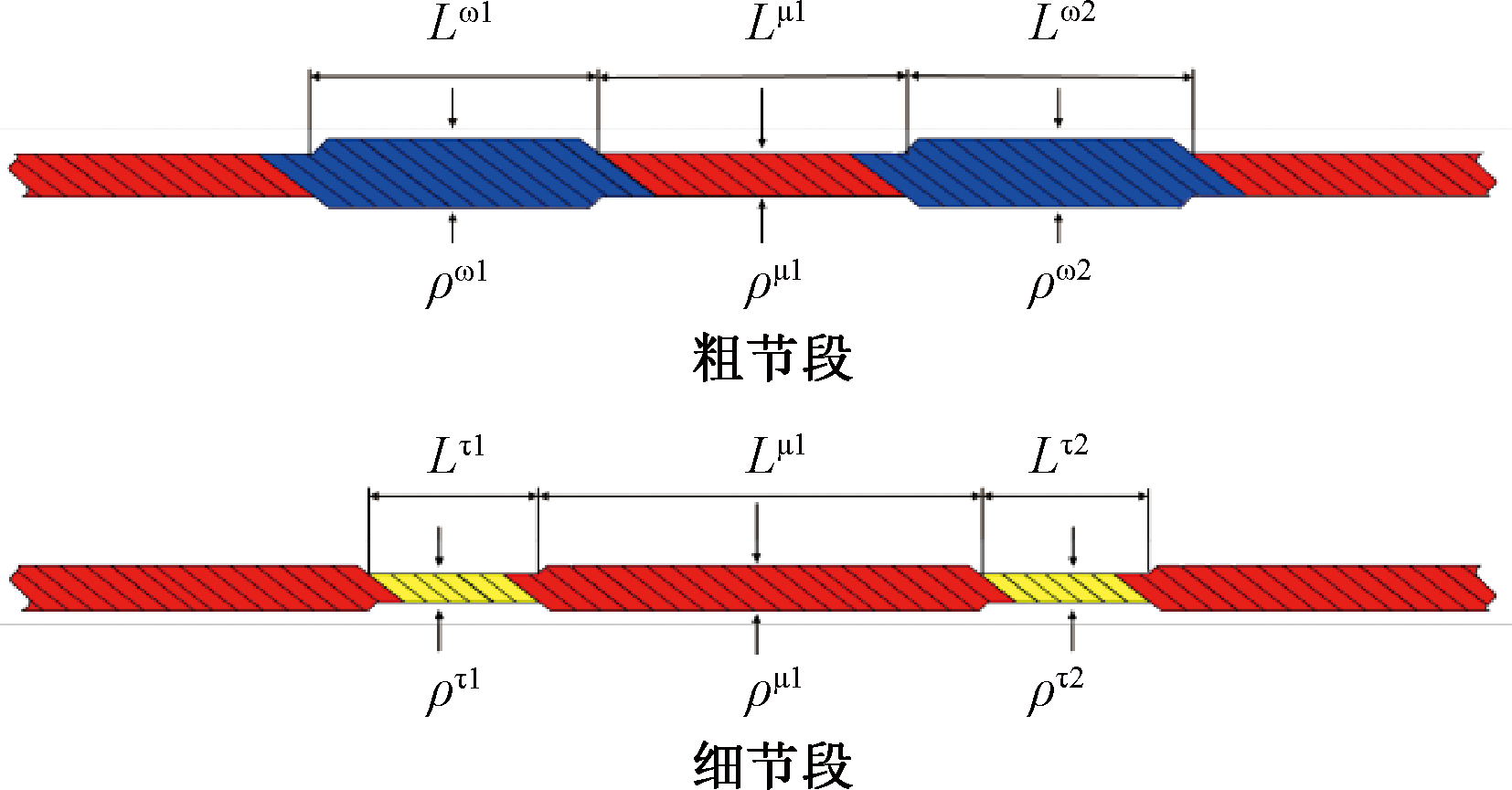
图1

段彩竹节纱粗节与细节"

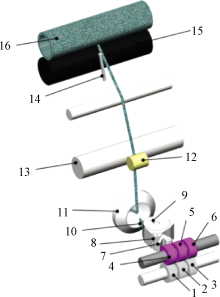
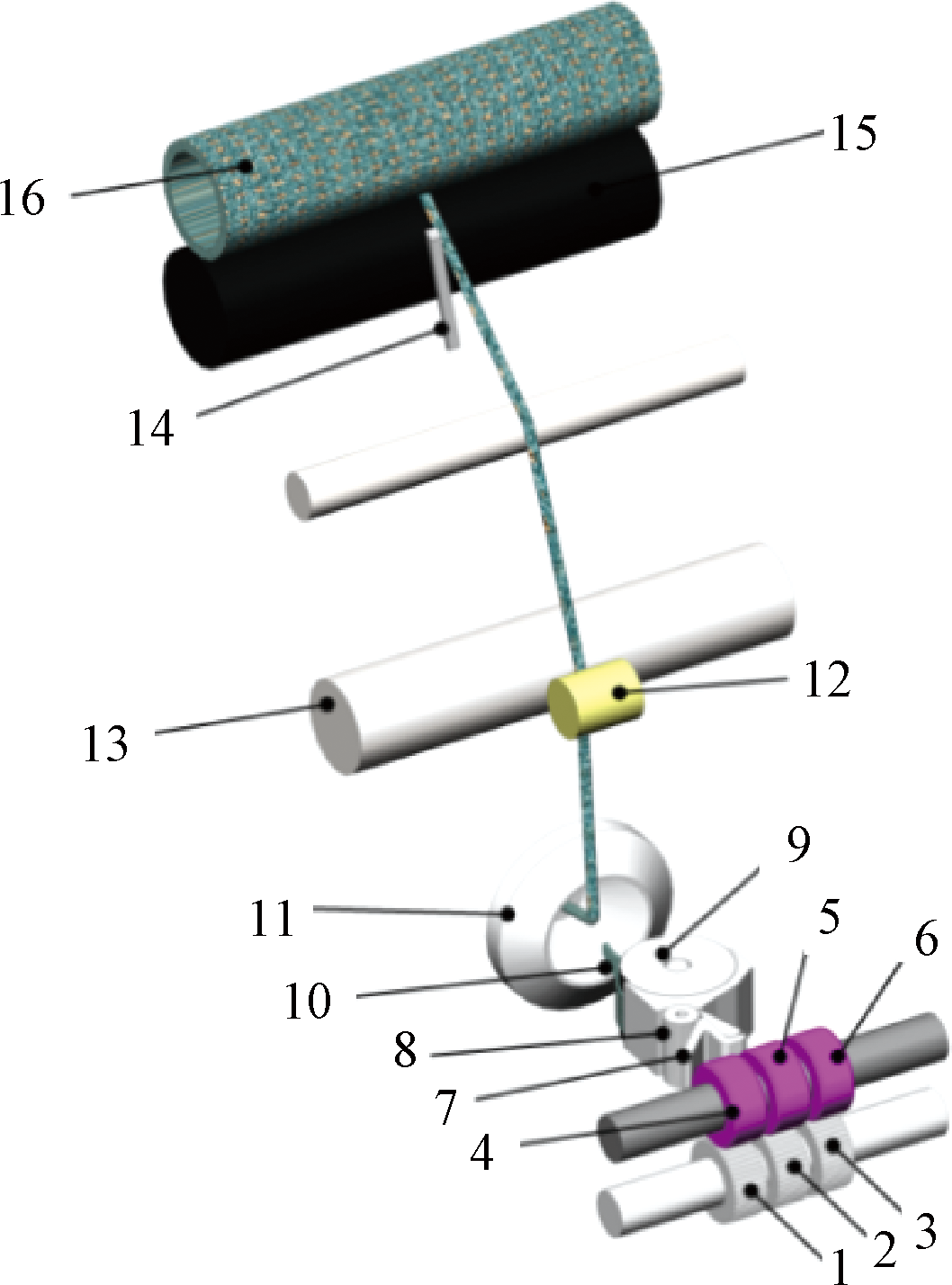
图2

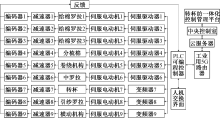
三通道数控转杯纺纱结构 注:1、2、3—左、中、右给棉罗拉;4、5、6—给棉皮辊;7—集棉器;8—中罗拉;9—分梳辊;10—梳棉气流通道;11—转杯;12—引纱皮辊;13—引纱罗拉;14—横动装置;15—卷绕罗拉;16—纱管。"

图3

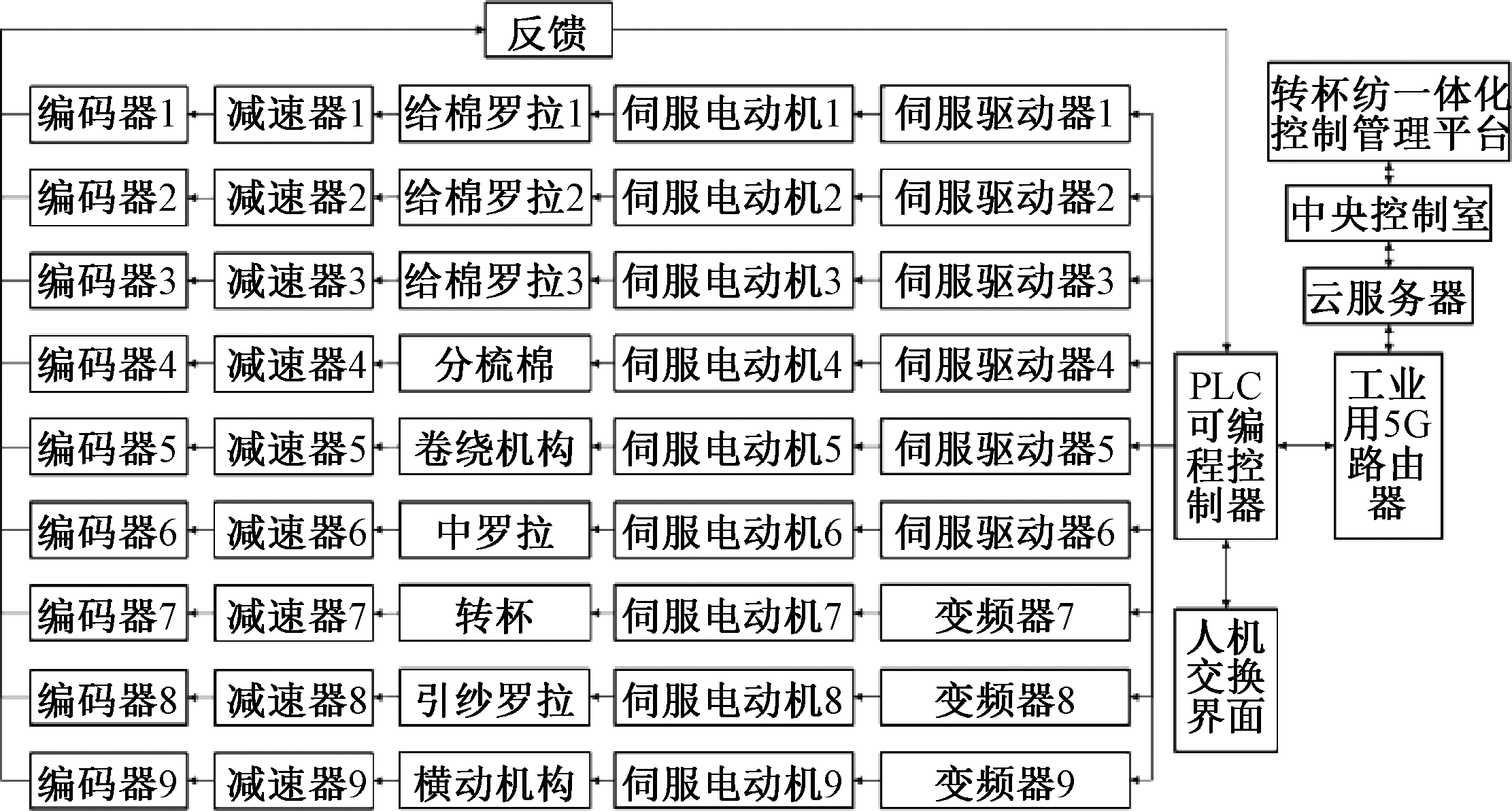
三通道数控转杯纺纱系统"

图4

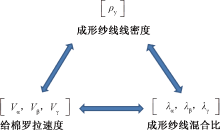
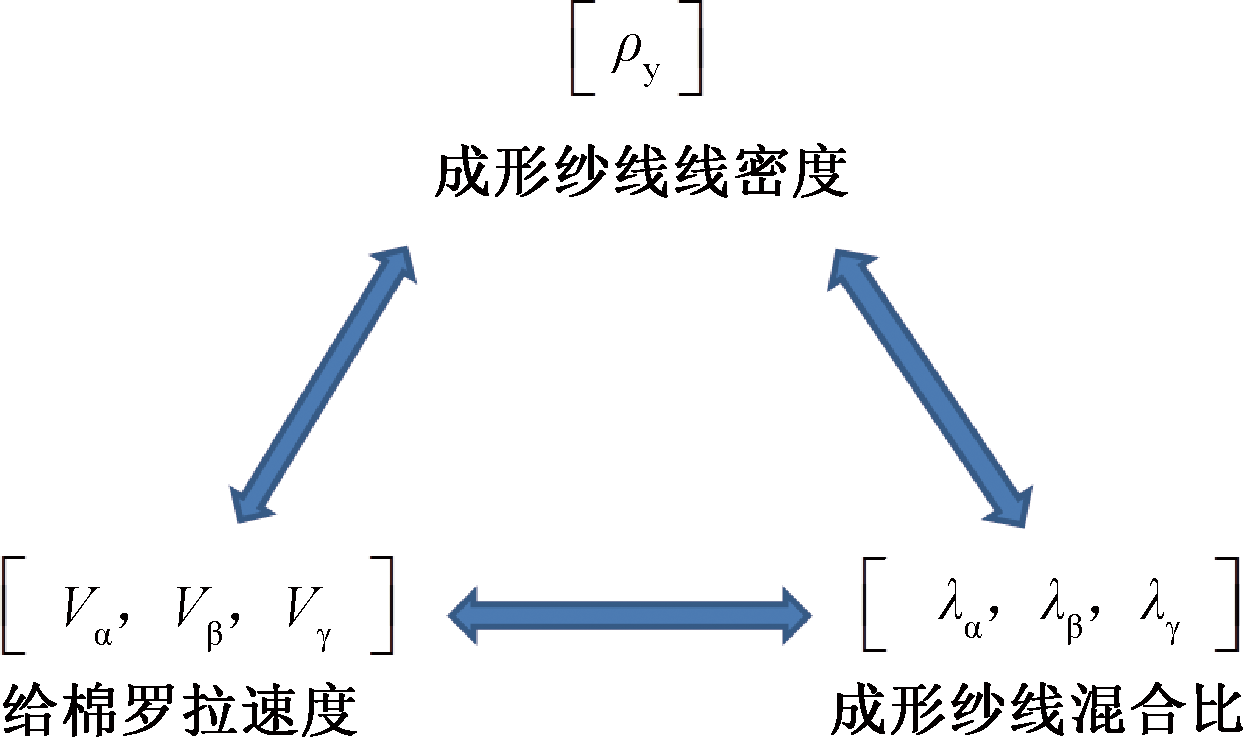
三要素调控机制"

表1

粗节段形态结构"

主纱
喂入模式
基纱段
组成
基纱段
混合比
辅纱断续
喂入模式
粗节段
组成
粗节倍率 粗节段
混合比
1个通道
V
恒速喂入
α 100%
0
0
另2个通道
K1V
K2V
同步喂入
α+ K1β+K2γ 1+ K1+K2 1/(1+ K1+K2)
K1/(1+ K1+K2)
K2/(1+ K1+K2)
另2个通道
K1V
K2V
异步喂入
α+ K1β 1+ K1 1/(1+ K1)
K1/(1+ K1)
0
α+K2γ 1+K2 1/(1+ K2)
0
K2/(1+ K2)
2个通道
V
K1 V
恒速喂入
α+ K1β 1/(1+ K1)
K1/(1+ K1)
0
另1个通道
K2V
断续喂入
α+ K1β+K2γ (1+ K1+K2)/(1+ K1) 1/(1+ K1+K2)
K1/(1+ K1+K2)
K2/(1+ K1+K2)

表2

细节段形态结构"

主纱
喂入模式
基纱段
组成
基纱段
混合比
辅纱断续
停喂模式
细节段
组成
细节倍率 细节段
混合比
3个通道
V
K1V
K2V
恒速喂入
α+ K1β+ K2γ 1/(1+ K1+K2)
K1/(1+ K1+K2)
K2/(1+ K1+K2)
1个通道
断续停喂
K1β+K2γ (K1+K2)/(1+K1+K2) 0
K1/(K1+K2)
K2/(K1+K2)
2个通道
同步
断续停喂
α 1/(1+K1+K2) 100%
0
0
2个通道
异步
断续停喂
α+K1β (1+K1)/(1+ K1+K2) 1/(1+ K1)
K1/(1+ K1)
0
α+K2γ (1+K2)/(1+ K1+K2) 1/(1+ K2)
0
K1/(1+ K2)
2个通道
V
K1 V
恒速喂入
α+ K1β 1/(1+ K1)
K1/(1+ K1)
0
1个通道
断续停喂
K1β K1/(1+K1) 0
100%
0

表3

段彩竹节纱粗节时序分布规律(同步喂入)"

纱线分段 分段长度/mm 分段线密度/tex 分段混合比 粗节倍率
基纱 Lμ1 24 0∶1∶0 -
粗节 Lω1 72 1∶1∶1 3

表4

段彩竹节纱粗节时序分布规律(异步喂入)"

纱线分段 分段长度/mm 分段线密度/tex 分段混合比 粗节倍率
基纱 Lμ1 24 0∶1∶0 -
粗节1 Lω1 48 1∶1∶0 2
基纱 Lμ2 24 0∶1∶0 -
粗节2 Lω2 48 0∶1∶1 2

表5

粗节时序分布的段彩竹节纱配色方案"

方案编号 左通道 中间通道 右通道 喂入方式
1 白色 青色 白色 同步
2 黄色 红色 黄色
3 白色 蓝色 黄色
4 红色 蓝色 黄色 异步
5 蓝色 红色 黄色
6 红色 黄色 蓝色

图5

粗节时序分布的段彩竹节纱形态"

表6

粗节时序分布的段彩竹节纱纺纱工艺(同步喂入)"

竹节分类 纱线分段 线密度/tex 喂入速度/(m·min-1) 喂入时间/
s
竹节长度/
mm
左给棉罗拉 中给棉罗拉 右给棉罗拉 中罗拉
短片段 1 基纱 24 0 1.47 0 1.83 7.13 2 142
粗节 72 1.47 1.47 1.47 1.83 0.42 125.6
长片段 1 基纱 24 0 1.47 0 1.83 26.9 8 041
粗节 72 1.47 1.47 1.47 1.83 4.75 1 420

表7

粗节时序分布的段彩竹节纱纺纱工艺(异步喂入)"

竹节
分类
纱线
分段
线密度/
tex
喂入速度/(m·min-1) 喂入时
间/s
竹节长
度/mm
左给棉罗拉 中给棉罗拉 右给棉罗拉 中罗拉
短片段 1 基纱 24 0 1.47 0 1.83 7.13 2 142
粗节 48 1.47 1.47 0 1.83 0.2 125.6
2 基纱 24 0 1.47 0 1.83 7.13 2 142
粗节 48 0 1.47 1.47 1.83 0.42 125.6
长片段 1 基纱 24 0 1.47 0 1.83 26.9 8 041
粗节 48 1.47 1.47 0 1.83 4.75 1 420
2 基纱 24 0 1.47 0 1.83 26.9 8 041
粗节 48 0 1.47 1.47 1.83 4.75 1 420

图6

不同方案下纺制的粗节时序分布的段彩竹节纱及其织物(短片段)"

图7

不同方案下纺制的粗节时序分布的段彩竹节纱及其织物(长片段)"

表8

段彩竹节纱力学性能测试结果"

竹节分类 纱线(配色) 断裂强力
平均值/cN
断裂强力/
CV值/%
断裂伸长率
平均值/%
断裂伸长率/
CV值/%
断裂强度/
(cN·tex)
图6(a)(白青白) 278.89 8.49 6.13 8.71 11.61
短片段 图6(b)(黄红黄) 265.21 7.46 6.59 11.82 11.07
图6(c)(白蓝黄) 263.64 6.67 5.97 9.24 10.98
图6(d)(红蓝黄) 272.93 7.37 5.77 8.82 11.36
图7(a)(白蓝黄) 283.45 9.61 6.60 9.58 11.80
长片段 图7(b)(红蓝黄) 282.00 8.75 6.18 9.08 11.70
图7(c)(蓝红黄) 284.37 6.76 6.27 1.36 11.85
图7(d)(红黄蓝) 282.04 8.75 6.18 9.08 11.73

表9

转杯纺棉本色纱技术要求"

线密度/
tex
单纱断裂强度/(cN·tex-1) 单纱断裂强度
变异系数/%
等级
起绒纱 机织用纱 针织用纱
21.1~
26.0
≥10.5 ≥11.5 ≥11.0 ≤9.5 优等
≥9.5 ≥10.5 ≥10.0 ≤12.5 一等
≥9.0 ≥10.0 ≥9.5 ≤16.5 二等
[1] 任学勤, 邱燕茹, 蔡彩虹. 花式纱线的开发现状和发展趋势[J]. 纺织导报, 2019(6):18,20,22,24.
REN Xueqin, QIU Yanru, CAI Caihong. Current situation and development trend of fancy yarns[J]. China Textile Leader, 2019(6):18,20,22,24.
[2] 卢雨正, 腾广兴. 竹节纱的生产方式及实际应用[J]. 纺织导报, 2013(10):61-64.
LU Zhengyu, TENG Guangxing. Production and application of slubby yarn[J]. China Textile Leader, 2013(10):61-64.
[3] 赵洋洋, 薛元, 刘曰兴, 等. 竹节纱粗细节形成机制及其纺纱工艺比较[J]. 纺织学报, 2019, 40(3):39-43,48.
ZHAO Yangyang, XUE Yuan, LIU Yuexing, et al. Formation mechanism of thick and thin sections of slub yarn and comparison of spinning process[J]. Journal of Textile Research, 2019, 40(3):39-43,48.
[4] 薛元, 高卫东, 杨瑞华, 等. 三组份异同步二级牵伸纺制多彩竹节纱的方法及装置:2015/0140910.4[P]. 2015-06-17.
XUE Yuan, GAO Weidong, YANG Ruihua, et al. Method and device of three-component asynchronous two-stage drafting spinning colorful slub yarn:201510140910.4[P]. 2015-06-17.
[5] 孔佳斌. 转杯竹节纱的工艺理论研究[D]. 上海: 东华大学, 2008:8-10.
KONG Jiabin. Theoretical study on the technics of the rotor slub yarn[D]. Shanghai: Donghua University, 2008:8-10.
[6] 汪军, 史倩倩, 李玲, 等. 双喂给双分梳转杯纺技术研究进展[J]. 纺织学报, 2022, 43(8):12-20.
WANG Jun, SHI Qianqian, LI Ling, et al. Research progress of dual-feed-opening rotor spinning technology[J]. Journal of Textile Research, 2022, 43 (8): 12-20.
[7] HAJILARI M, EAKANDARNEIJAD S, BURKHARDT H, et al. Effect of two separate fiber feed systems in rotor spinning on yarn properties[J]. Fiber and Polymers, 2007(8):543-549.
[8] 薛元, 汪燕燕, 王怡淞, 等. 段彩竹节纱时序化分布规律设计及其数控成形原理[J]. 服装学报, 2022, 7(6):471-479.
XUE Yuan, WANG Yanyan, WANG Yisong, et al. Time-sequential distribution design and numerical control forming principle of segment colored slub yarn[J]. Journal of Clothing Research, 2022, 7(6):471-479.
[9] 刘禹辰, 朱文硕, 薛元, 等. 数控三通道转杯纺纱系统构建及纺纱工艺实践[J]. 毛纺科技, 2023, 51(8):7-14.
LIU Yuchen, ZHU Wenshuo, XUE Yuan, et al. Construction of CNC three-channel rotor spinning system and its spinning process practice[J]. Wool Textile Journal, 2023, 51(8):7-14.
[10] 薛元, 王鸿博, 周建, 等. 三组分异同步牵伸调控纱线线密度及混纺比的方法及装置:201510140466[P]. 2018-10-30.
XUE Yuan, WANG Hongbo, ZHOU Jian, et al. A method and device for controlling yarn linear density and blending ratio by three component asynchronous drafting: 201510140466[P]. 2018-10-30.
[11] 刘常威. 转杯纺竹节纱的研制[D]. 苏州: 苏州大学, 2004:31-34.
LIU Changwei. The researeh of slab yarn produeed by rotor spinning[D]. Suzhou: Soochow University, 2004:31-34.
[1] 宋婉萌, 王宝弘, 孙宇, 杨家祥, 刘云, 王玉忠. 兼具力学性能与高效阻燃性能粘胶织物的制备及其性能[J]. 纺织学报, 2025, 46(02): 188-196.
[2] 卢海龙, 于影, 左雨欣, 王浩然, 陈洪立, 汝欣. 取向增强抗CO2腐蚀纤维薄膜的制备及其性能[J]. 纺织学报, 2024, 45(12): 33-40.
[3] 缪璐璐, 孟小奕, 董正梅, 彭倩, 何林伟, 邹专勇. 热处理工艺对喷气涡流纺低熔点涤纶长丝包芯纱力学性能的影响[J]. 纺织学报, 2024, 45(11): 73-79.
[4] 王宇航, 谭晶, 李好义, 徐锦龙, 杨卫民. 纳米纤维纱线静电纺制备技术研究进展[J]. 纺织学报, 2024, 45(11): 235-243.
[5] 杨鑫, 张昕, 潘志娟. 丝素纳米原纤增强再生丝素蛋白/聚乙烯醇纤维的结构与性能[J]. 纺织学报, 2024, 45(11): 1-9.
[6] 李蒙, 戴梦男, 俞杨销, 王建南. 丝素蛋白基骨修复材料的应用研究进展[J]. 纺织学报, 2024, 45(10): 224-231.
[7] 刘婷, 闫涛, 潘志娟. 香蕉茎秆纤维/抗菌纤维混纺纱的制备及其性能[J]. 纺织学报, 2024, 45(10): 48-54.
[8] 徐豫松, 周杰, 甘佳怡, 张涛, 张先明. 含磷氮水性聚氨酯的制备及其在涤纶织物阻燃整理中应用[J]. 纺织学报, 2024, 45(07): 112-120.
[9] 刘术, 侯腾, 周乐乐, 李祥龙, 杨斌. 桑蚕的强制牵伸抽丝及其纤维性能[J]. 纺织学报, 2024, 45(06): 11-15.
[10] 李文雅, 周剑, 廖昙倩, 董真真. 薄鞘高包覆涤纶/棉包芯纱的结构控制及其工艺[J]. 纺织学报, 2024, 45(06): 46-52.
[11] 黄晴, 苏振岳, 周一帆, 刘青松, 李懿, 赵萍, 王鑫. 饲料与桑叶饲喂的家蚕蚕丝品质分析[J]. 纺织学报, 2024, 45(05): 1-9.
[12] 谷金峻, 魏春艳, 郭紫阳, 吕丽华, 白晋, 赵航慧妍. 棉秆皮微晶纤维素/改性氧化石墨烯阻燃纤维的制备及其性能[J]. 纺织学报, 2024, 45(01): 39-47.
[13] 陈美玉, 李立凤, 董侠. 长碳链聚酰胺1012纤维在不同温度下的力学性能[J]. 纺织学报, 2023, 44(11): 9-18.
[14] 张颖, 宋明根, 姬洪, 陈康, 张先明. 热定形工艺对高强型聚酯工业丝结构性能的影响[J]. 纺织学报, 2023, 44(09): 43-51.
[15] 孙明涛, 陈成玉, 闫伟霞, 曹珊珊, 韩克清. 针刺加固频率对黄麻纤维/聚乳酸短纤复合板性能的影响[J]. 纺织学报, 2023, 44(09): 91-98.
Viewed
Full text


Abstract

Cited

  Shared   
  Discussed   
No Suggested Reading articles found!