纺织学报 ›› 2025, Vol. 46 ›› Issue (08): 1-9.doi: 10.13475/j.fzxb.20240907301
• 纤维材料 • 下一篇
高闻语1,2, 陈诚1,2, 奚晓玮1,2, 邓林红1,2,3, 刘杨1,2,3( )
)
GAO Wenyu1,2, CHEN Cheng1,2, XI Xiaowei1,2, DENG Linhong1,2,3, LIU Yang1,2,3()
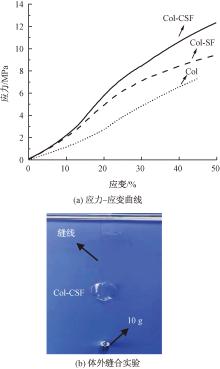
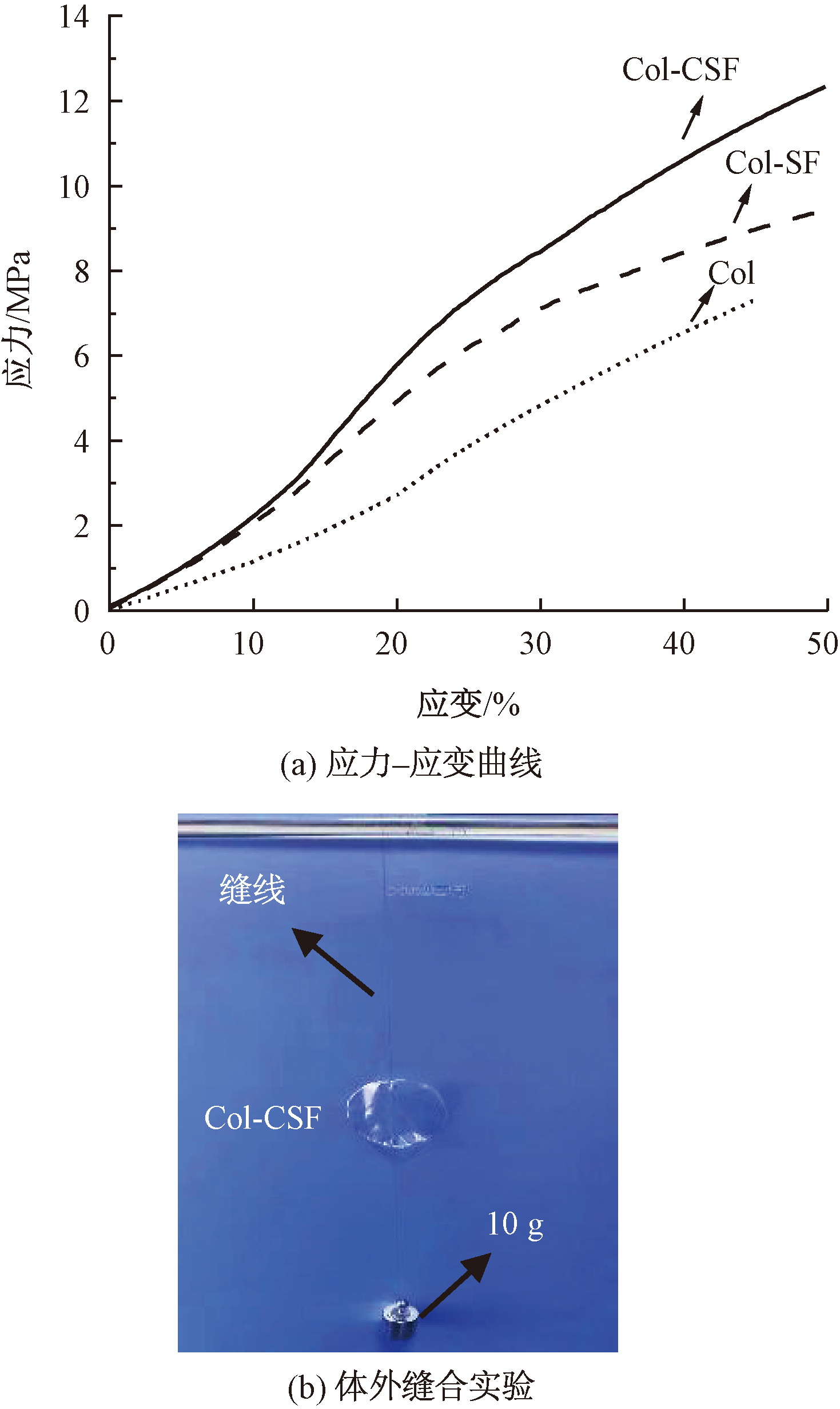
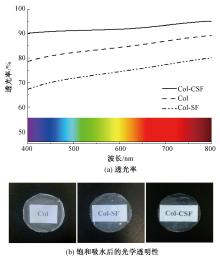
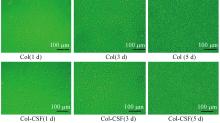
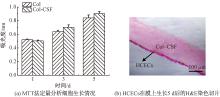
摘要: 针对胶原基角膜修复材料力学性能不好而导致的不耐缝合以及稳定性不足的问题,尝试将丝素蛋白引入到胶原(Col)基角膜修复材料的内部。首先对天然丝素纤维进行羧基化处理,随后将羧基化丝素蛋白(CSF)引入到胶原凝胶体系,并通过1-乙基-(3-二甲基氨基丙基)碳二亚胺盐酸盐和N-羟基琥珀酰亚胺对二者进行化学交联,成功制备了一种具备“钢筋混凝土”结构的胶原-羟基化丝素分子Col-CSF复合支架。通过红外、热重分析和力学性能测试等对材料进行表征。结果表明,CSF的引入显著提高了薄膜的力学性能,Col-CSF的抗张强度达到(12.66±0.11) MPa。此外,材料还具有良好的热稳定性和透光性能。体外细胞实验结果证明,Col-CSF无细胞毒性,有利于角膜上皮细胞的黏附与生长。
中图分类号:
| [1] | PRINCZ M A, SHEARDOWN H, GRIFFITH M J B, et al. Corneal tissue engineering versus synthetic artificial corneas[J]. Biomaterials and Regenerative Medicine in Ophthalmology, 2010. DOI:10.1533/9781845697433.1.134. |
| [2] |
INÊS A. BARROSO, MAN K, et al. Photocurable antimicrobial silk-based hydrogels for corneal repair[J]. Journal of Biomedical Materials Research, Part A, 2022, 110(7):1401-1415.
doi: 10.1002/jbm.a.37381 pmid: 35257514 |
| [3] |
MISHRA S, JOSHI A, GINU P, et al. Corneal transplantation: a walk to vision[J]. Medical Journal Armed Forces India, 2023, 79(6): 645-650.
doi: 10.1016/j.mjafi.2023.08.010 pmid: 37981925 |
| [4] | WANG L, LI A, ZHANG D, et al. Injectable double-network hydrogel for corneal repair[J]. Chemical Engineering Journal, 2023, 455: 140698. |
| [5] | JADIDI K, TAFTI M F, DIANAT M H, et al. Acellular human amniotic membrane: a safe and stable matrix for corneal stromal regeneration[J]. Colloids and Surface A:Physicochemical and Engineering Aspects, 2024, 690: 133745. |
| [6] | WANG B, FANG Q L, YANG Q, et al. Functional acellular matrix for tissue repair[J]. Materials Today Bio, 2023, 18:100530. |
| [7] |
KHAN R, KHAN M H. Use of collagen as a biomaterial: an update[J]. Journal of Indian Society of Periodontology, 2013, 17(4): 539-542.
doi: 10.4103/0972-124X.118333 pmid: 24174741 |
| [8] |
DUAN X, MCLAUGHLIN C, GRIFFITH M, et al. Biofunctionalization of collagen for improved biological response: scaffolds for corneal tissue engineering[J]. Biomaterials, 2007, 28(1):78-88.
pmid: 16962168 |
| [9] |
LIU W, DENG C, MCLAUGHLIN C R, et al. Collagen-phosphorylcholine interpenetrating network hydrogels as corneal substitutes[J]. Biomaterials, 2009, 30(8):1551-1559.
doi: 10.1016/j.biomaterials.2008.11.022 pmid: 19097643 |
| [10] |
GRIFFITH M, OSBORNE R, MUNGER R. Functional human corneal equivalents constructed from cell lines[J]. Science, 1999, 286(5447):2169-2172.
pmid: 10591651 |
| [11] | KOZAK L M, ELIZONDO R A, JOEL E, et al. Effect of surgical technique on corneal implant performance[J]. Translational Vision Science & Technology, 2014, 3(2):6-6. |
| [12] | KIM E Y, TRIPATHY N, CHO S A, et al. Collagen type I-PLGA film as an efficient substratum for corneal endothelial cells regeneration[J]. Journal of Tissue Engineering and Regenerative Medicine, 2017, 11(9):2471-2478. |
| [13] |
ARABPOUR Z, BARADARAN-RAFII A, BAKHSHAIESH N L, et al. Design and characterization of biodegradable multi layered electrospun nanofibers for corneal tissue engineering applications[J]. Journal of Biomedical Materials Research Part A, 2019, 107(10): 2340-2349.
doi: 10.1002/jbm.a.36742 pmid: 31161710 |
| [14] |
SUN X, YANG X, SONG W, et al. Construction and evaluation of collagen-based corneal grafts using polycaprolactone to improve tension stress[J]. ACS Omega, 2020, 5: 674-682.
doi: 10.1021/acsomega.9b03297 pmid: 31956817 |
| [15] | WU Z J, KONG B, LIU R, et al. Engineering of corneal tissue through an aligned PVA/collagen composite nanofibrous electrospun scaffold[J]. Nanomaterials, 2018.DOI:10.3390/nano8020124. |
| [16] | 姚双双, 付少举, 张佩华, 等. 再生丝素蛋白/聚乙烯醇共混取向纳米纤维膜的制备与性能[J]. 纺织学报, 2023, 44(9):11-19. |
| YAO Shuangshuang, FU Shaoju, ZHANG Peihua, et al. Preparation and properties of regenerated silk fibroin/polyvinyl alcohol blended nanofiber membranes with predesigned orientation[J]. Journal of Textile Research, 2023, 44(9):11-19. | |
| [17] |
LONG K, LIU Y, LI W, et al. Improving the mechanical properties of collagen-based membranes using silk fibroin for corneal tissue engineering[J]. Journal of Biomedical Materials Research Part A, 2015, 103(3):1159-1168.
doi: 10.1002/jbm.a.35268 pmid: 25044509 |
| [18] | SUN Z Y, HUANG R, LYU H, et al. Silk acid as an implantable biomaterial for tissue regeneration[J]. Advanced Healthcare Materials, 2023.DOI:10.1002/adhm.202301439. |
| [19] |
WU J, WANG S, ZHENG Z, et al. Fabrication of biologically inspired electrospun collagen/silk fibroin/bioactive glass composited nanofibrous scaffold to accelerate the treatment efficiency of bone repair[J]. Regenerative Therapy, 2022, 21: 122-138.
doi: 10.1016/j.reth.2022.05.006 pmid: 35844293 |
| [20] | OZCELIK B, BROWN K D, BLENCOWE A, et al. Ultrathin chitosan-poly(ethylene glycol) hydrogel films for corneal tissue engineering[J]. Acta Biomaterial, 2013, 9(5): 6594-6605. |
| [21] | LIU Y, LIU H, ZHANG C, et al. Preparation and investigation of a novel antibacterial collagen-based material loaded with gentamicin following surface modification with citric acid for corneal tissue engineering[J]. International Journal of Biological Macromolecules, 2023.DOI:10.1016/j.ijbiomac.2023.126791. |
| [22] | LI L, LU C, WANG L, et al. Gelatin-based photocurable hydrogels for corneal wound repair[J]. ACS Applied Materials & Interfaces, 2018, 10(16):13283-13292. |
| [1] | 梁锋, 方沿, 张伟华, 唐余玲, 李双洋, 周建飞, 石碧. 基于金属-多酚网络的胶原蛋白基纤维制备及其力学性能[J]. 纺织学报, 2025, 46(08): 10-17. |
| [2] | 陈晴宇, 陆春红, 张斌, 晋义凯, 黄琪帏, 王超, 丁彬, 俞建勇, 王先锋. 碳纤维增强水泥基灌浆料的制备及其性能[J]. 纺织学报, 2025, 46(08): 120-126. |
| [3] | 岳航, 鹿超, 王春红, 李瀚宇. 基于主要化学成分的红麻与大麻拉伸强度预测[J]. 纺织学报, 2025, 46(08): 62-70. |
| [4] | 刘宇祥, 乌婧, 徐锦龙, 谢锐敏, 王华平. 阳离子可染聚对苯二甲酸丙二醇酯预取向丝的制备及其性能[J]. 纺织学报, 2025, 46(07): 46-52. |
| [5] | 江淑宁, 杨海伟, 李长龙, 郑天亮, 王宗乾. 低共熔溶剂剥离法制备丝素蛋白纳米原纤及其成膜性能[J]. 纺织学报, 2025, 46(07): 1-9. |
| [6] | 朱雷, 李晓俊, 程春祖, 徐纪刚, 杜心宇. 四硼酸钠/单宁酸交联对海藻酸钙纤维结构与性能的影响[J]. 纺织学报, 2025, 46(07): 28-36. |
| [7] | 于梦菲, 高文丽, 任婧, 曹雷涛, 彭若铉, 凌盛杰. 摩擦纳米发电机用皮芯结构纤维的制备及其性能[J]. 纺织学报, 2025, 46(05): 1-9. |
| [8] | 时晓聪, 陈莉, 杜迅. 茜素-聚乳酸/胶原蛋白纳米纤维膜的制备及其氨气检测性能[J]. 纺织学报, 2025, 46(05): 143-150. |
| [9] | 罗欣, 王磊, 王筱悠, 伍韬, 张贞贞, 张一帆. 丝素蛋白多级结构的自组装机制及其重构材料研究进展[J]. 纺织学报, 2025, 46(03): 225-235. |
| [10] | 李金键, 薛元, 陈宥融. 时序分布的段彩竹节纱及三通道转杯成纱工艺设计[J]. 纺织学报, 2025, 46(03): 72-81. |
| [11] | 詹克静, 杨鑫, 张应龙, 张昕, 潘志娟. 自凝聚丝素蛋白微纳米纤维膜的制备及其力学增强[J]. 纺织学报, 2025, 46(02): 10-19. |
| [12] | 宋婉萌, 王宝弘, 孙宇, 杨家祥, 刘云, 王玉忠. 兼具力学性能与高效阻燃性能粘胶织物的制备及其性能[J]. 纺织学报, 2025, 46(02): 188-196. |
| [13] | 卢海龙, 于影, 左雨欣, 王浩然, 陈洪立, 汝欣. 取向增强抗CO2腐蚀纤维薄膜的制备及其性能[J]. 纺织学报, 2024, 45(12): 33-40. |
| [14] | 杨鑫, 张昕, 潘志娟. 丝素纳米原纤增强再生丝素蛋白/聚乙烯醇纤维的结构与性能[J]. 纺织学报, 2024, 45(11): 1-9. |
| [15] | 缪璐璐, 孟小奕, 董正梅, 彭倩, 何林伟, 邹专勇. 热处理工艺对喷气涡流纺低熔点涤纶长丝包芯纱力学性能的影响[J]. 纺织学报, 2024, 45(11): 73-79. |
|
||
 京公网安备11010502044800号