纺织学报 ›› 2026, Vol. 47 ›› Issue (04): 9-16.doi: 10.13475/j.fzxb.20250705001
林启松1, 戴钧明1( ), 查全亮2, 徐涛1, 吕汪洋1,3
LIN Qisong1, DAI Junming1(), ZHA Quanliang2, XU Tao1, LÜ Wangyang1,3
摘要:
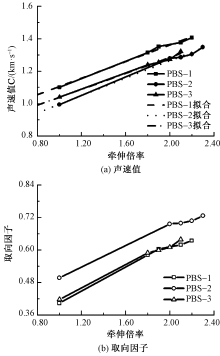
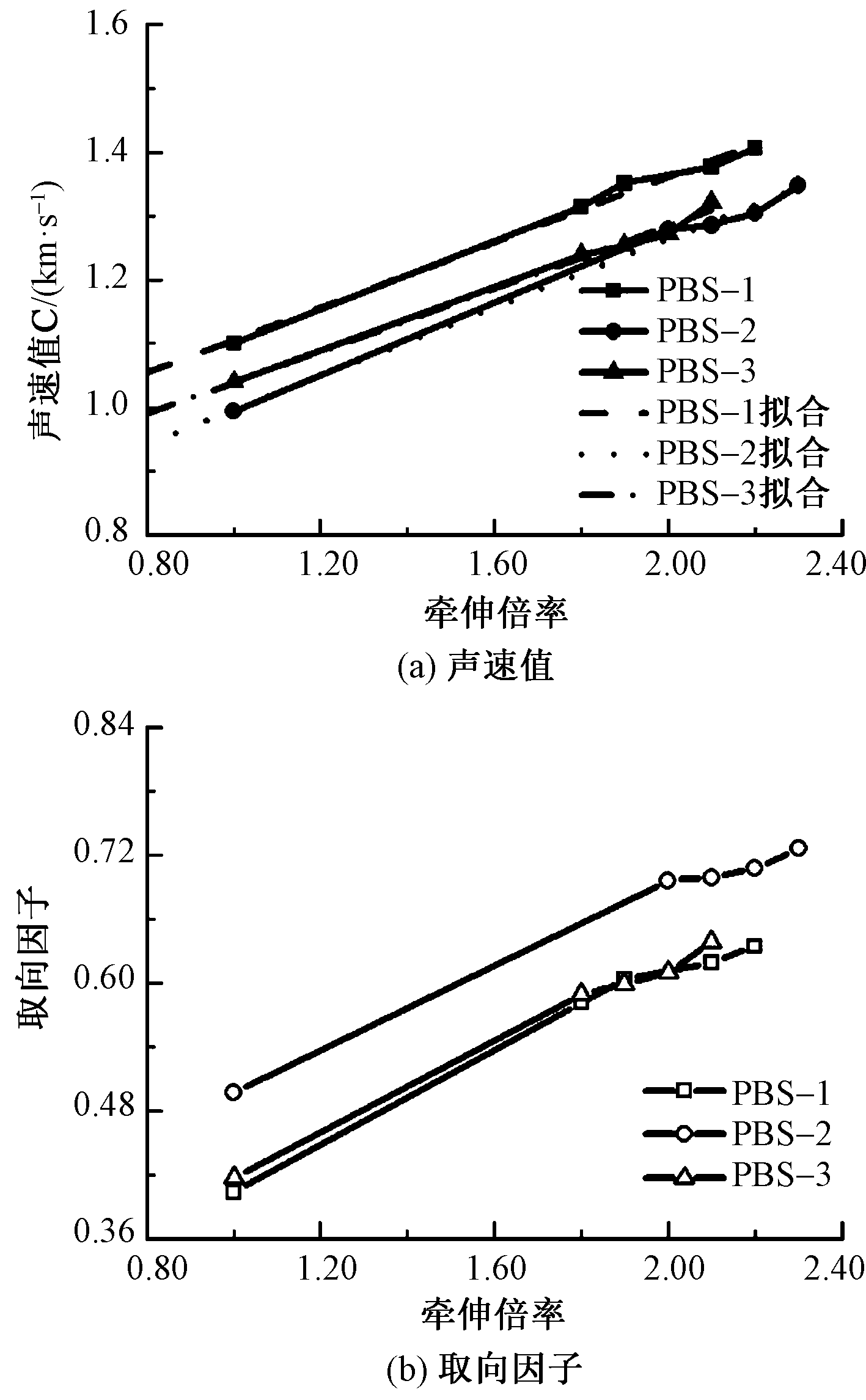
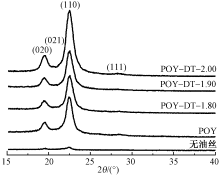
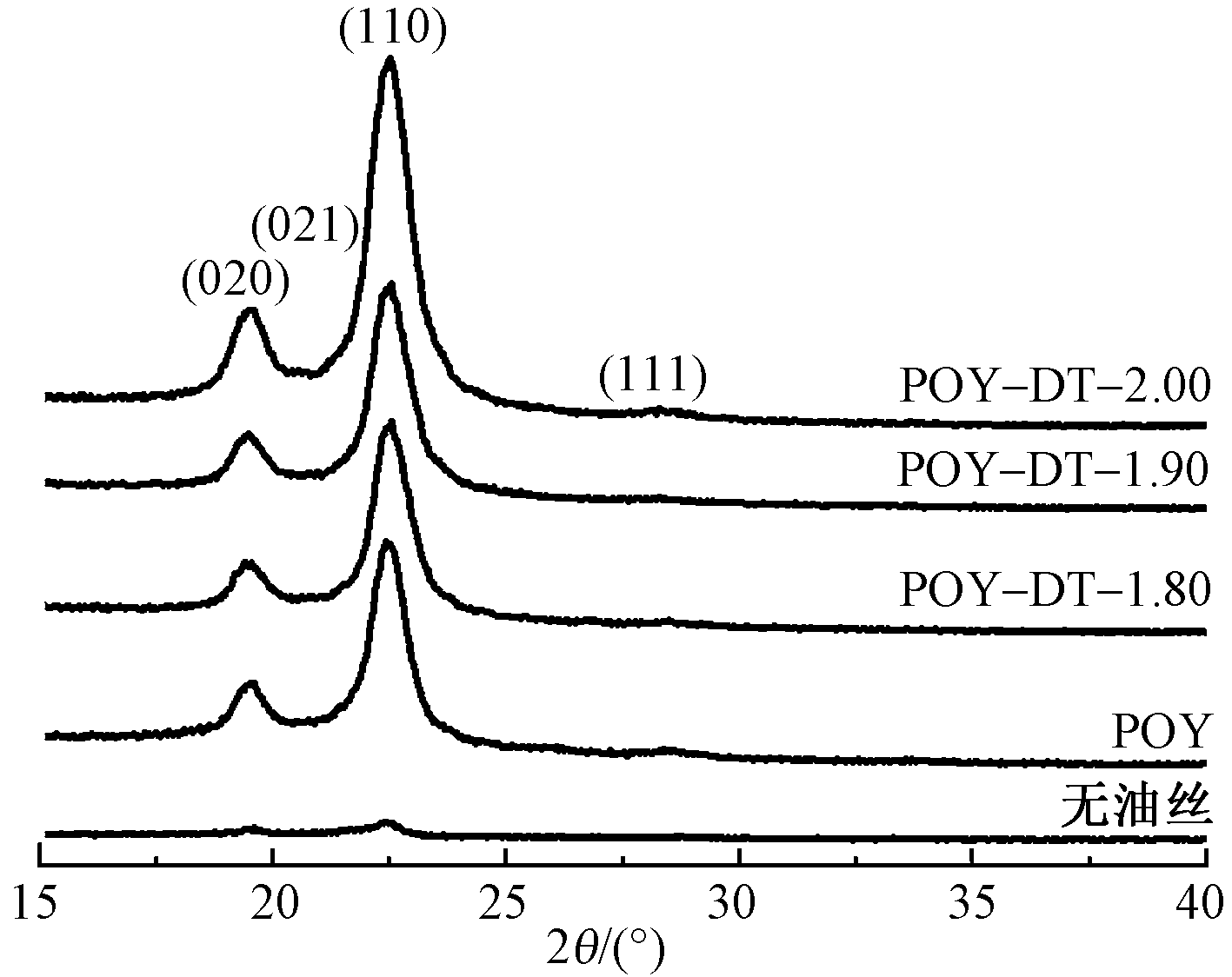
生物可降解聚丁二酸丁二醇酯(PBS)纤维具有仿羊毛的良好手感,但目前适合用于熔融纺丝的原料特性及纺丝工艺尚不明确。通过研究不同特性黏度PBS的纺丝性能,建立原料与PBS成纤性能之间的联系,并利用声速取向仪和X射线衍射分析纤维取向及晶体结构等聚集态特征随PBS纤维特性黏度、牵伸倍率等因素变化的关系规律。结果表明:高黏PBS有助于提高纤维纺丝速度,但其在纺丝过程中黏度下降显著,如原始特性黏度1.99 dL/g的PBS其无油丝黏度降为0.51 dL/g,导致纤维力学性能下降;部分支化的低黏PBS(特性黏度为1.53 dL/g)可在2 700 m/min的高速纺丝条件下制备预取向丝(POY)纤维,并保持1.74 cN/dtex的断裂强度;POY的断裂强度与纺丝速度成正比,且纺丝速度对其牵伸丝(POY-DT)的力学性能具有显著提升作用,POY纺丝速度由1 500 m/min提升至2 700 m/min时,最高牵伸倍率下得到的POY-DT的断裂强度由1.34 cN/dtex提升至2.91 cN/dtex;PBS纤维取向度随牵伸倍率的增大而提高,纤维特性黏度越高,其声速值越低,低黏PBS有利于纤维取向,但支化不利于纤维取向;纤维牵伸有助于晶粒尺寸细化和晶体结构完善,过程中结晶度可由无油丝的48.09%提升至牵伸2.00倍后的78.91%。
中图分类号:
| [1] | 史可, 张晶, 苏婷婷, 等. 生物可降解塑料的改性研究进展[J]. 化工新型材料, 2019, 47(4): 29-33. |
| SHI Ke, ZHANG Jing, SU Tingting, et al. Modification progress of biodegradable plastics[J]. New Chemical Materials, 2019, 47(4): 29-33. | |
| [2] | 纪晓寰, 孙宾, 王鸣义. 生物可降解聚酯的技术进展和应用前景[J]. 纺织导报, 2021(2): 13-26. |
| JI Xiaohuan, SUN Bin, WANG Mingyi. Technology progress and application prospect of biodegradable polyesters[J]. China Textile Leader, 2021(2): 13-26. | |
| [3] |
BARLETTA M, AVERSA C, AYYOOB M, et al. Poly(butylene succinate) (PBS): materials, processing, and industrial applications[J]. Progress in Polymer Science, 2022, 132: 101579.
doi: 10.1016/j.progpolymsci.2022.101579 |
| [4] | 黄关葆. 聚丁二酸丁二醇酯的研究与产业化现状[J]. 纺织学报, 2014, 35(8): 156-162. |
| HUANG Guanbao. Research and industrialization status quo of poly(butylene succinate)[J]. Journal of Textile Research, 2014, 35(8): 156-162. | |
| [5] | 陈美玉, 谷丰, 陈晗飞. 生物基PBS纤维结构及力学性能[J]. 纺织高校基础科学学报, 2019, 32(1): 1-6. |
| CHEN Meiyu, GU Feng, CHEN Hanfei. Structure and mechanical properties of bio-loased polybutylene succinate fiber[J]. Basic Sciences Journal of Textile Universities, 2019, 32(1): 1-6. | |
| [6] | 王成龙, 李立新, 吴绍明, 等. 染色促进剂对聚丁二酸丁二醇酯纤维分散染料染色动力学和热力学的影响[J]. 纺织学报, 2022, 43(1): 147-152. |
| WANG Chenglong, LI Lixin, WU Shaoming, et al. Effect of dyeing promoter on dyeing kinetics and thermodynamics of polybutylene succinate fiber dyeing with disperse dye[J]. Journal of Textile Research, 2022, 43(1): 147-152. | |
| [7] | 夏榆, 姚菊明, 周杰, 等. 聚丁二酸丁二醇酯/丝胶蛋白共混纤维的制备及其性能[J]. 纺织学报, 2023, 44(4): 1-7. |
|
XIA Yu, YAO Juming, ZHOU Jie, et al. Preparation and properties of poly(butylene succinate)/silk sericin blend fiber[J]. Journal of Textile Research, 2023, 44(4): 1-7.
doi: 10.1177/004051757404400101 |
|
| [8] |
EL SALMAWY A, YAMANE H, MIYAMOTO M, et al. Properties and degradability of melt-spun fibers of poly(butylene succinate) and its copolymer with L-lactic acid[J]. Sen'i Gakkaishi, 1999, 55(3): 120-126.
doi: 10.2115/fiber.55.3_120 |
| [9] | 周邓飞. 可生物降解PBS的合成及纤维制备[D]. 杭州: 浙江理工大学, 2016: 26-34. |
| ZHOU Dengfei. Synthesis of biodegradable PBS and fiber preparation[D]. Hangzhou: Zhejiang Sci-Tech University, 2016: 26-34. | |
| [10] | 李立新. 聚丁二酸丁二醇酯(PBS)纤维及其织物的染色性能研究[D]. 杭州: 浙江理工大学, 2021: 8-28. |
| LI Lixin. Study on dyeing properties of poly(butylene succinate)(PBS) fiber and fabric[D]. Hangzhou: Zhejiang Sci-Tech University, 2021: 8-28. | |
| [11] | WEISE B, COLZ J, WENNING S, et al. Polybutylene succinate—an emerging textile polyester[J]. Chemical Fibers International, 2018, 68(2): 72-74. |
| [12] | 曹宇恒. 聚丁二酸丁二醇酯长丝加弹过程的结构与性能变化[D]. 杭州: 浙江理工大学, 2020: 23. |
| CAO Yuheng. Changes of structure and properties of PBS filament during the texturing process[D]. Hangzhou: Zhejiang Sci-Tech University, 2020: 23. | |
| [13] | 陈咏, 叶梦婷, 王朝生, 等. 聚丁二酸丁二醇酯性能调控策略及应用[J]. 纺织学报, 2024, 45(1): 220-229. |
|
CHEN Yong, YE Mengting, WANG Chaosheng, et al. Research progress in performance regulation strategies of polybutylene succinate[J]. Journal of Textile Research, 2024, 45(1): 220-229.
doi: 10.1177/004051757504500305 |
|
| [14] | 顾晶君. 生物降解性聚酯聚丁二酸丁二醇酯(PBS)和聚对苯二甲酸—共—丁二酸丁二醇酯(PBST)的性能研究和纤维制备[D]. 上海: 东华大学, 2007: 8, 33-34. |
| GU Jingjun. The preparation and performance study on the biodegradable PBS, PBST polyester fibers[D]. Shanghai: Donghua University, 2007: 8, 33-34. | |
| [15] |
徐涛, 王勇军, 林启松, 等. 聚丁二酸丁二醇酯熔融缩聚增黏特性[J]. 化工进展, 2024, 43(10): 5663-5670.
doi: 10.16085/j.issn.1000-6613.2023-1642 |
|
XU Tao, WANG Yongjun, LIN Qisong, et al. Viscosification properties of poly(butylene succinate)by melt polycondensation[J]. Chemical Industry and Engineering Progress, 2024, 43(10): 5663-5670.
doi: 10.16085/j.issn.1000-6613.2023-1642 |
|
| [16] |
JIN T X, ZHOU M, HU S D, et al. Effect of molecular weight on the properties of poly(butylene succinate)[J]. Chinese Journal of Polymer Science, 2014, 32(7): 953-960.
doi: 10.1007/s10118-014-1463-4 |
| [17] |
ZHOU X X, DOU Q. Preparation of poly(butylene succinate)/soy protein isolate bio-composites by reactive compatibilization with peroxide and acrylate[J]. Journal of Polymers and the Environment, 2022, 30(5): 1847-1863.
doi: 10.1007/s10924-021-02321-0 |
| [18] |
SAVITHA K S, SENTHIL KUMAR M, JAGADISH R L. Ti(OBu)4/B(OBu)3: deciphering the mechanism for the formation of high molecular weight poly(butylene succinate)[J]. Journal of Applied Polymer Science, 2023, 140(20): e53842.
doi: 10.1002/app.v140.20 |
| [19] |
SAVITHA K S, SENTHIL KUMAR M, JAGADISH R L. Systematic approach in enhancing the selectivity of titanium tetrabutoxide towards high molecular weight poly(butylene succinate) synthesis[J]. Polymers for Advanced Technologies, 2023, 34(7): 2335-2339.
doi: 10.1002/pat.v34.7 |
| [20] | 张祥辉. 生物基呋喃聚酯的改性及其纤维的制备与表征[D]. 天津: 天津工业大学, 2023: 38. |
| ZHANG Xianghui. Modification of bio-based furan polyester and preparation and characterization of its fibers[D]. Tianjin: Tiangong University, 2023: 38. | |
| [21] |
薛钰, 殷德贤, 项鲁冰, 等. 扩链PBS的微孔发泡行为研究[J]. 中国塑料, 2021, 35(8): 125-130.
doi: 10.19491/j.issn.1001-9278.2021.08.018 |
|
XUE Yu, YIN Dexian, XIANG Lubing, et al. Study on microcellular foaming behavior of chain-extended poly(butylene succinate)[J]. China Plastics, 2021, 35(8): 125-130.
doi: 10.19491/j.issn.1001-9278.2021.08.018 |
|
| [22] | 陈稀, 罗宁燕, 吴嘉麟, 等. 3500m/min卷绕速度聚酯FOY热管纺丝一步法研究[J]. 纺织学报, 1991, 12(7): 319-322. |
| CHEN Xi, LUO Ningyan, WU Jialin, et al. Study on one-step method of polyester FOY heat pipe spinning with winding speed of 3500m/min[J]. Journal of Textile Research, 1991, 12(7): 319-322. | |
| [23] | LAI S Q, GAO Y, YUE L. Heterogeneous catalytic synthesis of poly(butylene succinate) by attapulgite-supported Sn catalyst[J]. Journal of Applied Polymer Science, 2015, 132(13): 41729. |
| [24] | 黄伟宽, 陈咏, 王亚宁, 等. 聚丁二酸丁二醇酯(PBS)纤维的凝聚态结构与性能[J]. 东华大学学报(自然科学版), 2025, 51(3): 1-10. |
| HUANG Weikuan, CHEN Yong, WANG Yaning, et al. Condensed-state structure and properties of poly(butylene succinate) (PBS) fibers[J]. Journal of Donghua University (Natural Science), 2025, 51(3): 1-10. |
| [1] | 王琎祺, 翟倩, 俞森龙, 朱倩沁, 周哲, 相恒学, 朱美芳. 聚乙烯微细纤维医疗防护应用研究进展[J]. 纺织学报, 2026, 47(03): 156-165. |
| [2] | 孙燕燕, 张世韬, 刘衡, 李明远, 蔡正国, 孙俊芬, 陈龙. 聚丙烯/聚对苯二甲酸丁二醇酯共混纤维的制备及其流变与热性能[J]. 纺织学报, 2025, 46(10): 11-18. |
| [3] | 王清清, 廖师琴, 魏取福. 光电双响应纱线应变传感器的制备及其性能[J]. 纺织学报, 2025, 46(08): 71-79. |
| [4] | 刘宇祥, 乌婧, 徐锦龙, 谢锐敏, 王华平. 阳离子可染聚对苯二甲酸丙二醇酯预取向丝的制备及其性能[J]. 纺织学报, 2025, 46(07): 46-52. |
| [5] | 王彪, 李源, 董杰, 张清华. 热亚胺化中应力对聚酰亚胺纤维结构和性能的影响[J]. 纺织学报, 2025, 46(03): 1-8. |
| [6] | 刘术, 侯腾, 周乐乐, 李祥龙, 杨斌. 桑蚕的强制牵伸抽丝及其纤维性能[J]. 纺织学报, 2024, 45(06): 11-15. |
| [7] | 陈咏, 叶梦婷, 王朝生, 乌婧, 王华平. 聚丁二酸丁二醇酯性能调控策略及应用[J]. 纺织学报, 2024, 45(01): 220-229. |
| [8] | 陈美玉, 李立凤, 董侠. 长碳链聚酰胺1012纤维在不同温度下的力学性能[J]. 纺织学报, 2023, 44(11): 9-18. |
| [9] | 李睿, 王梦柯, 于春晓, 郑晓頔, 邱志成, 李志勇, 武术方. 原位聚合法聚酰胺6/炭黑复合纤维的制备及其性能[J]. 纺织学报, 2023, 44(10): 1-8. |
| [10] | 赫爽, 孙莉娜, 胡红梅, 朱瑞淑, 俞建勇, 王学利. 全生物基聚呋喃二甲酸丙二醇酯及其纤维制备与性能[J]. 纺织学报, 2023, 44(05): 63-69. |
| [11] | 夏榆, 姚菊明, 周杰, 毛梦慧, 张玉梅, 姚勇波. 聚丁二酸丁二醇酯/丝胶蛋白共混纤维的制备及其性能[J]. 纺织学报, 2023, 44(04): 1-7. |
| [12] | 陈欢欢, 陈凯凯, 杨慕容, 薛昊龙, 高伟洪, 肖长发. 聚乳酸/百里酚抗菌纤维的制备与性能[J]. 纺织学报, 2023, 44(02): 34-43. |
| [13] | 朱燕龙, 谷英姝, 谷潇夏, 董振峰, 汪滨, 张秀芹. 抗菌和防紫外线双效功能聚乳酸/ZnO纤维的制备及其性能[J]. 纺织学报, 2022, 43(08): 40-47. |
| [14] | 王莉娟, 宫玉梅, 李晓妍, 王迎, 郝新敏, 樊丽君. 生物基聚酰胺56分子质量及其Mark-Houwink方程参数的测定[J]. 纺织学报, 2022, 43(07): 36-40. |
| [15] | 李龙龙, 魏朋, 吴萃霞, 闫金飞, 娄贺娟, 张一风, 夏于旻, 王燕萍, 王依民. 基于对羟基苯丙酸的生物基液晶共聚酯纤维的合成与性能[J]. 纺织学报, 2022, 43(01): 9-14. |
|
||
 京公网安备11010502044800号