纺织学报 ›› 2025, Vol. 46 ›› Issue (08): 71-79.doi: 10.13475/j.fzxb.20241106201
王清清( ), 廖师琴, 魏取福
WANG Qingqing(), LIAO Shiqin, WEI Qufu
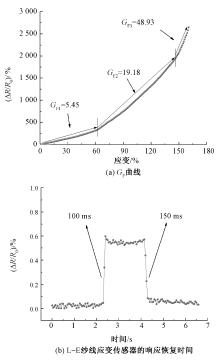
摘要: 为改善纱线应变传感器的传感性能,构建了光电双模式响应机制,从而提高可视化传感效果。采用湿法纺丝工艺制备柔性传感器基底,随后制备非均相捻线结构和负载聚多巴胺(PDA)/聚吡咯(PPy)导电层,最后刷涂硫化锌铜(ZnS:Cu)/聚二甲基硅氧烷(PDMS)力致发光层。借助扫描电子显微镜、X射线能谱分析仪、小型拉力机、数字源表和光纤光谱仪等对纱线应变传感器进行表征与分析。结果表明:经结构设计的纱线应变传感器具有高灵敏度和宽应变传感范围。传感器外层刷涂力致发光层后,不仅增强了传感器的传感信号可视化效果,也提高了耐用性。在可穿戴传感应用中,拉伸该纱线应变传感器,可同时产生光信号和电阻信号,能够准确识别人体的生理活动和关节运动。
中图分类号:
| [1] | CHU H Q, XUE J, LUO D, et al. Advances in wearable multifunctional devices based on human-body energy harvesting[J]. Advanced Materials Technologies, 2024, 9(21):2302068. |
| [2] | LIAO Y, TIAN S, LI Y, et al. Ambient nano rf-energy driven self-powered wearable multimodal real-time health monitoring[J]. Nano Energy, 2024, 128:109915. |
| [3] | LIN G, WENG L, ZHANG H, et al. Dual-mode flexible sensor based on magnetic film for wearable smart finger sleeve[J]. Smart Materials and Structures, 2024, 33(9):095035. |
| [4] | ZHANG K, CHANG S, SHANG Y, et al. Mechanoluminescent/Electric dual-mode sensors enabled by trace carbon nanotubes[J]. Small, 2024, 20(50):e2406398. |
| [5] |
汪小钰, 胡平, 操齐高, 等. 不同模式多功能柔性传感器研究进展[J]. 化工进展, 2022, 41(10):5474-5493.
doi: 10.16085/j.issn.1000-6613.2022-0016 |
| WANG Xiaoyu, HU Ping, CAO Qigao, et al. Research progress of multi-functional flexible sensors with different modes[J]. Chemical Industry Progress, 2022, 41(10):5474-5493. | |
| [6] | PAN J, YANG M, LUO L, et al. Stretchable and highly sensitive braided composite yarn@polydopamine@polypyrrole for wearable applications[J]. ACS Applied Materials & Interfaces, 2019, 11(7):7338-7348. |
| [7] |
常凯, 李倩倩, 李振. 力致发光现象及其应用研究进展[J]. 有机化学, 2020, 40(11):3656-3671.
doi: 10.6023/cjoc202006052 |
| CHANG Kai, LI Qianqian, LI Zhen. Research progress of photoluminescence phenomena and their applications[J]. Organic Chemistry, 2020, 40(11):3656-3671. | |
| [8] | ZHUANG Y, XIE R J. Mechanoluminescence rebrightening the prospects of stress sensing: a review[J]. Advanced Materials, 2021, 33(50):2005925. |
| [9] | LIU Z, QI D, HU G, et al. Surface strain redistribution on structured microfibers to enhance sensitivity of fiber-shaped stretchable strain sensors[J]. Advanced Materials, 2018, 30(5):1704229. |
| [10] | 万爱兰, 沈新燕, 王晓晓, 等. 聚多巴胺修饰还原氧化石墨烯/聚吡咯导电织物的制备及其传感响应特性[J]. 纺织学报, 2023, 44(1):156-163. |
| WAN Ailan, SHEN Xinyan, WANG Xiaoxiao, et al. Preparation and sensing response characteristics of graphene oxide/polypyrrole conductive fabric modified with polydopamine[J]. Journal of Textile Research, 2023, 44(1):156-163. | |
| [11] | 宋金亚. 聚吡咯/碳纳米管复合材料的制备及应用进展[J]. 化学与粘合, 2024, 46(2):184-187, 192. |
| SONG Jinya. Preparation and application of polypyrrole/carbon nanotube composites[J]. Chemistry and Adhesion, 2024, 46(2):184-187, 192. | |
| [12] | ZHANG J, BAO L, LOU H, et al. Flexible and stretchable mechanoluminescent fiber and fabric[J]. Journal of Materials Chemistry C, 2017, 5(32):8027-8032. |
| [13] | FAN W, LIU T, WU F, et al. An antisweat interference and highly sensitive temperature sensor based on poly (3, 4-ethylenedioxythiophene)-poly(styrenesulfonate) fiber coated with polyurethane/graphene for real-time monitoring of body temperature[J]. ACS Mano, 2023, 17(21):21073-21082. |
| [14] | WANG S, BAI Y, YANG X, et al. Highly stretchable potentiometric ion sensor based on surface strain redistributed fiber for sweat monitoring[J]. Talanta, 2020, 214:120869. |
| [15] | ZHANG X, CHEN J, ZHENG Z, et al. Flexible temperature sensor with high reproducibility and wireless closed-loop system for decoupled multimodal health monitoring and personalized thermoregulation[J]. Advanced Materials, 2024, 36(45):e2407859. |
| [16] |
ZHOU B, LIU J, HUANG X, et al. Mechanoluminescent-triboelectric bimodal sensors for self-powered sensing and intelligent control[J]. Nano-Micro Letters, 2023, 15(1):72.
doi: 10.1007/s40820-023-01054-0 pmid: 36964430 |
| [17] | 王玥, 杨伟峰, 陈浩廷, 等. 高性能ZnS:Cu基力致发光弹性体及其在视觉交互织物中的应用[J]. 发光学报, 2022, 43(10):1609-1619. |
| WANG Yue, YANG Weifeng, CHEN Haoting, et al. High performance ZnS:Cu-based luminescent elastomer and its application in visual interactive fabrics[J]. Chinese Journal of Luminescence, 2022, 43(10):1609-1619. | |
| [18] |
ISHIDA S, NARAHARA A. Stress-rate effect on time response of mechanoluminescent-sensor luminescent intensity[J]. Optics Express, 2019, 27(4):3935-3943.
doi: 10.1364/OE.27.003935 pmid: 30876017 |
| [1] | 权英, 张爱琴, 张曼, 刘淑强, 张钰晶. 基于三维编织结构的柔性应变传感器制备及其性能[J]. 纺织学报, 2025, 46(08): 136-144. |
| [2] | 杨天琪, 任家智, 王旭真, 陈宇恒. 混合精梳纤维卷投料比数学模型构建与应用[J]. 纺织学报, 2025, 46(07): 62-68. |
| [3] | 林玉婷, 许仕林, 胡毅. 多色彩热塑性聚氨酯/聚丙烯腈纳米纤维纱线的制备及其性能[J]. 纺织学报, 2025, 46(07): 78-86. |
| [4] | 贾陈诺瓦, 张勇, 朱威岩, 刘赛, 唐宁. 芯纱种类对聚丙烯腈纳米纤维导电包芯纱性能的影响[J]. 纺织学报, 2025, 46(07): 87-95. |
| [5] | 贾潞, 周苏秦, 郭龙灿, 刘淑强, 张瑜. 负载MXene的棉/氨纶导电包芯纱制备及其传感性能[J]. 纺织学报, 2025, 46(07): 96-102. |
| [6] | 吴雪杨, 徐启程, 单英浩, 林孝武, 刘晨铭. 集太阳能与电磁能量收集的人体可穿戴纳电网系统设计[J]. 纺织学报, 2025, 46(07): 202-208. |
| [7] | 林思伶, 刘赋瑶, 张成, 侯琳, 徐炎炎, 付冉迁, 樊威. 双向调温阻燃防静电纺织品的制备及其性能[J]. 纺织学报, 2025, 46(06): 38-44. |
| [8] | 张嘉诚, 于影, 左雨欣, 顾志清, 汤腾飞, 陈洪立, 吕勇. 聚丙烯腈/二硫化钼纤维薄膜的挠曲电效应与扭转传感特性[J]. 纺织学报, 2025, 46(06): 80-87. |
| [9] | 李朵, 谢晓雯, 张迪凡, 吴景霞, 陆凯, 陈培宁. Wi-Fi双频织物天线的构建及其电磁性能[J]. 纺织学报, 2025, 46(05): 10-16. |
| [10] | 吴梦婕, 夏勇, 张雨凡, 周欣然, 俞建勇, 熊佳庆. 智能变形纤维/织物材料研究进展[J]. 纺织学报, 2025, 46(05): 49-58. |
| [11] | 韩力杰, 刘樊, 张其冲. 纤维状水系锌离子电池的研究进展与展望[J]. 纺织学报, 2025, 46(05): 59-69. |
| [12] | 梁琦敏, 鄢卓君, 李长昕, 刘志锋, 何思斯. 纤维及织物基电化学传感器与水系电池的研究进展与展望[J]. 纺织学报, 2025, 46(05): 89-95. |
| [13] | 严艺, 朱达辉. 老年智能服装研究现状与发展趋势[J]. 纺织学报, 2025, 46(04): 244-254. |
| [14] | 邵秋, 杨瑞华. 再循环棉/原棉转杯纺纱线的耐磨性[J]. 纺织学报, 2025, 46(03): 64-71. |
| [15] | 李玲, 史倩倩, 田顺, 汪军. 输纤通道对称性对双喂入双分梳转杯纺气流场以及纱线特性的影响[J]. 纺织学报, 2025, 46(02): 69-77. |
|
||
 京公网安备11010502044800号