纺织学报 ›› 2026, Vol. 47 ›› Issue (07): 1-9.doi: 10.13475/j.fzxb.20260400101
• 第二十八届中国科协年会学术论文·减污降碳共性技术突破专栏· • 下一篇
沈忱思1, 侯传鑫1, 苏雄2, 李方1( )
)
SHEN Chensi1, HOU Chuanxin1, SU Xiong2, LI Fang1()
摘要:
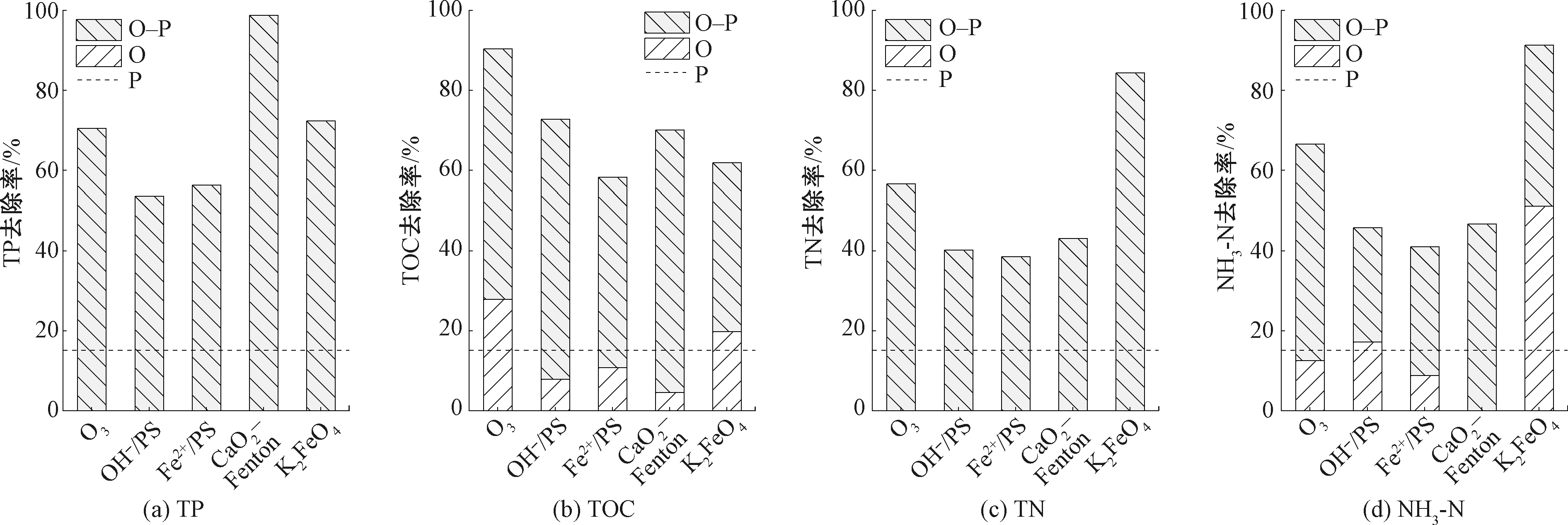
针对纺织阻燃整理废水中有机磷形态稳定和常规工艺处理效果有限的问题,考察了臭氧、碱活化过硫酸盐、Fe2+活化过硫酸盐、CaO2类Fenton及高铁酸钾氧化5种高级氧化技术(AOPs)对四羟甲基硫酸磷阻燃整理废水的预处理效果,并引入成本和减排维度综合评价了各预氧化-沉淀组合工艺的效能。结果表明,5种AOPs对有机磷的直接矿化能力有限,核心作用在于断裂部分C—P键,将有机磷转化为含磷酸基团的中间体,提升后续化学沉淀的络合除磷效率,形成预氧化活化-络合沉淀协同机制。其中,CaO2类Fenton组合工艺对废水总磷去除率最高(98.72%),每克磷的处理成本最低(71.3元/g);臭氧组合工艺对总有机碳去除率最优(90.39%);碱活化过硫酸盐组合工艺的综合运行成本最低(3.93元/m3)。无直接电耗的药剂体系减污降碳协同效益优于臭氧氧化体系,可依据出水水质目标灵活选择工艺路线。
中图分类号:
| [1] | 齐晓璐, 孙丽华, 张雅君, 等. 原位水解生成的羟基氧化铁凝聚吸附除磷效能与机制[J]. 环境工程学报, 2014, 8(2): 505-512. |
| QI Xiaolu, SUN Lihua, ZHANG Yajun, et al. Effectiveness and mechanism of the in situ formed iron hydroxide(FeOxHy) towards the removal of phosphate by coagulation and adsorption[J]. Chinese Journal of Environmental Engineering, 2014, 8(2): 505-512. | |
| [2] | 孙宇, 刘宝震, 安呈泰, 等. 基于高级氧化技术降解水中OPPs的研究进展[J]. 应用化工, 2024, 53(2): 428-432, 457. |
| SUN Yu, LIU Baozhen, AN Chengtai, et al. Research progress on degradation of organophosphorus pesticides in water based on advanced oxidation technology[J]. Applied Chemical Industry, 2024, 53(2): 428-432, 457. | |
| [3] | 许明鑫, 孙水裕, 戴文灿, 等. 络合沉淀结合混凝法去除浮选废水中有机磷[J]. 环境工程学报, 2014, 8(12): 5367-5371. |
| XU Mingxin, SUN Shuiyu, DAI Wencan, et al. Dephosphorization of flotation wastewater containing organophosphor using complex precipitation method[J]. Chinese Journal of Environmental Engineering, 2014, 8(12): 5367-5371. | |
| [4] | 马宏涛, 孙水裕, 许明鑫. 臭氧联合混凝沉淀法去除浮选废水中有机磷[J]. 环境工程学报, 2017, 11(1): 285-290. |
| MA Hongtao, SUN Shuiyu, XU Mingxin. Dephosphorization of flotation wastewater containing organic phosphorus using ozone-coagulation sedimentation method[J]. Chinese Journal of Environmental Engineering, 2017, 11(1): 285-290. | |
| [5] |
HAN Y P, ZHANG W Z, YU X, et al. Effects of tetrakis(hydroxymethyl)phosphonium sulfate pretreatment on characteristics of sewage sludge[J]. Journal of Environmental Sciences, 2019, 78: 174-182.
doi: 10.1016/j.jes.2018.09.013 |
| [6] |
COURTENS E N P, MEERBURG F, MAUSEN V, et al. When the smoke disappears: dealing with extinguishing chemicals in firefighting wastewater[J]. Water Science and Technology, 2014, 69(8): 1720-1727.
doi: 10.2166/wst.2014.081 pmid: 24759534 |
| [7] | 韦选香, 冯杨, 樊翔宇, 等. 牦牛绒均相高级氧化脱色技术及机制[J]. 纺织学报, 2025, 46(6): 151-159. |
| WEI Xuanxiang, FENG Yang, FAN Xiangyu, et al. Yak wool decolorization using homogeneous advanced oxidation technology and its mechanism[J]. Journal of Textile Research, 2025, 46(6): 151-159. | |
| [8] |
武浩, 周嫦娥, 高振清, 等. 基于还原-氧化体系的活性染料染色棉织物剥色[J]. 纺织学报, 2024, 45(12): 128-136.
doi: 10.13475/j.fzxb.20231202601 |
|
WU Hao, ZHOU Chang’e, GAO Zhenqing, et al. Color stripping performance of cotton fabrics dyed with reactive dyes based on reduction-oxidation system[J]. Journal of Textile Research, 2024, 45(12): 128-136.
doi: 10.13475/j.fzxb.20231202601 |
|
| [9] | 陈克强. 乙烯砜型活性染料染色废液的臭氧处理及循环利用[J]. 纺织学报, 1994, 15(1): 34-37. |
| CHEN Keqiang. Dyeing of cotton fabric with reactive dyes and ozonated spent dyebath water[J]. Journal of Textile Research, 1994, 15(1): 34-37. | |
| [10] |
孙德阳, 王洪波, 宋连心, 等. 铁基双金属活化过硫酸盐降解有机废水研究进展[J]. 水处理技术, 2025, 51(7): 21-26, 46.
doi: 10.16796/j.cnki.1000-3770.2025.07.004 |
|
SUN Deyang, WANG Hongbo, SONG Lianxin, et al. Progress on the degradation of organic wastewater by iron-based bimetallic activated persulfate[J]. Technology of Water Treatment, 2025, 51(7): 21-26, 46.
doi: 10.16796/j.cnki.1000-3770.2025.07.004 |
|
| [11] | 沈忱思, 王欣悦, 李方. 退浆废水预氧化-絮凝一体化处理及资源化技术[J]. 纺织学报, 2025, 46(8): 173-182. |
| SHEN Chensi, WANG Xinyue, LI Fang. Integrated treatment and resource recovery technology of desizing wastewater through pre-oxidation and flocculation[J]. Journal of Textile Research, 2025, 46(8): 173-182. | |
| [12] |
YANG T, WANG L, LIU Y L, et al. Removal of organoarsenic with ferrate and ferrate resultant nanoparticles: oxidation and adsorption[J]. Environmental Science & Technology, 2018, 52(22): 13325-13335.
doi: 10.1021/acs.est.8b01718 |
| [13] |
MAHMOOD Z, YUAN Y T, GARG S, et al. Catalytic versus pure ozonation: insights from real wastewater treatment performance[J]. Environmental Science & Technology, 2026, 60(5): 4440-4448.
doi: 10.1021/acs.est.5c15666 |
| [14] |
HUANG Z S, WANG L, LIU Y L, et al. Impact of phosphate on ferrate oxidation of organic compounds: an underestimated oxidant[J]. Environmental Science & Technology, 2018, 52(23): 13897-13907.
doi: 10.1021/acs.est.8b04655 |
| [15] |
HERRERA-ORDONEZ J. The role of sulfate radicals and pH in the decomposition of persulfate in aqueous medium: a step towards prediction[J]. Chemical Engineering Journal Advances, 2022, 11: 100331.
doi: 10.1016/j.ceja.2022.100331 |
| [16] | 杨博文, 张环, 李爽爽. 聚合多巴胺功能化非织造布增强Fe2+活化过硫酸盐降解酸性红B[J]. 环境科学学报, 2022, 42(7): 209-216. |
| YANG Bowen, ZHANG Huan, LI Shuangshuang. Enhanced degradation of acid red B by Fe2+ activated persulfate with polydopamine functionalized nonwovens cloth[J]. Acta Scientiae Circumstantiae, 2022, 42(7): 209-216. | |
| [17] |
黄靖宇, 徐佳, 李传龙, 等. 缓释氧剂的制备及其在黑臭水体治理方面的应用研究[J]. 现代化工, 2018, 38(12): 165-169.
doi: 10.16606/j.cnki.issn0253-4320.2018.12.037 |
|
HUANG Jingyu, XU Jia, LI Chuanlong, et al. Preparation of slow oxygen-releasing agent and application in treatment of urban black odorous water[J]. Modern Chemical Industry, 2018, 38(12): 165-169.
doi: 10.16606/j.cnki.issn0253-4320.2018.12.037 |
|
| [18] |
WANG H F, ZHAO Y S, LI T Y, et al. Properties of calcium peroxide for release of hydrogen peroxide and oxygen: a kinetics study[J]. Chemical Engineering Journal, 2016, 303: 450-457.
doi: 10.1016/j.cej.2016.05.123 |
| [19] |
林洋仟, 杨学珂, 李贤胜, 等. 高铁酸盐体系中高价铁氧中间体对双酚A的降解研究[J]. 现代化工, 2024, 44(4): 164-168, 174.
doi: 10.16606/j.cnki.issn0253-4320.2024.04.031 |
|
LIN Yangqian, YANG Xueke, LI Xiansheng, et al. Oxidation degradation of bisphenol A by high-valent iron oxide intermediates in ferrate system[J]. Modern Chemical Industry, 2024, 44(4): 164-168, 174.
doi: 10.16606/j.cnki.issn0253-4320.2024.04.031 |
|
| [20] |
KRALCHEVSKA R P, PRUCEK R, KOLAŘÍK J, et al. Remarkable efficiency of phosphate removal: ferrate(VI)-induced in situ sorption on core-shell nanoparticles[J]. Water Research, 2016, 103: 83-91.
doi: S0043-1354(16)30525-5 pmid: 27438903 |
| [21] | 张方方, 刘骁智, 张波. A2O+MBR+臭氧催化氧化用于化工园区污水厂升级改造[J]. 中国给水排水, 2022, 38(20): 61-64. |
| ZHANG Fangfang, LIU Xiaozhi, ZHANG Bo. Application of A2O/MBR/catalytic ozonation in upgrading and reconstruction of waste water treatment plant in chemical industrial park[J]. China Water & Wastewater, 2022, 38(20): 61-64. |
| [1] | 杨帆, 崔松松, 王姗丽, 王振华, 戴高奇, 余德游. 聚四氟乙烯中空纤维膜接触反应器中臭氧传质强化及其应用性能[J]. 纺织学报, 2026, 47(07): 10-18. |
| [2] | 张昊, 李筱轩, 王纯萍, 胡艳丽, 王金玉. 改性淀粉基絮凝剂的制备及其对印染废水的絮凝性能[J]. 纺织学报, 2026, 47(07): 19-26. |
| [3] | 王鑫杨, 乔曦冉, 徐成书, 王慧杰, 任燕, 韩彬, 徐子铮. 苝二酰亚胺/氧化石墨烯光催化剂的制备及其对活性染料的降解性能[J]. 纺织学报, 2026, 47(07): 27-33. |
| [4] | 艾雨池, 陆莎. 人工智能赋能纺织产业减污降碳的技术现状及创新路径[J]. 纺织学报, 2026, 47(07): 63-73. |
| [5] | 胡浙人, 俞乐, 金楠洋, 罗金明, 孔培振, 余德游. 全氟及多氟烷基物质吸附技术及其处理印染废水研究进展[J]. 纺织学报, 2026, 47(05): 273-282. |
| [6] | 郭正, 张贺凯, 宋云飞, 朱怡雷, 李佳颍, 郑佳悦, 王明环. 聚苯乙烯/ZIF-67纳米纤维的制备及其高级氧化降解应用[J]. 纺织学报, 2026, 47(04): 52-60. |
| [7] | 赵君丽, 肖远淑, 陈诚, 李帅, 宋均燕, 单国华. 罗布麻脱胶-染色一浴活性染料筛选及工艺优化[J]. 纺织学报, 2026, 47(02): 195-204. |
| [8] | 岳献阳, 王少博, 黄鑫, 王艳芝, 李冲冲, 张晓晓. 黄麻织物基磁性含氮多孔碳对Cr(VI)的吸附性能[J]. 纺织学报, 2026, 47(02): 255-263. |
| [9] | 凌磊, 陈凯, 高俊, 武丁胜, 汪邓兵, 张春, 凤权. 聚丙烯腈/共价有机框架复合纳米纤维膜的制备及其对Cr(Ⅵ)的吸附性能[J]. 纺织学报, 2026, 47(01): 54-62. |
| [10] | 刘劲扬, 李成才, 朱海霖, 郭玉海, 姜学梁. 非对称结构聚四氟乙烯中空管式纤维膜的制备及油水分离性能[J]. 纺织学报, 2025, 46(12): 11-18. |
| [11] | 谢围围, 朱庆鹏, 宋娇娇, 陈志明. 磁性固定化漆酶的制备及其对染料的高效降解[J]. 纺织学报, 2025, 46(12): 163-170. |
| [12] | 季巧, 于清源, 周爱晖, 马博谋, 徐进, 袁久刚. 细菌纤维素及其复合材料的应用研究进展[J]. 纺织学报, 2025, 46(12): 243-250. |
| [13] | 高俊, 凌磊, 陈缘, 武丁胜, 林韩蕾, 李振宇, 凤权. 氨基功能化聚丙烯腈纳米纤维膜的制备及其对Cr(Ⅵ)的吸附性能[J]. 纺织学报, 2025, 46(12): 57-65. |
| [14] | 王泓力, 张辉, 刘建宇, 尉海泽, 张雅宁, 王丽丽, 许学潮. 棉基生物炭-ZIF-L(Zn)-壳聚糖/聚丙烯复合膜的制备及其吸附-光催化性能[J]. 纺织学报, 2025, 46(09): 84-93. |
| [15] | 左卓帆, 卢凯亮, 李倩雯, 张维. 基于铝镁合金阳极的靛蓝染色废水电絮凝处理效能优化[J]. 纺织学报, 2025, 46(09): 197-204. |
|
||
 京公网安备11010502044800号