纺织学报 ›› 2026, Vol. 47 ›› Issue (07): 10-18.doi: 10.13475/j.fzxb.20260405701
• 第二十八届中国科协年会学术论文·减污降碳共性技术突破专栏· • 上一篇 下一篇
杨帆1,2, 崔松松3, 王姗丽4, 王振华1,2, 戴高奇1,2, 余德游1,2( )
)
YANG Fan1,2, CUI Songsong3, WANG Shanli4, WANG Zhenhua1,2, DAI Gaoqi1,2, YU Deyou1,2()
摘要:
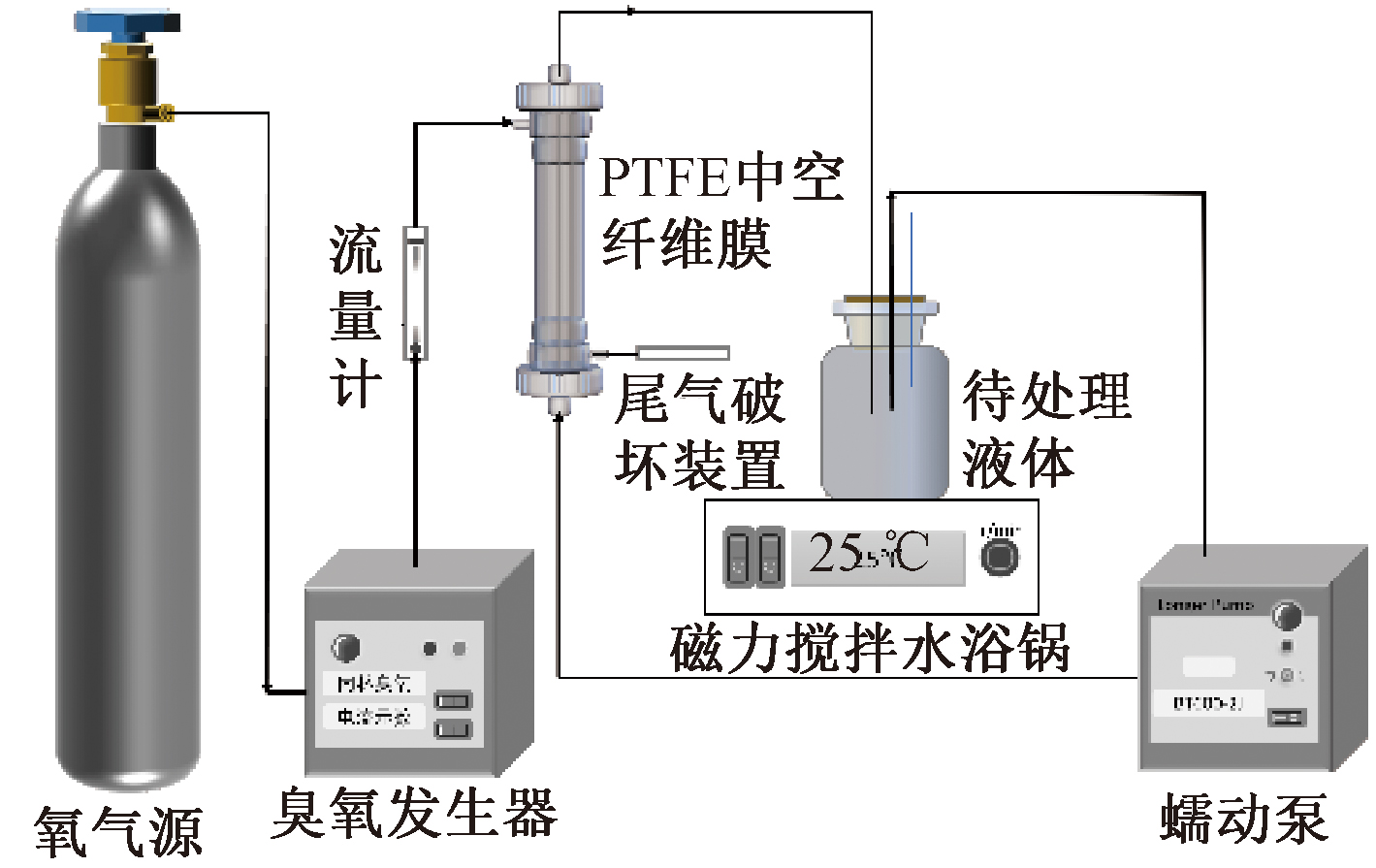
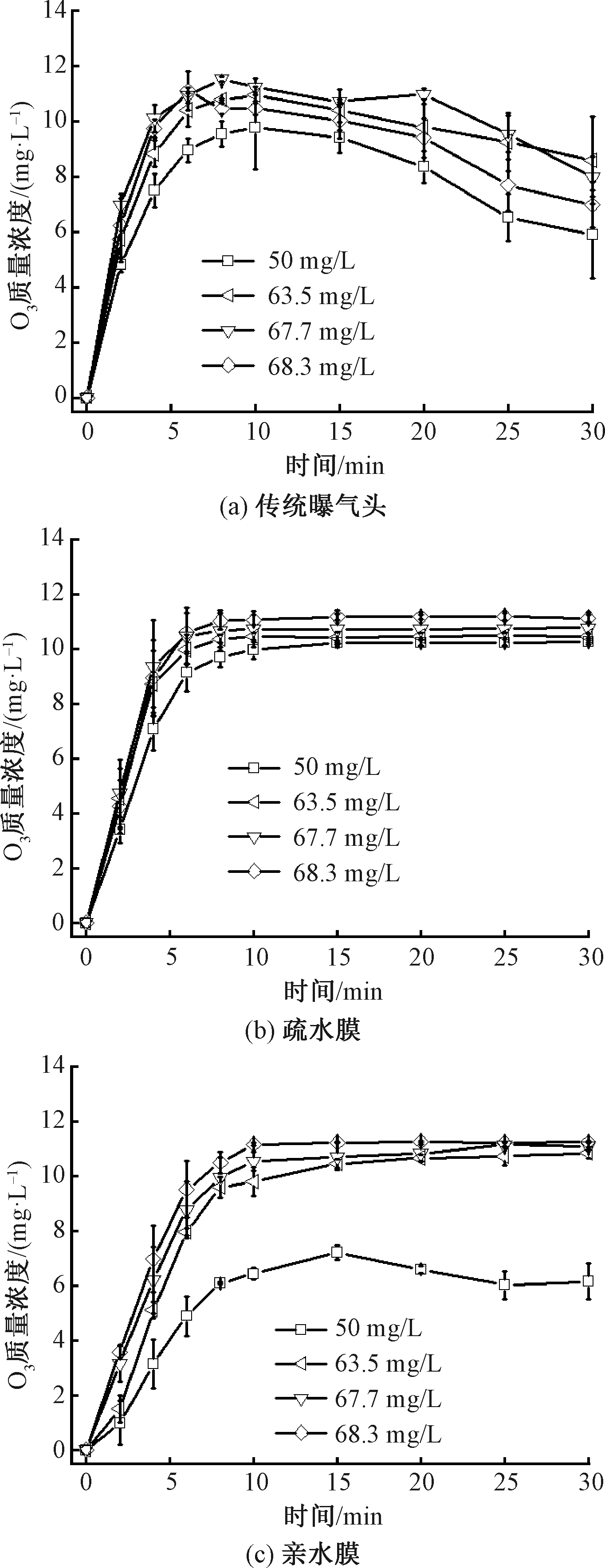
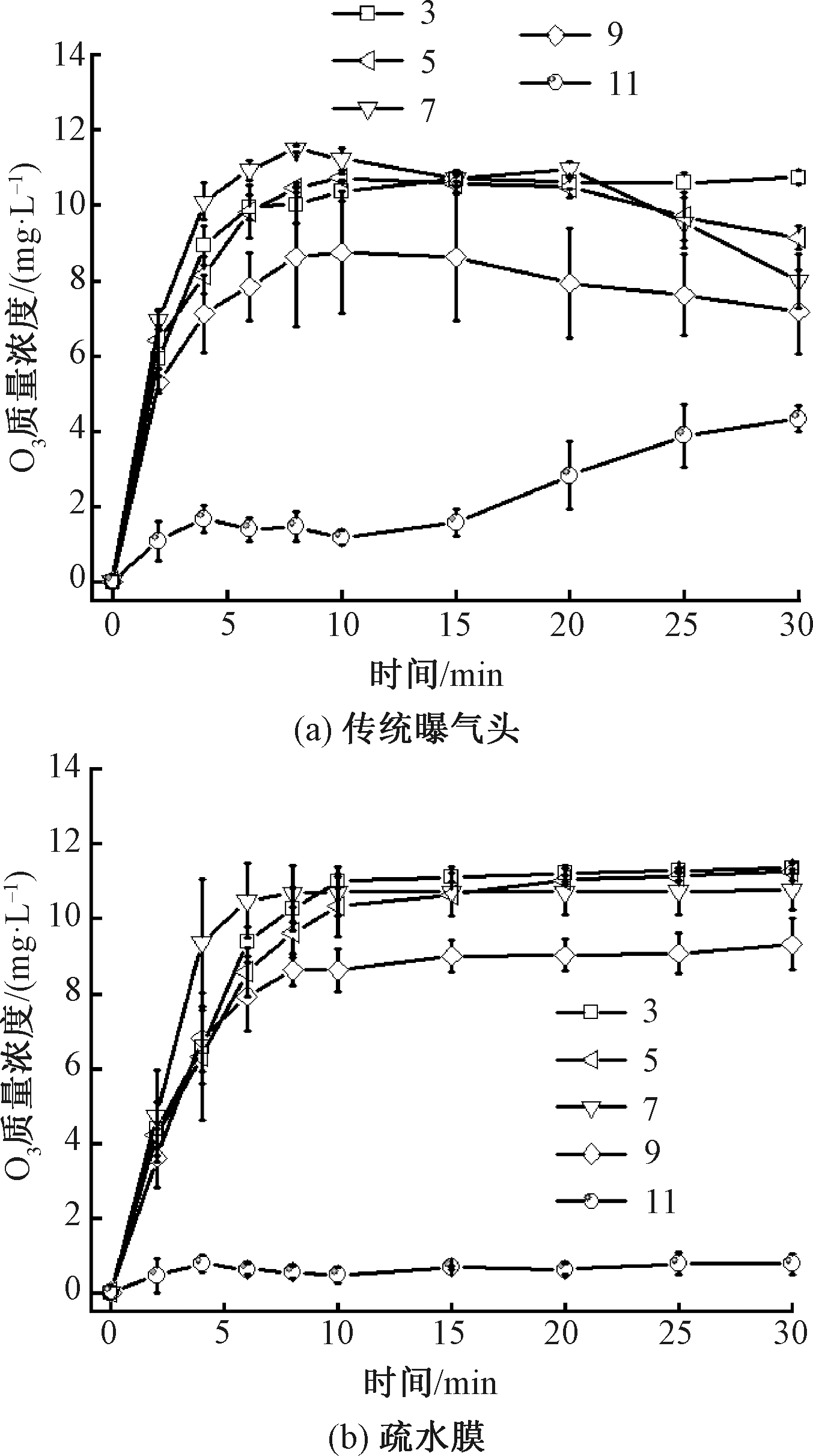
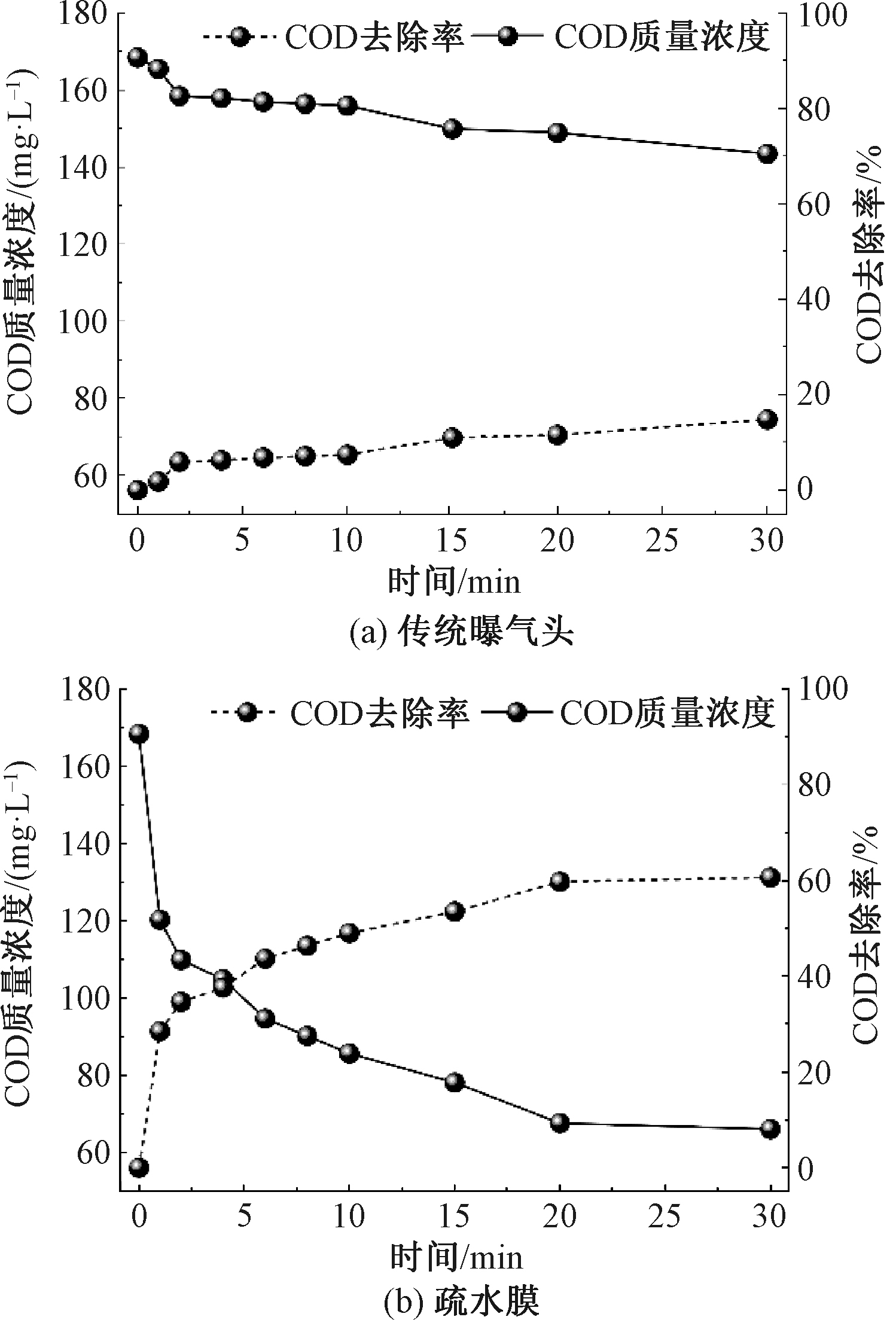
针对传统鼓泡曝气方式存在的臭氧(O3)传质效率低、利用率不足的瓶颈问题,采用聚四氟乙烯(PTFE)中空纤维膜构建膜接触反应器(MCR),实现O3气体无泡传质。系统对比分析了疏水膜、亲水膜及传统曝气3种O3传质方式的性能差异,考察了进水流量、进气流量、进气质量浓度及液相初始pH值等工艺参数对液相O3平衡质量浓度及表观传质系数的影响规律,并评估优化工艺条件对真实印染废水的深度处理效果。结果表明:疏水PTFE中空纤维膜在各种工艺条件下均表现出最优的O3传质性能。在疏水PTFE中空纤维膜MCR体系中,增大进水流量可减薄液膜边界层、提升传质系数,但会缩短接触时间、降低液相O3平衡质量浓度;最优进气流量为100 mL/min,且在进气质量浓度为67.7 mg/L时O3气体传质效果最佳;当溶液初始pH值为7时,传质推动力与O3稳定性达到最佳平衡。在进水流量为146.67 mL/min、进气流量为100 mL/min、进气质量浓度为67.7 mg/L、初始pH值为7的工艺条件下,疏水膜、亲水膜和传统曝气3种传质方式获得的最大表观传质系数分别为0.623、0.341和0.602 min-1。疏水膜对真实印染废水COD的去除率达60.7%、单位臭氧COD去除量为0.119 mg/mg,分别是传统曝气的4倍和3.8倍,展现出较好的印染废水处理应用潜力。
中图分类号:
| [1] |
ZHANG J, YANG L, WANG Z, et al. A highly permeable loose nanofiltration membrane prepared via layer assembled in-situ mineralization[J]. Journal of Membrane Science, 2019, 587: 117159.
doi: 10.1016/j.memsci.2019.05.083 |
| [2] | 唐政坤, 刘艳缤, 徐晨烨, 等. 面向减污降碳目标的纺织工业环境治理发展趋势[J]. 纺织学报, 2022, 43(1): 131-140. |
| TANG Zhengkun, LIU Yanbin, XU Chenye, et al. Trend of environmental governance in textile industry aiming at carbon neutrality and emission reduction[J]. Journal of Textile Research, 2022, 43(1): 131-140. | |
| [3] |
WANG J, CHEN H. Catalytic ozonation for water and wastewater treatment: recent advances and perspective[J]. Science of The Total Environment, 2020, 704: 135249.
doi: 10.1016/j.scitotenv.2019.135249 |
| [4] |
YAN Y, FOTIDIS I A, FU D, et al. Can ozone mass transfer in water treatment be enhanced through independent pressurized ozonation?[J]. Journal of Environmental Chemical Engineering, 2024, 12(5): 113714.
doi: 10.1016/j.jece.2024.113714 |
| [5] |
汪文强, 高鹏贺, 季献华, 等. E-H2O2耦合O3深度处理苯胺和硝基苯废水研究[J]. 水处理技术, 2025, 51(5): 132-137, 142.
doi: 10.16796/j.cnki.1000-3770.2025.05.022 |
|
WANG Wenqiang, GAO Penghe, JI Xianhua, et al. Advanced treatment of aniline and nitrobenzene wastewater by E-H2O2 coupled O3[J]. Technology of Water Treatment, 2025, 51(5): 132-137, 142.
doi: 10.16796/j.cnki.1000-3770.2025.05.022 |
|
| [6] |
秦月娇, 焦纬洲, 杨鹏飞, 等. 强化臭氧传质的研究进展[J]. 过程工程学报, 2017, 17(2): 420-426.
doi: 10.12034/j.issn.1009-606X.216292 |
|
QIN Yuejiao, JIAO Weizhou, YANG Pengfei, et al. Research progress of enhancement of ozone mass transfer[J]. The Chinese Journal of Process Engineering, 2017, 17(2): 420-426.
doi: 10.12034/j.issn.1009-606X.216292 |
|
| [7] |
SUN D, WANG Y, LIU B, et al. Study on the efficiency and mechanism of ozone micro-nano bubble system degradation of Geosmin[J]. Desalination and Water Treatment, 2025, 321: 100922.
doi: 10.1016/j.dwt.2024.100922 |
| [8] |
DUAN Y, ZHAO D, LIU Z, et al. Hydrogen peroxide enhancing the process of MnO2-modified ceramic membrane catalyzing micro-nano bubble[J]. Separation and Purification Technology, 2025, 353: 128320.
doi: 10.1016/j.seppur.2024.128320 |
| [9] |
CHEN X, WANG X, LI Y, et al. Bubbleless membrane contactor for enhanced ozone mass transfer and ozonation for water purification[J]. Separation and Purification Technology, 2024, 349: 127823.
doi: 10.1016/j.seppur.2024.127823 |
| [10] |
YIN Y, LIU Q, XIAO M, et al. Enhancing CO2 capture performance by changing membrane fiber arrangement in multi-fiber membrane contactors[J]. Journal of Environmental Chemical Engineering, 2025, 13(2): 115562.
doi: 10.1016/j.jece.2025.115562 |
| [11] |
SHIN J, MERLE T, COCKX A, et al. Ozonation of wastewater effluent by the MEMBRO3X contactor: Micropollutants abatement and bromate mitigation[J]. Water Research, 2025, 283: 123853.
doi: 10.1016/j.watres.2025.123853 |
| [12] | 刘劲扬, 李成才, 朱海霖, 等. 非对称结构聚四氟乙烯中空管式纤维膜的制备及油水分离性能[J]. 纺织学报, 2025, 46(12): 11-18. |
| LIU Jinyang, LI Chengcai, ZHU Hailin, et al. Preparation and oil-water separation performance of asymmetric structure polytetrafluoroethene empty tube fiber membrane[J]. Journal of Textile Research, 2025, 46(12): 11-18. | |
| [13] | 李成才, 朱登辉, 朱海霖, 等. 聚四氟乙烯膜的超疏水改性及应用研究进展[J]. 纺织学报, 2024, 45(8): 65-71. |
| LI Chengcai, ZHU Denghui, ZHU Hailin, et al. Research progress of superhydrophobic modification and application of polytetrafluoroethylene membrane[J]. Journal of Textile Research, 2024, 45(8): 65-71. | |
| [14] |
BEIN E, ZUCKER I, DREWES J E, et al. Ozone membrane contactors for water and wastewater treatment: a critical review on materials selection, mass transfer and process design[J]. Chemical Engineering Journal, 2021, 413: 127393.
doi: 10.1016/j.cej.2020.127393 |
| [15] |
ATCHARIYAWUT S, PHATTARANAWIK J, LEIKNES T, et al. Application of ozonation membrane contacting system for dye wastewater treatment[J]. Separation and Purification Technology, 2009, 66(1): 153-158.
doi: 10.1016/j.seppur.2008.11.011 |
| [16] | 卢凤华, 陈滢, 刘敏, 等. 靛蓝二磺酸钠分光光度法和碘滴定法测定水中臭氧含量适用条件的比较[J]. 理化检验(化学分册), 2014, 50(6): 778-780. |
| LU Fenghua, CHEN Ying, LIU Min, et al. Comparison of applicability of indigo disulfonate spectrophotometry and iodometric titration for determination of ozone content in water[J]. Physical Testing and Chemical Analysis (Chemical Analysis Section), 2014, 50(6): 778-780. | |
| [17] |
SCHMITT A, MENDRET J, BROSILLON S. Evaluation of an ozone diffusion process using a hollow fiber membrane contactor[J]. Chemical Engineering Research and Design, 2022, 177: 291-303.
doi: 10.1016/j.cherd.2021.11.002 |
| [18] |
姚福春, 毕莹莹, 刘超, 等. 膜传质强化催化臭氧氧化技术的研究与机理分析[J]. 现代化工, 2024, 44(9): 86-91.
doi: 10.16606/j.cnki.issn0253-4320.2024.09.017 |
|
YAO Fuchun, BI Yingying, LIU Chao, et al. Research and mechanism analysis on membrane mass transfer enhanced catalytic ozonation technology[J]. Modern Chemical Industry, 2024, 44(9): 86-91.
doi: 10.16606/j.cnki.issn0253-4320.2024.09.017 |
|
| [19] |
PRADA-VÁSQUEZ M A, PITUCO M M, CAIXETA M P, et al. Ozonation using a stainless-steel membrane contactor: gas-liquid mass transfer and pharmaceuticals removal from secondary-treated municipal wastewater[J]. Chemosphere, 2024, 349: 140888.
doi: 10.1016/j.chemosphere.2023.140888 |
| [20] |
HERRMANN S, PADLIGUR M C, BIENECK C J, et al. Modeling of tubular membrane contactors for ozonation of water reveals reduced bromate formation with static mixers[J]. Chemical Engineering Science, 2024, 291: 119924.
doi: 10.1016/j.ces.2024.119924 |
| [21] |
钱媛媛, 王永杰, 杨雪晶. 臭氧相关水处理工艺及其传质特征研究进展[J]. 化工进展, 2021, 40(S1):411-425.
doi: 10.16085/j.issn.1000-6613.2021-0416 |
|
QIAN Yuanyuan, WANG Yongjie, YANG Xuejing. Application of ozone for water treatment and implication of mass transfer characteristics[J]. Chemical Industry and Engineering Progress, 2021, 40(S1): 411-425.
doi: 10.16085/j.issn.1000-6613.2021-0416 |
| [1] | 沈忱思, 侯传鑫, 苏雄, 李方. 高级氧化预处理阻燃整理有机磷废水效能评价[J]. 纺织学报, 2026, 47(07): 1-9. |
| [2] | 张昊, 李筱轩, 王纯萍, 胡艳丽, 王金玉. 改性淀粉基絮凝剂的制备及其对印染废水的絮凝性能[J]. 纺织学报, 2026, 47(07): 19-26. |
| [3] | 王鑫杨, 乔曦冉, 徐成书, 王慧杰, 任燕, 韩彬, 徐子铮. 苝二酰亚胺/氧化石墨烯光催化剂的制备及其对活性染料的降解性能[J]. 纺织学报, 2026, 47(07): 27-33. |
| [4] | 胡浙人, 俞乐, 金楠洋, 罗金明, 孔培振, 余德游. 全氟及多氟烷基物质吸附技术及其处理印染废水研究进展[J]. 纺织学报, 2026, 47(05): 273-282. |
| [5] | 程尔骕, 王豪杰, 刘宇清, 孟凯, 赵荟菁. 气流辅助静电纺丝聚四氟乙烯血管支架覆膜的抗凝血和促内皮化研究[J]. 纺织学报, 2026, 47(05): 45-55. |
| [6] | 郭正, 张贺凯, 宋云飞, 朱怡雷, 李佳颍, 郑佳悦, 王明环. 聚苯乙烯/ZIF-67纳米纤维的制备及其高级氧化降解应用[J]. 纺织学报, 2026, 47(04): 52-60. |
| [7] | 李成才, 朱登辉, 殷向, 朱海霖, 张华鹏, 刘国金, 郭玉海, 刘炳荣. 内密外疏微孔结构膨体聚四氟乙烯管式纤维膜的制备及人工血管应用[J]. 纺织学报, 2026, 47(03): 1-8. |
| [8] | 王思思, 茅淑英, 方传杰, 李成才, 朱海霖, 刘国金. 耐非极性溶剂溶胀的聚四氟乙烯/聚全氟乙丙烯复合纤维膜制备及其性能调控[J]. 纺织学报, 2026, 47(02): 1-9. |
| [9] | 岳献阳, 王少博, 黄鑫, 王艳芝, 李冲冲, 张晓晓. 黄麻织物基磁性含氮多孔碳对Cr(VI)的吸附性能[J]. 纺织学报, 2026, 47(02): 255-263. |
| [10] | 凌磊, 陈凯, 高俊, 武丁胜, 汪邓兵, 张春, 凤权. 聚丙烯腈/共价有机框架复合纳米纤维膜的制备及其对Cr(Ⅵ)的吸附性能[J]. 纺织学报, 2026, 47(01): 54-62. |
| [11] | 刘劲扬, 李成才, 朱海霖, 郭玉海, 姜学梁. 非对称结构聚四氟乙烯中空管式纤维膜的制备及油水分离性能[J]. 纺织学报, 2025, 46(12): 11-18. |
| [12] | 谢围围, 朱庆鹏, 宋娇娇, 陈志明. 磁性固定化漆酶的制备及其对染料的高效降解[J]. 纺织学报, 2025, 46(12): 163-170. |
| [13] | 季巧, 于清源, 周爱晖, 马博谋, 徐进, 袁久刚. 细菌纤维素及其复合材料的应用研究进展[J]. 纺织学报, 2025, 46(12): 243-250. |
| [14] | 高俊, 凌磊, 陈缘, 武丁胜, 林韩蕾, 李振宇, 凤权. 氨基功能化聚丙烯腈纳米纤维膜的制备及其对Cr(Ⅵ)的吸附性能[J]. 纺织学报, 2025, 46(12): 57-65. |
| [15] | 姚晓军, 徐恩婷, 杨雪媛, 房磊, 包伟, 房宽峻. 聚乙烯吡咯烷酮对聚对苯二甲酸乙二醇酯中空纤维膜结构与性能的调控[J]. 纺织学报, 2025, 46(12): 66-73. |
|
||
 京公网安备11010502044800号