Journal of Textile Research ›› 2024, Vol. 45 ›› Issue (11): 73-79.doi: 10.13475/j.fzxb.20230903201

• Textile Engineering • Previous Articles     Next Articles

Effect of heat treatment on mechanical property of core-spun yarn from low melting point polyester filament made by air-jet vortex spinning

MIAO Lulu1,2, MENG Xiaoyi2, DONG Zhengmei2,3, PENG Qian2, HE Linwei3,4, ZOU Zhuanyong1,2()   

  1. 1. Key Laboratory of Clean Dyeing and Finishing Technology of Zhejiang Province, Shaoxing University, Shaoxing, Zhejiang 312000, China
    2. Shaoxing Key Laboratory of High Performance Fibers & Products, Shaoxing University, Shaoxing, Zhejiang 312000, China
    3. Shaoxing Guozhou Textile New Material Co., Ltd., Shaoxing, Zhejiang 312000, China
    4. Shaoxing Guozhou Textile Finishing Co., Ltd., Shaoxing, Zhejiang 312030, China
  • Received:2023-09-14 Revised:2024-05-21 Online:2024-11-15 Published:2024-12-30
  • Contact: ZOU Zhuanyong E-mail:zouzhy@usx.edu.cn

Abstract:

Objective Low melting point polyester fiber can be used as a hot-melt adhesive material. The strength of air-jet vortex spinning core-spun yarn is closely related to the mechanical properties of core-filament. We replace the core-filament of the air-jet vortex spinning core-spun yarn with a low melting point filament. By studying the appropriate heat treatment process, it can not only help the core-filament to maintain a certain mechanical properties, but also use the effect of thermal bonding enhancement of low melting point fibers to further improve the strength of air-jet vortex spinning core-spun yarn.

Method The core-spun yarn with low melting point polyester filament wrapped by polyester staple fiber was produced on MVS No.870 spinning machine, and the yarn was subjected to non-contact heat treatment on the XPLORE flat traction heating device. The heat treatment process was designed based on Box-Behnken Design (BBD) response surface. The effects of heat treatment temperature, heat treatment speed and draft multiple on the breaking strength, breaking elongation and breaking work of core-spun yarn were investigated by statistical analysis method. At the same time, the response value was optimized to obtain the best heat treatment scheme for the preparation of high strength core-spun yarn.

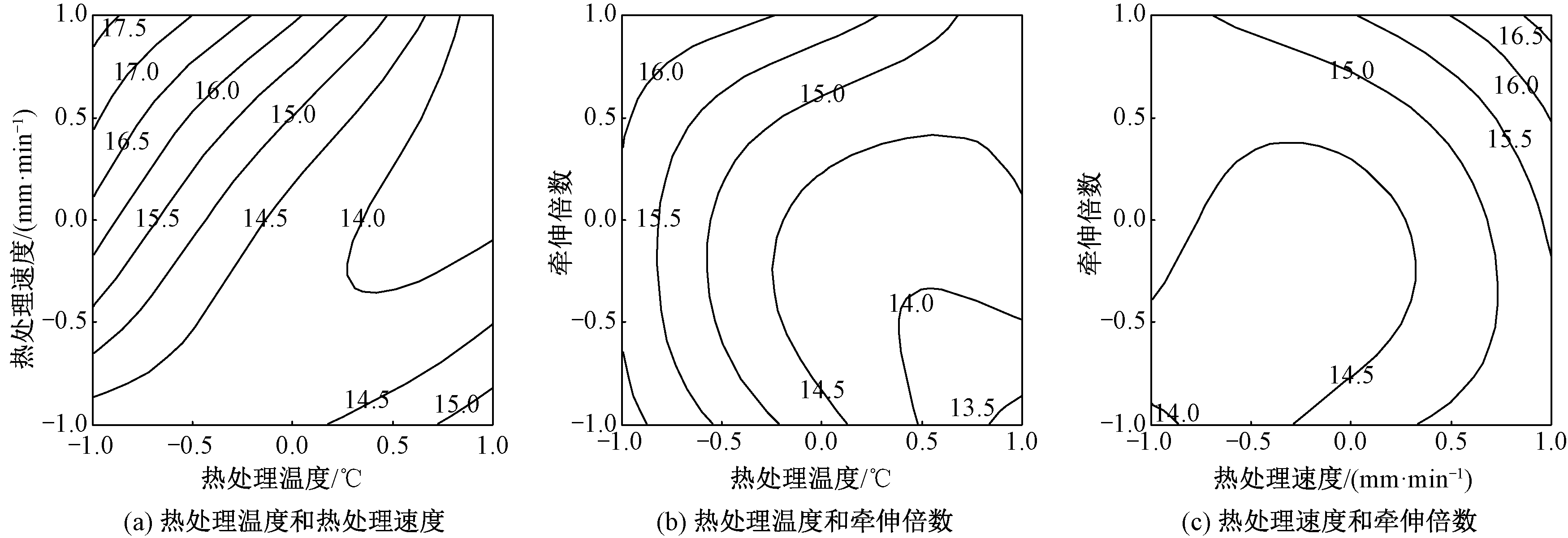
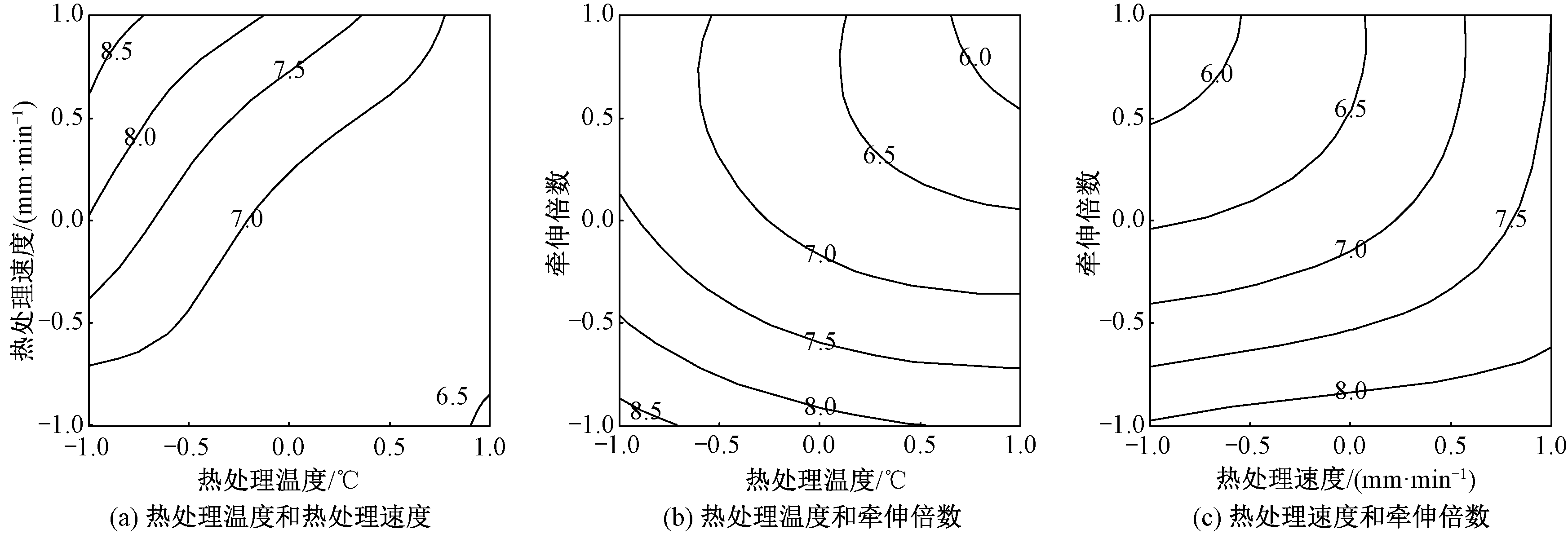
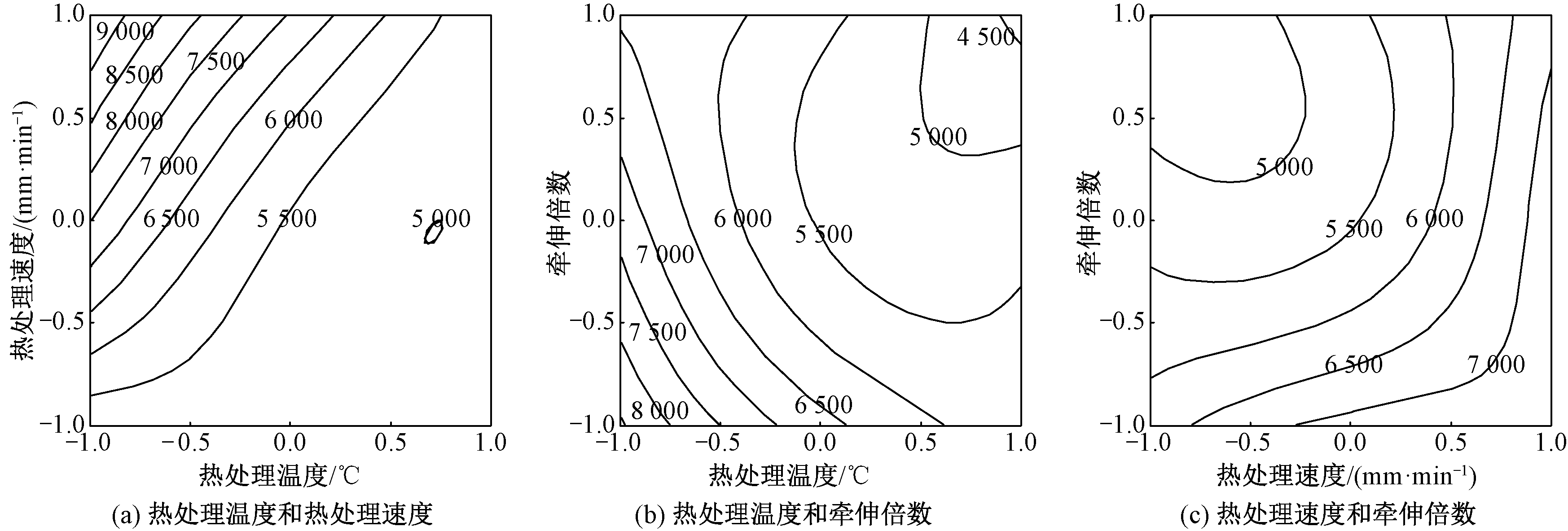
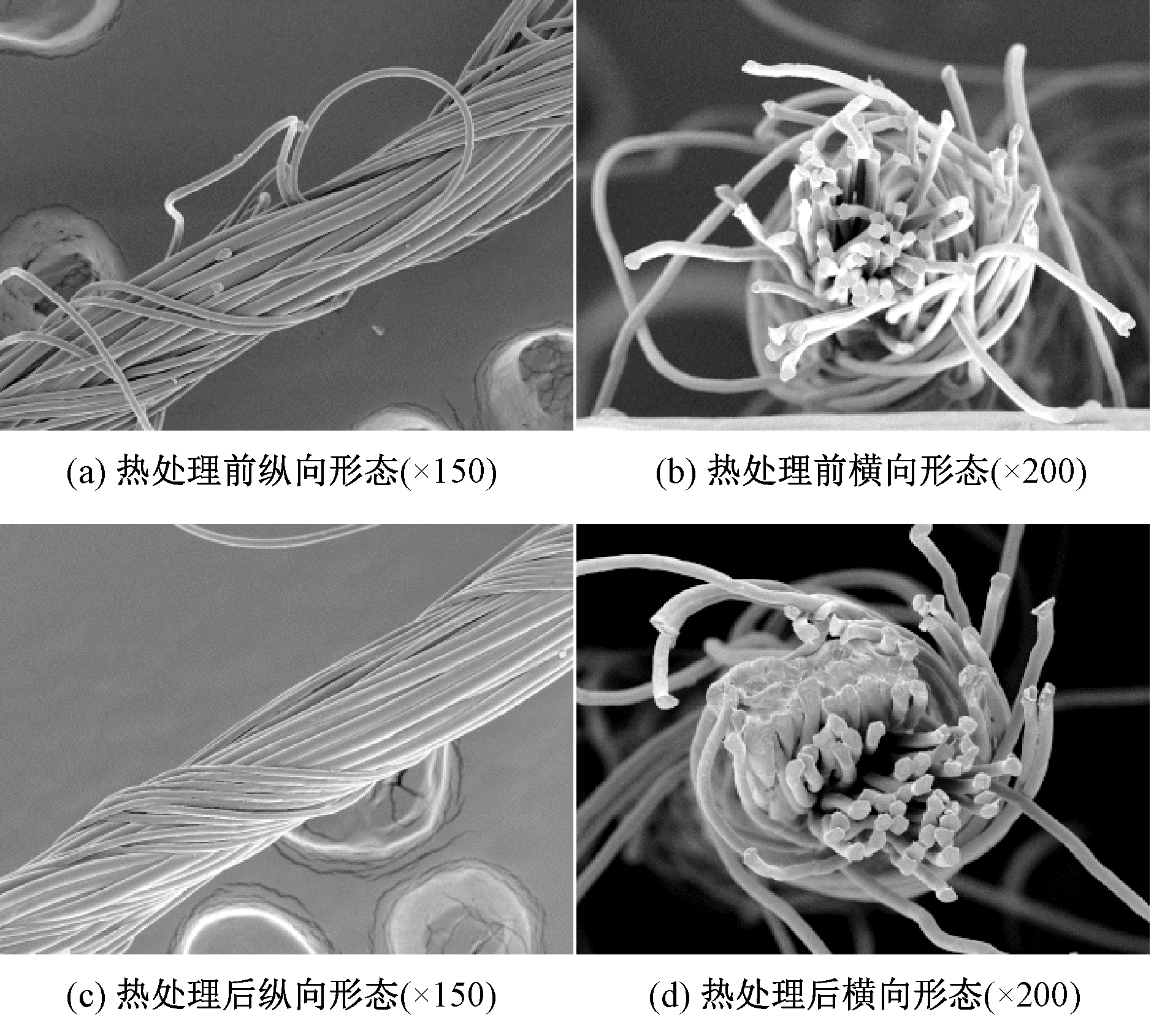
Results The breaking strength of the core-spun yarn was significantly affected by heat treatment temperature, heat treatment speed, draft multiple, as well as the interaction term of heat treatment temperature and heat treatment speed. The breaking elongation was significantly affected by heat treatment temperature, heat treatment speed, draft multiple, draft multiple secondary term, heat treatment temperature and heat treatment speed interaction term, and heat treatment speed and draft multiple interaction term. The breaking work was significantly affected by heat treatment temperature, heat treatment speed, draft multiple, heat treatment temperature secondary term, and heat treatment temperature and heat treatment speed interaction term. By analyzing contour plots of the relationship between response value and heat treatment process, it was found that under the same draft multiple, the breaking strength of the core-spun yarn showed an monotonous increase with the heat treatment speed increasing and the heat treatment temperature decreasing. The higher heat treatment temperature led to greater increase in the breaking strength of the core-spun yarn. In addition, at a stable draft multiple, when the heat treatment temperature was lower and the heat treatment speed was higher, the core-spun yarn breaking elongation was higher, and breaking work was higher. When the heat treatment temperature was constant, the breaking strength of the core-spun yarn would increase and the breaking elongation and the breaking work would decrease with the increase of the draft multiple. Combining the results of contour plots and response optimizer processing, the optimal heat treatment process parameters were obtained, with heat treatment temperature being 130 ℃, draft multiple 1.00, and heat treatment speed is 9 000 mm/min. After the heat treatment of the raw yarns, the yarn properties were improved, the longitudinal morphology of the core yarns became more compact, and some of the single fibers were bonded to each other in the cross-section. After the optimal heat treatment process, the yarn properties were improved, the longitudinal morphology of the core-spun yarn became more compact, and there was adhesion between some single fibers in the cross section.

Conclusion Air-jet vortex spinning was to prepare low melting point filament core-spun yarn. Through heat treatment process, the core-filament was partially melted, effectively limiting the slip of fibers in air-jet vortex spinning, and the cohesion between fibers can be improved. The breaking strength, breaking elongation and breaking work of the yarn are closely related to the setting of heat treatment temperature, heat treatment speed and draft multiple. In general, with the decrease of heat treatment temperature and draft multiple, and the increase of heat treatment speed, the breaking strength and breaking elongation of core-spun yarn increase, so the breaking work also increases. Using the optimized heat treatment process, the core-spun yarn breaking strength is increased by 7.64%, the breaking elongation is increased by 9.34%, and the breaking work is increased by 13.78%.

Key words: air-jet vortex spinning core-spun yarn, low melting point filament, heat treatment process, mechanical properties of yarn, spinning technology

CLC Number: 

  • TS104.2

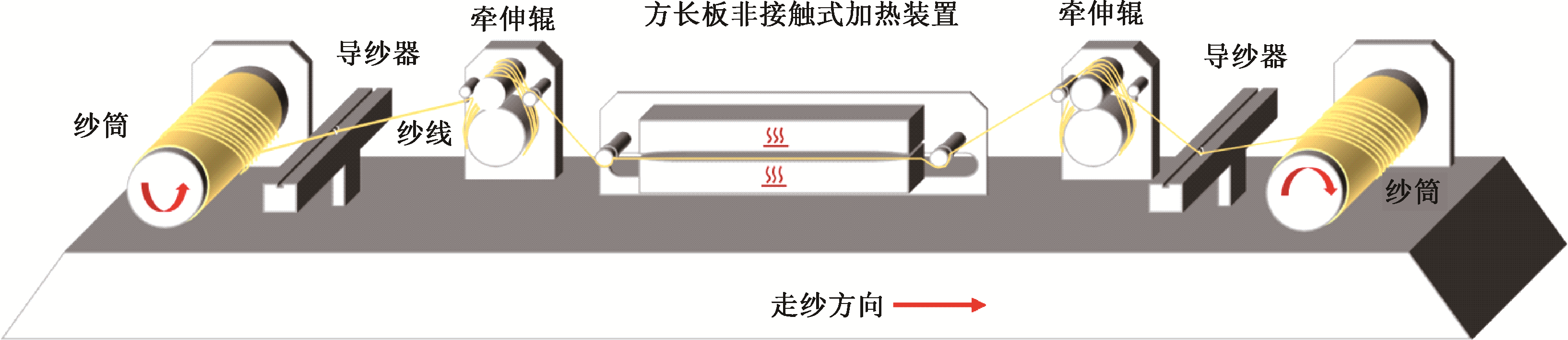
Fig.1

Schematic diagram of heat treatment device"

Tab.1

Factor-level table of heat treatment technology"

水平 热处理
温度A/℃
热处理速度
B/(mm·min-1)
牵伸
倍数C
-1 130 1 000 1
0 180 5 000 1.03
1 230 9 000 1.06

Tab.2

Heat treatment process experiment and yarn mechanical properties"

热处理
序号
A B C 断裂强度
X/(cN·tex-1)
断裂伸长率
Y/%
断裂功
Z/(cN·mm)
1 -1 -1 0 14.17 6.49 5 124.28
2 1 -1 0 15.33 6.42 5 465.42
3 -1 1 0 17.65 8.68 9 484.62
4 1 1 0 13.53 6.71 5 119.64
5 -1 0 -1 16.19 8.68 8 547.99
6 1 0 -1 13.28 7.93 5 768.69
7 -1 0 1 16.42 7.25 6 450.69
8 1 0 1 14.53 5.62 4 336.83
9 0 -1 -1 13.88 8.05 6 227.47
10 0 1 -1 15.49 8.26 7 112.08
11 0 -1 1 14.89 5.72 4 493.73
12 0 1 1 16.70 7.5 6 801.16
13 0 0 0 15.00 7.02 5 712.38
14 0 0 0 13.95 6.91 5 431.18
15 0 0 0 14.02 6.63 5 225.67

Tab.3

Regression analysis of response surface"

方差
来源
断裂强度X 断裂伸长率Y 断裂功Z
F P F P F P
A 28.78 0.002 42.82 0.000 87.11 0.000
B 12.43 0.012 43.79 0.000 56.90 0.000
C 6.54 0.043 102.24 0.000 34.04 0.001
A2 1.79 0.230 7.45 0.034
B2 3.40 0.115 4.25 0.085
C2 2.56 0.161 10.28 0.013 3.74 0.101
AB 26.65 0.002 15.82 0.004 48.53 0.000
BC 10.80 0.011 4.44 0.080
回归模型 11.60 0.002 37.62 0.000 30.56 0.000
失拟值 0.64 0.686 1.55 0.443 2.37 0.318

Fig.2

Contour plots of relationship between core-spun yarn breaking strength response value and heat treatment process. (a)Heat treatment temperature and speed; (b) Heat treatment temperature and draft multiple; (c) Heat treatment speed and draft multiple"

Fig.3

Contour plots of relationship between core-spun yarn breaking elongation response value and heat treatment process. (a) Heat treatment temperature and speed; (b) Heat treatment temperature and draft multiple; (c) Heat treatment speed and draft multiple"

Fig.4

Contour plots of relationship between core-spun yarn breaking work response value and heat treatment process. (a) Heat treatment temperature and speed; (b) Heat treatment temperature and draft multiple; (c) Heat treatment speed and draft multiple"

Tab.4

Response value optimization parameters"

类别 断裂强度
X/(cN·tex-1)
断裂伸长率
Y/%
断裂功
Z/(cN·mm)
范围 >13.28 >5.62 >4 336.83
目标 17.65 8.68 9 484.62
权重 0.5 0.5 1

Fig.5

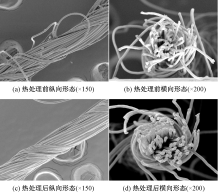
Longitudinal and transverse morphology of core-spun yarns before and after heat treatment. (a) Longitudinal morphology before heat treatment (×150); (b) Transverse morphology before heat treatment (×200); (c) Longitudinal morphology after heat treatment (×150); (d) Transverse morphology after heat treatment (×200)"

Tab.5

Heat treatment process optimization and verification"

A B C 断裂强度
X/(cN·tex-1)
断裂伸长率
Y/%
断裂功
Z/(cN·mm)
预测 实际 预测 实际 预测 实际
-1 1 -1 18.06 16.91 9.42 9.25 10 338 8 220.82

Tab.6

Independent sample test results"

性能指标 Levene方差齐次检验
(H0:σ1=σ2)
均值等同性t检验
(H0:μ1=μ2)
F P T P
断裂强度X 0.423 0.516 4.981 0.000
断裂伸长率Y 0.881 0.350 6.692 0.000
断裂功Z 0.152 0.697 5.192 0.000
[1] UYANIK S, BAYKAL P D. Effects of fiber types and blend ratios on Murata vortex yarn properties[J]. The Journal of the Textile Institute, 2017, 109(8):1099-1109.
[2] 刘俊芳, 彭珺, 赵东焕, 等. 中空涤纶莫代尔亚麻混纺喷气涡流纱的纺制[J]. 棉纺织技术, 2016, 44(9): 67-70.
LIU Junfang, PENG Jun, ZHAO Donghuan, et al. Spinning of hollow polyester modal flax blended air-jet vortex yarn[J]. Cotton Textile Technology, 2016, 44(9): 67-70.
[3] 戴俊, 高卫东, 傅佳佳, 等. 喷气涡流纺纺制纯棉细号纱的实践[J]. 棉纺织技术, 2019, 47(7): 61-64.
DAI Jun, GAO Weidong, FU Jiajia, et al. Spinning pure cotton air-jet vortex fine yarn[J]. Cotton Textile Technology, 2019, 47(7): 61-64.
[4] HAN C, CHENG L, GAO W, et al. Numerical simulation of the fiber trajectories in vortex spinning under different process parameters based on the finite element model[J]. Textile Research Journal, 2018, 89(13): 2626-2636.
[5] BHATTI M R A, TAUSIF M, MIR M A, et al. Effect of key process variables on mechanical properties of blended vortex spun yarns[J]. The Journal of the Textile Institute, 2018, 110(6): 932-940.
[6] 陈彩红, 陈洪立. 喷气涡流纺喷孔数量对喷嘴内气流场的影响[J]. 轻工机械, 2017, 35(1): 64-66.
CHEN Caihong, CEHN Hongli. Influences of orifice number of air jet vortex spinning[J]. Light Industry Machinery, 2017, 35(1): 64-66.
[7] SHANG S, SUN N, YU C, et al. Optimization of nozzle structure parameters of vortex spinning[J]. Textile Research Journal, 2014, 85(9): 998-1006.
[8] 邹专勇, 俞建勇, 薛文良, 等. 喷气涡流纺喷嘴内部三维流场的数值研究[J]. 纺织学报, 2008, 9(2):86-90.
ZOU Zhuanyong, YU Jianyong, XUE Wenliang, et al. Numerical study of three-dimensional flow field inside the nozzle of air jet vortex spinning[J]. Journal of Textile Research, 2008, 9(2): 86-90.
[9] HAN C, CHENG L, GAO W, et al. Analysis of the influence of the guided needle structure on the vortex spinning process and yarn properties[J]. Textile Research Journal, 2019, 89(7): 1246-1267.
[10] 闫琳琳, 邹专勇, 卫国, 等. 基于螺旋导引槽空心锭子的喷气涡流纺加捻腔流场模拟[J]. 纺织学报, 2018, 39(9):139-145.
YAN Linlin, ZOU Zhuanyong, WEI Guo, et al. Numerical simulation for twisting chamber of air jet vortex spinning based on hollow spindle with spiral guiding grooves[J]. Journal of Textile Research, 2018, 39(9): 139-145.
[11] YAN L, ZOU Z, CHENG L, et al. Numerical simulation of flow field in the twisting chamber of Murata vortex spinning based on the hollow spindle with different structures[J]. Textile Research Journal, 2019, 89(4): 645-656.
[12] 邹专勇, 缪璐璐, 董正梅, 等. 喷气涡流纺工艺对粘胶/涤纶包芯纱性能的影响[J]. 纺织学报, 2022, 43(8): 27-33.
ZOU Zhuanyong, MIAO Lulu, DONG Zhengmei, et al. Effect of air-jet vortex spinning process on properties of viscose/polyester core-spun yarns[J]. Journal of Textile Research, 2022, 43(8): 27-33.
[13] 韦炜, 汤清伦, 姚远, 等. 基于低熔点涤纶长丝的棉涤氨包芯纱开发[J]. 针织工业, 2019(11): 6-9.
WEI Wei, TANG Qinglun, YAO Yuan, et al. Development of core spun yarn using cotton,spandex and low-melting temperature polyester filament[J]. Knitting Industries, 2019(11): 6-19.
[14] 汤清伦, 韦炜, 姚远. 热处理对含低熔点涤纶长丝针织物性能的影响[J]. 针织工业, 2020(10): 20-24.
TANG Qinglun, WEI Wei, YAO Yuan. Influence of heat treatment on properties of knitted fabrics with low melting point polyester filament[J]. Knitting Industries, 2020(10): 20-24.
[15] 林燕燕, 邹专勇, 陈玉香, 等. 喷气涡流纺纱线热黏合增强工艺[J]. 纺织学报, 2019, 40(2): 58-62.
LIN Yanyan, ZOU Zhuanyong, CHEN Yuxiang, et al. Hot adhesion reinforcement technology of jet vortex spinning yarn[J]. Journal of Textile Research, 2019, 40(2): 58-62.
[16] 陈玉香, 虞美雅, 董正梅, 等. 喷气涡流纺纱线热粘合增强工艺优化与机制[J]. 纺织学报, 2020, 41(11): 48-52.
doi: 10.13475/j.fzxb.20200400805
CHEN Yuxiang, YU Meiya, DONG Zhengmei, et al. Analyzes on the mechanism and optimization of the enhanced process based on thermal adhesion for air jet vortex spun yarn[J]. Journal of Textile Research, 2020, 41(11): 48-52.
doi: 10.13475/j.fzxb.20200400805
[1] ZHANG Dianping, WANG Hao, LIN Wenfeng, WANG Zhenqiu. Simulation and design of multi-nozzle spinning device [J]. Journal of Textile Research, 2024, 45(10): 200-207.
[2] LI Wenya, ZHOU Jian, LIAO Tanqian, DONG Zhenzhen. Structural control and spinning technology of highly wrapped core-spun yarn with thin sheath [J]. Journal of Textile Research, 2024, 45(06): 46-52.
[3] FENG Ying, YU Hanzhe, ZHANG Hong, LI Kexin, MA Biao, DONG Xin, ZHANG Jianwei. Review on preparation of electrospun chitosan-based nanofibers and their application in water treatment [J]. Journal of Textile Research, 2024, 45(05): 218-227.
[4] GUAN Tuxiang, WU Jian, BAO Ningzhong. Research progress in graphene fiber-based flexible supercapacitors prepared by microfluidic spinning [J]. Journal of Textile Research, 2023, 44(12): 205-215.
[5] LI Long, ZHANG Xian, WU Lei. Research progress in preparation and application of conductive yarn materials [J]. Journal of Textile Research, 2023, 44(07): 214-221.
[6] CHEN Kang, CHEN Gaofeng, WANG Qun, WANG Gang, ZHANG Yumei, WANG Huaping. Influence of heat-treatment tension in post-processing on structural properties of high modulus low shrinkage industrial polyester fibers [J]. Journal of Textile Research, 2022, 43(10): 10-15.
[7] XIA Zhigang, XU Ao, WAN Youshun, WEI Jiang, ZHANG Huixia, TANG Jiandong, ZHENG Minbo, GUO Qinsheng, DING Cailing, YANG Shengming, XU Weilin. Analysis of new five-element-integration spinning technology based on human-machine-material-method-environment for carbon neutralization [J]. Journal of Textile Research, 2022, 43(01): 58-66.
[8] SUN Chaoxu, LIU Xiucai. Research progress on applications of bio-based polyamide 56 fibers in textile fields [J]. Journal of Textile Research, 2021, 42(04): 26-32.
[9] WEI Yanhong, XIE Chunping, LIU Xinjin, SU Xuzhong, YIN Gaowei. Drafting mechanism and application of spun yarn produced by large diameter soft rubber-covered roll [J]. Journal of Textile Research, 2019, 40(10): 62-67.
[10] . Microfluidic spinning technology for multifunctional nanofibers and application and research progress thereof [J]. Journal of Textile Research, 2018, 39(12): 158-165.
[11] . Development of stainless steel fiber/cotton composite yarn and its performances [J]. JOURNAL OF TEXTILE RESEARCH, 2014, 35(7): 36-0.
[12] . Industrialized green spinning technology and application of pure chitosan fibers [J]. JOURNAL OF TEXTILE RESEARCH, 2014, 35(2): 157-0.
[13] HUANG Lixin;ZHU Chunxiang. Solospun technology and its product properties [J]. JOURNAL OF TEXTILE RESEARCH, 2007, 28(5): 35-37.
[14] XIE Chunping;YANG Lili;SU Xuzhong;FENG Jie. Analysis of compact effect and yarn structure of compact Siro spinning [J]. JOURNAL OF TEXTILE RESEARCH, 2007, 28(3): 9-12.
Viewed
Full text


Abstract

Cited

  Shared   
  Discussed   
No Suggested Reading articles found!