Journal of Textile Research ›› 2024, Vol. 45 ›› Issue (12): 18-24.doi: 10.13475/j.fzxb.20230905301

• Fiber Materials • Previous Articles     Next Articles

Preparation and properties of intelligent phase change thermoregulated polylactic acid fiber membrane

LIU Xia, WU Gaihong(), YAN Zihao, WANG Cailiu   

  1. College of Textile Engineering, Taiyuan University of Technology, Jinzhong, Shanxi 030600, China
  • Received:2023-09-21 Revised:2024-01-16 Online:2024-12-15 Published:2024-12-31
  • Contact: WU Gaihong E-mail:gaigai2003@126.com

Abstract:

Objective In developing textiles, wearable devices, aerospace and other fields, the core element of intelligent temperature regulation function is based on the use of phase change temperature regulating fibers. As the basic unit of intelligent temperature regulating textiles, phase change fibers mainly combine phase change materials with matrix materials through various spinning technologies. With the increasingly serious energy crisis and environmental protection problems, the development of thermal energy storage materials with environmental protection characteristics is very important for the sustainable development of energy. At present, there are limited studies on phase change fibers (membranes) based on biodegradable materials and phase change materials. Therefore, it is of great significance to develop biodegradable phase change fiber materials (membranes) with high latent heat.

Method Polyactic Acid (PLA) nanofiber membrane has good biodegradability, and as a phase change material, disodium hydrogen phosphate dodecahydrate (DHPD) is widely used in the field of thermal energy storage. Through adding phase change materials to PLA nanofibers, the fiber membrane can achieve temperature regulation function. In this study, DHPD was used as a phase change functional material, and PLA was used as a carrier for encapsulating phase change materials. The biodegradable fiber membrane with temperature regulating function was prepared by electrospinning technology. The morphology structure, thermal energy storage performance and thermal regulation performance of the temperature-regulated fiber membrane were analyzed. In addition, the thermal cycle performance, wettability and water absorption performance of the temperature-regulated fiber membrane were evaluated.

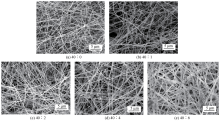
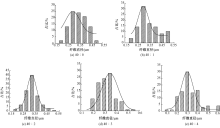
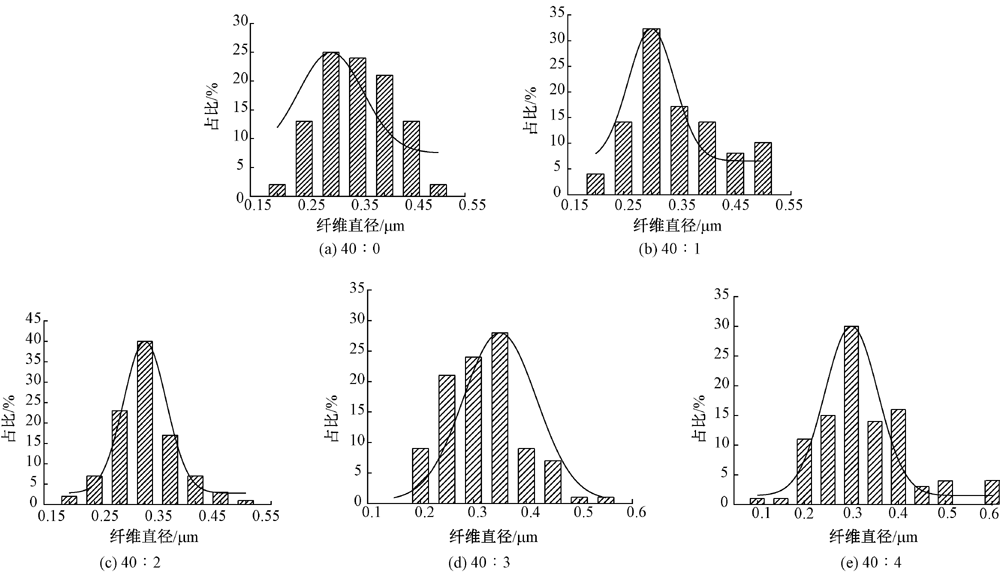
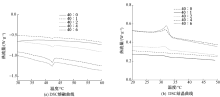
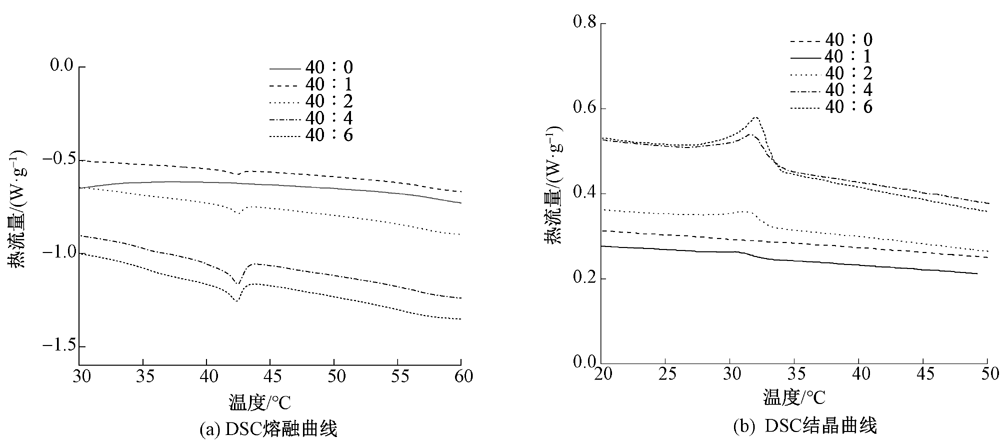
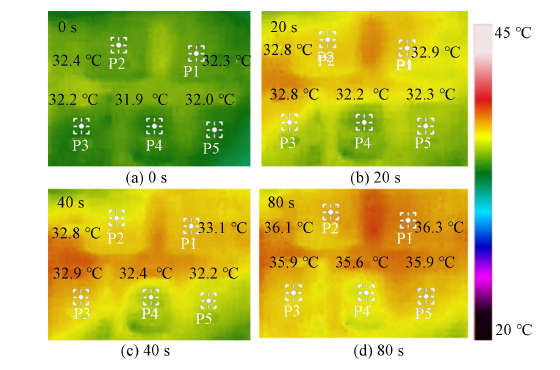
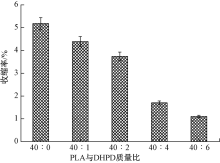
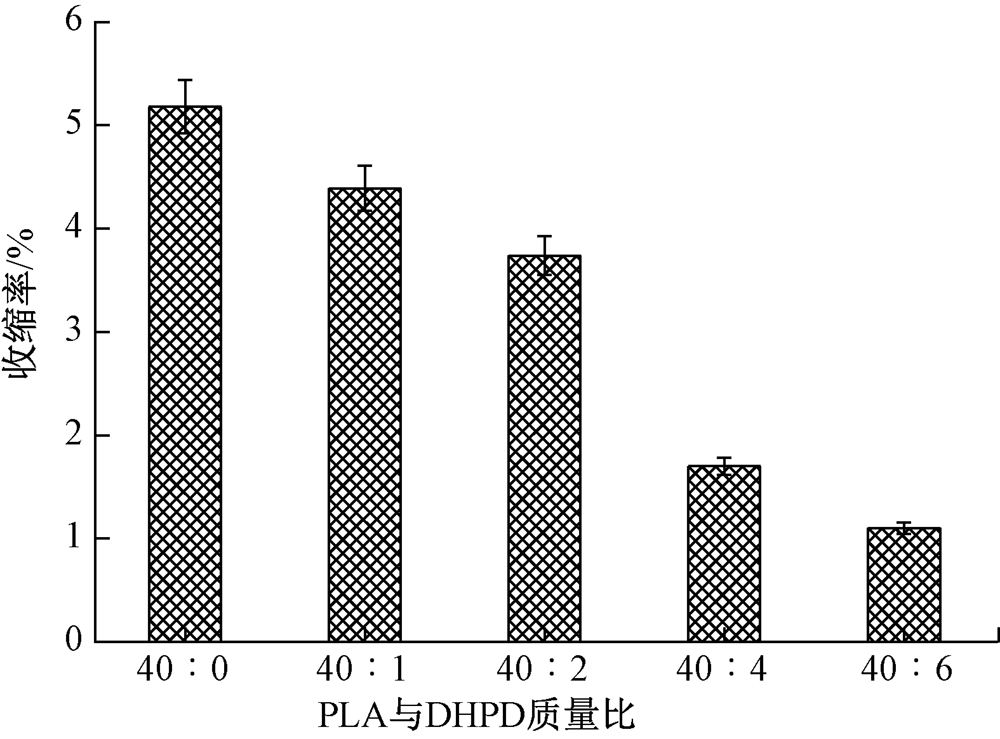
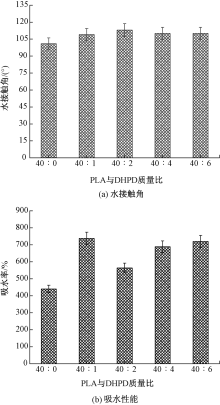
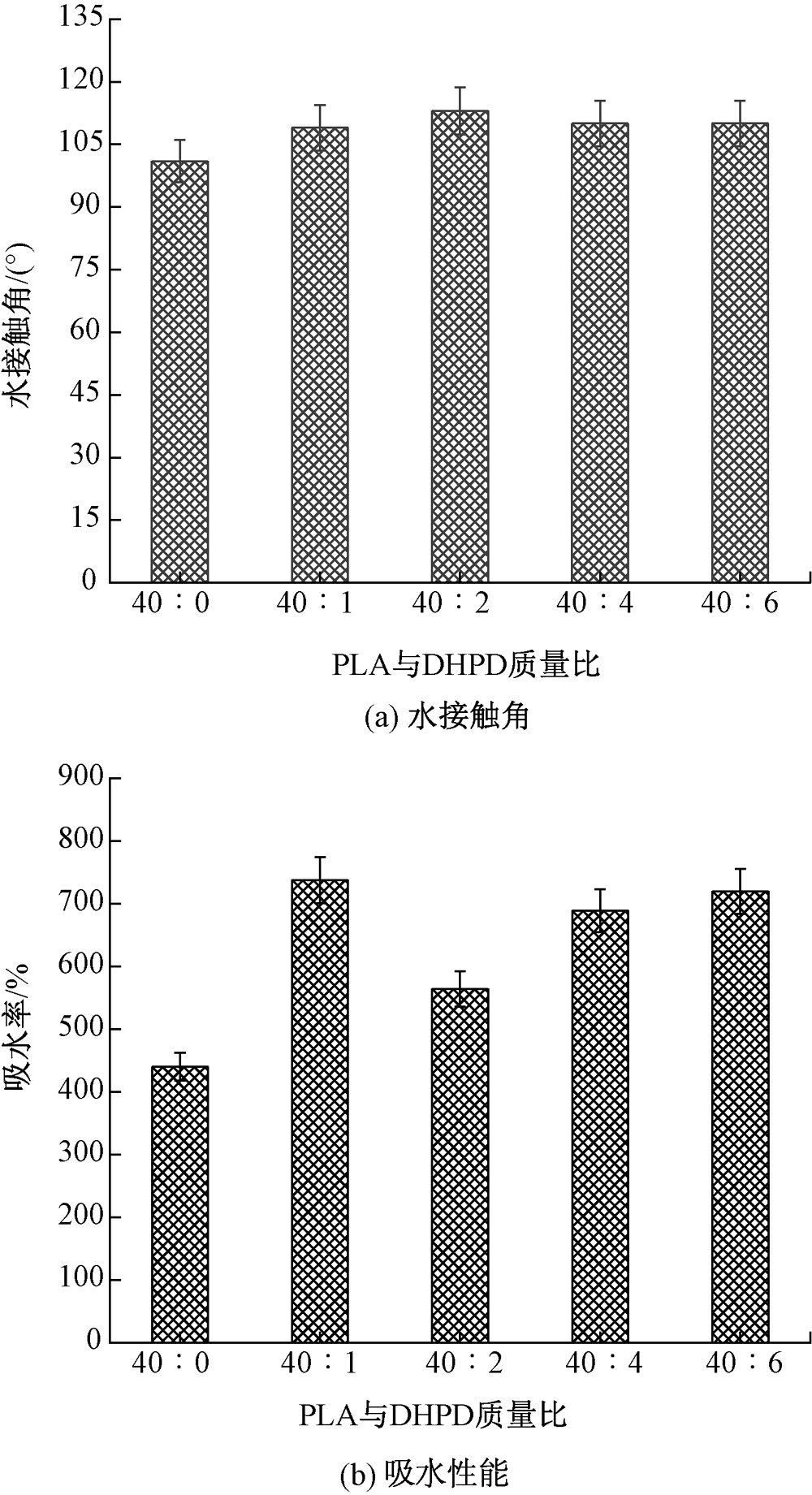
Results When the mass fraction of PLA was 8% and the mass ratio of PLA to DHPD was 40∶4, the nanofiber membrane with an average fiber diameter of 342 nm was successfully prepared. The results showed that the fiber surface of the thermoregulated fiber membrane was smooth and continuous, and the morphology of the fiber membrane was also good. The heat storage performance of the temperature-regulating fiber membrane was studied and analyzed, and it was found that after adding DHPD, the thermal properties of the thermoregulated fiber membrane changed significantly. With the increase of DHPD mass, the melting enthalpy and crystallization enthalpy of the thermoregulated fiber membrane were significantly improved. When the mass ratio of PLA to DHPD is 40∶4, the melting temperature of the thermoregulated fiber membrane was 42 ℃, and the melting enthalpy was 1.96 J/g. The temperature-regulated fiber membrane showed an obvious exothermic peak at 31-33 ℃, and 31.85 ℃ was the crystallization temperature, when the crystallization enthalpy was 1.49 J/g. Thermal imaging technology was used to test and analyze the thermal regulation performance of the thermoregulated fiber membrane on human simulated skin. It was clearly observed that the final temperature difference of the thermoregulated fiber membrane with a mass ratio of PLA to DHPD of 40∶0 and a mass ratio of PLA to DHPD of 40∶4 was 0.3 ℃ during the 80 s period. The surface temperature of the thermoregulated fiber membrane with a mass ratio of PLA to DHPD of 40∶4 was increased by only 3.7 ℃. After 50 heating and cooling cycles, the shrinkage of the thermo-regulated fiber membrane decreased with the increase of DHPD mass ratio, indicating that the addition of DHPD had an effect on the thermal stability of the thermo-regulated fiber membrane. Finally, the wettability and water absorption properties of the thermoregulated fiber membrane were analyzed. The results showed that the addition of DHPD had an effect on the hydrophilicity and water absorption of the thermoregulated fiber membrane. When the mass ratio of PLA to DHPD was 40∶4, the water contact angle of the thermoregulated fiber membrane reached 110°, and the water absorption rate reached 689%.

Conclusion In summary, a biodegradable fiber membrane with temperature regulation function was successfully prepared by electrospinning technology in this research with a simple route. When the mass ratio of PLA to DHPD is 40∶4, the heat storage performance and thermal regulation performance of the thermo-regulated fiber membrane are both good. In addition to the unique flexibility of the fiber membrane, this temperature-regulated fiber membrane also has good heat storage performance, thermal regulation, reusability and water absorption. The temperature-regulated fiber membrane prepared by this method also provides a new strategy for the development of environmentally compatible thermal energy storage textiles.

Key words: polylactic acid, temperature controlled nanofiber membrane, smart textile, phase change fiber, electrospinning, disodium hydrogen phosphate dodecahydrate

CLC Number: 

  • TB34

Fig.1

SEM images of thermoregulated fiber membrane prepared by PLA and DHPD with different mass fractions"

Fig.2

Fiber diameter distribution diagram of thermoregulated fiber membrane prepared by PLA and DHPD with different mass fractions"

Fig.3

DSC curves diagram of thermoregulated fiber membrane prepared by PLA and DHPD with different mass fractions. (a) DSC melting curves; (b)DSC crystallization curves"

Tab.1

Thermal performance data of thermoregulated fiber membrane"

PLA与DHPD
质量比
Tm/℃ ΔHm/
(J·g-1)
Tc/℃ ΔHc/
(J·g-1)
40∶0
40∶1 42.38 0.28 30.77 -0.18
40∶2 42.54 0.59 31.60 -0.57
40∶4 42.45 1.96 31.85 -1.49
40∶6 42.37 1.45 32.10 -3.03

Fig.4

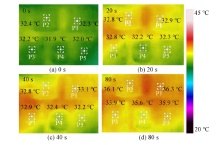
Thermal imaging state and temperature diagram of thermoregulated fiber membrane within 80 s"

Fig.5

Effect of cyclic heating on shrinkage of thermo-regulated fiber membrane"

Fig.6

Moisture absorption properties of thermoregulated fiber membrane. (a) Contact angle; (b) Absorbing quality"

[1] 孙玲, 卢业虎. 新型调温材料在服装中的应用[J]. 现代纺织技术, 2019, 27(4): 38-43.
SUN Ling, LU Yehu. Application of novel temperature adj ustable materials in clothing[J]. Advanced Textile Technology, 2019, 27(4): 38-43.
[2] 肖尧, 余弘, 李卫东, 等. 相变调温纺织品研究现状及评价方法[J]. 纺织检测与标准, 2019, 5(4): 1-5.
XIAO Yao, YU Hong, LI Weidong, et al. Research status and evaluation method of phase change thermostat textiles[J]. Textile Testing and Standard, 2019, 5(4): 1-5.
[3] YAN Yurong, LI Weipei, ZHU Ruitian, et al. Flexible phase change material fiber: a simple route to thermal energy control textiles[J]. Materials, 2021, 14(2): 401-401.
[4] 何韧, 马驰, 范敬辉, 等. 基于石墨烯气凝胶及相变微胶囊的相变复合材料的研究[J]. 应用化工, 2022, 51(7): 1864-1868.
HE Ren, MA Chi, FAN Jinghui, et al. Research on phase change composite material of graphene aerogel and phase change microcapsule[J]. Applied Chemical Industry, 2022, 51(7): 1864-1868.
[5] LIU Zenan, HU Diefei, YAO Juming, et al. Fabrication and performance of phase change thermoregulated fiber from bicomponent melt spin-ning[J]. Polymers, 2022, 14(9):1895.
[6] SIVANATHAN Amende, DOU Qingqing, WANG Yuxuan, et al. Phase change materials for building construction: an overview of nano-/micro-encapsula-tion[J]. Nanotechnology Reviews, 2020, 9(1): 896-921.
[7] 蔡以兵, 孙桂岩, 刘盟盟, 等. 定形相变复合材料的研究进展—静电纺丝法[J]. 高分子通报, 2015(2): 18-25.
CAI Yibing, SUN Guiyan, LIU Mengmeng, et al. The research progress of form-stable phase change composite materials-electrospinning[J]. Polymer Bulletin, 2015(2): 18-25.
[8] 夏长林. 静电纺超细相变纤维的研究进展[J]. 合成纤维, 2019, 48(8): 19-26.
XIA Changlin. Research progress of electrospinning ultrafine phase change fibers[J]. Synthetic Fiber in China, 2019, 48(8): 19-26.
[9] WU Yang, CHEN Changzhong, JIA Yifan, et al. Review on electrospun ultrafine phase change fibers (pcfs) for thermal energy storage[J]. Applied Energy, 2017,201: 167-181.
[10] 徐兆宝, 何翠, 赵瑾朝, 等. 同轴静电纺多级微纳米纤维膜的制备及其相变调温性能[J]. 纺织学报, 2022, 43(2): 69-73,80.
XU Zhaobao, HE Cui, ZHAO Jinchao, et al. Preparation of coaxially electrospun multi-level fiber membrane and its phase change temperature-regulating performance[J]. Journal of Textile Research, 2022, 43(2): 69-73,80.
[11] HASSAN Ahmed, LAGHARI Mohammad Shakeel, RASHID Yasir, et al. Micro-encapsulated phase change materials: a review of encapsulation, safety and thermal characteristics[J]. Sustainability, 2016, 8(10):1046.
[12] XIANG Li, LUO Dajun, YANG Jingkui, et al. Construction and design of paraffin/PVDF hollow fiber linear-phase change energy storage materials[J]. Energy & Fuels, 2019, 33(11): 11584-11591.
[1] ZHANG Man, QUAN Ying, FENG Yu, LI Fu, ZHANG Aiqin, LIU Shuqiang. Advances in textile-based wearable flexible strain sensors [J]. Journal of Textile Research, 2024, 45(12): 225-233.
[2] WANG Yawen, LIU Na, WANG Yuanfei, WU Tong. Regulation of cell migration and vascularization using electrospun nanofiber yarns [J]. Journal of Textile Research, 2024, 45(12): 25-32.
[3] LU Hailong, YU Ying, ZUO Yuxin, WANG Haoran, CHEN Hongli, RU Xin. Preparation and properties of orientation reinforced CO2 corrosion resistant fiber membrane [J]. Journal of Textile Research, 2024, 45(12): 33-40.
[4] OU Zongquan, YU Jinchao, PAN Zhijuan. Spinning of photochromic polylactic acid/polyhydroxybutyrate blend fiber and its structure and properties [J]. Journal of Textile Research, 2024, 45(12): 9-17.
[5] LEI Fuwang, FENG Qi, HOU Aohan, ZHAO Zhenhong, TAN Jiazhao, ZHAO Jing, WANG Xianfeng. Preparation and properties of polyvinylidene fluoride-polyacrylonitrile/SiO2 fibrous membrane with unidirectional water-transport function [J]. Journal of Textile Research, 2024, 45(12): 1-8.
[6] LIU Jian, DONG Shoujun, WANG Chenghao, LIU Yongru, PAN Shanshan, YIN Zhaosong. Electric field simulation and optimization on petal shaped electrospinning nozzle with multiple tips [J]. Journal of Textile Research, 2024, 45(10): 191-199.
[7] ZHANG Dianping, WANG Hao, LIN Wenfeng, WANG Zhenqiu. Simulation and design of multi-nozzle spinning device [J]. Journal of Textile Research, 2024, 45(10): 200-207.
[8] WANG Qingpeng, ZHANG Haiyan, WANG Yuting, ZHANG Tao, ZHAO Yan. Preparation and properties of polyethylene oxide/Al2O3 passive radiative cooling membrane [J]. Journal of Textile Research, 2024, 45(09): 33-41.
[9] WANG Yongzheng, HUANG Lintao, SONG Fuquan. Process optimization and properties of petroleum pitch/polyacrylonitrile electrospun carbon nanofibers [J]. Journal of Textile Research, 2024, 45(08): 107-115.
[10] YAN Di, WANG Xuefang, TAN Wenping, GAO Guojin, MING Jinfa, NING Xin. Preparation of porous poly(L-lactic acid) nanofiber membranes with rich imidazole groups and dual performances in water purification [J]. Journal of Textile Research, 2024, 45(08): 116-126.
[11] QIAN Yang, ZHANG Lu, LI Chenyang, WANG Rongwu. Preparation and performance of electrospun sodium alginate composite nanofiber membranes [J]. Journal of Textile Research, 2024, 45(08): 18-25.
[12] LIU Jiawei, JI Dongxiao, QIN Xiaohong. Research progress in electrospun nanofiber materials for air filtration [J]. Journal of Textile Research, 2024, 45(08): 35-43.
[13] LIU Delong, WANG Hongxia, LIN Tong. Research progress in airflow-assisted electrospinning [J]. Journal of Textile Research, 2024, 45(08): 44-53.
[14] YU Wen, DENG Nanping, TANG Xiangquan, KANG Weimin, CHENG Bowen. Review on preparation and applications of electro-blown spun micro-nano inorganic fibers [J]. Journal of Textile Research, 2024, 45(07): 230-239.
[15] YANG Chenhui, CHEN Mengdi, GUAN Yan, XIAO Hong. Design and realization of optical fiber fabric based on grating animation pattern synthesis [J]. Journal of Textile Research, 2024, 45(07): 40-46.
Viewed
Full text


Abstract

Cited

  Shared   
  Discussed   
No Suggested Reading articles found!