Journal of Textile Research ›› 2025, Vol. 46 ›› Issue (01): 62-71.doi: 10.13475/j.fzxb.20231000401

• Textile Engineering • Previous Articles     Next Articles

Full-color gamut mixing model constructed by four-color fibers and its use for color yarn spinning

WANG Yanyan1, XUE Yuan1(), CHEN Yourong2, CHEN Guofang2   

  1. 1. College of Textile Science and Engineering, Jiangnan University, Wuxi, Jiangsu 214122, China
    2. Zhejiang Taitan Co., Ltd., Shaoxing, Zhejiang 311800, China
  • Received:2023-10-07 Revised:2024-03-21 Online:2025-01-15 Published:2025-01-15
  • Contact: XUE Yuan E-mail:fzxueyuan@qq.com

Abstract:

Objective In recent years, colored spun yarn has been developed rapidly because of its unique color blending effect and environmentally friendly production process. However, the current spinning of colored spun yarn primarily relies on the fiber blending ratio and point-to-point color matching of the yarn, lacking a suitable color mixing model to systematically guide the spinning of colored fibers and enable real-time adjustment of the yarn color. In order to address this issue, a full-color gamut gridded color mixing model is established, incorporating the characteristics of three-channel numerical control rotor spinning. This model guides fiber spinning within the full-color gamut range created by four primary colors and regulates the hue, brightness, and saturation of the yarn color across the entire color gamut.

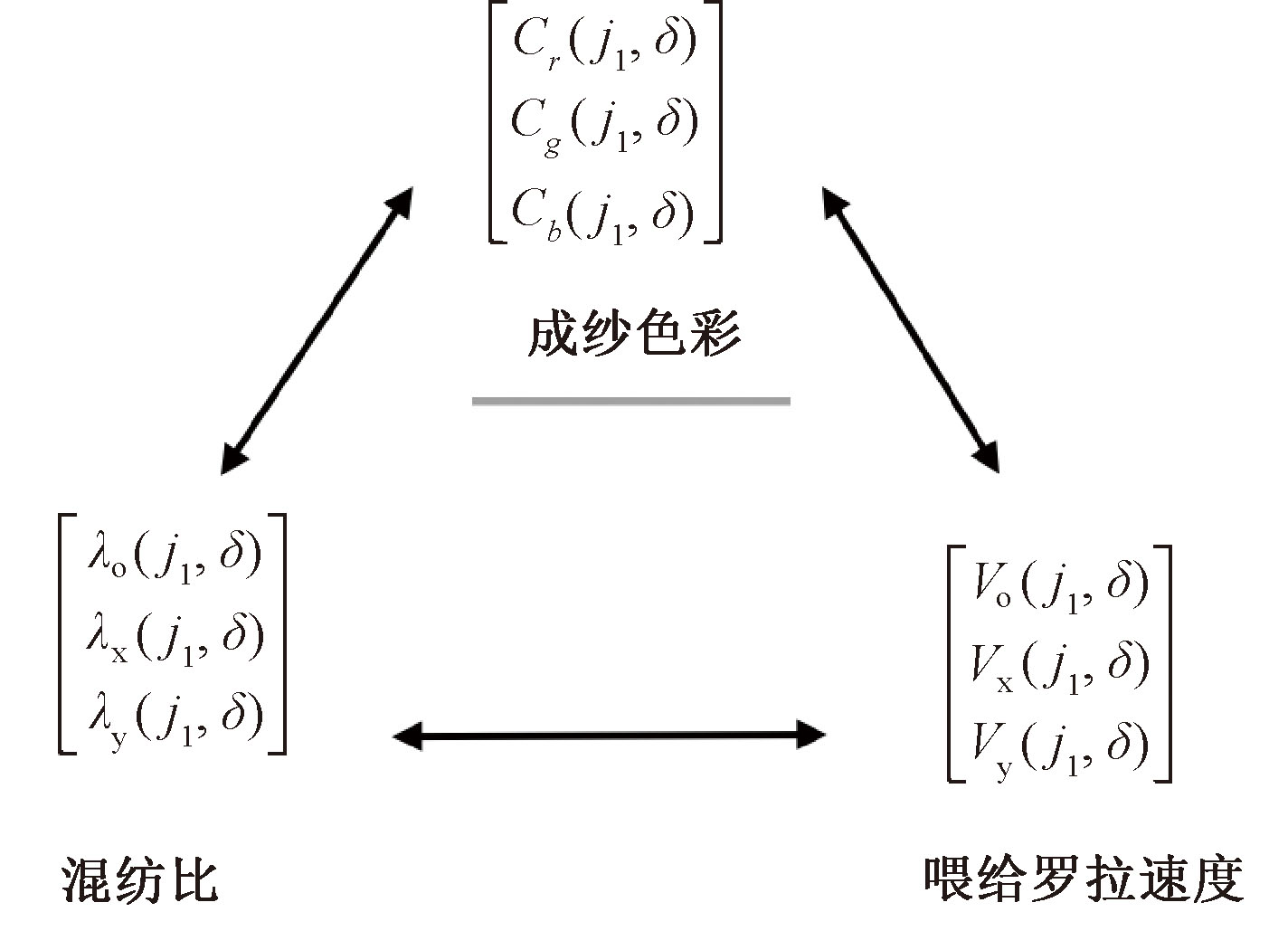
Method First, a four-primary color coupling-superposition mixing model was constructed using three types of colored fibers and one gray fiber as raw materials. This mixing model enabled precise digital control of hue, brightness, and saturation within the entire color gamut, and this model was utilized to guide the spinning of four primary color fibers. Then, by combining the principles of three-channel computer numerical control (CNC) cup spinning, a three-channel cup spinning mixing mechanism was developed to synergistically control the ratios of feeding speeds, blending ratios of primary fibers, and colors of formed yarns. This breakthrough eliminated the barriers between feeding speed ratios, blending ratios of primary fibers, and colors of formed yarns, enabling adjustment of the other two variables based on any one variable. Lastly, a total of 156 colors were selected from the full-color gamut mixing model, including three types, i.e. equal brightness with different hue series, equal hue and different brightness series, and equal hue and different saturation series. Utilizing the three-channel rotor spinning platform, the selected 156 colors were made into mixed color yarns and fabrics with the four primary color fibers. The color changes of the mixed yarns and fabrics were compared with the corresponding type of color spectrums, so as to validate the feasibility of producing mixed color yarns across the full-color gamut utilizing the full-color gamut mixing model in conjunction with the three-channel digitally controlled rotor spinning platform. By measuring the HSL value of the yarn, the feasibility of spinning mixed yarn in the full-color gamut range was further investigated based on the built full color gamut mesh color mixing model.

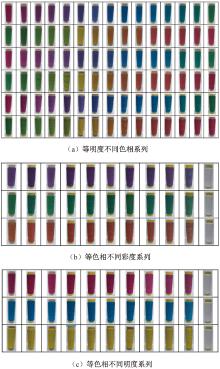
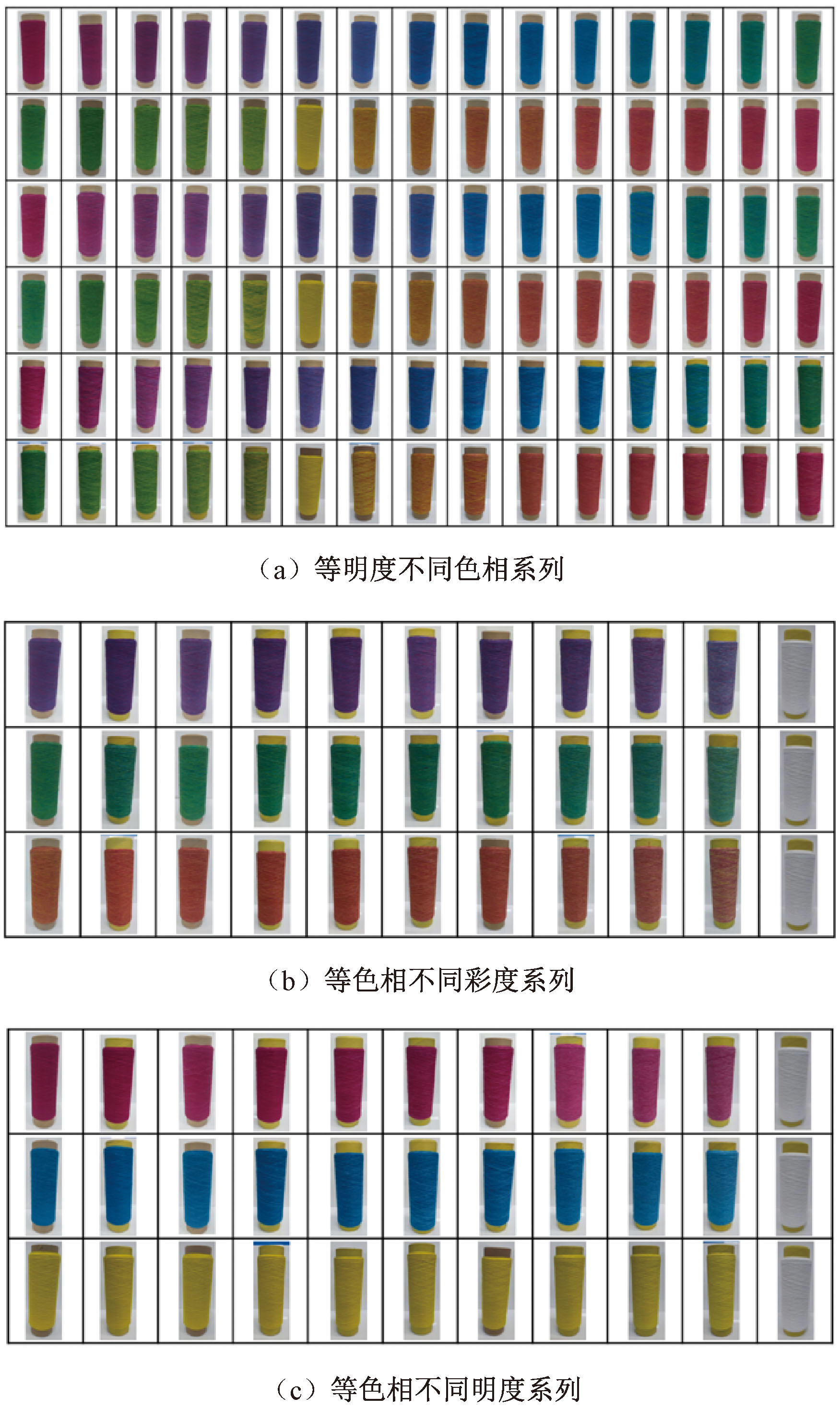
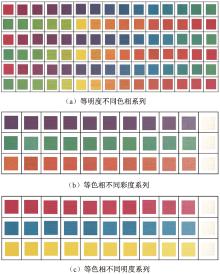
Results Comparing the images of three types of mixed colored yarns and mixed colored fabrics with the chromatograms of the three types, it was found that the hue changes of mixed colored yarns and fabrics with equal brightness and different hue series were consistent with the chromatograms. The brightness changes of mixed yarns and fabrics with equal hue and different brightness series were consistent with the chromatogram. The saturation changes of mixed yarns and fabrics with equal hue and different saturation series were consistent with the chromatogram. It was evident that based on the full-color gamut grid based color mixing model, the color change trend in the mixed yarns and the fabrics was consistent with the color change trend of the mixed yarn color map, which verified the three-channel rotor spinning mechanism of coordinated control of draft ratio, blending ratio, and yarn color. From the HSL values of the three types of mixed yarns, it was seen that in the first type the hue angle changes from 0° to 360°, and the hue change trend was consistent with the constructed full-color gamut mixing model. In the second type the hue remains basically unchanged, and the chromaticity change trend was consistent with the constructed full-color gamut mixing model. In the third type the hue remains basically unchanged, the brightness change trend was consistent with the constructed full-color gamut mixing model. The feasibility of spinning full-color gamut mixed yarn using the constructed full-color gamut mixing model was verified again from a new perspective. The results showed that the color changes of the mixed yarns and fabrics produced based on the full-color gamut mixing model exhibited consistent patterns with the color changes of the mixed yarn color map. Therefore, spinning mixed yarns over the full-color gamut by adjusting the ratios of feeding speeds, blending ratios of primary fibers, and yarn color was feasible.

Conclusion In summary, based on the full-color gamut mixing model and the three-channel CNC cup spinning platform, the spinning of mixed yarns over the full-color gamut can be practically achieved. The color variation of the mixed yarns and fabrics based on the full-color gamut mixing model aligns with the color variation of the full-color gamut mixing model, exhibiting a consistent pattern. The mixed yarn demonstrates a hue change range of 0°-360°, a brightness change range of 0-1, and a saturation change range of 0-1. This verifies that the constructed full-color gamut mixing model enables online control of yarn color from three dimensions: hue, brightness, and saturation.

Key words: colored yarn, full-color gamut mixing model, rotor spinning, color control, computer numerical control spinning

CLC Number: 

  • TS104.1

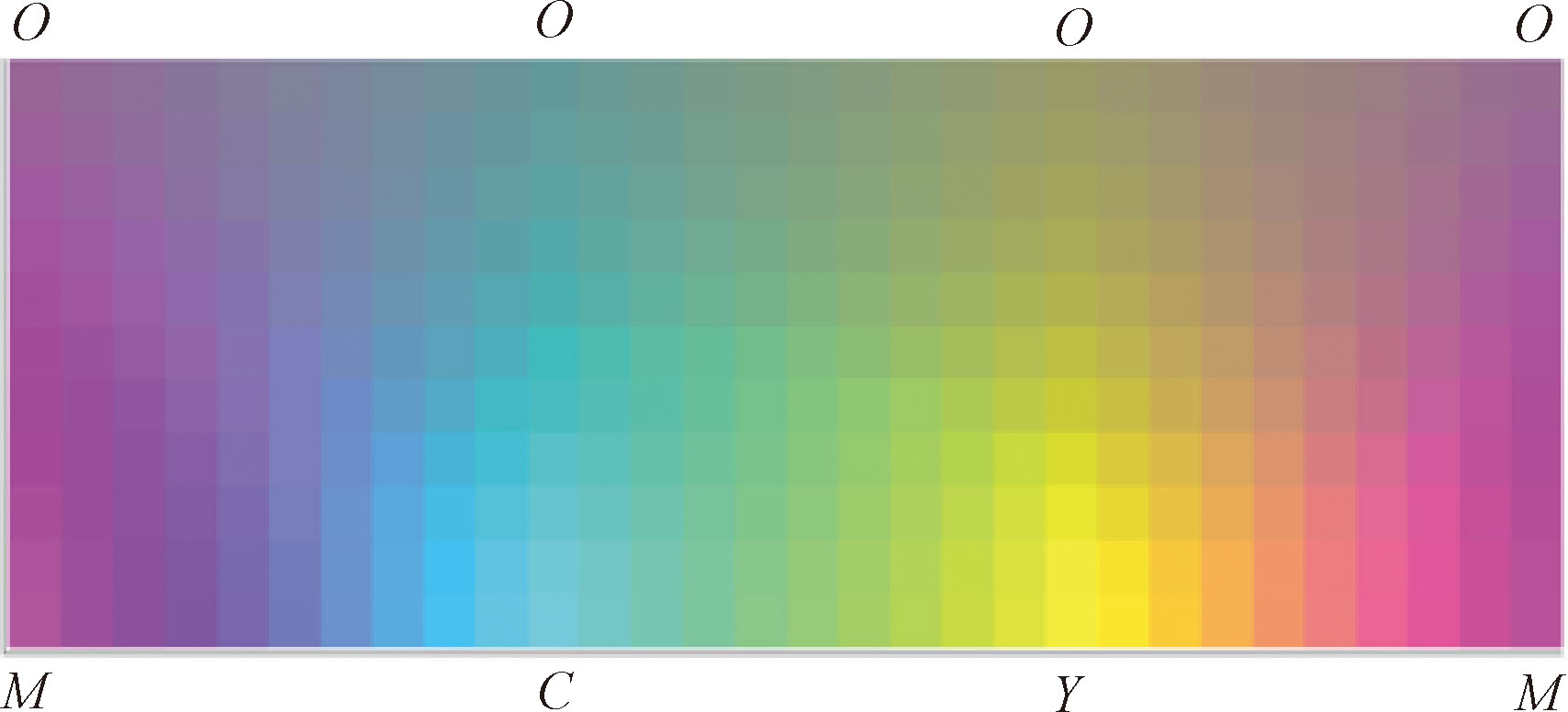
Fig.1

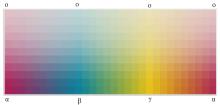
Chromatogram of full-color gamut corresponding to full-color gamutgridded color mixing model"

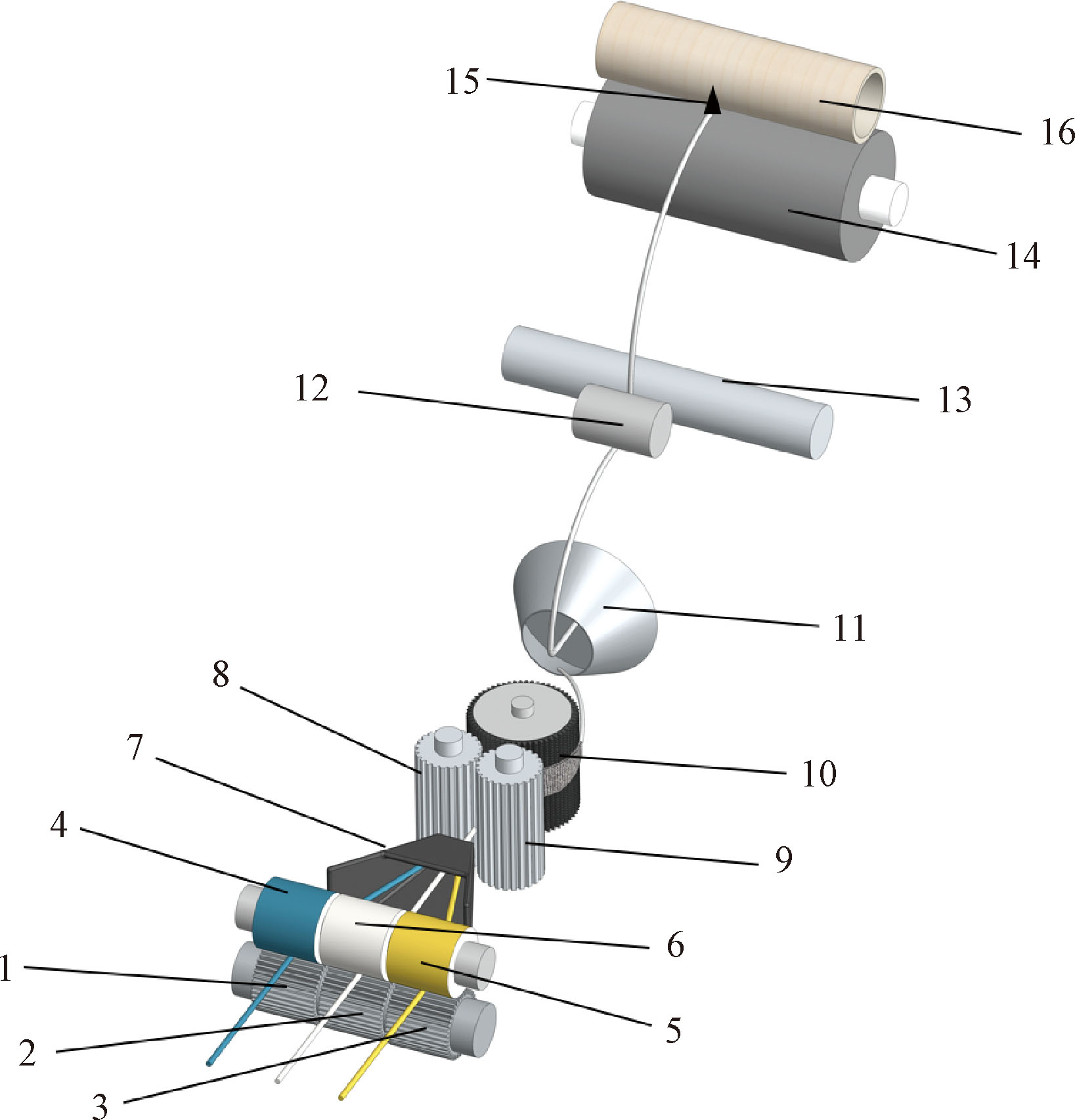
Fig.2

Three-channel CNC rotor spinning system"

Fig.3

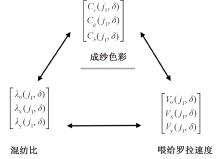
Three element control mechanism of three channel CNC spinning"

Tab.1

Color values of four primary color cotton strips"

棉条颜色 Lab值 RGB值
品红(α) (40.14,60.22,5.19) (178,28,89)
青(β) (49.93,-31.34,-25.75) (0,134,162)
黄(γ) (82.04,2.4,86.51) (238,200,0)
灰(o) (93.13,0.2,3.06) (238,235,229)

Fig.4

Four primary color grid mixed color gamut chromatography"

Fig.5

Three different series of mixed color yarns.(a) Equal brightness with different hue series; (b) Equal hue with different saturation series; (c) Equal hue with different brightness series"

Fig.6

Three different series of mixed color yarn knitted fabric. (a) Equal brightness with different hue series; (b) Equal hue with different saturation series; (c) Equal hue with different brightness series"

Tab.2

HSL values of blended yarns with equal brightness and different hue series"

编号 H S L 编号 H S L 编号 H S L
C1,1 337.87 74.48 35.22 C3,1 337.99 70.64 36.64 C7,1 338.62 65.11 38.54
C1,2 331.08 50.10 31.27 C3,2 330.14 44.81 33.49 C7,2 332.35 41.55 37.03
C1,3 325.31 41.85 29.78 C3,3 318.56 31.74 31.49 C7,3 325.19 31.70 35.11
C1,4 313.37 28.73 29.99 C3,4 309.14 25.65 31.18 C7,4 311.35 22.82 34.22
C1,5 283.87 21.90 30.17 C3,5 289.91 22.79 30.45 C7,5 281.97 17.43 35.08
C1,6 263.20 20.41 31.11 C3,6 266.21 19.69 31.97 C7,6 254.25 16.02 36.93
C1,7 227.15 23.85 31.43 C3,7 242.04 17.97 35.22 C7,7 238.85 15.32 38.52
C1,8 213.78 32.96 32.41 C3,8 219.74 27.03 34.69 C7,8 210.55 30.71 34.96
C1,9 198.15 63.51 29.45 C3,9 201.64 54.76 28.61 C7,9 196.74 54.59 32.83
C1,10 192.76 100.00 24.80 C3,10 192.60 96.17 26.64 C7,10 194.12 69.59 31.16
C1,11 190.40 100.00 26.92 C3,11 189.83 100.00 28.35 C7,11 189.04 100.00 29.12
C1,12 184.60 100.00 24.13 C3,12 188.41 100.00 27.13 C7,12 184.75 100.00 27.20
C1,13 175.26 100.00 23.17 C3,13 175.07 100.00 23.46 C7,13 177.05 88.26 26.18
C1,14 162.71 59.99 29.66 C3,14 164.85 64.53 29.15 C7,14 170.72 55.31 32.83
C1,15 154.17 46.32 31.61 C3,15 151.96 34.77 34.61 C7,15 155.30 31.19 40.76
C1,16 121.95 27.80 40.02 C3,16 140.81 35.75 37.19 C7,16 127.33 25.12 42.59
C1,17 120.21 27.04 40.13 C3,17 116.60 28.13 39.74 C7,17 96.97 29.92 42.08
C1,18 73.25 51.19 37.48 C3,18 93.22 33.68 40.07 C7,18 87.00 33.41 42.82
C1,19 67.42 52.47 38.48 C3,19 64.18 56.25 38.45 C7,19 65.45 45.42 42.63
C1,20 63.30 60.62 37.99 C3,20 51.87 100.00 37.49 C7,20 51.26 61.90 45.93
C1,21 45.85 100.00 45.63 C3,21 46.51 100.00 45.89 C7,21 46.58 93.61 47.83
C1,22 31.88 71.93 45.19 C3,22 34.67 76.39 44.74 C7,22 35.17 62.32 50.06
C1,23 24.43 63.58 44.58 C3,23 27.54 66.57 45.03 C7,23 24.68 54.65 47.93
C1,24 17.44 56.24 45.91 C3,24 15.06 49.63 47.44 C7,24 19.54 48.96 49.41
C1,25 16.05 56.68 44.58 C3,25 9.41 48.38 46.31 C7,25 10.81 45.62 48.63
C1,26 6.59 49.90 45.19 C3,26 8.96 51.91 44.54 C7,26 5.67 42.69 47.56
C1,27 0.85 47.68 44.64 C3,27 0.39 46.53 45.82 C7,27 356.75 41.19 47.86
C1,28 0.07 48.78 44.21 C3,28 359.91 45.11 46.17 C7,28 350.90 46.11 44.94
C1,29 350.08 57.42 41.09 C3,29 349.34 57.54 40.65 C7,29 350.31 44.74 46.05
C1,30 343.87 64.90 38.58 C3,30 345.58 60.03 39.85 C7,30 345.17 48.77 44.31

Tab.3

HSL values of blended yarns with equal hue and different saturation series"

编号 H S L 编号 H S L 编号 H S L
C1,5 283.87 21.90 30.17 C1,15 154.17 46.32 31.61 C1,25 11.05 56.68 44.58
C2,5 285.71 20.70 30.32 C2,15 152.14 30.31 31.94 C2,25 11.78 54.00 44.30
C3,5 289.91 22.79 30.45 C3,15 151.96 34.77 34.61 C3,25 10.41 48.38 46.31
C4,5 286.69 22.03 30.59 C4,15 155.40 44.01 34.68 C4,25 10.44 48.13 46.54
C5,5 288.58 20.32 30.71 C5,15 153.98 34.06 38.15 C5,25 10.52 46.46 47.97
C6,5 289.39 19.05 32.30 C6,15 151.58 35.05 38.37 C6,25 10.95 45.05 47.99
C7,5 281.97 17.43 35.08 C7,15 155.30 31.19 40.76 C7,25 10.81 45.62 48.63
C8,5 284.79 16.21 36.15 C8,15 154.79 33.10 40.52 C8,25 10.44 43.38 50.74
C9,5 283.42 13.02 40.77 C9,15 154.15 28.25 43.81 C9,25 11.00 43.34 55.45
C10,5 287.25 10.05 49.91 C10,15 151.90 20.16 52.25 C10,25 10.82 41.86 57.64

Tab.4

HSL values of blended yarns with equal hue and different brightness series"

编号 H S L 编号 H S L 编号 H S L
C1,1 337.87 74.48 35.22 C1,11 190.40 100.00 26.92 C1,21 45.85 100.00 45.63
C2,1 337.87 72.51 36.72 C2,11 190.36 100.00 27.37 C2,21 46.02 100.00 45.86
C3,1 337.99 70.64 36.64 C3,11 189.83 100.00 28.35 C3,21 46.51 100.00 45.89
C4,1 338.73 63.71 39.11 C4,11 190.10 100.00 28.56 C4,21 46.51 100.00 45.33
C5,1 339.07 60.15 39.94 C5,11 189.78 100.00 28.36 C5,21 46.75 100.00 45.92
C6,1 339.28 57.43 41.05 C6,11 189.25 100.00 28.36 C6,21 46.68 100.00 45.85
C7,1 338.62 65.11 38.54 C7,11 189.04 100.00 29.12 C7,21 46.58 93.61 47.83
C8,1 340.16 47.34 45.46 C8,11 188.78 100.00 29.41 C8,21 44.95 82.35 53.03
C9,1 340.43 40.77 48.67 C9,11 188.64 81.93 33.74 C9,21 44.49 81.85 59.27
C10,1 340.68 39.53 53.18 C10,11 190.33 48.47 44.31 C10,21 44.89 83.12 60.42
[1] 张婷婷, 薛元, 徐志武, 等. 三通道数码纺混色纱色谱体系构建及其彩色纱性能分析[J]. 纺织学报, 2019, 40(9): 48-55.
ZHANG Tingting, XUE Yuan, XU Zhiwu, et al. Color system construction of three-channel digital spinning mixed color yarn and performance analysis of colored yarn[J]. Journal of Textile Research, 2019, 40(9): 48-55.
[2] 章斐燕, 金亦佳, 李启正, 等. 空间并置混色色织物颜色预测方法的比较[J]. 丝绸, 2014, 51(11): 22-27.
ZHANG Feiyan, JIN Yijia, LI Qizheng, et al. Comparison of color prediction methods of yarn-dyed fabrics with spatial juxtaposition[J]. Journal of Silk, 2014, 51(11): 22-27.
[3] 钱爱芬. 色纺纱产品特点及调配色原理[J]. 棉纺织技术, 2010, 38(11): 66-68.
QIAN Aifen. Colored spun yarn characteristic and color mixing & matching principle[J]. Cotton Textile Technology, 2010, 38(11): 66-68.
[4] 曾祥松, 杨晓华, 章友鹤, 等. 我国色纺纱生产技术与产品创新探析[J]. 棉纺织技术, 2022, 50(1): 34-39.
ZENG Xiangsong, YANG Xiaohua, ZHANG Youhe, et al. Analysis on production technology and productinnovation of colored spun yarn in our country[J]. Cotton Textile Technology, 2022, 50(1): 34-39.
[5] 金亚琪, 邹专勇, 许梦露, 等. 色纺纱产品开发现状及技术发展需求[J]. 棉纺织技术, 2012, 40(12): 65-68.
JIN Yaqi, ZOU Zhuanyong, XU Menglu, et al. Development status and technology development demands of colored spun yarn[J]. Cotton Textile Technology, 2012, 40(12): 65-68.
[6] 陈飞荣. 服装材料中色纺纱配色算法改进[J]. 辽东学院学报(自然科学版), 2021, 28(4): 278-284.
CHEN Feirong. Color matching algorithm improvement for colored spun yarn[J]. Journal of Eastern Liaoning University(Natural Science), 2021, 28(4): 278-284.
[7] 潘真祯. 产业链视角下我国色纺纱产业的创新发展研究[D]. 上海: 东华大学, 2022:24-28.
PAN Zhenzhen. Research on the innovative development of the colored spun yarn industry in China from the perspective of industrial chain[D]. Shanghai: Donghua University, 2022:24-28.
[8] 顾燕, 薛元, 高卫东, 等. 采用三通道数码纺的色彩渐变纱性能[J]. 纺织学报, 2018, 39(2): 62-67.
GU Yan, XUE Yuan, GAO Weidong, et al. Analysis of properties of gradient yarns spun by three-channel digital ring spinning[J]. Journal of Textile Research, 2018, 39(2): 62-67.
[9] 薛元, 高卫东, 杨瑞华. 三通道数码纺纱:纱线的柔性数字化加工技术[J]. 纺织导报, 2017(8): 46-50.
XUE Yuan, GAO Weidong, YANG Ruihua. Three-channel digitalized spinning: a flexible digital technology for yarn production[J]. China Textile Leader, 2017(8): 46-50.
[10] 朱文硕, 薛元, 徐志武, 等. 对称循环渐变色彩设计及其色彩渐变纱纺制[J]. 纺织学报, 2022, 43(2): 116-124.
ZHU Wenshuo, XUE Yuan, XU Zhiwu, et al. Symmetrical periodic gradient color design and spinning of gradient-colored yarns[J]. Journal of Textile Research, 2022, 43(2): 116-124.
[11] 薛元, 高卫东, 李杨, 等. 三通道数码纺纱传动系统构建及数控纺纱成形机理机制分析[J]. 纺织导报, 2018(10): 108-112.
XUE Yuan, GAO Weidong, LI Yang, et al. Construction of three channel digital spinning transmission system and analysis on forming mechanism of NC spinning[J]. China Textile Leader, 2018(10):108-112.
[12] XUE Yuan, GAO Weidong, YANG Ruihua, et al. Rotor spinning method and apparatus using three-cotton-sliver asynchronous input and multi-stage carding: WO2017/031612A1[P]. 2017-03-16.
[13] 张震, 薛元, 徐志武, 等. 数码纺循环渐变色纱设计及渐变色织物的织制[J]. 毛纺科技, 2020, 48(11): 12-18.
ZHANG Zhen, XUE Yuan, XU Zhiwu, et al. Design of digital spinning cycle gradient yarn and spinning of gradient fabric[J]. Wool Textile Journal, 2020, 48(11):12-18.
[14] 武臣, 薛元, 高林郁, 等. 五通道数控环锭纺纱系统构建及纺制花式纱机制分析[J]. 毛纺科技, 2020, 48(11): 1-5.
WU Chen, XUE Yuan, GAO Linyu, et al. Construction of numerical control five-channel ring spinning system and analysis of spinning fancy yarn mechanism[J]. Wool Textile Journal, 2020, 48(11):1-5.
[15] ZHU Wenshuo, XUE Yuan, XU Zhiwu, et al. Symmetrical circulation gradient color system construction and gradient color yarn spun by a three-channel numerical control spinning system[J]. Textile Research Journal, 2022, 92: 2046-2060.
[16] SUN Xianqiang, XUE Yuan, CUI Peng, et al. Serialized gradient chromatography for the digital blending of colored fibers and spinning of gradient colored yarn[J]. Textile Research Journal, 2022, 92: 43-58.
[1] ZHANG Dingtiao, WANG Qianru, QIU Fang, LI Fengyan. Simulation of flow field and fiber straightening in reconstructed fiber transport channel in rotor spinning [J]. Journal of Textile Research, 2025, 46(02): 100-105.
[2] LI Ling, SHI Qianqian, TIAN Shun, WANG Jun. Influence of fiber channel symmetry on dual-feed-opening rotor spinning flow field and yarn characteristics [J]. Journal of Textile Research, 2025, 46(02): 69-77.
[3] GONG Xinxia, SHAO Qiu, YANG Ruihua. A study on movement and deformation of fibers in rotor spinning devices [J]. Journal of Textile Research, 2024, 45(12): 199-205.
[4] SHI Jingjing, YANG Enlong. Effect of advance-feeding on structure and performance of cotton/wool segment colored yarns [J]. Journal of Textile Research, 2024, 45(12): 67-73.
[5] ZHANG Dingtiao, WANG Qianru, QIU Fang, LI Fengyan. Comparison on multi-dimensional numerical simulation of airflow field in carding and trash removal zone for rotor spinning [J]. Journal of Textile Research, 2024, 45(10): 64-71.
[6] LI Ling, DING Qian, WANG Jun. Model construction and analysis based on rotor spinning merging effect [J]. Journal of Textile Research, 2023, 44(12): 43-49.
[7] SUN Xianqiang, XUE Yuan, LIU Yuexing, ZHANG Guoqing, LIU Lixia. Full color phase mixing model constructed by blending of six primary colored fibers and colored yarn production [J]. Journal of Textile Research, 2023, 44(09): 60-67.
[8] SHI Jingjing, YANG Enlong. Analysis of structure and properties of cotton/wool siro segment colored yarns [J]. Journal of Textile Research, 2023, 44(03): 55-59.
[9] YANG Ruihua, HE Chuang, GONG Xinxia, CHEN Hewen. Numerical simulation of airflow field in carding and trash removal zone of rotor spinning [J]. Journal of Textile Research, 2022, 43(10): 31-35.
[10] WANG Jun, SHI Qianqian, LI Ling, ZHANG Yuze. Research progress of dual-feed-opening rotor spinning technology [J]. Journal of Textile Research, 2022, 43(08): 12-20.
[11] AO Limin, LOU Huan, TANG Wen. Residual twist of core yarn and its application in hollow spindle cover spinning [J]. Journal of Textile Research, 2022, 43(07): 41-46.
[12] SHI Qianqian, WANG Jiang, ZHANG Yuze, LIN Huiting, WANG Jun. Numerical analysis on formation mechanism of airflow field in rotor spinning unit [J]. Journal of Textile Research, 2021, 42(02): 180-184.
[13] ZHANG Tingting, XUE Yuan, HE Yudong, LIU Yuexing, ZHANG Guoqing. Construction of Kubelka-Munk double-constant color matching model for ring digital yarn color prediction [J]. Journal of Textile Research, 2020, 41(01): 50-55.
[14] DENG Qianqian, YANG Ruihua, XU Yaya, GAO Weidong. Study on mixing uniformity of fibers in rotor-spun mixed yarns [J]. Journal of Textile Research, 2019, 40(07): 31-37.
[15] SHI Qianqian, AKANKWASA Nicholus Tayari, LIN Huiting, ZHANG Yuze, WANG Jun. Comparative analysis of rotor spinning machines and yarn performance between conventional and dual-feed rotor spinning [J]. Journal of Textile Research, 2019, 40(02): 63-68.
Viewed
Full text


Abstract

Cited

  Shared   
  Discussed   
No Suggested Reading articles found!