Journal of Textile Research ›› 2025, Vol. 46 ›› Issue (03): 141-150.doi: 10.13475/j.fzxb.20240202801

• Dyeing and Finishing Engineering • Previous Articles     Next Articles

Preparation and spectral compatibility of bistable thermochromic printed fabrics

MAO Lifen1, XIAO Hong2, MAO Qinghui1, MA Wujun1, LIANG Zhijie1, LI Min1()   

  1. 1. School of Textile and Clothing, Nantong University, Nantong, Jiangsu 226019, China
    2. Institute of Systems Engineering, Academy of Military Sciences, Beijing 100010, China
  • Received:2024-02-26 Revised:2024-12-04 Online:2025-03-15 Published:2025-04-16
  • Contact: LI Min E-mail:minmin0421@163.com

Abstract:

Objective Aiming at the problem that the color of monostable thermochromic textiles changes with the external environment, resulting in the hue uncontrolled autonomously. In this study, multi-spectrum-compatible thermochromic textiles are prepared by using bistable thermochromic microcapsules with two color-changing dots, compounding them with dispersion dyes and combining them with a color block printed with photonic crystals as a low-emission material.

Method The bistable thermochromic microcapsules and conventional disperse dyes were used as colorants. The bistable thermochromic microcapsules were colorless under high temperature stimulation and colored under low temperature stimulation, and the color of conventional disperse dyes was not affected by temperature. The bistable thermochromic fabric was printed by screen printing method, and the near-infrared camouflage was achieved by adjusting the color paste formulation. In addition, printed fabrics with low-emissivity color blocks were overprinted by screen printing with photonic crystals as color paste.

Results The two kinds of printed color blocks have high color change sensitivity (color change response time ≤30 s), good fatigue resistance (≥200 cycles), and the color blocks can be achieved by high temperature and low temperature stimulation in the range of 10~50 ℃ to maintain the two specific colors in a steady state, thus realizing the color of the color blocks of the autonomous control; in which the average spectral reflectance ratio (KG) of the medium green and dark green color blocks in the 710-880 nm band and 620-660 nm band are 6.44 and 8.16, respectively, and have a broad-spectrum spectral simulation effect on typical angiosperms; in addition, the photonic crystal as a low hair material printed with the photonic crystal as a low-hair material, and has a broad-spectrum spectral simulation effect. The KG of the medium green and dark green color blocks in the 710-880 nm band and 620-660 nm band is 6.44 and 8.16, respectively, and has a broad-spectrum spectral simulation of typical angiosperms; in addition, the emissivity of the color blocks printed with photonic crystals as the low-emitting material is 0.47, and thermal infrared imaging shows that it can play a role in the infrared low-detectability effect; the printed fabrics printed with three color block overprinting have good color fastness to soap washing, friction and sunlight, and their gloss is low.

Conclusion The research addresses the difficulty in the color of monostable thermochromic textiles changes with the change of external environment, which leads to the incapability to control the hue independently. Based on the large difference between the achromatic temperature and the chromogenic temperature of the bistable thermochromic microcapsules, it is compounded with disperse dyes to prepare printed fabrics that can maintain two colors steadily in high and low temperature environments. Combined with low-emitting materials, it is expected to be applied to the field of camouflage and camouflage of textiles.

Key words: visible light, near infrared, thermal infrared, steady-state discoloration, printed fabric, microcapsule, thermochromic textiles

CLC Number: 

  • TS194.2

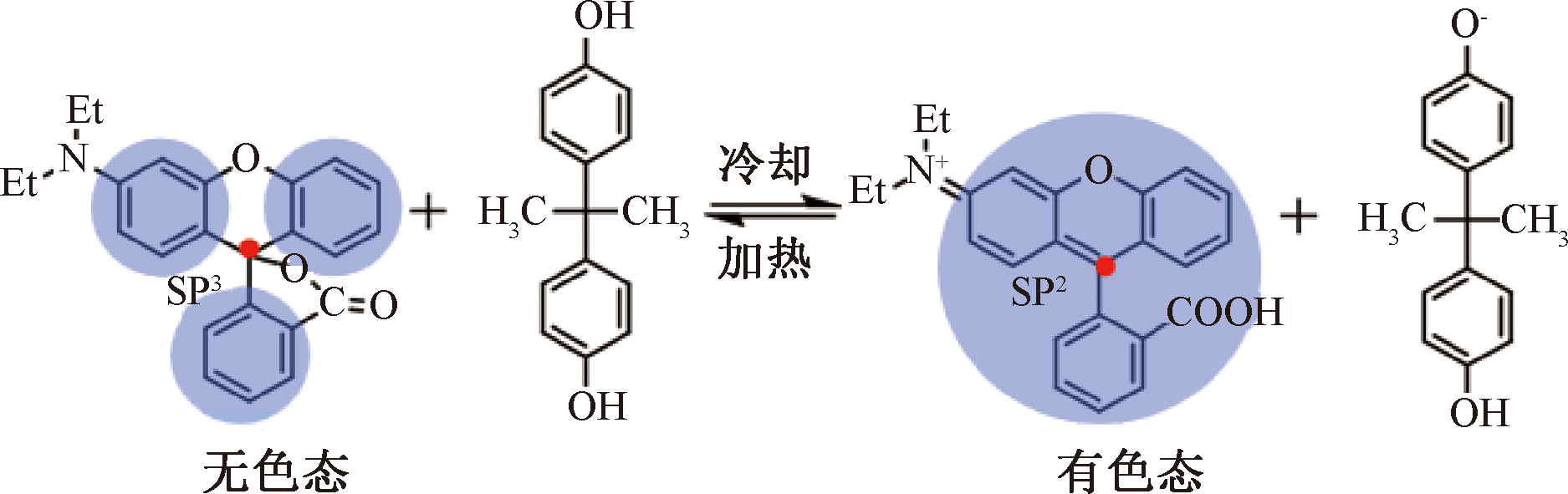
Fig.1

Schematic diagram of discoloration principle of thermochromic microcapsules"

Tab.1

Visible light color paste formula and color parameters of fabric printing"

配方序号 变色微胶囊用量/g 分散染料用量/g 高温下颜色参数 低温下颜色参数
ΔL* Δa* Δb* ΔL* Δa* Δb*
1# 1.0 3.8 0.5 0.7 2.3 0.03 -0.3 12.31 -0.67 19.31
2# 1.0 7.0 0 0 0 0 0 0
3# 2.0 7.0 0.14 0.19 -0.29 -0.31 1.97 -0.04
4# 1.0 1.5 7.0 1.80 -0.42 0.05 1.78 0.32 2.71
5# 1.0 8.0 1.08 -0.36 0.87 -0.45 0.14 -2.08
6# 1.0 7.0 1.5 1.33 0.27 -0.79 -2.82 0.42 1.02

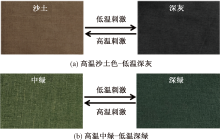
Fig.2

Printed color blocks. (a) Sand likecolor at high temperature-dark gray at low temperature; (b) Medium green at high temperature-dark green at low temperature"

Tab.2

Color parameters of printed color blocks"

色块 高温刺激 低温刺激
L* a* b* 色相 L* a* b* 色相
可见光变色色块 48.17 4.59 15.71 沙土色 40.02 0.85 -0.79 深灰色
可见光变色兼容近红外色块 34.92 -9.92 13.85 中绿色 28.31 -7.37 5.74 深绿色

Fig.3

Color lightness-temperature curve and color changing object. (a) Lightness-temperature curves; (b) Color change diagram of color block in heating and cooling processes"

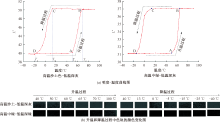
Fig.4

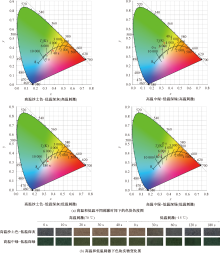
Chromaticity diagram and physical diagram of color blocks under different stimulation time period conditions. (a) Color block chromaticity diagram under different stimulation time period conditions at high temperature and low temperature; (b) Physical change diagrams of color block under high temperature and low temperature stimulation"

Fig.5

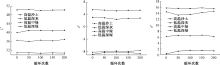
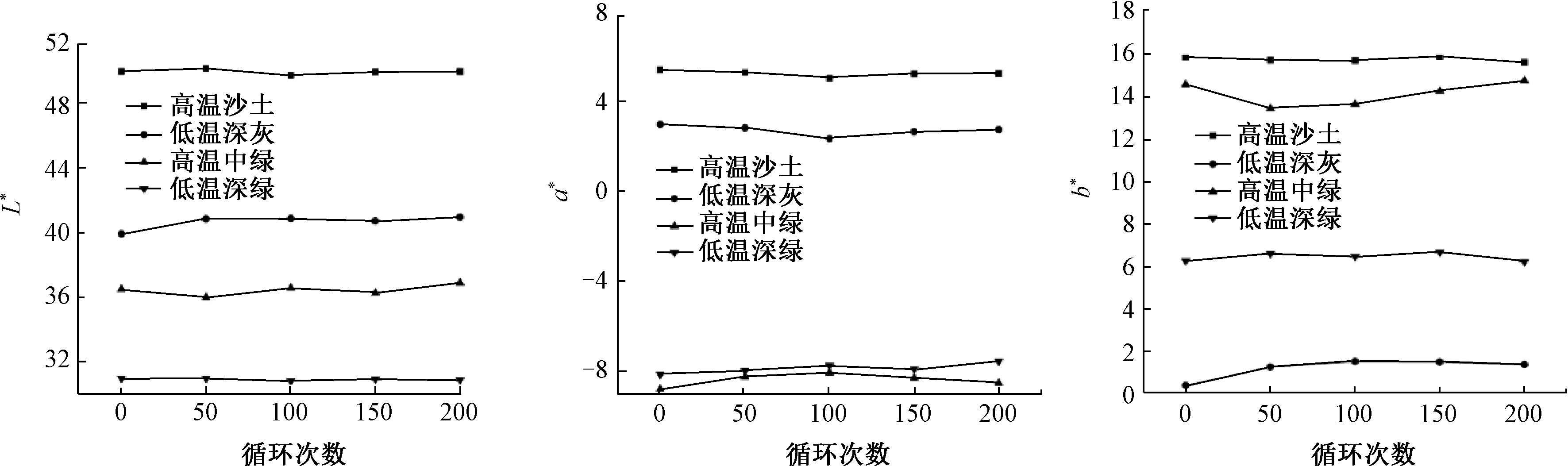
Color parameters of color blocks under different cycle"

Fig.6

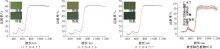
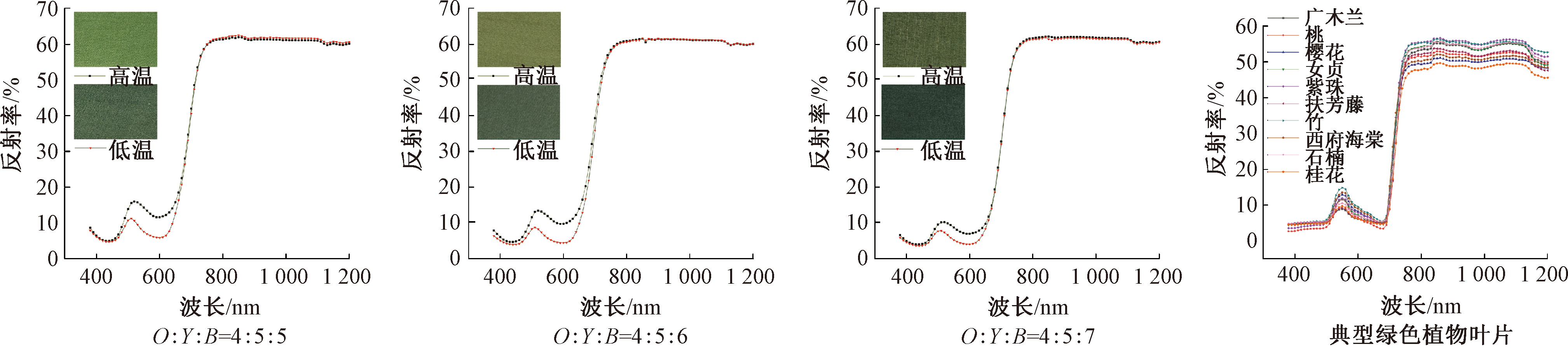
Reflection spectra curves of color blocks different contents of disperse dyes Blue S-GL and typical green plant leaves printed under"

Tab.3

Reflectance spectral fit data of samples to plant leaves"

叶片类型 高温 低温
拟合度 欧式距离 光谱角度/rad 拟合度 欧式距离 光谱角度/rad
380~
1 200 nm
400~
780 nm
780~
1 200 nm
400~
780 nm
780~
1 200 nm
380~
1 200 nm
400~
780 nm
780~
1 200 nm
400~
780 nm
780~
1 200 nm
广玉兰 0.983 0.549 0.514 0.256 0.023 0.982 2.289 0.496 0.265 0.024
0.987 0.526 0.640 0.245 0.013 0.985 2.280 0.621 0.257 0.013
樱花 0.987 0.507 0.749 0.220 0.011 0.985 2.374 0.730 0.250 0.012
女贞 0.985 0.484 0.506 0.238 0.027 0.984 2.371 0.488 0.255 0.028
紫珠 0.987 0.444 0.418 0.225 0.020 0.986 2.406 0.400 0.243 0.020
扶芳藤 0.983 0.558 0.630 0.329 0.025 0.982 2.281 0.611 0.305 0.025
0.986 0.437 0.422 0.228 0.011 0.984 2.494 0.403 0.260 0.012
桂花 0.985 0.600 0.859 0.242 0.018 0.983 2.230 0.840 0.258 0.019
石楠 0.984 0.506 0.486 0.244 0.021 0.983 2.355 0.467 0.259 0.022
西府海棠 0.988 0.466 0.701 0.210 0.014 0.986 2.421 0.682 0.243 0.014
标准值 ≤4.0 ≤17.2 ≤6.87 ≤4.0 ≤17.2 ≤6.87

Fig.7

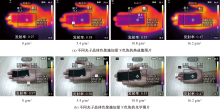
Thermal imaging images and emissivity of black color blocks. (a) Thermal imaging images of color blocks under different application amounts of photonic crystal color paste; (b) Optical images of color blocks under different application amounts of photonic crystal color paste"

Fig.8

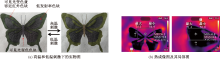
Bistable thermochromic printed fabric. (a) Physical images under high temperature and low temperature stimulation; (b) Thermal imaging and its local image"

Tab.4

Color fastness, hand feeling and mechanical properties of bistable color-changing fabric"

参数 耐皂洗色
牢度/级
耐摩擦色
牢度/级
耐日晒
色牢度/
主观指标

力学性能
方向 断裂强力/
N
断裂伸长
率/%
断裂功/
(N·mm)
平滑 柔软 温暖 综合
沾色 变色 干摩擦 湿摩擦
原布 0.51 0.49 0.67 0.54 1.2 经向 1 195 23.83 15 146
纬向 741 19.15 8 304
印花
织物
4 4 4 4 3~4 0.61 0.61 0.75 0.65 0.9 经向 1 269 35.06 27 605
纬向 814 25.19 13 201
[1] 叶景鹏. 热敏变色微胶囊的制备及其在纺织品上的应用研究[D]. 杭州: 浙江理工大学, 2022: 1-14.
YE Jingpeng. Preparation of thermochromic microcapsules and its application in textiles[D]. Hangzhou: Zhejiang University of Technology, 2022: 1-14.
[2] 胡安钟. 温致变色织物变色灵敏度提升方法研究[D]. 无锡: 江南大学, 2022: 1-6.
HU Anzhong. Research on the method of improving the color sensitivity of thermochromic fabrics[D]. Wuxi: Jiangnan University, 2022: 1-6.
[3] CHENG Y L, ZHANG X Q, FANG C Q, et al. Discoloration mechanism, structures and recent applications of thermochromic materials via different methods: a review[J]. Journal of Materials Science & Technology, 2018, 34(12): 2225-2234.
[4] 胡怡斌, 包妮沙, 刘善军, 等. 典型伪装材料高光谱特征及识别方法研究[J]. 光谱学与光谱分析, 2023, 43(1): 297-302.
HU Yibin, BAO Nisha, LIU Shanjun, et al. Research on hyperspectral features and identification methods of typical camouflage materials[J]. Spectroscopy and Spectral Analysis, 2023, 43(1): 297-302.
[5] LIU L, ZHANG K Q, LIU H Y, et al. Experimental study on the interfacial heat transfer of sessile droplet evaporation using temperature-sensitive paint[J]. Experimental Thermal and Fluid Science, 2021. DOI: 10.1016/j.expthermflusci.2021.110436.
[6] WANG Y, YU M, GAO Y, et al. Three-layer composite coatings with compatibility of low infrared emissivity and high wave transmittance[J]. Journal of Alloys and Compounds, 2023. DOI: 10.1016/j.jall-com.2023.169038.
[7] ZHANG W G, LV D D. Preparation and characterization of Ge/TiO2 one-dimensional photonic crystal with low infrared-emissivity in the 8-14 μm band[J]. Materials Research Bulletin, 2019. DOI: 10.1016/j.materresbull.2019.110747.
[8] WANG C C, GONG X D, LI J S, et al. Ultrahigh-sensitivity thermochromic smart fabrics and flexible temperature sensors based on intramolecular proton-coupled electron transfer[J]. Chemical engineering journal, 2022. DOI: 101016/j.cej.2022.136444.
[9] 钟子恒. 耐晒温致变色织物的制备及性能研究[D]. 无锡: 江南大学, 2023: 3-11.
ZHONG Ziheng. Preparation and properties of sun-resistant thermochromic fabrics[D]. Wuxi: Jiangnan University, 2023: 3-11.
[10] ZHANG W, JI X Z, PENG J B, et al. High-Performance thermoresponsive dual-output dye system for smart textile application[J]. Advanced Functional Materials, 2019. DOI: 10.1002/adfm.201906463.
[11] 张典典, 李敏, 关玉. 仿植被可见光-近红外反射光谱特征的分散染料印花织物制备及其性能[J]. 纺织学报, 2023, 44(1): 142-148.
ZHANG Diandian, LI Min, GUAN Yu, et al. Preparation and properties of disperse dye printed fabrics imitating the characteristics of visible-near infrared reflectance spectra of vegetation[J]. Journal of Textile Research, 2023, 44(1): 142-148.
[12] WU F, CHEN M Y, CHEN Z X, et al. Omnidirectional terahertz photonic band gap broaden effect in one-dimensional photonic crystal containing few-layer graphene[J]. Optics Communications, 2021.DOI: 10.1016/j.optcom.2021.126898.
[13] 于献, 郁飞, 倪维良, 等. 黄绿色红外低发射率无光涂层的制备及表征[J]. 涂料工业, 2015, 45(5): 18-22.
YU Xian, YU Fei, NI Weiliang, et al. Preparation and characterization of yellow-green infrared low emissivity matt coating[J]. Coating Industry, 2015, 45(5): 18-22.
[1] LUO Qiaoling, FU Shaohai, WANG Dong, WANG Meihui, GUO Yafei, HAO Xinmin. Dyeing of bio-based polyamide 56 with weak acidic dyes for green vegetation imitation [J]. Journal of Textile Research, 2025, 46(02): 130-137.
[2] LU Hui, CAI Qinze, ZHANG Guoqing, ZHOU Lan, LIU Guojin, SHAO Min. Preparation of multi-colorant photochromic microcapsules and their photochromic properties in fabrics [J]. Journal of Textile Research, 2025, 46(01): 111-118.
[3] WANG Bo, JIANG Zhiqing, BAO Junfang, LIU Jinwei. Research progress in geographic origin traceability technology for cotton fibers [J]. Journal of Textile Research, 2024, 45(11): 244-250.
[4] LIU Wenjing, ZHANG Xinrui, ZHAO Xiaoman, HONG Jianhan, WANG Hongbo, HAN Xiao. Research progress in microcapsules of phase change materials [J]. Journal of Textile Research, 2024, 45(09): 235-243.
[5] WEN Jiaqi, LI Xinrong, FENG Wenqian, LI Hansen. Rapid extraction of edge contours of printed fabrics [J]. Journal of Textile Research, 2024, 45(05): 165-173.
[6] SUN Langtao, YANG Yushan. Preparation of thermoregulation and antibacterial microcapsules and its application in cotton fabrics [J]. Journal of Textile Research, 2024, 45(02): 171-178.
[7] SHUAI Qi, SUN Shuo, CHENG Shijie, ZHANG Hongwei, ZUO Danying. Effect of isocyanate microcapsules on UV protection of carbon quantum dot finished cotton fabrics [J]. Journal of Textile Research, 2023, 44(08): 126-132.
[8] ZHAO Mingshun, CHEN Xiaoxiong, YU Jinchao, PAN Zhijuan. Spinning and microstructure and properties of photochromic polylactic acid fibers [J]. Journal of Textile Research, 2023, 44(07): 10-17.
[9] TAN Jialing, LIU Jiayin, YU Weidong, YIN Yunjie, WANG Chaoxia. Preparation and properties of multichromatic thermochromic cotton fabrics using SiO2 microcapsules [J]. Journal of Textile Research, 2023, 44(07): 167-174.
[10] WANG Guoqin, FU Xiaohang, ZHU Yuke, WU Liguang, WANG Ting, JIANG Xiaojia, CHEN Huali. Photodegradation mechanism and pathway of visible light-response mesoporous TiO2 for Rhodamine B [J]. Journal of Textile Research, 2023, 44(05): 155-163.
[11] ZHANG Diandian, LI Min, GUAN Yu, WANG Sixiang, HU Huanchuan, FU Shaohai. Preparation and performance of disperse dye printed fabrics with characteristics of vegetation-like Vis-NIR reflectance spectrum [J]. Journal of Textile Research, 2023, 44(01): 142-148.
[12] WANG Rui, SI Yinsong, LU Haohao, GAO Shuang, FU Yaqin. Rapid quantitative detection of silk grafting ratio based on near infrared spectroscopy [J]. Journal of Textile Research, 2022, 43(11): 29-34.
[13] ZHOU Xiaoju, HU Zhenglong, REN Yiming, XIE Landong. Fabrication and photocatalyic performance of Bi2MoO6 modified TiO2 nanorod array photocatalyst [J]. Journal of Textile Research, 2022, 43(10): 97-105.
[14] YANG Mengfan, WANG Chaoxia, YIN Yunjie, QIU Hua. Printing and photochromic properties of spiropyran microcapsules on cotton fabrics [J]. Journal of Textile Research, 2022, 43(09): 137-142.
[15] CHENG Yanting, MENG Jiaguang, XUE Tao, ZHI Chao. Preparation of 3D printed weft plain knitted fabric [J]. Journal of Textile Research, 2022, 43(09): 115-119.
Viewed
Full text


Abstract

Cited

  Shared   
  Discussed   
No Suggested Reading articles found!