Journal of Textile Research ›› 2025, Vol. 46 ›› Issue (08): 102-110.doi: 10.13475/j.fzxb.20240903001

• Textile Engineering • Previous Articles     Next Articles

Fabric texture regularity characterization based on contrast perception of texture primitives

GUO Yanchi, PAN Ruru, ZHOU Jian()   

  1. Key Laboratory of Eco-Textiles(Jiangnan University), Wuxi, Jiangsu 214122, China
  • Received:2024-09-18 Revised:2025-04-22 Online:2025-08-15 Published:2025-08-15
  • Contact: ZHOU Jian E-mail:jzhou@jiangnan.edu.cn

Abstract:

Objective Regularity (periodicity), as one of the most important attribute features of texture images, is a key index for classifying and describing texture images. Relating to the unique production process of woven fabrics, the texture of woven fabric images exhibits a high degree of regularity, which is a typical structural texture. Therefore, utilizing regularity to describe the surface attributes of fabric textures is of great practical significance in the fields of fabric classification, fabric retrieval, and fabric apparent quality detection and evaluation.

Method This paper first proposes four metrics for characterizing the regularity of fabric textures based on the spatial arrangement of primitive elements and human visual perception factors (grey scale contrast, structural symmetry and edge consistency). Then, significant peaks and valleys are extracted by threshold division on autocorrelation Pearson coefficients and distance matching function curves, and the relationship between peaks and valleys is used to achieve the characterization of the above metrics. Finally, the weighted summation is used to perform the comprehensive characterization of texture regularity.

Results The overall regularity metrics are validated using different types of fabric samples and some structured textures from the Brodatz Album. The results show that for fabric texture, the proposed metric is able to achieve the characterization of the regularity of fabric texture and distinguish effectively textures with different degrees of regularity. In addition, the comparison with other methods shows that the proposed metric is more in line with the visual perception law of the human eye and has a higher accuracy rate. Under the understanding that the textures in the Brodatz Album usually show a high degree of regularity and have a relatively large and unique size of the periodic unit, two different combinations of the weights are discussed in order to find the most suitable weights, and calculate the overall degree of regularity of the texture with the proposed metric under the weight. It is concluded from the discussion that the proposed metric can also achieve the characterization of the regularity of fabric textures. The results show that the proposed metrics are capable of extracting structural textures other than near-regular fabric textures.

Conclusion The texture regularity index is subdivided from the perspective of the visual perception of the human eye, so as to achieve the characterization of texture regularity in a more comprehensive and detailed way. The experimental results show that the proposed metrics are not only applicable to fabric textures with small and soft sizes, but can also characterize the regularity of various specific types of texture images by combining the importance of different metrics and applying different weights. In the future, the proposed metrics can be considered to be combined with other attribute features of texture images for practical applications such as texture classification and defect detection.

Key words: fabric texture, texture regularity, contrast, autocorrelation Pearson coefficient, human visual feature

CLC Number: 

  • TS111

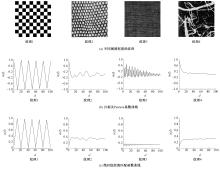
Fig.1

Autocorrelation Pearson coefficients and absolute value DMF corresponding to textures with different degree of regularity. (a)Textures with varying degrees of regularity;(b)Autocorrelation Pearson coefficient curve; (c)Absolute distance matching function curve"

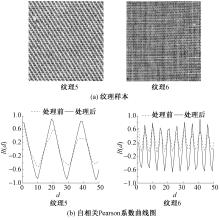
Fig.2

Example for calculation of spatial alignment regularity Rpos. (a)Texture samples;(b)Autocorrelation Pearson coefficient curves"

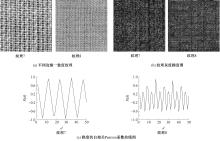
Fig.3

Example for calculation of edge consistency Rmag. (a)Textures with varying edge consistency; (b)Grayscale gradient representation of textures;(c)Autocorrelation Pearson coefficient curve of gradients"

Tab.1

Calculation results of fabric texture regularity"

样本
编号
按行方向展开 按列方向展开 R
Rpos Rcon Rsym Rmag Rx Rpos Rcon Rsym Rmag Ry
T1 0.911 0.748 0.605 0.906 0.830 0.874 0.719 0.576 0.812 0.788 0.809
T2 0.898 0.649 0.877 0.898 0.797 0.946 0.650 0.942 0.964 0.830 0.814
T3 0.909 0.721 0.646 0.883 0.816 0.871 0.711 0.757 0.783 0.788 0.802
T4 0.933 0.667 0.705 0.919 0.812 0.945 0.693 0.895 0.442 0.766 0.789
P1 0.506 0.466 0.000 0.570 0.474 0.434 0.435 0.000 0.627 0.441 0.458
P2 0.441 0.421 0.000 0.721 0.452 0.473 0.383 0.000 0.704 0.448 0.450
P3 0.899 0.405 0.000 0.851 0.650 0.792 0.556 0.673 0.916 0.710 0.680
P4 0.895 0.299 0.000 0.539 0.558 0.923 0.387 0.386 0.537 0.524 0.591
P5 0.769 0.410 0.000 0.936 0.612 0.416 0.488 0.477 0.871 0.516 0.564
P6 0.459 0.358 0.000 0.526 0.406 0.457 0.280 0.000 0.595 0.384 0.395
P7 0.906 0.310 0.000 0.691 0.590 0.875 0.336 0.488 0.436 0.574 0.582
P8 0.486 0.341 0.302 0.511 0.423 0.504 0.367 0.375 0.448 0.434 0.429
S1 0.916 0.540 0.949 0.950 0.772 0.978 0.540 0.957 0.804 0.776 0.774
S2 0.813 0.711 0.951 0.612 0.749 0.936 0.740 0.827 0.365 0.767 0.758
C1 0.905 0.602 0.000 0.720 0.711 0.918 0.682 0.651 0.766 0.787 0.749
C2 0.842 0.597 0.766 0.898 0.749 0.942 0.609 0.629 0.845 0.779 0.764

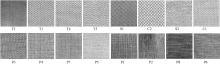
Fig.4

Fabrics arranged in descending order of final rule degree from high to low"

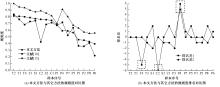
Fig.5

Comparison results of this paper's method with other methods. (a)Comparison diagram of regularity degrees between our method and other methods;(b)Comparative ranking chart of regularity levels between our method and other methods"

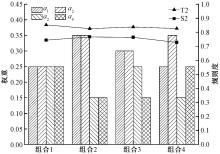
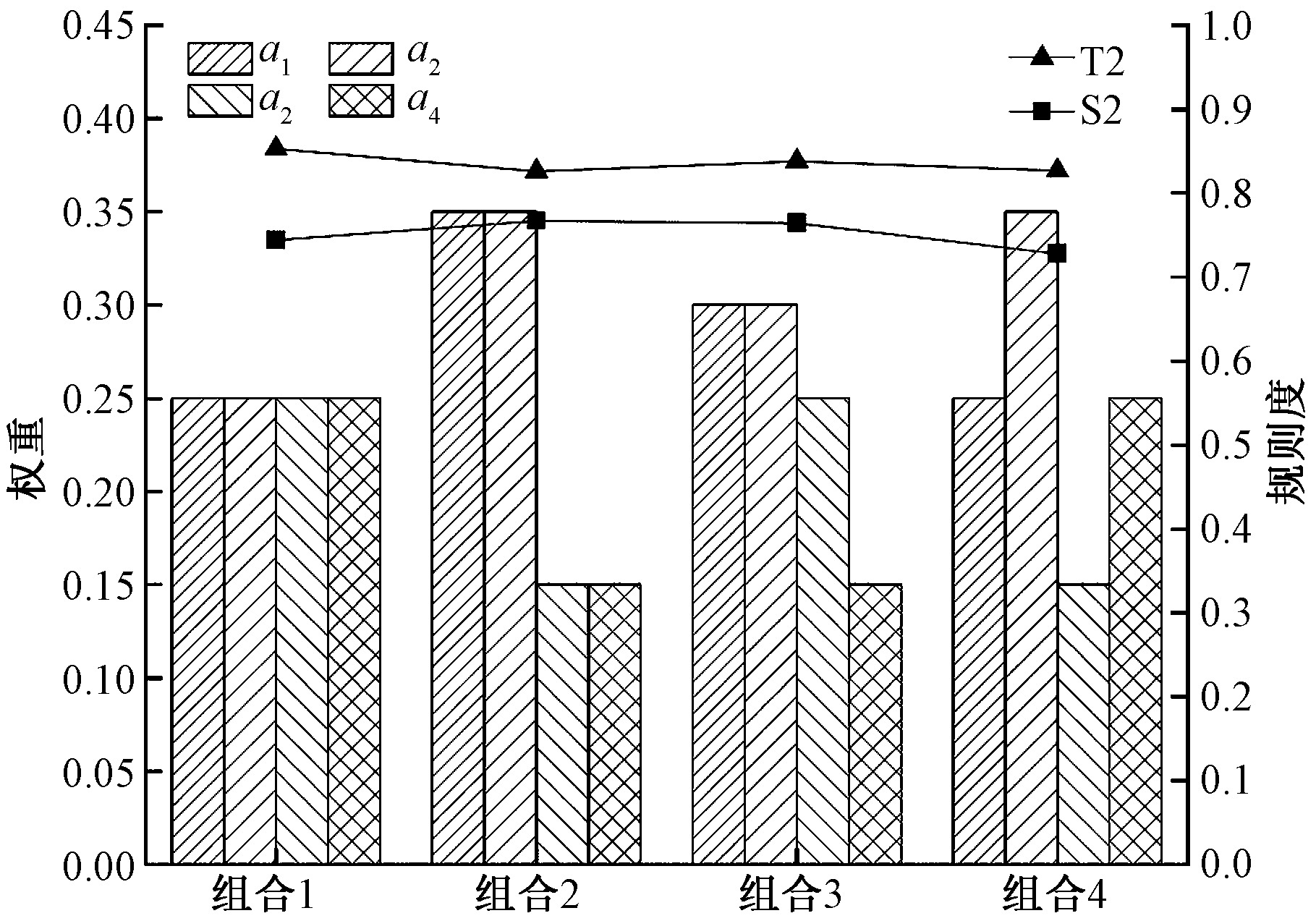
Fig.6

Changes in regularity of samples T2 and S2 with different combinations of weights"

Tab.2

Changes in ranking of samples T2 and S2 with different combinations of weights"

序号 权重 T2的排
名变化
S2的排
名变化
α1 α2 α3 α4
组合1 0.25 0.25 0.25 0.25 0 0
组合2 0.35 0.35 0.15 0.15 0 1
组合3 0.30 0.30 0.25 0.15 0 1
组合4 0.25 0.35 0.15 0.25 0 0

Tab.3

Calculation of texture regularity in Brodatz"

样本
名称
权重1 权重2
Rx Ry R Rx Ry R
D20 0.724 0.859 0.792 0.715 0.580 0.647
D22 0.788 0.551 0.670 0.666 0.476 0.571
D53 0.866 0.661 0.763 0.796 0.540 0.668
D67 0.625 0.514 0.570 0.472 0.388 0.430
D101 0.898 0.910 0.904 0.724 0.737 0.730
D102 0.868 0.882 0.875 0.726 0.722 0.724
D103 0.794 0.748 0.771 0.564 0.534 0.549
D104 0.745 0.715 0.730 0.559 0.521 0.540

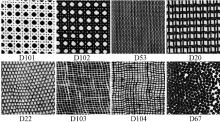
Fig.7

Texture samples in Brodatz are arranged in descending order of overall regularity"

[1] PROTONOTARIOS E D, GRIFFIN L D, JOHNSTON A, et al. A spatial frequency spectral peakedness model predicts discrimination performance of regularity in dot patterns[J]. Vision Research, 2018, 149: 102-114.
doi: S0042-6989(18)30107-X pmid: 29958873
[2] ZHIVAGO K A, ARUN S P. Texture discriminability in monkey inferotemporal cortex predicts human texture perception[J]. Journal of Neurophysiology, 2014, 112(11): 2745-55.
doi: 10.1152/jn.00532.2014 pmid: 25210165
[3] LEU J G. On indexing the periodicity of image textures[J]. Image and Vision Computing, 2001, 19(13): 987-1000.
[4] HARALICK R M. Statistical and structural approaches to texture[J]. Proceedings of the IEEE, 1985, 2: 304-322.
[5] HUANG Y, DE B V, ZHOU F G, et al. Review of wavelet-based unsupervised texture segmentation, advantage of adaptive wavelets[J]. Iet Image Processing, 2018, 12 (9): 1626-1638.
[6] 朱浩, 丁辉, 尚媛园, 等. 多纹理分级融合的织物缺陷检测算法[J]. 纺织学报, 2019, 40 (6): 118-125.
ZHU Hao, DING Hur, SHANG Yuanyuan, et al. Defect detection algorithm for multiple texture hierarchical fusion fabric[J]. Journal of Textile Research, 2019, 40(6): 118-125.
[7] 吴莹, 占竹, 汪军. 基于通用字典的局部机织物纹理稳定表征[J]. 纺织学报, 2019, 40 (11): 45-49.
doi: 10.13475/j.fzxb.20181100806
WU Ying, ZHAN Zhu, WANG Jun. Local fabric texture stability characterization using general dictionary[J]. Journal of Textile Research, 2019, 40 (11): 45-49.
doi: 10.13475/j.fzxb.20181100806
[8] SUN H C, KINGDOM F A A, BAKER C L. Perceived regularity of a texture is influenced by the regularity of a surrounding texture[J]. Scientific Reports, 2019, 9(1): 1637.
[9] SUN H C, ST-AMAND D, BAKER C, et al. Visual perception of texture regularity: Conjoint measurements and a wavelet response-distribution model[J]. Plos Computational Biology, 2021, 17 (10): e1008802.
[10] CHETVERIKOV D. Pattern regularity as a visual key[J]. Image and Vision Computing, 2000, 18 (12): 975-985.
[11] DO M N, VETTERLI M. Wavelet-based texture retrieval using generalized gaussian density and kullback-leibler distance[J]. IEEE Transactions on Image Processing, 2002, 11 (2): 146-158.
doi: 10.1109/83.982822 pmid: 18244620
[12] LEE K L, CHEN L H. An efficient computation method for the texture browsing descriptor of MPEG-7[J]. Image and Vision Computing, 2005, 23 (5): 479-489.
[13] NGAN H Y T, PANG G K H. Regularity analysis for patterned texture inspection[J]. IEEE Transactions on Automation Science and Engineering, 2009, 6 (1): 131-144.
[14] CHETVERIKOV D, HANBURY A. Finding defects in texture using regularity and local orientation[J]. Pattern Recognition, 2002, 35 (10): 2165-2180.
[15] 蒋圣, 汤国安, 刘凯. 利用累加距离匹配函数的纹理规则度计算方法[J]. 计算机辅助设计与图形学学报, 2015, 27 (10): 1874-1880.
JIANG Sheng, TANG Guoan, LIU Kai. A computation method of texture regularity using summed-up distance matching function[J]. Journal of Computer-Aided Design & Computer Graphics, 2015, 27 (10): 1874-1880.
[16] VARADARAJAN S, KARAM L J. A no-reference texture regularity metric based on visual saliency[J]. IEEE Transactions on Image Processing, 2015, 24(9): 2784-2796.
[17] 姜丰, 朱家玲, 胡开永, 等. Pearson相关系数评价ORC系统蒸发器特性的应用研究[J]. 太阳能学报, 2019, 40 (10): 2732-2738.
JIANG Feng, ZHU Jialing, HU Kaiyong, et al. Applied research to assess envapopator performances in ORC system by pearson correlation coefficient[J]. Acta Energiae Solaris Sinica, 2019, 40 (10): 2732-2738.
[18] OH G, LEE S, SHIN S Y. Fast determination of textural periodicity using distance matching function[J]. Pattern Recognition Letters, 1999, 20 (2): 191-197.
[19] DONG X H, DONG J Y, CHANTLER M J. Perceptual texture similarity estimation: an evaluation of computational features[J]. IEEE Transactions on Pattern Analysis and Machine Intelligence, 2021, 43(7): 2429-2448.
[20] CHEN S C, CHIU C C. Texture construction edge detection algorithm[J]. Applied Sciences, 2019, 9(5): 897.
[1] WU Ying, ZHAN Zhu, WANG Jun. Local fabric texture stability characterization using general dictionary [J]. Journal of Textile Research, 2019, 40(11): 45-49.
[2] ZHU Hao, DING Hui, SHANG Yuanyuan, SHAO Zhuhong. Defect detection algorithm for multiple texture hierarchical fusion fabric [J]. Journal of Textile Research, 2019, 40(06): 117-124.
[3] DU Shuai, LI Yueyang, WANG Mengtao, LUO Haichi, JIANG Gaoming. Fabric defect detection based on improved local adaptive contrast method [J]. Journal of Textile Research, 2019, 40(02): 38-44.
[4] . Woven fabric texture representation and application based on K-SVD dictionary [J]. JOURNAL OF TEXTILE RESEARCH, 2018, 39(02): 165-170.
[5] . Sparse representation of woven fabric texture based on discrete cosine transform over-complete dictionary [J]. JOURNAL OF TEXTILE RESEARCH, 2018, 39(01): 157-163.
[6] . Study on woven fabric texture using frequency spectrum [J]. Journal of Textile Research, 2015, 36(07): 55-60.
[7] . Detection of foreign fibers among cotton based on image multi-resolution difference method [J]. JOURNAL OF TEXTILE RESEARCH, 2014, 35(5): 13-0.
[8] CHEN Li-Hua. Contrasts between different formaldehyde test standards of textiles and regression analysis of formaldehyde determination results [J]. JOURNAL OF TEXTILE RESEARCH, 2012, 33(8): 87-91.
[9] WANG Xiu-Chen, LI Xiao-Jiu. Fuzzy recognition of fabric texture with double conditions [J]. JOURNAL OF TEXTILE RESEARCH, 2012, 33(8): 55-58.
[10] ZHANG Chang-Huan, CHEN Li-Hua.  Difference of textile pH value detection standards and correlation analysis of detection results [J]. JOURNAL OF TEXTILE RESEARCH, 2012, 33(5): 46-49.
[11] MAO Chengdong;ZHANG Mingguang;GUO Xin. Test and analysis of the bubbling aperture of woven filter cloth [J]. JOURNAL OF TEXTILE RESEARCH, 2008, 29(5): 39-41.
Viewed
Full text


Abstract

Cited

  Shared   
  Discussed   
No Suggested Reading articles found!