Journal of Textile Research ›› 2025, Vol. 46 ›› Issue (08): 199-208.doi: 10.13475/j.fzxb.20241206201

• Apparel Engineering • Previous Articles     Next Articles

Development and performance research of saw-resistant clothing

WANG Xu1(), WAN Tengshu1,2, CUI Jing1, ZHAO Chunwang1, LIU Junwei1, HU Kuncai1, ZHANG Yichun1, XIAO Chaojie3   

  1. 1. School of Fashion, Henan University of Engineering, Zhengzhou, Henan 451191, China
    2. Research Institute of Textile and Clothing Industries, Zhongyuan University of Technology, Zhengzhou, Henan 451191, China
    3. Tomax Garments Factory, Xinxiang, Henan 453000, China
  • Received:2024-12-26 Revised:2025-04-24 Online:2025-08-15 Published:2025-08-15

Abstract:

Objective The research and development of special protective clothing is of vital importance for ensuring the safety of personnel in high-risk industries. Currently, most of the saw-resistant clothing in China are developed by imitation, which have problems such as poor wearing comfort. To effectively protect the occupational health of practitioners of hand-held electric chain saws, a series of saw-resistant clothing that meet the requirements of both protection and comfort and conform to ergonomics have been developed.

Method The characteristics of saw-resistant clothing were analyzed and summarized by 86 types of saw-resistant clothing collecting from both domestic and foreign. 6 types of clothing fabric and 6 types of saw-resistant interlayer fabric were selected to compare and analyze their air permeability, moisture permeability, insulation, abrasion resistance, tear strength and saw-resistant performance respectively. The comprehensive performances evaluation of the saw-resistant materials were conducted by the gray near-optimal method in order to select the best garment fabric. 10 male volunteers with body type close to 175/92A were invited to complete the ergonomic evaluation for four types of self-design saw-resistant suit.

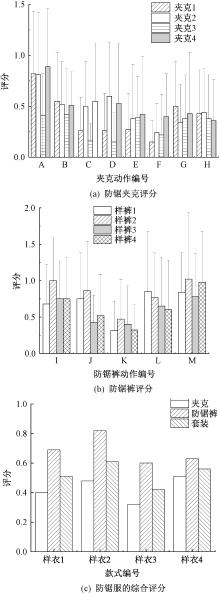
Results It was found that the style variations of the saw-resistant jackets mainly focus on the aspects such as silhouette, collar type, sleeve type, cuffs, pockets and opening design, while the style variations of the saw-resistant pants are mainly reflected in the functional designs such as waist, pockets and knees. To ensure the protective performance of saw-resistant clothing, the outer fabric of saw-resistant clothing usually adopts woven fabric with good wear resistance, and the protective interlayer between the fabric and the lining is made of multi-layer cut-resistant fiber fabric or blocking materials. The research conducts style and structure design based on the design principles of sportswear, and fully considers factors such as wearing occasions and working methods, improving the comfort, functionality and safety of saw-resistant clothing. The comfort and mechanical performance indicators of six kinds of outdoor sportswear fabric were compared in the experiments. It was found that the Cordura fabric had outstanding breathability, moisture permeability, wear resistance and tear resistance, the lowest heat preservation rate, and good heat dissipation effect. The performance of the six kinds of saw-resistant fabric were comprehensively evaluated. It was found that the UHMWPE fabric had the best comprehensive performance. The number of cutting layers of saw-resistant fabric is inversely proportional to its tightness. The greater the tightness of the fabric is, the fewer the number of cutting layers is, and the better the saw-resistant performance will be. The higher the breaking strength and elongation at break of the fibers are, the better the saw-resistant performance of the fabric will be. By comparing the ergonomic test results of four kinds of saw-resistant jacket and four kinds of saw-resistant pants, the movement freedom of saw-resistant jacket is higher than that of saw-resistant pants. Elastic fabric can provide sufficient movement freedom for clothing. The structural design method of continuous cutting of the shoulder and sleeve can reduce the restrictions on arm movement. The comprehensive score of the third type of saw-resistant suit is the lowest which indicates that this type of suit can better meet the ergonomic requirements, and has good sport comfort and activity freedom. This type of saw-resistant suit is almost unrestricted during movement and has a relatively reasonable structural and style design.

Conclusion This paper focuses on product design from aspects such as functionality, practicality and comfort, and develops saw-resistant clothing that meets the needs of electric chainsaw operators, minimizes potential occupational hazards for practitioners. It provides a theoretical basis for improving the safety protection effect and wearing comfort of anti-cutting clothing, which is conducive to promote the healthy development of the domestic saw-resistant clothing market and provide theoretical support and technical references for saw-resistant clothing manufacturers.

Key words: saw-resistant clothing, cut-resistant material, clothing style design, ergonomic, saw-resistant performance

CLC Number: 

  • TS941.2

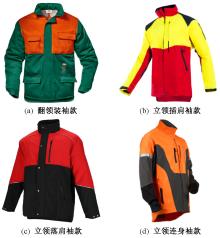
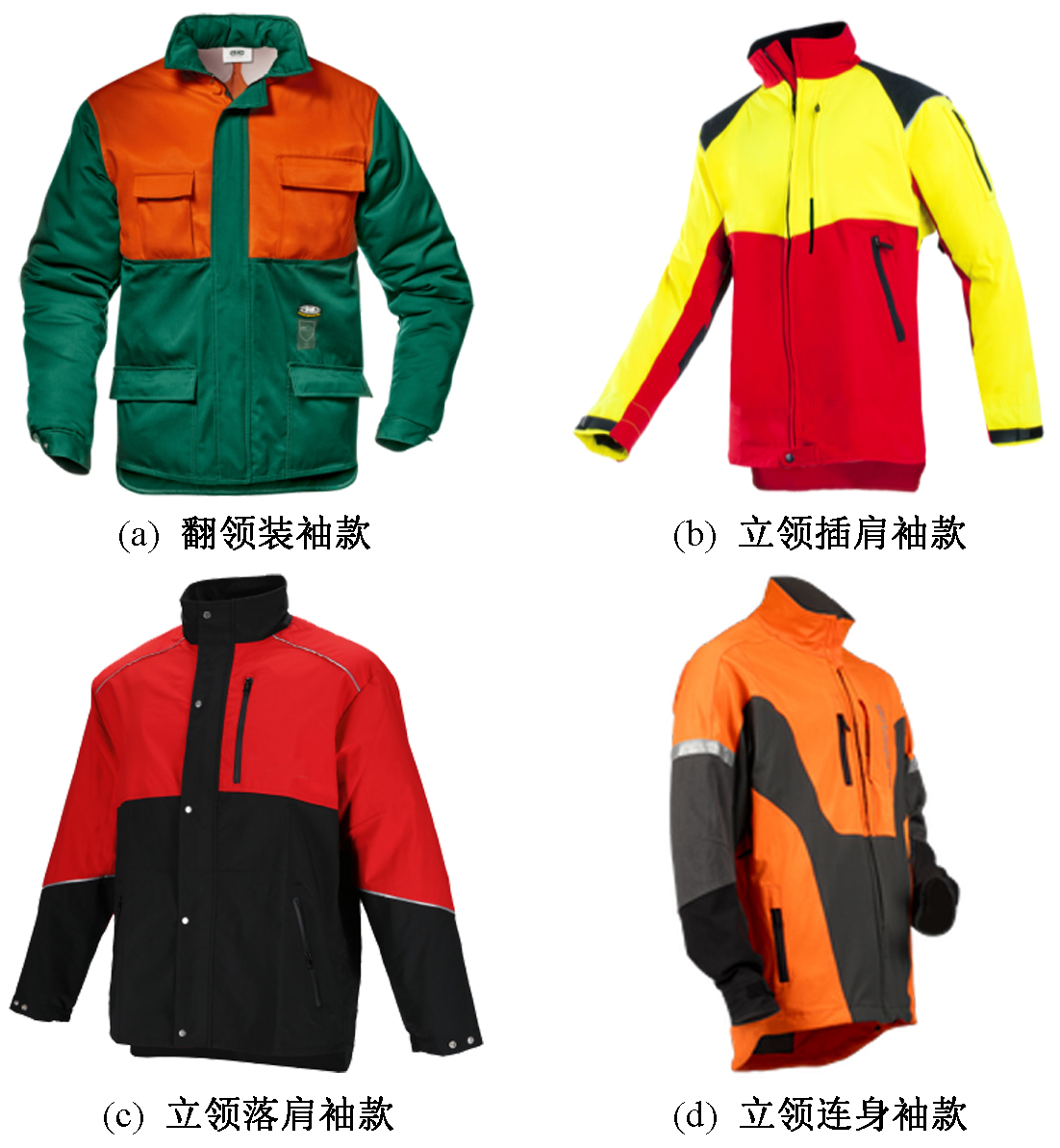
Fig.1

Different styles of saw-resistant jacket. (a) Lapels and sleeves style; (b) Stand collar and raglan sleeves style; (c) Stand collar dropped shoulder sleeves style; (d) Stand collar and jumpsuit sleeves style"

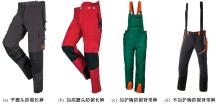
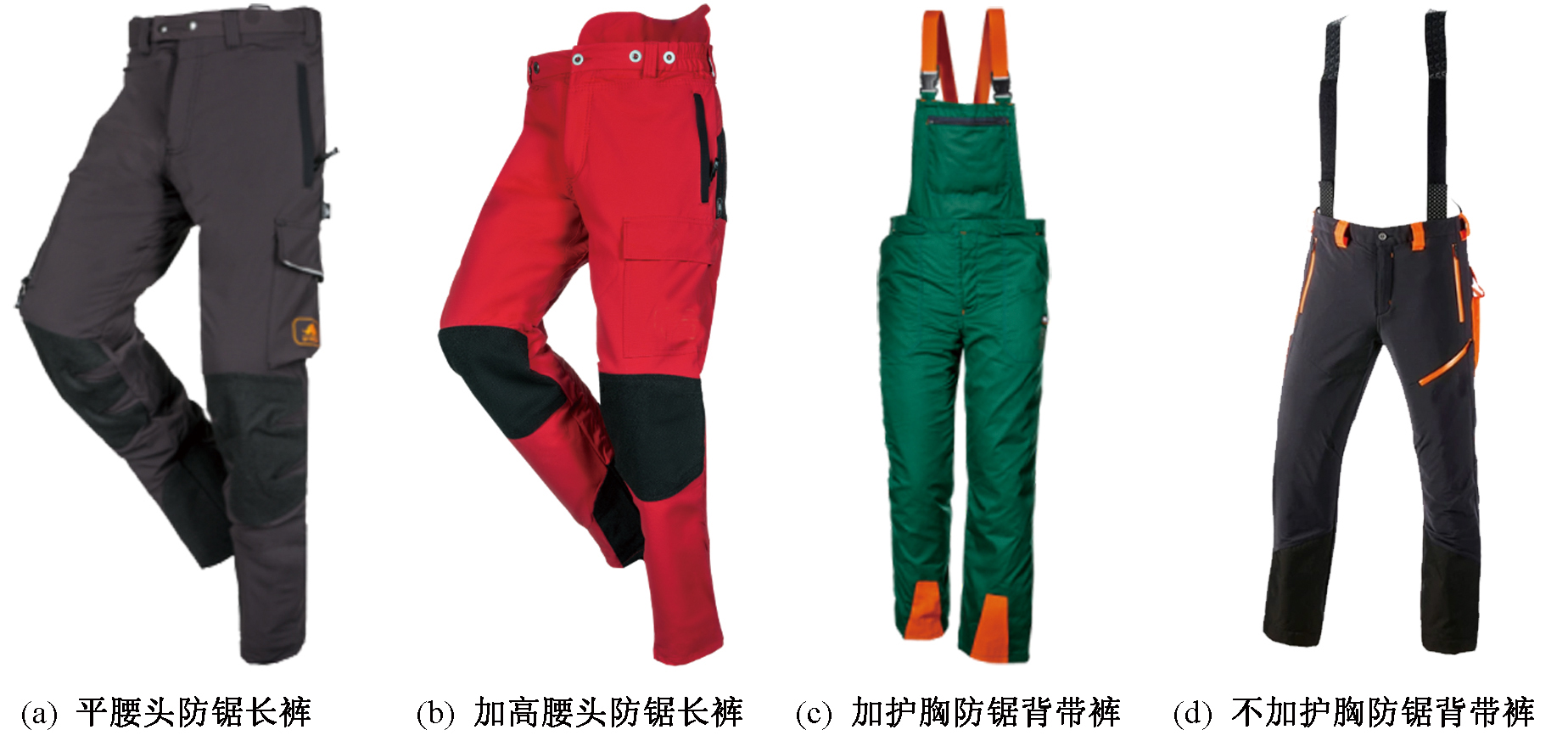
Fig.2

Different styles of saw-resistant pants. (a) Saw-resistant pants with flat waist band; (b) Saw-resistant pants with high waist band; (c) Saw-resistant braces with chest protection; (d) Saw-resistant braces without chest protection"

Tab.1

Specification parameters of six kinds fabric of outdoor sportswear"

编号 名称 原料 面密度/
(g·m-2)
厚度/
mm
经密/
(根·(10 cm)-1)
纬密/
(根·(10 cm)-1)
经纱线
密度/tex
纬纱线
密度/tex
1# 登山布 涤纶/氨纶(95/5) 320 0.96 556 290 22.2 22.2+28.9
2# 考杜拉织物 聚酰胺66 285 0.37 140 100 111.1 111.1
3# 斜纹布 涤纶 260 0.38 560 240 17.8 53.3
4# 登山布 锦纶/氨纶(90/10) 250 0.56 634 222 10.0 20.0+35.6
5# 登山布 涤纶 250 0.01 490 340 10.0 20.0
6# 牛津布 涤纶 200 0.14 184 110 72.2 72.5

Tab.2

Specification parameters of six kinds of saw-resistant interlayer fabric"

编号 原料 面密度/
(g·m-2)
厚度/
mm
密度/(根·(10 cm)-1) 线密度/tex 紧度/% 总紧
度/%
经密 纬密 经纱 纬纱 径向 纬向
7# UHMWPE纤维 170 0.62 66 48 111.1 111.1 25.5 18.5 39.3
8# UHMWPE纤维 175 0.53 76 46 111.1 111.1 29.3 17.7 41.9
9# UHMWPE纤维 144 0.37 36 38 166.7 111.1 17.0 18.0 31.9
10# UHMWPE纤维 240 0.40 94 90 111.1 111.1 36.3 34.7 58.4
11# 碳纤维 250 0.14 58 56 200.0 200.0 23.9 23.1 41.5
12# 芳纶 240 0.22 72 72 155.6 155.6 26.6 26.6 46.1

Tab.3

Test results of comfort and mechanical properties of outer fabric of saw-resistant clothing"

编号 透气率/
(mm·
s-1)
透湿率/
(g·m-2·
h-1)
保温
率/%
耐磨性/
(g·m-2)
撕裂强力/N
经纱 纬纱
1# 72.27 212.37 42.05 0.048 107.16 125.81
2# 189.30 226.40 8.72 1.036 426.95 440.92
3# 71.17 195.52 31.28 0.273 99.39 95.95
4# 26.46 210.25 19.49 0.386 116.04 97.24
5# 0.45 6.48 18.97 0.530 13.61 24.53
6# 0.50 15.67 19.49 0.522 123.18 103.82

Tab.4

Test results of comfort and saw-resistant properties of saw-resistant interlayer fabric"

编号 透气率/
(mm·s-1)
透湿率/
(g·m-2·h-1)
保温率/
%
切穿
层数
7# 1 012.85 212.60 48.21 3
8# 935.58 229.70 48.21 2
9# 1 869.30 211.31 30.77 4
10# 85.14 178.68 45.64 1
11# 54.36 195.89 35.90 6
12# 8.43 147.23 34.36 2

Fig.3

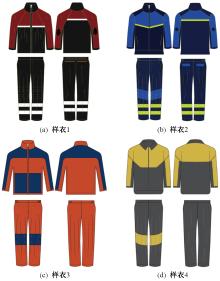
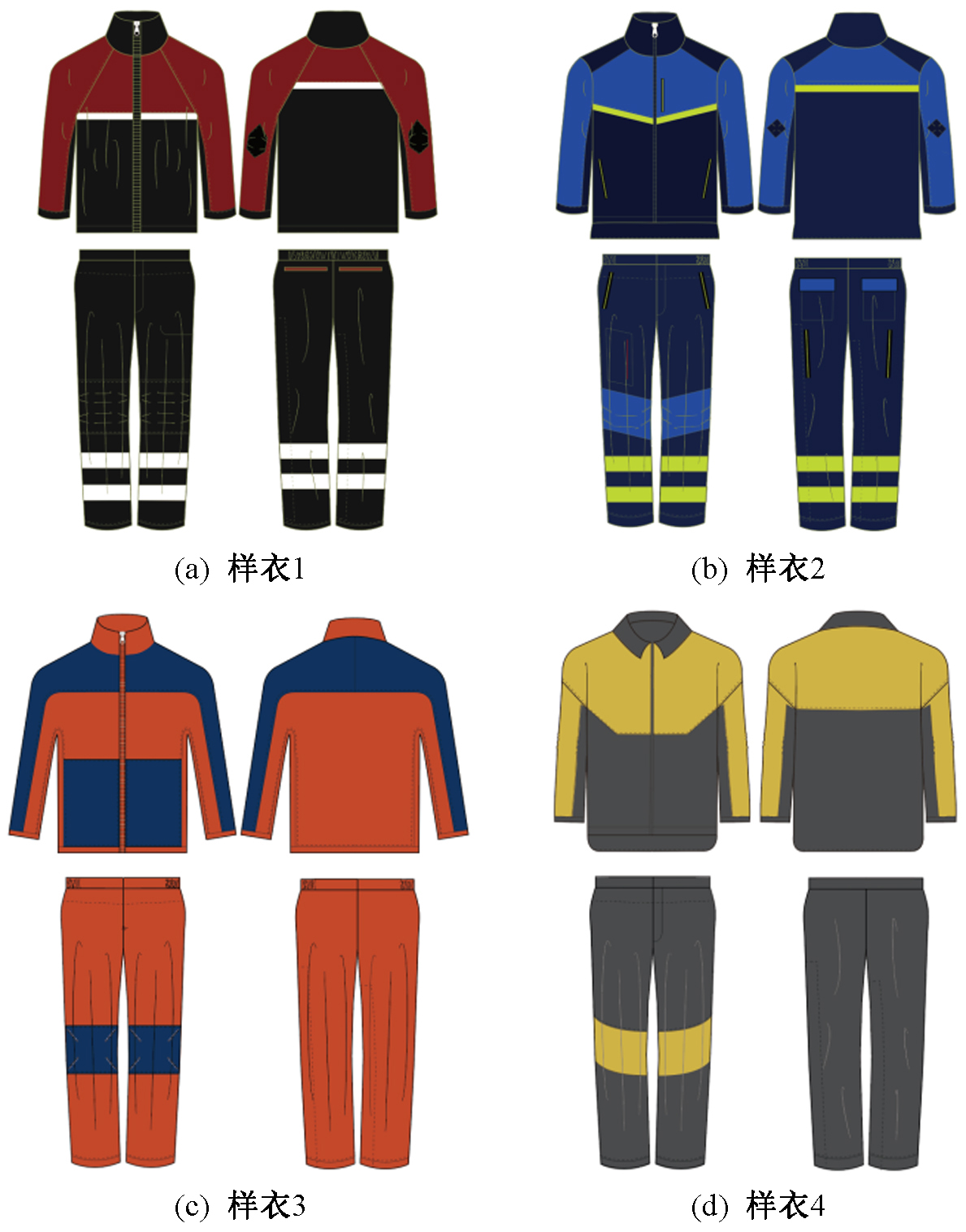
Style diagram of 4 kinds of saw-resistant suit. (a) Sample 1; (b) Sample 2; (c) Sample 3; (d) Sample 4"

Tab.5

Size chart of specifications for saw-resistant jacket cm"

款式 前衣
后衣
袖长 胸围 领围 肩宽 袖口 前领
后领
领座
翻领
样衣1 72 74 58 128 54 48 36 7.5 8
样衣2 72 77 60 128 53 48 36 7.5 8
样衣3 72 74 60 128 54 48 36 7.5 7
样衣4 72 74 60 128 56 48 36 2.5 6

Fig.4

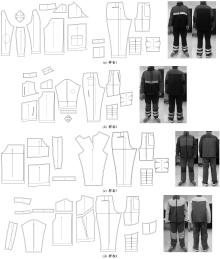
Industrial samples and garment pictures of 4 sets of saw-resistant suit. (a) Sample 1; (b) Sample 2; (c) Sample 3; (d) Sample 4"

Fig.5

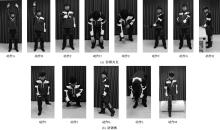
Ergonomic test action of saw-resistant suit. (a) Saw-resistant jacket; (b) Saw-resistant pants"

Tab.6

Standard movements of ergonomic"

服装
类型
动作
编号
动作描述
夹克 A 向前抬起手臂,使其高于头部
B 将手臂侧举至头顶上方
C 向前和侧向弯曲手臂
D 将躯干向前弯曲,双臂伸展
E 双腿弯曲,从地面捡起物体
F 双脚稍微分开站立,手持电锯,分别左右
90°转动身体
G 在电机不运转情况下握住电锯,像切割树枝
动作似的移动电锯
H 站在约800 mm高的工作台面前,双手合十,
操纵小物体
裤子 I 两腿弓步
J 身体下蹲
K 以正常行走速度行走5 m
L 检查防锯裤装与安全鞋是否有令人满意的重叠
M 跨过直径为(60±5) cm的管子

Fig.6

Ergonomic test score. (a) Score of saw- resistant jacket;(b) Score of saw-resistant pants; (c) Comprehensive score of saw-resistant suit"

[1] 周润康. 高温环境中防护服对人体热生理和心理影响的研究[D]. 西安: 西安科技大学, 2020: 1-2.
ZHOU Runkang. Study on the influence of personal protective clothing on human thermal physiological and psychological response in hot environment[D]. Xi'an: Xi'an University of Science and Technology, 2020: 1-2.
[2] 古丽努尔·伊克然周润康. 新疆金三角地区特种防护服款式设计研究[J]. 教育教学论坛, 2022(48): 161-162.
GURINUR Ikran. Research on the style design of special protective clothing in the golden triangle region of Xinjiang[J]. Education and Teaching Forum, 2022(48): 161-162.
[3] 刘东, 刘哲, 贾丽丽, 等. 特种防护服的技术发展趋势[J]. 皮革制作与环保科技, 2022, 3(24): 30-32.
LIU Dong, LIU Zhe, JIA Lili, et al. Technical development trend of special protective clothing[J]. Leather Manufacture and Environmental Technology, 2022, 3(24): 30-32.
[4] 郭晶, 李丽, 樊争科, 等. 个体安全防护用纺织品研究[J]. 针织工业, 2022(12):1-5.
GUO Jing, LI Li, FAN Zhengke, et al. Research of personal safety protective textiles[J]. Knitting Industries, 2022(12):1-5.
[5] 王曼青, 凌群民, 汪泽幸, 等. 人体工程学在特种防护服装结构设计中的应用[J]. 轻纺工业与技术, 2020, 49(10): 79-80, 86.
WANG Manqing, LING Qunmin, WANG Zexing, et al. Application of ergonomics in the structural design of special protective clothing[J]. Light and Textile Industry and Technology, 2020, 49(10): 79-80, 86.
[6] 叶卓然, 罗靓, 潘海燕, 等. 超高分子量聚乙烯纤维及其复合材料的研究现状与分析[J]. 复合材料学报, 2022, 39(9):4286-4309.
YE Zhuoran, LUO Liang, PAN Haiyan, et al. Research status and analysis of ultra-high molecular weight polyethylene fiber and its composites[J]. Acta Materiae Compositae Sinica, 2022, 39(9):4286-4309.
[7] 闫海燕. 超高分子量聚乙烯纤维产业现状及未来趋势[J]. 现代化工, 2024, 44(11):1-5.
doi: 10.16606/j.cnki.issn0253-4320.2024.11.001
YAN Haiyan. Development status and trend of ultra-high molecular weight polyethylene fiber industry[J]. Modern Chemical Industry, 2024, 44(11):1-5.
doi: 10.16606/j.cnki.issn0253-4320.2024.11.001
[8] 武博语, 王碧武, 邢俊杰, 等. UHMWPE纤维及其复合材料防刺性能概述[J]. 广东化工, 2023, 50(7):94-95, 93.
WU Boyu, WANG Biwu, XING Junjie, et al. Overview of stab resistance of UHMWPE fiber and its compo-sites[J]. Guangdong Chemical Industry, 2023, 50(7):94-95, 93.
[9] 杨勇胜. 防割装备现状及发展趋势[J]. 中国安全防范技术与应用, 2019(2):66-69.
YANG Yongsheng. Current situation and development trend of anti-cutting equipment[J]. China Security Protection Technology and Application, 2019(2):66-69.
[10] 王旭, 马海舒, 黄宏俊, 等. 一种防锯服装防锯性能检测装置及其检测方法: 202211216570.5[P]. 2023-01-03.
WANG Xu, MA Haishu, HUANG Hongjun, et al. An saw-resistant performance device and its detection method: 202211216570.5[P]. 2023-01-03.
[11] 张燕, 于淼. 基于人体工学的劳动防护服结构设计[J]. 劳动保护, 2024(1): 110-112.
ZHANG Yan, YU Miao. Structural design of labor protection clothing based on ergonomics[J]. Labour Protection, 2024(1): 110-112.
[12] RUCKMAN J E, MURRAY R, CHOI H. Engineering of clothing systems for improved thermophysiological comfort: the effect of openings[J]. International Journal of Clothing Science and Technology 1999, 10(1): 37-52.
[13] 张兰, 蒋晓文. 对流传热原理在服装设计中的应用分析[J]. 轻纺工业与技术, 2017(1): 30-34.
ZHANG Lan, JIANG Xiaowen. Analysis of the application of convective heat transfer principle in clothing design[J]. Light and Textile Industry and Technology, 2017(1): 30-34.
[14] 王建萍, 苗明珠, 沈德垚, 等. 仿生鸟羽结构针织面料开发与性能评价[J]. 纺织学报, 2022, 43(4): 55-61.
WANG Jianping, MIAO Mingzhu, SHEN Deyao, et al. Development and performance evaluation of knitted fabric with bionic bird feather structure[J]. Journal of Textile Research, 2022, 43(4): 55-61.
[15] 赵伟. 基于灰色近优法的织物服用性能评价[J]. 合成材料老化与应用, 2020, 49(3): 54-56.
ZHAO Wei. Wearability evaluation of fabrics based on grey near-optimal method[J]. Synthetic Materials Aging and Application, 2020, 49(3): 54-56.
[1] LIU Jinling, HE Yating, GU Bingfei. Classification and recognition of human head-neck-back curvature morphology for personalized curved-pillow design [J]. Journal of Textile Research, 2025, 46(08): 183-190.
[2] CONG Honglian, FANG Leimei, JIANG Fei, LI Huijian, YU Xuliang. Modular design of knitted protective jackets based on functional partitioning [J]. Journal of Textile Research, 2025, 46(05): 227-235.
[3] WANG Zhongyu, WANG Yunyi, WANG Shitan. Research progress in ergonomic performance of caps based on pressure measurement [J]. Journal of Textile Research, 2023, 44(12): 242-250.
[4] WANG Lu, HAN Xue, LOU Lin, HE Linghua, ZHOU Xiaohong. Development of electric-heating protective gloves and ergonomic experiments under extreme cold environment [J]. Journal of Textile Research, 2021, 42(05): 150-154.
[5] SHEN Jinzhu, ZHAO Xiaolu, ZHANG Fan, YU Qing, SU Junqiang. Design and ergonomic evaluation of flexible rehabilitation gloves [J]. Journal of Textile Research, 2020, 41(09): 119-127.
[6] . Development and evaluation of fuel protective coveralls [J]. Journal of Textile Research, 2015, 36(03): 88-91.
[7] . Advances in research of ergonomic evaluation for protective clothing [J]. JOURNAL OF TEXTILE RESEARCH, 2014, 35(1): 158-0.
[8] .  Development and ergonomic evaluation of overall for oil tank cleaner [J]. JOURNAL OF TEXTILE RESEARCH, 2013, 34(8): 105-0.
Viewed
Full text


Abstract

Cited

  Shared   
  Discussed   
No Suggested Reading articles found!