Journal of Textile Research ›› 2025, Vol. 46 ›› Issue (09): 213-224.doi: 10.13475/j.fzxb.20250306501

• Apparel Engineering • Previous Articles     Next Articles

Research on style design of Qing dynasty mandarin square based on Cycle GAN

LIU Beifen1, ZHANG Tantan2, FENG Zhengrong2   

  1. 1. School of Textile and Clothing, Anhui Polytechnic University, Wuhu, Anhui 241000, China
    2. Key Laboratory of Advanced Perception and Intelligent Control of High-end Equipment, Ministry of Education, Anhui Polytechnic University, Wuhu, Anhui 241000, China
  • Received:2025-03-31 Revised:2025-06-04 Online:2025-09-15 Published:2025-11-12

Abstract:

Objective An improved cycle generative adversarial network (Cycle GAN) style transfer method is proposed to address insufficient color preservation and loss of multi-layered pattern details when transferring Qing dynasty mandarin square badge styles, aiming to preserve these imperial rank insignia's cultural heritage while effectively reproducing their complex pattern systems through deep learning techniques.

Method The Qing dynasty mandarin square patterns were analyzed through pattern elements, color schemes, and compositional structure. Five style transfer models, i.e., self-discriminative cycle generative adversarial networks (SD GAN), no-independent-component-for-encoding GAN (Nice GAN), dual generative adversarial network (Dual GAN), generative adversarial networks that learns to discover relations between different domains (Disco GAN), and cycle generative adversarial network (Cycle GAN), were compared. Based on the recognition of Cycle GAN as the optimal foundation, three modifications were implemented, including adding feature fusion modules to the generator to enhance pattern detail capture, and simplifying the discriminator structure to preserve compositional features, and introducing perceptual loss functions to prevent pattern-background color merging.

Results The modified model demonstrated significant technical enhancements. The structural similarity index measure (SSIM) increased by 0.041, peak signal-to-noise ratio (PSNR) improved by 2.17 dB, mean squared error (MSE) decreased by 0.031, learned perceptual image patch similarity (LPIPS) reduced by 0.042, and the frÉchet inception distance (FID) index dropped by 4.157.

The modified model also generated clearer traditional motifs, particularly auspicious cloud patterns and sea-mountain designs. It effectively separated background colors from foreground patterns, enhancing layering effects and edge definition crucial to these historical insignia. The feature fusion mechanism in the generator captured multi-scale pattern features more effectively, preserving intricate details of emblematic elements while maintaining proportional relationships. This improvement appeared most notably in the preservation of fine line work and distinctive gradations in cloud and water motifs. The simplified discriminator better preserved pattern distribution logic and spatial relationships between decorative elements, maintaining the symbolic hierarchy inherent in these rank-signifying textiles. This improvement particularly affected the compositional integrity of central animal motifs (such as cranes or lions) that designated specific ranks. The perceptual loss functions addressed color bleeding between foreground and background elements, resulting in more precise color boundaries while maintaining harmonious transitions characteristic of traditional silk embroidery. The improved color fidelity preserved symbolic color associations while allowing adaptability to contemporary palettes.

Visual assessment confirmed the improved model reproduced the distinctive qualities of Qing dynasty mandarin squares more accurately, including balanced composition, symbolic coherence, and intricate detailing.

Conclusion This study systematically analyzed style transfer models for Qing dynasty mandarin square patterns, revealing their unique artistic characteristics through content form, color composition, and layout arrangement. Through comprehensive evaluation of five mainstream image generation style transfer models using artistic and technical metrics, Cycle GAN was identified as the optimal choice. Effective improvements were developed addressing insufficient layering, pattern overlapping, and excessive color blending in generated images. The improved model achieved breakthroughs in three key areas, namely (i) the feature fusion module enhanced multi-scale pattern feature capture, particularly improving preservation of cloud motifs and sea-mountain designs, (ii) the optimized discriminator with 1×1 convolution kernels and reduced network layers prevented information loss, enhanced understanding of unique compositional layouts, and resolved pattern continuity issues, and (iii) the perceptual loss functions optimized background-pattern separation, creating natural color transitions consistent with traditional principles. These improvements enabled successful transfer of artistic characteristics while preserving modern image content, integrating traditional elements with contemporary aesthetics. This research provides an innovative pathway for digital inheritance of mandarin square patterns, enabling automated creation of modern animal images in traditional styles, improving design efficiency and meeting personalization requirements. Future research will explore this method's applicability to other complex traditional patterns.

Key words: style transfer, clothing pattern, auxiliary design, generative adversarial network, Qing dynasty mandarin square, artistic evaluation

CLC Number: 

  • TS941.26

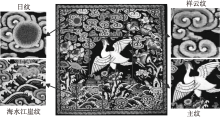
Fig.1

Qing Dynasty mandarin square pattern composition"

Tab.1

Comparative analysis of migration of Qing Dynasty mandarin square styles for each model"

模型 主要特点 清代官补迁移的优点 清代官补迁移的缺点 内容形式 色彩构成 构图布局
SD GAN ·自辨别机制
·全向像素梯度卷积核
·对细节捕捉能力强
·在早期轮次中SSIM高
·动物图案象征意义易丢失
·FID指标较高,真实度不足
基本达到 未达到 基本达到
Nice GAN ·重用判别器作为编码器
·分离训练策略
·训练效率较高
·生成图像较稳定
·后续训练增益有限
·不适合复杂纹样迁移
基本达到 基本达到 基本达到
Dual GAN ·双学习框架
·双GAN负责双向转换
·能处理无配对数据
·快速进入平台期
·缺乏针对纹样的特殊机制
·在清代官补上表现糟糕
未达到 基本达到 未达到
Disco GAN ·强调域一致性损失
·注重发现跨域关系
·风格转换效果明显
·结构特征方面较好
·生成图像文化真实性不足
·清代官补风格过于单一
未达到 基本达到 未达到
Cycle GAN ·循环一致性损失
·双向转换机制
·适合无配对数据
·训练稳定性好
·细节保留不足
·文化特征可能淡化
基本达到 基本达到 达到

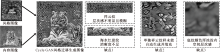
Fig.2

Schematic diagram of Cycle GAN Qing dynasty mandarin square style migration defects"

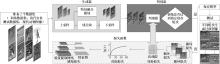
Fig.3

Proposed model migration process"

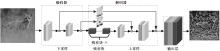
Fig.4

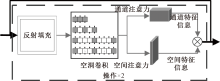
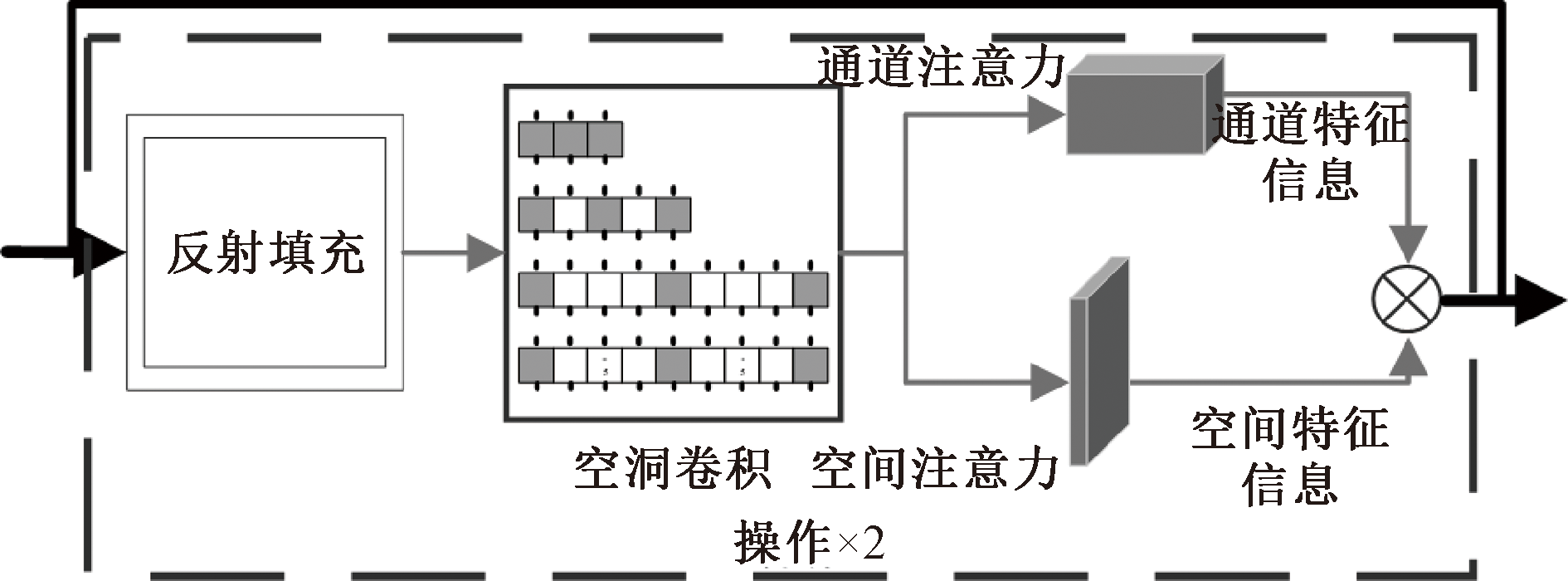
Generator network model"

Fig.5

Resnet block structure"

Fig.6

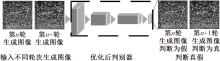
Discriminator network model"

Tab.2

Software and hardware configuration"

软硬件 参数配置
核处理器 18 vCPU AMD EPYC 9754
显卡 RTX 3090
内存 64GB
操作系统 ubuntu18.04
CUDA版本 Cuda11.1
深度学习框架 PyTorch1.9.0
Python版本 Python3.8
扫描仪 佳能TR7500 series

Fig.7

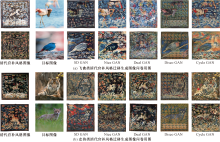
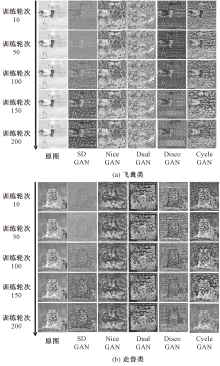
Questionnaire diagrams for five models to generate images. (a) Generated images of birds in Qing dynasty mandarin square style transfer for questionnaire use; (b) Generated images of beasts in Qing dynasty mandarin square style transfer for questionnaire use"

Tab.3

Contents of art evaluation and mean values of individual indicators"

模型 受访者 S Co D A Cr W
SD GAN 了解补子文化 3.061 3.122 3.163 3.224 3.265 3.167
不了解补子文化 3.043 3.304 3.086 3.043 3.391 3.158
Nice GAN 了解补子文化 3.081 3.448 3.163 3.326 3.204 3.234
不了解补子文化 3.130 3.347 3.043 3.173 3.347 3.203
Dual GAN 了解补子文化 2.632 2.775 2.714 2.734 2.775 2.719
不了解补子文化 3.000 3.173 2.782 3.086 2.956 3.006
Disco GAN 了解补子文化 3.102 2.938 3.122 3.020 3.204 3.080
不了解补子文化 2.826 2.913 3.000 3.000 2.956 2.934
Cycle GAN 了解补子文化 3.979 4.183 4.061 4.163 4.040 4.080
不了解补子文化 3.608 4.000 3.695 3.652 3.565 3.682

Tab.4

Evaluation of technical indicators"

轮次 模型 SSIM↑ PSNR↑ MSE↓ LPIPS↓ FID↓
10 Sd GAN 0.087 12.166 0.056 0.662 222.438
Nice GAN 0.059 10.216 0.101 0.596 159.246
Dual GAN 0.054 11.128 0.090 0.465 82.536
Disco GAN 0.03 10.340 0.094 0.508 213.618
Cycle GAN 0.034 10.033 0.098 0.561 205.503
50 Sd GAN 0.082 11.993 0.065 0.549 135.633
Nice GAN 0.058 10.238 0.101 0.592 153.851
Dual GAN 0.056 11.224 0.088 0.463 81.9141
Disco GAN 0.032 10.693 0.095 0.549 135.633
Cycle GAN 0.039 11.068 0.094 0.489 115.690
100 Sd GAN 0.071 12.357 0.068 0.512 99.819
Nice GAN 0.059 10.286 0.099 0.595 156.279
Dual GAN 0.054 11.172 0.089 0.465 81.271
Disco GAN 0.037 10.245 0.097 0.493 185.626
Cycle GAN 0.041 11.142 0.087 0.464 83.419
150 Sd GAN 0.070 12.035 0.083 0.493 108.035
Nice GAN 0.059 10.286 0.099 0.595 156.279
Dual GAN 0.054 11.129 0.090 0.466 81.610
Disco GAN 0.037 10.383 0.095 0.493 176.100
Cycle GAN 0.040 11.718 0.087 0.459 79.901
200 Sd GAN 0.060 11.314 0.087 0.475 101.915
Nice GAN 0.058 10.339 0.099 0.584 153.182
Dual GAN 0.054 11.113 0.091 0.466 81.619
Disco GAN 0.038 10.462 0.092 0.487 148.609
Cycle GAN 0.041 11.329 0.089 0.448 77.294

Fig.8

Results of artistic visual experiments on avian species (a) and terrestrial animals (b)"

Tab.5

Comparative indicators of ablation experiments"

轮次 模型
变体
SSIM↑ PSNR↑ MSE↓ LPIPS↓ FID↓
10 N 0.034 10.033 0.098 0.561 205.503
G 0.056 10.841 0.083 0.494 201.116
D 0.035 10.336 0.096 0.546 208.858
L 0.050 10.639 0.088 0.511 202.213
A 0.061 11.043 0.085 0.477 200.019
50 N 0.039 11.068 0.094 0.489 115.390
G 0.068 11.423 0.077 0.437 100.400
D 0.042 11.201 0.088 0.480 114.956
L 0.061 11.334 0.081 0.462 104.222
A 0.075 11.412 0.073 0.434 96.577
100 N 0.041 11.142 0.087 0.464 83.419
G 0.072 11.655 0.075 0.441 82.074
D 0.053 11.334 0.081 0.460 83.240
L 0.064 11.527 0.076 0.445 81.660
A 0.079 11.783 0.068 0.421 81.488
150 N 0.040 11.718 0.087 0.459 79.901
G 0.072 12.118 0.066 0.419 76.444
D 0.052 11.868 0.079 0.447 78.980
L 0.064 12.018 0.071 0.428 78.058
A 0.080 12.218 0.063 0.413 76.830
200 N 0.041 11.329 0.089 0.448 77.294
G 0.074 13.065 0.064 0.417 73.968
D 0.056 11.980 0.080 0.438 76.047
L 0.066 12.631 0.070 0.433 75.800
A 0.082 13.499 0.058 0.406 73.137

Fig.9

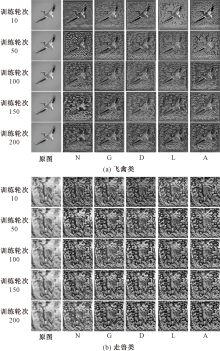
Ablation experiments on Qing dynasty mandarin square style transfer for avian species (a) and terrestrial animals(b)"

[1] 赵琳琳, 孙梦梦. 新文创背景下中华优秀传统文化传承路径探究[J]. 文化学刊, 2025(1): 168-171.
ZHAO Linlin, SUN Mengmeng. Research on the inheritance path of excellent traditional Chinese culture in the context of new cultural creativity[J]. Journal of Culture, 2025(1): 168-171.
[2] 颜丙义, 侯金, 黄启煜, 等. 典型传统服饰图像的在线识别系统[J]. 纺织学报, 2023, 44(5): 184-190.
YAN Bingyi, HOU Jin, HUANG Qiyu, et al. Online recognition system for typical traditional clothing images[J]. Journal of Textile Research, 2023, 44(5): 184-190.
[3] 毛敬, 杜程, 李淑嵘. 语义学视阈下清代文官清代官补艺术语言及意涵[J]. 印染, 2024, 50(3): 106-108.
MAO Jing, DU Cheng, LI Shurong. Artistic language and meaning of Qing dynasty civil official badges from the perspective of semantics[J]. China Dyeing and Finishing, 2024, 50(3): 106-108.
[4] 李楠, 张毅. 清代官补纹样艺术特征及其创新设计应用[J]. 服装学报, 2020, 5(1): 47-53.
LI Nan, ZHANG Yi. Characteristics of the art of official repair patterns in the Qing dynasty and their innovative design applications[J]. Journal of Apparel Studies, 2020, 5(1): 47-53.
[5] 胡琦瑶, 刘乾龙, 彭先霖, 等. SN-CLPGAN:基于谱归一化的中国传统山水画风格迁移方法[J]. 西北大学学报(自然科学版), 2025, 55(1): 63-74.
HU Qiyao, LIU Qianlong, PENG Xianlin, et al. SN-CLPGAN: style migration method of traditional Chinese landscape painting based on spectrum normalization[J]. Journal of Northwest University(Natural Science Edition), 2025, 55(1): 63-74.
[6] 张泽宇, 王铁君, 郭晓然, 等. AI绘画研究综述[J]. 计算机科学与探索, 2024, 18(6): 1404-1420.
doi: 10.3778/j.issn.1673-9418.2401075
ZHANG Zeyu, WANG Tiejun, GUO Xiaoran, et al. AI painting research review[J]. Computer Science and Exploration, 2024, 18(6): 1404-1420.
[7] 赖丽娜, 米瑜, 周龙龙, 等. 生成对抗网络与文本图像生成方法综述[J]. 计算机工程与应用, 2023, 59(19): 21-39.
doi: 10.3778/j.issn.1002-8331.2211-0392
LAI Lina, MI Yu, ZHOU Longlong, et al. Survey about generative adversarial network and text-to-image synthesis[J]. Computer Engineering and Applications, 2023, 59(19): 21-39.
doi: 10.3778/j.issn.1002-8331.2211-0392
[8] REED S, AKATA Z, YAN X, et al. Generative adversarial text to image synthesis[C]// Proceedings of the 33rd International Conference on International Conference on Machine Learning-Volume 48 (ICML'16). New York: JMLR, 2016: 1060-1069.
[9] RUMELHART D E, HINTON G E, WILLIAMS R J. Learning representations by back-propagating errors[J]. Nature, 1986, 323(6088): 533-536.
doi: 10.1038/323533a0
[10] BOURLARD H, KAMP Y. Auto-association by multilayer perceptrons and singular value decom-position[J]. Biological Cybernetics, 1988, 59(4/5): 291-294.
doi: 10.1007/BF00332918
[11] 陈淑环, 韦玉科, 徐乐, 等. 基于深度学习的图像风格迁移研究综述[J]. 计算机应用研究, 2019, 36(8): 2250-2255.
CHEN Shuhuan, WEI Yuke, XU Le, et al. Survey of image style transfer based on deep learning[J]. Application Research of Computers, 2019, 36(8): 2250-2255.
[12] 陈淮源, 张广池, 陈高, 等. 基于深度学习的图像风格迁移研究进展[J]. 计算机工程与应用, 2021, 57(11): 37-45.
doi: 10.3778/j.issn.1002-8331.2101-0019
CHEN Huaiyuan, ZHANG Guangchi, CHEN Gao, et al. Research progress of image style transfer based on deep learning[J]. Computer Engineering and Applications, 2021, 57(11): 37-45.
doi: 10.3778/j.issn.1002-8331.2101-0019
[13] 姚琳涵, 张颖, 姚岚, 等. 基于多尺度纹理合成的刺绣风格迁移模型[J]. 纺织学报, 2023, 44(9): 84-90.
YAO Linhan, ZHANG Ying, YAO Lan, et al. Embroidery style transfer model based on multi-scale texture synthesis[J]. Journal of Textile Research, 2023, 44(9): 84-90.
[14] 陈鋆纯, 季铁, 彭坚, 等. 基于风格特征的花瑶挑花图案智能设计路径[J]. 丝绸, 2023, 60(9): 112-119.
CHEN Junchun, JI Tie, PENG Jian, et al. Based on the style characteristics, the intelligent design path of the flower picking pattern[J]. Journal of Silk, 2023, 60(9): 112-119.
[15] 沙莎, 李怡, 蒋惠敏, 等. 基于ChipGAN-ViT模型的汉绣艺术风格迁移与模拟[J]. 纺织工程学报, 2023, 1(5): 68-77.
SHA Sha, LI Yi, JIANG Huimin, et al. Migration and simulation of Han embroidery art style based on ChipGAN-ViT model[J]. Journal of Textile Engineering, 2023, 1(5): 68-77.
[16] 李敏, 刘冰清, 彭庆龙, 等. 基于Cycle GAN算法的迷彩服装图案设计方法研究[J]. 丝绸, 2022, 59(8): 100-106.
LI Min, LIU Bingqing, PENG Qinglong, et al. Research on camouflage clothing pattern design method based on Cycle GAN algorithm[J]. Journal of Silk, 2022, 59(8): 100-106.
[17] 王伟珍, 张功. 基于Cycle GAN的服装图像混搭风格迁移[J]. 现代纺织技术, 2023, 31(4): 250-258.
WANG Weizhen, ZHANG Gong. Mix and match style transfer for the images of clothes with Cycle GAN[J]. Modern Textile Technology, 2023, 31(4): 250-258.
[18] 王清和, 曹兵, 朱鹏飞, 等. 基于自判别循环生成对抗网络的人脸图像翻译[J]. 中国科学:信息科学, 2022, 52:1447-1462.
WANG Q H, CAO B, ZHU P F, et al. Self-discriminative cycle generative adversarial networks for face image translation[J]. Science in China: Information Science, 2022, 52: 1447-1462.
[19] CHEN R, HUANG W, HUANG B, et al. Reusing discriminators for encoding:towards unsupervised image-to-image translation[C]// 2020 IEEE/CVF Conference on Computer Vision and Pattern Recog-nition (CVPR). Seattle: IEEE, 2020: 8165-8174.
[20] YI Z, ZHANG H, TAN P, et al. Dual GAN:Unsupervised dual learning for image-to-image translation[C]// 2017 IEEE International Conference on Computer Vision (ICCV). Venice: IEEE, 2017: 2868-2876.
[21] KIM T, CHA M, KIM H, et al. Learning to discover cross-domain relations with generative adversarial networks[C]// Proceedings of the 34th International Conference on Machine Learning. PMLR, 2017 Sydney NSW Australia: 1857-1865.
[22] ZHU JY, PARK T, ISOLA P, et al. Unpaired image-to-image translation using cycle-consistent adversarial networks[C]// 2017 IEEE International Conference on Computer Vision (ICCV). Venice: IEEE, 2017: 2242-2251.
[23] 王渊. 服装纹样中的等级制度:中国明清补服的形与制[M]. 北京: 中国纺织出版社, 2016:86-151.
WANG Yuan. Hierarchical system in clothing patterns: form and system of Ming and Qing dynasty mandarin square[M]. Beijing: China Textile Press, 2016:86-151.
[24] 臧诺. 清代官补[M]. 北京: 华夏出版社, 2016: 23-272.
ZANG Nuo. Qing dynasty official badges[M]. Beijing: Huaxia Publishing House, 2016: 23-272.
[25] 大卫·哈古斯. 补子: 明清时期的品级标识[M]. 王敬雅, 伍泰格,译. 北京: 社会科学文献出版社, 2023: 37-95.
HAGUS D. Buzi: rank badges of the Ming and Qing dynasties[M]. WANG Jingya, WU Taige, translating. Beijing: Social Sciences Academic Press, 2023: 37-95.
[26] 李莉, 毛子晗, 吕思奇, 等. GAN与Diffusion在传统纹样设计中的实验研究[J]. 丝绸, 2024, 61(8): 9-22.
LI Li, MAO Zihan, LÜ Siqi. An experimental study on the application of GAN and Diffusion models in traditional pattern designn[J]. Journal of Silk, 2024, 61(8): 9-22.
[1] WANG Jianhui, ZHANG Huaxiong, JIN Yao, LIU Zhi. Color transfer method for fabric patterns based on trending colors [J]. Journal of Textile Research, 2025, 46(07): 144-153.
[2] SHI Jia, LI Mengzhu, XIAO Boxiang. Technical research progress in functional speed skating suits [J]. Journal of Textile Research, 2025, 46(06): 250-260.
[3] CAI Liling, WANG Mei, SHAO Yibing, CHEN Wei, CAO Huaqing, JI Xiaofen. Intelligent customization recommendation for traditional Hanfu based on improved stack-generative adversarial network [J]. Journal of Textile Research, 2024, 45(12): 180-188.
[4] LU Yinwen, HOU Jue, YANG Yang, GU Bingfei, ZHANG Hongwei, LIU Zheng. Single dress image video synthesis based on pose embedding and multi-scale attention [J]. Journal of Textile Research, 2024, 45(07): 165-172.
[5] YAO Linhan, ZHANG Ying, YAO Lan, ZHENG Xiaoping, WEI Wenda, LIU Chengxia. Embroidery style transfer modeling based on multi-scale texture synthesis [J]. Journal of Textile Research, 2023, 44(09): 84-90.
[6] CHEN Jinwen, WANG Xin, LUO Weihao, MEI Chennan, WEI Jingyan, ZHONG Yueqi. VR-oriented personalized head and face texture generation technology of dressed human body [J]. Journal of Textile Research, 2023, 44(09): 188-196.
[7] REN Ze, ZHONG Anhua. Digital pattern making of underwear based on NURBS surface model of male waist, hip and crotch [J]. Journal of Textile Research, 2023, 44(08): 167-173.
[8] LIU Yuye, WANG Ping. High-precision intelligent algorithm for virtual fitting based on texture feature learning [J]. Journal of Textile Research, 2023, 44(05): 177-183.
[9] CHEN Jia, YANG Congcong, LIU Junping, HE Ruhan, LIANG Jinxing. Cross-domain generation for transferring hand-drawn sketches to garment images [J]. Journal of Textile Research, 2023, 44(01): 171-178.
[10] YANG Zhengyan, XUE Wenliang, ZHANG Chuanxiong, DING Yi, MA Yanxue. Recommendations for user's bottoms matching based on generative adversarial networks [J]. Journal of Textile Research, 2021, 42(07): 164-168.
[11] . Methods of clothing pattern designing based on quasi-regular patterns with shadow effect [J]. JOURNAL OF TEXTILE RESEARCH, 2017, 38(07): 124-129.
[12] . Interpretation of Taiwan Paiwan tribe clothing patterns cultural connotation [J]. JOURNAL OF TEXTILE RESEARCH, 2016, 37(12): 111-116.
[13] . Application of generalized Julia set graphics in clothing pattern design [J]. Journal of Textile Research, 2015, 36(07): 104-109.
Viewed
Full text


Abstract

Cited

  Shared   
  Discussed   
No Suggested Reading articles found!