Journal of Textile Research ›› 2026, Vol. 47 ›› Issue (05): 228-235.doi: 10.13475/j.fzxb.20250805201

• Machinery & Equipment • Previous Articles     Next Articles

Design of fiber-winding and forming robot system for carbon/carbon composite preforms of conical section

WANG Fuyu1,2, DONG Jiuzhi1,2(), CHEN Xiaoxia1,2, CHEN Yunjun3, LI Rui1,2   

  1. 1 School of Mechanical Engineering, Tiangong University, Tianjin 300387, China
    2 Advanced Mechatronics Equipment Technology Tianjin Area Major Laboratory, Tiangong University, Tianjin 300387, China
    3 School of Electrical Engineering and Automation, Tiangong University, Tianjin 300387, China
  • Received:2025-08-26 Revised:2026-03-17 Online:2026-05-15 Published:2026-07-10
  • Contact: DONG Jiuzhi E-mail:dongjiuzhi@tiangong.edu.cn

Abstract:

Objective This study aims to enhance the efficiency and quality consistency of fiber winding and forming for carbon/carbon (C/C) composite preforms of a conical section, and to better meet the evolving demands on conical components, by developing a fiber-winding and forming robot system. Employing constant-tension control and precise trajectory planning, the system is expected to improve winding-path consistency and reduce defect rates, thereby providing a technical paradigm for the automated production of other C/C composite preforms.

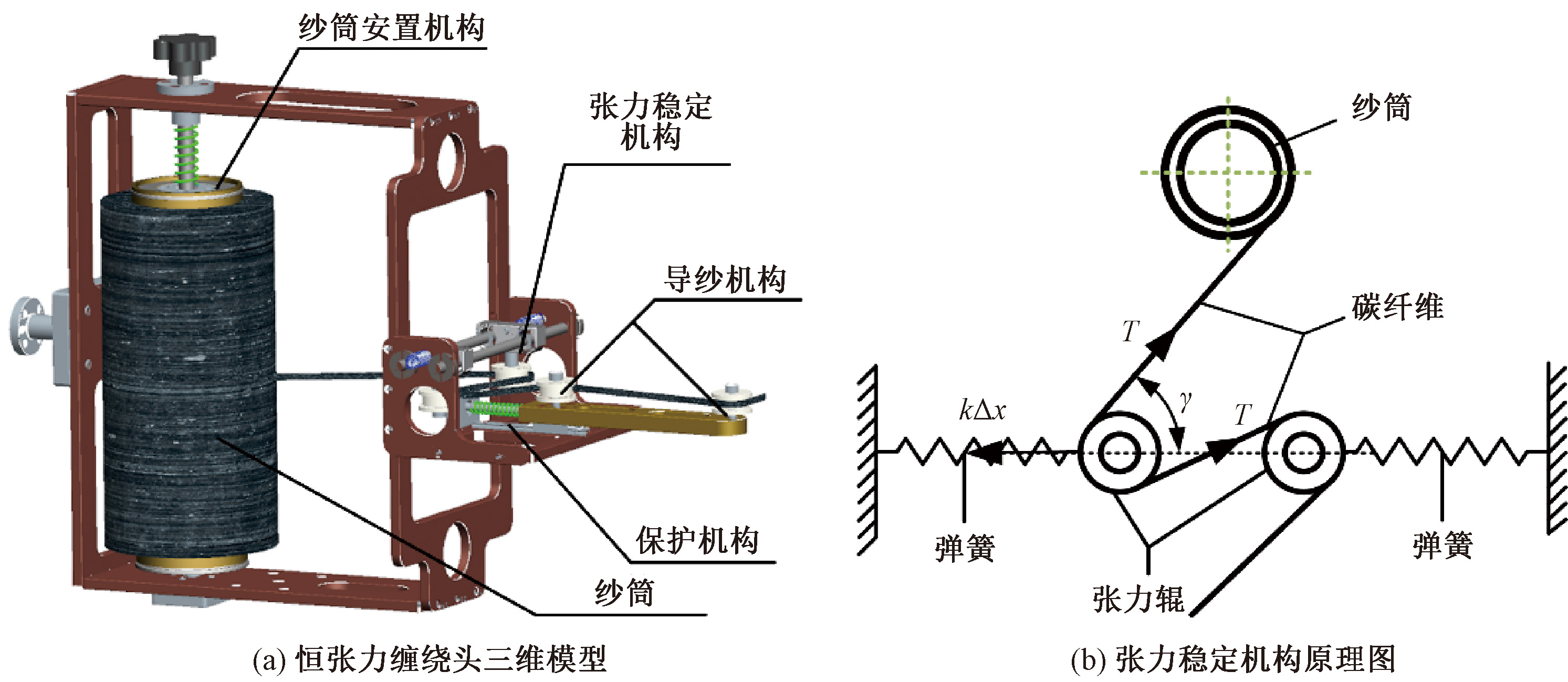
Method A constant-tension winding head was designed to meet the demands of dry-fiber reinforcement winding, employing a spring-based tension mechanism to maintain consistent tension on the carbon fibers. In order to accommodate the uncapped ends of the conical mandrel and enable reliable fiber reversal and retention at the pin locations, a pin-plate tooling fixture was developed. Drawing on the mandrel's geometric characteristics and helical-winding theory, a mathematical model of the spiral winding trajectory was established, and MatLab-based simulations were conducted to numerically model and visually verify the winding paths. Additionally, a fiber-winding and forming robot system for conical C/C composite preforms was implemented, featuring a programmable logic controller (PLC) based control unit and seven-axis coordinated motion. Robot trajectory planning was performed using helical-winding theory in conjunction with an enhanced Denavit-Hartenberg parameter method.

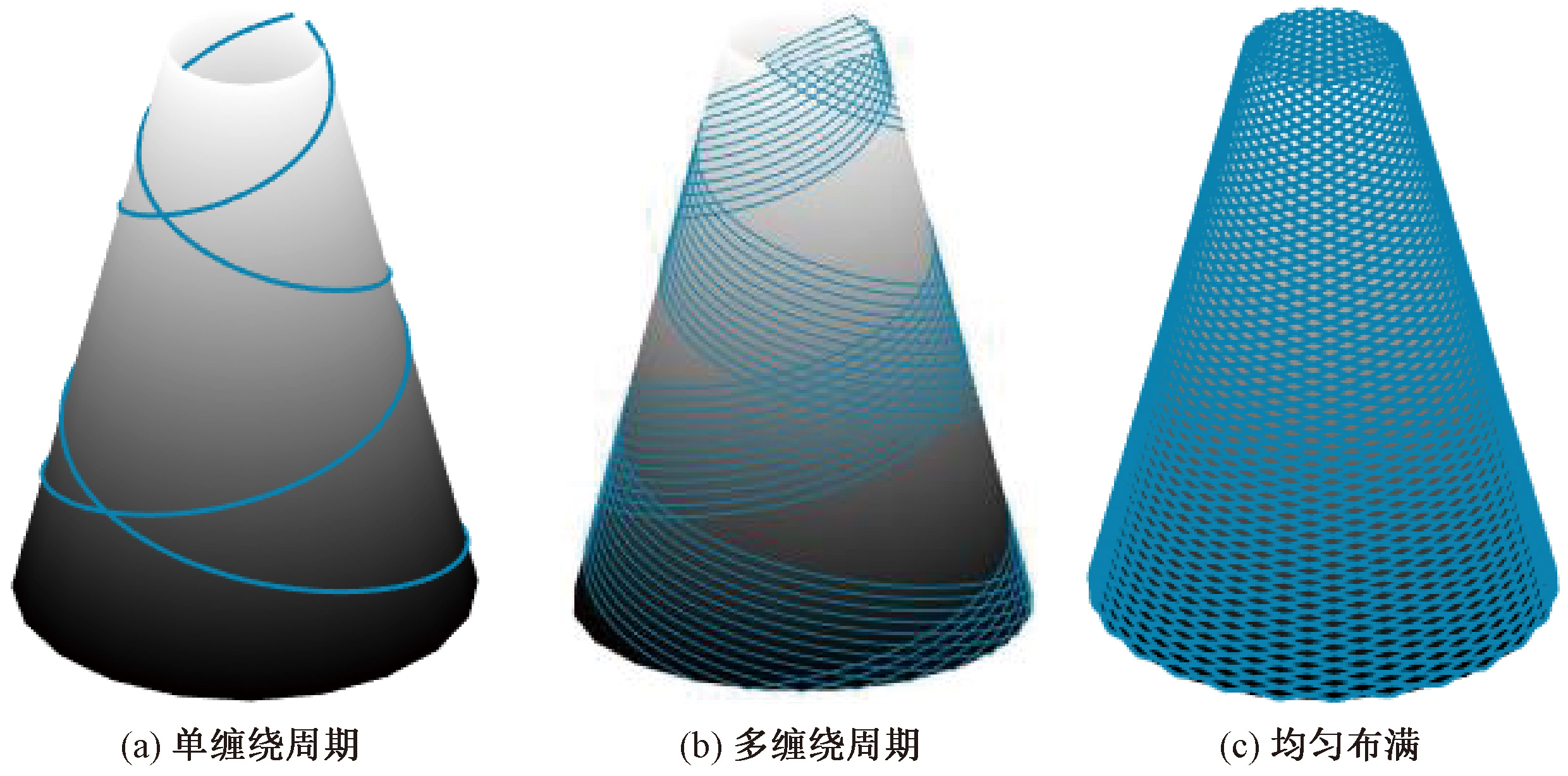
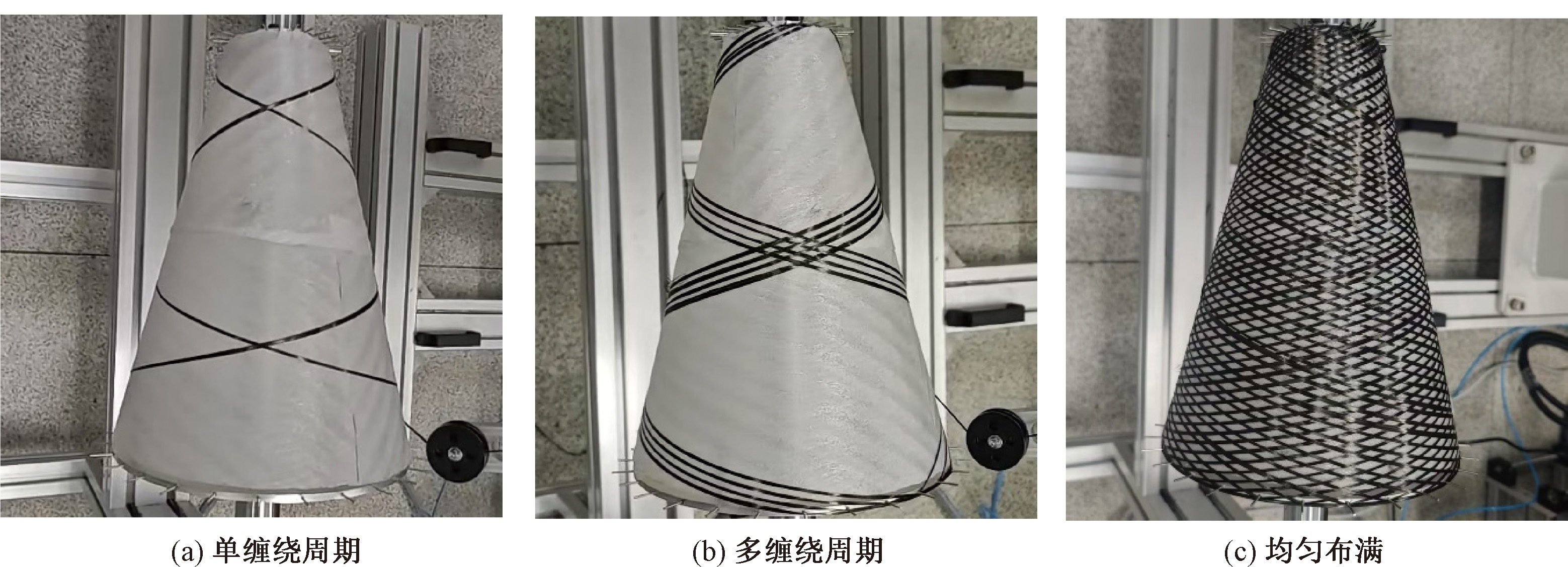
Results After prototype commissioning, dry-fiber winding experiments were conducted on the C/C composite preforms of the conical section using constant-tension 12K PAN-based carbon fiber. Process parameters were set according to the constraint equations and mandrel geometric dimensions, where the mandrel rotational speed ω was π/4 rad/s, and the winding-head end-effector speed v was 20 mm/s. During each winding cycle, the first half-cycle comprised a 720° mandrel rotation while the end effector traversed the mandrel's generatrix at constant speed from the large end to the small end. In the second half-cycle, the mandrel rotated an additional 720° + Δθθ is constant angular displacement) and the end effector returned from the small end to the large end. At cycle completion, the mandrel exhibited a constant angular displacement of Δθ=13.85°, establishing the precise spatial offset between successive layers via periodic angular superposition. A total of 26 cycles were required to achieve full coverage, at which point the cumulative mandrel rotation reached 360° and the carbon fibers densely and uniformly covered the conical surface. Throughout each cycle, the fibers were stably guided by the rotating mandrel and end effector in both winding directions, with uniform deposition and no fiber overlap. Comparison of the actual winding trajectories to the simulated profiles showed excellent agreement. The planned path enabled smooth, collision-free operations between the winding head and mandrel, with no fiber bridging or pin interference observed. During early cycles, the fibers maintained intimate contact with the mandrel surface without slippage, and at the end of each cycle, fibers adhered equally well to both the mandrel and underlying layers, without noticeable slip. A protractor was adopted to sample the winding angles at the large end, mid-section, and small end of the conical mandrel over five winding cycles, and the mean relative error was calculated. The mean relative errors at the large end, mid-section, and small end were 0.62%, 0.91%, and 1.71%, respectively. The largest deviation occurred at the small end, primarily due to the introduction of the tuning coefficient ξ and inherent measurement uncertainties. All errors remained below 2%, which satisfies the allowable process tolerance.

Conclusion This study solves the problems on low efficiency, high labor intensity, and poor consistency of manual winding for the C/C composite preforms of the conical section by developing an automated fiber-winding and forming robot system. At its core, a PLC-based controller coordinates a constant-tension carbon-fiber winding head as the end-effector and a servo-driven rotating mandrel as an external auxiliary axis, thereby ensuring stable fiber tension control and synchronized mandrel rotation. Drawing on helical-winding theory and trajectory simulation, a pin-plate tooling-assisted winding scheme was devised. Furthermore, precise path planning based on an enhanced D-H parameter method was performed to guarantee smooth robot motion along the prescribed trajectories. Experimental results demonstrate good agreement between theoretical and actual winding paths, uniform fiber placement without overlap or slippage, confirming the feasibility and engineering value of the proposed pin-plate-assisted conical winding approach and robot system.

Key words: conical section, carbon/carbon composite preform, industrial robot, dry fiber reinforcement winding, needle disk fixture

CLC Number: 

  • TP23

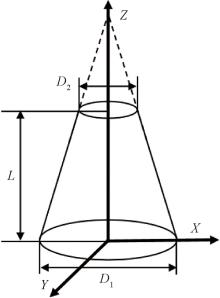
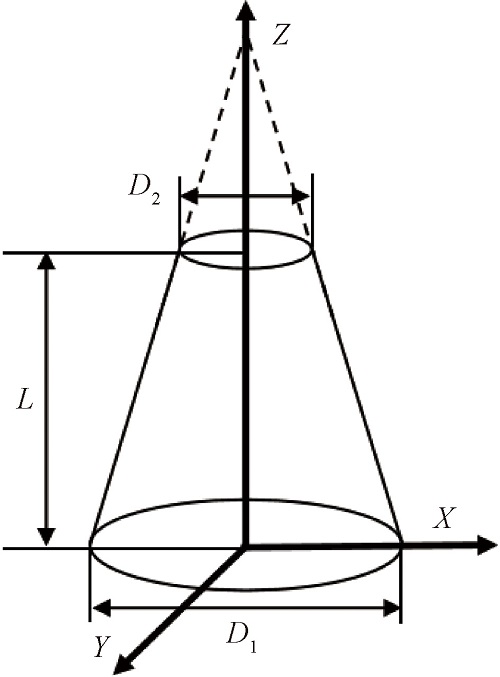
Fig.1

Mandrel geometric model"

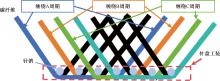
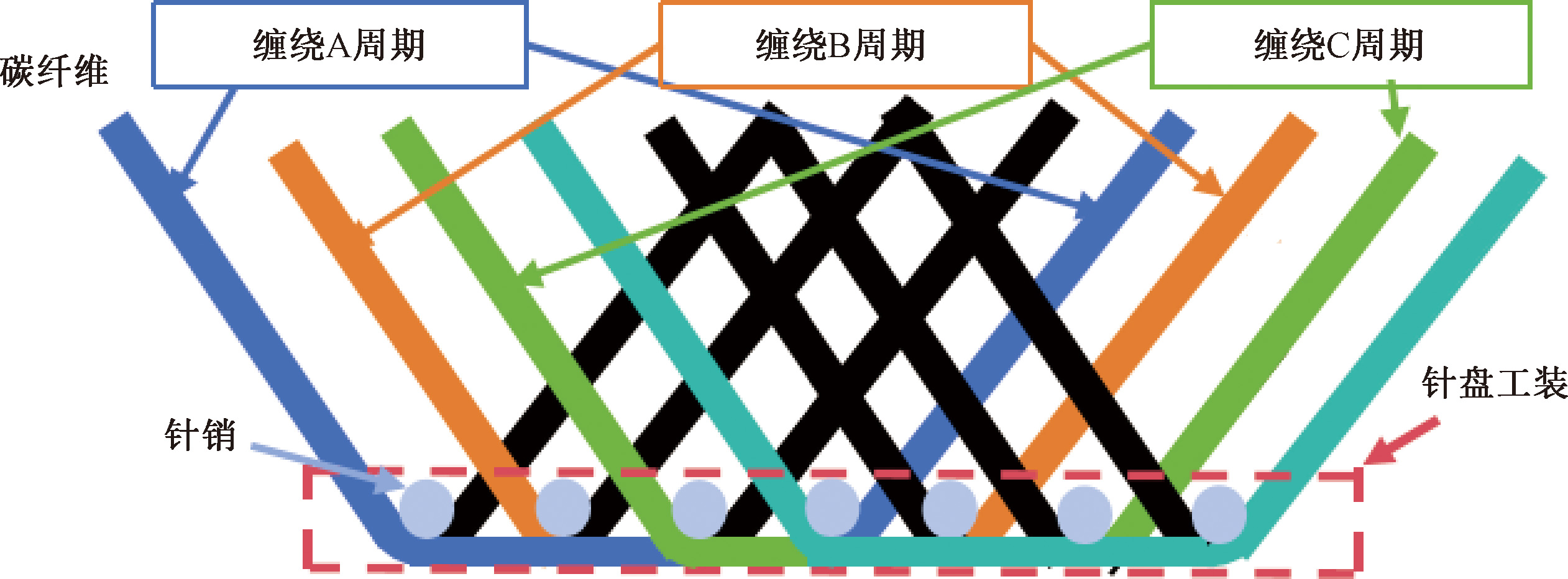
Fig.2

Operating principle of needle disk fixture"

Fig.3

Filament winding pattern simulation diagram. (a) Single winding cycle; (b) Multiple winding cycle; (c) Uniform coverage"

Fig.4

Design of constant tension winding head. (a) 3D model of constant tension winding head; (b) Principle diagram of tension-stabilizing mechanism"

Fig.5

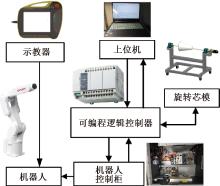
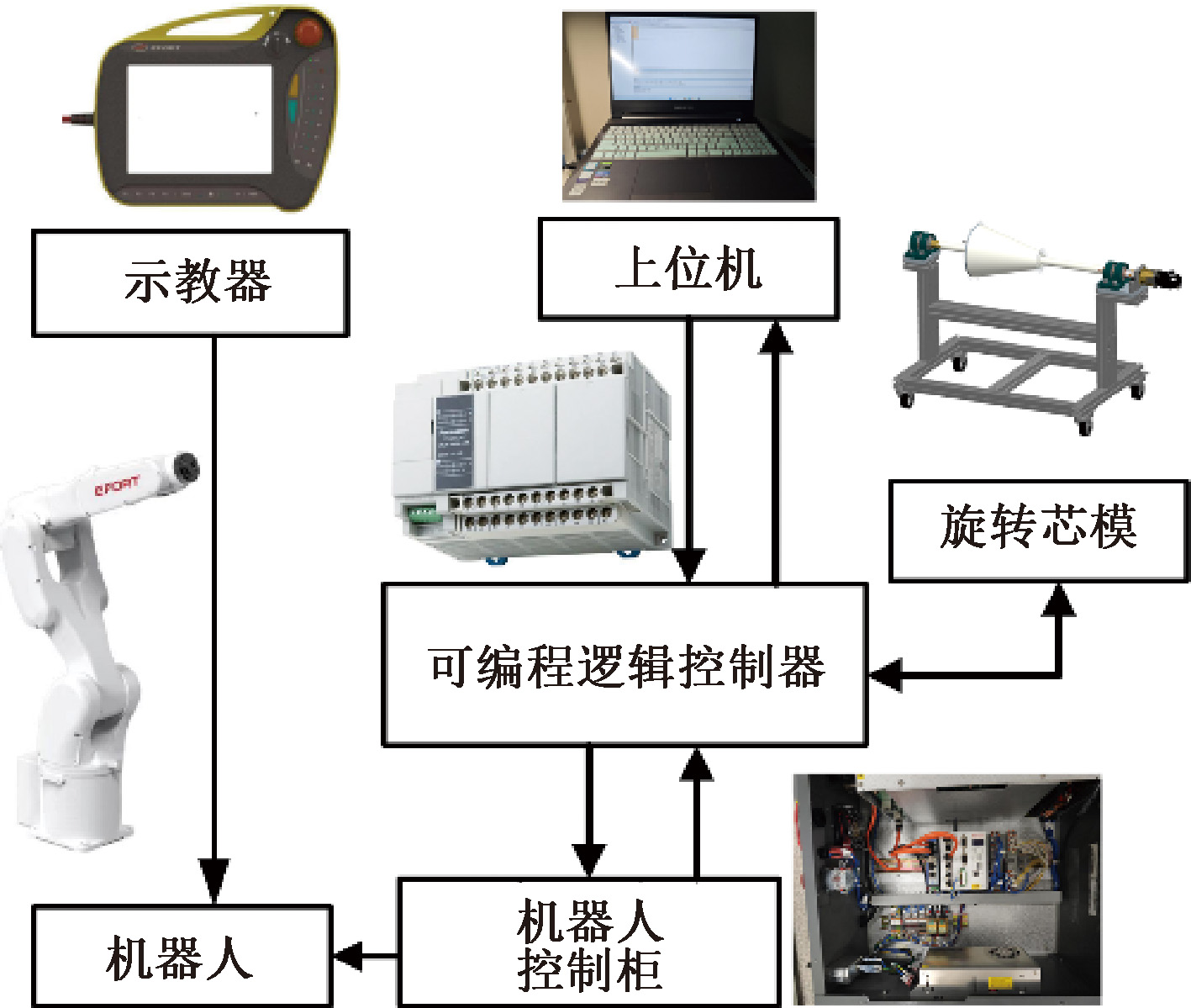
Principle diagram of control system"

Tab.1

Modified D-H table"

i θi/(°) di/mm ai-1/mm αi-1/(°) 运动范围/(°)
1 θ1 376.0 0 0 ±170
2 θ2 0 50 π/2 +100/-135
3 θ3 0 430 0 +200/-75
4 θ4 427.5 50 π/2 ±190
5 θ5 0 0 -π/2 ±120
6 θ6 89.0 0 π/2 ±360

Fig.6

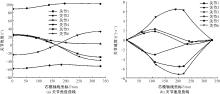
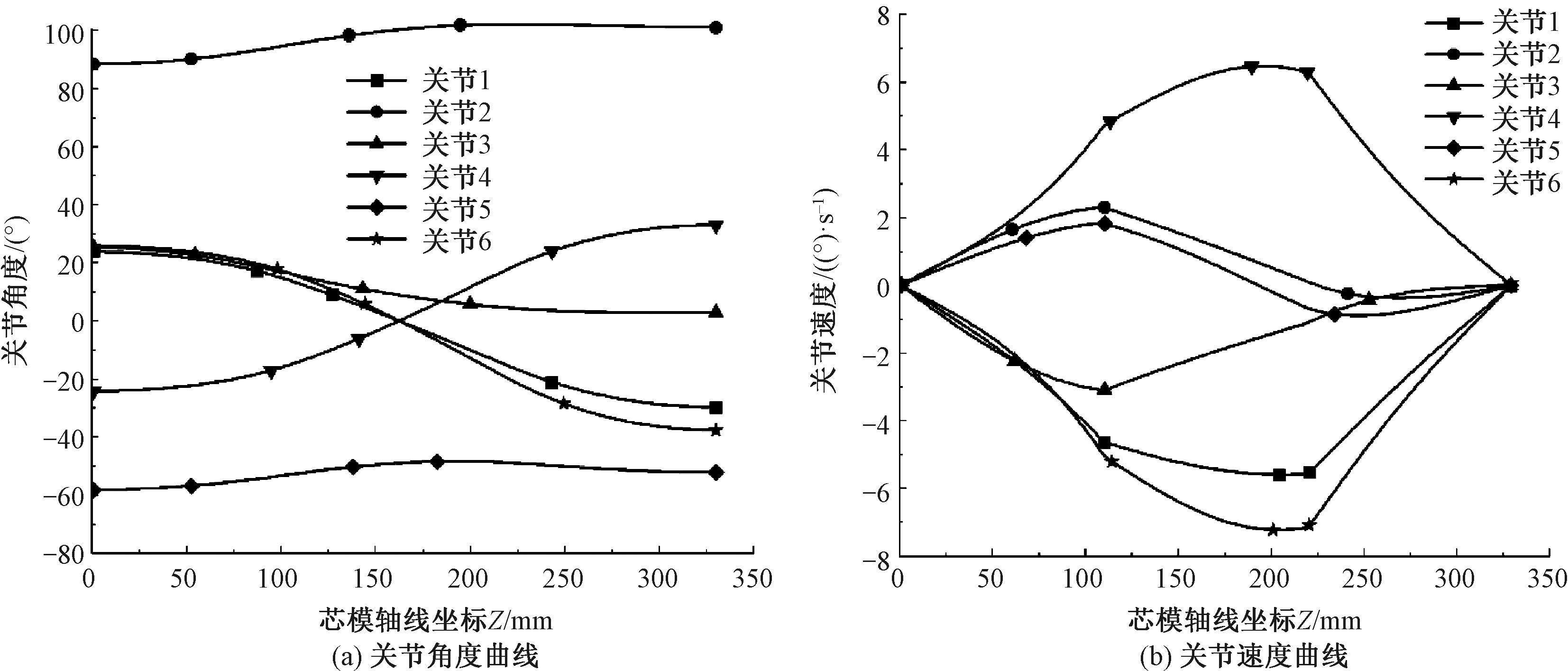
Trajectory planning results. (a) Joint angle curves; (b) Joint velocity curves"

Fig.7

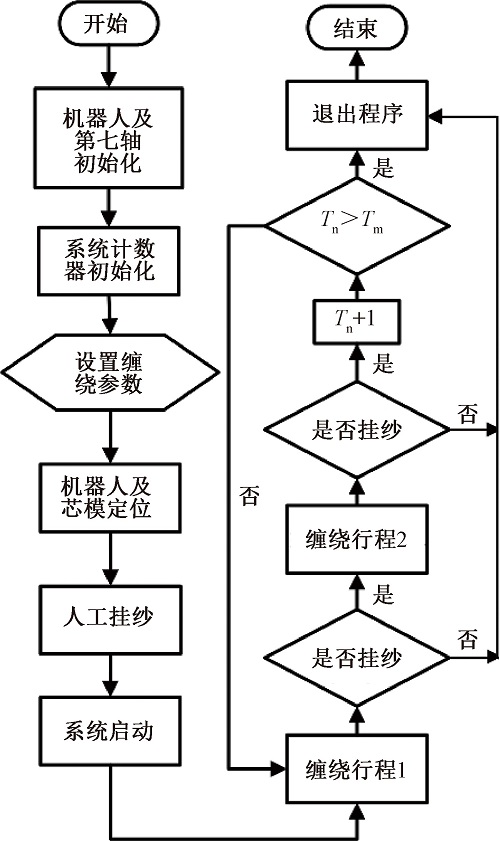
Programming design flowchart"

Fig.8

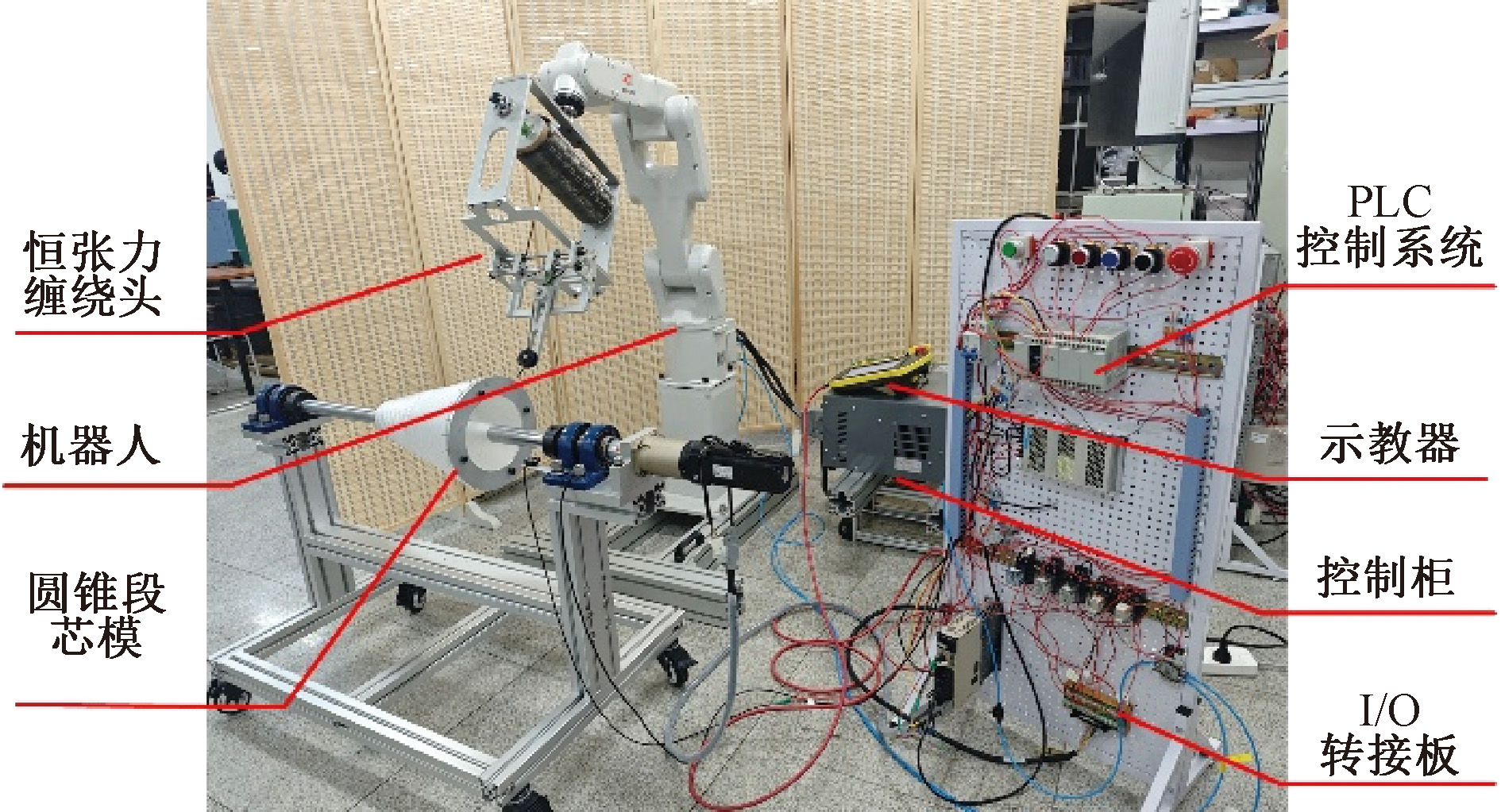
Filament winding robot system"

Fig.9

Winding experiment.(a) Single winding cycle; (b) Multiple winding cycle; (c) Uniform coverage"

Tab.2

Winding angle measurement"

缠绕周期数 芯模大端/(°) 芯模中部/(°) 芯模小端/(°)
1 77.30 72.40 57.40
2 78.60 72.70 57.30
3 78.10 71.50 58.30
4 77.80 72.60 57.90
5 78.20 71.10 57.60
理论值 77.66 71.83 56.73
相对误差平均值/% 0.62 0.91 1.71
[1] 王天琦, 魏程, 于柏峰, 等. 航天用碳/碳复合材料研究进展[J]. 纤维复合材料, 2024, 41(2): 112-115.
WANG Tianqi, WEI Cheng, YU Baifeng, et al. Research progress in C/C composites for aerospace[J]. Fiber Composites, 2024, 41(2): 112-115.
[2] 李皎, 辛世纪, 陈利, 等. 双工位针刺机器人系统设计[J]. 纺织学报, 2024, 45(7): 204-212.
LI Jiao, XIN Shiji, CHEN Li, et al. Design of double-station needling robot system[J]. Journal of Textile Research, 2024, 45(7): 204-212.
[3] 景喆, 董九志, 梅宝龙, 等. 考虑纤维随机分布的整体穿刺碳纤维毡压实过程仿真研究[J]. 航空制造技术, 2025, 68(21): 186-192.
JING Zhe, DONG Jiuzhi, MEI Baolong, et al. Simulation research on compaction process of integral pierced carbon fiber felt considering random fiber distribution[J]. Aeronautical Manufacturing Technology, 2025, 68(21): 186-192.
[4] 邢力鹏, 董九志, 陈云军, 等. 软硬混编预制体窄缝通道连续碳纤维束引纬系统的设计及实验验证[J]. 中国机械工程, 2025, 36(7): 1512-1519.
XING Lipeng, DONG Jiuzhi, CHEN Yunjun, et al. Design and experimental verification of a narrow-channel continuous carbon fiber tow weft insertion system for soft-hard blended preforms[J]. China Mechanical Engineering, 2025, 36(7): 1512-1519.
[5] 王俊山, 徐林, 李炜, 等. 航天领域C/C复合材料研究进展[J]. 宇航材料工艺, 2022, 52(2): 1-12.
WANG Junshan, XU Lin, LI Wei, et al. Research progress on C/C composites for aerospace applications[J]. Aerospace Materials & Technology, 2022, 52(2): 1-12.
[6] 田小永, 张亚园, 刘腾飞, 等. 连续碳纤维增强尼龙复合材料预浸丝制备与3D打印性能研究[J]. 航空制造技术, 2021, 64(15): 24-33.
TIAN Xiaoyong, ZHANG Yayuan, LIU Tengfei, et al. Prepreg preparation and 3D printing of continuous carbon fiber reinforced nylon composite[J]. Aeronautical Manufacturing Technology, 2021, 64(15): 24-33.
[7] 韩清壮, 向阳, 彭志航, 等. 防隔热一体化材料研究进展[J]. 粉末冶金材料科学与工程, 2025, 30(2): 79-100.
HAN Qingzhuang, XIANG Yang, PENG Zhihang, et al. Research progress of anti-thermal insulation materials[J]. Materials Science and Engineering of Powder Metallurgy, 2025, 30(2): 79-100.
[8] KOUSTAS I, PAPINGIOTIS T, VOSNIAKOS G, et al. On the development of a filament winding robotic system[J]. Procedia Manufacturing, 2018,(17):919-926.
[9] SORRENTINO L, ANAMATEROS E, BELLINI C, et al. Robotic filament winding: an innovative technology to manufacture complex shape structural parts[J]. Composite Structures, 2019, 220: 699-707.
doi: 10.1016/j.compstruct.2019.04.055
[10] 王增加, 李辅安, 刘建超. 锥体结构单向纤维缠绕线型及程序设计[J]. 玻璃钢/复合材料, 2005(2): 34-37.
WANG Zengjia, LI Fuan, LIU Jianchao. Study on single-way filament winding pattern and program design for cone structure[J]. Fiber Reinforced Plastics/Composites, 2005(2): 34-37.
[11] 白侠, 李辅安, 李崇俊, 等. 纤维单向缠绕制备C/C扩张段成型技术[J]. 宇航材料工艺, 2008, 38(4): 63-65, 69.
BAI Xia, LI Fuan, LI Chongjun, et al. Molding technology of new C/C divergent section[J]. Aerospace Materials & Technology, 2008, 38(4): 63-65, 69.
[12] 许家忠, 刘美军, 孙栋. 缠绕机器人CAD/CAM系统设计及应用[J]. 中国机械工程, 2019, 30(12): 1416-1422.
XU Jiazhong, LIU Meijun, SUN Dong. Design and applications of robotic filament winding CAD/CAM system[J]. China Mechanical Engineering, 2019, 30(12): 1416-1422.
[13] 许家忠, 孙栋, 杨海, 等. 纤维缠绕机器人离线编程及应用[J]. 哈尔滨理工大学学报, 2018, 23(5): 92-99.
XU Jiazhong, SUN Dong, YANG Hai, et al. Off-line programming of robotized filament winding and its application[J]. Journal of Harbin University of Science and Technology, 2018, 23(5): 92-99.
[14] 牟星, 刘浩, 范玉辉, 等. 锥柱一体化复合材料壳体结构设计与损伤失效分析[J]. 复合材料学报, 2025, 42(5): 2916-2927.
MOU Xing, LIU Hao, FAN Yuhui, et al. Structural design and damage failure analysis of cone-cylinder integrated composite case[J]. Acta Materiae Compositae Sinica, 2025, 42(5): 2916-2927.
[15] 王征, 董九志, 陈云军, 等. 碳纤维增强碳/碳坩埚预制体柔性缠绕成形系统设计与实验研究[J]. 中国机械工程, 2023, 34(10): 1184-1190, 1198.
WANG Zheng, DONG Jiuzhi, CHEN Yunjun, et al. Design and experimental study of a flexible winding forming system for carbon fiber reinforced carbon/carbon crucible preform[J]. China Mechanical Engineering, 2023, 34(10): 1184-1190, 1198.
doi: 10.3969/j.issn.1004-132X.2023.10.007
[16] 邹财勇, 孔令国, 李张增. 复合材料锥形缠绕机构及控制系统设计[J]. 复合材料科学与工程, 2020(6): 105-108.
ZOU Caiyong, KONG Lingguo, LI Zhangzeng. Research on design and application of composite conical structure winding[J]. Composites Science and Engineering, 2020(6): 105-108.
[17] 刘冬, 田明, 王菲, 等. 碳纤维复合材料壳体预浸带铺放原位成型轨迹规划[J]. 复合材料学报, 2024, 41(12): 6488-6497.
LIU Dong, TIAN Ming, WANG Fei, et al. Trajectory planning of in-situ fiber placement for carbon fiber composite shells[J]. Acta Materiae Compositae Sinica, 2024, 41(12): 6488-6497.
[18] 杨圣明. 锥形管的计算机辅助缠绕线型设计方法[D]. 上海: 华东师范大学, 2023:3-10.
YANG Shengming. CAD method for filament wound conical tube[D]. Shanghai: East China Normal University, 2023:3-10.
[1] SONG Jiexin, FU Tianyu, LI Fengming, SONG Rui, LI Yibin. Prediction method for tension of fabric sewn by robot based on extensibility [J]. Journal of Textile Research, 2022, 43(12): 173-180.
[2] WU Liubo, LI Xinrong, DU Jinli. Research progress of motion trajectory planning of sewing robot based on contour extraction [J]. Journal of Textile Research, 2021, 42(04): 191-200.
[3] LIU Lidong, LI Xinrong, LIU Hanbang, LI Dandan. Electrostatic adsorption model based on characteristics of weft knitted fabrics [J]. Journal of Textile Research, 2021, 42(03): 161-168.
Viewed
Full text


Abstract

Cited

  Shared   
  Discussed   
No Suggested Reading articles found!