Journal of Textile Research ›› 2025, Vol. 46 ›› Issue (03): 72-81.doi: 10.13475/j.fzxb.20231008601

• Textile Engineering • Previous Articles     Next Articles

Design of segment colored slub yarn with time series distribution and three-channel rotor yarn forming process

LI Jinjian1, XUE Yuan1(), CHEN Yourong2   

  1. 1. College of Textile Science and Engineering, Jiangnan University, Wuxi, Jiangsu 214122, China
    2. Zhejiang Taitan Co., Ltd., Shaoxing, Zhejiang 311800, China
  • Received:2023-10-25 Revised:2024-08-07 Online:2025-03-15 Published:2025-04-16
  • Contact: XUE Yuan E-mail:fzxueyuan@qq.com

Abstract:

Objective As a combination of segment color yarn and slub yarn, segment colored slub yarn has multi-component changes in shape, structure and color, which gives textile and garment a stronger sense of color hierarchy and mechanism fullness, and provides new impetus for fabric design. At present, the methods of spinning segment colored slub yarn mainly focus on the ring spinning machine, but few reports on the rotor spinning segment colored slub yarn are known. In this paper, how to spin segment colored slub yarn with shape, structure and color timing changes by three-channel CNC rotor spinning is studied.

Method Firstly, the linear density, twist, blending ratio, thick and thin knot and color of segment colored slub yarn were parametrically characterized and the corresponding mathematical model was established. Then, combined with the principle of yarn formation by three-channel CNC rotor spinning and the mechanism of yarn morphology regulation, the formation mechanism of thick and thin knot and segment color of segment colored slub yarn with spinning timing distribution was constructed based on the three-channel CNC rotor spinning machine. On this basis, eight different styles of segment colored slub yarn with timing distribution of thick knots and their fabrics were prepared, and the mechanical properties of the yarns were tested.

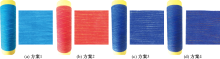
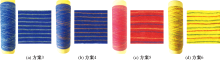
Results In this study, eight types of segment-colored slub yarns were designed, comprising four with short slub segments (125.6 mm length) and four with long slub segments (1 420 mm length). Among the four short-segment slub yarns, two types were blended from two colored fibers, while the other two incorporated three colored fibers. Compared to the two-color slub segments, the three-color variants demonstrated richer color expression and enhanced three-dimensional effects on fabric surfaces. Similarly, among the four long-segment slub yarns, two types were blended from three colored fibers, while the remaining two used two colored fibers. Each long-segment slub yarn featured two distinct color combination patterns, exhibiting greater color variability and more pronounced color transitions compared to the former. The mechanical property tests performed with the XL-2 yarn strength tester showed that the yarn strength follows this order from lowest to highest: the base yarn segment is less than the base-slub transition segment is less than the slub segment. All test results met the first-grade requirements of FZ/T 12001―2015 ‘Cotton Rotor Spun Grey Yarn’.

Conclusion Based on the principle of three-channel CNC rotor spinning, this paper extends the yarn forming principle of three-channel CNC rotor spinning machine for spinning segment colored slub yarn, and establishes the formation mechanism and timing model of base yarn, thick and thin knot and color of segment colored slub yarn. The eight kinds of segment colored slub yarn fabrics have the characteristics of bright color, unique pattern, changeable style and strong three-dimensional sense, which provides a new idea for the design of clothing fabrics. However, due to the limitation of the mechanical structure (rotor circumference) of the rotor spinning machine, the shortest length of the slub segment of the spun segment colored slub yarn has to be greater than or equal to the rotor circumference, which is also the core issue to be faced in the future.

Key words: segment colored slub yarn, three channel rotor spinning, spinning process, time series, thick and thin knot, mechanical property

CLC Number: 

  • TS104.7

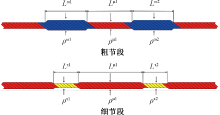
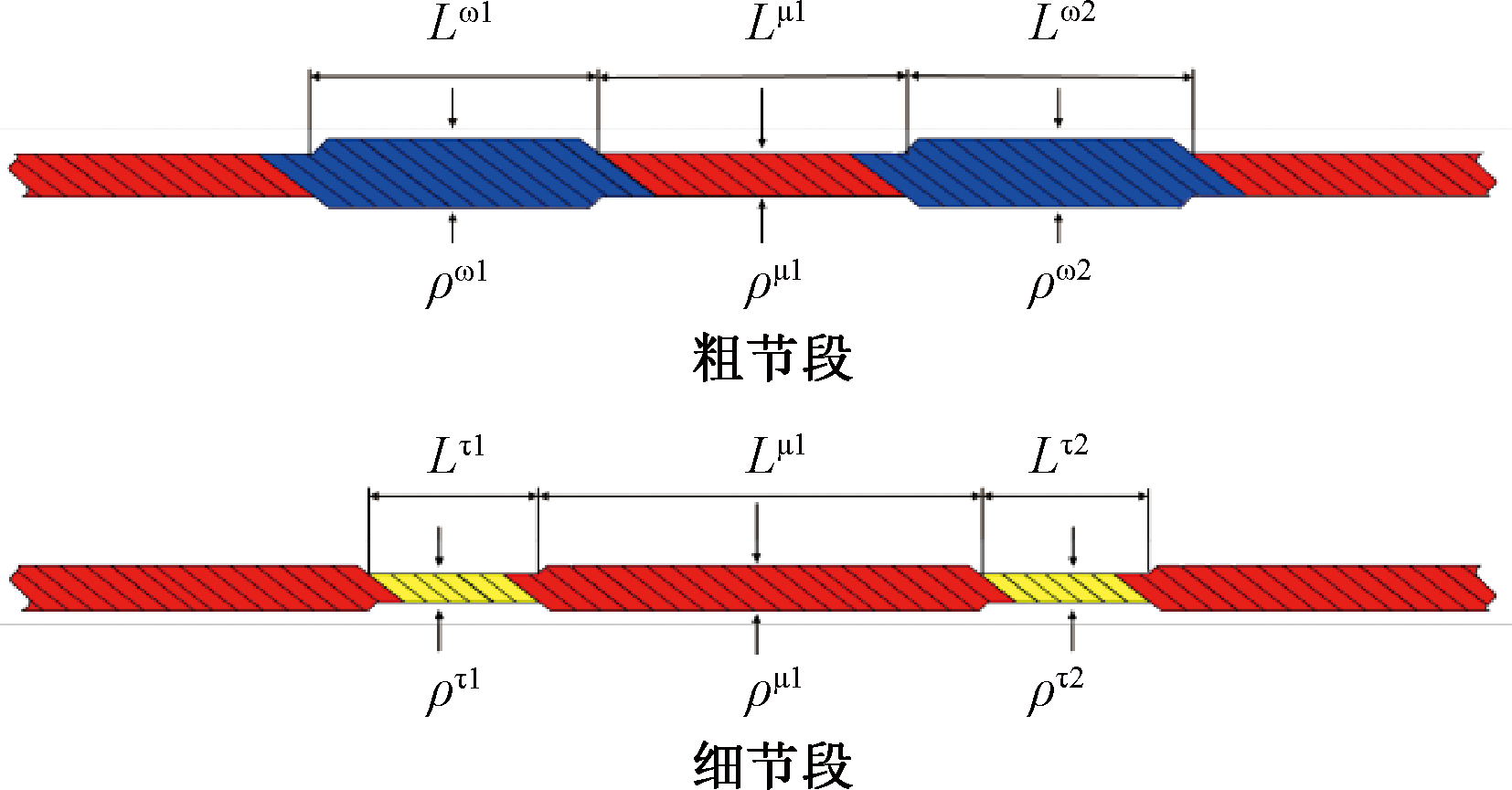
Fig.1

Thick and thin knots of segment colored slub yarn"

Fig.2

Three-channel CNC rotor spinning structure"

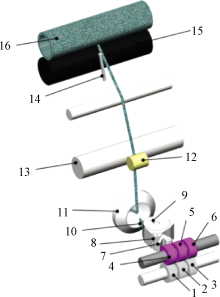
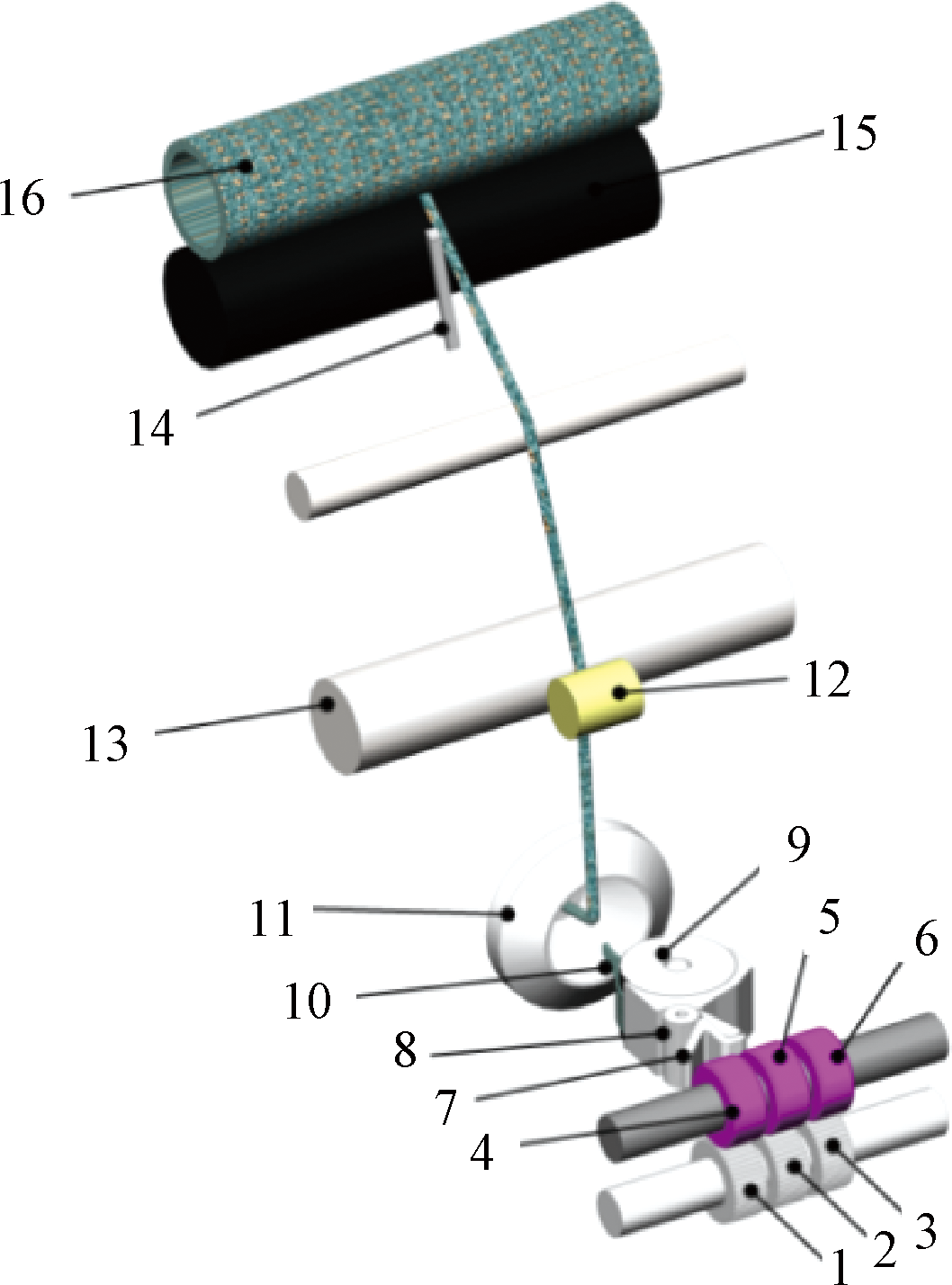
Fig.3

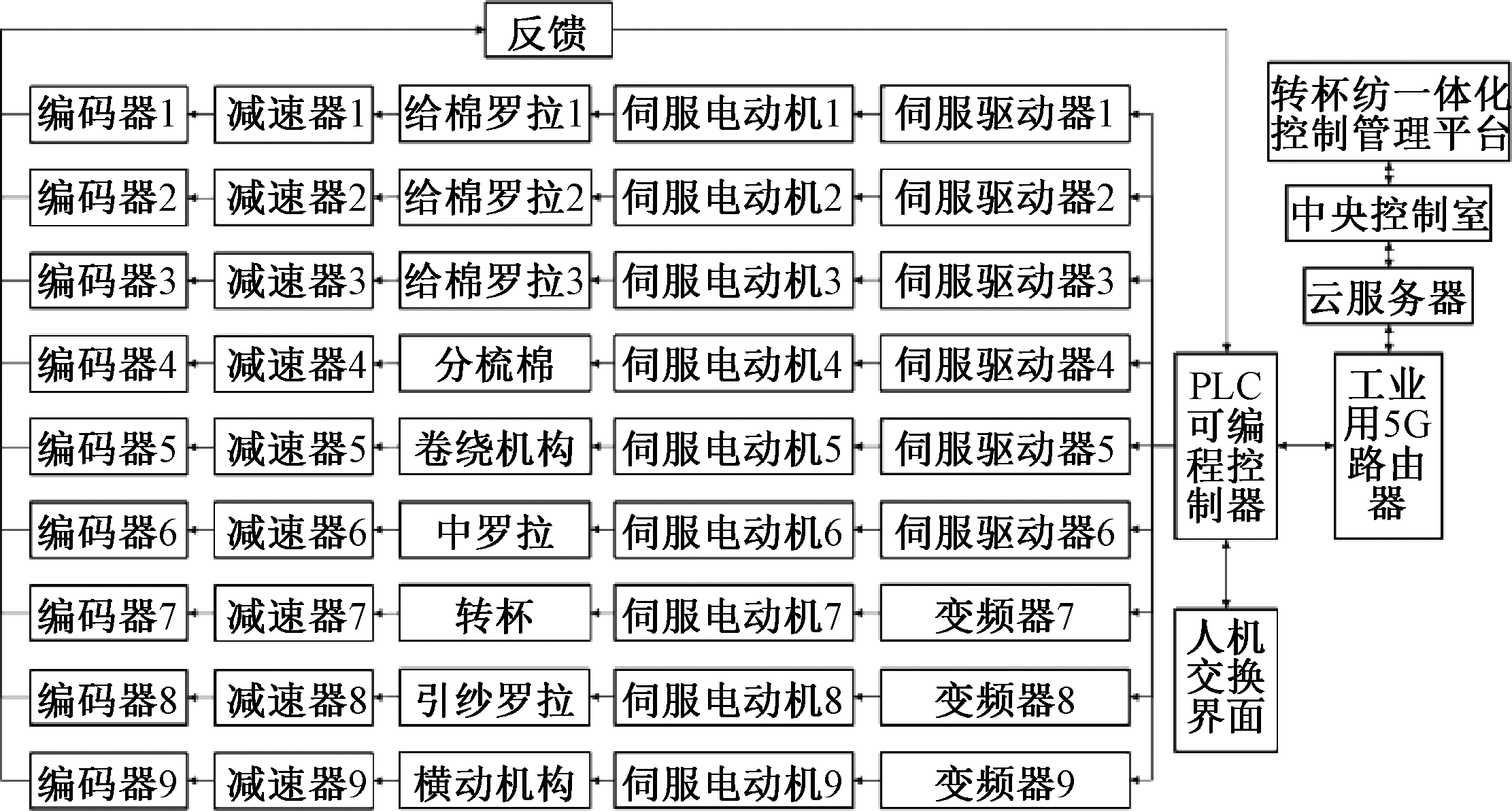
Three-channel CNC rotor spinning system"

Fig.4

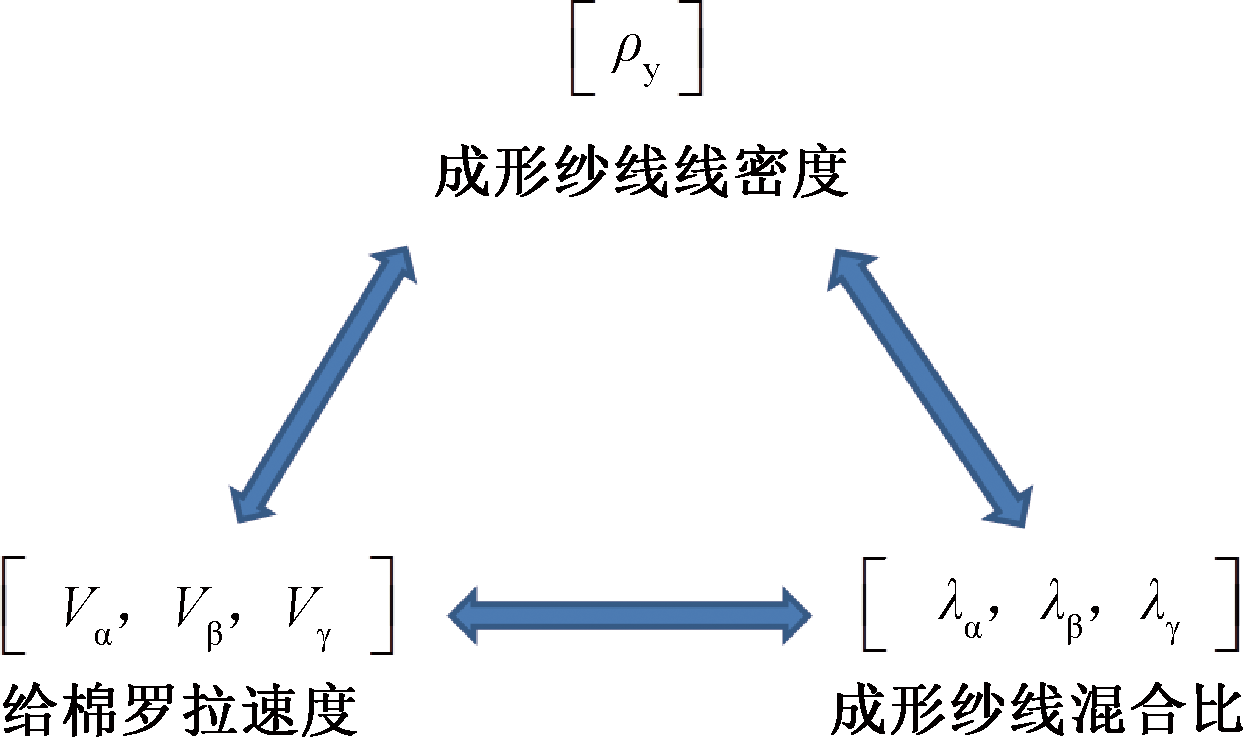
Mechanism of three-element regulation"

Tab.1

Morphological Structure of thick knot Segments"

主纱
喂入模式
基纱段
组成
基纱段
混合比
辅纱断续
喂入模式
粗节段
组成
粗节倍率 粗节段
混合比
1个通道
V
恒速喂入
α 100%
0
0
另2个通道
K1V
K2V
同步喂入
α+ K1β+K2γ 1+ K1+K2 1/(1+ K1+K2)
K1/(1+ K1+K2)
K2/(1+ K1+K2)
另2个通道
K1V
K2V
异步喂入
α+ K1β 1+ K1 1/(1+ K1)
K1/(1+ K1)
0
α+K2γ 1+K2 1/(1+ K2)
0
K2/(1+ K2)
2个通道
V
K1 V
恒速喂入
α+ K1β 1/(1+ K1)
K1/(1+ K1)
0
另1个通道
K2V
断续喂入
α+ K1β+K2γ (1+ K1+K2)/(1+ K1) 1/(1+ K1+K2)
K1/(1+ K1+K2)
K2/(1+ K1+K2)

Tab.2

Morphological structure of thin knot segments"

主纱
喂入模式
基纱段
组成
基纱段
混合比
辅纱断续
停喂模式
细节段
组成
细节倍率 细节段
混合比
3个通道
V
K1V
K2V
恒速喂入
α+ K1β+ K2γ 1/(1+ K1+K2)
K1/(1+ K1+K2)
K2/(1+ K1+K2)
1个通道
断续停喂
K1β+K2γ (K1+K2)/(1+K1+K2) 0
K1/(K1+K2)
K2/(K1+K2)
2个通道
同步
断续停喂
α 1/(1+K1+K2) 100%
0
0
2个通道
异步
断续停喂
α+K1β (1+K1)/(1+ K1+K2) 1/(1+ K1)
K1/(1+ K1)
0
α+K2γ (1+K2)/(1+ K1+K2) 1/(1+ K2)
0
K1/(1+ K2)
2个通道
V
K1 V
恒速喂入
α+ K1β 1/(1+ K1)
K1/(1+ K1)
0
1个通道
断续停喂
K1β K1/(1+K1) 0
100%
0

Tab.3

Temporal distribution pattern of thick knot in segment colored slub yarn (synchronous feeding)"

纱线分段 分段长度/mm 分段线密度/tex 分段混合比 粗节倍率
基纱 Lμ1 24 0∶1∶0 -
粗节 Lω1 72 1∶1∶1 3

Tab.4

Temporal distribution pattern of thick knot in segment colored slub yarn (asynchronous feeding)"

纱线分段 分段长度/mm 分段线密度/tex 分段混合比 粗节倍率
基纱 Lμ1 24 0∶1∶0 -
粗节1 Lω1 48 1∶1∶0 2
基纱 Lμ2 24 0∶1∶0 -
粗节2 Lω2 48 0∶1∶1 2

Tab.5

Color scheme for segment colored slub yarn with thick knot time series distribution"

方案编号 左通道 中间通道 右通道 喂入方式
1 白色 青色 白色 同步
2 黄色 红色 黄色
3 白色 蓝色 黄色
4 红色 蓝色 黄色 异步
5 蓝色 红色 黄色
6 红色 黄色 蓝色

Fig.5

Morphologies of segment colored slub yarn with thick knot time series distribution"

Tab.6

Spinning process of segment colored slub yarn with thick knot time series distribution (synchronous feeding)"

竹节分类 纱线分段 线密度/tex 喂入速度/(m·min-1) 喂入时间/
s
竹节长度/
mm
左给棉罗拉 中给棉罗拉 右给棉罗拉 中罗拉
短片段 1 基纱 24 0 1.47 0 1.83 7.13 2 142
粗节 72 1.47 1.47 1.47 1.83 0.42 125.6
长片段 1 基纱 24 0 1.47 0 1.83 26.9 8 041
粗节 72 1.47 1.47 1.47 1.83 4.75 1 420

Tab.7

Spinning process of segment colored slub yarn with thick knot time series distribution (asynchronous feeding)"

竹节
分类
纱线
分段
线密度/
tex
喂入速度/(m·min-1) 喂入时
间/s
竹节长
度/mm
左给棉罗拉 中给棉罗拉 右给棉罗拉 中罗拉
短片段 1 基纱 24 0 1.47 0 1.83 7.13 2 142
粗节 48 1.47 1.47 0 1.83 0.2 125.6
2 基纱 24 0 1.47 0 1.83 7.13 2 142
粗节 48 0 1.47 1.47 1.83 0.42 125.6
长片段 1 基纱 24 0 1.47 0 1.83 26.9 8 041
粗节 48 1.47 1.47 0 1.83 4.75 1 420
2 基纱 24 0 1.47 0 1.83 26.9 8 041
粗节 48 0 1.47 1.47 1.83 4.75 1 420

Fig.6

Segmental colored slub yarn and its fabrics with thick knot time series distribution (short segments) woven according to different schemes. (a)Scheme 1;(b) Scheme 2;(c)Scheme 3;(d)Scheme 4"

Fig.7

Segmental colored slub yarn and its fabrics with thick knot time series distribution (long segments) woven according to different schemes. (a)Scheme 3;(b) Scheme 4;(c)Scheme 5;(d)Scheme 6"

Tab.8

Mechanical property test results of segmental colored slub yarn"

竹节分类 纱线(配色) 断裂强力
平均值/cN
断裂强力/
CV值/%
断裂伸长率
平均值/%
断裂伸长率/
CV值/%
断裂强度/
(cN·tex)
图6(a)(白青白) 278.89 8.49 6.13 8.71 11.61
短片段 图6(b)(黄红黄) 265.21 7.46 6.59 11.82 11.07
图6(c)(白蓝黄) 263.64 6.67 5.97 9.24 10.98
图6(d)(红蓝黄) 272.93 7.37 5.77 8.82 11.36
图7(a)(白蓝黄) 283.45 9.61 6.60 9.58 11.80
长片段 图7(b)(红蓝黄) 282.00 8.75 6.18 9.08 11.70
图7(c)(蓝红黄) 284.37 6.76 6.27 1.36 11.85
图7(d)(红黄蓝) 282.04 8.75 6.18 9.08 11.73

Tab.9

Technical requirements for cotton rotor spun grey yarn"

线密度/
tex
单纱断裂强度/(cN·tex-1) 单纱断裂强度
变异系数/%
等级
起绒纱 机织用纱 针织用纱
21.1~
26.0
≥10.5 ≥11.5 ≥11.0 ≤9.5 优等
≥9.5 ≥10.5 ≥10.0 ≤12.5 一等
≥9.0 ≥10.0 ≥9.5 ≤16.5 二等
[1] 任学勤, 邱燕茹, 蔡彩虹. 花式纱线的开发现状和发展趋势[J]. 纺织导报, 2019(6):18,20,22,24.
REN Xueqin, QIU Yanru, CAI Caihong. Current situation and development trend of fancy yarns[J]. China Textile Leader, 2019(6):18,20,22,24.
[2] 卢雨正, 腾广兴. 竹节纱的生产方式及实际应用[J]. 纺织导报, 2013(10):61-64.
LU Zhengyu, TENG Guangxing. Production and application of slubby yarn[J]. China Textile Leader, 2013(10):61-64.
[3] 赵洋洋, 薛元, 刘曰兴, 等. 竹节纱粗细节形成机制及其纺纱工艺比较[J]. 纺织学报, 2019, 40(3):39-43,48.
ZHAO Yangyang, XUE Yuan, LIU Yuexing, et al. Formation mechanism of thick and thin sections of slub yarn and comparison of spinning process[J]. Journal of Textile Research, 2019, 40(3):39-43,48.
[4] 薛元, 高卫东, 杨瑞华, 等. 三组份异同步二级牵伸纺制多彩竹节纱的方法及装置:2015/0140910.4[P]. 2015-06-17.
XUE Yuan, GAO Weidong, YANG Ruihua, et al. Method and device of three-component asynchronous two-stage drafting spinning colorful slub yarn:201510140910.4[P]. 2015-06-17.
[5] 孔佳斌. 转杯竹节纱的工艺理论研究[D]. 上海: 东华大学, 2008:8-10.
KONG Jiabin. Theoretical study on the technics of the rotor slub yarn[D]. Shanghai: Donghua University, 2008:8-10.
[6] 汪军, 史倩倩, 李玲, 等. 双喂给双分梳转杯纺技术研究进展[J]. 纺织学报, 2022, 43(8):12-20.
WANG Jun, SHI Qianqian, LI Ling, et al. Research progress of dual-feed-opening rotor spinning technology[J]. Journal of Textile Research, 2022, 43 (8): 12-20.
[7] HAJILARI M, EAKANDARNEIJAD S, BURKHARDT H, et al. Effect of two separate fiber feed systems in rotor spinning on yarn properties[J]. Fiber and Polymers, 2007(8):543-549.
[8] 薛元, 汪燕燕, 王怡淞, 等. 段彩竹节纱时序化分布规律设计及其数控成形原理[J]. 服装学报, 2022, 7(6):471-479.
XUE Yuan, WANG Yanyan, WANG Yisong, et al. Time-sequential distribution design and numerical control forming principle of segment colored slub yarn[J]. Journal of Clothing Research, 2022, 7(6):471-479.
[9] 刘禹辰, 朱文硕, 薛元, 等. 数控三通道转杯纺纱系统构建及纺纱工艺实践[J]. 毛纺科技, 2023, 51(8):7-14.
LIU Yuchen, ZHU Wenshuo, XUE Yuan, et al. Construction of CNC three-channel rotor spinning system and its spinning process practice[J]. Wool Textile Journal, 2023, 51(8):7-14.
[10] 薛元, 王鸿博, 周建, 等. 三组分异同步牵伸调控纱线线密度及混纺比的方法及装置:201510140466[P]. 2018-10-30.
XUE Yuan, WANG Hongbo, ZHOU Jian, et al. A method and device for controlling yarn linear density and blending ratio by three component asynchronous drafting: 201510140466[P]. 2018-10-30.
[11] 刘常威. 转杯纺竹节纱的研制[D]. 苏州: 苏州大学, 2004:31-34.
LIU Changwei. The researeh of slab yarn produeed by rotor spinning[D]. Suzhou: Soochow University, 2004:31-34.
[1] LU Hailong, YU Ying, ZUO Yuxin, WANG Haoran, CHEN Hongli, RU Xin. Preparation and properties of orientation reinforced CO2 corrosion resistant fiber membrane [J]. Journal of Textile Research, 2024, 45(12): 33-40.
[2] WANG Yuhang, TAN Jing, LI Haoyi, XU Jinlong, YANG Weimin. Research progress in electrospinning technology for nanofiber yarns [J]. Journal of Textile Research, 2024, 45(11): 235-243.
[3] YANG Xin, ZHANG Xin, PAN Zhijuan. Structure and properties of fibroin nanofibril reinforced regenerated silk protein/polyvinyl alcohol fiber [J]. Journal of Textile Research, 2024, 45(11): 1-9.
[4] LI Meng, DAI Mengnan, YU Yangxiao, WANG Jiannan. Research progress in application of silk fibroin-based biomaterials for bone repair [J]. Journal of Textile Research, 2024, 45(10): 224-231.
[5] LIU Ting, YAN Tao, PAN Zhijuan. Preparation and properties of banana stem fiber/antibacterial fiber blended yarn [J]. Journal of Textile Research, 2024, 45(10): 48-54.
[6] XU Yusong, ZHOU Jie, GAN Jiayi, ZHANG Tao, ZHANG Xianming. Preparation of phosphorus and nitrogen containing waterborne polyurethane and its application in polyester fabrics for flame retardant finishing [J]. Journal of Textile Research, 2024, 45(07): 112-120.
[7] LIU Shu, HOU Teng, ZHOU Lele, LI Xianglong, YANG Bin. Properties of Bombyx mori silkworm silk obtained by forced reeling [J]. Journal of Textile Research, 2024, 45(06): 11-15.
[8] HUANG Qing, SU Zhenyue, ZHOU Yifan, LIU Qingsong, LI Yi, ZHAO Ping, WANG Xin. Analysis of silks from silkworms reared with artificial diet and mulberry leaves [J]. Journal of Textile Research, 2024, 45(05): 1-9.
[9] MA Chengnuo, JIANG Kaixiang, CHEN Chunhui, LIU Yuanling, ZHANG Youqiang. Analysis on mechanical properties and fracture morphology of Xinjiang long-staple cotton fiber [J]. Journal of Textile Research, 2024, 45(02): 36-44.
[10] GU Jinjun, WEI Chunyan, GUO Ziyang, LÜ Lihua, BAI Jin, ZHAO Hanghuiyan. Preparation and performonce of cotton stalk bast microcrystalline cellulose/modified graphene oxide composite flame-retardant fiber [J]. Journal of Textile Research, 2024, 45(01): 39-47.
[11] CHEN Meiyu, LI Lifeng, DONG Xia. Mechanical properties of long carbon chain polyamide 1012 fiber at different temperature fields [J]. Journal of Textile Research, 2023, 44(11): 9-18.
[12] ZHANG Ying, SONG Minggen, JI Hong, CHEN Kang, ZHANG Xianming. Influence of heat-setting process on structure and properties of high-tenacity polyester industrial yarns [J]. Journal of Textile Research, 2023, 44(09): 43-51.
[13] SUN Mingtao, CHEN Chengyu, YAN Weixia, CAO Shanshan, HAN Keqing. Influence of needling reinforcement frequency on properties of jute/polylactic acid fiber composite sheets [J]. Journal of Textile Research, 2023, 44(09): 91-98.
[14] YANG Qiliang, YANG Haiwei, WANG Dengfeng, LI Changlong, ZHANG Lele, WANG Zongqian. Fabrication and oil absorbency of superhydrophobic and elastic silk fibroin fibrils aerogel [J]. Journal of Textile Research, 2023, 44(09): 1-10.
[15] ZHAO Mingshun, CHEN Xiaoxiong, YU Jinchao, PAN Zhijuan. Spinning and microstructure and properties of photochromic polylactic acid fibers [J]. Journal of Textile Research, 2023, 44(07): 10-17.
Viewed
Full text


Abstract

Cited

  Shared   
  Discussed   
No Suggested Reading articles found!