Journal of Textile Research ›› 2026, Vol. 47 ›› Issue (1): 207-213.doi: 10.13475/j.fzxb.20250804101

• Apparel Engineering • Previous Articles     Next Articles

Influences of soft finger compression and speed on long straight-line sewing deviations

WANG Jianping1,2,3,4, CHU Linping1,2,3, SHEN Jinzhu1,2,3,5(), ZHANG Fan6   

  1. 1. College of Fashion and Art Design, Donghua University, Shanghai 200051, China
    2. Key Laboratory of Clothing Design and Technology, Ministry of Education, Donghua University, Shanghai 200051, China
    3. Shanghai Belt and Road Joint Laboratory of Textile Intelligent Manufacturing, Donghua University, Shanghai 200051, China
    4. Shanghai International College of Design & Innovation, Tongji University, Shanghai 200092, China
    5. Higher Technical School of Engineering and Industrial Design, Polytechnic University of Madrid, Madrid 28012, Spain
    6. Suzhou Rochu Robotics Co., Ltd., Suzhou, Jiangsu 215600, China
  • Received:2025-08-19 Revised:2025-11-11 Online:2026-01-15 Published:2026-01-15
  • Contact: SHEN Jinzhu E-mail:1219101@mail.dhu.edu.cn

Abstract:

Objective In order to explore the influence of fingers compression force and sewing speed on the sewing deviations during long straight-line sewing process, the collaborative control of the robot and the sewing machine during this process was studied. This contributes to improving the theoretical research on long straight-line intelligent sewing, expanding the convenitional quilting sewing theory and production methods, and would provide certain theoretical references for the research on unmanned sewing methods for clothing.

Method This study focused on nine-square grid quilting, using three common pure cotton fabrics. The long straight-line sewing path was divided into three segments with three repeated sewing. Two soft fingers served as the UR5 arm's end-effector, with force sensors monitoring their normal contact force and feeding speed during sewing. L25 (52) orthogonal experiments were carried out to investigate the influences of force and speed combinations applied by soft fingers on the sewing deviations. A support vector regression model optimized by grid search (GS), Bayesian optimization (BO), and particle swarm optimization (PSO) was established to predict the sewing deviations.

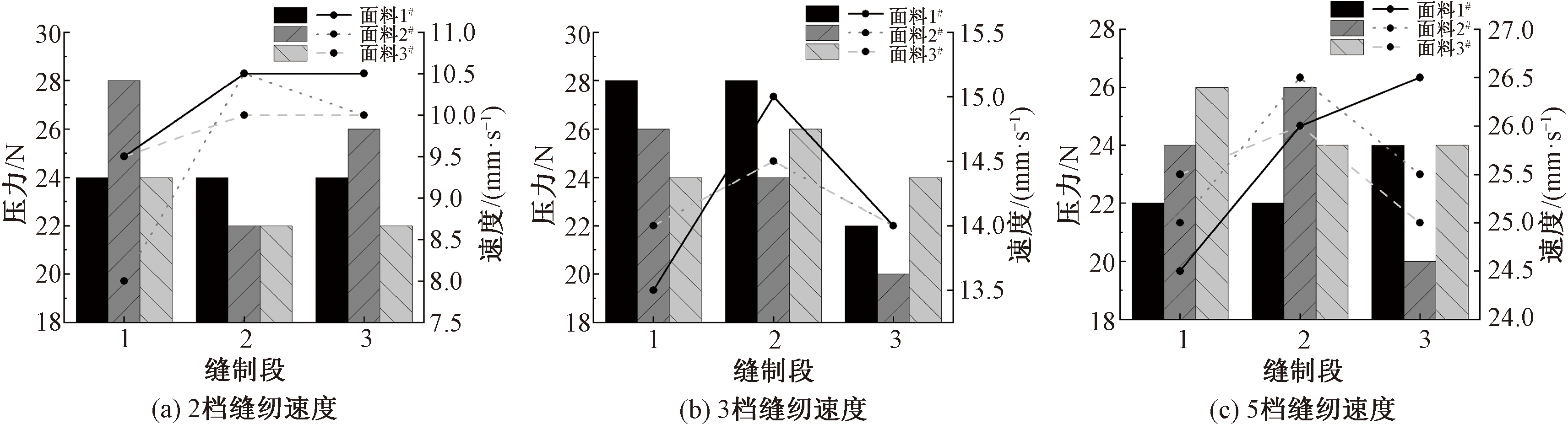
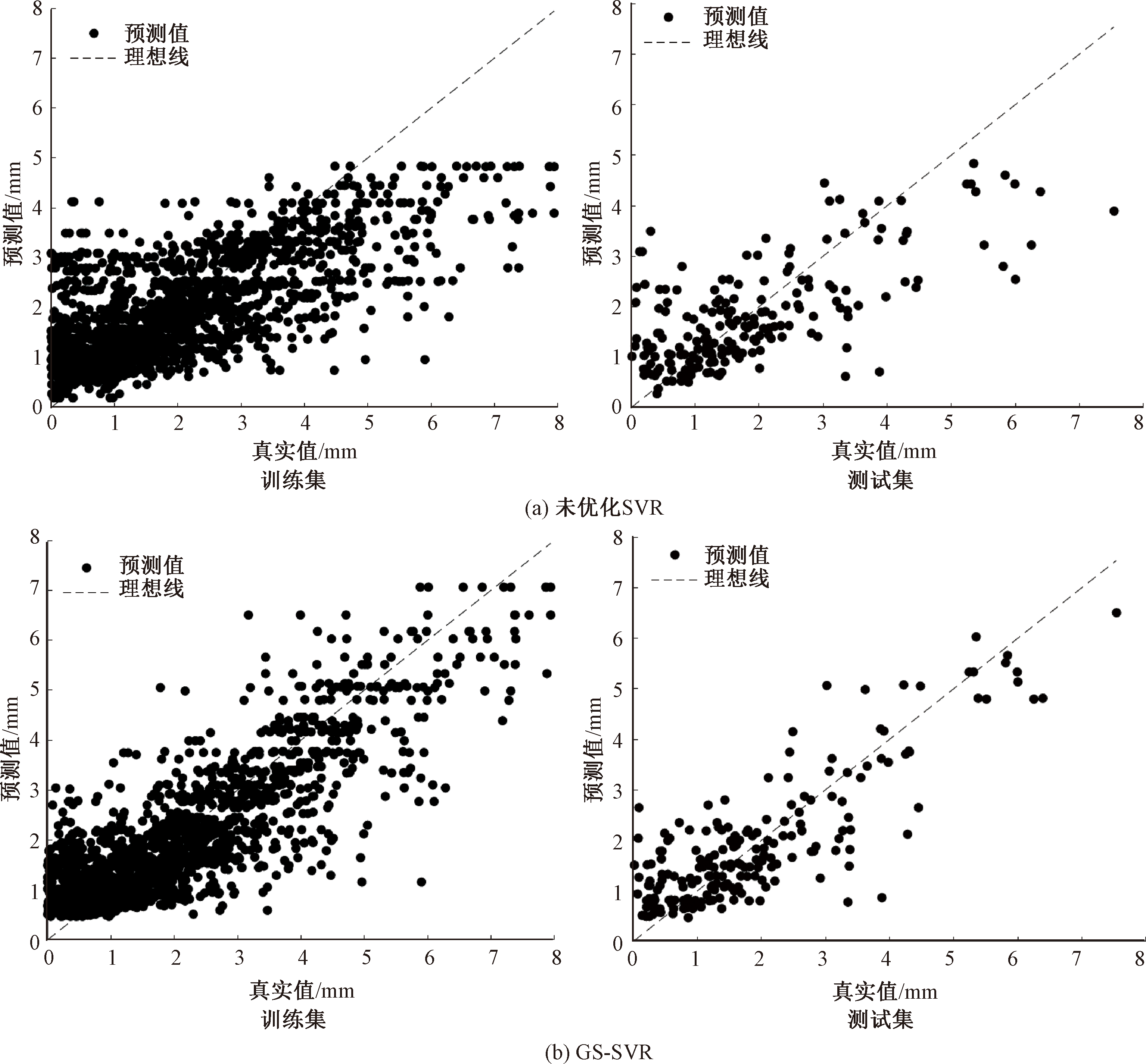
Results When the sewing speed was set to the gear 2, the optimal combination of force and speed for the soft fingers of the fabric 1# in the three sewing segments is (24 N, 9.5 mm/s), (24 N, 10.5 mm/s), and (24 N, 10.5 mm/s); for fabric 2#, the optimal combination is (28 N, 8 mm/s), (22 N, 10.5 mm/s), and (26 N, 10 mm/s); and for fabric 3#, the optimal combination is (24 N, 9.5 mm/s), (22 N, 10 mm/s), and (22 N, 10 mm/s). For the first sewing segment of fabric 1#, the influence of the soft finger speed on the sewing deviation is the greatest, followed by the interaction effect. For the second and third sewing segments of fabric 1#, the soft finger force, speed, and their interaction all have an impact on the sewing deviation. Among them, the interaction has the strongest impact on the second segment, while soft finger speed dominates the third segment. Before optimization, the support vector regression (SVR) model only had a small portion of the predicted values close to the actual values on both the training set and the test set. When the actual values were large, the corresponding predicted value distribution was relatively scattered, deviating significantly from the ideal line. After optimization using GS, BO, and PSO, the performance of the SVR model on the training set and the test set was significantly better than that of the unoptimized model. Among them, the model obtained by optimizing with GS had the best generalization ability and optimization efficiency (root-mean-square error of 0.039 7 mm, optimization time of 26.52 s), and most of the predicted values were concentrated near the ideal line, meaning they were close to the actual values.

Conclusion At the same sewing speed, the optimal combinations of soft finger compression force and sewing speed differ among the three-cycle sewing segments for the same fabric, and also vary across different fabrics for the same sewing segment. For the same fabric, the influence of soft finger force, speed, and their interaction on sewing deviations vary with sewing speed and cyclic sewing segment, with significant differences observed between different fabrics. Therefore, the optimal combinations of robotic arm parameters for different sewing segments of various fabrics under different sewing speeds should be dynamically matched according to the specific fabric, sewing segment, and sewing speed. This approach can effectively reduce sewing deviations and improve sewing accuracy. The optimized support vector regression models outperform the unoptimized ones significantly in both training and test sets. Among them, the model optimized by GS exhibits the best generalization ability and optimization efficiency. Thus, the support vector regression model optimized by GS can relatively accurately and efficiently predict the absolute value of sewing deviation for different sewing segments and robotic arm parameter combinations under varying sewing speeds.

Key words: sewing robot, soft finger, sewing speed, long straight-line sewing, sewing deviation, orthogonal experiment, support vector regression

CLC Number: 

  • TS941.63

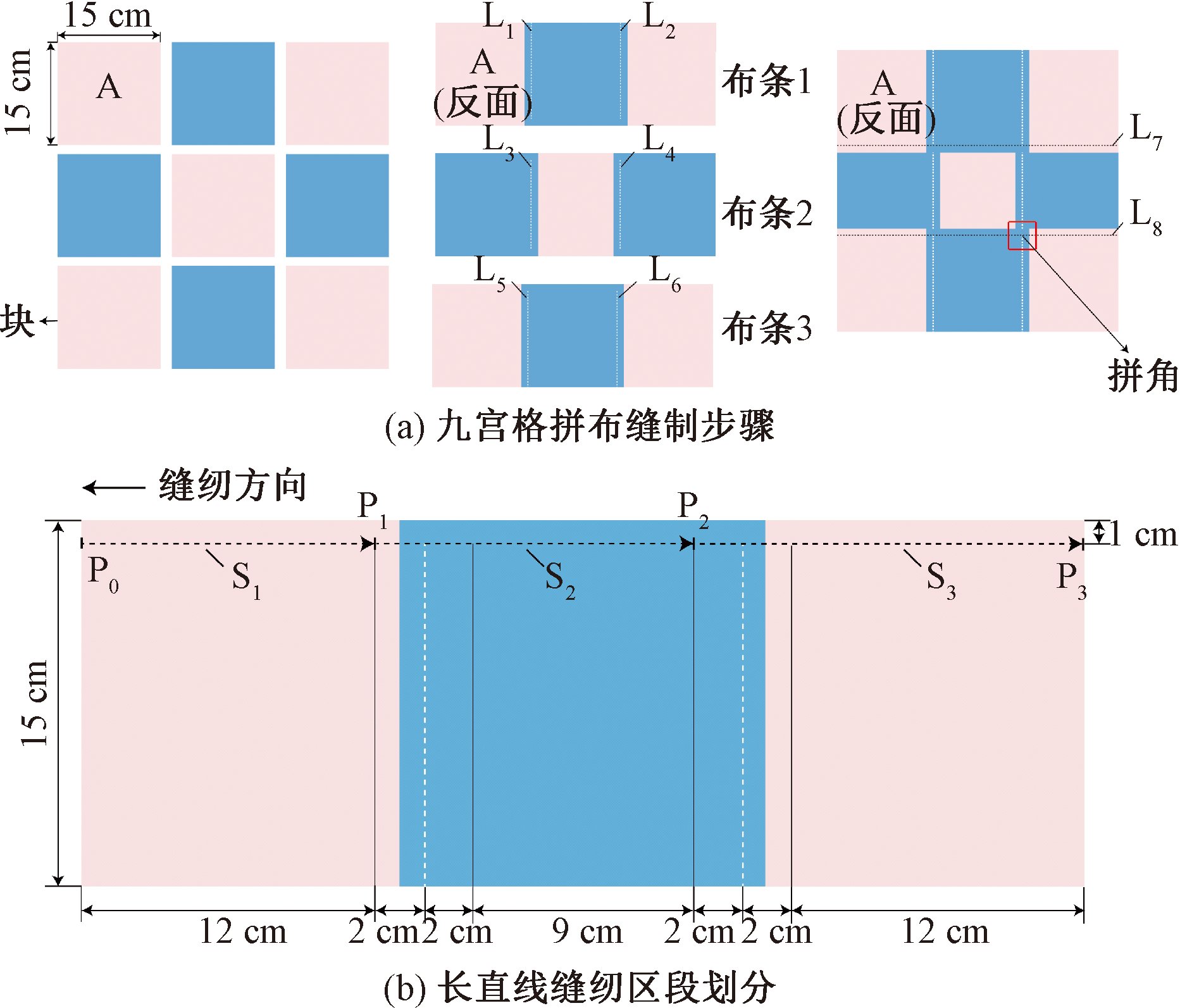
Fig.1

Schematic diagram of multi-cycle straight-line sewing. (a) Sewing steps of nine-square grid pattern quilting; (b) Long straight-line sewing segment division"

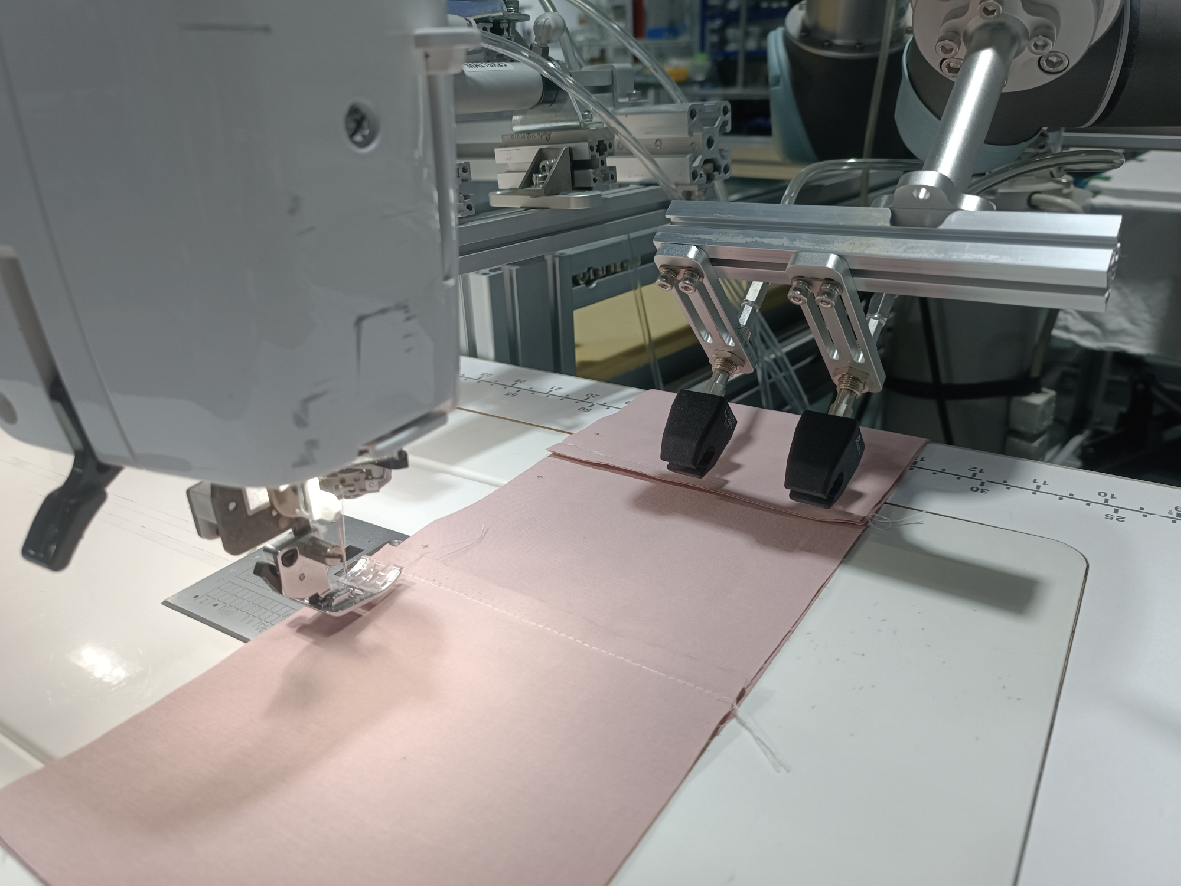
Fig.2

Diagram of experimental equipment and materials"

Tab.1

Fabric property parameters"

面料
编号
面密度/
(g·m-2)
厚度/
mm
弯曲长度/mm 弹性模量/MPa
经向 纬向 经向 纬向
1# 190.467 0.391 0.10 0.07 6.33 9.55
2# 225.333 0.422 0.26 0.23 3.68 10.20
3# 232.400 0.452 0.40 0.15 3.45 9.88

Tab.2

Factor-lever table"

缝纫
速度
水平 A
压力/N
B
速度/(mm·s-1)
缝制段1 缝制段2 缝制段3
2档 1 20 8.0 9.0 9.0
2 22 8.5 9.5 9.5
3 24 9.0 10.0 10.0
4 26 9.5 10.5 10.5
5 28 10.0 11.0 11.0
3档 1 20 13.0 13.0 13.0
2 22 13.5 13.5 13.5
3 24 14.0 14.0 14.0
4 26 14.5 14.5 14.5
5 28 15.0 15.0 15.0
5档 1 20 24.0 25.0 25.0
2 22 24.5 25.5 25.5
3 24 25.0 26.0 26.0
4 26 25.5 26.5 26.5
5 28 26.0 27.0 27.0

Fig.3

Optimal parameter combinations for three sewing segments of three types of fabrics. (a) Gear 2; (b) Gear 3; (c) Gear 5"

Tab.3

Optimal hyperparameter combinations"

模型 正则化参数C 核函数参数σ 不敏感参数ε
GS-SVR 10.000 0 0.100 0 0.500 0
BO-SVR 4.278 0 0.100 9 0.679 3
PSO-SVR 49.900 7 0.100 0 0.693 2

Tab.4

Model performance evaluation"

模型 E/mm R2 T/s
训练集 测试集 训练集 测试集
SVR 1.117 0 1.063 0 0.502 9 0.486 3
GS-SVR 0.008 1 0.039 7 0.712 3 0.695 7 26.52
BO-SVR 0.855 8 0.813 0 0.708 2 0.699 5 63.85
PSO-SVR 0.855 5 0.813 9 0.708 4 0.698 8 339.12

Fig.4

Regression graphs of SVR training set and test set before and after optimization. (a) Unoptimized SVR; (b) GS-SVR"

[1] 吴柳波, 李新荣, 杜金丽. 基于轮廓提取的缝纫机器人运动轨迹规划研究进展[J]. 纺织学报, 2021, 42(4): 191-200.
WU Liubo, LI Xinrong, DU Jinli. Research progress on trajectory planning of sewing robot based on contour extraction[J]. Journal of Textile Research, 2021, 42(4): 191-200.
[2] LÁZÁR K. Industrial robots in the textile and clothing industry[J]. International Journal of Industrial and Manufacturing Systems Engineering, 2024, 9(1): 1-9.
doi: 10.11648/j.ijimse
[3] KOUSTOUMPARDIS P N, ASPRAGATHOS N A. Intelligent hierarchical robot control for sewing fabrics[J]. Robotics and Computer-Integrated Manufacturing, 2014, 30(1): 34-46.
doi: 10.1016/j.rcim.2013.08.001
[4] 付天宇, 李凤鸣, 崔涛, 等. 基于视觉/力觉的机器人协同缝制系统[J]. 机器人, 2022, 44(3): 352-360.
doi: 10.13973/j.cnki.robot.210414
FU Tianyu, LI Fengming, CUI Tao, et al. A robotic collaborative sewing system based on visual and force perception[J]. Robot, 2022, 44(3): 352-360.
doi: 10.13973/j.cnki.robot.210414
[5] 王晓华, 王育合, 张蕾, 等. 缝纫机器人对织物张力与位置的模糊阻抗控制[J]. 纺织学报, 2021, 42(11): 173-178.
doi: 10.13475/j.fzxb.20200605706
WANG Xiaohua, WANG Yuhe, ZHANG Lei, et al. Fuzzy impedance control of sewing robot for fabric tension and position[J]. Journal of Textile Research, 2021, 42(11): 173-178.
doi: 10.13475/j.fzxb.20200605706
[6] KOSAKA N, CHIDA Y, TANEMURA M, et al. Real-time optimal control of automatic sewing considering fabric geometric shapes[J]. Mechatronics, 2023, 94: 103005.
doi: 10.1016/j.mechatronics.2023.103005
[7] LI F M, HOU D, FU T Y, et al. Research on robot sewing method based on process modeling[J]. International Journal of Intelligent Robotics and Applications, 2024, 8(2): 401-421.
doi: 10.1007/s41315-024-00326-1
[8] TANG K, TOKUDA F, SEINO A, et al. Time-scaling modeling and control of robotic sewing system[J]. IEEE/ASME Transactions on Mechatronics, 2024, 29(4): 3166-3174.
doi: 10.1109/TMECH.2024.3398713
[9] ZHU Y X, SHEN J Z, WANG J P, et al. A study on the formulation of process parameters for soft finger-assisted fabric stitching[J]. International Journal of Clothing Science and Technology, 2024, 36(6): 1004-1019.
doi: 10.1108/IJCST-01-2024-0001
[10] WANG J P, SHEN J Z, YAO X F, et al. Research progress of automatic grasping methods for garment fabrics[J]. International Journal of Clothing Science and Technology, 2023, 35(6): 997-1022.
doi: 10.1108/IJCST-05-2023-0068
[11] 王建萍, 朱妍西, 沈津竹, 等. 软体机器人在服装领域的应用进展[J]. 纺织学报, 2024, 45(5): 239-247.
WANG Jianping, ZHU Yanxi, SHEN Jinzhu, et al. Application progress of soft robot in clothing field[J]. Journal of Textile Research, 2024, 45(5): 239-247.
[12] 王建萍, 沈津竹, 姚晓凤, 等. 服装裁片自动抓取技术及其布局方法的研究进展[J]. 纺织学报, 2024, 45(6): 227-234.
WANG Jianping, SHEN Jinzhu, YAO Xiaofeng, et al. Research progress on automatic grasping technology and layout method of garment cutting pieces[J]. Journal of Textile Research, 2024, 45(6): 227-234.
[13] SMOLA A J, SCHÖLKOPF B. A tutorial on support vector regression[J]. Statistics and Computing, 2004, 14(3): 199-222.
doi: 10.1023/B:STCO.0000035301.49549.88
[14] DONG Z B, YANG D Z, REINDL T, et al. A novel hybrid approach based on self-organizing maps, support vector regression and particle swarm optimization to forecast solar irradiance[J]. Energy, 2015, 82: 570-577.
doi: 10.1016/j.energy.2015.01.066
[15] YANG L, SHAMI A. On hyperparameter optimization of machine learning algorithms: theory and practice[J]. Neurocomputing, 2020, 415: 295-316.
doi: 10.1016/j.neucom.2020.07.061
[1] LI Shun, JIA Yanjun, LI Xinrong, FENG Wenqian, WEN Jiaqi. Modeling of driving force for pressure plate sewing robot based on flexural deformation [J]. Journal of Textile Research, 2025, 46(04): 215-225.
[2] WANG Jianping, WENG Yuxin, SHEN Jinzhu, ZHANG Fan, LIU Xianke. Automatic fabric flipping device based on soft fingers and its application effect [J]. Journal of Textile Research, 2025, 46(01): 197-205.
[3] WANG Jianping, SHEN Jinzhu, YAO Xiaofeng, ZHU Yanxi, ZHANG Fan. Review on automatic grasping technology and arrangement methods for garment pattern pieces [J]. Journal of Textile Research, 2024, 45(06): 227-234.
[4] WANG Xiaohua, WANG Yuhe, ZHANG Lei, WANG Wenjie. Force and position fuzzy impedance control of a sewing robot [J]. Journal of Textile Research, 2021, 42(11): 173-178.
[5] . Parameters' optimization combination of sewing process of winter coat filled with wool [J]. JOURNAL OF TEXTILE RESEARCH, 2014, 35(6): 115-0.
[6] . Online soft measurement of sizing percentage based on intergrated multiple SVR fusion by Bagging [J]. JOURNAL OF TEXTILE RESEARCH, 2014, 35(1): 62-0.
[7] DU Zhao-Fang, HUANG Fu-Rong.  Process optimization of composite microorganisms of ramie [J]. JOURNAL OF TEXTILE RESEARCH, 2012, 33(5): 56-61.
[8] YU Tianshi;GUO Xinxin;QIU Hua;GE Mingqiao. Synthesis of Gemini surfactant with waste polyester [J]. JOURNAL OF TEXTILE RESEARCH, 2010, 31(4): 20-24.
[9] JU Chengjun;CHENG Longdi;YU Jianyong;XUE Wenliang. Optimization of air pressure combination in manufacturing parallel ply yarn [J]. JOURNAL OF TEXTILE RESEARCH, 2009, 30(05): 25-27.
[10] BAI Xiu′e;GUAN Xinhai. Process optimization of alkali treatment of PTT fibers [J]. JOURNAL OF TEXTILE RESEARCH, 2008, 29(5): 15-18.
[11] LI Lian-ju. One bath oxidative pretreatment of cotton fabric [J]. JOURNAL OF TEXTILE RESEARCH, 2005, 26(6): 109-111.
[12] WANG Lan;ZENG Jun-ying;YAN Jun. Union dyeing process of silk/wool blended fabric [J]. JOURNAL OF TEXTILE RESEARCH, 2005, 26(6): 44-46.
Viewed
Full text


Abstract

Cited

  Shared   
  Discussed   
No Suggested Reading articles found!