Journal of Textile Research ›› 2026, Vol. 47 ›› Issue (04): 207-214.doi: 10.13475/j.fzxb.20250703001

• Apparel Engineering • Previous Articles     Next Articles

Intelligent classification of head neck and shoulder shapes for youths in East China

ZHONG Yutong1,2, LU Yehu1,2()   

  1. 1 School of Textile and Clothing Engineering, Soochow University, Suzhou, Jiangsu 215006, China
    2 National Engineering Laboratory for Modern Silk, Suzhou, Jiangsu 215123, China
  • Received:2025-07-14 Revised:2026-02-10 Online:2026-04-15 Published:2026-04-15
  • Contact: LU Yehu E-mail:yhlu@suda.edu.cn

Abstract:

Objective Traditional designs of head, neck and shoulder products ignore individual shape differences, causing user discomfort. Taking the young group in East China as the target, 3-D scanning technology and machine learning are used in this study to establish an intelligent classification system for head, neck and shoulder shapes. The research aims to provide a scientific basis for personalized engineering design (such as pillows) to enhance product comfort. The objectives of this study include identifying key morphological indicators, establishing intelligent classification models, and visualizing the results through 3-D modeling.

Method Data of 228 participants were collected using the Vitus Smart XXL 3-D scanner. Seven indicators were extracted from the model processed by Geomagic Studio, which are tragus point-lateral width of the acromion, lateral depth of the neck, wall-anterior shoulder distance, occipital process point distance, cervical depth, occipitocervical distance and scapular distance of the neck. The normality of the data was verified through the Kolmogorov-Smirnov and Shapiro-Wilk tests. Shape classification was carried out using the K-means clustering method of SPSS 27.0, and a 3-D visualization model was generated through 3ds Max software. The intelligent classification model was established by using computer ensemble learning.

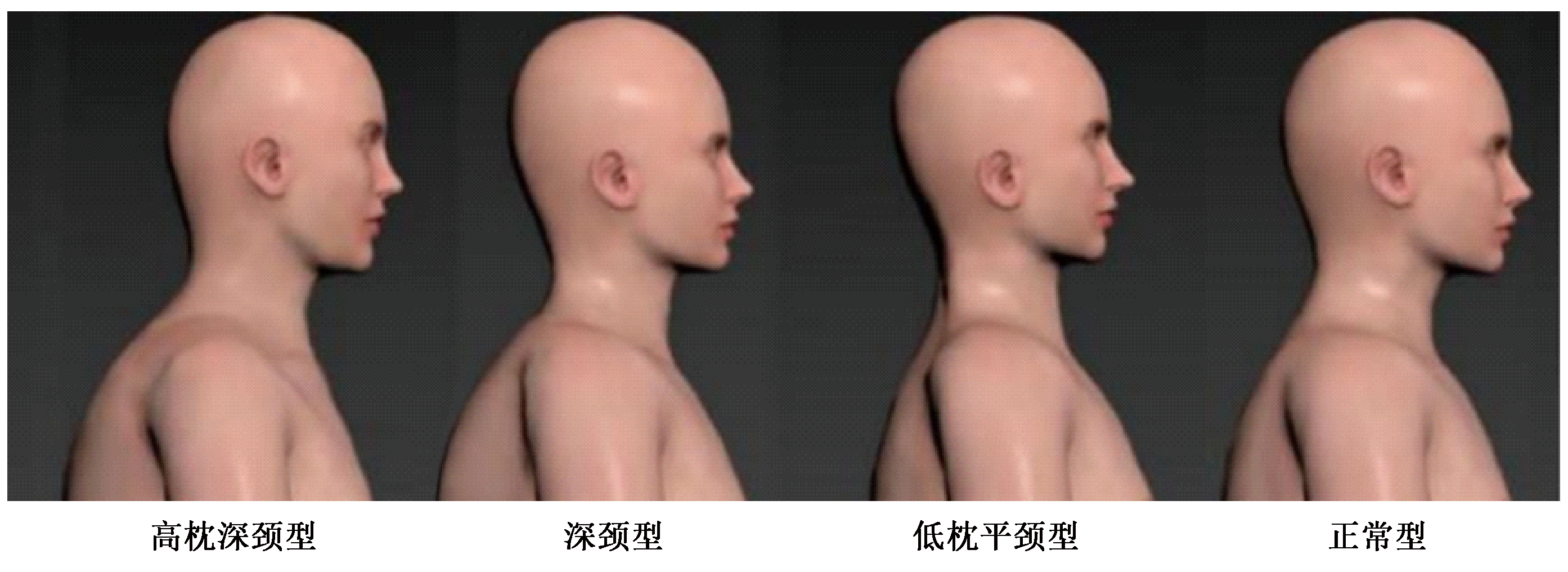
Results By analyzing the 3-D human body scan data, no significant differences were identified in the head, neck and shoulder data between men and women, and the scanned data of men and women were combined for discussion. Using SPSS cluster analysis, the head, neck and shoulder shapes of 222 young people from East China were classified into four types, namely the normal type, deep neck type, low occipital flat neck type and high occipital deep neck type. All the indicators of the normal group were within the median range, manifesting that no significant morphological abnormalities were detected in the head, neck and shoulder structure. The occipital process distance of the low occipital and flat neck type group was found significantly lower than that of the normal type (with a mean difference of 3.5 cm), indicating that the position of the posterior occipital point shifted relatively backward, the cervical depth distance shortened by 1.6 cm, and there was an abnormal physiological curvature of the cervical vertebrae. The depth of the neck in the deep-necked group was 1.3 cm smaller compared with the normal type. The group with high occipital and deep neck type showed typical characteristics of an increase of 2.9 cm in occipital process distance and 3.1 cm in cervical depth distance respectively. The results of 3-D modeling further revealed various visual shape differences. In the process of establishing an intelligent classification model for young people's heads, necks and shoulders using machine learning, the SMOTE algorithm was employed to generate minority class samples through interpolation, in order to balance the category distribution of the training set. The linear model (SVM/LR) was significantly superior to the tree model (RF). All models tended to choose stronger regularization (C=10), and SVM selected the linear kernel. the study analysis indicated obvious linear relationships among the features. The performance of all model test sets was lower than that of cross-validation, and the random forest decreased most significantly (13.85%), indicating that the tree model was severely overfitted. The prediction results of the base models showed a high degree of similarity, and the voting ensemble did not surpass the best base model (SVM/LR). The overall accuracy rate of the intelligent classification model based on ensemble learning was found to be 92%, reaching an excellent level. The recognition effects of most categories were excellent, with 100% for the low-pillow flat-neck type, 94% for the normal type, and 92% for the deep-neck type.

Conclusion Based on 3-D human body scan data and cluster analysis, this study classified the young group into four categories, aiming to improve the deficiencies of existing head, neck and shoulder research in the fields of transgender and intelligent classification. By integrating 3-D scanning, cluster analysis, modeling techniques and machine learning, precise basis for the development of personalized engineering products (such as sleep pillows) was formulated. In the future, it is necessary to further verify the applicability of the classification system among a wider range of people (such as different age and occupational groups), and explore the influence of dynamic postures on morphology.

Key words: youth, three-dimensional human body scanning, head-neck-shoulders, three-dimensional modeling, intelligent classification model

CLC Number: 

  • TS941.75

Tab.1

Mean and standard deviation of head, neck and shoulder data measurements for males and females"

性别 指标 平均值/mm 标准差 CV值 样本量
男性 形态面长 120 7.8 6.5 96
头高 232 12.6 5.4 67
身高 1 687 67.5 4.0 37
肩宽 386 19.8 5.1 59
女性 形态面长 111 7.0 6.3 90
头高 227 11.6 5.1 60
身高 1 572 72.0 3.8 33
肩宽 354 18.2 5.1 59

Tab.2

Definition of measurement indicators"

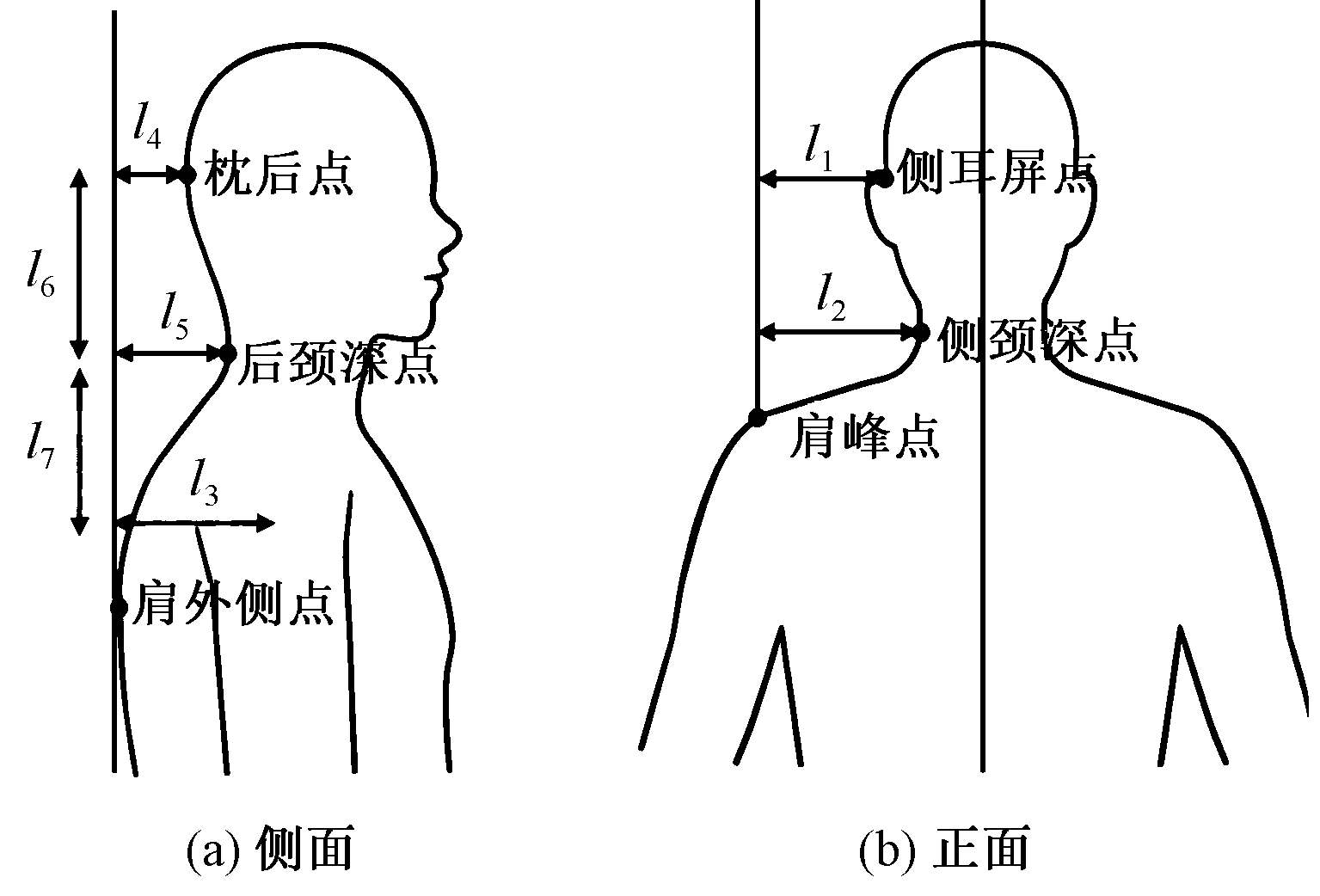
序号 测量指标 定义
l1 侧耳屏肩距 任意一耳屏点与肩峰点之间垂直于矢状面的距离
l2 侧颈深 任意一侧颈深点与肩峰点之间垂直于矢状面的距离
l3 墙肩距 从背部后缘至肩峰点,平行于矢状面的纵向水平直线距离
l4 枕突距 从背部后缘至枕突点,平行于矢状面的纵向水平直线距离
l5 颈深距 从背部后缘至颈椎点,平行于矢状面的纵向水平直线距离
l6 枕骨颈间距 枕后点与颈深点之间平行于冠状面的纵向水平直线距离
l7 颈肩间距 颈深点与颈肩峰点平行于冠状面的纵向水平直线距离

Fig.1

Schematic diagram of measurement indicators. (a)Side view; (b) Front view"

Tab.3

Error analysis of measurement indicators"

测量指标 标准差/mm 变异系数/%
侧耳屏肩距 3.8 3.7
侧颈深 6.6 5.2
墙肩距 4.9 4.5
枕突距 3.1 5.3
颈深距 3.0 4.1
枕骨颈间距 7.1 5.8
颈肩间距 2.9 4.1

Tab.4

Normal distribution test table of head, neck and shoulder measurement data for men and women"

性别 测量
指标
K-S S-W
统计 自由度 显著性 统计 自由度 显著性
侧颈深 0.082 112 0.063 0.990 112 0.553
侧耳屏肩距 0.051 112 0.200* 0.991 112 0.711
枕骨颈间距 0.073 112 0.197 0.984 112 0.209
颈肩间距 0.082 112 0.060 0.983 112 0.159
墙肩距 0.067 112 0.200* 0.985 112 0.239
枕突距 0.074 112 0.179 0.986 112 0.321
颈深距 0.088 112 0.051 0.978 112 0.063
侧颈深 0.078 110 0.097 0.978 110 0.066
侧耳屏肩距 0.083 110 0.057 0.983 110 0.179
枕骨颈间距 0.072 110 0.200* 0.980 110 0.106
颈肩间距 0.060 110 0.200* 0.989 110 0.497
墙肩距 0.051 110 0.200* 0.987 110 0.400
枕突距 0.077 110 0.123 0.987 110 0.363
颈深距 0.057 110 0.200* 0.991 110 0.690

Tab.5

Independent sample T-test"

测量
指标
莱文方差等
同性检验
平均值等同性T检验
(假定等方差)
平均值等同性T检验
(不假定等方差)
F Sig. t df Sig.
(双侧)
t df Sig.
(双侧)
l1 0.187 0.666 0.249 220 0.804 0.249 219.896 0.804
l2 6.461 0.012 1.150 220 0.251 1.152 212.953 0.251
l3 1.578 0.210 0.564 220 0.573 0.563 216.098 0.574
l4 0.565 0.453 0.923 220 0.357 0.924 217.877 0.356
l5 8.854 0.003 2.262 220 0.055 2.267 209.611 0.054
l6 0.288 0.592 -1.043 220 0.298 -1.043 219.825 0.298
l7 1.605 0.207 -1.638 220 0.103 -1.637 217.648 0.103

Tab.6

Youth head, neck and shoulder clustering"

体型
分类
指标/cm 数量 占比/
%
l1 l2 l3 l4 l5 l6 l7
高枕
深颈
9.8 12.3 12.7 8.8 10.4 9.8 5.9 33 14.9
深颈 11.5 13.5 12.8 6.0 8.6 11.1 7.3 53 23.9
低枕
平颈
11.1 13.3 9.9 2.4 5.7 13.8 8.0 54 24.3
正常 10.3 12.7 10.8 5.9 7.3 12.2 7.1 82 36.9

Fig.2

Classification and modeling of head, neck and shoulder morphology in young people"

Tab.7

Model cross-validation performance"

数据类型 模型 准确率/% 相对训练集下降/%
训练集 SVM 98.28
逻辑回归 97.60
随机森林 93.85
测试集 SVM 92.00 -5.60
逻辑回归 92.00 -6.28
随机森林 80.00 -13.85
投票集成 92.00

Tab.8

Comparison of performance in various categories"

体型类别 精确率/% 召回率/% F1
低枕平颈 100 100 1.00
正常 100 89 0.94
深颈 86 100 0.92
高枕深颈 82 82 0.82
[1] LI Y, WU J, LU C, et al. Pillow support model with partitioned matching based on body pressure distribution matrix[J]. Healthcare, 2021, 9(5): 571-593.
doi: 10.3390/healthcare9050571
[2] XU L, DANG J, YANG X, et al. Research progress of cervical pillow in prevention and treatment of cervical spondylosis[J]. Journal of Contemporary Medical Practice, 2025, 7(8): 14-16.
[3] JEON M Y, JEONG H, LEE S, et al. Improving the quality of sleep with an optimal pillow: a randomized, comparative study[J]. The Tohoku Journal of Experimental Medicine, 2014, 233(3): 183-188.
doi: 10.1620/tjem.233.183
[4] GORDON S J, GRIMMER-SOMERS K. Your pillow may not guarantee a good night's sleep or symptom-free waking[J]. Physiotherapy Canada, 2011, 63(2): 183-190.
doi: 10.3138/ptc.2010-13 pmid: 22379258
[5] ZHONG D, LIN C, HSIEH Y, et al. The effect of the air massage pillow for individuals with neck pain: a randomized double-blind, cross-over study[J]. QJM: An International Journal of Medicine, 2025: hcaf161.
[6] 王珊珊, 王鸿博. 基于三维人体测量的江浙在职男青年颈部形态[J]. 纺织学报, 2013, 34(10): 131-136.
WANG Shanshan, WANG Hongbo. Neck morphology research of on-the-job young men in Jiangsu and Zhejiang areas by means of three-dimensional anthropometry[J]. Journal of Textile Research, 2013, 34(10): 131-136.
[7] HOY D G, PROTANI M, DE R, et al. The epidemiology of neck pain[J]. Best Practice & Research Clinical Rheumatology, 2010, 24(6): 783-792.
[8] WANG L, WANG H, ZHANG H, et al. Somatotype identification of middle-aged women based on decision tree algorithm[J]. International Journal of Clothing Science and Technology, 2021, 33(3): 402-420.
doi: 10.1108/IJCST-12-2019-0193
[9] CAI X, GU B, HE H. Classification analysis of young female students'waist-abdomen-hip based on body photos[J]. Textile Research Journal, 2021, 91(11/12): 1409-1418.
doi: 10.1177/0040517520979742
[10] YAO T, MIN Y, WANG J, et al. Classification of female body shape based on two-dimensional image and computer vision technology[J]. Textile Research Journal, 2023, 93(19/20): 4383-4391.
doi: 10.1177/00405175231173871
[11] 郭芳, 黄硕, 刘宁, 等. 3种不同髁突头部形态全颞下颌关节假体的生物力学研究[J]. 医用生物力学, 2022, 37(6): 1095-1100, 1144.
GUO Fang, HUANG Shuo, LIU Ning, et al. Biomechanical study of temporomandibular joint prostheses with three different condylar head shapes[J]. Journal of Medical Biomechanics, 2022, 37(6): 1095-1100, 1144.
[12] 李靖, 洪智, 徐元铭, 等. 飞行员头部特征分析及头型分类方法研究[J]. 航天医学与医学工程, 2014, 27(6): 430-433.
LI Jing, HONG Zhi, XU Yuanming, et al. Research on the Characteristics and Classification of Pilots' Head[J]. Space Medicine & Medical Engineering, 2014, 27(6): 430-433.
[13] 张金花, 王宏付. 基于三维人体测量的女性肩部研究[J]. 纺织学报, 2011, 32(5): 95-97.
ZHANG Jinhua, WANG Hongfu. Study of womens' shoulder based on 3-D body measurement[J]. Journal of Textile Research, 2011, 32(5): 95-97.
[14] WANG T, GU B. Automatic recognition and 3D modeling of the neck-shoulder human shape based on 2D images[J]. International Journal of Clothing Science and Technology, 2021, 33(5): 796-810.
doi: 10.1108/IJCST-05-2020-0079
[15] ZHANG J, XU K, ZHAO S, et al. Automatic recognition of the neck-shoulder shape based on 2D photos[J]. Textile Research Journal, 2022, 92(23/24): 5095-5105.
doi: 10.1177/00405175221115764
[16] CUI M H, CHOI Y L, NAM Y J. Classification of Men's shoulder shapes based on pyramid method[J]. Advanced Materials Research, 2012, 605-607: 244-249.
doi: 10.4028/www.scientific.net/AMR.605-607
[17] 侯梦婕. 基于三维人体扫描枕型的结构研究[D]. 西安: 西安工程大学, 2019: 12-28.
HOU Mengjie. Research on pillow structure based on three-dimensional scanning of human body[D]. Xi'an: Xi'an Polytechnic University, 2019: 12-28.
[18] DAANEN H A M, TER HAAR F B. 3D whole body scanners revisited[J]. Displays, 2013, 34(4): 270-275.
doi: 10.1016/j.displa.2013.08.011
[19] 史家宇. 基于青年男性头颈肩分类的睡枕结构设计模型研究[D]. 苏州: 苏州大学, 2023: 11-13.
SHI Jiayu. Design model of sleeping pillow structure based on head, neck and shoulder classification of young male[D]. Suzhou: Soochow University, 2023: 11-13.
[20] 汪芬芬, 王革辉, 黄添宜, 等. 正侧面形态特征驱动的女性腿型分类[J]. 纺织学报, 2022, 43(9): 188-194.
WANG Fenfen, WANG Gehui, HUANG Tianyi, et al. Female leg shape classification based on frontal and lateral morphological characteristics[J]. Journal of Textile Research, 2022, 43(9): 188-194.
[21] 杨剑锋, 乔佩蕊, 李永梅, 等. 机器学习分类问题及算法研究综述[J]. 统计与决策, 2019, 35(6): 36-40.
YANG Jianfeng, QIAO Peirui, LI Yongmei, et al. A Review of Machine-learning Classification and Algorithms[J]. Statistics and Decision, 2019, 35(6): 36-40.
[22] ZHOU Q, ZHANG X, ZHANG Y. Ensemble learning with attention-based multiple instance pooling for classification of SPT[J]. IEEE Transactions on Circuits and Systems II: Express Briefs, 2022, 69(3): 1927-1931.
[23] 石洪波, 陈雨文, 陈鑫. SMOTE过采样及其改进算法研究综述[J]. 智能系统学报, 2019, 14(6): 1073-1083.
SHI Hongbo, CHEN Yuwen, CHEN Xin. Summary of research on SMOTE oversampling and its improved algorithms[J]. CAAI Transactions on Intelligent Systems, 2019, 14(6): 1073-1083.
[24] 胡局新, 张功杰. 基于K折交叉验证的选择性集成分类算法[J]. 科技通报, 2013, 29(12): 115-117.
HU Juxin, ZHANG Gongjie. K-fold cross-validation based selected ensemble classification algorithm[J]. Bulletin of Science and Technology, 2013, 29(12): 115-117.
[1] LIU Jinling, HE Yating, GU Bingfei. Classification and recognition of human head-neck-back curvature morphology for personalized curved-pillow design [J]. Journal of Textile Research, 2025, 46(08): 183-190.
[2] YU Yukun, SUN Yue, HOU Jue, LIU Zheng, YICK Kitlun. Dynamic finite element modeling and simulation of single layer clothing ease allowance [J]. Journal of Textile Research, 2022, 43(04): 124-132.
[3] WANG Di, KE Ying, WANG Hongfu. Parametric fashion design based on Voronoi graphics [J]. Journal of Textile Research, 2021, 42(12): 131-137.
[4] . Design and application of three-dimensional parametric technology in construction of new forms of modern clothing [J]. Journal of Textile Research, 2018, 39(12): 118-123.
[5] . Calculating method of characteristics girth of young female body by 3-D scanning data [J]. JOURNAL OF TEXTILE RESEARCH, 2017, 38(05): 110-114.
[6] . Camber features of women's shoulder and influence thereof on fitted clothes' structure [J]. JOURNAL OF TEXTILE RESEARCH, 2016, 37(10): 94-100.
Viewed
Full text


Abstract

Cited

  Shared   
  Discussed   
No Suggested Reading articles found!