纺织学报 ›› 2024, Vol. 45 ›› Issue (12): 98-108.doi: 10.13475/j.fzxb.20231102401

• 纺织工程 • 上一篇    下一篇

变厚度头锥体织物的工艺设计与验证

郭琦1,2, 吴宁1,2(), 孟影1,2, 安达1,2, 黄建龙1,2, 陈利1,2   

  1. 1.天津工业大学 纺织科学与工程学院, 天津 300387
    2.天津工业大学 先进纺织复合材料教育部重点实验室, 天津 300387
  • 收稿日期:2023-11-14 修回日期:2024-04-15 出版日期:2024-12-15 发布日期:2024-12-31
  • 通讯作者: 吴宁(1981—),男,副研究员,博士。主要研究方向为纺织复合材料结构与性能、高性能纤维可织性评价与性能优化。E-mail:wuning@tiangong.edu.cn
  • 作者简介:郭琦(1997—),男,硕士生。主要研究方向为纺织结构复合材料。
  • 基金资助:
    天津市教委科研计划重点项目(2019ZD03);航空发动机及燃气轮机基础科学中心项目(P2022-B-IV-014-001);天津市高等学校创新团队培养计划(TD13-5043)

Process design and verification of tapered axisymmetric preform with variable thickness

GUO Qi1,2, WU Ning1,2(), MENG Ying1,2, AN Da1,2, HUANG Jianlong1,2, CHEN Li1,2   

  1. 1. College of Textile Science and Engineering, Tiangong University, Tianjin 300387, China
    2. Key Laboratory ofAdvanced Textile Composite Materials of Ministry of Education, Tiangong University, Tianjin 300387, China
  • Received:2023-11-14 Revised:2024-04-15 Published:2024-12-15 Online:2024-12-31

摘要:

为实现天线罩用三维立体织物的近净成形,以头锥体立体特征为依据,角联锁结构为织物基础组织,提出了基于椭圆形纱线截面假设的变厚度层数计算模型和变截面经纱加列模型,并由此建立了织物纤维体积分数的预测模型,完成了头锥体结构织物顶部到薄壁均匀过渡的工艺设计与实验验证。研究结果表明,层数计算模型和经纱加列模型分别实现了织物厚度和织物截面的连续变化,其试织织物的三坐标扫描图与所设计头锥体三维模型相似度达97.36%,纤维体积分数与预测值误差为1.84%,验证了变厚度头锥体织物结构设计方案的可行性,并且织造过程中使用沿纬斜方向线密度梯度变化的经纬纱线有利于减小织物内层接线处的摩擦,提高预制体性能。

关键词: 头锥体织物, 结构设计, 变厚度, 变截面, 三维角联锁织物, 一体化成形, 纺织结构复合材料

Abstract:

Objective In order to form near-net tapered axisymmetric preform for radome using three-dimensional angular interlocking structure, a layer calculation model and a warp yarn adding model under the assumption of elliptical yarn cross section are put forward based on the analysis of the characteristics of variable thickness and variable cross section of the radome, and a fabric preform of variable thickness rotary cover is woven by combining the three-dimensional weaving technology.

Method The three-dimensional characteristics of tapered axisymmetric body with variable thickness were analyzed, and the mathematical model for calculating thickness (weft skew) and number of layers and the warp yarn adding model were established. Firstly, the simulation experiment of warp and weft extrusion state was established, and the regression equations for yarn long and short diameter (a, b) were obtained by response surface analysis. The unit thickness (single layer warp and weft thickness) model along the weft oblique direction was modified. Then, the mathematical model of layers and the model of warp yarn addition were established. Finally, the two models were used to design the number of layers, layer reduction scheme and warp yarn adding scheme of the radome fabric, and the fabric was practically woven to verify the feasibility of the fabric structure design scheme.

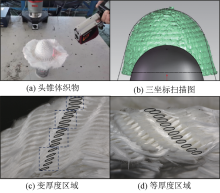
Results According to the analysis and calculation of the three-dimensional structure of the radome and the fineness as well as density of the selected warp and weft, four symmetrical 2.5D looms were used for weaving. In the weaving process, the regression equations of the long and short axes a and b of the yarn are obtained by determining the working conditions and inputting the horizontal coding of the corresponding factors, and then the number of weft layers was calculated according to the modified unit cell thickness model. When calculating the number of layers, it was determined that the position where the fineness of the warp yarn was reduced was the second weft according to the warp yarn difference rate f, and the number of layers after the thinning of the warp yarn needs to be equal to or less than that of the previous weft yarn due to the difficulty in adding layers. In the case that the predicted value of fabric fiber volume content is much different from the specified value, the yarn fineness would be redesigned. The warp and weft yarns with varying fineness gradient were used to improve the phenomena of "tight inside and loose outside" and uneven density of the fabric with variable thickness, and to reduce the friction at the yarn connection and reduce the fuzzing phenomenon. After weaving, the cover fabric was scanned in three coordinates, and the obtained three-coordinate scanning map showed 97.36% similarity with the cover model, and the error between the measured value and the predicted value of fabric fiber volume content was as small as 1.84%. The cured fabric was cut to obtain yarn sections in the variable thickness area and the equal thickness area.

Conclusion Based on the assumption of elliptical yarn cross-section, this paper makes a geometric analysis of the radome fabric preform with diagonal interlocking structure according to the two characteristics of variable thickness and variable cross-section. Combined with the regression equations of long and short diameters of yarns, the unit thickness model along the weft skew direction is modified, and then establishes the mathematical calculation model of thickness (weft skew) and number of layers and the warp and weft yarn adding model are established, dividing the warp and weft yarn distribution in detail. Through the actual weaving on the machine, the design effect of the model is verified, and the results show the feasibility of the structure and process design of the fabric preform with variable thickness. It can realize the integrated near-shape weaving of the radome of hypersonic aircraft and improve the overall performance of the radome.

Key words: tapered axisymmetric body, structural design, variable thickness, variable cross section, three-dimensional angular interlocking fabric, integrated forming, textile composite material

中图分类号: 

  • TS105.1

图1

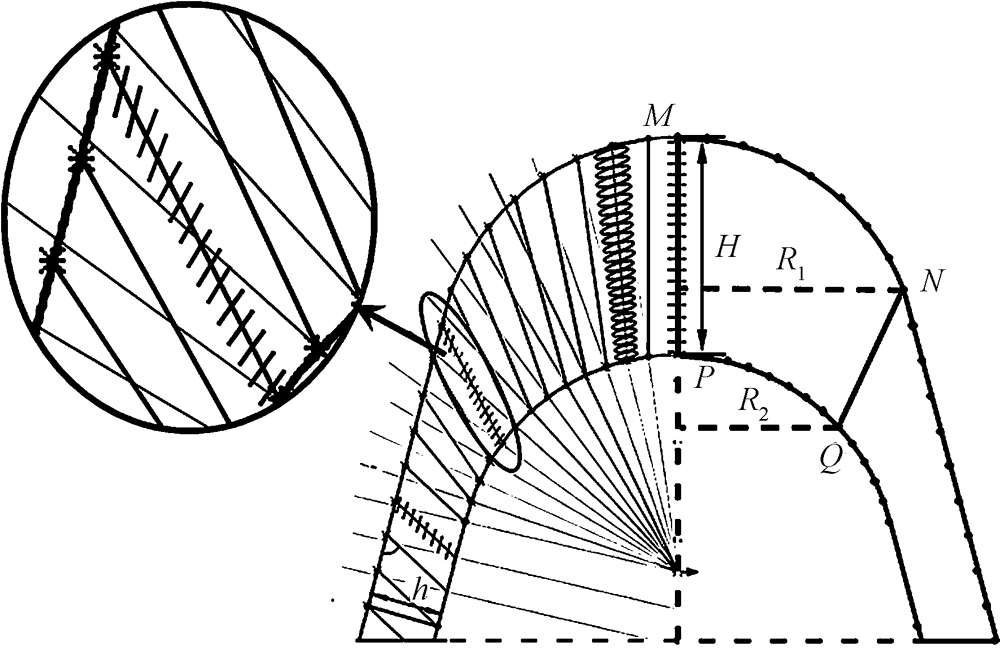
头锥体三维模型"

图2

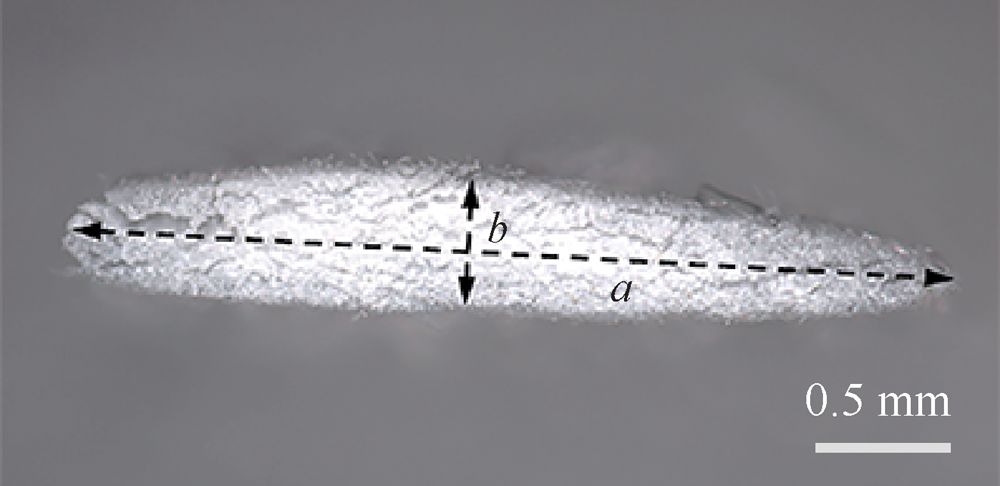
近似椭圆纱线截面"

表1

因素水平编码表"

水平 衬底A B C D
-1 双层气泡膜 0 570 4
0 塑料薄膜 0.24 950 42
1 3层玻璃纤维布 0.48 1 330 80

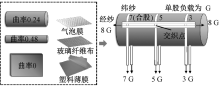
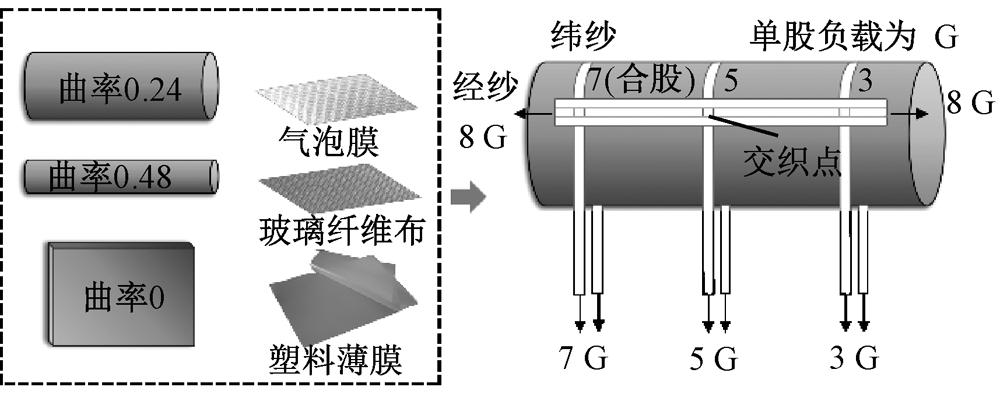
图3

纱线横截面形态模拟实验示意图"

表2

长半轴a的回归分析"

来源 自由度 平方和 均方差 F P
回归 14 8.70 0.620 43.34 <0.000 1
残差 14 0.20 0.014
失效拟合 10 0.18 0.018 4.04 0.095 3
纯误差 4 0.018 0.004 522
总平方和 28 8.9

表3

短半轴b的回归模型"

来源 自由度 平方和 均方差 F P
回归 14 0.064 0.004 601 23.06 <0.000 1
残差 14 0.002 793 0.001 995
失效拟合 10 0.002 486 0.002 486 3.24 0.134 5
纯误差 4 0.000 307 0.000 076
总平方和 28 0.067

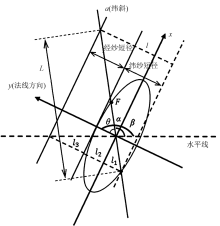
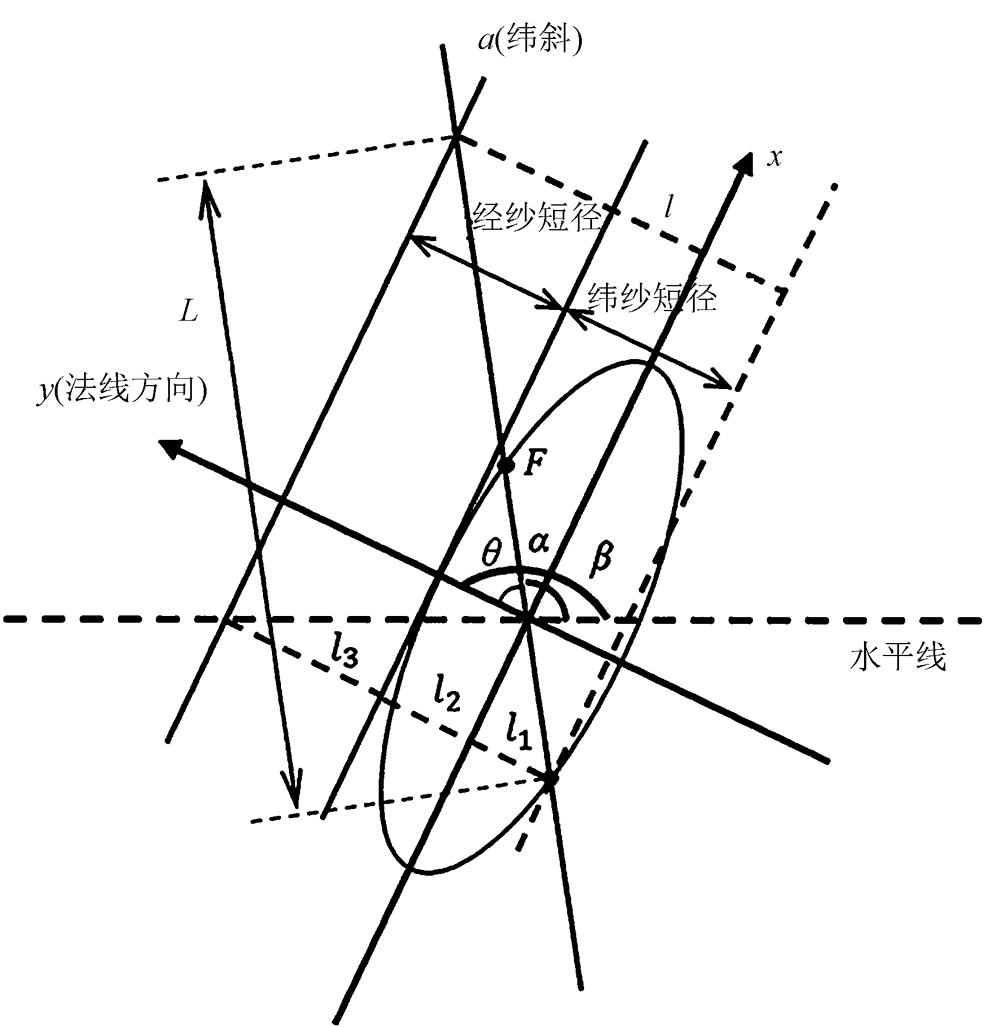
图4

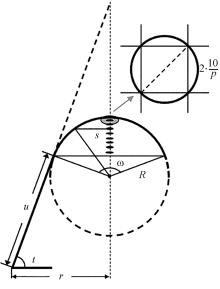
单胞几何分析图"

表4

斜率计算结果"

纬 数 tan (90° - θ)
υ = 0 υ = 1 υ = 2 υ = 3
1 7.077 7.463 7.893 8.375
2 5.697 5.374 5.085 4.824
3 4.983 4.360 3.870 3.474
4 4.266 3.504 2.981 2.584
5 3.612 2.879 2.375 2.005
6 3.285 2.510 2.004 1.644
7 2.800 2.103 1.650 1.328
8 2.336 1.744 1.352 1.067
9 1.916 1.588 1.335 1.131
10 1.732 1.546 1.387 1.249
11 1.604 1.553 1.503 1.456
12 1.598 1.663 1.732 1.805
13 1.827
14 1.827
15 1.827
16 1.827
17 1.827

图5

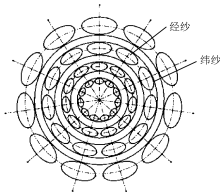
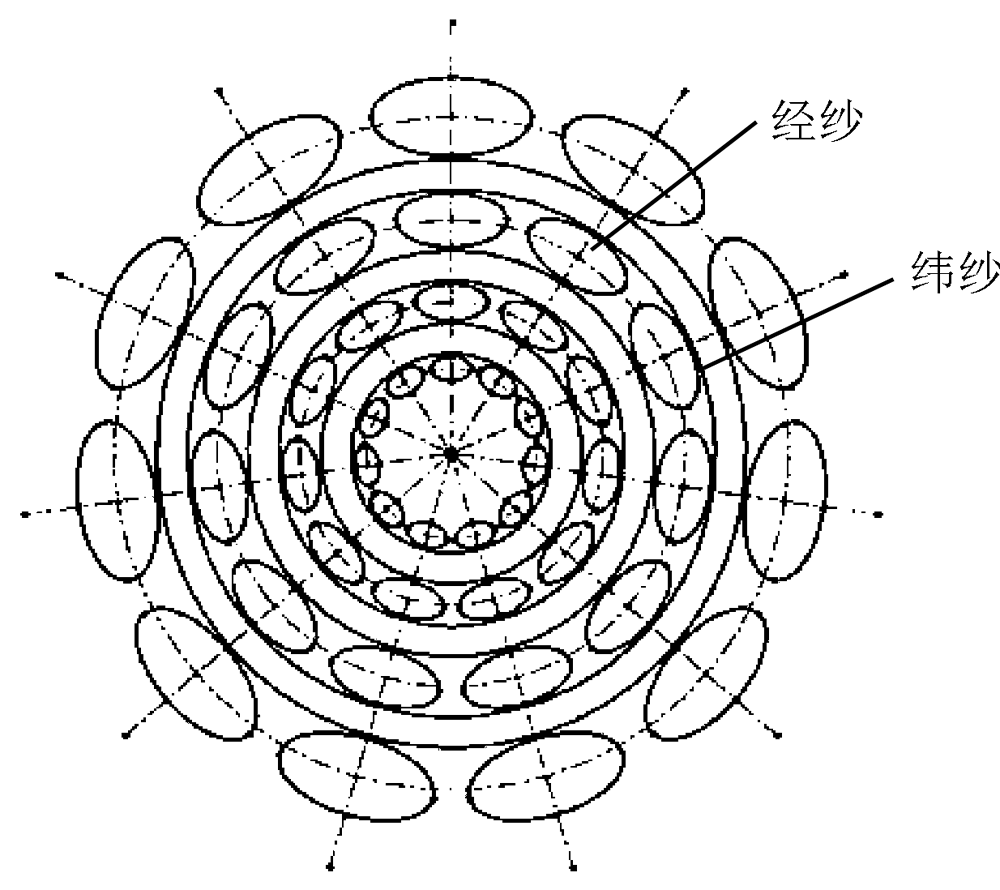
同心圆分割法示意图"

表5

经纱差异率"

纬数 R 1 R 2 Δ R f
1 3.940 3.851 0.089 0.022 59
2 8.955 6.806 2.149 0.239 98
3 13.701 9.851 3.850 0.281 00
4 18.403 12.597 5.806 0.315 49
5 22.254 15.194 7.060 0.317 25
6 25.970 17.761 8.209 0.316 10
7 28.881 20.015 8.866 0.306 98
8 31.075 22.119 8.956 0.288 21
9 32.418 24.045 8.373 0.258 28
10 33.582 25.701 7.881 0.234 68
11 34.925 27.179 7.746 0.221 79
12 36.358 28.254 8.104 0.222 90
13 37.433 29.284 8.149 0.217 70
14 38.687 30.448 8.239 0.212 97
15 39.851 31.612 8.239 0.206 75
16 41.194 32.866 8.328 0.202 17

表6

纱线线密度变化后的L值"

纬 数 第1梯度 第2梯度 第3梯度 第4梯度
1 0.853 5 0.871 6 0.886 9 0.904 2
2 0.810 2 0.848 6 0.884 4 0.916 8
3 0.814 0 0.854 9 0.896 1 0.934 0
4 0.820 0 0.866 5 0.915 1 0.962 4
5 0.827 9 0.881 9 0.941 1 1.002 6
6 0.833 9 0.896 7 0.969 1 1.049 8
7 0.847 0 0.922 0 1.013 5 1.122 1
8 0.867 5 0.959 5 1.077 5 1.227 1
9 0.899 1 0.983 5 1.082 5 1.195 7
10 0.920 1 0.990 9 1.068 1 1.147 9
11 0.938 5 0.989 9 1.041 0 1.087 8
12 0.939 9 0.971 2 1.001 1 1.025 5
13 0.969 0 0.988 9 1.008 9 1.022 5
14 0.969 0 0.988 9 1.008 9 1.022 5
15 0.969 0 0.988 9 1.008 9 1.022 5
16 0.969 0 0.988 9 1.008 9 1.022 5
17 0.969 0 0.988 9 1.008 9 1.022 5

表7

层数估算结果"

纬 数 各梯度层数 总计
第1梯度 第2梯度 第3梯度 第4梯度
0 9 9 8 8 34
1 9 9 8 8 34
2 9 9 8 8 34
3 9 8 8 8 33
4 8 8 8 7 31
5 8 7 7 7 29
6 7 7 6 6 26
7 6 6 6 5 23
8 5 5 5 5 20
9 5 4 4 4 17
10 4 4 4 3 15
11 4 3 3 3 13
12 3 3 3 3 12
13 3 3 3 3 12
14 3 3 3 3 12
15 3 3 3 3 12
16 3 3 3 3 12
17 3 3 3 3 12

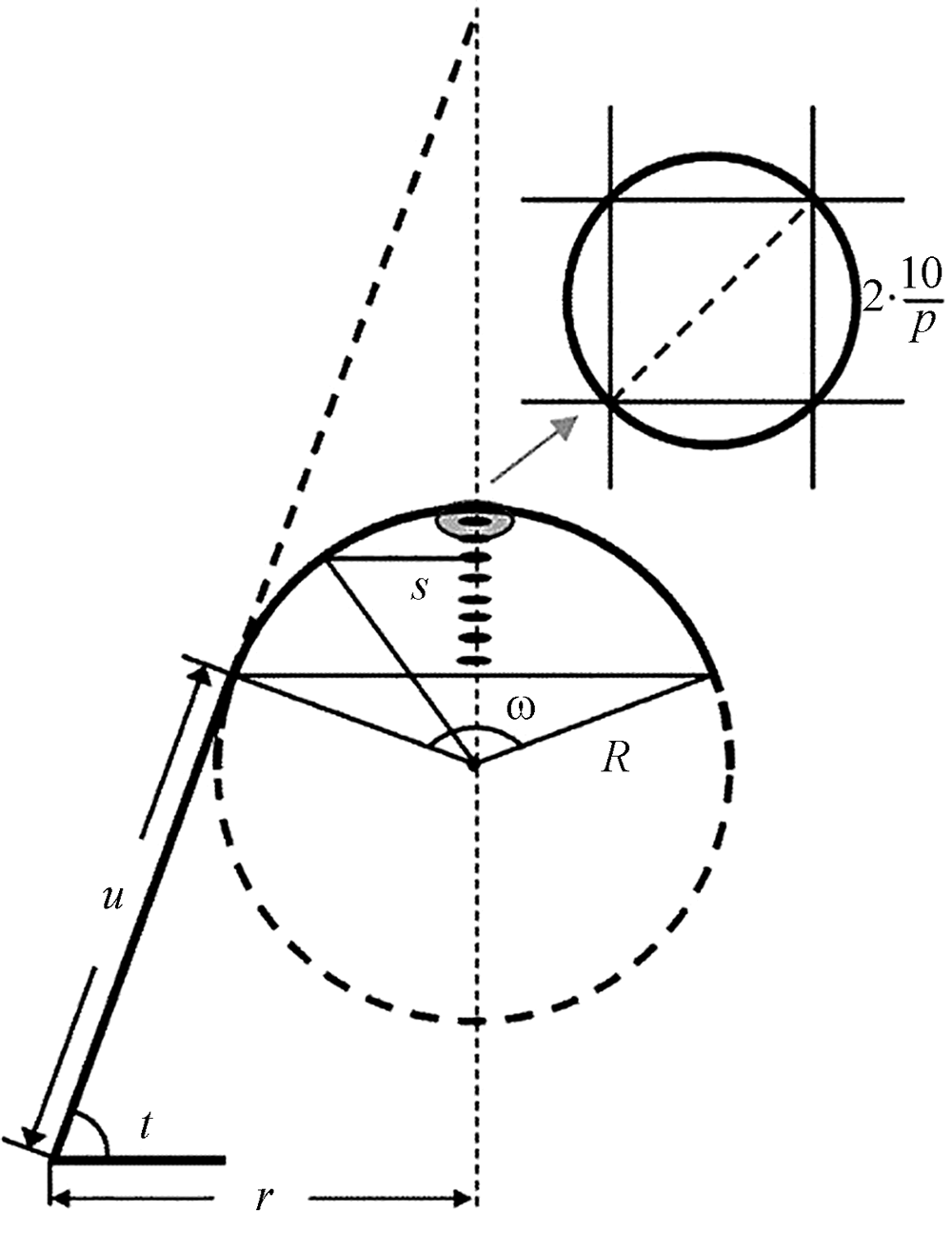
图6

经纱加列示意图"

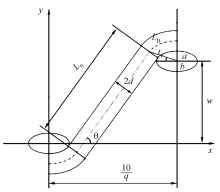
图7

经纱加列几何分析示意图"

图8

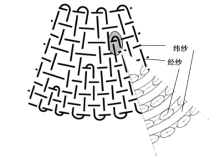
头锥体织物纱线细观结构"

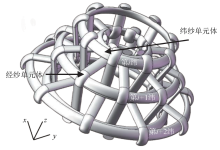
图9

经纱单元体细观结构示意图"

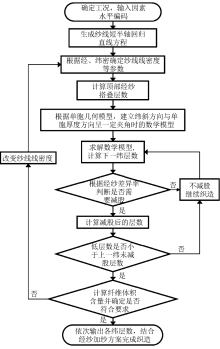
图10

工艺设计流程图"

图11

织物下机图"

[1] 王旭, 闵尔君, 李少聪, 等. 基于平织机的管状三维机织物设计及其矩阵模型[J]. 纺织学报, 2023, 44(8):103-109.
WANG Xu, MIN Erjun, LI Shaocong, et al. Tubular 3D woven fabric design based on flat loom and its matrix model[J]. Journal of Textile Research, 2023, 44(8):103-109.
[2] LI Z, LI D, ZHU H, et al. Mechanical properties prediction of 3D angle-interlock woven composites by finite element modeling method[J]. Materials Today Communications, 2020. DOI: 10.1016/j.mtcomm.2019.100769.
[3] HUANG T, WANG Y, WANG G. Review of the mechanical properties of a 3D woven composite and its applications[J]. Polymer-Plastics Technology and Engineering, 2018, 57(8):740-756.
[4] REN Y, ZHANG B, ZHONG Z, et al. Reusable, high specific surface areas, and excellent thermal stability Al2O3-SiO2 aerogel composites as high-temperature thermal insulators for radome applications[J]. Journal of alloys and compounds, 2024. DOI: 10.1016/j.jallcom.2024.173990.
[5] 刘菁, 靖逸凡. 圆锥壳体三维织物的织造及其性能[J]. 棉纺织技术, 2018, 46(5):37-40.
LIU Jing, JING Yifan. Weaving and properties of three-dimensional fabric with conical shell[J]. Cotton Textile Technology, 2018, 46(5):37-40.
[6] 张长龙, 陈利, 王静, 等. 防弹头盔用三维机织预制体的曲面成型性研究[J]. 兵工学报, 2024, 45(6):2017-2024.
ZHANG Changlong, CHEN Li, WANG Jing, et al. Study on surface formability of three-dimensional woven preform for bulletproof helmet[J]. Defence Technology, 2024, 45(6):2017-2024
[7] 刘俊岭. 减纱对2.5D织物变形性及其复合材料力学性能的影响[D]. 天津: 天津工业大学, 2018:9-16.
LIU Junling. Influence of yarn reduction on deformability of 2.5D fabric and mechanical properties of its composites[D]. Tianjin:Tiangong University, 2018:9-16.
[8] WANG N, WEN W, CHANG Y, et al. Quasi-static mechanical behavior of 2.5D woven variable thickness composites[J]. Composite Structures, 2024. DOI: 10.1016/j.compstruct.2023.117759.
[9] LI M, ZHANG B, LIU K, et al. Study on the shear-pretension coupling behavior of 3D uniform and variable thickness woven fabrics[J]. Polymer Testing, 2023. DOI: 10.1016/j.polymertesting.2023.107963.
[10] LIU A, ZHOU X, GAO Y, et al. Bending property of novel 3D woven variable thickness composites: Experiment and finite element analysis[J]. Polymer Composites, 2023, 44(3):1993-2004.
[11] ZHOU Y, WEN W, CUI H. Spatial modelling of 3D woven variable thickness composite plate at the mesoscopic scale[J]. Composite Structures, 2020. DOI: 10.1016/j.compstruct.2020.111946.
[12] 窦宏通, 王晓旭, 刘晓东, 等. 三维异型纺织复合材料的预制体织造技术及材料力学性能研究进展[J]. 材料工程, 2023, 51(4):88-102.
DOU Hongtong, WANG Xiaoxu, LIU Xiaodong, et al. Research progress on weaving technology and mechanical properties of three-dimensional profiled textile composites[J]. Materials Engineering, 2023, 51(4):88-102.
[13] KUNDAK H, BILISIK K. Development of three-dimensional (3D) biodegradable polyglycolic acid fiber (PGA) preforms for scaffold applications: experimental patterning and fiber volume fraction-porosity modeling study[J]. Polymers, 2023. DOI:10.3390/polym15092083.
[14] NASSER S, HALLAL A, HAMMOUD M, et al. Geometrical modeling of yarn's cross-section towards a realistic unit cell of 2D and 3D woven composites[J]. Journal of The Textile Institute, 2021, 112(5):767-782.
[15] AGWU N, OZOEGWU C G. Critical investigation on the effect of fiber geometry and orientation on the effective mechanical properties of fiber-reinforced polymer composites[J]. Mechanics of Advanced Materials and Structures, 2023, 30(15):3051-3060.
[16] 周光明, 王新峰, 王鑫伟, 等. 三维机织复合材料的力学模型与实验验证[J]. 南京航空航天大学学报, 2004(4):444-448.
ZHOU Guangming, WANG Xinfeng, WANG Xinwei, et al. Mechanical model and experimental verification of 3D woven composites[J]. Journal of Nanjing University of Aeronautics and Astronautics, 2004(4):444-448.
[17] 李磊, 容治军, 仇普霞, 等.一种回转壳体织物的封顶织造方法及回转壳体织物的织造方法:110258003A[P]. 2020-12-01.
LI Lei, RONG Zhijun, QIU Puxia, et al. A top-capping weaving method of rotary shell fabric and the weaving method of rotary shell fabric: 110258003A[P]. 2020-12-01.
[1] 陈钰珊, 蒋高明, 李炳贤. 基于双扎口的纬编管状无缝织物三维仿真[J]. 纺织学报, 2024, 45(10): 95-102.
[2] 吕丽华, 庞现柯, 刘澳. 变厚度三维机织复合材料的抗冲击性能[J]. 纺织学报, 2024, 45(09): 91-96.
[3] 王遵钦, 刘东炎, 王晓旭, 张典堂. 机织角联锁变密度复合材料的面外压缩力学特性[J]. 纺织学报, 2024, 45(07): 63-71.
[4] 王一品, 李小辉. 服装褶皱形态的参数化表征方法[J]. 纺织学报, 2024, 45(06): 149-154.
[5] 徐辉, 朱昊, 潘苏情, 史红艳, 应迪. 基于变截面复丝模型的机织物模拟[J]. 纺织学报, 2024, 45(05): 70-78.
[6] 董智佳, 郭燕雨秋, 刘海桑, 姚思宏. 经编全成形镂空紧身衣的结构设计与实现[J]. 纺织学报, 2023, 44(12): 130-137.
[7] 王予涛, 丛洪莲, 顾洪阳. 纬编成形护膝结构设计及其热湿舒适性[J]. 纺织学报, 2023, 44(10): 68-74.
[8] 李皎, 陈利, 姚天磊, 陈小明. 类回转预制体针刺机器人系统设计[J]. 纺织学报, 2023, 44(07): 207-213.
[9] 周赳, 胡伊丽. 等经浮长的三纬组合全显结构设计与应用[J]. 纺织学报, 2023, 44(06): 78-84.
[10] 吕钧炜, 罗龙波, 刘向阳. 基于直接氟化技术的芳纶表/界面结构设计与制备研究进展[J]. 纺织学报, 2023, 44(06): 21-27.
[11] 陈弈菲, 刘驰, 杨萌. 基于响应曲面分析的连体泳装结构情绪测量[J]. 纺织学报, 2022, 43(10): 161-168.
[12] 徐铭涛, 嵇宇, 仲越, 张岩, 王萍, 眭建华, 李媛媛. 碳纤维/环氧树脂基复合材料增韧改性研究进展[J]. 纺织学报, 2022, 43(09): 203-210.
[13] 鲁虹, 宋佳怡, 李圆圆, 滕峻峰. 基于合体两片袖的内旋造型结构设计[J]. 纺织学报, 2022, 43(08): 140-146.
[14] 董智佳, 孙菲, 丛洪莲, 俞旭良. 低损耗纬编成形女士背心的结构设计与建模[J]. 纺织学报, 2022, 43(07): 129-134.
[15] 雷鸽, 李小辉. 数字化服装结构设计技术的研究进展[J]. 纺织学报, 2022, 43(04): 203-209.
Viewed
Full text


Abstract

Cited

  Shared   
  Discussed   
No Suggested Reading articles found!