纺织学报 ›› 2025, Vol. 46 ›› Issue (04): 207-214.doi: 10.13475/j.fzxb.20240106401

• 机械与设备 • 上一篇    下一篇

旋转式圆形编织机拨盘与锭子座传动间隙分析及优化

杜诚杰1,2,3,4(), 洪剑寒1,2,3,4, 张昆1,2,3,4, 梁宽5, 谢国炎6, 梁贤君5   

  1. 1.绍兴文理学院 纺织科学与工程学院, 浙江 绍兴 312000
    2.浙江省清洁染整技术研究重点实验室,浙江 绍兴 312000
    3.绍兴文理学院 绍兴市高性能纤维及制品重点实验室, 浙江 绍兴 312000
    4.绍兴文理学院 国家碳纤维工程技术研究中心分中心, 浙江 绍兴 312000
    5.浙江本发科技有限公司, 浙江 绍兴 312000
    6.浙江东进新材料有限公司, 浙江 绍兴 312000
  • 收稿日期:2024-01-31 修回日期:2024-12-26 出版日期:2025-04-15 发布日期:2025-06-11
  • 作者简介:杜诚杰(1993—),男,讲师,博士。主要研究方向为高端纺织装备系统。E-mail:dcj_dhu@163.com
  • 基金资助:
    中国博士后科学基金项目(2023M740554);浙江省“尖兵”“领雁”研发攻关计划项目(2023C01097);浙江省自然科学基金探索公益项目(LTGY24E030001);绍兴市基础公益重点项目(2024A11004)

Analysis and optimization of transmission clearance between horn gear and carrier base of rotary circular braiding machine

DU Chengjie1,2,3,4(), HONG Jianhan1,2,3,4, ZHANG Kun1,2,3,4, LIANG Kuan5, XIE Guoyan6, LIANG Xianjun5   

  1. 1. College of Textile and Apparel, Shaoxing University, Shaoxing, Zhejiang 312000, China
    2. Key Laboratory of Clean Dyeing and Finishing Technology of Zhejiang Province, Shaoxing, Zhejiang 312000, China
    3. Shaoxing Key Laboratory of High Performance Fibers & Products, Shaoxing University, Shaoxing, Zhejiang 312000, China
    4. Zhejiang Sub-Center of National Carbon Fiber Engineering Technology Research Center, Shaoxing University, Shaoxing, Zhejiang 312000, China
    5. Zhejiang Benfa Technology Co., Ltd., Shaoxing, Zhejiang 312000, China
    6. Zhejiang Dongjin New Material Co., Ltd., Shaoxing, Zhejiang 312000, China
  • Received:2024-01-31 Revised:2024-12-26 Published:2025-04-15 Online:2025-06-11

摘要:

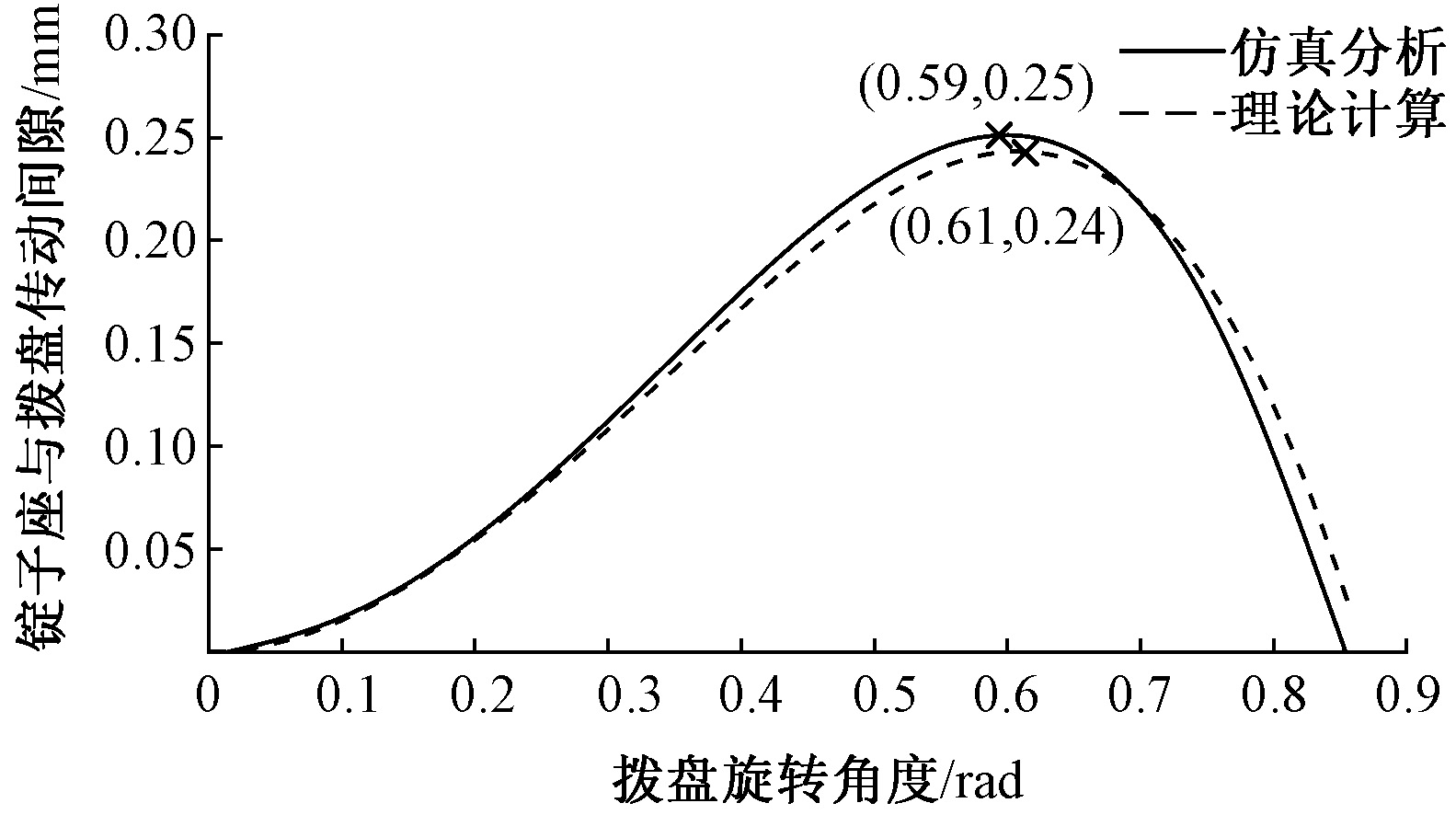
针对旋转式圆形编织机中共面拨盘与锭子座传动间隙大,导致锭子运动不平稳加剧纱线磨损,从而降低预成型体编织质量的问题,分析了拨盘与锭子座传动间隙的产生原因,基于此设计了异面拨盘以改善编织机结构,构建了共面/异面拨盘与锭子座传动间隙的数学模型;利用MatLab软件得到传动间隙变化曲线,结果表明共面拨盘传动间隙最大值为1.63 mm,异面拨盘传动间隙最大值为0.24 mm,且锭子交换全程异面拨盘传动间隙一直小于共面拨盘。通过ABAQUS软件建立了异面拨盘与锭子座传动间隙的有限元模型,结合实验验证的方法,得到传动间隙的仿真结果与实验结果分别为0.25 mm和0.27 mm,与理论计算误差小,验证了理论模型的准确性,证明异面拨盘能有效降低与锭子座的传动间隙。

关键词: 旋转式圆形编织机, 传动间隙, 拨盘, 锭子座, 仿真, 编织质量

Abstract:

Objective Rotary circular braiding machine is one of the most popular equipment for the preparation of high performance fiber composite preforms. This research reduces the braiding machine transmission clearance through structural optimization in order to improve the smoothness of the equipment, and to ensure the high quality development of the composite material industry.

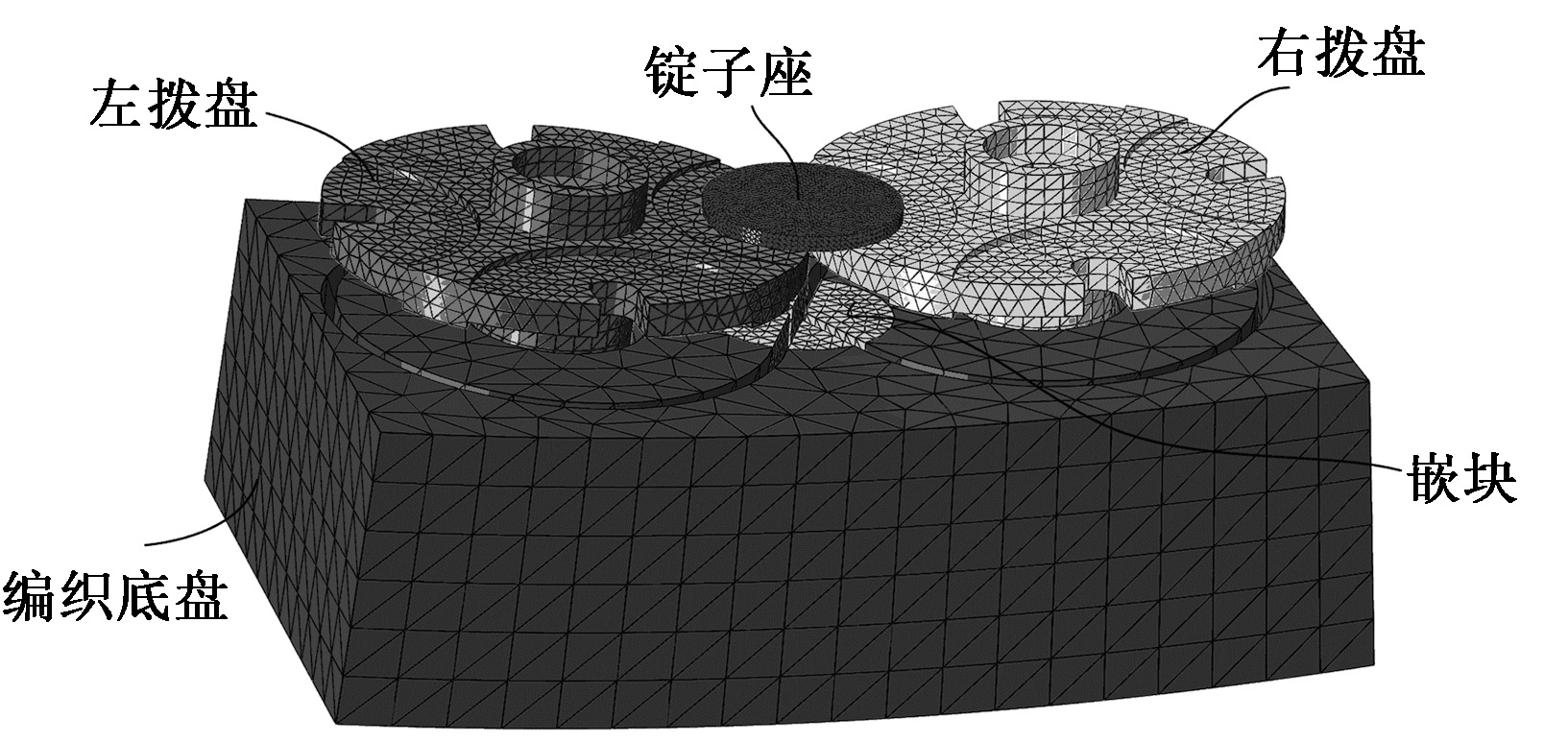
Method In this paper, a combination of theoretical calculation, simulation analysis, and experimental verification was used to study the transmission clearance of rotary circular braiding machine. Firstly, linear algebra theory was used to construct a general mathematical model of the transmission clearance between coplanar/non-coplanar horn gears and carrier bases respectively. The mathematical model was then substituted into MatLab software to calculate the theoretical results. Secondly, a finite element model of the transmission clearance of the non-coplanar horn gear was established in ABAQUS software. Finally, the experimental result of transmission clearance was obtained using indirect measurements.

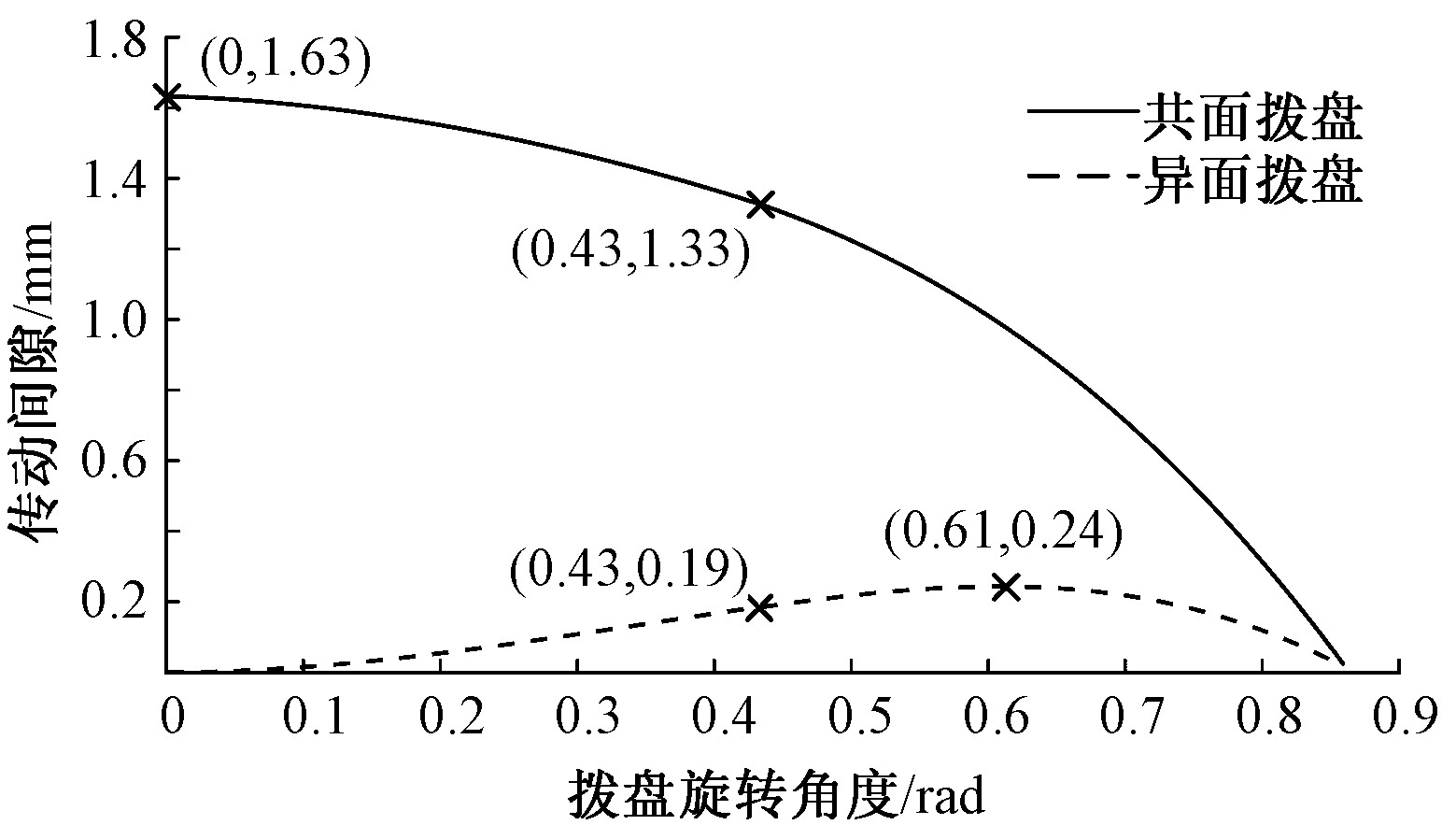
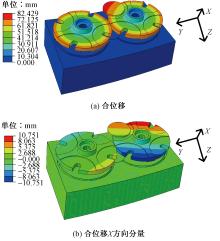
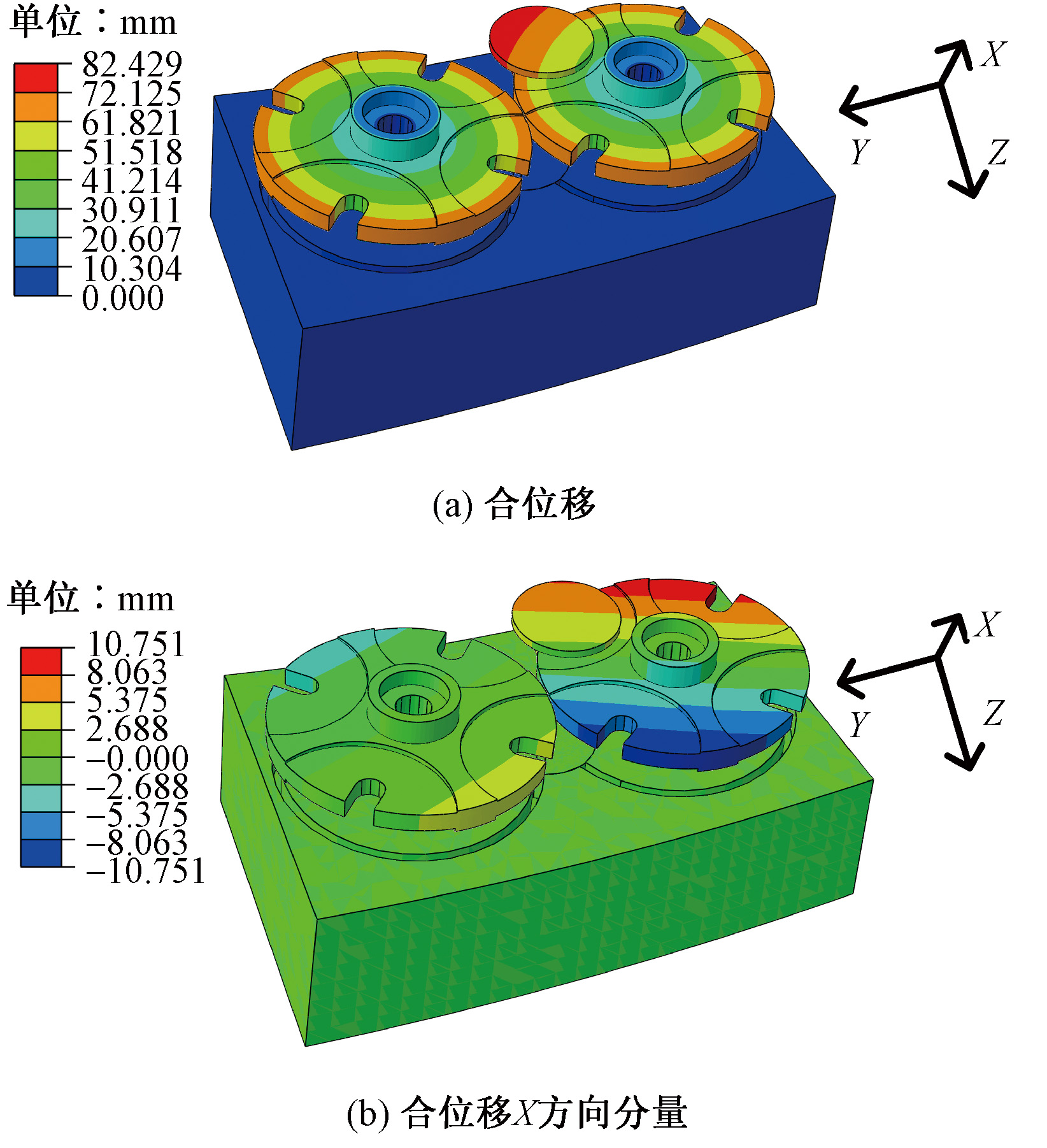
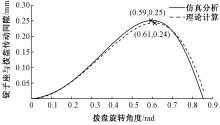
Results Theoretical values of coplanar/non-coplanar horn gear transmission clearance were obtained by substituting circular braiding machine parameters into the mathematical model. According to the theoretical results, it can be seen that during the period from the initial position of the carrier exchange to the complete separation of the carrier seat and the left horn gear, the transmission clearance of the coplanar horn gear has been larger than that of the non-coplanar horn gear. The transmission clearance of coplanar horn gear decreases monotonically with a maximum value of 1.63 mm, which occurs at the initial position, while the transmission clearance of non-coplanar horn gear increases and then decreases with a maximum value of 0.24 mm, which occurs at the arc stage in the carrier exchange. Theoretical model initially demonstrated that the non-coplanar horn gear can significantly reduce transmission clearance. All the data of the carrier base upper surface center and lower surface center in the X-direction component of the combined displacement was extracted, and the difference between the two was the simulation result of the transmission clearance between the non-coplanar horn gear and the carrier base. It can be seen that the maximum value of transmission clearance was 0.25 mm, which was 4.17% different from the maximum value of 0.24 mm obtained by theoretical calculation, and the two curves basically match, proving that the theoretical model was accurate and reliable. Further, the experimental result showed that the maximum value of the transmission clearance between the non-coplanar horn gear and the carrier base was 0.27 mm. The good quality of the preform braided by the braiding machine using non-coplanar horn gears proved that the theoretical model had a certain degree of accuracy and that the non-coplanar horn gear could reduce the clearance and improve the quality of braiding.

Conclusion This research analyzed the mechanism of transmission clearance generated by rotary circular braiding machine with commercially available coplanar horn gears, on the basis of which a non-coplanar horn gear is designed to reduce the transmission clearance. The mathematical models of transmission clearance between coplanar/non-coplanar horn gear and carrier seat were established respectively by using linear algebra theory, and through numerical analysis, it can be seen that the transmission clearance of coplanar horn gear has been larger than that of non-coplanar horn gear throughout the carrier exchange. Through the combination of simulation analysis and experimental verification, the maximum value of the transmission clearance of the non-coplanar horn gear was 0.25 mm and 0.27 mm, respectively, which have small errors with the theoretical calculation, verifying the accuracy of the theoretical model, and proved that the use of the non-coplanar horn gear on the circular braiding machine can effectively reduce the transmission clearance and improve the braiding quality.

Key words: rotary circular braiding machine, transmission clearance, horn gear, carrier seat, simulation, weave quality

中图分类号: 

  • TS103.1

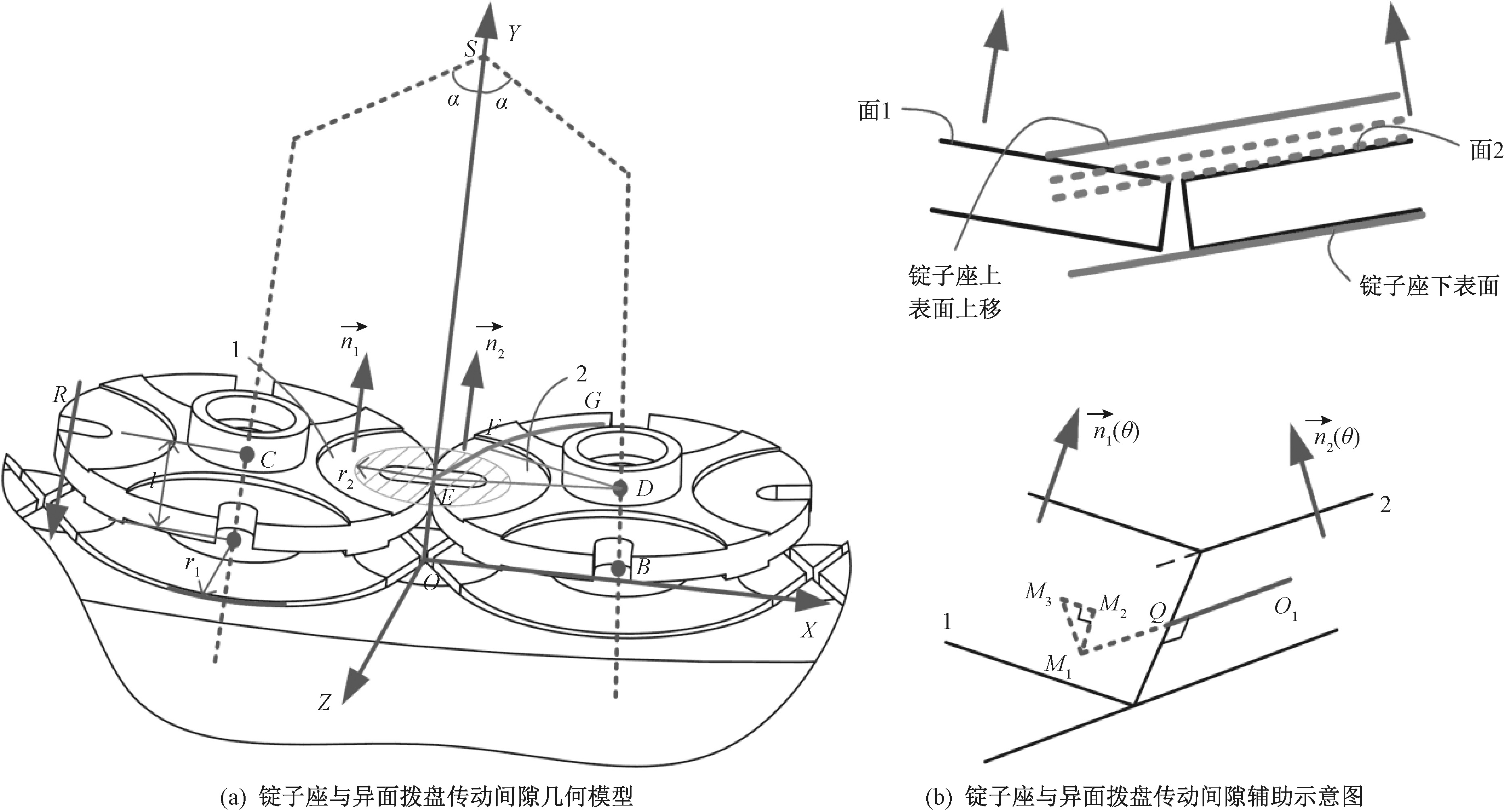
图1

旋转式圆形编织机传动间隙产生原因"

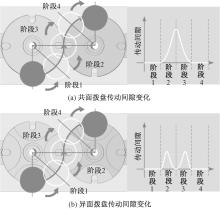
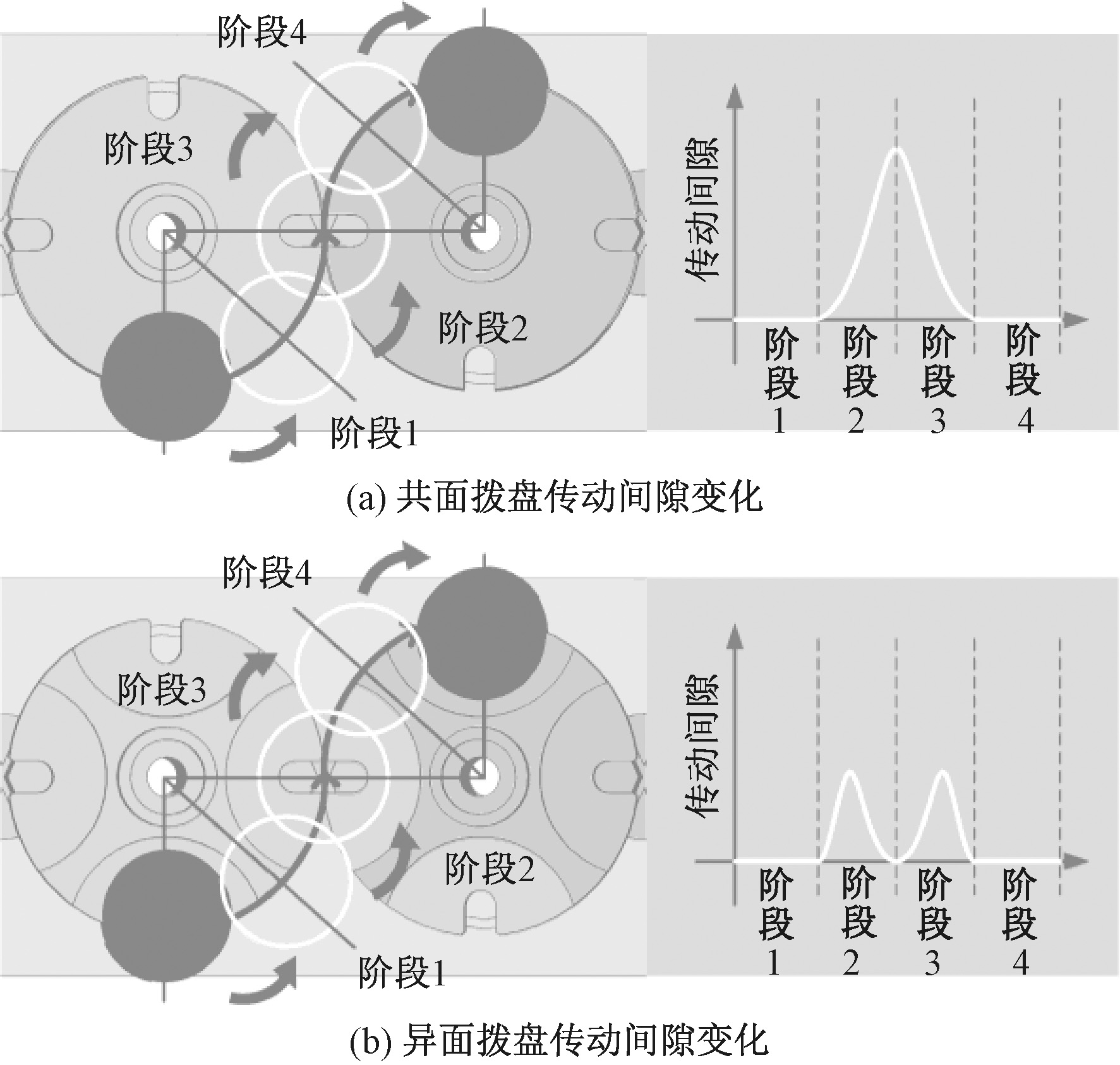
图2

旋转式圆形编织机传动间隙变化分析"

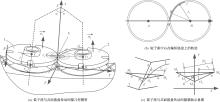
图3

锭子座与共面拨盘传动间隙分析示图"

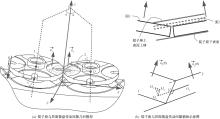
图4

锭子座与异面拨盘传动间隙分析示意图"

表1

圆形编织机参数"

编织底
盘半径
R/mm
相邻拨盘
中心线夹角
2α/rad
拨盘上表面
与编织底盘
距离l/mm
轨道中心
线半径
r1/mm
锭子座
半径
r2/mm
1 550 π/60 32 73 32

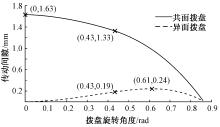
图5

锭子座与拨盘传动间隙数值分析结果"

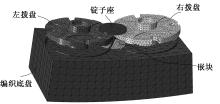
图6

锭子座与拨盘传动间隙有限元模型"

图7

各零部件位移云图"

图8

异面拨盘传动间隙理论与仿真对比"

图9

拨盘与锭子座传动间隙测试实验"

表2

锭子座槽宽"

编号 1 2 3 4 5
槽宽/mm 12.17 12.19 12.21 12.23 12.25
编号 6 7 8 9 10
槽宽/mm 12.27 12.29 12.31 12.33 12.35

图10

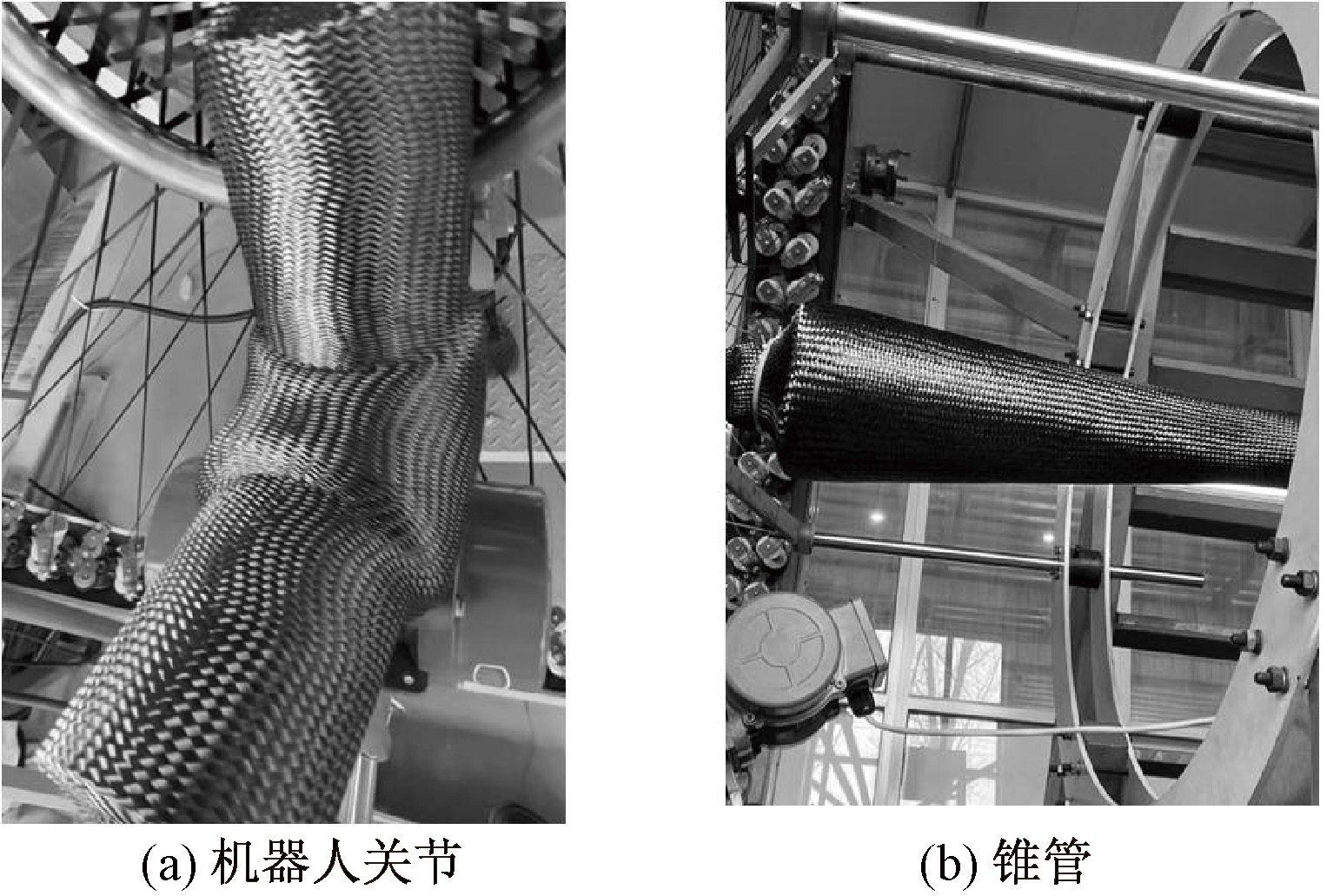
预成型体样品"

[1] 单忠德, 周征西, 孙正, 等. 航空航天先进复合材料三维预制体成形技术与装备研究[J]. 机械工程学报, 2023, 59(20): 64-79.
doi: 10.3901/JME.2023.20.064
SHAN Zhongde, ZHOU Zhengxi, SUN Zheng, et al. Research of 3D advanced aerospace composite preforms forming technology and equipment[J]. Journal of Mechanical Engineering, 2023, 59(20): 64-79.
doi: 10.3901/JME.2023.20.064
[2] LI Qianqian, ZHANG Honghua, MOSLEH Y, et al. Development and analysis of a three-dimensional braided honeycomb structure[J]. Textile Research Journal, 2022, 93(9/10): 2078-2094.
[3] KYOSEV Y. Numerical modelling of 3D braiding machine with variable paths of the carriers[J]. Applied Composite Materials, 2018, 25(4): 773-783.
[4] DU Chengjie, MENG Zhuo, SUN Yize, et al. Optimal design of the horn gear for rotary three-dimensional braiding machine[J]. Journal of the Textile Institute, 2020, 111(11): 1596-1602.
doi: 10.1080/00405000.2020.1716530
[5] 马文锁, 陈凯, 丁磊. 五月柱圆管编织机锭子运动学分析及其轨迹优化[J]. 机械设计与制造, 2017(3): 43-47.
MA Wensuo, CHEN Kai, DING Lei. Kinematics analysis and trajectory optimization of the carrier in the circular maypole braider[J]. Machinery Design & Manufacture, 2017(3): 43-47.
[6] 扈昕瞳, 张玉井, 孟婥, 等. 编织锭子放线速度对纱线张力调控的建模与影响[J]. 纺织学报, 2017, 38(6): 111-117.
HU Xintong, ZHANG Yujing, MENG Zhuo, et al. Modeling and influence about speed of released-yarn in braiding spindles on yarn tension[J]. Journal of Textile Research, 2017, 38(6): 111-117.
[7] MA Guangli, BRANSCOMB D J, BEALE D G. Modeling of the tensioning system on a braiding machine carrier[J]. Mechanism and Machine Theory, 2012, 47: 46-61.
[8] 张玉井, 孟婥, 苏刘元, 等. 立体编织机机头工况设计与声振耦合仿真[J]. 纺织学报, 2017, 38(2): 170-176.
ZHANG Yujing, MENG Zhuo, SU Liuyuan, et al. Vibro-acoustic coupling simulation of 3-D circular braiding machine's head section under different working conditions[J]. Journal of Textile Research, 2017, 38(2): 170-176.
[9] ZHANG Yujing, MENG Zhuo, DU Chengjie, et al. Dynamical analysis of carrier-track contact model in a braiding machine[J]. Tehnicki Vjesnik-techniacal Gazette, 2022, 29(2): 528-535.
[10] 刘宜胜, 徐海亮, 吴镇宇, 等. 三维编织机运动仿真分析及其轨道优化设计[J]. 纺织学报, 2017, 38(4): 134-139.
LIU Yisheng, XU Hailiang, WU Zhenyu, et al. Motion simulation analysis and track optimal design for three-dimensional braiding machine[J]. Journal of Textile Research, 2017, 38(4): 134-139.
[1] 陈馨蔚, 顾冰菲, 田佳莉, 周思凡, 刘瑜希, 刘金灵, 易洁伦, 孙玥. 基于参数化设计和数值模拟仿真技术的运动文胸版型优化[J]. 纺织学报, 2025, 46(04): 162-170.
[2] 张久尚, 杨涛, 周玉峰, 田秀峰, 宋良, 刘畅, 刘健, 杜宇. 角联织机多经轴送经张力控制系统研究[J]. 纺织学报, 2025, 46(04): 197-206.
[3] 尚静雨, 蒋高明, 陈钰珊, 刘海桑, 李炳贤. 花式纱罗织物设计与三维仿真[J]. 纺织学报, 2025, 46(04): 81-88.
[4] 梁金星, 李东盛, 韩开放, 胡新荣, 彭佳佳, 李立军. 基于物理约束的纬编针织物动态形变模拟[J]. 纺织学报, 2025, 46(03): 109-115.
[5] 马运娇, 王蕾, 潘如如. 基于双斜交平面镜的纱线条干三维仿真[J]. 纺织学报, 2025, 46(02): 86-91.
[6] 黄小源, 王青云, 侯珏, 杨阳, 刘正. 基于技能熟练度的服装流水线仿真优化及其应用[J]. 纺织学报, 2025, 46(01): 169-178.
[7] 刘健, 王程皓, 董守骏, 刘泳汝. 半封闭自由表面式静电纺丝喷头设计与优化[J]. 纺织学报, 2024, 45(11): 215-225.
[8] 陈钰珊, 蒋高明, 李炳贤. 基于双扎口的纬编管状无缝织物三维仿真[J]. 纺织学报, 2024, 45(10): 95-102.
[9] 张佃平, 王昊, 林文峰, 王振秋. 多喷头纺丝装置的仿真与设计[J]. 纺织学报, 2024, 45(10): 200-207.
[10] 关松松, 蒋高明, 杨美玲, 李炳贤. 基于线圈结构的双针床经编毛绒织物三维仿真[J]. 纺织学报, 2024, 45(09): 84-90.
[11] 陶静, 汪俊亮, 张洁. 数据驱动与有限元仿真融合的纱线断裂强力分析方法[J]. 纺织学报, 2024, 45(02): 238-245.
[12] 丁彩红, 左今朝. 不停丝自动化铲板系统的集排丝技术研究[J]. 纺织学报, 2023, 44(12): 162-169.
[13] 赵俊杰, 蒋高明, 程碧莲, 李炳贤. 毛衫绞花织物的三维仿真与实现[J]. 纺织学报, 2023, 44(12): 81-87.
[14] 杨美玲, 蒋高明, 王婷, 李炳贤. 基于弹簧-质点模型的单贾卡经编鞋材三维仿真[J]. 纺织学报, 2023, 44(11): 113-119.
[15] 冯清国, 巫鳌飞, 任家智, 陈宇恒. 棉纺精梳机分离罗拉连杆驱动机构动力学仿真及有限元分析[J]. 纺织学报, 2023, 44(09): 197-204.
Viewed
Full text


Abstract

Cited

  Shared   
  Discussed   
No Suggested Reading articles found!