纺织学报 ›› 2025, Vol. 46 ›› Issue (01): 1-8.doi: 10.13475/j.fzxb.20240201501
• 纤维材料 • 下一篇
朱雪1,2, 钱鑫1,2( ), 郝梦圆1, 张永刚1,2
ZHU Xue1,2, QIAN Xin1,2(), HAO Mengyuan1, ZHANG Yonggang1,2
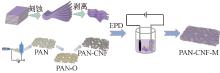
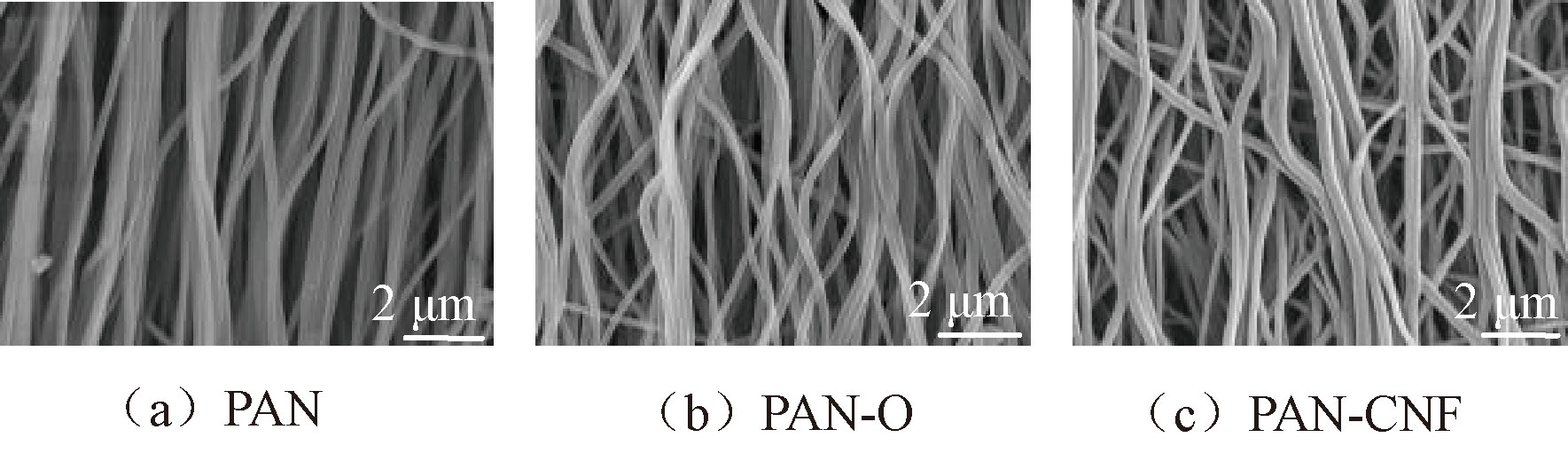
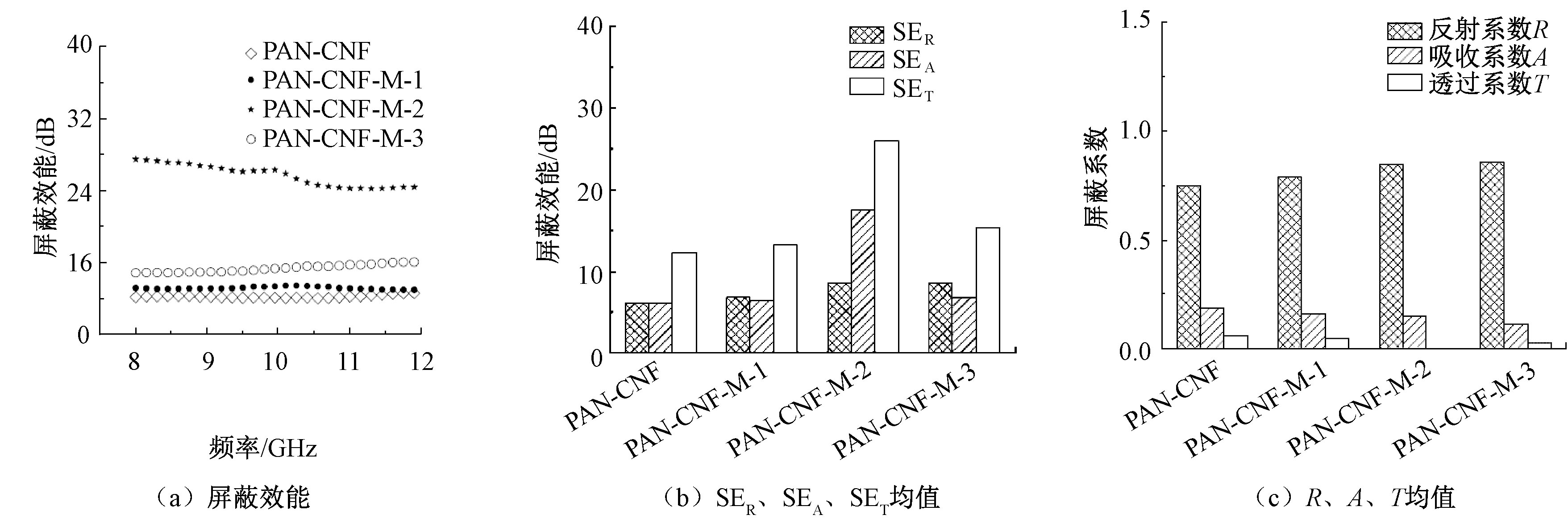
摘要: 为制备高效电磁屏蔽织物,采用静电纺丝技术制备了聚丙烯腈基纳米纤维膜,经预氧化和炭化处理得到导电性优异的聚丙烯腈基碳纳米纤维(PAN-CNF),并采用电泳沉积方法将其与过渡金属碳/氮化物(MXene)结合,制备了具有电磁屏蔽效能的功能性导电复合膜(PAN-CNF-M)。借助扫描电子显微镜、X射线衍射仪、拉曼光谱仪等对复合膜的结构进行表征,利用四探针电阻仪和矢量网络分析仪表征材料的导电性能和电磁屏蔽性能。结果表明:用静电纺丝法制备的纳米纤维经预氧化和炭化处理后具有高度取向的特征,纤维直径分布均匀,具备一定的导电性(2 406 S/m);适当的电沉积处理(5 V、10 min)可有效提高薄膜的导电性和电磁屏蔽效能,相比于碳纳米纤维膜,PAN-CNF-M复合膜的电导率提升了83%,电磁屏蔽效能提高了112%,屏蔽效率高达99.75%。
中图分类号:
| [1] | KIM Dohoon, LEE Young Jin, AHN Kyung Hyun. Interconnected network of Ag and Cu in bioplastics for ultrahigh electromagnetic interference shielding efficiency with high thermal conductivity[J]. Composites Communications, 2022. DOI: 10.1016/j.coco.2022.101093. |
| [2] | MA Shufei, XU Zizhe, JIA Zhixin, et al. Facile fabrication of carbon fiber skeleton structure of MoS2 supported on 2D MXene composite with highly efficient and stable hydrogen evolution reaction[J]. Composites Science and Technology, 2022. DOI: 10.1016/j.compscitech.2022.109380. |
| [3] | LIU Lixia, GUO Rui, GAO Jie, et al. Mechanically and environmentally robust composite nanofibers with embedded MXene for wearable shielding of electromagnetic wave[J]. Composites Communications, 2022. DOI: 10.1016/j.coco.2022.101094. |
| [4] | GONG Xiangjie, YANG Tao, SONG Yan, et al. Understanding the behaviors of ZIF-67 reinforced electrospun carbon nanofibers in the preparation and stabilization[J]. Composites Science and Technology, 2024. DOI: 10.1016/j.compscitech.2023.110403. |
| [5] | DEERAJ B D S, GEORGE Gejo, DHINESHBABU N R, et al. Electrospun ZrO2@carbon nanofiber mats and their epoxy composites as effective EMI shields in Ku band[J]. Materials Research Bulletin, 2021. DOI: 10.1016/j.materresbull.2021.111477. |
| [6] | QI Yang, DAI Bushi, ZHANG Bowen, et al. Effect of graphite defect type and heterogeneous atomic doping structure on the electromagnetic wave absorption properties of sulfur-doped carbon fibers[J]. Crystal Growth & Design, 2023, 23(6):4655-4668. |
| [7] | NAGUIB M, MOCHALIN V N, BARSOUM M W, et al. MXenes: a new family of two-dimensional mater-ials[J]. Advanced Materials, 2014, 26(7):992-1005. |
| [8] | 蔡洁, 王亮, 付宏俊, 等. 玻璃纤维/碳纤维织物基复合材料的电磁屏蔽性能[J]. 纺织学报, 2023, 44(2): 111-117. |
| CAI Jie, WANG Liang, FU Hongjun, et al. Electromagnetic interference shielding properties of composites reinforced with glass fiber/carbon fiber fabrics[J]. Journal of Textile Research, 2023, 44(2): 111-117. | |
| [9] | 郑贤宏, 唐金好, 李长龙, 等. 中空磁性Fe3O4纳米球/MXene复合棉织物的制备及其电磁屏蔽性能[J]. 纺织学报, 2023, 44(11): 142-150. |
| ZHENG Xianhong, TANG Jinhao, LI Changlong, et al. Preparation and electromagnetic shielding performance of hollow magnetic Fe3O4 nanosphere/MXene composite cotton fabrics[J]. Journal of Textile Research, 2023, 44(11): 142-150. | |
| [10] | ZHOU Bing, ZHANG Zhen, LI Yanli, et al. Flexible, robust, and multifunctional electromagnetic interference shielding film with alternating cellulose nanofiber and MXene layers[J]. ACS Applied Materials Interfaces, 2020, 12(4):4895-4905. |
| [11] | ZHANG Yali, RUAN Kunpeng, GU Junwei. Flexible sandwich-structured electromagnetic interference shielding nanocomposite films with excellent thermal conductivities[J]. Small, 2021. DOI: 10.1002/smll.202101951. |
| [12] | HU Yi, CHEN Junzhen, YANG Guoyu, et al. Highly conductive and mechanically robust MXene@CF core-shell composites for in-situ damage sensing and electromagnetic interference shielding[J]. Composites Science and Technology, 2024. DOI: 10.1016/j.compscitech.2023.110356. |
| [13] | NAGUIB Michael, KURTOGLU Murat, PRESSER Volker, et al. Two-dimensional nanocrystals produced by exfoliation of Ti3AlC2[J]. Advanced Materials, 2011, 23(37):4248-4253. |
| [14] | ZHAO Xiaofei, VASHISTH Aniruddh, BLIVIN J W, et al. pH, nanosheet concentration, and antioxidant affect the oxidation of Ti3C2Tx and Ti2CTx MXene dispersions[J]. Advanced Materials Interfaces, 2020. DOI: 10.1002/admi.202000845. |
| [15] | 葛媛. PAN 基碳纤维原丝预氧化过程中的结构性能研究及皮芯结构的改善[D]. 长春: 长春工业大学,2021:26-30. |
| GE Yuan. Investigation of structure and property in polyacrylonitrile-based carbon fiber precursor during thermal oxidative stabilization and the improvement of skin-core structure[D]. Changchun: Changchun University of Technology, 2021:26-30. | |
| [16] | 于继胤. 聚丙烯腈(PAN)基碳纤维碳化过程微观结构与导电性能研究[D]. 长春: 长春工业大学,2022:25-28. |
| YU Jiyin. Microstructure and electrical conductivity of polyacrylonitrile (PAN)-based carbon fibers during carbonization[D]. Changchun: Changchun University of Technology, 2022:25-28. | |
| [17] | ZHU Yunyi, LIU Ji, GUO Tong, et al. Multifunctional Ti3C2Tx MXene composite hydrogels with strain sensitivity toward absorption-dominated electromagnetic-interference shielding[J]. ACS Nano, 2021, 15(1):1465-1474. |
| [18] | WEI Huawei, DONG Jidong, FANG Xiaojiao, et al. Ti3C2Tx MXene/polyaniline (PANI) sandwich intercalation structure composites constructed for microwave absorption[J]. Composites Science and Technology, 2019, 169:52-59. |
| [19] | XU Zijie, DING Xin, LI Shikuo, et al. Oxidation-resistant MXene-based melamine foam with ultralow-percolation thresholds for electromagnetic-infrared compatible shielding[J]. ACS Applied Material Interfaces, 2022, 14(35):40396-40407. |
| [1] | 詹克静, 杨鑫, 张应龙, 张昕, 潘志娟. 自凝聚丝素蛋白微纳米纤维膜的制备及其力学增强[J]. 纺织学报, 2025, 46(02): 10-19. |
| [2] | 范梦晶, 岳欣琰, 邵剑波, 陈雨, 洪剑寒, 韩潇. 基于静电纺纤维包芯纱的电容式扭转传感器构建及其传感性能[J]. 纺织学报, 2025, 46(02): 106-112. |
| [3] | 赵超, 金欣, 王闻宇, 朱正涛. 自充电超级电容器用聚丙烯腈纳米纤维隔膜的制备及其性能[J]. 纺织学报, 2025, 46(02): 20-25. |
| [4] | 梁雯宇, 季东晓, 覃小红. 微纳米纤维包芯纱制备及其电致发光性能[J]. 纺织学报, 2025, 46(01): 42-51. |
| [5] | 左红梅, 高敏, 阮芳涛, 邹梨花, 徐珍珍. MXene-氧化石墨烯改性碳纤维/聚乳酸复合材料制备及其力学性能[J]. 纺织学报, 2025, 46(01): 9-15. |
| [6] | 雷福旺, 冯其, 侯奥菡, 赵振鸿, 谭佳兆, 赵景, 王先锋. 聚偏氟乙烯-聚丙烯腈/SiO2单向导湿纤维膜的制备及其性能[J]. 纺织学报, 2024, 45(12): 1-8. |
| [7] | 刘霞, 吴改红, 闫子豪, 王彩柳. 智能相变调温聚乳酸纤维膜的制备及其性能[J]. 纺织学报, 2024, 45(12): 18-24. |
| [8] | 王雅文, 刘娜, 王元非, 吴桐. 静电纺纳米纤维纱线及其对细胞迁移和血管化的调控[J]. 纺织学报, 2024, 45(12): 25-32. |
| [9] | 卢海龙, 于影, 左雨欣, 王浩然, 陈洪立, 汝欣. 取向增强抗CO2腐蚀纤维薄膜的制备及其性能[J]. 纺织学报, 2024, 45(12): 33-40. |
| [10] | 李韩, 王海霞, 张旭, 刘丽萍, 刘小琨. 基于聚乙烯醇缩丁醛/聚乙二醇的同轴纳米纤维膜储热织物制备及其热管理性能[J]. 纺织学报, 2024, 45(11): 37-45. |
| [11] | 刘允璞, 刘威, 王黎明, 覃小红. 静电纺三维纳米纤维材料的制备方法与应用进展[J]. 纺织学报, 2024, 45(11): 226-234. |
| [12] | 刘健, 王程皓, 董守骏, 刘泳汝. 半封闭自由表面式静电纺丝喷头设计与优化[J]. 纺织学报, 2024, 45(11): 215-225. |
| [13] | 王宇航, 谭晶, 李好义, 徐锦龙, 杨卫民. 纳米纤维纱线静电纺制备技术研究进展[J]. 纺织学报, 2024, 45(11): 235-243. |
| [14] | 刘健, 董守骏, 王程皓, 刘泳汝, 潘山山, 尹兆松. 花瓣状多尖端静电纺丝喷头的电场模拟及优化[J]. 纺织学报, 2024, 45(10): 191-199. |
| [15] | 张佃平, 王昊, 林文峰, 王振秋. 多喷头纺丝装置的仿真与设计[J]. 纺织学报, 2024, 45(10): 200-207. |
|
||
 京公网安备11010502044800号