纺织学报 ›› 2025, Vol. 46 ›› Issue (05): 159-168.doi: 10.13475/j.fzxb.20240407501

• 纺织工程 • 上一篇    下一篇

结合频域卷积模块的机织物图像疵点目标检测

顾孟尚, 张宁, 潘如如, 高卫东()   

  1. 生态纺织教育部重点实验室(江南大学), 江苏 无锡 214122
  • 收稿日期:2024-04-30 修回日期:2024-08-09 出版日期:2025-05-15 发布日期:2025-06-18
  • 通讯作者: 高卫东(1959—),男,教授,博士。主要研究方向为纺织数字图像技术。E-mail:gaowd3@163.com
  • 作者简介:顾孟尚(1995—),男,博士生。主要研究方向为织物图像检测技术。
  • 基金资助:
    国家自然科学基金项目(62202202)

Object detection of weaving fabric defects using frequency-domain convolution modules

GU Mengshang, ZHANG Ning, PAN Ruru, GAO Weidong()   

  1. Key Laboratory of Eco-Textiles (Jiangnan University), Ministry of Education, Wuxi, Jiangsu 214122, China
  • Received:2024-04-30 Revised:2024-08-09 Published:2025-05-15 Online:2025-06-18

摘要:

为解决深度学习模型在织物图像疵点目标检测过程中存在特征提取效率不高和泛化性不足的问题,提出了一种针对机织物图像的频域卷积(FFC-tex)模块。通过结合二维傅里叶变换与传统卷积的优势,设计了FFC-tex模块,用于局部和全局特征解耦,提升模型整体性能。首先基于傅里叶频域表示特性和织物图像特点设计了FFC-tex模块;然后结合该模块与YOLOv5目标检测模型设计了织物疵点检测方案;最后,通过控制织物和疵点构建了不同的数据集组合,用于充分验证提出模块对于模型性能的提升效果,同时设计了消融实验用于验证模块中组件的有效性。结果表明,提出的频域卷积能够通过在网络浅层提供全局感受野以实现织物图像全局特征和局部特征的解耦,优化特征提取流程,解决了传统卷积在织物图像处理中的局限性,有效提升了网络的泛化能力和鲁棒性。

关键词: 织物疵点检测, 深度学习, 卷积神经网络, 傅里叶变换, 频域卷积, 织物图像

Abstract:

Objective This study aims to developing an advanced frequency-domain convolution module to overcome the limitations in texture recognition and feature representation in textile defect detection. By effectively integrating two-dimensional Fourier transform with conventional convolution, this research harnesses the periodic characteristics of fabric images, decouples global and local features, and enhances the model's ability to represent textile image features. The importance and necessity of this study arise from the need for more efficient and accurate textile quality control.
Method Combining theoretical models with empirical methods, the proposed approach integrates the advantages of two-dimensional Fourier transform with deep learning. A specialized frequency-domain convolution module was designed specifically for textile image defect detection and applied within the YOLOv5 object detection framework. This study explores the application of image frequency-domain representation in textiles, using frequency-domain convolution to enhance the global receptive field, improve model performance, and ensure computational efficiency. By organically combining large and small kernel convolution techniques, the model architecture is optimized to decouple local and global feature processing, enhancing the analysis process of textile image features. By incorporating prior experience, the representation of frequency-domain features is optimized, improving the model's interpretability, reducing the learning burden, and enhancing feature expression capabilities. Additionally, an attention mechanism component designed for frequency-domain features is implemented to optimize the extraction of these features.
Results It demonstrates the performance enhancements achieved by different models in textile defect detection across various datasets. The models integrating frequency-domain convolution have shown significant improvements, especially in more complex datasets. For instance, the proposed model 1 displayed performance increments in mAP50 (mean average precision at an IoU threshold 50%) by 1.5%, 5.0%, 11.9%, and 16.3% and in mAP75 (mean average precision at a stricter IoU threshold of 75%) by 6.8%, 19.1%, 28.9%, and 32.9% across the datasets, indicating the effectiveness of incorporating frequency-domain convolution to address the challenges in textile image processing. This method leverages the global receptive field and decouples global and local features, thereby enhancing the model's capability to process diverse fabric types and defect patterns effectively. Additionally, the proposed model 1 showed superior detection speed (189.1 frames per second) compared to the baseline YOLOv5 model (158.7 frames per second), confirming that the computational efficiency of frequency-domain convolution excels in shallow network layers because of faster matrix multiplication speeds, despite a decrease in efficiency in deeper layers where Fourier transformations become costly. This structure proves particularly advantageous for textile defect detection, where the complexity and variety of fabric types and defects require robust and adaptable models.Extensive ablation experiments were conducted to validate the efficacy of the frequency-domain convolution module (FFC-tex), specifically optimized for textile image processing. In ablation model 1, a pure convolution module with an FFC structure was adopted to replace the FFC-tex module to isolate the impact of the feature crossover structure. Ablation model 2 integrated the complete original FFC module to confirm the effectiveness of frequency-domain convolution. In ablation model 3, frequency-domain features were restructured, including the decoupling of amplitude and phase features and the creation of frequency distribution and waveform orientation maps, so as to validate the effectiveness of these components. Ultimately, by comparing the proposed model 1 with the ablation model 3, the effectiveness of the introduced frequency-domain attention mechanism was examined. The significant improvements in mAP50 scores during the addition of these components underscore the necessity of each component in the FFC-tex module for enhancing model performance. The optimized FFC-tex module effectively utilizes the frequency-domain features of fabric images, showing notable improvements in precision and generalization capabilities compared to baseline and earlier ablation models, making it suitable for a variety of fabric types and defect patterns.
Conclusion The YOLOv5 model is improved by integrating frequency-domain convolution, improving its generalization and robustness for textile defect detection. Frequency-domain convolution provides a global receptive field, allowing shallow network layers to utilize more contextual information and better understand complex structures. It simplifies computational complexity by transforming time-domain convolutions into element-wise multiplications in the frequency domain. The optimized FFC-tex module enhances feature extraction and generalization across fabric types, significantly boosting model performance in defect detection by decoupling local and global features.

Key words: fabric defect detection, deep learning, convolutional neural network, Fourier transform, frequency-domain convolution, fabric image

中图分类号: 

  • TS101.9

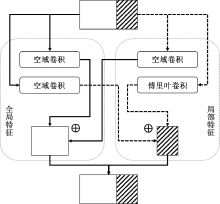
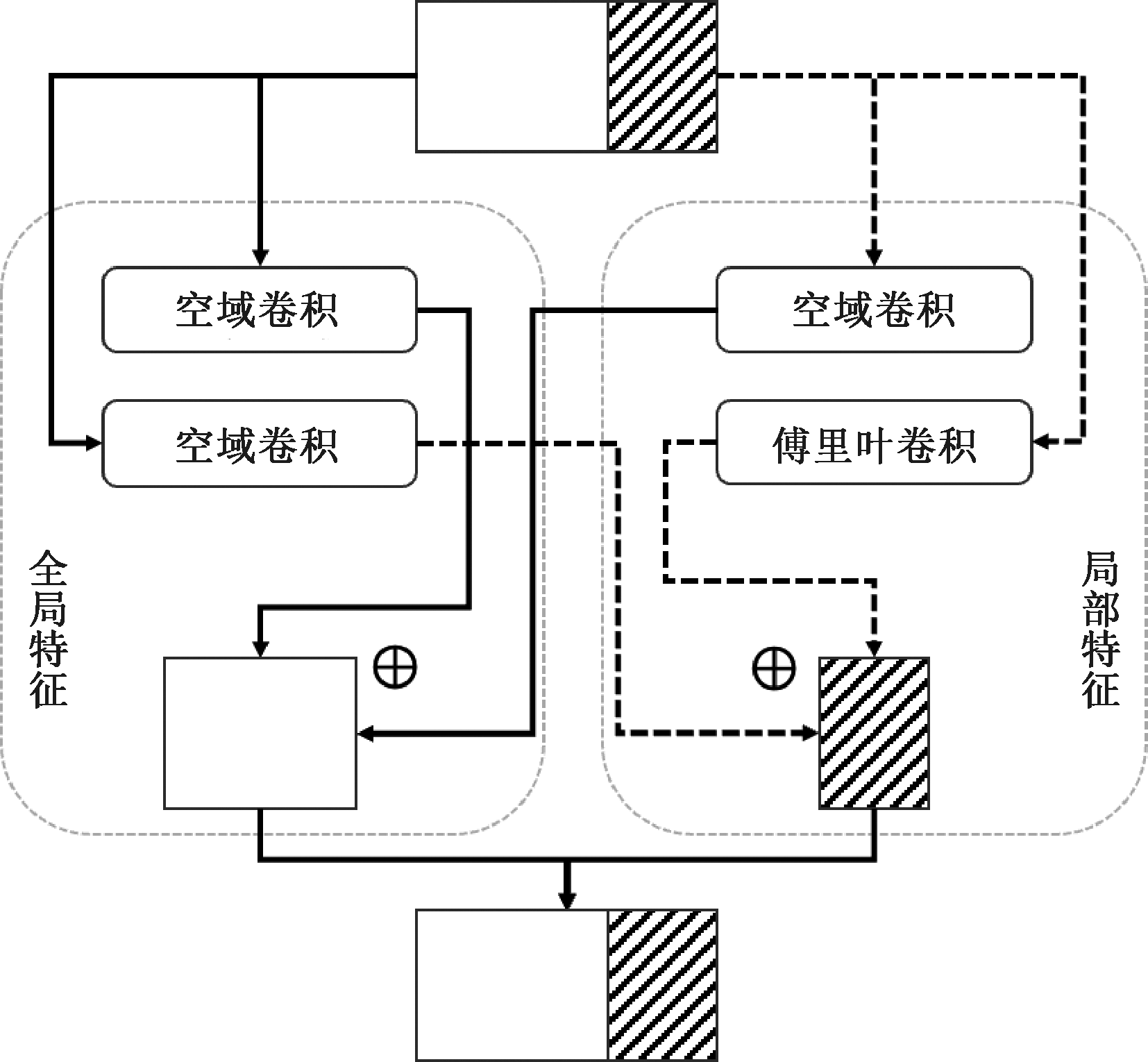
图1

快速傅里叶卷积的基本结构"

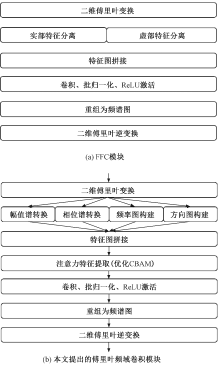
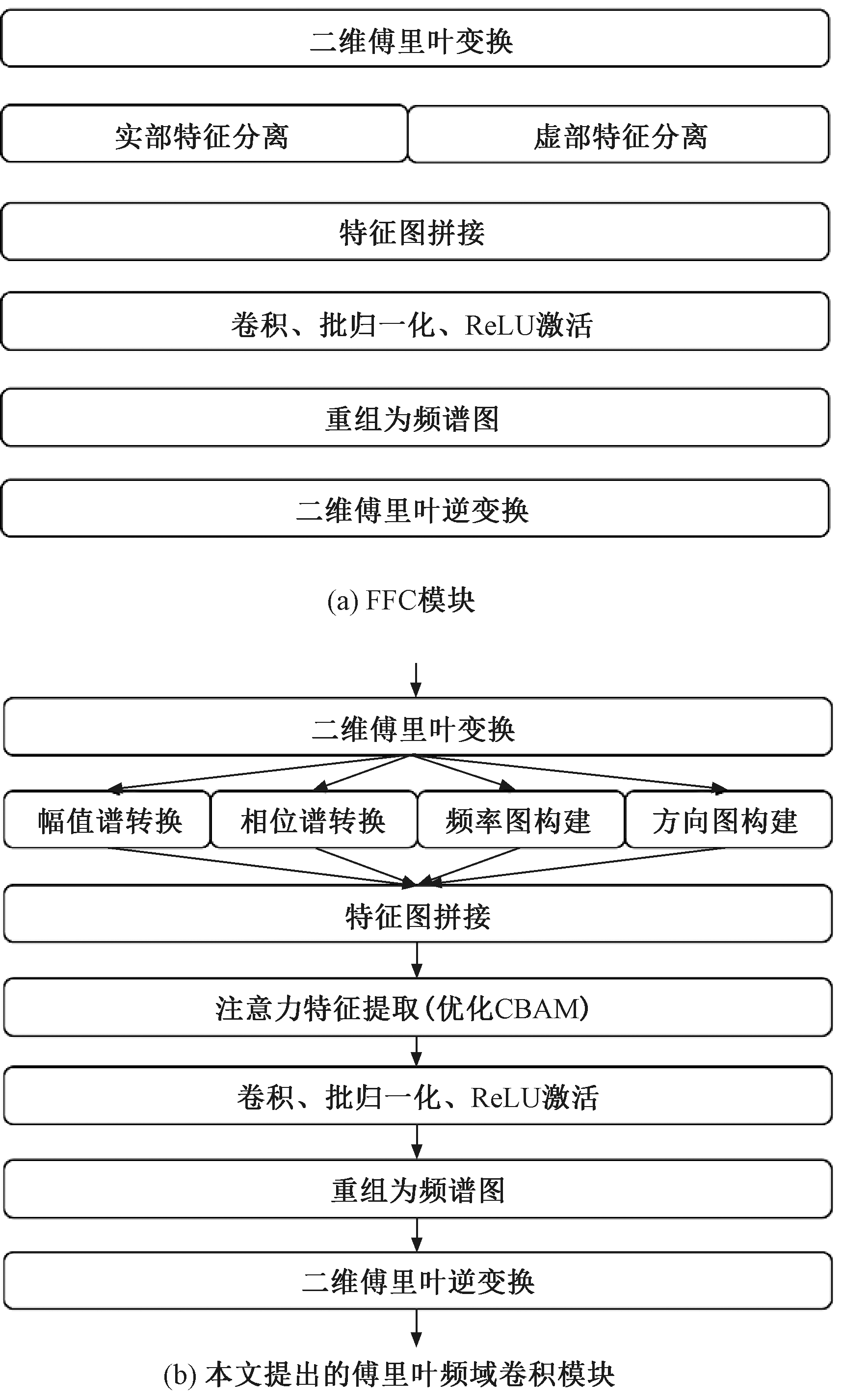
图2

改进前后的傅里叶频域卷积模块"

表1

本文自定义织物与疵点数据集的规格"

数据集
编号
训练集 验证集
疵点
类型
织物
类型
数量 疵点
类型
织物
类型
数量
A 单类 多类 320 已知 已知 80
B 多类 单类 1 200 已知 已知 300
C1 多类 多类 3 000 已知 已知 300
C2 多类 多类 3 000 未知 未知 300

图3

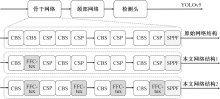
本文所提模型针对骨干网络的改进"

表2

不同目标检测模型在各数据集上的表现及检测速率"

模型 数据集 检测速率/
(帧·s-1)
A B C1 C2
mAP50 mAP75 mAP50 mAP75 mAP50 mAP75 mAP50 mAP75
YOLOv5n 92.6 56.1 84.8 52.8 65.7 21.4 59.1 6.9 158.7
RetinaNetR101 75.6 23.2 69.7 16.4 66.3 17.0 66.3 7.4 26.6
FasterRcnnR101 87.7 35.5 74.4 33.9 78.3 20.7 66.0 13.4 33.8
YOLOv3-SPP 91.6 60.7 80.5 53.6 61.1 23.9 59.6 5.9 153.9
YOLOv5l 93.0 61.0 87.9 54.8 80.0 40.6 64.5 21.1 82.2
YOLOX-s 91.4 51.8 74.7 37.3 73.2 12.1 63.4 12.3 233.3
YOLOv8n 82.7 50.2 61.7 32.3 50.3 23.2 38.8 1.6 142.9
本文模型1 94.1 62.9 89.8 71.9 78.2 50.3 75.4 39.8 189.1
本文模型2 94.0 62.8 85.5 57.8 77.8 42.3 64.5 25.8 89.7

表3

各模型在不同数据集上的表现(mAP50)"

模型 数据集编号
A B C1 C2
YOLOv5 92.63 84.77 65.73 59.1
消融
模型1
92.65
(+0.02)
83.04
(-1.73)
69.55
(+3.82)
60.74
(+1.64)
消融
模型2
93.4
(+0.75)
86.51
(+3.47)
75.46
(+5.91)
65.75
(+5.28)
消融
模型3
93.95
(+0.55)
87.18
(+0.67)
74.79
(-0.67)
71.1
(+5.35)
本文
模型1
94.10
(+0.15)
89.76
(+2.58)
78.15
(+3.18)
75.42
(+4.22)

图4

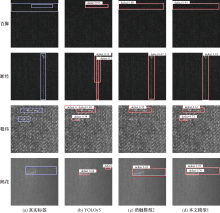
不同模型疵点检测结果对比"

图5

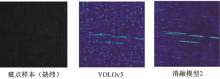
检测过程中不同模型浅层特征提取的可视化结果"

[1] REDMON Joseph, DIVVALA Santosh, GIRSHICK Ross, et al. You only look once: unified, real-time object detection[C]// Proceedings of the IEEE conference on computer vision and pattern Recognition. tas Vegas: IEEE, 2016: 779-788.
[2] YU Kai, LYU Wentao, YU Xuyi, et al. FA-yolo: a high-precision and efficient method for fabric defect detection in textile industry[J/OL]. IEICE Transactions on Fundamentals of Electronics, Communications and Computer Sciences, 2023. DOI:10.1587/transfun.2023EAP1030.
[3] YUE Xi, WANG Qing, HE Lei, et al. Research on tiny target detection technology of fabric defects based on improved yolo[J]. Applied Sciences, 2022. DOI:10.3390/app12136823.
[4] REDMON Joseph, FARHADI Ali. Yolov3: an incremental improvement[J]. arXiv, 2018.DOI: arXiv:1804.02767.
[5] RIPPEL Oliver, ZWINGE Corinna, MERHOF Dorit. Increasing the generalization of supervised fabric anomaly detection methods to unseen fabrics[J]. Sensors (Basel, Switzerland), 2022. DOI:10.3390/s22134750.
[6] SUVOROV Roman, LOGACHEVA Elizaveta, MASHIKHIN Anton, et al. Resolution-robust large mask in painting with Fourier convolutions[C]// Proceedings of the IEEE/CVF winter conference on applications of computer Vision Waikoloa: IEEE, 2022: 2149-2159.
[7] DING Xiaohan, ZHANG Yiyuan, GE Yixiao, et al. Unireplknet: a universal perception large-kernel convnet for audio, video, point cloud, time-series and image recognition[J]. arXiv, 2023.DOI: arXiv:2311.15599.
[8] 张素贞, 叶建隆, 邹采荣. 织物图像增强技术的研究[J]. 电子器件, 2011, 34(4): 473-476.
ZHANG Suzhen, YE Jianlong, ZOU Cairong. Research on fabric image enhancement techniques[J]. Electronic Devices, 2011, 34(4): 473-476.
[9] 郭永平, 徐增波, 李汝勤. 傅里叶变换技术在织物和无纺布结构参数测试中的应用[J]. 中国纺织大学学报, 1998, 24(6): 18-22.
GUO Yongping, XU Zengbo, LI Ruqin. Application of fourier transform techniques in the testing of fabric and nonwoven structural parameters[J]. Journal of China Textile University, 1998, 24(6): 18-22.
[10] SHEPHERD N, ALLEN T, BATTLEY M. Modified Fourier transform misalignment analysis multi-rotate method for measuring fibre alignment in stitched glass fabrics[J]. Composites Part A: Applied Science and Manufacturing, 2024. DOI: 10.1016/j.compositesa, 2024,108013.
[11] 王蕾, 厉征鑫, 刘建立, 等. FFT 和 Hough 变换在织物纹理方向检测上的应用[J]. 计算机工程与应用, 2014, 50(18): 39-43.
WANG Lei, LI Zhengxin, LIU Jianli, et al. Application of FFT and Hough transform in fabric texture direction detection[J]. Computer Engineering and Applications, 2014, 50(18): 39-43.
[12] ZHANG Jie, PAN Ruru, GAO Weidong. Automatic inspection of density in yarn-dyed fabrics by utilizing fabric light transmittance and Fourier analysis[J]. Applied Optics, 2015, 54(4): 966-972.
[13] 楼越升, 祝成炎, 郭振荣, 等. 基于离散傅里叶变换的织物纹理信息在线检测[J]. 东华大学学报: 自然科学版, 2016, 42(5): 732-737.
LOU Yuesheng, ZHU Chengyan, GUO Zhenrong, et al. Online detection of fabric texture information based on discrete Fourier transform[J]. Journal of Donghua University: Natural Science Edition, 2016, 42(5): 732-737.
[14] 朱丹丹, 潘如如, 高卫东. 基于傅里叶特征谱和相关系数的织物疵点检测[J]. 计算机工程与应用, 2014, 50(19): 182-186.
ZHU Dandan, PAN Ruru, GAO Weidong. Fabric defect detection based on Fourier feature spectrum and correlation coefficient[J]. Computer Engineering and Applications, 2014, 50(19): 182-186.
[15] HU Guanghua, HUANG Junfeng, WANG Qinghui, et al. Unsupervised fabric defect detection based on a deep convolutional generative adversarial network[J]. Textile Research Journal, 2020, 90(3/4): 247-270.
[16] OUYANG Wenbin, XU Bugao, HOU Jue, et al. Fabric defect detection using activation layer embedded convolutional neural network[J]. IEEE Access, 2019, 7: 70130-70140.
doi: 10.1109/ACCESS.2019.2913620
[17] 崔展豪, 刘剑. 基于Hough 变换和 fft 多投影精测的织物纬斜快速检测方法研究[J]. 计算机测量与控制, 2021, 29(11): 48-52.
CUI Zhanhao, LIU Jian. Study on rapid detection method of fabric bias based on Hough transform and FFT multi-projection precision measurement[J]. Computer Measurement & Control, 2021, 29(11): 48-52.
[18] CHI Lu, JIANG Borui, MU Yadong. Fast Fourier convolution[J]. Advances in Neural Information Processing Systems, 2020, 33: 4479-4488.
[1] 张爱丹, 王倩. 三纬组合全显结构织物的颜色预测方法[J]. 纺织学报, 2025, 46(05): 151-158.
[2] 白雨薇, 徐健, 朱耀麟, 丁展博, 刘晨雨. 基于改进YOLOv8的梳棉机棉网上棉结检测方法[J]. 纺织学报, 2025, 46(03): 56-63.
[3] 黄小源, 侯珏, 杨阳, 刘正. 基于改进深度学习模型的高精度服装样板自动生成[J]. 纺织学报, 2025, 46(02): 236-243.
[4] 蔡丽玲, 王梅, 邵一兵, 陈炜, 曹华卿, 季晓芬. 基于改进堆叠生成对抗网络的传统汉服智能定制推荐[J]. 纺织学报, 2024, 45(12): 180-188.
[5] 刘燕萍, 郭佩瑶, 吴莹. 面向织物疵点检测的深度学习技术应用研究进展[J]. 纺织学报, 2024, 45(12): 234-242.
[6] 庄冰冰, 向军, 张宁, 潘如如, 张卜文. 便携式织物图像颜色测量系统开发[J]. 纺织学报, 2024, 45(10): 208-215.
[7] 李杨, 张永超, 彭来湖, 胡旭东, 袁嫣红. 基于改进甲壳虫全域搜索算法的机织物疵点检测[J]. 纺织学报, 2024, 45(10): 89-94.
[8] 王小东, 陈俊鹏, 裴泽光. 基于U-Net卷积神经网络的织物压力传感阵列串扰解决方法[J]. 纺织学报, 2024, 45(07): 86-93.
[9] 陆寅雯, 侯珏, 杨阳, 顾冰菲, 张宏伟, 刘正. 基于姿态嵌入机制和多尺度注意力的单张着装图像视频合成[J]. 纺织学报, 2024, 45(07): 165-172.
[10] 文嘉琪, 李新荣, 冯文倩, 李瀚森. 印花面料的边缘轮廓快速提取方法[J]. 纺织学报, 2024, 45(05): 165-173.
[11] 胡旭东, 汤炜, 曾志发, 汝欣, 彭来湖, 李建强, 王博平. 基于轻量化卷积神经网络的纬编针织物组织结构分类[J]. 纺织学报, 2024, 45(05): 60-69.
[12] 陆伟健, 屠佳佳, 王俊茹, 韩思捷, 史伟民. 基于改进残差网络的空纱筒识别模型[J]. 纺织学报, 2024, 45(01): 194-202.
[13] 池盼盼, 梅琛楠, 王焰, 肖红, 钟跃崎. 基于边缘填充的单兵迷彩伪装小目标检测[J]. 纺织学报, 2024, 45(01): 112-119.
[14] 张爱丹, 郭珍妮. 异形网点结构提花织物设计及其灰度仿真特性[J]. 纺织学报, 2023, 44(09): 68-74.
[15] 杨宏脉, 张效栋, 闫宁, 朱琳琳, 李娜娜. 一种高鲁棒性经编机上断纱在线检测算法[J]. 纺织学报, 2023, 44(05): 139-146.
Viewed
Full text


Abstract

Cited

  Shared   
  Discussed   
No Suggested Reading articles found!