纺织学报 ›› 2026, Vol. 47 ›› Issue (05): 133-140.doi: 10.13475/j.fzxb.20241101601
吕丽华( ), 潘佳欣, 张多多
LÜ Lihua(), PAN Jiaxin, ZHANG Duoduo
摘要:
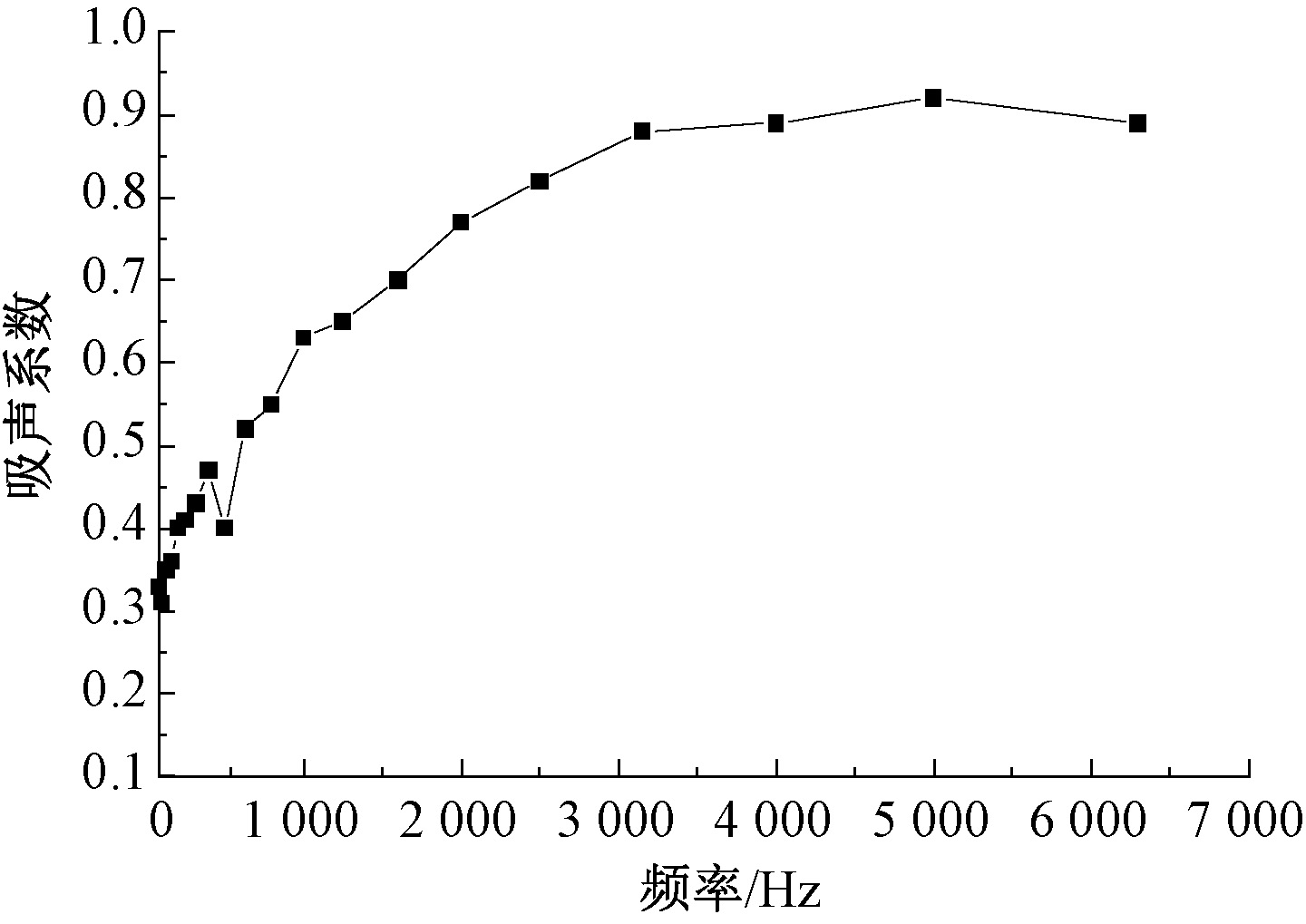
针对大麻纺纱落麻纤维可纺性差、资源化利用率低的问题,为拓展废弃天然纤维在吸声材料领域的应用场景,以废弃大麻纤维为增强体、聚乳酸纤维为基体,采用梳理成网-热压成形工艺,制备废弃大麻/聚乳酸纤维吸声复合材料。探究了热压温度、热压压力、热压时间和废弃大麻纤维质量分数、材料密度、材料厚度和后置空气层厚度等因素对复合材料吸声性能的影响。采用降噪系数与平均吸声系数作为吸声性能的评价指标,对复合材料的制备工艺参数进行了优化。最优工艺条件下制备的废弃大麻/聚乳酸纤维吸声复合材料表现出优异的吸声性能:最大吸声系数为0.920,平均吸声系数为0.575,降噪系数为0.553,有效吸声频段覆盖 80~6 300 Hz。本研究为废弃大麻纤维在吸声复合材料中的资源化应用提供了实验依据和理论支撑,同时也为废弃天然纤维的高值化回收利用提供了新途径。
中图分类号:
| [1] | 谭淳, 张寅. 探究声屏障在工业企业噪声污染控制上的应用[J]. 清洗世界, 2023, 39(1): 100-102. |
| TAN Chun, ZHANG Yin. Explore the application of sound barrier in noise pollution control of industrial enterprises[J]. Cleaning World, 2023, 39(1): 100-102. | |
| [2] |
CREA F. Light and noise pollution and socioeconomic status: the risk factors individuals cannot change[J]. European Heart Journal, 2021, 42(8): 801-804.
doi: 10.1093/eurheartj/ehab074 pmid: 33611398 |
| [3] | 林金波. 随机多孔金属纤维材料建模与吸声性能分析[D]. 大连: 大连理工大学, 2020: 1-47. |
| LIN Jinbo. Modeling and sound absorption performance analysis of random porous metal fiber material[D]. Dalian: Dalian University of Technology, 2020: 1-47. | |
| [4] |
YANG T, HU L Z, XIONG X M, et al. Sound absorption properties of natural fibers: a review[J]. Sustainability, 2020, 12(20): 8477.
doi: 10.3390/su12208477 |
| [5] | ABDULLAH Y, PUTRA A, EFFENDY H, et al. Investigation on natural waste fibers from dried paddy straw as a sustainable acoustic absorber[C]// 2011 IEEE Conference on Clean Energy and Technology (CET). New York: IEEE, 2011: 311-314. |
| [6] |
PATNAIK A, MVUBU M, MUNIYASAMY S, et al. Thermal and sound insulation materials from waste wool and recycled polyester fibers and their biodegradation studies[J]. Energy and Buildings, 2015, 92: 161-169.
doi: 10.1016/j.enbuild.2015.01.056 |
| [7] |
XIE X X, YANG J B, KANG Y Z, et al. Sound transmission loss of absorber-barrier-absorber structures with kapok fibers as absorption layers[J]. Journal of Industrial Textiles, 2023, 53: 15280837231157270.
doi: 10.1177/15280837231157270 |
| [8] |
WANG X, ZHAO F W, CHEUNG T W, et al. Enhancing hemp fiber performance: insights into chitosan treatment and structural evolution[J]. Textile Research Journal, 2024, 94(21/22): 2341-2350.
doi: 10.1177/00405175241240153 |
| [9] |
SHELLY D, LEE S, PARK S. Hemp fiber and its bio-composites: a comprehensive review part I: characteristics and processing[J]. Advanced Composites and Hybrid Materials, 2025, 8(3): 252.
doi: 10.1007/s42114-025-01314-0 |
| [10] |
MURUGU NACHIPPAN N, ALPHONSE M, BUPESH RAJA V K, et al. Experimental investigation of hemp fiber hybrid composite material for automotive application[J]. Materials Today: Proceedings, 2021, 44: 3666-3672.
doi: 10.1016/j.matpr.2020.10.798 |
| [11] |
BOOMINATHAN S, BHUVANESHWARI M, SANGEETHA K, et al. Influence of fiber blending on thermal and acoustic properties nonwoven material[J]. Journal of Natural Fibers, 2022, 19(15): 11193-11203.
doi: 10.1080/15440478.2021.2021123 |
| [12] | 范皖月, 李自豪, 李端鑫, 等. 棉型大麻纤维的精细化研究现状[J]. 黑龙江纺织, 2021(1): 4-7. |
| FAN Wanyue, LI Zihao, LI Duanxin, et al. Present situation of fine research on hemp fiber of cotton type[J]. Heilongjiang Textiles, 2021(1): 4-7. | |
| [13] |
LIU Y J, LYU L H, XIONG X Q, et al. Structural characteristics and sound absorption properties of poplar seed fibers[J]. Textile Research Journal, 2020, 90(21/22): 2467-2477.
doi: 10.1177/0040517520921396 |
| [14] | 刘雪亭, 洪杰, 晏雄, 等. 木棉及其混合纤维非织造材料吸声预测模型[J]. 纺织学报, 2015, 36(3): 15-19. |
| LIU Xueting, HONG Jie, YAN Xiong, et al. Predicting model of sound absorption for kapok-based fiber nonwoven fabrics[J]. Journal of Textile Research, 2015, 36(3): 15-19. | |
| [15] |
LIAO J B, ZHANG S Y, TANG X N. Sound absorption of hemp fibers (Cannabis sativa L.) based nonwoven fabrics and composites: a review[J]. Journal of Natural Fibers, 2022, 19(4): 1297-1309.
doi: 10.1080/15440478.2020.1764453 |
| [16] | 鞠泽辉. 木质复合隔墙板隔声特性研究[D]. 南京: 南京林业大学, 2018:1-50. |
| JU Zehui. Study on sound insulation of wood composite partition board[D]. Nanjing: Nanjing Forestry University, 2018:1-50. | |
| [17] |
SHEN Y, JIANG G M. Sound absorption properties of composite structure with activated carbon fiber felts[J]. The Journal of the Textile Institute, 2014, 105(10): 1100-1107.
doi: 10.1080/00405000.2014.899080 |
| [18] | 梁晓斌. 汉麻/聚乳酸全降解复合材料的制备和性能研究[D]. 大连: 大连理工大学, 2010:3-10. |
| LIANG Xiaobin. Study on the preparation and properties of the fully-degradable hemp fiber/polylactic acid composite[D]. Dalian: Dalian University of Technology, 2010:3-10. | |
| [19] | 彭敏, 赵晓明. 纤维类吸声材料的研究进展[J]. 材料导报, 2019, 33(21): 102-108. |
| PENG Min, ZHAO Xiaoming. Advances in the fiber-based sound-absorbing materials[J]. Materials Reports, 2019, 33(21): 102-108. | |
| [20] | 孙旭东, 王鹏. 浅析吸声材料的研究与展望[J]. 科学技术创新, 2019(5): 151-152. |
| SUN Xudong, WANG Peng. Research and prospect of sound absorbing materials[J]. Scientific and Technological Innovation, 2019(5): 151-152. |
| [1] | 冯笑琳, 魏静雯, 李旭明. 聚乳酸/聚己内酯共混纤维的制备及其性能[J]. 纺织学报, 2026, 47(05): 18-27. |
| [2] | 王赋宇, 董九志, 陈晓霞, 陈云军, 李锐. 圆锥段碳/碳复合材料预制体增强纤维缠绕成形机器人系统设计[J]. 纺织学报, 2026, 47(05): 228-235. |
| [3] | 刘家杰, 孙启龙, 曹丽霞, 叶伟, 张杏, 谭伟. 基于废旧芳纶阻燃服回收纤维的纱线制备及其性能[J]. 纺织学报, 2026, 47(05): 99-106. |
| [4] | 代文居, 张天雨, 吴倩, 支超. 三维间隔织物/离子凝胶复合材料的光热电性能[J]. 纺织学报, 2026, 47(02): 181-187. |
| [5] | 张涛, 张富丽, 郭红, 李钊, 李丹, 王涯舟, 林沩. 不同纤维素纳米晶的制备及其对复合膜功能的影响[J]. 纺织学报, 2026, 47(02): 247-254. |
| [6] | 岳献阳, 王少博, 黄鑫, 王艳芝, 李冲冲, 张晓晓. 黄麻织物基磁性含氮多孔碳对Cr(VI)的吸附性能[J]. 纺织学报, 2026, 47(02): 255-263. |
| [7] | 贺辛亥, 冯温柔, 王博, 刘菲, 梁军浩, 孙勇. 复合材料三维预制体整体穿刺虚拟样机设计[J]. 纺织学报, 2025, 46(12): 224-232. |
| [8] | 杨迎雪, 高念钊, 邓年明, 江敬辉, 董庆奇, 刘向东. 废旧涤纶纺织品再生循环利用的研究进展[J]. 纺织学报, 2025, 46(12): 251-259. |
| [9] | 谢宜轩, 钟林, 徐柠浩, 黄晓梅, 曹海建. 三维深角联芳纶织物/环氧树脂复合材料的弯曲性能[J]. 纺织学报, 2025, 46(11): 118-125. |
| [10] | 费旌源, 徐乃库, 肖长发. 水可溃散砂质芯模设计及其在中空异形碳纤维复合材料成型中的应用[J]. 纺织学报, 2025, 46(11): 137-146. |
| [11] | 高龙威, 蒋金华, 陈南梁, 邵慧奇. 经编双轴向碳纤维织物增强复合材料的冲击损伤特性[J]. 纺织学报, 2025, 46(11): 147-154. |
| [12] | 郭艳文, 夏蕊, 黄晓梅, 陈红霞, 曹海建. 经纬向紧度比对三维浅交弯联机织复合材料拉伸性能的影响[J]. 纺织学报, 2025, 46(10): 103-110. |
| [13] | 唐曾华, 李宏杰, 毕思伊, 邵光伟, 蒋金华, 陈南梁, 邵慧奇. 增强结构对碳纤维/热塑性聚氨酯柔性复合材料电磁屏蔽性能的影响[J]. 纺织学报, 2025, 46(10): 111-119. |
| [14] | 顾戚惠, 阳知乾, 王海楼, 魏发云, 张伟. 机织间隔织物增强水泥基复合材料的制备及其力学性能[J]. 纺织学报, 2025, 46(10): 120-128. |
| [15] | 唐春霞, 王一帆, 毛云山, 刘健, 付少海. 电磁屏蔽用纤维素基复合材料结构设计的研究进展[J]. 纺织学报, 2025, 46(09): 36-45. |
|
||
 京公网安备11010502044800号