纺织学报 ›› 2025, Vol. 46 ›› Issue (08): 111-119.doi: 10.13475/j.fzxb.20240703101

• 纺织工程 • 上一篇    下一篇

基于灰度统计和改进算术优化算法分类器的提花针织物疵点检测与分类

张永超1,2, 史伟民1(), 郭斌3, 屠佳佳2, 李杨2   

  1. 1.浙江理工大学 浙江省现代纺织装备技术重点实验室, 浙江 杭州 310018
    2.浙江机电职业技术大学自动化学院, 浙江 杭州 310053
    3.浙江省质量科学研究院全省数字精密测量技术研究重点实验室, 浙江 杭州 310018
  • 收稿日期:2024-07-15 修回日期:2025-05-28 出版日期:2025-08-15 发布日期:2025-08-15
  • 通讯作者: 史伟民(1965—),男,教授,博士。主要研究方向为纺织装备机电控制技术。E-mail:swm@zstu.edu.cn
  • 作者简介:张永超(1986—),男,讲师,博士。主要研究方向为计算机图像处理与模式识别。
  • 基金资助:
    浙江省市场监督管理局科技计划项目(ZC2023007)

Detection and classification of jacquard knitted fabric defects based on gray statistics and improve arithmetic optimization algorithm classifier

ZHANG Yongchao1,2, SHI Weimin1(), GUO Bin3, TU Jiajia2, LI Yang2   

  1. 1. Key Laboratory of Modern Textile Machinery & Technology of Zhejiang Province, Zhejiang Sci-Tech University, Hangzhou, Zhejiang 310018, China
    2. School of Automation, Zhejiang Mechanical and Electrical Vocational and Technical College, Hangzhou, Zhejiang 310053, China
    3. Zhejiang Key Laboratory of Digital Precision Measurement Technology Research, Zhejiang Institute of Quality Sciences, Hangzhou, Zhejiang 310018, China
  • Received:2024-07-15 Revised:2025-05-28 Published:2025-08-15 Online:2025-08-15

摘要: 为解决提花针织物疵点特征提取困难、特征表示局限及多尺度信息整合难等问题,提出融合信息熵特征和灰度特征与改进算术优化算法分类器的提花织物疵点检测与分类算法。首先,将提花织物图像经过灰度化和滤波去噪获取织物纹理与疵点在灰度特征上的差异,并提取信息熵及统计量特征,采用加权融合方法增强图像中疵点与正常纹理的对比度。针对支持向量机(SVM)分类器的参数调优难题,引入基于Levy飞行机制的算术优化算法(AOA算法);将Levy飞行的全局搜索能力和AOA的局部精细搜索相结合,实现对SVM分类器参数的快速而精确的寻优;最后,构建提花织物疵点数据库,对疵点检测和分类效果进行实验。结果表明:提出的疵点检测方法在检测准确率上达到了98.5%,优化后的SVM分类器在疵点类型判别上的正确率也达到了99.4%,证明该算法在提花针织物疵点检测与分类中的高效性和准确性。

关键词: 提花针织物疵点, 灰度统计, 信息熵特征, 统计量特征, 加权融合, 检测与分类

Abstract:

Objective Jacquard knitting fabric with its diversified pattern design can meet consumers’ personalized fashion and pursuit. However, defects in the production process would seriously damage the integrity of the pattern and reduce the aesthetics of products. Due to the pattern color and edge texture, it is difficult to distinguish the normal fabric texture from the minor defects by the traditional detection method, which increases the detection difficulty and complexity. Therefore, strengthening the quality monitoring of jacquard knitting products and identifying the defects on the fabric quickly and accurately become the key link to ensure product quality.

Method Based on the obvious difference between the defect area and texture area of jacquard knitted fabric in the gray value and its distribution, the information entropy and statistics were introduced into the two-dimension feature extraction technology. The weighting fusion mechanism was designed to integrate the multi-source features, so that the optimal reconstruction of features and the geometric outline and statistical feature framework for capturing defects were achieved. These features were used as input data for the support vector machine(SVM) classifier. To optimize the performance of SVM, a new algorithm integrating arithmetic optimization and Levy flight strategy was introduced.

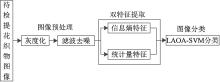
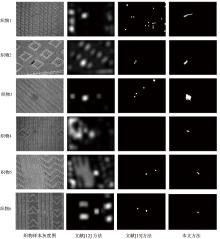
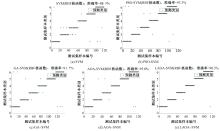
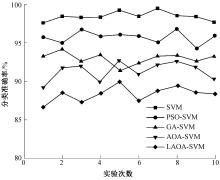
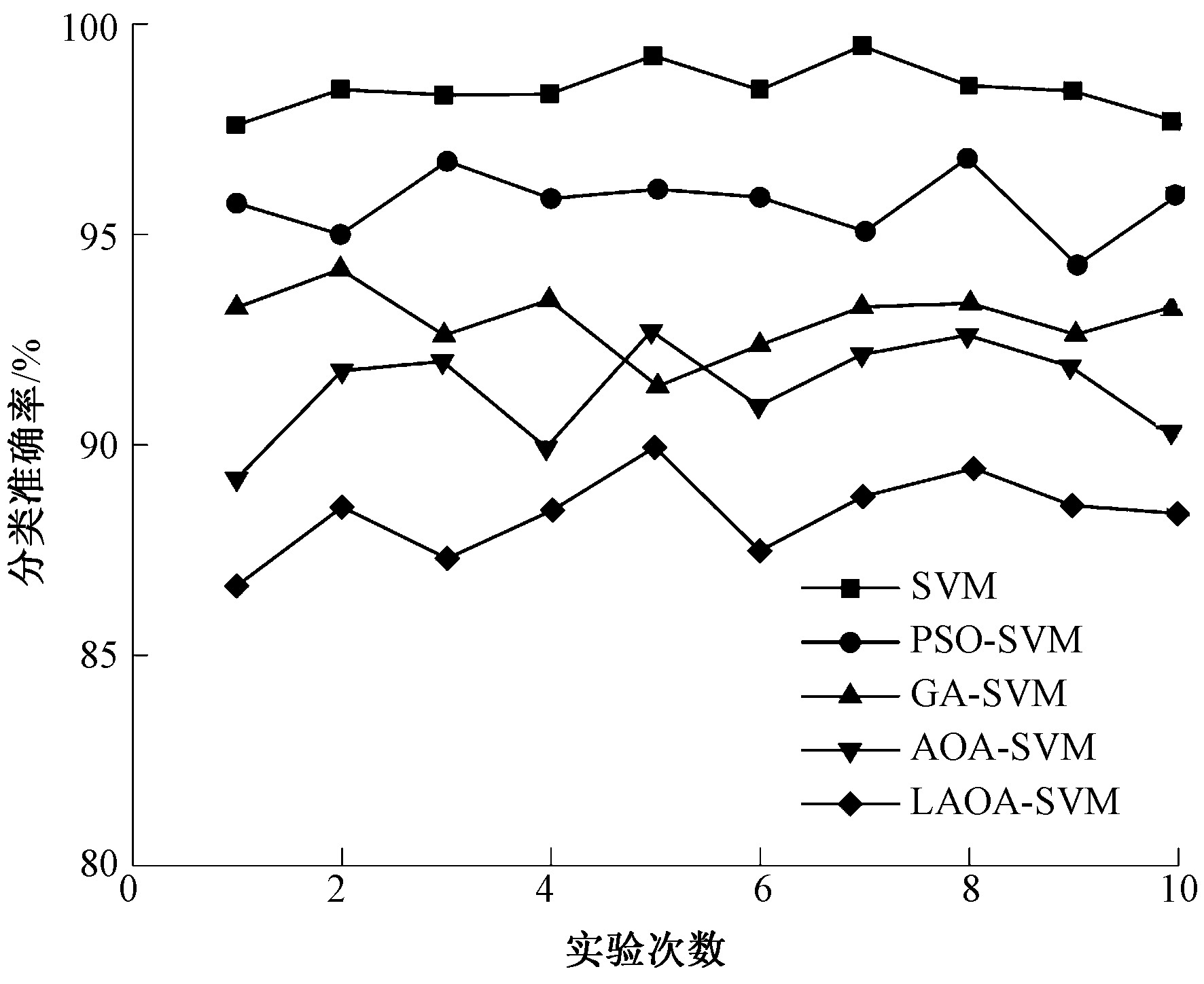
Results The information entropy feature and feature quantity feature were used to represent the defect image on the gray scale. The location of defects was determined by analyzing the difference between texture and defect in spatial distribution. The detection process was mainly composed of three modules. The image pre-processing module was responsible for the preliminary processing of the input jacquard fabric image, including noise removal, contrast enhancement and other steps, so as to improve the image quality and lay a foundation for the subsequent feature extraction. The feature extraction module was the algorithm using information entropy feature and statistical feature to divide the texture area and defect area by weighting fusion dual feature area, and extract information that can represent defect characteristics. The classification module was based on the feature data provided by the feature extraction module, using the improved SVM classification algorithm to classify the defects and mark the position of the defects. High detection rate was achieved for broken yarns and holes, but low detection rate was obtained for low strength defects such as knot and yarn jumping. The combined algorithm significantly improved the detection rate after image pre-processing. Single-feature algorithm was efficient for specific defects, but the algorithm in this paper maintained a high detection rate for all kinds of defects, and verified the effectiveness and robustness of its pretreatment and detection algorithm for complex texture and defects of jacquard knitted fabric. Under the input condition of multiple characteristic parameters combination, the Levy optimization algorithm-support vector machine(LAOA-SVM) classification algorithm and its comparison algorithm designed in this paper showed the highest classification accuracy. The LAOA-SVM classifier performed well on the independent test set, with an accuracy rate of 99.4%, and the time of 0.93 s was less than that of other methods, indicating that the algorithm was efficient and accurate in the fabric defect classification task. The LAOA-SVM classifier showed good classification performance after training, with only a little misjudgment between yarn jumping and knot. Up to 100% accuracy was reached for other fabric defect classifications. Especially for the regional defects with obvious similarity in characteristics, such as yarn breaking and hole breaking, the advantage of LAOA-SVM was highlighted. Other classification algorithms demonstrated a high misclassification rate when dealing with different types of defects. This result strongly demonstrated the high efficiency of LAOA-SVM classifier in fabric defect recognition.

Conclusion The image pre-processing stage effectively enhances the contrast between the defect and the texture through grayscale and filter denoising. Then, the information entropy and statistical features are used to extract the defect information, and the feature optimization is achieved by double-feature weighting fusion. The designed LAOA-SVM classification algorithm and its comparison algorithm show the highest classification accuracy. The LAOA-SVM classifier performs well on the independent test set, with an accuracy rate of 99.4%, and the time of 0.93 s is less than that of other methods, which indicates that the algorithm is efficient and accurate in the fabric defect classification task. The experimental results show that, compared with the prior art, the method performs excellently in the detection of defects such as holes, flying sparks, yarn jumping, greasy dirt and yarn breaking, with a detection rate of up to 99%, and a classification accuracy of 99.4%, especially when dealing with defects with similar characteristics.

Key words: jacquard knitted fabric defect, grayscale statistics, information entropy feature, statistical characteristic, weighted fusion, detection and classification

中图分类号: 

  • TS181.9

图1

疵点检测流程"

图2

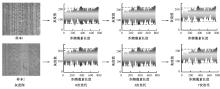
织物灰度图滤波去噪及迭代过程中织物梯度分布"

图3

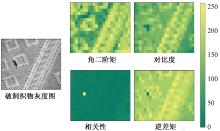
灰度共生矩阵不同统计量的提取结果"

图4

不同方法对不同疵点检测结果对比"

表1

各疵点检测算法检测准确性比较"

检测方法 织物图像 检出率/% 误检率/% 漏检率/% 准确率/%
文献[12] 含疵点 79.8 16.1 4.1 79.5
正常 78.3 21.7
文献[13] 含疵点 82.4 11.4 6.2 82.6
正常 83.3 16.7
本文 含疵点 99.0 0.7 0.3 98.5
正常 96.7 3.3

表2

各分类算法的测试结果"

分类
方法
几何特征 统计特征 缺陷图 组合特征
准确
率/%
时间/
s
准确
率/%
时间/
s
准确
率/%
时间/
s
准确
率/%
时间/
s
SVM 81.9 1.84 78.6 1.76 75.3 2.38 89.6 2.03
PSO-SVM 87.8 1.46 86.1 1.39 85.3 2.04 94.4 1.59
GA-SVM 85.3 1.17 83.6 1.14 81.9 1.76 92.8 1.34
AOA-SVM 80.3 1.02 88.6 0.99 86.9 1.87 96.9 1.16
LAOA-SVM 91.9 0.74 89.4 0.68 88.6 1.14 99.4 0.93

图5

各分类算法在测试集上的分类效果"

图6

各分类算法的10次实验结果"

[1] 胡越杰. 基于深度学习的纬编针织物疵点检测研究[D]. 无锡: 江南大学, 2022:9-10.
HU Yuejie. Research on defect detection of weft knitted fabric based on deep learning[D]. Wuxi: Jiangnan University, 2022:9-10.
[2] 杨婷, 胡佳琳, 唐泽华, 等. 基于形态学处理的提花针织物纹样相似性识别[J]. 毛纺科技, 2023, 51(11): 85-90.
YANG Ting, HU Jialin, TANG Zehua, et al. Pattern similarity recognition of jacquard knitted fabricsbased on morphological processing[J]. Wool Textile Technology, 2023, 51 (11): 85-90,.
[3] 刘亚, 张团善, 王恩芝. 基于高效边缘检测的彩色图像灰度化算法[J]. 轻工机械, 2022, 40(6):52-58.
LIU Ya, ZHANG Tuanshan, WANG Enzhi. Color image decolorization algorithm based on efficient edge detec-tion[J]. Light Industry Machinery, 2022, 40 (6): 52-58.
[4] 胡明珠, 宋晓霞. 基于误差扩散算法的针织提花织物研究[J]. 针织工业, 2021(8): 10-13.
HU Mingzhu, SONG Xiaoxia. Error diffusion algorithm based knitted jacquard fabric study[J]. Knitting Industries, 2021(8): 10-13.
[5] BODNAROVA A, BENNAMOUN M, LATHAM S J, et al. Flaw detection in jacquard fabrics using Gabor filters[J]. International Society for Optics and Photo-nics, 1999(3837): 254-265.
[6] NGAN Y, PANG G, YUNG S, et al. Defect detection on patterned jacquard fabric[J]. IEEE Computer Society, 2003(3): 163-168.
[7] LI W, XUE W, CHENG L. Intelligent detection of defects of yarn-dyed fabrics by energy-based local binary patterns[J]. Textile Research Journal, 2012, 82(19): 1960-1972.
[8] ZHU D, PAN R, GAO W, et al. Yarn-dyed fabric defect detection based on autocorrelation function and GLCM[J]. Autex Research Journal, 2015, 15(3): 226-232.
[9] 李敏, 崔树芹, 陈佳. 应用视觉显著性的小提花织物疵点检测[J]. 纺织学报, 2016, 37(12): 38-42.
LI Min, CUI Shuqin, CHEN Jia. Defect detection of small jacquard fabrics using visual saliency[J]. Journal of Textile Research, 2016, 37(12): 38-42.
[10] ZHANG Bo, TANG Chunming. A method for defect detection of yarn-dyed fabric based on frequency domain filtering and similarity measurement[J]. Autex Research Journal, 2019, 19(3): 257-262.
[11] 周文明, 周建, 潘如如. 应用上下文视觉显著性的色织物疵点检测[J]. 纺织学报, 2020, 41(8): 39-44.
ZHOU Wenming, ZHOU Jian, PAN Ruru. Color fabric defect detection using contextual visual saliency[J]. Journal of Textiles Research, 2020, 41(8): 39-44.
[12] 王春妍, 郭宇, 张晓丽. 基于组合特征和GA_SVM的织物疵点分类[J]. 纺织科技进展, 2024, 46(10): 20-23.
WANG Chunyan, GUO Yu, ZHANG Xiaoli. Fabric defect classification based on combined features and GA-SVM[J] Progress in Textile Science and Technology, 2024, 46(10): 20-23.
[13] 杨晓波. 基于无抽样离散小波变换的复杂纹理织物疵点检测[J]. 毛纺科技, 2024, 52(2): 133-138.
YANG Xiaobo. Complex texture fabric defect detection based on non sampling discrete wavelet transform[J]. Wool Textile Technology, 2024, 52(2): 133-138.
[1] 李杨, 张永超, 彭来湖, 胡旭东, 袁嫣红. 基于改进甲壳虫全域搜索算法的机织物疵点检测[J]. 纺织学报, 2024, 45(10): 89-94.
[2] 张琦, 左露娇, 屠佳妮, 聂美婷. 经编贾卡鞋面材料透气性的数值模拟[J]. 纺织学报, 2024, 45(09): 78-83.
[3] 彭来湖, 侯良美, 齐育宝, 汝欣, 刘建廷. 基于自适应Loess的纱线张力信号处理方法[J]. 纺织学报, 2024, 45(02): 246-254.
[4] 彭来湖, 刘建廷, 李杨, 齐育宝, 李建强, 茅木泉. 基于卷积滤波的接触式纱线张力测量方法[J]. 纺织学报, 2023, 44(08): 73-80.
[5] 史伟民, 简强, 李建强, 汝欣, 彭来湖. 基于非线性扩散和多特征融合的提花针织物疵点检测[J]. 纺织学报, 2023, 44(07): 86-94.
[6] 李杨, 彭来湖, 刘建廷, 胡旭东, 郑秋扬. 基于横向振动频率的轴向运动纱线张力测量[J]. 纺织学报, 2023, 44(06): 72-77.
[7] 李杨, 彭来湖, 李建强, 刘建廷, 郑秋扬, 胡旭东. 基于深度信念网络的织物疵点检测[J]. 纺织学报, 2023, 44(02): 143-150.
[8] 杜帅, 李岳阳, 王孟涛, 罗海驰, 蒋高明. 基于改进局部自适应对比法的织物疵点检测[J]. 纺织学报, 2019, 40(02): 38-44.
[9] 冀鹤 蒋高明 吕建国. 基于人体足部特征的织袜模型设计及一体成形算法[J]. 纺织学报, 2018, 39(12): 53-58.
Viewed
Full text


Abstract

Cited

  Shared   
  Discussed   
No Suggested Reading articles found!