纺织学报 ›› 2026, Vol. 47 ›› Issue (1): 223-230.doi: 10.13475/j.fzxb.20250603901
刘荣芳1,2,3, 李新荣1,2,3( ), 李理1,2,3, 袁程栩1,2,3
LIU Rongfang1,2,3, LI Xinrong1,2,3(), LI Li1,2,3, YUAN Chengxu1,2,3
摘要:
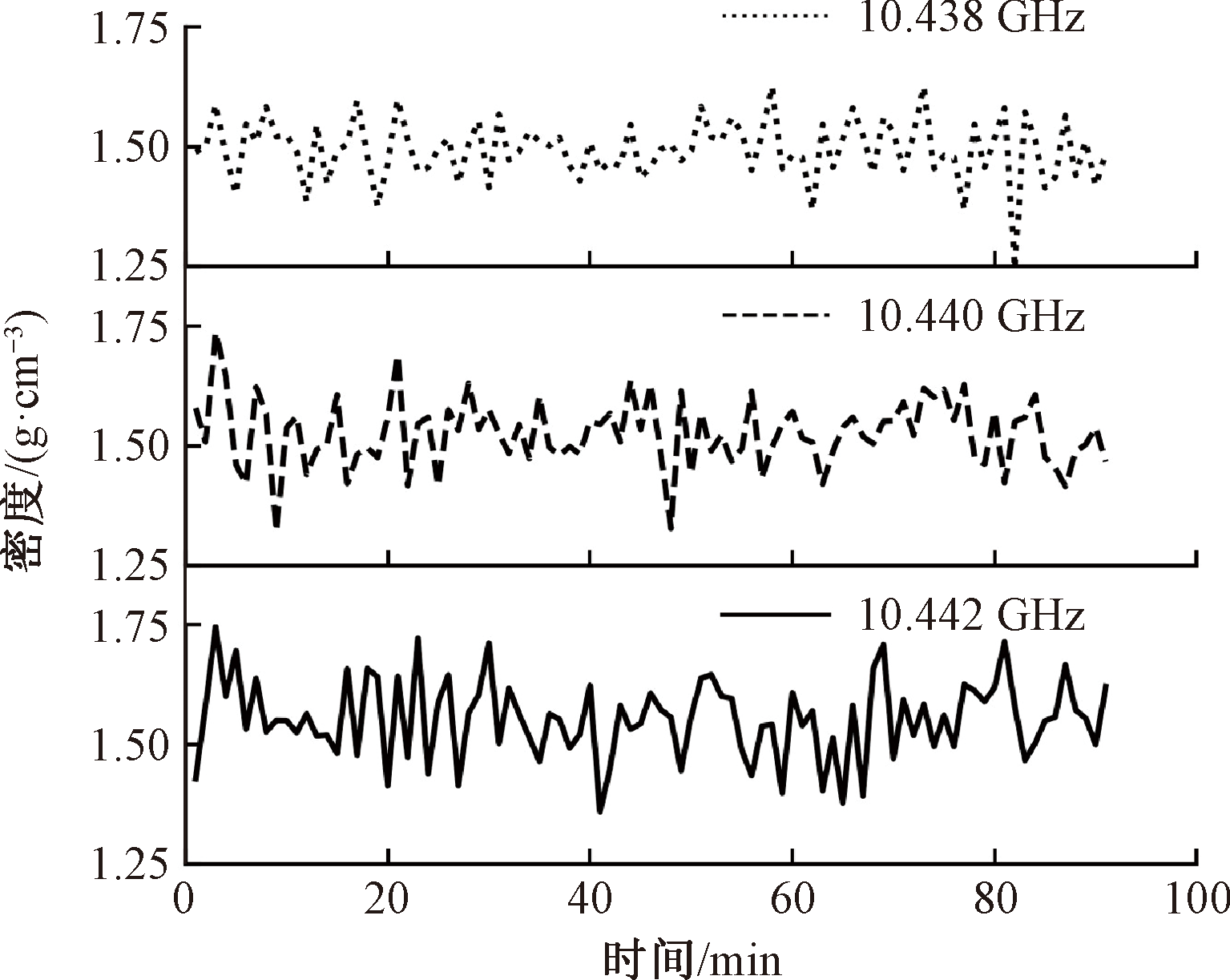
随着纺纱设备向智能化方向发展,针对传统的精梳条条干质量检测方法已无法满足行业对实时检测与智能化控制需求的问题,提出一种精梳条条干质量在线微波检测方法。首先,基于微波谐振腔微扰理论并结合精梳工艺及纤维特性建立条干密度与谐振腔频率的关系模型;其次,对微波传感器谐振腔的关键参数进行确定,计算谐振腔在TM010工作模式下的半径与高度,并结合安装位置对传感器进行外形设计;随后,结合精梳机车速及采样周期对采样频率进行计算确定;然后,通过模拟谐振腔内棉条介电常数的变化进行条干密度仿真,并将理论密度值与仿真密度值进行对比分析,初步验证精梳条在线检测系统的理论正确性;最后,搭建在线检测实验平台进行现场实验,综合考虑灵敏度与误差后,选择了3种频率下的多组实验数据分别与条干仪的测量结果进行分析对比,结果表明,3种频率下的各条干变异系数(CV值)与条干仪测量数据的误差均在3%之内,证明该系统能够准确实现精梳条条干均匀度的在线检测。研究结果为实现精梳条条干在线检测系统的研究提供了理论参考和新思路。
中图分类号:
| [1] |
CHEN Y H, GAO W D, REN J Z, et al. Theoretical and experimental study on the formation mechanism of fiber bundle hooks in the combing process[J]. Textile Research Journal, 2025, 95(15/16): 1956-1975.
doi: 10.1177/00405175241307047 |
| [2] |
CARVALHO V, BELSLEY M, VASCONCELOS R, et al. A comparison of mass parameters determination using capacitive and optical sensors[J]. Sensors and Actuators A: Physical, 2011, 167(2): 327-331.
doi: 10.1016/j.sna.2011.03.006 |
| [3] | 任家智. 国产棉纺精梳机的创新发展与展望[J]. 棉纺织技术, 2023, 51(10): 25-32. |
| REN Jiazhi. Innovative development and prospect of domestic cotton comber[J]. Cotton Textile Technology, 2023, 51(10): 25-32. | |
| [4] | 徐晓昂. 纺纱条干均匀度的在线检测与控制方法研究[J]. 现代纺织技术, 2012, 20(1): 6-10. |
| XU Xiaoang. The study of online detection and control method of spinning evenness[J]. Advanced Textile Technology, 2012, 20(1): 6-10. | |
| [5] | PEREIRA F, CARVALHO V, SOARES F, et al. Computer vision techniques for detecting yarn defects[M]//Applications of Computer Vision in Fashion and Textiles. Cambridge: Woodhead Publishing, 2018: 123-145. |
| [6] | 杨卫林, 胡鹏. 智能化纤维须条均匀度测试仪的研制[J]. 纺织机械, 2013(4): 53-56. |
| YANG Weilin, HU Peng. Development of intelligent fiber whisker evenness tester[J]. Textile Machinery, 2013(4): 53-56. | |
| [7] |
WANG X, LIANG J G, WU J K, et al. Microwave detection with various sensitive materials for humidity sensing[J]. Sensors and Actuators B: Chemical, 2022, 351: 130935.
doi: 10.1016/j.snb.2021.130935 |
| [8] |
CHEN S C, GUO M C, XU K W, et al. A frequency synthesizer based microwave permittivity sensor using CMRC structure[J]. IEEE Access, 2018, 6: 8556-8563.
doi: 10.1109/ACCESS.2018.2808362 |
| [9] | 王晓, 梁峻阁, 强天, 等. 基于微带天线的粮食水分含量检测研究[J]. 传感技术学报, 2021, 34(11): 1541-1548. |
| WANG Xiao, LIANG Junge, QIANG Tian, et al. Research of moisture content measurement of grains based on microstrip antennas[J]. Chinese Journal of Sensors and Actuators, 2021, 34(11): 1541-1548. | |
| [10] |
SHI S X, LI X R, FENG W Q, et al. Research on sliver detection based on microwave resonant cavity perturbation principle[J]. The Journal of the Textile Institute, 2025, 116(7): 1276-1283.
doi: 10.1080/00405000.2024.2373032 |
| [11] |
NIU G Y, LI S, FU X, et al. A novel resonator cavity microwave sensor for high-temperature blade tip clearance measurement[J]. Measurement, 2024, 234: 114798.
doi: 10.1016/j.measurement.2024.114798 |
| [12] | 张涛, 蒋勤, 刘杰, 等. 基于微波谐振技术的润滑油含水率在线检测装置研发及应用[J]. 吉林大学学报(工学版), 2025, 55(6): 1923-1930. |
| ZHANG Tao, JIANG Qin, LIU Jie, et al. Development and application of online measurement device for water content of lubricating oil based on microwave resonance technology[J]. Journal of Jilin University (Engineering and Technology Edition), 2025, 55(6): 1923-1930. | |
| [13] | 向忠, 赵唯, 何仕伟, 等. 双组分织物含水率的微波谐振腔法测量技术[J]. 纺织学报, 2024, 45(4): 221-228. |
| XIANG Zhong, ZHAO Wei, HE Shiwei, et al. Moisture content measurement technology of two-component fabrics by microwave resonant cavity method[J]. Journal of Textile Research, 2024, 45(4): 221-228. | |
| [14] |
SONG C Y, HUANG W H. Noninvasive beam diagnosis based on the TM010 mode[J]. Nuclear Science and Techniques, 2024, 35(7): 127.
doi: 10.1007/s41365-024-01409-1 |
| [15] | 张杰. 微波密度传感器谐振腔的结构设计[J]. 现代制造工程, 2009(4): 108-110, 142. |
| ZHANG Jie. The structure design of microwave resonator of density sensor[J]. Modern Manufacturing Engineering, 2009(4): 108-110, 142. |
| [1] | 马文佳, 刘新金. 牵伸区内纤维变速点分布对半精梳棉条质量的影响[J]. 纺织学报, 2025, 46(04): 56-62. |
| [2] | 陶静, 汪俊亮, 徐楚桥, 张洁. 基于视觉校准的环锭纺细纱条干特征在线提取方法[J]. 纺织学报, 2023, 44(04): 70-77. |
| [3] | 徐健, 胡道杰, 刘秀平, 韩琳, 闫焕营. 基于改进型RFB-MobileNetV3的棉杂图像检测[J]. 纺织学报, 2023, 44(01): 179-187. |
| [4] | 陆浩杰, 李曼丽, 金恩琪, 张宏伟, 周赳. 基于弧形电容器的浆纱回潮率在线测量[J]. 纺织学报, 2023, 44(01): 201-208. |
| [5] | 陈宇恒, 高卫东, 任家智. 精梳机分离牵伸力在线检测与规律分析[J]. 纺织学报, 2022, 43(08): 1-6. |
| [6] | 任维佳, 杜玉红, 左恒力, 袁汝旺. 棉花中异性纤维检测图像分割和边缘检测方法研究进展[J]. 纺织学报, 2021, 42(12): 196-204. |
| [7] | 张文昌, 单忠德, 卢影. 基于机器视觉的纱笼纱杆快速定位方法[J]. 纺织学报, 2020, 41(12): 137-143. |
| [8] | 张建新, 李琦. 基于机器视觉的筒子纱密度在线检测系统[J]. 纺织学报, 2020, 41(06): 141-146. |
| [9] | 常永和 薛元 韩晨晨 杨瑞华 高卫东 张毅. 环锭纺导纱板受力信号在线检测及纺纱张力分析[J]. 纺织学报, 2018, 39(09): 146-152. |
| [10] | 牟新刚 蔡逸超 周晓 陈国良. 基于机器视觉的筒子纱缺陷在线检测系统[J]. 纺织学报, 2018, 39(01): 139-145. |
| [11] | 吕汉明 王晓叶 马崇启. 基于电容传感器的醋酸纤维含油率检测[J]. 纺织学报, 2017, 38(06): 106-110. |
| [12] | 李强 杨艺 刘基宏 高娜. 赛络纺粗纱断纱在线检测[J]. 纺织学报, 2016, 37(10): 120-0124. |
| [13] | 宋晓亮 刘建立 徐阳 刘基宏 高卫东. 光电式环锭断纱在线检测系统[J]. 纺织学报, 2014, 35(8): 94-0. |
| [14] | 陶建勤 张宏伟 陈锡勇 刘娜 张祥富. 以品质指数为导向的精梳纯毛纱条干质量控制[J]. 纺织学报, 2014, 35(11): 28-0. |
| [15] | 汪军. 环锭纺纱线质量检测技术发展现状及趋势[J]. 纺织学报, 2013, 34(6): 131-136. |
|
||
 京公网安备11010502044800号