纺织学报 ›› 2025, Vol. 46 ›› Issue (08): 96-101.doi: 10.13475/j.fzxb.20241100301

• 纺织工程 • 上一篇    下一篇

双经四纬单纬渐变显色提花结构成形及其呈色特征

陆爽怿1,2, 陈思1,2, 周赳1,2()   

  1. 1.浙江理工大学 浙江省丝绸与时尚文化研究中心, 浙江 杭州 310018
    2.浙江理工大学嵊州创新研究院, 浙江 绍兴 312400
  • 收稿日期:2024-11-01 修回日期:2025-04-28 出版日期:2025-08-15 发布日期:2025-08-15
  • 通讯作者: 周赳(1969—),男,教授,博士。主要研究方向为纺织品设计、数智时尚。E-mail:zhoujiu34@126.com
  • 作者简介:陆爽怿(1996—),男,博士生。主要研究方向为数码纺织品设计。
  • 基金资助:
    国家社科基金艺术学项目(22BG121)

Construction and color rendering characteristics of jacquard structure model with double warps and quadruple wefts for single-weft color gradation

LU Shuangyi1,2, CHEN Si1,2, ZHOU Jiu1,2()   

  1. 1. Silk and Fashion Research Center of Zhejiang Province, Zhejiang Sci-Tech University, Hangzhou, Zhejiang 310018, China
    2. Zhejiang Sci-Tech University Shengzhou Innovation Research Institute, Shaoxing, Zhejiang 312400, China
  • Received:2024-11-01 Revised:2025-04-28 Published:2025-08-15 Online:2025-08-15

摘要: 为通过单经单纬交织在双经四纬提花织物表层实现渐变织纹效果,基于双层结构原理提出含8种显色结构类型双经四纬单纬渐变显色提花结构模型。基于阴影组织成形原理构建表层组织库,并讨论里层经纬浮沉规律与表里层关系配置类型,用于双经四纬单纬渐变显色组织成形及数量统计,最终模拟试样来分析双经四纬单纬渐变显色提花结构的呈色特征。结果表明:以缎纹组织为基础组织时,双经四纬提花结构模型含经纬浮沉规律超1060个,其中,双经四纬单纬渐变显色提花结构显色组织数目超1029个;将红、黄、绿、蓝、黑、白6种原色丝线作为经、纬纱线色彩,试样表层具有实现黑白灰无彩色的明度调控以及单一色相有彩色的明度与饱和度调节的能力,可指导双经四纬单纬渐变显色提花产品体系构建与产品开发。

关键词: 数码提花, 双经, 双层织物, 单纬渐变显色, 结构成形, 结构显色, 织物设计

Abstract:

Objective In order to realize the color gradation effect for face layer through the interlacement of single warp and single weft in jacquard structure model with double warps and quadruple wefts, single-weft color gradation jacquard structure model with double warps and quadruple wefts were proposed based on the construction principle of double-ply weave, including 8 structural series. This study serves as a significant part of the construction and color rendering characteristics analysis of jacquard structure model with double warps and quadruple wefts and provides methods to jacquard fabric development.

Method First, two groups of warps and four groups of wefts were placed for the construction of jacquard structure model with double warps and quadruple wefts. Then, face weave-database was built based on shaded weave construction principle. What's more, warp and weft intersection diagram for back layer construction, as well as face and back layer relationships were configurated for developing single-weft color gradation coloring weaves, with their quantities calculated simultaneously. Finally, the structural coloring characteristics of jacquard structure with double warps and quadruple wefts for single-weft color gradation were analyzed through specimen simulation.Results 48 types of color thread configurations were obtained when two groups of achromatic warp threads and four groups of chromatic weft threads are employed, while 288 series of that were realized when two groups of achromatic weft threads replacing two groups of chromatic weft threads. Then, 8 structural coloring varieties of jacquard structure model with double warps and quadruple wefts for single-weft coloring gradation were established. The maximum of warp and weft intersection diagram for jacquard structure model with double warps and quadruple wefts is 2 to the 8R squared power. Further, more than 8.4×1029 single-weft color gradation weaves were calculated when weave repeat R (weave repeat) equals to 5, while more than 1.6×1060 warp and weft intersection diagram for jacquard structure model with double warps and quadruple wefts were obtained. What's more, specimen simulation was carried out under specific technique parameters, 12-threads 5-steps satin shaded face weave-database as well as warp and weft float were employed, with the interlacement of achromatic color threads, though influenced by the thread density and the density of face warp and weft, the black, white and the gray transition were obtained, besides, texture changed when warp or weft floats varied on the surface of specimen. In addition, on one hand, lightness and saturation adjustment of chromatic color gradation achieved through the interlacement of single achromatic warp and single chromatic weft on the fabric surface, on the other hand, the color of the ground part expressed a specific hue tendency. Last but not least, the figured part and the ground part of each specimen are able to be realized via independent regulation of warp and weft selection on the fabric surface layer simultaneously, presenting that the jacquard structure model with double warps and quadruple wefts for single-weft color gradation proposed is effective.

Conclusion Jacquard structure model with double warps and quadruple wefts for single-weft color gradation is able to realize the independent control of the face and back warp and weft. If weave repeat outnumbers 5, more than warp and weft intersection diagram generates under jacquard structure model with double warps and quadruple wefts, while the quantity of single-weft color gradation coloring weaves exceeds. Besides, structural coloring of specimen simulation not only achieves lightness transition of achromatic color, but also realizes saturation transition of single chromatic color. Thus, this study contributes to the construction of digital weave-database and product development of jacquard structure model with double warps and quadruple wefts for single-weft color gradation.

Key words: digital jacquard, double warp, double-ply, single-weft color gradation, structure formation, structural coloring, fabric design

中图分类号: 

  • TS105.1

表1

双经四纬单纬渐变显色提花结构模型经纬色彩配置"

配置
类型
经纬纱线色彩配置 数量 表层显色经纬色彩纱线配置类型
经纱 纬纱 经向 纬向
P 无彩色2组 有彩色4组 A 2 2× A 4 4=48 无彩色1组 有彩色1组
Q 无彩色2组 无彩色2组
有彩色2组
A 2 2× C 4 2× C 2 2× A 4 4=288 无彩色1组
无彩色1组
无彩色1组
有彩色1组

表2

双经四纬单纬渐变显色结构类型"

单纬渐变
显色结构
类型
表经 表纬 里经 里纬
i 甲经A 甲纬a 乙经B 乙纬b、丙纬c、丁纬d
ii 乙纬b 甲纬a、丙纬c、丁纬d
iii 丙纬c 甲纬a、乙纬b、丁纬d
iv 丁纬d 甲纬a、乙纬b、丙纬c
v 乙经B 甲纬a 甲经A 乙纬b、丙纬c、丁纬d
vi 乙纬b 甲纬a、丙纬c、丁纬d
vii 丙纬c 甲纬a、乙纬b、丁纬d
viii 丁纬d 甲纬a、乙纬b、丙纬c

表3

双经四纬单纬渐变显色里层组合经纬浮沉规律"

类型 与里经交
织的里纬
组数
是否存在填
芯里纬
里层组合经纬浮
沉规律候选数
1 N B i = C 3 1 × N S W = 3 × N S W
2 N B i i = C 3 2 × N S W 2 = 3 × N S W 2
3 N B i i i = N S W 3

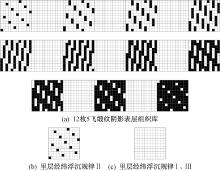
图1

阴影表层组织库与里层经纬浮沉规律"

表4

EAT织物模拟技术参数"

类别 线密度/
dtex
纱线类名 纬纱色彩配置
类型
丝纱色彩(排列比) 总密度/
(根·(10 cm)-1)
经纬交叉关系配置
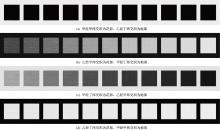
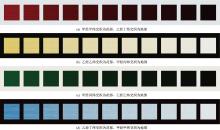
经线 55.55 EAT标准长丝 黑色∶白色(1∶1) 1 180 12枚5飞阴影表层组织、经浮点、纬浮点
纬线 83.33 EAT标准长丝 Q-X类
P-Y类
黑色∶黄色∶绿色∶白色(1∶1∶1∶1)
红色∶黄色∶绿色∶蓝色(1∶1∶1∶1)
1 180

图2

Q-X类双经四纬单纬渐变显色提花织物试样模拟效果"

图3

P-Y类双经四纬单纬渐变显色提花织物试样模拟效果"

[1] 李加林. 现代丝织像景织物及结构设计特征[J]. 丝绸, 2004(3): 11-13.
LI Jialin. Modern silk woven photograph and its structure design features[J]. Journal of Silk, 2004(3): 11-13.
[2] 张聿, 鲁佳亮, 杨婷婷, 等. 丝绸提花图案的单色渐变显像原理和方法[J]. 纺织学报, 2010, 31(8): 41-44, 55.
ZHANG Yu, LU Jialiang, YANG Tingting, et al. Principle and method of color gradient expression of jacquard patterns on silk fabrics[J]. Journal of Textile Research, 2010, 31(8): 41-44, 55.
[3] 周赳, 吴文正. 无彩数码提花织物的创新设计原理和方法[J]. 纺织学报, 2006, 27(4): 1-5.
ZHOU Jiu, NG Frankie. Innovative principle and method of colourless digital Jacquard fabric design[J]. Journal of Textile Research, 2006, 27(4): 1-4.
[4] 张爱丹, 周赳. 一纬全显织物结构设计要素与其显色规律的关系[J]. 纺织学报, 2017, 38(9): 40-44.
ZHANG Aidan, ZHOU Jiu. Relationship between design elements and color rendering law of one-weft shaded weaves[J]. Journal of Textile Research, 2017, 38(9): 40-44.
[5] 周赳, 陆爽怿. 数码提花织物分层组合设计原理及其实践[J]. 纺织学报, 2020, 41(2): 58-63.
ZHOU Jiu, LU Shuangyi. Design principal and practice of layered-combination mode[J]. Journal of Textile Research, 2020, 41(2): 58-63.
[6] 周赳, 吴文正. 仿真数码提花织物的设计原理和方法[J]. 纺织学报, 2007, 28(8): 46-49.
ZHOU Jiu, NG Frankie. Design principle and method on true-to-original digital jacquard fabrics[J]. Journal of Textile Research, 2007, 28(8): 46-49.
[7] 张爱丹, 郭珍妮, 汪阳子. 模块组合全显色结构提花织物设计与仿色优化比较[J]. 纺织学报, 2021, 42(10): 67-74.
ZHANG Aidan, GUO Zhenni, WANG Yangzi. Comparative research on color simulation optimization of jacquard fabric based on modularized compound full-color structure[J]. Journal of Textile Research, 2021, 42(10): 67-74.
doi: 10.13475/j.fzxb.20201101308
[8] KIM K R. A study on structural optimisation and colour mixing systems of digital Jacquard textile based on full-colour compound structure[D]. Hongkong: Hongkong Polytechnic University, 2014: 114-128.
[9] 华涛. 单色经多色纬机织物的表面显色和织造方法: 中国, 201810712581.X[P]. 2020-05-22.
HUA Tao. Method of surface color rendering and weaving for woven fabric with single-color warp and multi-color wefts: CN201810712581.X[P]. 2020-05-22.
[10] 周赳, 段丽娜, 屠永坚. 双经双纬渐变显色提花织物设计原理与方法[J]. 纺织学报, 2016, 37(6): 36-41, 47.
ZHOU Jiu, DUAN Lina, TU Yongjian. Design principle and method of color gradient expression on double-warp double-weft jacquard fabric[J]. Journal of Textile Research, 2016, 37(6): 36-41, 47.
[11] 刘志娟. 双经三纬渐变显色提花织物设计研究与实践[D]. 杭州: 浙江理工大学, 2020: 10-14.
LIU Zhijuan. Design research and practice of color gradient effect jacquard fabric with double-warps and three-wefts[D]. Hangzhou: Zhejiang Sci-Tech University, 2020: 10-14.
[12] 陆爽怿, 周赳. 基于双向多基色的全色域提花结构模型构建[J]. 纺织学报, 2024, 45(11): 88-98.
doi: 10.13475/j.fzxb.20231100301
LU Shuangyi, ZHOU Jiu. Construction of jacquard structure model with full gamut color spaces based on bidirectional multi-primary color[J]. Journal of Textile Research, 2024, 45(11): 88-98.
doi: 10.13475/j.fzxb.20231100301
[1] 张爱丹, 王倩. 三纬组合全显结构织物的颜色预测方法[J]. 纺织学报, 2025, 46(05): 151-158.
[2] 陆爽怿, 周赳. 基于双向多基色的全色域提花结构模型构建[J]. 纺织学报, 2024, 45(11): 88-98.
[3] 穆秀萍, 蒋高明, 陈钰珊, 李炳贤. 纬编多针道织物数字化设计方法[J]. 纺织学报, 2024, 45(11): 106-113.
[4] 尹昂, 丛洪莲. 经编单向导湿织物设计与结构优化[J]. 纺织学报, 2023, 44(04): 86-91.
[5] 张萌, 周赳. 附加纬接结的双层全显色结构设计原理和方法[J]. 纺织学报, 2022, 43(03): 83-88.
[6] 彭稀, 屠永坚, 周赳. 纬排2比1纬二重渐变显色结构设计原理与方法[J]. 纺织学报, 2021, 42(12): 63-69.
[7] 黄锦波, 祝成炎, 张红霞, 洪兴华, 周志芳. 基于剑杆织机改造的三维间隔机织物工艺设计[J]. 纺织学报, 2021, 42(06): 166-170.
[8] 金诗怡, 周赳. 具有双层效果的提花-印花-剪花织物的设计[J]. 纺织学报, 2020, 41(06): 48-54.
[9] 孙婷, 吕智宁, 李艳清, 祝成炎, 田伟. 立体几何褶皱织物的成型与织造[J]. 纺织学报, 2020, 41(02): 64-68.
[10] 张萌 周赳. 双面双层结构提花织物的表里换层设计与实践[J]. 纺织学报, 2018, 39(12): 41-46.
[11] 刘杰 王府梅. 单向导湿机织物结构设计[J]. 纺织学报, 2018, 39(03): 50-55.
[12] 周赳 白琳琳. 纬二重渐变全遮盖结构设计研究与实践[J]. 纺织学报, 2018, 39(01): 32-38.
[13] 梁然然 肖红 王妮. 双层及多层电磁屏蔽织物的屏蔽效能[J]. 纺织学报, 2017, 38(09): 51-58.
[14] 周赳 张萌 金诗怡. 组合半遮盖提花结构设计原理与方法[J]. 纺织学报, 2017, 38(06): 40-45.
[15] 黄紫娟. 利用表里接结结构的双面异效小花纹织物设计[J]. 纺织学报, 2016, 37(09): 26-30.
Viewed
Full text


Abstract

Cited

  Shared   
  Discussed   
No Suggested Reading articles found!