纺织学报 ›› 2025, Vol. 46 ›› Issue (12): 243-250.doi: 10.13475/j.fzxb.20250204002
季巧1, 于清源1, 周爱晖2, 马博谋1, 徐进1, 袁久刚1( )
)
JI Qiao1, YU Qingyuan1, ZHOU Aihui2, MA Bomou1, XU Jin1, YUAN Jiugang1()
摘要:
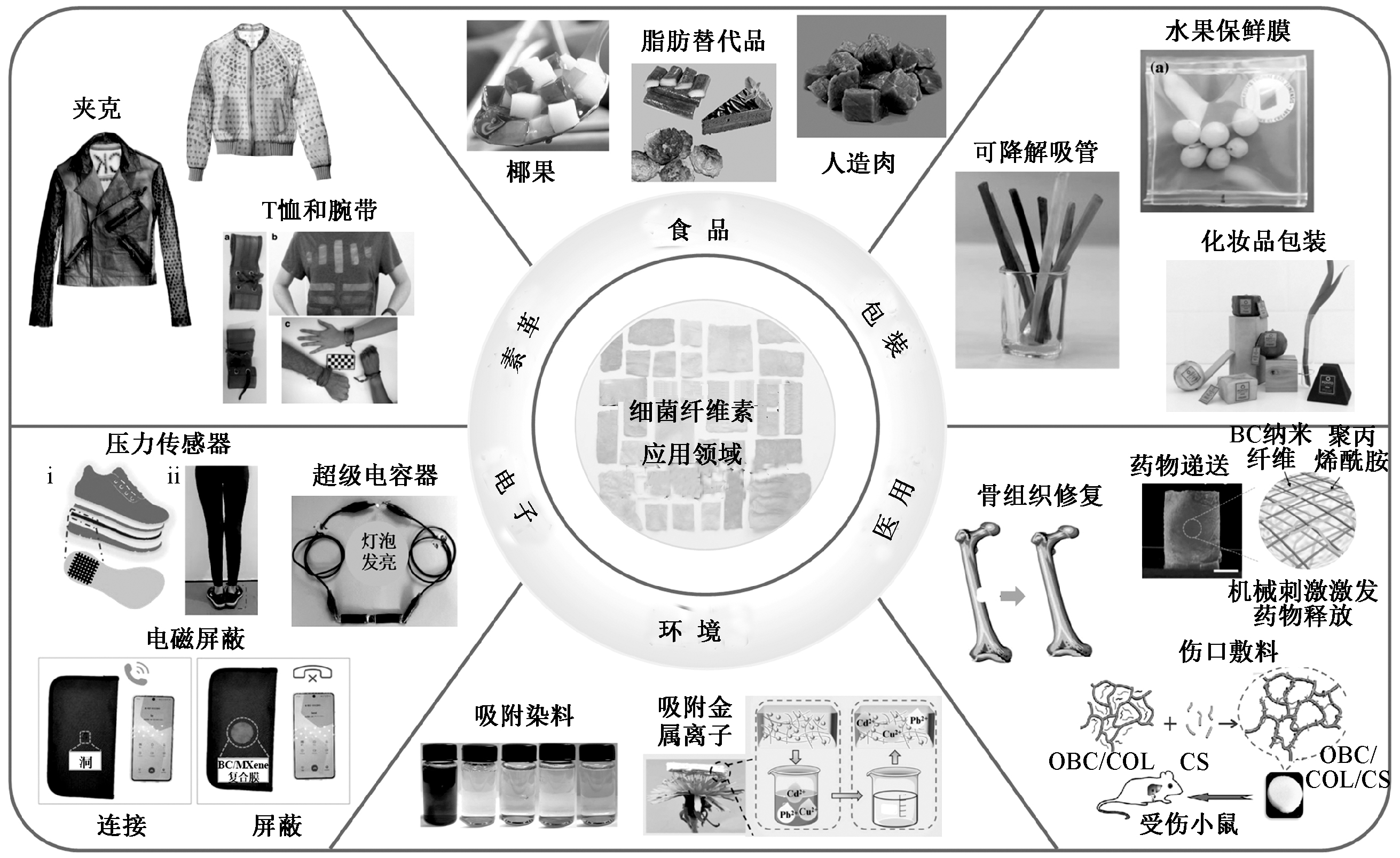
细菌纤维素(BC)凭借其独特的三维网状结构、卓越的力学性能以及良好的生物相容性,在绿色材料领域展现出巨大应用潜力,但在纺织领域中仍然难以实现大规模生产。为推动BC在纺织材料中的应用,结合BC的天然特性,综合分析了目前国内外BC复合材料的研究进展,包括在包装材料、新型素革、柔性可穿戴、医用纺织品、废水处理等纺织材料中的应用优势及创新成果。针对BC规模化应用难题,从基因工程、添加剂优化、发酵工艺改进以及低成本培养基等方面扩大产量、降低成本。此外,探讨了强氢键作用和结构致密对复合化的影响,并提出通过溶剂溶胀、物理拉伸和化学改性等技术提升性能。最后,对BC材料发展方向进行展望,结合生物技术及人工智能手段,有望实现BC高效低成本规模化生产,推动其在纺织领域的可持续发展。
中图分类号:
| [1] | 余晨锐. 木醋杆菌发酵制备细菌纤维素膜及其改性研究[D]. 芜湖: 安徽工程大学,2023: 1-4, 10. |
| YU Chenrui. Preparation of bacterial cellulose film by gluconacetobacter xylinus fermentation and its modification[D]. Wuhu: Anhui University of Technology, 2023: 1-4, 10. | |
| [2] | 曾傲琼. 具有抑菌活性的细菌纤维素的生物制备及应用研究[D]. 无锡: 江南大学,2023: 6-12. |
| ZENG Aoqiong. Biological preparation and application of bacterial cellulose with bacteriostatic activity[D]. Wuxi: Jiangnan University,2023: 6-12. | |
| [3] |
CACICEDO M L, CASTRO M C, SERVETAS I, et al. Progress in bacterial cellulose matrices for biotechnological applications[J]. Bioresource Technology, 2016, 213: 172-180.
doi: S0960-8524(16)30208-5 pmid: 26927233 |
| [4] |
PODDAR M K, DIKSHIT P K. Recent development in bacterial cellulose production and synthesis of cellulose based conductive polymer nanocomposites[J]. Nano Select, 2021, 2(9): 1605-1628.
doi: 10.1002/nano.v2.9 |
| [5] |
YANG F, ZHANG Z X, YUAN J G, et al. Eco-friendly production of leather-like material from bacterial cellulose and waste resources[J]. Journal of Cleaner Production, 2024, 476: 143700.
doi: 10.1016/j.jclepro.2024.143700 |
| [6] | Business Research Insights. Microbial and Bacterial Cellulose Market[J/OL] (2025-2-10)[2025-02-20]. https://www.businessresearchinsights.com/zh/market-reports/microbial-and-bacterial-cellulose-market-100001. |
| [7] | 赵海雯. 细菌纤维素薄膜增强与增韧研究[D]. 上海: 东华大学,2022: 14-17. |
| ZHAO Haiwen. Study on strengthening and toughening bacterial cellulose films[D]. Shanghai: Donghua University,2022: 14-17. | |
| [8] |
MBITUYIMANA B, LIU L, YE W L, et al. Bacterial cellulose-based composites for biomedical and cosmetic applications: research progress and existing pro-ducts[J]. Carbohydrate Polymers, 2021, 273: 118565.
doi: 10.1016/j.carbpol.2021.118565 |
| [9] |
YANG H B, LIU Z X, YIN C H, et al. Edible, ultrastrong, and microplastic-free bacterial cellulose-based straws by biosynthesis[J]. Advanced Functional Materials, 2022, 32(15): 2111713.
doi: 10.1002/adfm.v32.15 |
| [10] | MAGAZINE D. Elena amato bacteria packaging de-sign[J/OL](2019-02-28)[2025-2-10]. https://www.dezeen.com/2019/02/28/elena-amato-bacteria-packaging-design/. |
| [11] |
KAMIŃSKI K, JAROSZ M, GRUDZIEŃ J, et al. Hydrogel bacterial cellulose: a path to improved materials for new eco-friendly textiles[J]. Cellulose, 2020, 27(9): 5353-5365.
doi: 10.1007/s10570-020-03128-3 |
| [12] | LEE S. Grow Your Own Clothes[J/OL].(2019-07-22) [2024-09-06]. https://www.ted.com/speakers/suzanne_lee.html. |
| [13] |
GUAN F Y, HAN Z L, JIN M T, et al. Durable and flexible bio-assembled RGO-BC/BC bilayer electrodes for pressure sensing[J]. Advanced Fiber Materials, 2021, 3(2): 128-137.
doi: 10.1007/s42765-021-00066-y |
| [14] |
LIU M X, ZHANG H R, HUANG X M, et al. An electric-magnetic dual-gradient composite film comprising MXene, hollow Fe3O4, and bacterial cellulose for high-performance EMI shielding and infrared camouflage[J]. Advanced Functional Materials, 2025, 35(22): 2419077.
doi: 10.1002/adfm.v35.22 |
| [15] | YUAN H B, CHEN L, HONG F F. A biodegradable antibacterial nanocomposite based on oxidized bacterial nanocellulose for rapid hemostasis and wound hea-ling[J]. ACS Applied Materials & Interfaces, 2020, 12(3): 3382-3392. |
| [16] |
PARK D, KIM J W, SHIN K, et al. Bacterial cellulose nanofibrils-reinforced composite hydrogels for mechanical compression-responsive on-demand drug release[J]. Carbohydrate Polymers, 2021, 272: 118459.
doi: 10.1016/j.carbpol.2021.118459 |
| [17] |
ZHAO X Q, YANG M B, SHI Y C, et al. Multifunctional bacterial cellulose-bentonite@polyethylenimine composite membranes for enhanced water treatment: sustainable dyes and metal ions adsorption and antibacterial properties[J]. Journal of Hazardous Materials, 2024, 477: 135267.
doi: 10.1016/j.jhazmat.2024.135267 |
| [18] |
ALMEIDA T, KARAMYSHEVA A, VALENTE B F A, et al. Biobased ternary films of thermoplastic starch, bacterial nanocellulose and Gallic acid for active food packaging[J]. Food Hydrocolloids, 2023, 144: 108934.
doi: 10.1016/j.foodhyd.2023.108934 |
| [19] |
JU S Y, ZHANG F L, DUAN J F, et al. Characterization of bacterial cellulose composite films incorporated with bulk chitosan and chitosan nanoparticles: a comparative study[J]. Carbohydrate Polymers, 2020, 237: 116167.
doi: 10.1016/j.carbpol.2020.116167 |
| [20] |
NAYAK R, CLEVELAND D, TRAN G, et al. Potential of bacterial cellulose for sustainable fashion and textile applications: a review[J]. Journal of Materials Science, 2024, 59(16): 6685-6710.
doi: 10.1007/s10853-024-09577-6 |
| [21] |
WU H, ZHANG Y N, YUAN W Y, et al. Highly flexible, foldable and stretchable Ni-Co layered double hydroxide/polyaniline/bacterial cellulose electrodes for high-performance all-solid-state supercapacitors[J]. Journal of Materials Chemistry A, 2018, 6(34): 16617-16626.
doi: 10.1039/C8TA05673K |
| [22] |
ABEER M M, MOHD AMIN M C, MARTIN C. A review of bacterial cellulose-based drug delivery systems: their biochemistry, current approaches and future prospects[J]. Journal of Pharmacy and Pharmacology, 2014, 66(8): 1047-1061.
doi: 10.1111/jphp.12234 pmid: 24628270 |
| [23] |
JIJI S, UDHAYAKUMAR S, ROSE C, et al. Thymol enriched bacterial cellulose hydrogel as effective material for third degree burn wound repair[J]. International Journal of Biological Macromolecules, 2019, 122: 452-460.
doi: S0141-8130(18)35003-7 pmid: 30385344 |
| [24] |
JIJI S, UDHAYAKUMAR S, MAHARAJAN K, et al. Bacterial cellulose matrix with in situ impregnation of silver nanoparticles via catecholic redox chemistry for third degree burn wound healing[J]. Carbohydrate Polymers, 2020, 245: 116573.
doi: 10.1016/j.carbpol.2020.116573 |
| [25] | MAO L, HU S M, GAO Y H, et al. Biodegradable and electroactive regenerated bacterial cellulose/MXene (Ti3 C2 tx) composite hydrogel as wound dressing for accelerating skin wound healing under electrical stimulation[J]. Advanced Healthcare Materials, 2020, 9(19): e2000872. |
| [26] | ZHANG W X, ZHAO S B, GUAN Q F, et al. Enhancing chronic wound healing through engineering Mg2+-coordinated Asiatic acid/bacterial cellulose hybrid hydrogels[J]. ACS Applied Materials & Interfaces, 2024, 16(7): 8238-8249. |
| [27] | COELHO F, DO Vale Braido, G V, CAVICCHIOLI M, et al. Toxicity of therapeutic contact lenses based on bacterial cellulose with coatings to provide transpa-rency[J]. Contact Lens & Anterior Eye, 2019, 42(5): 512-519. |
| [28] |
JAYANI T, SANJEEV B, MARIMUTHU S, et al. Bacterial Cellulose Nano Fiber (BCNF) as carrier support for the immobilization of probiotic, Lactobacillus acidophilus 016[J]. Carbohydrate Polymers, 2020, 250: 116965.
doi: 10.1016/j.carbpol.2020.116965 |
| [29] |
CHAABANE L, CHAHDOURA H, MEHDAOUI R, et al. Functionalization of developed bacterial cellulose with magnetite nanoparticles for nanobiotechnology and nanomedicine applications[J]. Carbohydrate Polymers, 2020, 247: 116707.
doi: 10.1016/j.carbpol.2020.116707 |
| [30] |
SILVA R R, RAYMUNDO-PEREIRA P A, CAMPOS A M, et al. Microbial nanocellulose adherent to human skin used in electrochemical sensors to detect metal ions and biomarkers in sweat[J]. Talanta, 2020, 218: 121153.
doi: 10.1016/j.talanta.2020.121153 |
| [31] |
LIU G D, MA M J, MENG H Y, et al. In-situ self-assembly of bacterial cellulose/poly(3, 4-ethylenedioxythiophene)-sulfonated nanofibers for peripheral nerve repair[J]. Carbohydrate Polymers, 2022, 281: 119044.
doi: 10.1016/j.carbpol.2021.119044 |
| [32] | YANG X L, HUANG J J, CHEN C T, et al. Biomimetic design of double-sided functionalized silver nanoparticle/bacterial cellulose/hydroxyapatite hydrogel mesh for temporary cranioplasty[J]. ACS Applied Materials & Interfaces, 2023, 15(8): 10506-10519. |
| [33] |
SUN Y, GAO Y W, LI Y X, et al. Novel bifunctional in-based metal-organic gel/bacterial cellulose composite gels for effective tetracycline antibiotics removal: synergistic behavior and mechanism insight of adsorption-photocatalysis[J]. Chemical Engineering Journal, 2023, 475: 146107.
doi: 10.1016/j.cej.2023.146107 |
| [34] |
LIN Z Y, LI L H, SONG K G, et al. Boronic acid-modified bacterial cellulose microspheres as packing materials for enveloped virus removal[J]. Science of The Total Environment, 2023, 859: 160341.
doi: 10.1016/j.scitotenv.2022.160341 |
| [35] |
XU Z H, ZHENG X D, BAO S F, et al. ZCS-TiO2 modified bacterial cellulose multifunctional membranes for highly effective and antibacterial oil-water separa-tion[J]. Process Safety and Environmental Protection, 2024, 181: 377-386.
doi: 10.1016/j.psep.2023.11.042 |
| [36] |
YANG F, CAO Z J, LI C, et al. A recombinant strain of Komagataeibacter xylinus ATCC 23770 for production of bacterial cellulose from mannose-rich resources[J]. New Biotechnology, 2023, 76: 72-81.
doi: 10.1016/j.nbt.2023.05.002 pmid: 37182820 |
| [37] | 刘嘉恒, 王旭, 彭昭君, 等. 木葡糖酸醋杆菌运动相关基因的敲除及对细菌纤维素合成的影响[J]. 生物工程学报, 2024, 40(6): 1856-1867. |
|
LIU Jiaheng, WANG Xu, PENG Zhaojun, et al. Knockdown of motility-related genes of Komagataeibacter xylinus and its effect on bacterial cellulose synthe-sis[J]. Chinese Journal of Biotechnology, 2024, 40(6): 1856-1867.
doi: 10.13345/j.cjb.230684 pmid: 38914496 |
|
| [38] |
ISLAM M U, ULLAH M W, KHAN S, et al. Strategies for cost-effective and enhanced production of bacterial cellulose[J]. International Journal of Biological Macromolecules, 2017, 102: 1166-1173.
doi: S0141-8130(17)30716-X pmid: 28487196 |
| [39] |
CHENG K C, CATCHMARK J M, DEMIRCI A. Effect of different additives on bacterial cellulose production by Acetobacter xylinum and analysis of material pro-perty[J]. Cellulose, 2009, 16(6): 1033-1045.
doi: 10.1007/s10570-009-9346-5 |
| [40] |
ATWA N, EL-DIWANY A, EL-SAIED H, et al. Improvement in bacterial cellulose production using Gluconacetobacter xylinus ATCC 10245 and characterization of the cellulose pellicles produced[J]. Egyptian Pharmaceutical Journal, 2015, 14(2): 123.
doi: 10.4103/1687-4315.161286 |
| [41] |
HSIEH J T, WANG M J, LAI J T, et al. A novel static cultivation of bacterial cellulose production by intermittent feeding strategy[J]. Journal of the Taiwan Institute of Chemical Engineers, 2016, 63: 46-51.
doi: 10.1016/j.jtice.2016.03.020 |
| [42] |
BLANCO PARTE F G, SANTOSO S P, CHOU C C, et al. Current progress on the production, modification, and applications of bacterial cellulose[J]. Critical Reviews in Biotechnology, 2020, 40(3): 397-414.
doi: 10.1080/07388551.2020.1713721 pmid: 31937141 |
| [43] |
ZHONG C Y. Industrial-scale production and applications of bacterial cellulose[J]. Frontiers in Bioengineering and Biotechnology, 2020, 8: 605374.
doi: 10.3389/fbioe.2020.605374 |
| [44] |
JOZALA A F, PÉRTILE R A N, DOS SANTOS C A, et al. Bacterial cellulose production by Gluconacetobacter xylinus by employing alternative culture media[J]. Applied Microbiology and Biotechnology, 2015, 99(3): 1181-1190.
doi: 10.1007/s00253-014-6232-3 pmid: 25472434 |
| [45] |
FAN X, GAO Y, HE W Y, et al. Production of nano bacterial cellulose from beverage industrial waste of citrus peel and pomace using Komagataeibacter xyli-nus[J]. Carbohydrate Polymers, 2016, 151: 1068-1072.
doi: 10.1016/j.carbpol.2016.06.062 |
| [46] |
SAR T, YESILCIMEN AKBAS M. Potential use of olive oil mill wastewater for bacterial cellulose production[J]. Bioengineered, 2022, 13(3): 7659-7669.
doi: 10.1080/21655979.2022.2050492 pmid: 35264062 |
| [47] | 刘备备. 细菌纤维素的溶解与静电纺丝工艺研究[D]. 南京: 南京理工大学,2012: 1-4, 30. |
| LIU Beibei. Solubilisation of bacterial cellulose and electrostatic spinning process studies[D]. Nanjing: Nanjing University of Science and Technology,2012: 1-4, 30. | |
| [48] |
PHAN H N, BUI H M, VU N K. Fabric-like bacterial cellulose for textile applications-analysis of influences between physical and thermal dehydration on end-use performance[J]. The Journal of the Textile Institute, 2024, 115(9): 1644-1654.
doi: 10.1080/00405000.2023.2261749 |
| [49] | 王莎. 高性能纤维素材料的构建与性能研究[D]. 广州: 华南理工大学, 2018: 39-40. |
| WANG Sha. Construction and properties of high performance cellulose materials[D]. Guangzhou: South China University of Technology, 2018: 39-40. | |
| [50] |
SUN Y, MENG C M, ZHENG Y D, et al. The effects of two biocompatible plasticizers on the performance of dry bacterial cellulose membrane: a comparative study[J]. Cellulose, 2018, 25(10): 5893-5908.
doi: 10.1007/s10570-018-1968-z |
| [51] |
SONG J E, SU J, LOUREIRO A, et al. Ultrasound-assisted swelling of bacterial cellulose[J]. Engineering in Life Sciences, 2017, 17(10): 1108-1117.
doi: 10.1002/elsc.201700085 pmid: 32624738 |
| [52] |
ADITYA T, ALLAIN J P, JARAMILLO C, et al. Surface modification of bacterial cellulose for biomedical applications[J]. International Journal of Molecular Sciences, 2022, 23(2): 610.
doi: 10.3390/ijms23020610 |
| [53] |
BADSHAH M, ULLAH H, KHAN A R, et al. Surface modification and evaluation of bacterial cellulose for drug delivery[J]. International Journal of Biological Macromolecules, 2018, 113: 526-533.
doi: S0141-8130(17)33655-3 pmid: 29477541 |
| [1] | 刘劲扬, 李成才, 朱海霖, 郭玉海, 姜学梁. 非对称结构聚四氟乙烯中空管式纤维膜的制备及油水分离性能[J]. 纺织学报, 2025, 46(12): 11-18. |
| [2] | 谢围围, 朱庆鹏, 宋娇娇, 陈志明. 磁性固定化漆酶的制备及其对染料的高效降解[J]. 纺织学报, 2025, 46(12): 163-170. |
| [3] | 王梁宇, 高晓红, 于彩娇, 张雪婷, 杨旭礼. 还原氧化石墨烯/铜纳米颗粒导电棉织物的制备及其传感性能[J]. 纺织学报, 2025, 46(12): 181-187. |
| [4] | 高俊, 凌磊, 陈缘, 武丁胜, 林韩蕾, 李振宇, 凤权. 氨基功能化聚丙烯腈纳米纤维膜的制备及其对Cr(Ⅵ)的吸附性能[J]. 纺织学报, 2025, 46(12): 57-65. |
| [5] | 姚晓军, 徐恩婷, 杨雪媛, 房磊, 包伟, 房宽峻. 聚乙烯吡咯烷酮对聚对苯二甲酸乙二醇酯中空纤维膜结构与性能的调控[J]. 纺织学报, 2025, 46(12): 66-73. |
| [6] | 张帆, 蔡再生, 刘慧景, 陆少锋, 黄旭明. 高牢固光致变色棉织物的点击化学法制备及其性能[J]. 纺织学报, 2025, 46(11): 196-202. |
| [7] | 王莎莎, 李超婧, 李彦, 毛吉富, 王富军, 王璐. 智能可穿戴健康纺织品应用研究进展[J]. 纺织学报, 2025, 46(10): 265-273. |
| [8] | 赵捷清, 王瑧, 秦孝天, 王成成, 张丽平. 模拟绿叶颜色变化的温致变色织物制备及其性能[J]. 纺织学报, 2025, 46(09): 19-26. |
| [9] | 傅林, 钱建华, 单江音, 林灵, 卫梦蓉, 翁可欣, 吴晓睿. 银纳米线/聚氨酯纳米纤维膜柔性传感器制备及其性能[J]. 纺织学报, 2025, 46(09): 74-83. |
| [10] | 王泓力, 张辉, 刘建宇, 尉海泽, 张雅宁, 王丽丽, 许学潮. 棉基生物炭-ZIF-L(Zn)-壳聚糖/聚丙烯复合膜的制备及其吸附-光催化性能[J]. 纺织学报, 2025, 46(09): 84-93. |
| [11] | 侯颖慧, 刘肖燕, 柳东辰, 郝矿荣, 邹婷. 基于体外降解的输尿管支架管的多目标优化[J]. 纺织学报, 2025, 46(09): 154-162. |
| [12] | 左卓帆, 卢凯亮, 李倩雯, 张维. 基于铝镁合金阳极的靛蓝染色废水电絮凝处理效能优化[J]. 纺织学报, 2025, 46(09): 197-204. |
| [13] | 项文龙, 杨静冉, 肖晓珍. 铁钴双金属有机框架/稻谷壳复合材料的制备及其染料脱色性能[J]. 纺织学报, 2025, 46(06): 178-186. |
| [14] | 王惠婷, 陈宇鉴, 刘诗仪, 张显涛, 陆斌, 邹专勇, 王建, 张寅江. 海藻酸盐基非织造医用敷料的研究进展[J]. 纺织学报, 2025, 46(06): 240-249. |
| [15] | 刘烨, 王俊胜, 金星. 消防员个人防护装备用智能纺织品研究进展[J]. 纺织学报, 2025, 46(05): 105-115. |
|
||
 京公网安备11010502044800号