纺织学报 ›› 2026, Vol. 47 ›› Issue (07): 111-119.doi: 10.13475/j.fzxb.20251103701
刘佳兴1, 王伟1, 郝新敏2, 宫玉梅1( )
)
LIU Jiaxing1, WANG Wei1, HAO Xinmin2, GONG Yumei1()
摘要:
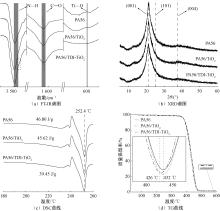
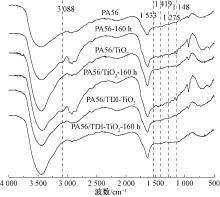
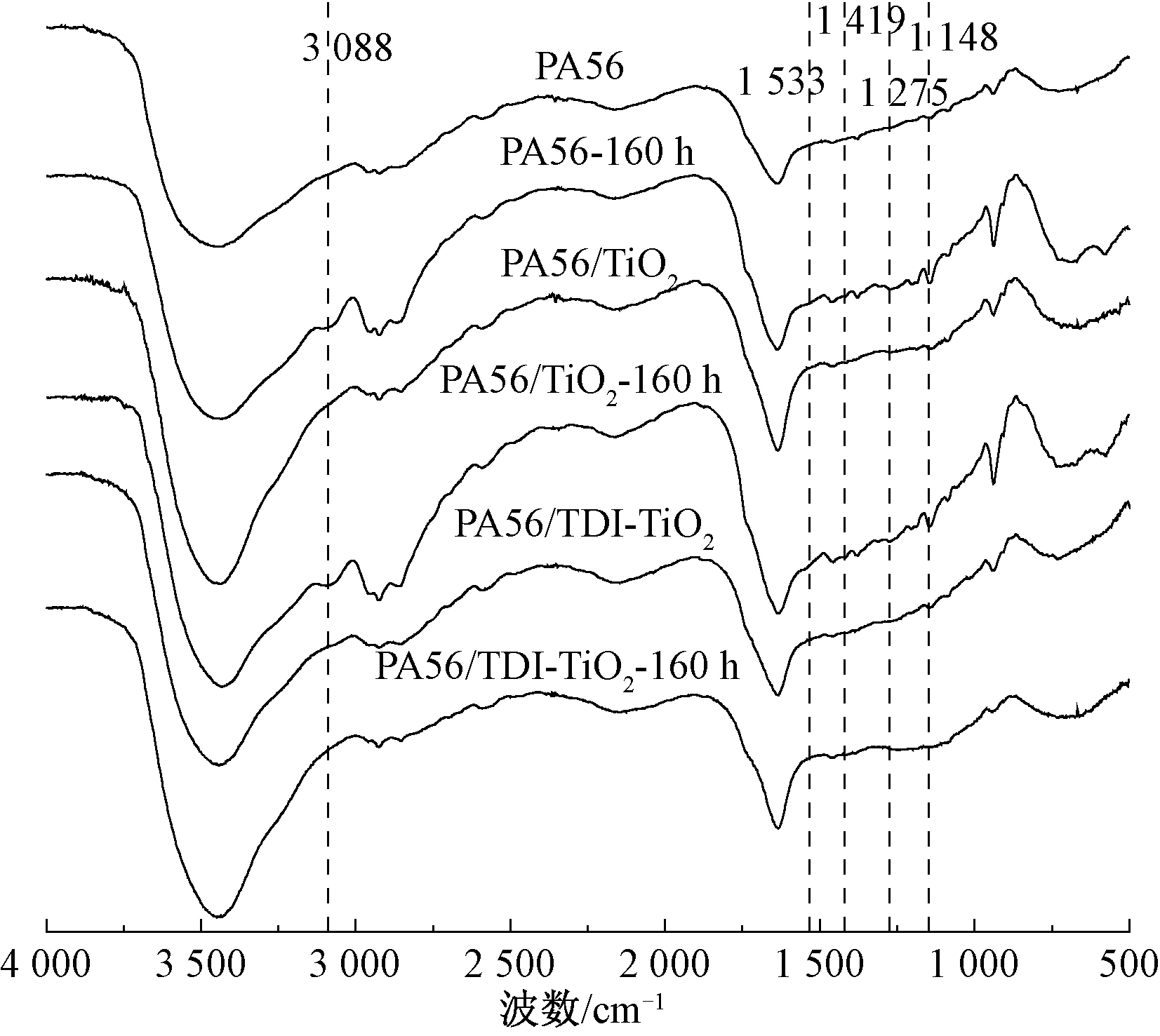
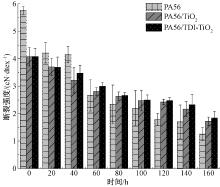
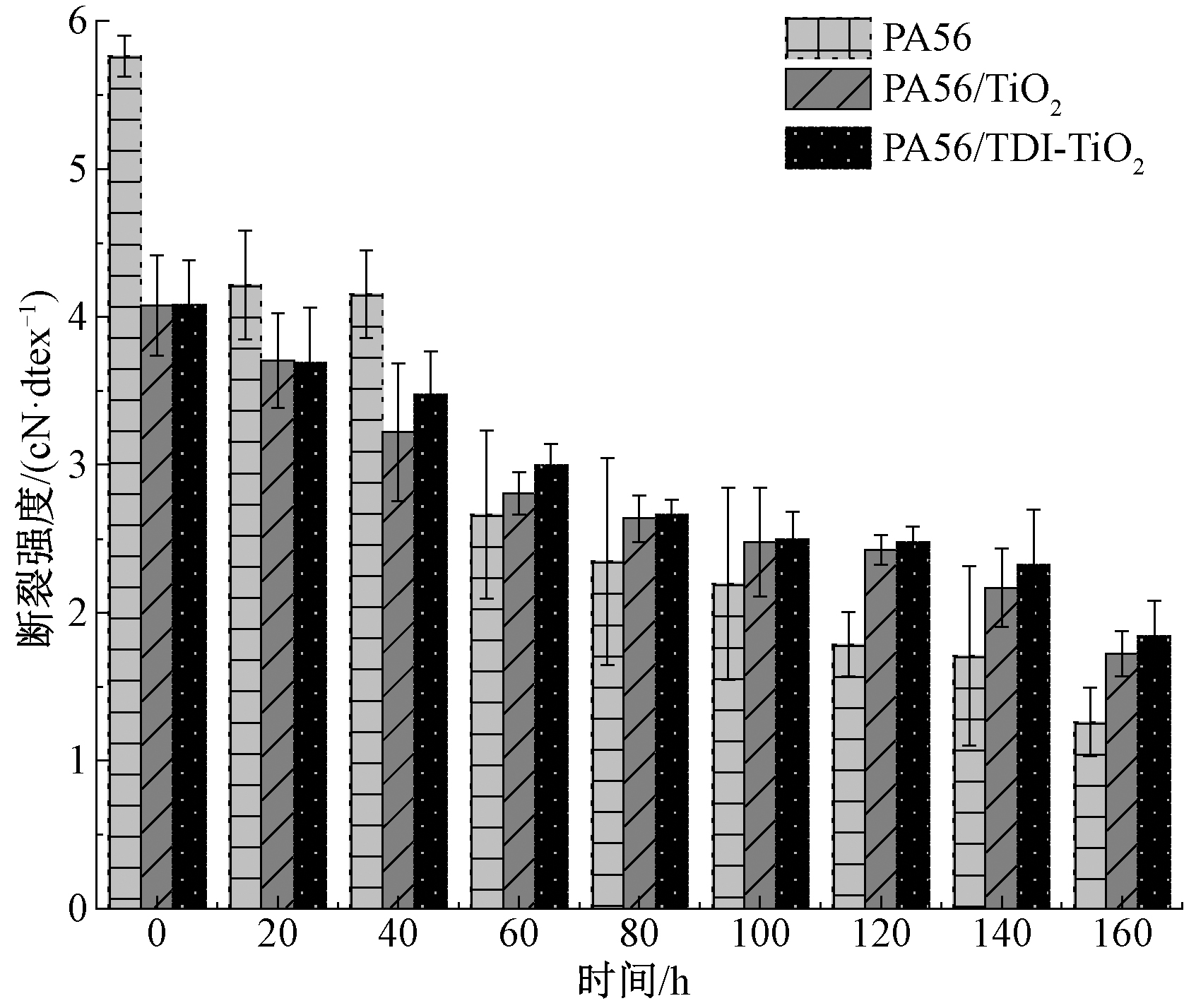
为提升生物基聚酰胺56(PA56)纤维的抗紫外线老化性能,采用甲苯二异氰酸酯(TDI)对TiO2表面进行修饰,并通过熔融共混纺丝制备PA56/TDI-TiO2复合纤维。利用扫描电子显微镜、傅里叶变换红外光谱仪、X射线光电子能谱仪及X射线衍射等对纤维结构与性能进行表征,并结合紫外线加速老化实验评价其抗紫外线行为。结果表明:TDI改性有效提升了TiO2在PA56基体中的分散性与界面相容性,其未反应的异氰酸酯基团(—NCO)与PA56链端氨基(—NH2)形成脲键结构(—NHCONH—),实现TiO2与PA56的共价键合;经160 h紫外线老化后,PA56/TDI-TiO2复合纤维的断裂强度保持率为45.1%(1.84 cN/dtex),显著高于纯PA56纤维(1.26 cN/dtex)与未改性PA56/TiO2体系(1.72 cN/dtex),相较于纯PA56体系力学性能保留率提升20.8个百分点。机制分析表明,TDI接枝不仅抑制TiO2的光催化活性,减少自由基生成,同时通过增强界面结合与紫外线屏蔽效应,有效延缓PA56分子链的光氧化降解。因此,基于TDI的表面改性策略为开发高性能抗紫外线聚酰胺纤维提供了有效实验依据和解决方案。
中图分类号:
| [1] |
GÜLEL Ş, GÜVENILIR Y. Preparation and characterization of novel bio-based polyamide 5.6 composites as sustainable alternatives to petroleum-derived polyamide 6.6[J]. Polymer Composites, 2024, 45(12): 11033-11043.
doi: 10.1002/pc.v45.12 |
| [2] |
PASSINGER T, SCHMOHL L, ZARGES J C, et al. Investigation of the UV-aging behavior of bio-based polyamides for automotive interiors[J]. Polymer Testing, 2025, 146: 108796.
doi: 10.1016/j.polymertesting.2025.108796 |
| [3] |
ZHANG X Q, YANG H Y, GUO Y X, et al. Pyrolysis kinetics and flame retardant enhancement of bio-based polyamide 56/6[J]. Thermochimica Acta, 2024, 741: 179869.
doi: 10.1016/j.tca.2024.179869 |
| [4] | 冯淑芹, 吕品. 抗酚黄变油剂对聚酰胺纤维的改性研究[J]. 印染助剂, 2022, 39(1): 26-29. |
| FENG Shuqin, LÜ Pin. Modification of polyamide fibers with anti-phenol yellowing oil agent[J]. Textile Auxiliaries, 2022, 39(1): 26-29. | |
| [5] |
CHEN P, LI Z Q, LIU S, et al. Preparation of polyamide 6 and its titanium dioxide photocatalytic composite powders for laser powder bed fusion[J]. Materials Science in Additive Manufacturing, 2022, 1(3): 14.
doi: 10.18063/msam.v1i3.14 |
| [6] |
BIENIEK A, LIPP-SYMONOWICZ B, SZTAJNOWSKI S. Influence of the structures of polyamide 6 fibers on their ageing under intensive insolation conditions[J]. Polimery, 2009, 54(11/12): 840-844.
doi: 10.14314/polimery |
| [7] |
DANN T, RAPHEL J, GAMMON S T, et al. Anatase titanium dioxide imparts photoluminescent properties to PA2200 commercial 3D printing material to generate complex optical imaging phantoms[J]. Materials, 2021, 14(7):1813.
doi: 10.3390/ma14071813 |
| [8] | 王莉娟, 宫玉梅, 李晓妍, 等. 生物基聚酰胺56分子质量及其Mark-Houwink方程参数的测定[J]. 纺织学报, 2022, 43(7): 36-40. |
| WANG Lijuan, GONG Yumei, LI Xiaoyan, et al. Determination of molecular weight and Mark-Houwink parameters of bio-based polyamide 56[J]. Journal of Textile Research, 2022, 43(7): 36-40. | |
| [9] | 房鑫, 徐英男, 侯传金, 等. 甲苯二异氰酸酯聚脲的合成与性能[J]. 合成树脂及塑料, 2019, 36(4): 19-22, 37. |
| FANG Xin, XU Yingnan, HOU Chuanjin, et al. Synthesis and properties of toluene diisocyanate polyurea[J]. China Synthetic Resin and Plastics, 2019, 36(4): 19-22, 37. | |
| [10] |
RAHIMI A, MURPHY M, UPADHYAY V, et al. Amphiphilically modified self-stratified siloxane-glycidyl carbamate coatings for anti-icing applications[J]. Journal of Coatings Technology and Research, 2021, 18(1): 83-97.
doi: 10.1007/s11998-020-00402-8 |
| [11] |
NASIRI S, RABIEI M, PALEVICIUS A, et al. Modified Scherrer equation to calculate crystal size by XRD with high accuracy, examples Fe2O3, TiO2 and V2O5[J]. Nano Trends, 2023, 3: 100015.
doi: 10.1016/j.nwnano.2023.100015 |
| [12] |
VORONTSOV A V, TSYBULYA S V. Influence of nanoparticles size on XRD patterns for small monodisperse nanoparticles of Cu0 and TiO2 anatase[J]. Industrial & Engineering Chemistry Research, 2018, 57(7): 2526-2536.
doi: 10.1021/acs.iecr.7b04480 |
| [13] |
LI C, HUANG Y, CHEN C, et al. High-performance polymer electrolyte membrane modified with isocyanate-grafted Ti3+ doped TiO2 nanowires for lithium batteries[J]. Applied Surface Science, 2021, 563: 150248.
doi: 10.1016/j.apsusc.2021.150248 |
| [14] |
ZHANG Y T, TANG Y W, JIN B M, et al. Urea-modified hazelnut shell biochar (N-HSB) for efficient Cr(VI) removal: performance and mechanism insights[J]. Journal of Contaminant Hydrology, 2024, 266: 104414.
doi: 10.1016/j.jconhyd.2024.104414 |
| [15] |
YANG H Y, ZHANG X Q, LIU Y M, et al. Synthesis and comprehensive characterization of bio-based polyamide 56/6 copolymer: mechanical, Thermal, and processing properties[J]. European Polymer Journal, 2024, 202: 112593.
doi: 10.1016/j.eurpolymj.2023.112593 |
| [16] | 毛续然, 焦睿澍, 宫玉梅, 等. 原位聚合生物基聚酰胺56-聚乙二醇复合物的制备及纤维成形[J]. 高分子材料科学与工程, 2023, 39(6): 22-27. |
| MAO Xuran, JIAO Ruishu, GONG Yumei, et al. Preparation of biobased polyamide 56-polyethylene glycol composite and fibers forming through in-situ polymerization[J]. Polymer Materials Science & Engineering, 2023, 39(6): 22-27. | |
| [17] |
TSENG C H, TSAI P S. Biobased copolyamides 56/66: synthesis, characterization and crystallization kinetics[J]. Polymers, 2022, 14(18): 3879.
doi: 10.3390/polym14183879 |
| [18] |
丁剑峰, 王伟, 刘耀, 等. 无机成核剂改性聚酰胺6/碳纤维复合材料的结构与性能[J]. 中国塑料, 2020, 34(12): 8-16.
doi: 10.19491/j.issn.1001-9278.2020.12.002 |
|
DING Jianfeng, WANG Wei, LIU Yao, et al. Structure and properties of polyamide 6/carbon fiber composites modified with inorganic nucleating agents[J]. China Plastics, 2020, 34(12): 8-16.
doi: 10.19491/j.issn.1001-9278.2020.12.002 |
|
| [19] | 徐丽亚, 汪瑱, 杨鸿杰, 等. 氧化锌-银/生物基聚酰胺56纳米纤维膜的制备及其抗菌性能[J]. 纺织学报, 2025, 46(7): 37-45. |
| XU Liya, WANG Tian, YANG Hongjie, et al. Preparation and antibacterial property of zinc oxide-silver/bio-based polyamide 56 composite nanofiber membranes[J]. Journal of Textile Research, 2025, 46(7): 37-45. | |
| [20] |
WANG H Z, JIAO C M, ZHAO L, et al. Preparation and characterization of TiO2-coated hollow glass microsphere and its flame-retardant property in thermoplastic polyurethane[J]. Journal of Thermal Analysis and Calorimetry, 2018, 131(3): 2729-2740.
doi: 10.1007/s10973-017-6719-0 |
| [21] |
HOBSON J, YIN G Z, AO X, et al. A phosphorus and nitrogen containing halloysite derivative as multifunctional flame retardant for biobased polyamide 56[J]. Advanced Engineering Materials, 2025, 27(19): 2500291.
doi: 10.1002/adem.v27.19 |
| [22] |
YANG J D, LI G, GAO L, et al. Effect of aromatization degree of mesophase pitch on cracks and mechanical properties of mesophase pitch-based carbon fibers[J]. Journal of Industrial and Engineering Chemistry, 2025, 142: 736-745.
doi: 10.1016/j.jiec.2024.08.017 |
| [23] |
CUI Y L, LIU Y, GU D X, et al. Three-dimensional cross-linking network coating for the flame retardant of bio-based polyamide 56 fabric by weak bonds[J]. Polymers, 2024, 16(8): 1044.
doi: 10.3390/polym16081044 |
| [24] |
MAYER-TRZASKOWSKA P, ROBAKOWSKA M, GIERZ Ł, et al. Observation of the effect of aging on the structural changes of polyurethane/polyurea coatings[J]. Polymers, 2024, 16(1): 23.
doi: 10.3390/polym16010023 |
| [25] | 杨婷婷, 高远博, 郑毅, 等. 生物基聚酰胺56纤维的热降解动力学及其热解产物[J]. 纺织学报, 2021, 42(4): 1-7. |
|
YANG Tingting, GAO Yuanbo, ZHENG Yi, et al. Thermal degradation kinetics and pyrolysis products of bio-based polyamide 56 fiber[J]. Journal of Textile Research, 2021, 42(4): 1-7.
doi: 10.1177/004051757204200101 |
|
| [26] |
FAN S H, TANG W L, WU Y, et al. Yellowing mechanism of PA56 during thermal oxidation process[J]. Polymer Degradation and Stability, 2024, 229: 110970.
doi: 10.1016/j.polymdegradstab.2024.110970 |
| [27] | 王瀚文, 李万鑫, 李晨, 等. 金属氯化物对聚酰胺66氢键调控及力学性能的影响[J]. 纺织学报, 2025, 46(11): 9-18. |
| WANG Hanwen, LI Wanxin, LI Chen, et al. Influence of metal chlorides on hydrogen bonding regulation and mechanical properties of polyamide 66[J]. Journal of Textile Research, 2025, 46(11): 9-18. | |
| [28] | 孙鹤情, 赵聪颖, 吴冰雪, 等. 长效型抗菌聚酰胺66纤维的制备及其性能[J]. 纺织学报, 2025, 46(9): 66-73. |
| SUN Heqing, ZHAO Congying, WU Bingxue, et al. Preparation and properties of long-lasting antimicrobial polyamide 66 fibers[J]. Journal of Textile Research, 2025, 46(9): 66-73. | |
| [29] |
CAI L H, QI Z G, XU J, et al. Thermo-oxidative degradation of Nylon 1010 films: colorimetric evaluation and its correlation with material properties[J]. Chinese Chemical Letters, 2017, 28(5): 949-954.
doi: 10.1016/j.cclet.2016.11.017 |
| [1] | 赵美宁, 李博, 孙艳丽, 武海良, 田诗溢. 具备光热转化性再生羊毛角蛋白基复合纤维的开发[J]. 纺织学报, 2026, 47(04): 17-25. |
| [2] | 杨鸿杰, 徐丽亚, 汪蔚. 含一氧化氮供体的生物基聚酰胺56纳米纤维膜制备及其性能[J]. 纺织学报, 2026, 47(04): 43-51. |
| [3] | 贺浩, 吴雨欣, 陈佩, 李婷婷. 用于汗液葡萄糖检测的纤维电极的制备及其性能[J]. 纺织学报, 2026, 47(02): 119-125. |
| [4] | 梁锋, 方沿, 张伟华, 唐余玲, 李双洋, 周建飞, 石碧. 基于金属-多酚网络的胶原蛋白基纤维制备及其力学性能[J]. 纺织学报, 2025, 46(08): 10-17. |
| [5] | 陈廷彬, 蒋鑫, 毛海力, 王成成, 张丽平. 双模式热管理功能性纺织品的制备及其性能[J]. 纺织学报, 2025, 46(07): 160-168. |
| [6] | 朱雷, 李晓俊, 程春祖, 徐纪刚, 杜心宇. 四硼酸钠/单宁酸交联对海藻酸钙纤维结构与性能的影响[J]. 纺织学报, 2025, 46(07): 28-36. |
| [7] | 徐丽亚, 汪瑱, 杨鸿杰, 汪蔚. 氧化锌-银/生物基聚酰胺56纳米纤维膜的制备及其抗菌性能[J]. 纺织学报, 2025, 46(07): 37-45. |
| [8] | 魏一, 徐红, 钟毅, 张琳萍, 毛志平. 聚(环三磷腈-间苯三酚)微球的制备及其在聚酯阻燃中的应用[J]. 纺织学报, 2025, 46(01): 119-129. |
| [9] | 雷福旺, 冯其, 侯奥菡, 赵振鸿, 谭佳兆, 赵景, 王先锋. 聚偏氟乙烯-聚丙烯腈/SiO2单向导湿纤维膜的制备及其性能[J]. 纺织学报, 2024, 45(12): 1-8. |
| [10] | 罗梦颖, 陈慧君, 夏明, 王栋, 李沐芳. 弹性导电复合纤维的制备及其应变与温度传感性能[J]. 纺织学报, 2024, 45(10): 9-15. |
| [11] | 赵强, 刘正江, 高晓平, 张云婷, 张宏. 蒙脱土协同TiO2整理棉织物的功能性[J]. 纺织学报, 2024, 45(09): 121-128. |
| [12] | 王浩然, 于影, 左雨欣, 顾志清, 卢海龙, 陈洪立, 柯俊. 聚乙烯亚胺/聚丙烯腈复合纤维薄膜的制备及其功能化应用[J]. 纺织学报, 2024, 45(09): 26-32. |
| [13] | 李倩倩, 郭晓玲, 崔文豪, 许宇真, 王林峰. 汽车座椅用抗菌涤纶针织物制备及其性能[J]. 纺织学报, 2024, 45(06): 127-133. |
| [14] | 时吉磊, 陈廷彬, 付少海, 张丽平. 低红外发射率控温热红外伪装材料的制备与性能[J]. 纺织学报, 2024, 45(06): 32-38. |
| [15] | 王新庆, 季东圣, 李舒畅, 杨晨, 张宗宇, 刘实诚, 王航, 田明伟. 包载型聚丙烯腈/SiO2气凝胶复合纳米纤维制备及其隔热性能[J]. 纺织学报, 2024, 45(05): 35-42. |
|
||
 京公网安备11010502044800号