Journal of Textile Research ›› 2025, Vol. 46 ›› Issue (03): 100-108.doi: 10.13475/j.fzxb.20231101101

• Textile Engineering • Previous Articles     Next Articles

Testing method of pile face properties for felting knitted wool fabrics

YAO Yiting1, AO Limin2(), ZHANG Zhanwang1, SU Youpeng1   

  1. 1. Jiaxing Yuanchuang Textile Co., Ltd., Jiaxing, Zhejiang 314001, China
    2. College of Material and Textile Engineering, Jiaxing University, Jiaxing, Zhejiang 314001, China
  • Received:2023-11-06 Revised:2024-03-28 Online:2025-03-15 Published:2025-04-16
  • Contact: AO Limin E-mail:aolimin@126.com

Abstract:

Objective The pile face qualities of knitted woollen fabric include pile (hairiness) height, pile face softness and compressing elasticity, they are important components of fabric qualities which determine the luster, texture clarity, pilling resistance, as well as hand and tactile comfort of fabric, etc. The existing test methods related to fabric hairiness can only test the height or quantity of hairiness on fabric surface and are not applicable to testing knitted woollen fabric, and the evaluation of the pile properties currently still basically relies on experience of subjective evaluators. This research aims to investigate the feasibility using single side compression method to measure the characteristics of hairiness on the fabric surface of knitted woollen fabric, and construct indicator system to characterize the pile face properties.

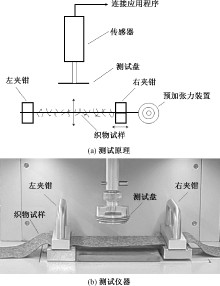
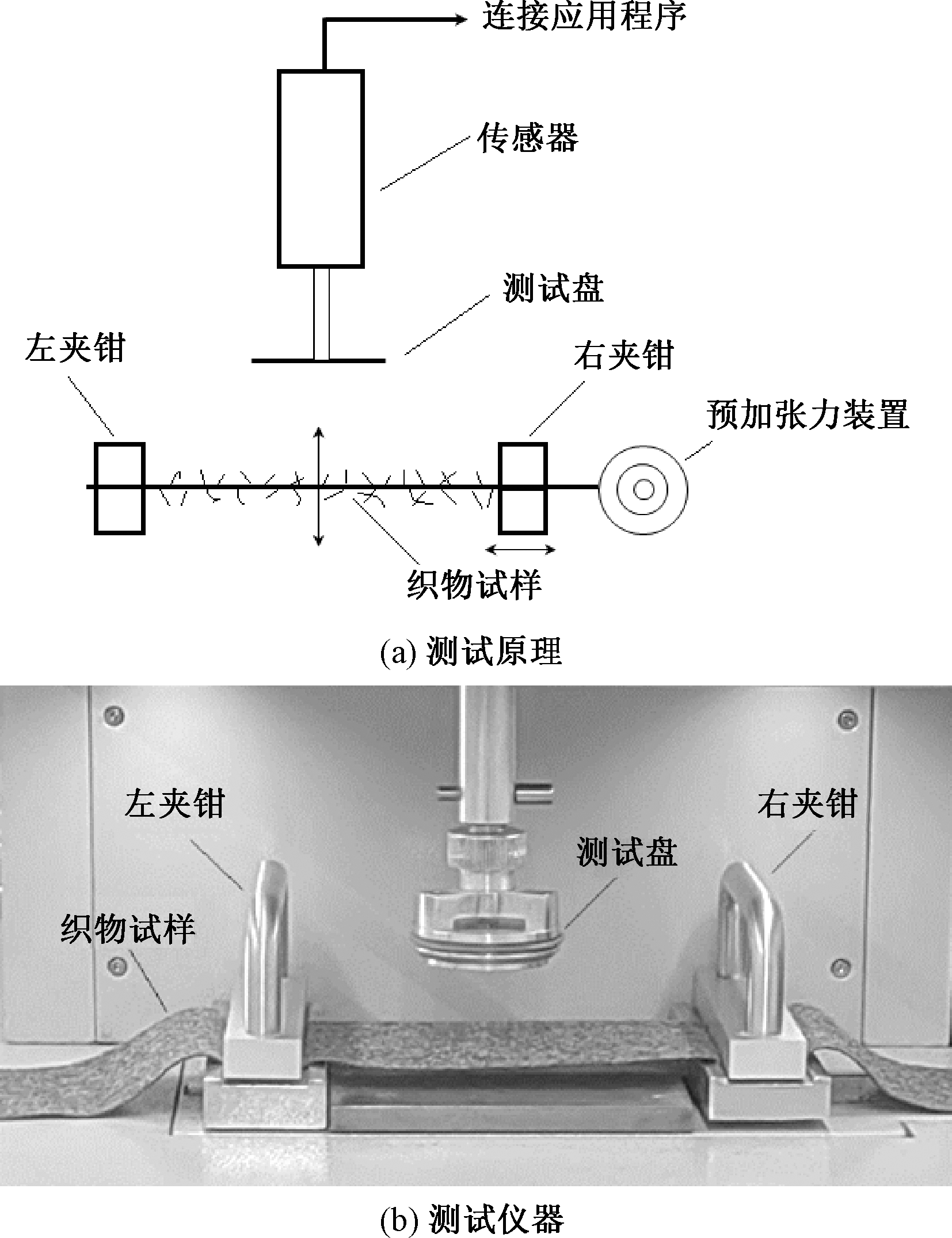
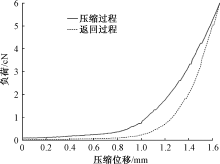
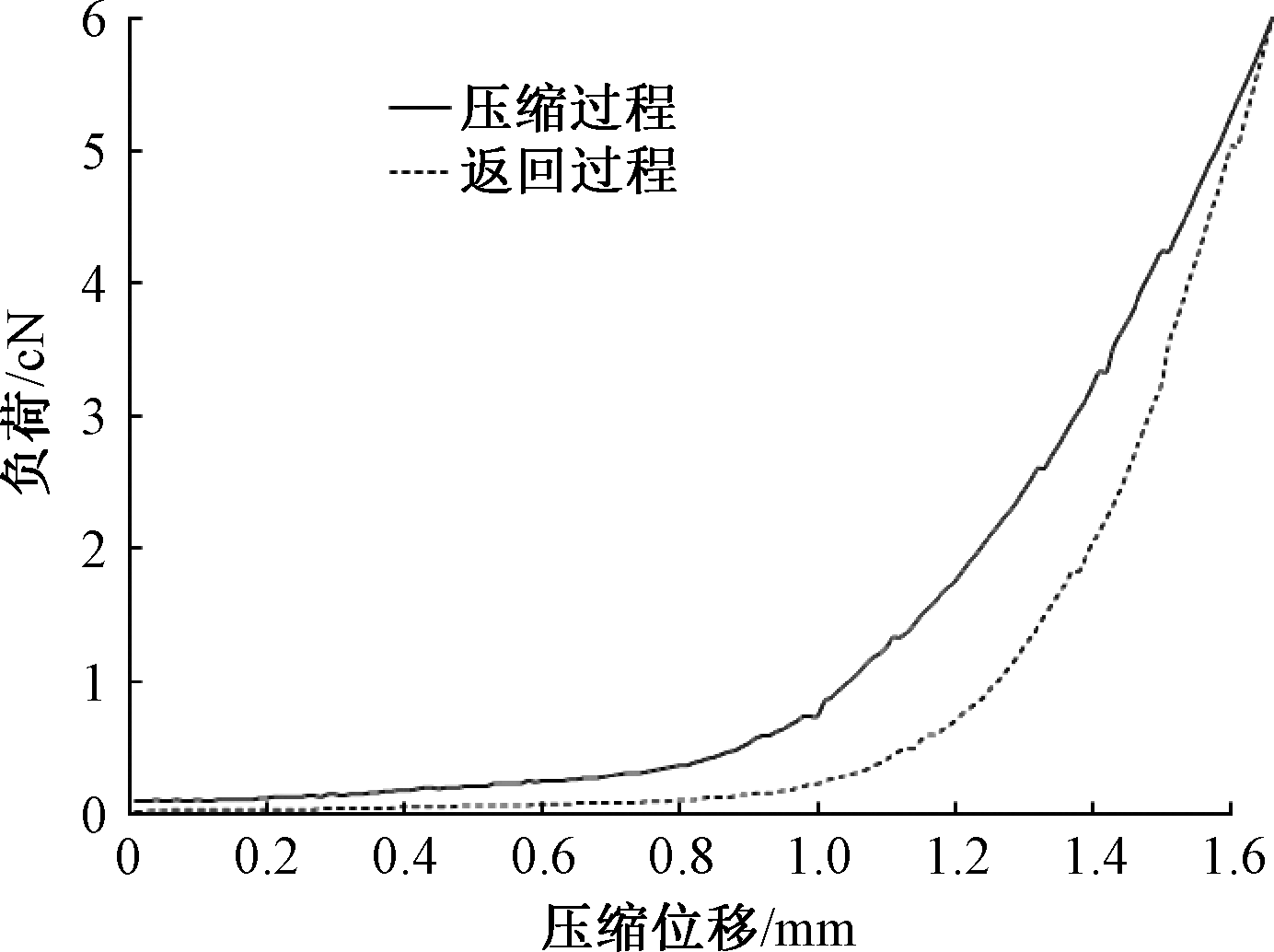
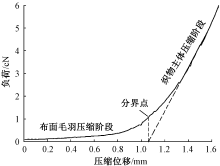
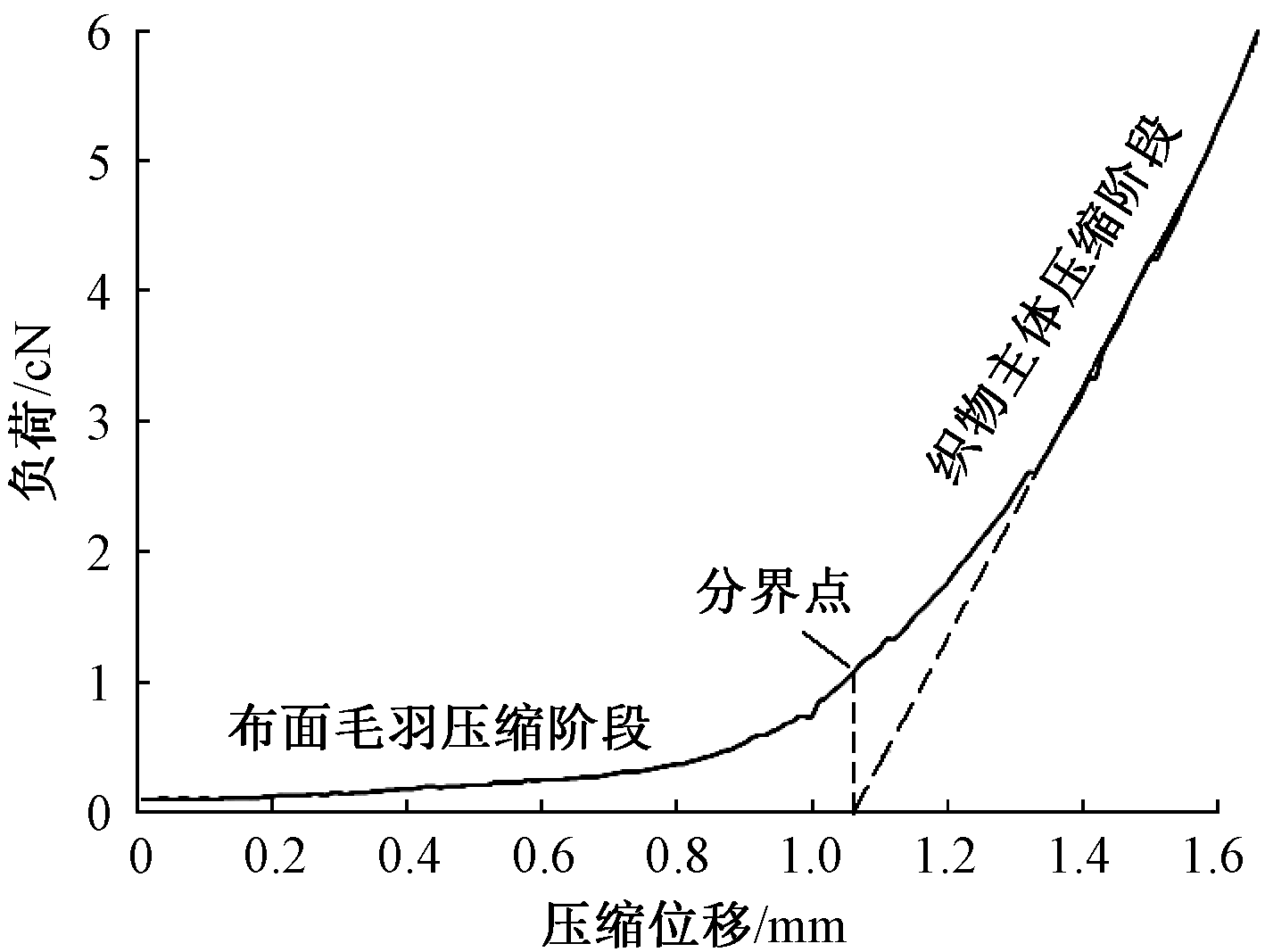
Method The principle of single side compression of fabric sample with set load were given, and the basic requirements of the testing device for achieving single side compression of fabric sample were analyzed. A typical compression-return process curve for knitted woollen fabric sample was shown, and the method was proposed for determining the boundary point between the compressing stage of the hairiness part and the main body of the fabric on the curve. Based on the compressing curve of the sample, indicators were extracted to characterize the single side compressing properties of the fabric, and further indicators were constructed to characterize the pile face properties. Single side compressing tests on selected samples were conducted, the influences of main experimental parameters such as sample tension, compression-return speed, sample pretreatment methods and conditions on the test results were compared. The feasibility of the testing method was investigated by experiments on the same variety of products with different shearing parameters, and the consistency of the test results was discussed by experiments on different varieties of products with the same shearing parameters.

Results Using the intersection point of the fitted straight line of the fabric body compression stage and the horizontal axis (compression displacement) as the dividing point, the compression part curve of the fabric hairiness was segmented from the compression and return curve. The intercept of the fitted straight line on the horizontal axis, as well as parameters constructed based on the compression curve during the hairiness compression stage, such as the compressing work, specific work, and work coefficient, were adopted to characterize the characteristics of the hairiness compression stage. Single side compressing test results of a double-sided weft knitted wool fabric under four pretension conditions, as well as the test results using five compression-return speeds and using four pretreatment conditions while keeping other test conditions unchanged, were given. At the same time, the single side compression test results of the same variety with different shearing process samples and different varieties with the same shearing process samples were also provided.

Conclusion The pile face properties of knitted woollen fabric can be tested and characterized using the single side compression method. The thickness of the pile (height of hairiness) can be characterized by the compression displacement during the hairiness compression stage; the softness of the pile face can be expressed by the compression work, specific work, and work coefficient during the hairiness compression stage; The elasticity of the pile face can be characterized by the change rate of the hairiness height and compression work during the compression and return processes. The pretension and pre-treatment conditions have significant impact on the test results, and the pretension should be selected reasonably based on the sample specifications.

Key words: knitted woollen fabris, pile face property, single side compression method, hairiness height on pile face, pile face softness

CLC Number: 

  • TS186.2

Fig.1

Testing principle and instrument. (a) Testing principle; (b) Testing instrument"

Fig.2

Typical one-time compression-return process curve"

Fig.3

Determination of boundary point"

Tab.1

Test results under different pre-tension of specimen"

试样
张力/cN
阶段 拟合直线
斜率
拟合系数 数据
个数
毛羽
高度/mm
分界
压力/cN
压缩功/
(cN·mm)
压缩比功/
cN
功系数
均值
/mm
CV值
/%
均值
/mm
CV值
/%
均值
/mm
CV值
/%
均值
/mm
CV值
/%
均值
/mm
CV值
/%
均值
/mm
CV值
/%
均值
/mm
CV值
/%
均值
/mm
CV值
/%
100 压缩 3.831 7.98 0.999 0.00 52.9 7.64 1.024 9.21 0.967 7.3 0.383 9.87 0.375 7.43 0.388 5.68
返回 4.917 8.26 0.999 0.05 41.1 8.62 0.734 6.31 1.093 2.48 0.378 6.94 0.516 3.09 0.472 2.27
300 压缩 7.410 5.74 0.998 0.15 27.3 5.74 0.923 16.45 1.053 8.84 0.325 16.71 0.353 9.39 0.336 7.30
返回 10.062 7.03 0.998 0.12 20.1 6.82 0.469 12.59 1.051 6.97 0.219 11.07 0.469 6.65 0.447 4.63
500 压缩 9.436 7.16 0.998 0.16 21.1 6.87 0.848 15.73 1.137 7.32 0.317 14.17 0.375 7.43 0.331 7.29
返回 13.108 7.39 0.997 0.36 15.2 6.79 0.444 10.93 1.069 8.26 0.209 12.28 0.470 4.85 0.441 5.93
700 压缩 10.711 9.44 0.997 0.13 18.8 6.04 0.796 11.38 1.168 8.10 0.312 11.00 0.393 10.07 0.336 4.44
返回 15.729 5.41 0.995 0.95 12.6 4.10 0.422 14.42 1.134 10.82 0.206 19.16 0.485 8.05 0.429 4.66

Tab.2

Test results at different compression speeds"

压缩速度/
(mm·min-1)
阶段 拟合直线
斜率
拟合系数 数据
个数
毛羽
高度/mm
分界
压力/cN
压缩功/
(cN·mm)
压缩
比功/cN
功系数
均值
/mm
CV值
/%
均值
/mm
CV值
/%
均值
/mm
CV值
/%
均值
/mm
CV值
/%
均值
/mm
CV值
/%
均值
/mm
CV值
/%
均值
/mm
CV值
/%
均值
/mm
CV值
/%
10 压缩 9.365 6.61 0.999 0.08 21.5 5.91 0.992 12.99 1.105 6.03 0.331 10.96 0.336 10.39 0.305 7.25
返回 13.494 3.31 0.999 0.05 15.0 3.81 0.535 10.69 1.134 4.16 0.246 12.44 0.462 6.18 0.408 4.21
20 压缩 9.546 6.09 0.998 0.05 21.2 5.36 0.928 14.50 1.154 6.36 0.332 10.30 0.361 9.88 0.313 6.47
返回 13.508 4.20 0.997 0.07 14.6 7.36 0.437 13.25 1.085 4.96 0.206 13.97 0.472 5.74 0.435 4.30
30 压缩 9.536 5.96 0.997 0.17 21.3 7.02 0.859 8.25 1.161 7.75 0.327 11.00 0.380 5.83 0.328 3.65
返回 13.280 5.09 0.998 0.12 15.1 3.76 0.419 6.93 1.039 8.22 0.193 10.26 0.460 4.96 0.444 4.56
40 压缩 8.676 3.20 0.997 0.13 23.3 3.53 0.880 13.43 1.082 11.57 0.313 18.73 0.357 15.24 0.330 8.51
返回 12.464 3.54 0.994 0.21 16.4 8.72 0.501 14.29 1.095 6.98 0.235 13.80 0.470 6.06 0.430 7.44
50 压缩 9.402 5.82 0.994 0.25 21.1 6.10 0.858 15.57 1.112 6.70 0.320 15.97 0.374 7.72 0.336 3.98
返回 13.375 4.53 0.992 0.17 14.8 6.21 0.439 12.57 1.060 6.64 0.201 11.71 0.460 6.41 0.434 6.31

Tab.3

Test results under different pre-treatment conditions"

预处理条件 阶段 拟合直线
斜率
拟合系数 数据
个数
毛羽
高度/mm
分界
压力/cN
压缩功/
(cN·mm)
压缩比功/
cN
功系数
均值
/mm
CV值
/%
均值
/mm
CV值
/%
均值
/mm
CV值
/%
均值
/mm
CV值
/%
均值
/mm
CV值
/%
均值
/mm
CV值
/%
均值
/mm
CV值
/%
均值
/mm
CV值
/%
不处理 压缩 12.468 9.89 0.997 0.10 16.5 10.4 0.418 18.57 0.974 11.95 0.156 18.01 0.375 12.44 0.386 8.19
返回 15.414 9.33 0.997 0.27 13.1 9.14 0.198 15.4 0.895 14.51 0.087 21.8 0.442 10.96 0.497 7.79
喷汽1 s晾干 压缩 8.333 6.46 0.998 0.09 24.0 5.89 0.885 13.15 1.101 8.38 0.323 14.87 0.367 11.78 0.334 7.49
返回 12.218 6.67 0.997 0.28 16.1 7.44 0.503 13.11 1.108 11.93 0.24 15.55 0.477 9.96 0.432 5.35
喷汽2 s晾干 压缩 9.223 6.29 0.998 0.16 21.5 5.90 0.927 23.88 1.174 6.96 0.362 21.40 0.394 9.15 0.336 8.32
返回 13.501 5.98 0.997 0.19 14.8 6.21 0.437 11.81 1.095 6.48 0.206 11.32 0.472 4.16 0.432 4.96
喷汽5 s晾干 压缩 8.840 5.35 0.998 0.08 22.3 4.25 0.982 20.37 1.157 5.51 0.363 17.69 0.377 16.05 0.325 15.04
返回 12.496 5.05 0.997 0.17 15.8 4.99 0.547 16.39 1.086 7.56 0.257 18.37 0.470 7.04 0.434 5.87

Tab.4

Test results of the same variety and different shearing processes"

剪毛
工艺
阶段 拟合
直线斜率
毛羽
高度/mm
分界
压力/cN
压缩功/
cN·mm
压缩
比功/cN
功系数 毛羽高度变化
率/%
压缩功
变化率/%
均值
/mm
CV值
/%
均值
/mm
CV值
/%
均值
/mm
CV值
/%
均值
/mm
CV值
/%
均值
/mm
CV值
/%
均值
/mm
CV值
/%
均值
/mm
CV值
/%
均值
/mm
CV值
/%
剪光 压缩 10.038 8.20 0.697 14.93 1.109 7.33 0.261 16.09 0.374 7.82 0.338 6.38 39.786 20.87 26.431 45.18
返回 14.025 10.89 0.417 15.60 1.059 8.25 0.19 16.16 0.456 4.67 0.432 7.74
剪到底 压缩 10.348 11.04 0.788 16.07 1.145 9.48 0.298 16.82 0.381 10.82 0.333 10.59 42.233 25.25 31.955 27.38
返回 14.188 11.13 0.448 14.06 1.072 9.24 0.202 17.68 0.450 7.05 0.421 5.36
一张纸紧 压缩 10.405 5.68 0.797 19.57 1.052 11.06 0.267 14.4 0.342 14.82 0.325 9.34 35.250 29.33 20.327 51.69
返回 13.006 4.9 0.508 18.65 1.023 6.18 0.210 10.92 0.420 9.56 0.411 8.78
不剪 压缩 8.662 8.54 1.114 12.98 1.195 7.70 0.428 11.44 0.387 11.03 0.324 9.29 35.142 22.56 18.746 57.28
返回 11.070 8.86 0.714 8.43 1.227 7.61 0.345 11.13 0.482 5.88 0.394 4.52

Tab.5

Test results of different varieties by same shearing process"

面密度/
(g·m-2)
阶段 拟合直线
斜率
毛羽
高度/mm
分界
压力/cN
压缩功/
(cN·mm)
压缩
比功/cN
功系数 毛羽高度
变化率/%
压缩功
变化率/%
均值
/mm
CV值
/%
均值
/mm
CV值
/%
均值
/mm
CV值
/%
均值
/mm
CV值
/%
均值
/mm
CV值
/%
均值
/mm
CV值
/%
均值
/mm
CV值
/%
均值
/mm
CV值
/%
350 压缩 11.045 8.86 0.757 15.18 1.087 5.49 0.279 13.45 0.371 10.68 0.341 6.97 38.602 18.53 26.946 28.25
返回 14.185 10.02 0.461 13.20 1.067 5.28 0.202 9.92 0.441 7.67 0.413 5.27
280 压缩 9.841 8.24 0.817 20.22 1.125 6.84 0.300 14.49 0.372 10.63 0.332 11.67 40.841 28.12 31.163 33.10
返回 13.390 9.44 0.469 11.21 1.052 12.51 0.205 16.76 0.436 10.31 0.417 6.75
320 压缩 9.463 6.75 0.777 11.51 1.103 6.84 0.306 11.39 0.395 7.23 0.358 5.04 40.685 25.45 34.018 28.68
返回 13.305 7.50 0.455 13.89 1.061 8.15 0.201 15.76 0.442 7.18 0.418 8.53
320 压缩 11.285 5.24 0.712 9.81 1.041 10.07 0.238 13.04 0.335 12.02 0.322 7.79 51.208 18.4 37.017 20.46
返回 14.355 7.54 0.346 20.06 0.959 14.67 0.151 21.54 0.436 8.57 0.461 12.57
[1] 马艳柳, 王云仪. 织物刺痒感的形成与作用机制的研究进展[J]. 毛纺科技, 2020, 48(12):78-83.
MA Yanliu, WANG Yunyi. Research progress on the formation and mechanism of fabric prickle[J]. Wool Textile Journal, 2020, 48(12): 78-83.
[2] CONG Honglian, ZHAO Boyu, HAN Hao, et al. Investigation of the properties of knitted woolen fabrics treated with oxygen low-temperature plasma for sportswear applications[J]. Textile Research Journal, 2022, 92 (1/2): 210-218.
[3] XIA Zhigang, ZHOU Mian, WANG Hongshan, et al. Evaluating the surface hairiness of woven fabric belts with a yarn hairiness tester[J]. Journal of The Textile Institute, 2022, 113(1): 116-124.
doi: 10.1080/00405000.2020.1865505
[4] 敖利民, 郁崇文. 织物单面压缩性质测试仪原理与表征织物单面压缩性质指标体系的建立[J]. 东华大学学报(自然科学), 2007, 33(5):622-628.
AO Limin, YU Chongwen. The principle of the fabric sigle-side compressing tester and establishment of the index system characterizing the characteristics of fabric single side compressing[J]. Journal of Donghua University (Natural Science), 2007, 33(5): 622-628.
[5] 敖利民. 基于织物单面压缩性质的苎麻类机织物刺痒感评价[D]. 上海: 东华大学, 2007:28-32.
AO Limin. Evaluation of prickle of ramie woven fabrics based on single-sided compression properties[D]. Shanghai: Donghua University, 2007:28-32.
[6] 敖利民, 郁崇文, 李春钢. 基于布面毛羽特征变化的织物烧毛效果评价[J]. 纺织学报, 2015, 36(4):102-106.
AO Limin, YU Chongwen, LI Chungang. Evaluation on fabric singeing effect based on change of fabric hairiness characteristics[J]. Journal of Textile Research, 2015, 36 (4): 102-106.
[7] 张林彦, 敖利民, 郁崇文. 基于布面毛羽特征参数测试的织物抗起毛性客观评价[J]. 纺织学报, 2013, 34(4):57-63.
ZHANG Linyan, AO Limin, YU Chongwen. Objective evaluation of fuzz resistance of fabric based on testing of characteristic parameters of fabric hairiness[J]. Journal of Textile Research, 2013, 34 (4): 57-63.
[8] 敖利民, 张林彦, 郁崇文. 基于布面毛羽特征参数测试的织物抗起球性客观评价[J]. 纺织学报, 2013, 34(11):54-61.
AO Limin, ZHANG Linyan, YU Chongwen. Objective evaluation of pilling resistance of fabric based on testing of characteristic parameters of fabric hairiness[J]. Journal of Textile Research, 2013, 34 (11): 54-61.
[9] 敖利民, 郁崇文. 基于织物单面压缩性质的织物刺痒感客观评价[J]. 东华大学学报(自然科学), 2007, 33(6):756-759.
AO Limin, YU Chongwen. Objective evaluation on fabric-evoked prickle based on one-side compressing characteristics of fabric[J]. Journal of Donghua University (Natural Science), 2007, 33(6): 756-759.
[10] 刘宇清, 戚媛, 于伟东. 毛纤维刺扎力学行为的测量[J]. 纺织学报, 2005, 26(2):61-63.
LIU Yuqing, QI Yuan, YU Weidong. Measurement of the mechanical stinging behaviour of single wool fibers[J]. Journal of Textile Research, 2005, 26(2): 61-63.
[11] 于伟东. 纺织材料学[M]. 2版. 北京: 中国纺织出版社, 2018:108-110.
YU Weidong. Textile Material[M]. 2nd ed. Beijing: China Textile & Apparel Press, 2018: 108-110.
[1] WU Xiaowen, FANG Leimei, JIANG Kun, CONG Honglian. Partition design of flat knitting forming sports underwear based on thermal and humid comfort [J]. Journal of Textile Research, 2024, 45(12): 172-179.
[2] MU Xiuping, JIANG Gaoming, CHEN Yushan, LI Bingxian. Digital design method for multi-needle bed weft-knitted fabric [J]. Journal of Textile Research, 2024, 45(11): 106-113.
[3] ZHAO Yajie, CONG Honglian, SUN Jianglong. Design and performance evaluation of knitted soft mat fabric [J]. Journal of Textile Research, 2024, 45(11): 99-105.
[4] YAO Chenxi, WAN Ailan. Thermal and moisture comfort of polybutylene terephthalate/polyethylene terephthalate weft-knitted sports T-shirt fabrics [J]. Journal of Textile Research, 2024, 45(01): 90-98.
[5] ZHAO Junjie, JIANG Gaoming, CHENG Bilian, LI Bingxian. Three-dimensional simulation and realization of sweater cabled fabrics [J]. Journal of Textile Research, 2023, 44(12): 81-87.
[6] YU Xuliang, CONG Honglian, SUN Fei, DONG Zhijia. Design and application of functional knitted fabric imitating nepenthe mouth structure [J]. Journal of Textile Research, 2023, 44(07): 72-78.
[7] ZHENG Peixiao, JIANG Gaoming, CONG Honglian, LI Bingxian. Design and three-dimensional simulation of multi-color striped fabrics [J]. Journal of Textile Research, 2023, 44(06): 85-90.
[8] CHEN Yushan, JIANG Gaoming, LI Bingxian. Design and 3-D simulation of weft knitted wrap fabric [J]. Journal of Textile Research, 2022, 43(12): 62-68.
[9] WANG Yue, WANG Chunhong, XU Lei, LIU Shengkai, LU Chao, WANG Lijian, YANG Lu, ZUO Qi. Development of environmentally friendly knitted fabrics with 3-D moisture conductive structure and performance evaluation on moisture absorption and quick-drying [J]. Journal of Textile Research, 2022, 43(10): 58-64.
[10] RU Xin, ZHU Wanzhen, SHI Weimin, PENG Laihu. Deformation prediction and simulation of weft knitted fabrics with non-uniform density distribution [J]. Journal of Textile Research, 2022, 43(06): 63-69.
[11] ZHOU Mengmeng, JIANG Gaoming, GAO Zhe, ZHENG Peixiao. Research progress in weft-knitted biaxial tubular fabric reinforced composites [J]. Journal of Textile Research, 2021, 42(07): 184-191.
[12] ZHENG Peixiao, JIANG Gaoming. Three-dimensional simulation of weft-knitted jacquard fabric based on WebGL [J]. Journal of Textile Research, 2021, 42(05): 59-65.
[13] HU Xudong, SONG Yanfeng, RU Xin, PENG Laihu. Modeling and loop length reverse design for reducing diameter tubular weft knitted fabrics [J]. Journal of Textile Research, 2021, 42(04): 80-84.
[14] LI Xintong, GAO Zhe, GU Hongyang, CONG Honglian. Study on stiffness style of knitted suit fabrics [J]. Journal of Textile Research, 2020, 41(11): 53-58.
[15] . Material consumption forecasting mode of flat knitting sweater [J]. JOURNAL OF TEXTILE RESEARCH, 2017, 38(02): 159-164.
Viewed
Full text


Abstract

Cited

  Shared   
  Discussed   
No Suggested Reading articles found!